Trading without Explicit Ontologies
Michael Schroeder, Julie McCann, and Daniel HaynesCity University, London
msch,jam @soi.city.ac.uk
Abstract. Classical approaches to traders in middleware rely on a common
lan-guage of server, clients, and traders to understand each other. In these systems, pre-defined ontologies play a crucial role. But when dealing with large-scale, open systems such ontologies are no longer available. To cope with this problem, we have developed a radically different approach to trading. Rather than relying 100% on a trader, we assume that traders provide only rough matches and that clients need to make intelligent choices to find a more suited service. To this end, we introduce the notion of trust, which evolves with the client’s experience. We implement a simulation of this trust-based trading system and run several test scenarios investigating the use of history and dynamic trust to discover the more suited services. Our analysis and simulation indicate that intelligent clients and rough traders may considerably extend the scope of trading towards large-scale, open distributed systems.
1
Introduction
A trader is a middleware component currently used to match requests for services to services. They are typically used in relatively closed environments where a single de-fined language and set of semantics are used to describe requests and services. Many researchers are beginning to see a broader use of trading within a more open distributed system, such as the Web. In this environment it is expected that trading systems need to be able to carry out more fuzzy mappings between requests and services as the se-mantics and languages are no longer standard. Further, systems which request services (clients) need to be able to acquire a level of trust in both the traders and the services when deciding to use them in future. The client must be able to break away from a service that it notices is deteriorating, so as to obtain a better one. Further, it is also en-visaged that future services, and in fact the trading service itself, will charge for usage. Current trading systems are unable to provide this level of service; in this paper we provide an alternative which does. This system stores a history of quality of services to establish its trust, carry out fuzzy matching of services while providing the ability to dynamically rebind from one service to another. The perception of trust must also take into account that a service will cost and this cost may fluctuate also. To this end, we propose a new trading system and have built a simulation of its behaviour so as to study how metrics such as trust and costs affect client/trader selection. The structure of this paper is as follows. Firstly, we introduce the concept of middleware trading
systems. We then describe some systems currently in operation and follow this with a description of more intelligent traders that are able to carry out fuzzy mapping of service to requests. We highlight the shortcomings of current trader architectures and then describe our model of trading and the simulation model which is being used to look at their behaviour. Finally, we draw some conclusions.
2
Traders
The concept of the trader was first formally specified in the early 1990s by ANSA [Apm98] which lead to the Open Distributed Processing (ODP) trading function spec-ification (under the ISO and ITU) and in 1997 the Object Management Group (OMG) added the Trading service to its CORBA architecture [Omg92].
The principle idea of a trading service is to have a mediator that acts as a broker between clients and servers. Previously a client needed to locate a service by naming this service. Naming services, such as the Internet Domain Name service, the X.500 directory service or the CORBA Naming service map hierarchically organised names to component identifications such as IP addresses or CORBA object references. This is called white- page-matching, similar to a telephone directory. However, often a client does not know the name of the component it wants to use. Although white-page-matching improves location transparency, it limits clients, which may not know the name of the service they want to use, but which do know a service profile only. To this end, traders enable a client to ask for service profiles rather than service names. The client changes perspective from asking ’who?’ to asking ’what?’.
Thus, trading services provide a higher level of abstraction than naming services. Servers register the services they offer with a trader and clients use the trader to enquire about services. Once the trader has matched a client inquiry with a service offer, most clients and servers communicate privately without involvement of the trader (there are exceptions; some monitor QoS and allow run- time rebinding). Hence traders usually do not impose any overhead on the communication between clients and servers, they just enable clients to find the most suitable server and thus facilitate service discovery. The trader may select a suitable service provider on behalf of the client or it may simply recommend a list of suitable services to the client. The idea is not restricted to distributed systems, but is found as well in other (non-computerised) systems. A good example is yellow pages; service providers, such as plumbers or lawyers, register with the publisher of the yellow pages: Clients who wish to use a particular service can then look up the yellow pages by service providers to find a provider that offers the required service. Other examples similar to the yellow pages are stockbrokers and insurance brokers. This is why this kind of matching is termed Yellow Pages matching of services to requests.
In current systems, there has to be a language for expressing the types of services that both the client and server understands. This language has to be expressive enough to define the different types of services that a server offers or that a client may wish to use. Moreover, the language has to be expressive enough so that a client can ask for given degree of service quality, such as performance, reliability or privacy. Servers use the expressiveness of the language in order to advertise the quality of their services. In order
to enable a trading service to act as a broker between clients and servers, the servers have to register the services they offer with the trader. They use the above language to declare the types of services they offer and their qualities during the registration.
The quality of service may be defined statically or dynamically. A static definition is appropriate (because it is simpler) if the quality of service is independent of the state of the server. This might be the case for qualities such as precision, privacy or reliability. For qualities such as performance, however, the server may not be able to ensure a particular quality of service statically at the time it registers the service with the trader. Then a dynamic definition of the quality is used that makes the trading service inquire about the quality when a client needs to know it.
After servers have registered the types of services they offer with the trader, the trader is in a position to respond to service inquiries from clients. A client uses the common language to ask the trader for a server that provides the type of service the client is interested in. Clients may or may not include specifications of the quality of service that they expect the server to provide. The trader reacts to such an inquiry of clients in different ways. The trader may itself attempt to match the clients request with the best offer and just return the identification of a single server that provides the service with the intended quality. This technique is known as service matching. The trader can also compile a list of those servers that offer a service, which matches the clients request. The trader returns the list to the client in order to enable the client to select the most appropriate server itself. This technique is known as service shopping.
3
Object Traders and Service Discovery
There are a number of Trading systems available at the moment, we describe these briefly below.
3.1 Corba trader
The Corba trading service works in principle as the trader described above. As a com-mon communication language it uses Corba’s interface definition language IDL. Ad-ditionally, the client can specify properties, given as attribute/value pairs, which the service has to provide. Technically, a trader recommends services matched to a client’s request. The client can then dynamically look up the service’s interface in Corba’s in-terface repository. With this information, the client is then able dynamically construct a request to a service.
Corba is a very popular architecture for distribution object interaction and most applications make heavy use of its name service, which is implemented by most com-mercial and academic Corba platforms. Corba’s trading server is less widely used, since many applications are not so dynamic that they would require trading. If they do, then the Corba trader works well for in-house applications, but not for truly open systems, where service discovery requires fuzzy matching of service requests. To put it suc-cinctly, with Corba naming the client needs to know the server name, with trading it needs to know the service name, which is still too inflexible.
3.2 ANSAware Distributed Systems Platform
The ANSAware software model [Apm98], developed at APM Ltd., is based on a location-independent object model providing uniform interaction schemes between communication. The roles of client, trader, and server, the use of attribute/value pairs to specify properties are similar to the Corba trader. Interfaces in ANSAware are defined in an Interface Definition Language and the operations import, export, and a second language - a Distributed Processing Language, describes interface implementations. If the trader finds matching candidates, an implicit binding between the peers is created. Although attribute- based matching provided by the trader enables enhanced flexibility, there is no notion of runtime adaptation and hence the same critique as to the Corba trader applies.
3.3 Aster
The Aster project [Iss98], developed at Irisa/Inria, addresses middleware reconfigura-tions based on software specification matching, which selects the components of the middleware customized to the application needs. The Aster environment provides three elements: the Aster type checker, which implements type checking of components de-scribed using the Aster language, the Aster selector, which retrieves middleware com-ponents that satisfy the interaction requirements and thus acts as a trader, and the Aster generator, which is responsible for interfacing the source code files with the middleware objects. The selector in the three-stage selection method processes non- functional prop-erties described in terms of formulas of first order predicate calculus. The stages are; exact match selection, plug-in match selection (the selected component implements be-haviour that satisfy the application, but does not match exactly the application’s require-ments), and closest match selection (the selected middleware needs to be customized through complementary components).
Although Aster presents a powerful framework for parameterized component selec-tion enabling automated customizaselec-tion, it does not address dynamic runtime adaptaselec-tion.
3.4 Matchmaking
The Matchmaking framework [Ram98], developed at the University of Wisconsin-Madison, is based on components describing their requirements and provisions in clas-sified advertisements, which are matched by a designated service: the matchmaker. Classified advertisements enable components to be described in terms of parameters enhanced with arithmetical and logical operators (e.g. Type = Machine, Activity = Idle, Arch = INTEL, Rank = 10, etc.) The matchmaker compares relevant parameters of component advertisements, and notifies components; then the client contacts the server using a claiming protocol to establish a dynamic binding.
Powerful parameter-based matching resource allocation provides the required flexi-bility, however it does not allow user-defined service selection from a group of matching ones, nor does it support decentralization and runtime adaptation.
3.5 MAGNET
The MAGNET trader [Kos98a,b,c] caters for dynamic resource management in a object based distributed system. In particular, it deals with operating systems and mobile com-puting. Similar, to other object traders it implements a yellow-page-service. However contrary to most others, MAGNET monitors the quality of service and rebinds services if necessary. Technically, the Magnet trader contains a shared data repository available to all components based on the tuplespace paradigm. Structured data items (requests and service descriptions or meta-Knowledge) are placed into the information pool as tuples. Uniquely to Magnet, the shared information pool is distributed via federations thus avoiding the performance bottleneck problems experienced previous trading archi-tectures.
3.6 Summary of Classical Traders
To summarise, current trading mechanisms fall short when dealing with a truly open distributed environment. Although they extend location transparency and provide flex-ible load balancing, it is still necessary to know the service name to be used. That is, most object traders provide flexible robust systems and fault tolerance at no cost, but do not support service discovery and therefore are not useful for truly open system such as the web.
3.7 Service Discovery
As argued above, currently available object traders do not cater for truly open sys-tems, where no assumptions regarding name and signature of a service can be made in advance. While such flexibility is not necessary for many applications, it allows one to explore the wealth of components available over the Internet. And although such components have to be treated carefully as they may not be reliable or worse may be malicious, the easy and free access to them, turns service discovery into a vision for a new programming paradigm, where the network is the computer. Here it is envisaged that a computer program is generated on the fly from composing objects obtained on the Web.
Service discovery could be realised through regular search engines. However, cur-rently used engines limit themselves to plain text when indexing and cannot make use of other formats. Search engines of the future may overcome this problem. The Agora [Sea98] and Webtrader [Vas99] project are two such efforts. In the Webtrader system, servers advertise their services on XML pages containing keywords, metadata (such as QoS) and the service interface. Keywords and metadata help the trader to match ser-vices against client requests; the interface allows the client to use the service. While this approach requires servers to advertise in the required XML format, Agora aims to trade existing components, which are already online. Similar to classical search en-gines, which parse HTML pages for indexing, Agora parses Java class files and indexes them. Preliminary results show that this method is promising for applets, JavaBeans, and ActiveX, but has limitations for Corba objects, whose interface is not directly ac-cessible.
Agora and Webtrader are paving the way for a new computing paradigm and con-sequently three application domains may benefit directly [Vas99]:
1. Application level brokers, such as the shopping agent Jango, which integrates given online information sources 2. Adaptive content delivery, which enables a client with limited capabilities to obtain contents in the format it requires. 3. Application re-contexting, which may be necessary due to limited resources to reconfigure thin clients on mobile devices as their environment changes.
With such service discovery systems at hand, it is paramount to deploy intelligent clients, which do not fully trust the traders recommendations and which learn to choose the best services. Service discovery being the first step, the second and more difficult step is the client’s service selection process. Obviously, this choice should be informed and not be made by the trader as we opt for service shopping rather than matching. Therefore, we have to consider selection criteria for clients. One approach [Pud95] to help the client understand service descriptions is the use of ontologies. But the problem all ontologies face is the question, who defines them and who ensures that all parties give them the same meaning [Nwa99]. Therefore, the approach followed in [Pud95] is severely limited and the author’s point out rightly that the challenge remains to have clients, servers, and traders learn the shared ontology.
4
Rough Traders and Intellient Clients
In our approach, we want to go a step further and drop any notion of explicit mean-ing, which we cannot obtain. Instead we rely on meanmean-ing, which evolves implicitly. As Wittgenstein said, ’The meaning of a word is its use in language’, we argue ’the mean-ing of a service is given by its use by the client’. That is, the client learns which services to use through experience. Rather than relying on the trader, our intelligent clients base their choice on their history of use to generate a notion of trust in services. This trust evolves over time and reflects the client and servers joint understanding of service de-scriptions. Recently, there has been considerable interest in the notion of trust within agent systems [Elo98, Jon99]. In particular, Jonker and Treur [Jon99] define a com-prehensive framework of useful trust functions based on e.g. different window sizes of history, which can serve as sound basis for the client’s adaptive selection process. Avoiding the problems of ontologies, the use of intelligent clients with a trust mecha-nism reduces the service selection problem to service assessment. The main difficulty for a client to update its trust in a server is for it to have a fair judgement on the service it had rendered. While many aspects may be impossible to formalise, issues such as time taken, exceptions generated, cost, and simple service specs (did the sort service return a sorted list?) can be automated.
4.1 Requirements
Let us summarise the two main ideas of adaptive service discovery and more flexible trading as outlined above: 1. traders provide rough matches to client requests based on informal service description and keyword search. 2. It is up to the client to choose the service and to learn over time, which of the services is best suited. To implement these
two ideas our trading simulation has to meet the following criteria: 1. A client maintains a history of its interactions with a given service. The history of its interactions with a service is used to update the client trust value of that service. 2. A client maintains a history of its interactions with the trader The history of its interactions with the trader is used to inform the trust value the client will associate with any future interaction with the trader. 3. The trader’s recommendations for the clients is of variable ’quality’ and almost never perfect. 4. Services actively pursue client interaction through advertising with a trader and providing appropriate descriptions of their service.
4.2 The Current Implementation
In our current implementation in Java, the trader maintains data (an informal service description and a server reference) on all of the services that are currently registered. Service objects can register and de-register with the trader. When registering with the trader the service object supplies all the required data. Service objects comprise a qual-ity value and a cost value. Service qualqual-ity may be static or vary over time. The client object maintains data (a history object) on its interactions with the trader and with the services it uses. At a simple level the client maintains a trust rating for the trader and a trust rating for all the services that it uses. In selecting a new service the client uses its own rating in conjunction with the traders matching rating for each service to come to a decision. After using a service the client updates its rating of the service. The Client has a test mechanism to ’test’ a service. While this is ostensibly the same as using a partic-ular service, a test mechanism would be entirely reasonable for many types of service (e.g. translation service). Testing may be expensive in terms of ’cost’ (or alternatively services may offer a test mechanism at a lower/no cost) and overloading the network so it is in the interests of the client to keep testing to a minimum. Depending on the client’s trust of any particular list of services (from the trader) the client can then test a number of choices before selecting a particular service. The client’s default behaviour is to iter-ate through the entire list of services recommended by the trader. The client then selects a service from all successful test invocations by rating the service by its ’quality’ and its cost. The ’quality’ is an arbitrary value (between 1 worst and 100 best) associated with each service. This value may remain static or may change over time depending on the particular service. The cost value is a charge associated with each service for the use of that service. At present the cost value associated with each service is fixed over time. The client chooses the service with the lowest cost per quality ratio. It then invokes the service method on the service. If the invocation fails the client will try to invoke the service method again until a successful invocation is achieved (the method invocation failure is simulated and simply means that the service was not carried out). The client will then make a new request to the trader and repeat the process. There are two options to change the behaviour of the client. Firstly, the ’Using History’ option. Here the client, after iterating through the entire trader list will retrieve any data it has on the services on that list from its own ’database’ (a History object). For each service the client calculates its reliability value. This is simply the ratio of invocation failures to invocation successes for that particular service. The client then calculates an overall rating for each service based on its reliability and the cost per quality value it got from testing the service. The client then selects and uses the service with the highest overall
rating. The second option is the ’Dynamic Trust’ option. At present the client divides the trader list equally into four quarters and depending on its current trust rating of the trader will either iterate through one quarter, one half, three quarters or the whole list when conducting its testing process. (The assumption being made here is that the trader is returning an ordered list with its highest matched services at the top of the list and less likely services lower down). Whenever the client makes a selection it records where in the trader list the selection was found. Before each testing process the client checks its recent selection record. If selections were predominantly been above the mean point of its current trust rating value then the Client would increase its trust rating of the trader and thereby choose to test a smaller portion of the list of service. If recent selections have been below the current trust rating mean point then the client will lower its cur-rent trust rating of the Trader. At present the ’Dynamic Trust’ option effects the overall costs acquired by the client when testing. The cost associated with testing a particular service can be changed by adjusting the ’Test Cost’ setting. While this cost is presently a monetary cost it could equally be thought of and changed accordingly to become a value associated with use of a network in a distributed system a ’network cost’
4.3 Simulation
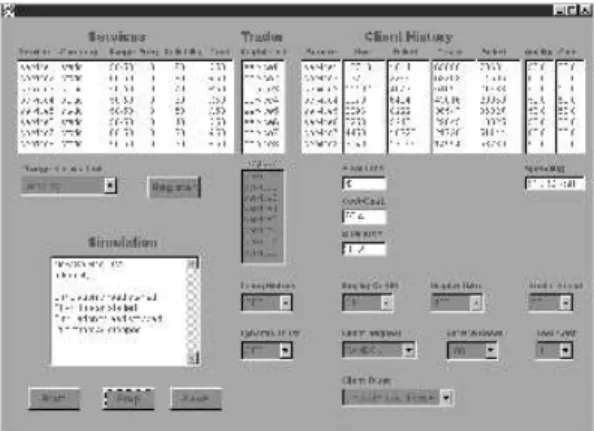
Consider Figure 1. Among others, the GUI shows the failure rate in percent, the client’s cost/quality, quality/use, and the overall spending. The history option allows to en-able/disable the use of experience with the service in the client’s decision making. Thus, this option implements the history-based trust functions described in [Jon99]. Besides rating the services, the client can rate the trader which is enabled by activating ’Dy-namic Trust’. Values can range from unconditional distrust to conditional trust. The ’Random’ setting instructs the trader to return a list containing all registered services in a randomised order. Test cost alters the cost incurred by the client when testing a particular service. A setting of ’1’ means the testing cost is the same cost as using a service. A higher cost setting reduces the cost of testing in relation to the cost of using a service.
Figure 1 shows in particular the eight services that are registered with the trader. All these services oscillate their ’quality’ value between the range shown and at the frequency shown. In this test the cost of each service is fixed to reflect the average quality a service delivers over an extended period of time. The trader returns a list of these services at random to the client upon each request The client history window shows how many times each service was used during the test run. It also displays the average quality it received from each service and the average cost incurred for each service (this is in fact the fixed cost, as the cost value does not alter). In this test run the client has used service1 (for a maximum of 301157 times) and has obtained an average quality from that service of 73.6. The average service quality service1 produces is 50. The overall ’cost per quality’ is 0.73. Because of the parity between the average quality of each service and their fixed cost a client randomly selecting services would expect a ’cost per quality’ of 1.00. In this set-up the client trust (trust of the trader) is set at ’8’. The client tests all eight services it receives from the trader and chooses the service with the lowest ’cost per quality’. A client that had more ’trust’ in the trader may set its trust value to, for example. ’3’ and only test the three most highly matched
Fig. 1. Screenshot of rough trader and intelligent client simulation.
services it receives from the trader. After selecting and using a service the client, as configured in this set-up, will continue to use the service providing the ’cost per quality’ value remains the same or is not less than its previous use of the service. The test cost variable provides the ability to change the cost to the client of testing a service. The service-reset rate provides the ability to reset all the services at regular intervals during a test run. Initial service settings are randomised between the accepted range of each service. The client does not use any of the history data that it gathers to aid its selection choice. It does not alter its trust value (of the trader) and it does not alter its request to the trader during a test run. This functionality will be added to the client to enhance its ’intelligence’. It is intended that the prototype will be enhanced further by allowing multiple clients (differently configured) and allowing different ’types’ of services which will register and de-register (or become unavailable) during a simulation Three example tests are included in this paper to demonstrate the functioning of the system. Each test is configured to demonstrate the effectiveness of the client selection process with differently configured services. These tests are primarily to demonstrate the potential benefits that can be gained from an ’intelligent’ client using a rough trader to maximise its service selection efficiency.
Reliability Test This simulation run demonstrates the clients’ capabilities when
pre-sented with a list of services with differing reliabilities. There are eight services, all providing a static quality of service of 50. The services cost is also fixed at 50. Service1 has a reliability factor of 90. This equates to a service failure rate of 10 %. Service8 is the least reliable service with a failure rate of 80%. Figure 2 shows the results from running the client without history/trust, with history, with trust, with both. The history mechanism in the client effectively reduces the number of service use failures. In this test the dynamic trust mechanism has no effect on the clients efficiencies because the cost per quality of each service is the same and is fixed, so the client rates all the
ser-vices equally, and therefore cannot make a judgement on the ’trustworthiness’ of the trader list.
Reliability Default History Trust Both
Failures(%) 44 11 44 19
Cost/Quality 5.40 5.40 5.40 4.07 Quality/Use 27.99 44.21 28.10 40.15
Fig. 2. Reliability test results
Oscillating Service Quality Test This simulation run demonstrates the clients
capabil-ities when presented with a list of services whose quality oscillates between set values over time. All these services are 100% reliable and thus do not produce any invoca-tion failures. The cost of each service is fixed. There are eight services all providing a service whose quality oscillates (a sine wave) over the stated range. Service1 produces a service whose quality ranges from 55 to 95 and whose cost is fixed at 75. Service8 produces a service whose quality ranges from 20 to 60 and whose cost is fixed at 40. Figure 3 shows the results of the simulation.
Reliability Default History Trust Both
Failures(%) 0 0 0 0
Cost/Quality 7.64 7.65 4.95 4.90 Quality/Use 66.79 66.7 66.4 66.44
Fig. 3. Oscillating test results
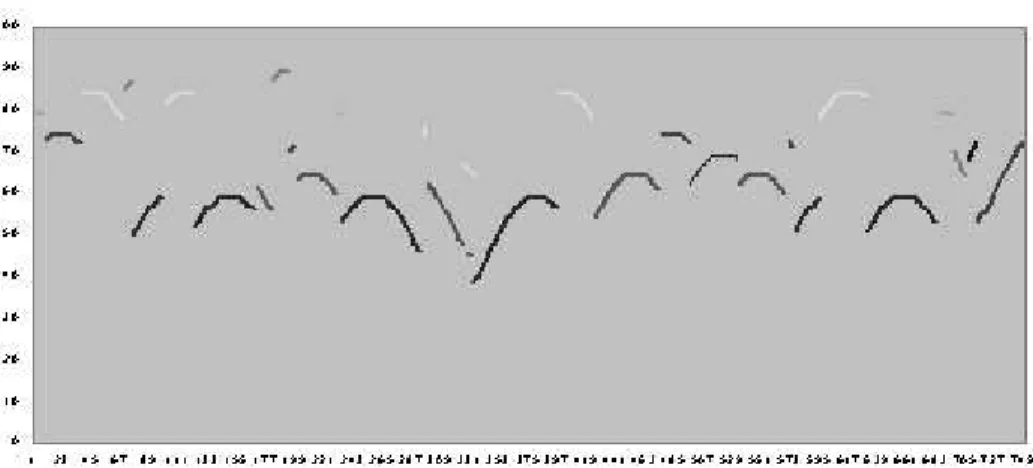
Consider Figure 4. The graph shows the clients view of the services it uses in the oscillating test. Different colours represent different services. So each spline is part of its service’s complete quality curve, which is, for clarity sake, not shown. Around time point 350, the client selects e.g. service 8, whose quality steadily increases. As it declines at around time point 400, the client switches to service 3, with much higher quality. At first glance, it appears the client should always select the highest quality, but in fact it optimises quality per cost, so that it does not simply stick with the best quality. As one may expect, the client tends to stick with a service as the service quality improves and drops it as it declines. The table and graph show that the history mecha-nism has no effect on the average cost per quality incurred by the client. This is simply because all services are 100% reliable and thus the history mechanism offers no extra information to the client on top of what it gains from running tests on the services. The trust mechanism effectively reduces the clients cost per quality because the client is able to alter its judgement as the ’trustworthiness’ of the trader list and is thus able to reduce the amount of service testing that it does from the default.
Fig. 4. Clients perspective of selected services with oscillating quality (y axis) over time (x axis).
Different colours represent different services. The splines correspond to the fragments of service quality curve that were selected by the client.
Mixed Test This simulation run demonstrates the clients capabilities when presented
with a list of oscillating services with differing reliabilities. There are eight services all providing a service that varies. The services cost is fixed at 50. Service1 has a reliability factor of 92. This equates to a service failure rate of 8 %. Its quality varies between 55 and 95. Service4 has a failure rate of 2%. The history mechanism reduces the amount of service failures but increases the cost per quality. The increase in the cost per quality is due to the fixed nature of the cost associated with each service and the fact the more unreliable services are offering a generally higher quality of service. The dynamic trust mechanism reduces the cost per quality, and both mechanisms operating together offer a better failure rate and a better cost per quality than the default run.
Mixed Default History Trust Both
Failures(%) 6 2 5 2
Cost/Quality 5.19 6.95 3.58 4.7 Quality/Use 77.71 60.46 73.42 58.96
Fig. 5. Mixed test results
Conclusions from Testing The results show that both client mechanisms, using history
and dynamic trust, are effective in enabling the client to select and use services in a more efficient manner. In particular, they achieve a failure reduction and lower cost
per quality during operation. Additionally, the two mechanisms enable the client to use and judge the quality of the information it receives from the trader. 4.3.5 Further Enhancements to the Model The next step for the simulation is to move from a simulated trader to a real online service discovery tool such as Agora [Sea98] and Webtrader [Vas99]. Additionally, it would be interesting to implement a feedback loop for the trader, which would amount to a joint learning of best service provision by all parties involved. Regarding, clients it would be interesting to consider the ability of clients to reformulate requests, if the trader does not provide satisfactory results.
5
Conclusions
The concept of traders to realise flexible and fault-tolerant open distributed systems is around for over 10 years. Large bodies such as ANSA and OMG developed and integrated traders into their platforms. Nonetheless, trading solutions are not so widely adopted, which is partly due to the inability to deal with newly available services, which were not envisaged at design time of the system. All classical approaches such as the Corba trader [Omg92], AnsaWare [Apm98], Aster [Iss98], Matchmaker [Ram98], and Magnet [Kos98a,b,c] rely on a common language and understanding of services and clients, which is a severe limit when dealing with an open system. In most approaches the common language is simply predefined and joint understanding between clients and servers is tackled through joint ontologies. Although the research into ontologies and common understanding has been active for a few years, there is not yet a groundbreak-ing solution to this difficult problem [Nwa99]. Our approach is dramatically different in that it does not rely on any pre-defined ontology or notion of meaning. We follow Wittgensteins idea that the meaning of a word is its in language and allow a joint under-standing between clients and servers to evolve over time and experience. To this end, we introduce a trust function [Jon99] into our clients, which enables the client to learn the best suited service profiles and adapt its service selection accordingly. Motivated by [Jon99], we compare clients taking decisions based on no history and full history, respectively. Additionally, we compare and vary the client trust into the trader ratings. We implemented this scenario and ran tests regarding failure rate, oscillating service quality, and a mix of both. Our simulation indicates that the use of the client’s expe-rience (history) reduces the failure rate substantially. The dynamic trust option, which allows the client to rate the traders recommendations, are valuable to reduce the cost, as the client does not have to test services constantly, when it can rely on its perceptions of the trader’s ratings. To take the results of our simulation further, future work will con-centrate on making the trader more intelligent and replacing it by an operational service discovery tool such as Agora [Sea98] or Webtrader [Vas99] and embedding it into mid-dleware solutions such as Magnet [Kos98a,b,c]. To summarise, the contributions of this paper are fourfold. First, we review trading platforms and service discovery as currently used in middleware and outlines their strength and weaknesses. Second, we introduce a radically different approach to trading, which does not rely on any pre-defined ontology or other explicitly defined meaning. Third, to underpin our novel ideas, we implemented a simulation of an intelligent client dealing with unreliable traders. For the client deci-sion making process we focused on two aspects: the use of previous experience and the
client’s rating of the trader’s recommendations. Forth, we evaluated the simulation and came to the conclusion that history data can substantially reduce the service failure rate and the rating of the trader can reduce the costs, as less testing of services is required. Acknowledgements We’d like to thank Patty Kostkova, who contributed substantially to the trader in middleware survey.
6
Bibliography
(Apm98) A.P.M. Ltd. The ANSA Reference Manual Release 01.00. APM Cambridge Lim-ited, UK, March 1989.
(Elo98) G. Elofson. Developing Trust with Intelligent Agents: An Exploratory Study. In Proceedings of the First International Workshop on Trust, 1998
(Dec97) K. Decker, K. Sycara, and M. Williamson. Middle- Agents for the Internet. In Proc. of IJCAI97, Nagoya, Japan, August 1997.
(Des92) J.-P. Deschrevel. A Brief Overview of the ANSA Trading Service. ISA Project technical report APM/RC.324.00, February 1992
(Iss98) V. Issarny, C. Bidan, T. Saridakis. Achieving Middleware Customization in a Configuration-Based Development In Proc. of Intl. Conf. on Configurable Dis-tributed Systems, p207-214, 1998.
(Jon99) C. M. Jonker and J. Treur. Formal Analysis of Models for the Dynamics of Trust Based on Experiences. In Proc. of MAAMAW99, Springer-Verlag, LNAI 1647. 1999
(Kos98a) P.Kostkova, MAGNET: QoS-based Dynamic Adaptation in a Chang-ing Environment. Technical Reprt. City University. Feb 1998. ftp://ftp.cs.city.ac.uk/users/patty/qos- abstract.html
(Kos98b) P.Kostkova, T.Wilkinson: MAGNET: A Virtual Shared Tuplespace Resource Man-ager. In Intl. J. on Parallel and Distributed Computing. 1(3), September 1998. (Kos98c) P. Kostkova, J. S. Crane, J. A. McCann, T. Wilkinson: MAGNET: A Dynamic
Infor-mation Broker for Mobile Environments. Technical Report. City University. March 1998. ftp://ftp.cs.city.ac.uk/users/patty/broker-abstract.html
(Pud95) A. Puder et al, AI-based Trading in Open Distributed Environments. In IFIP Inter-national Conference on Open Distributed Processing. Brisbane, Australia, 1995 (Omg92) Corba - The Object Management Group, OMG The Common Object Request
Bro-ker: Architecture and Specification. Wiley. 1992
(Nwa99) H. Nwana and D. Ndumu. A perspective on software agents research. In Knowledge engineering review. 14:2(125- 142). Cambridge University Press, 1999
(Ram98) R. Raman, M. Livny, M. Solomon. Matchmaking: Distributed Resource Manage-ment for High Throughput Computing. In Proc. of IEEE Intl. Symp. on High Per-formance Distributed Computing, Chicago, USA, July 1998.
(Sea98) R. C. Seacord, S. A. Hissam, K. C. Wallnau. Agora: A Search Engine for Software Components. CMU/SEI-98-TR-011. August 1998
(Vas99) V. Vasudevan and T. Bannon, WebTrader: Discovery and Programmed Access to Web-based Services. In Proc.of Intl. WWW Conf. Toronto, Canada, May 1999