Shahrinaz Ismail, Daniel Ling Howe Yii, Yamen Batch Faculty of Management and Information Technology UCSI University, Kuala Lumpur, Malaysia
Abstract
With the development of Web 2.0 technology, social media has evolved from diverse concepts and work together collaboratively in supporting personal knowledge management and interactive learning. Wiki, which is a new concept of content management system with database for creating, browsing and searching through information, has found its niche among adult learners and institute of higher learning. The issue of information overload, due to exposure to the Internet, is neatly ironed out with the use of wiki. Yet, a normal wiki would have hyperlinks to information on other websites, which could cause a diversion of attention on the learners’ side, making the learners out of focus on the original subject. This paper suggests an implementation of wiki and the university database integration to provide focused learning support and environment to the adult learners. Seeing the advantage of wiki, there is a possibility of reducing the users’ resistance, which this study takes into account in the questionnaire survey. Diagrams are presented for further elaboration on the architecture of the proposed system. Recommendations on the learning contents, the use of this wiki in focused learning support, and the role of instructor in facilitating learners in using wiki are included. This study is part of a bigger picture in using the advantages of social media in the current research of “Social Realm of Teaching (and Learning) System (SOCRATES)”.
Keywords: Database integration, focused learning support, wiki
1. INTRODUCTION
O’Reilly (2004) introduced the Web 2.0 as the concept of a new generation of web-based tools for knowledge sharing, which has given birth to a number of emerging technologies that are labelled under the name social media. This phenomenon has great potential to socialise e-learning to a greater extent than before (Bryant, 2007), as it is considered as “architecture of participation that harnesses the wisdom of crowds” (Surowiecki, 2004). Social media include blogs, wikis, social bookmarking and virtual worlds, which have particular educational significance (Trinder et. al., 2008). Wiki, being one of those emerging technologies, has made its way through the type of virtual presence, especially in education. With proper customisation and integration with existing database, this tool could be of great benefit in providing focused learning support to learners in institutes of higher learning.
Public schools and universities are exploring the use of these emerging tools to increase the effectiveness of instruction (Deters, Cuthrell & Stapleton, 2010). Renowned universities are implementing Web 2.0 for classroom activities to reach students and to bridge students from
Collaborating Wiki with University Database
diverse cultures. Among a few examples are the use of blogs at the University of Warwick, blogs and wikis at the University of Leeds, blogs at University of Brighton, wikis at Deakin University, second life (virtual reality) at Goldsmith’s College, and blogs, social bookmarking and podcasts at University of Edinburgh. Overall, the tools would take some time to be accepted, but once the students picked up the interests and skills on the tools, the adoption is quite positive.
This paper focuses on the wiki as the main social media used in the system proposed. Wiki primarily enables users to engage in a collaborative and social nature in the open editing function, which allows users to visit, read, re-organise and update (Deters, Cuthrell & Stapleton, 2010). The issue of information overload, due to exposure to the Internet, is neatly ironed out with the use of wiki. Yet, a normal wiki would have hyperlinks to information on other websites, which could cause a diversion of attention on the learners’ side, making the learners out of focus on the original subject.
This research project proposes a collaboration of wiki and the existing databases in a university, for focused learning support to students. Based on preliminary findings of the acceptance of wiki in the case university, it is expected that this research could reduce the users’ resistance from both the academicians and students.
2. LITERATURE REVIEW A. Wiki as Learning Tool
Duffy and Bruns (2006) listed several possible educational uses of wikis. Among the main uses of wiki are: students can use a wiki to develop research projects; students can add summaries of their thoughts from the prescribed readings, building a collaborative annotated bibliography on a wiki; and a wiki can be used for publishing course resources like syllabi and handouts, and students can edit and comment on these directly for all to see. Overall, wikis can be used as a knowledge base for teachers to share reflections and thoughts regarding teaching practices, allowing versioning and documentation (Duffy & Bruns, 2006; Tonkin, 2005). Furthermore, wiki can be used to map concepts that are expandable to producing a linked network of resources.
The educational uses of wikis are quite commonly practiced online, all over the world, but the evaluation on learners’ performance via wiki is still in debate. Duffy and Bruns (2006) mentioned that wikis can be used for course evaluation, a place for students to collaboratively write reviews of courses they have taken. The success in this area may be in question, depending on the culture and the diversity of learners in a classroom setting.
In supporting the idea of using wiki as learning tool, Tonkin (2005) identified four different forms of education wikis: single-user wikis that allow individually collected and edited thoughts over Web-based environment; lab book wikis for students to keep notes online with benefits of having them peer reviewed and changed by fellow students; collaborative writing wikis for joint writing in a team; and knowledge base wikis that provide a knowledge repository for a group. Under the same agreement, Huang (2010) concluded from other resources that wikis, unlike blogs, are organised by topics of interests rather than chronological order of postings, and are composed by groups of contributors instead of the
common single blog writers. Wiki allows users to monitor the progress of the document by saving date- and time-stamped editing processes with user identifications.
One of the recent studies on wiki usage in education is in the form of communication tool for students who are in need of extra support during their internship. Davie and Berlach (2010) concluded that wiki is a valuable asset in the tasks of communicating and monitoring. Since it appeals the IT savvy generation of students, it would be easier to make the transition from the legacy system to wiki. Academicians likewise appreciated the benefits provided by the system in keeping them informed by each other’s comments, allowing immediate availability of information for quick response and more accurate intervention.
Another research on wiki in education is a study on student perceptions of using wikis in online coursework, focusing on using the wikis as instructional applications. Instead of merely pointing out the issues arose, Deters, Cuthrell and Stapleton (2010) recommended a few steps to follow: the instructor should decide on the purpose of the wiki and the platform to be used before developing the template; directions for the project should be created, which include expectations for the content to be posted as well as directions for using the technology by making useful resources available for the participants; and decisions must be made on assessment mechanism if the wiki is used as a class assignment, alongside having necessary extra time set aside to deal with the technological problems that emerge. Proper planning on teaching style and the purpose of using wiki are also mentioned by Huang (2010).
Augar, Raitman, Zhou (2004) laid out a brief analysis outlining the features that make some wikis suitable for use in an e-learning setting, emphasizing the importance of selecting a wiki that is easy to use. On top of that, additional features such as authentication and tracking are required for wikis to be suitable for teaching and learning online, to enable all wiki edits to be traced back to the author, enabling the assessment process. Even though wiki can be used to enhance social interaction amongst students online, tracking feature is still needed to help secure wiki content against possible misuse and intentional deletions. Agreeing to this, Huang (2010), on another hand, brought out the subject of the importance in increasing and sustaining the interaction among learners in wiki, since it could cause frustration on the learners’ side in terms of complexity of the structure apprehended by the openness and high-level participation requirement inherent with wikis.
B. The Needs to be Locally Hosted
There were several reasons for creating locally managed systems, as captured by the University of Leeds (Franklin, 2007). The most important reason is the management of the university, or the web master, prefers that institutional content be hosted locally within the university rather than externally, where the basic infrastructure has already been made available, ready to be extended. In addition to this policy the university has, there is a possibility to attach the university branding to locally-hosted solutions, and the roll out would be manageable in terms of hosting and technical support by the internal central web team. It is also easier for academicians to enroll their students into the wiki (or other social media tools) if they want to use the systems in their teaching.
University of Edinburgh agreed to this, saying that the university should host social media services supported by university’s single sign-on system (Franklin, 2007). With the facilities and features made available by current services in social media, it is easy to integrate with
university’s virtual learning environments (VLEs) and management information system, and this was adopted by University of Brighton.
There are some other reasons for not incorporating these tools into the existing institutional virtual learning environments (VLEs), or learning management systems. For example, the institution may be in a period of transition between the VLEs and integration work will likely begin when a new VLE is in place (Franklin, 2007). Other than that, social media tools are usually promoted to academicians as flexible tools for openness, creativity and community to be used as and when appropriate beyond application in learning and teaching, so the usage may not be as fully utilised as it should be.
3. PROBLEM STATEMENT AND OBJECTIVE
The case university website does provide a platform for lecturers to place their lecture notes and tutorials, but it is only available deep within the website of multiple links and for downloads only. Lecturers found that it is difficult to announce any updates on the subject page because students may only go in once to download the entire lecture notes provided and never bother to visit the page any more, which results to difficulties in reaching the students after class.
From the problem stated, the main objective of this research project is to propose a prototype of an online platform for focused learning support to students of a private university, by collaborating wiki with the university databases.
4. METHODOLOGY
The development of the proposed prototype is implemented by the use of the Website Development Methodology (WSDM), which is recommended for proper planning of the wiki-based system development. WSDM is audience driven design method for Web applications, and it allows identification of prospect users as audience, to ease in planning the system architecture and interface design.
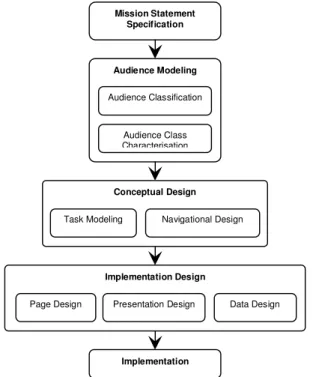
As shown in Figure 1 below, WSDM consists of five-phase design: mission statement specification, audience modeling, conceptual design, implementation design, and implementation. Under audience modeling phase, audience classification and audience class characterisation are required, which contribute to the audience-driven factor of this model. Conception design phase includes task modeling and navigational design, as commonly used in multimedia application development. As for implementation design phase, it includes page design, presentation design and data design, which covers the human-computer interaction aspects in terms of interface and functionalities of objects on the page.
Figure 1: Website Development Methodology (WSDM) A. Current System Analysis and Specification
In order to gather the basic requirements of prospect users’ expectations on features to be made available on the wiki-based system, a questionnaire survey is used. This questionnaire consists of three sections: Section A to understand the background of the respondents; Section B to gather information on current system; and Section C to understand respondents’ requirement of the proposed system.
The questionnaires were distributed randomly using quota sampling to 100 respondents in the case university, where 94 respondents (n = 94) returned the completed questionnaires. Respondents are students of the case university, with understanding of the same current system provided for learning.
Based on the quota sampling, 53 percent of the respondents is female and the rest is male. The background of the students ranged from Food Science and Nutrition (23%), Business Information System (25%), Accounting and Finance (6%), Computing (7%), Diploma in IT (5%), Mass Communication (4%), Biotechnology (18%), Pharmacy (6%), and Architecture (6%).
Results from Section A of the questionnaire survey shows that all respondents (n = 94) know about wikis or heard of Wikipedia before. This proves the respondents are from the generation of students who often retrieve information from Wikipedia for references and learning materials. Yet, only 92 percent of these respondents claimed that they used wikis for any source of information, with 8 percent refuse to use it out of worry on the origin of the information retrieved. Mission Statement Specification Audience Modeling Audience Classification Audience Class Characterisation Conceptual Design Task Modeling Navigational Design
Implementation Design
Page Design Presentation Design Data Design
B. Audience Modeling
The mission statement gave a general indication of the audience involved in the proposed web-based system. For further specification of the target audience and decision whether or not the audience should be modeled, two sub-phases are used: audience classification and audience class characterisation.
The general target audience includes lecturers and students. In most cases, aside from target audience, there are also site owners, which are not included in the mission statement because of their supporting nature in the system. This supporting ‘actors’ are referred to as the administrator.
The steps involve in audience modeling include:
Step 1: Consider the activities of the organisation related to the purpose of the web site.
Step 2: For each activity, identify the people who are involved in the activity and restrict them to the target audience. Consider only those people who belong to the target audience formulated in the mission statement.
Step 3: Divide the target audience into audience classes based on different information or functional requirements. From these audience classes, audience class hierarchy can be formed. This hierarchy shows all audience classes in terms of sub and super classes. The top of the audience class hierarchy is always the visitor class, and group all the requirements common to all audience classes. The visitor just needs to be able to retrieve general information about the web site.
Audience modeling is a set of characteristics as per audience class specified. Some examples of these user characteristics are: level of experience with websites in general, frequency of use, language issues, education or intellectual abilities, age, income and lifestyle. If these can be distinguished within one audience class, groups of members with different characteristics can be introduced as audience class variants.
C. System Design and Implementation
The system design consists of conceptual design and implementation design phases. The conceptual design deals with the conceptual of ‘what and how’, according to the following steps:
Step 1: In the information modeling, especially for data intensive Web Sites, questions to be answered are like: What kind of information is needed? With functional modeling for application type Web Sites, which emphasis on what functionality is needed? The information modeling and functional modeling are part of the task modeling.
Step 2: The conceptual design describes the (conceptual) structure of the website and model how the members from different audience classes will be able to navigate through the site. The goal of the conceptual design phase is to turn the requirements which identified in the audience modeling phase into high level, formal description which can be used later on to generate effective websites.
Step 3: For task modeling, information and functional modeling is done by means of object chunks. Any modeling technique can be used to do this, but ORM
(Object Role Modeling) is being used with some extra notation to represent the functional information. Figure 2 shows a sample of ORM.
Step 4: Navigation design step describes the structure of the website and the navigational possibilities for each audience class. This is done by creating a navigation track for each individual audience class. Such a navigation track reflects the information, functional and navigational requirements as described in previous steps. All the navigation tracks together form the navigation model which is used to implement the website. Tracks are composed of components that represent units of information or functionality, and links that connect those components. In addition, links can be conditional depending on the logical true of a condition.
Figure 2: Student profile Object Role Modeling (ORM)
The implementation design is the next step of the method. This phase consists of three subphases: page design, presentation design, and data design. Page design involves the arrangement of pages information while specifying the graphical user interface for presentation design purpose. Data design involves the creation of data needed and the design of database.
5. CURRENT SYSTEM ANALYSIS AND SPECIFICATION A. Current System Problem
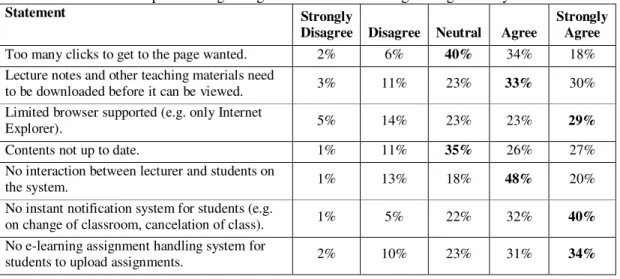
Results from Section B of the questionnaire survey are shown in Table 1, which summarises respondents’ grading on the current learning management system in the case university, with the highest frequency for each statement bolded. Overall response is fairly high in agreeing to the listed statements.
Table 1: Respondents’ grading on the current learning management system
Statement Strongly
Disagree Disagree Neutral Agree
Strongly Agree Too many clicks to get to the page wanted. 2% 6% 40% 34% 18% Lecture notes and other teaching materials need
to be downloaded before it can be viewed. 3% 11% 23% 33% 30% Limited browser supported (e.g. only Internet
Explorer). 5% 14% 23% 23% 29%
Contents not up to date. 1% 11% 35% 26% 27%
No interaction between lecturer and students on
the system. 1% 13% 18% 48% 20%
No instant notification system for students (e.g.
on change of classroom, cancelation of class). 1% 5% 22% 32% 40% No e-learning assignment handling system for
No discussion section to allow students to ask
questions on the system provided. 1% 10% 29% 30% 30%
The first statement is more related to human-computer interaction issue found to be significant in the current system. Even though 40 percent of the respondents chose to be “neutral” in their opinion on the number of clicks to get to the desired page, the total of “agree” and “strongly agree” on the statement is more than half (52%), skewing the whole response to oppose disagreement for 92%. Another case of high percentage of “neutral” opinion is on the statement on up-to-date contents. This result shows the diverse situations found from case to case, in terms of lecturers’ updates on materials according to the requirement of subject contents throughout a semester.
Another significant statement is on the behaviour of the system content, where the respondents have to download the posted files before they can view the files content, instead of having a content preview or knowing the brief idea of the content before having a possibility of downloading a wrong file. The highest percentages on this statement fall on “agree” and “strongly agree”, giving the total of 52 percent. The rest of the statements received heavy agreement totals, especially in terms of system not giving any interaction features between students and lecturer. Respondents agreed and strongly agreed on statements of no interaction (68%), no instant notification (52%), and no discussion section (60%).
B. Specification
Based on the objective of this study, the mission statement of this proposed web-based development is to provide a wiki-based environment as a platform for transaction of teaching and learning materials, alongside for better connection and instant communication among the students and lecturers. In preparing for the mission statement specification, results from Section C of the questionnaire survey are used to outline the requirements for the proposed wiki-based site.
Results from Section C are shown in Table 2, which summarises the respondents’ agreements to functions and features required in the proposed learning management system (i.e. wiki), with the highest frequency for each statement bolded.
Table 2: Respondent’s requirements on proposed learning management system Statement
Strongly
Disagree Disagree Neutral Agree
Strongly Agree I can see what I wanted in the front page. 4% 7% 26% 41% 22% The contents are displayed while entering the
page without the need to download. 4% 5% 37% 31% 23%
Almost all browsers are supported (e.g. Mozilla
FireFox, Safari, Mobile browser). 3% 4% 22% 42% 29%
Real-time update of contents. 3% 8% 31% 31% 27%
Lecturers and students can discuss on the subject
related matters. 4% 11% 28% 36% 21%
Instantly notify students of important
announcements. 5% 11% 18% 34% 32%
Students can upload assignments and lecturers
Q&A discussion to allow students to ask questions, and answers may be provided by other students or lecturer.
7% 7% 23% 33% 30%
From Table 2, it shows that the respondents are heavy in agreeing to most of the statements, with highest percentages on “agree”, whereas “neutral” agreement takes up about 27 percent of the whole total of this questionnaire survey section. The highest percentage of “agree” is on browsers compatibility (42%), followed by the ability to see the page desired (41%), and discussion facility between lecturers and students on the subject related matters (36%). The statement on display of contents on the page without the need to download receives 37 percent of “neutral” opinion, partly because of the respondents’ incapability to understand and visualise the feature suggested by the statement.
Two interesting statements received interesting feedback of having very close differences between “neutral” and “agree”: real-time update of contents (31% “neutral” against 31% “agree”), and facility for students to upload assignments and lecturers to mark and comment online (31% “neutral” against 30% “agree”). Another two interesting feedbacks are the agreement on instant notification of important announcements to students (34%) and open discussion allowing students to ask and others – both students and lecturer – to answer (33%). This shows the concern on students in getting them updated and their curiosity answered instantly via the proposed system, as it is the most basic services expected from the students of a private university.
6. AUDIENCE MODELING
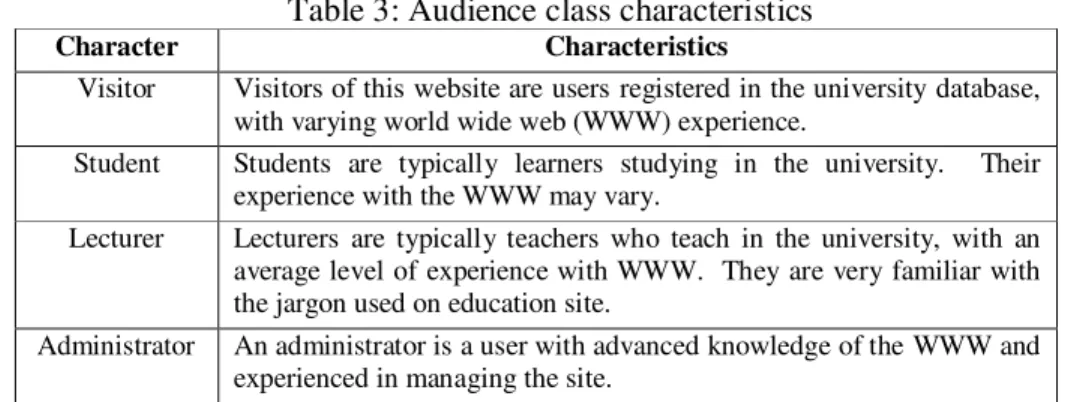
Characteristics of audience classes can be used to distinguish the audiences besides functional and information requirements. Members of one audience class may diverge in how the information should be presented to them. Figure 3 below shows the audience class hierarchy for this study.
Figure 3: Audience class hierarchy
Table 3: Audience class characteristics
Character Characteristics
Visitor Visitors of this website are users registered in the university database, with varying world wide web (WWW) experience.
Student Students are typically learners studying in the university. Their experience with the WWW may vary.
Lecturer Lecturers are typically teachers who teach in the university, with an average level of experience with WWW. They are very familiar with the jargon used on education site.
Administrator An administrator is a user with advanced knowledge of the WWW and experienced in managing the site.
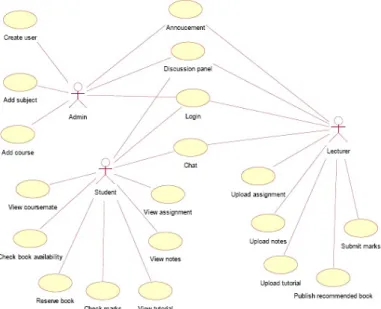
These different categories of audience, or in technical term referred to as users, have different needs and requirements as follows:
i. Students: These users should be able to have access to their own page, using login identification and password provided during the registration. Students can view their current subjects and results on the page. They can directly access to the lecture notes without the need to download it. Students can upload their assignment online and their lecturer can mark and provide a grade instantly for students to check. A link to the library can be added for students’ convenience so that they can check the library book availability and make reservation as needed. Students can receive up-to-date news, for example change of classroom or change of timetable. Chat system is included for better interaction between students and lecturers. Schedule guidelines are also added for better references of the upcoming lecture.
ii. Lecturers: These users should be able to browse through the system based on the provided access area, in terms of subjects allocated for them to teach in the current semester. They should have the access to search for the students’ online submitted assignment based on the subject, mark on the spot and give a grading to the assignment marked. They should also be able to search for all the lecture notes and edit or update them instantly. Any urgent news and updates, such as change of classroom or timetable, will be updated on the lecturer’s page and the lecturer can then announce through the portal and all affected students will be notified. The lecturer can make special announcements as they wish as well. Lecturers, same as students, have access to the chat system to discuss academic related topics when they are off-campus.
iii. Administrators: These users are responsible for the management of the proposed system. From the integration with the university database, administrators do not have to re-assign identification and password. They only need to activate the accounts of students (according to the subjects registered in the semester) and lecturers (according to the subjects allocated in the semester), set their access privilege and maintain the account. A lecturer can change the category or subcategory of the subject if necessary with the need of administrator’s approval. If there is any general announcement from the school management, the administrator will post and manage it.
Figure 4: Use case diagram for the proposed wiki
7. SYSTEM DESIGN AND IMPLEMENTATION
The design of the prototype is based on the specification and audience modeling discussed above. The proposed system is a web application based on the 3-tier architecture: presentation layer (client that usually request the resources through web browser), application layer (Web server that provides the requested resources) and data layer (database server where the data and resources are stored).
Figure 5 shows the class diagram for the conceptual design of the proposed system, which include the functions of the three types of users (administrator, lecturer, and student), and the two main module (course and note).
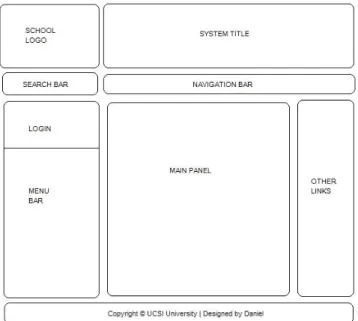
Figure 6 shows the system overview in terms of interface layout, for the purpose of the implementation design. The layout comprises of significant components, such as menu bar (which shows different sets of menus depending on the user type – administrator, lecturer, or student), main panel (which is the main location for contents, module features and other facility transactions), and other links (which includes future expansion on collaboration with other university databases, like library system, students’ record system and students’ activity system).
Figure 6: System overview of the interface layout
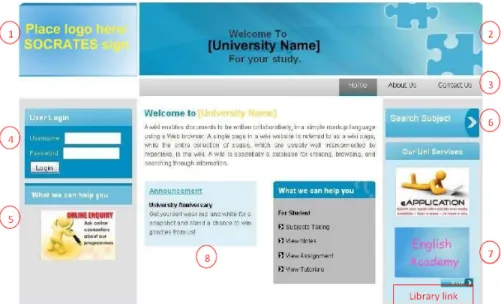
Figure 7 shows the proposed look of the system interface design, or presentation design. As mentioned, the menu bar (shown as number 5 in Figure 7) shows different sets of menus after user logs in, depending on the user type. Administrator can access 3 functions (subject management, course management and user management), lecturer can access 3 functions (notes management, assignment management and tutorials management), and student can view 3 functions based on the current subjects taken (view notes, assignment and tutorials).
Figure 7: Proposed system interface design
8. FINDINGS AND DISCUSSIONS
The full design of this proposed collaboration system is expected to have full wiki functions with good content management system, on top of validation on users’ view based on users’ records in the legacy database system. This is to ensure security during login where only users involved with the coursework are able to use the system, without the need to register as wiki members. It is also to ensure that the users (especially lecturers) can monitor the changes made by others (such as students) and the time students upload assignments for coursework submission purpose.
On the lecturers’ perspective, there is no need of editing the notes from their own computer and upload it again when there are any changes to be made. Lecturers can view the notes from the proposed system and edit it on the spot. Yet, this technology usage is only applicable to authorised users, who are the lecturers of particular subjects, where the records in the existing university database could be linked to ensure the restriction. Notes meant for lecturers to edit are not editable to students (or other users), to avoid students from simply accessing the notes and editing them.
When the lecturers make the tutorial links available, the students can then access and do the tutorial online. Most of the tutorials will be in structured form. For multiple choice questions, student can get their marks once they have completed the questions, along with the correct answers for wrongly answered questions. It is more convenient for the lecturers as they do not have to mark individual tutorials.
Administrator can make general announcements for any course or subject, whereas lecturers only have the permission to make announcements on particular subjects taught by them. As students can view the current subjects they are taking as well as the notes uploaded by the lecturer, students can also view the past semesters notes but only limited to the subjects that they have taken in those previous semesters. In other words, every semester would have ‘fresh’ sets of notes and class activities materials.
Besides that, this proposed system is implanted with the similarity of blogging system where posting and commenting are allowed throughout the system. As the discussion panel is made visible for all students who are taking the particular subject, information from one student can be shared, encouraging information and knowledge sharing among students. Students can upload their assignments through this proposed system while lecturers can mark them on the spot. It allows lecturers and other students to give comments or even rate their peers’ assignments.
9. CONCLUSION, LIMITATIONS AND RECOMMENDATIONS
The uniqueness of this project is that the proposed system is not just another wiki system, but collaboration between social media and online tools associated with existing databases, such as course registration database. The combination of these technologies is being presented on a wiki platform, because the main functions are based on wiki services. In addition to that, it gives the facility to the students to view the notes without the need of downloading them. Most e-learning or web-based applications come with attachments whereby they require the users to download to view them. Thus, the implementation of proposed project solves this issue, by providing a more convenient way for users.
This proposed wiki for university is at the first stage of preparing the platform. As how any web-based system is developed, there are always rooms for improvement, especially if the proposed system is able to fully utilise the integrated database from the legacy systems of a university. For example, the presentation design was done according to the requirement, but without evaluation phase, the success of the implementation in terms of human-computer interaction is not ensured. Another limitation of this system is the database integration between the proposed system and the university database needs to be tested in terms of speed performance of data flow for each query and transaction.
In terms of recommendation, further research on users’ acceptance in using wiki can enhance in collecting data for better development and implementation of the proposed system. Users could only respond towards a system that they are used to, instead of imagining how the system would look like based on the questionnaire.
This research project is expandable to further phases, with more modules related to the coursework, such as books recommendation by lecturers linking to library management system for students to check if the books used in the class are available for loan. Since the system could identify the current students in a particular class, this extended library review system can be made to allow students to know if the recommended book is being borrowed by their own peers, in order for the students to contact the peers personally to get reviews on the book from a student’s perspective.
Another expansion recommended is on mobile phone platform, where students can get updates via mobile phones on certain news and announcements that are important to them. As a conclusion, the main purpose of having a wiki platform with restriction of access according to current subjects taken by students (and also lecturers) is for focused learning, due to students’ difficulty in selecting the right information from the Internet caused by information overload. By getting lecturers involved in the daily discussion and contents presentation over the proposed system, the students are expected to be more focused and
confident on the origin of the information and knowledge retrieved. Furthermore, the subjects accessed are based on the current class cohort, so that the students are more focused in terms of time and scope as well. Lecturers (as human support) along with wiki and university database (as systems support) could assist students in their quest for focused knowledge on semester basis.
10. REFERENCES
[1] Augar, N., Raitman, R. & Zhou, W. (2004). Teaching and learning online with wikis.
Proceedings of ASCILITE. [online]. http://ascilite.org.au/conferences/perth04/procs/augar.html [2] Bryant, L. (2007). Emerging Trends in Social Software for Education, in Emerging,
Technologies for Learning, 2 Becta. [online]. http://www.becta.org.uk/research.
[3] Davie, S. & Berlach, R.G. (2010). Using Wikis to Facilitate Communication for Rural, Remote and At-risk Practicum Students. MERLOT Journal of Online Learning and Teaching, 6 (1), 78-88.
[4] Deters, F., Cuthrell, K. & Stapleton, J. (2010). Why Wikis? Student Perceptions of Using Wikis in Online Coursework. MERLOT Journal of Online Learning and Teaching, 6 (1), 122-134. [5] Duffy, P. & Bruns, A. (2006). The use of blogs, wikis and RSS in education: A conversation of
possibilities. Proceedings of the Online Learning and Teaching Conference 2006, Brisbane: September 26. [online]. http://eprints.qut.edu.au/5398/1/5398.pdf
[7] Huang, W-H.D. (2010). A Case Study of Wikis’ Effects on Online Transactional Interactions. MERLOT Journal of Online Learning and Teaching, 6 (1), 1-14.
[8] O’Reilly, T. (2004). “What is Web 2.0: Design Patterns and Business Models for the Next Generation of Software”, [online]. O’Reilly, http://www.oreillynet.com/pub/a/oreilly/tim/news/ 2005/09/30/what-is-web-20.html.
[9] Surowiecki, J. (2004). The Wisdom of Crowds: Why the Many are Smarter than the Few. London, UK: Abacus.
[10] Tonkin, E. (2005). Making the Case for a Wiki, Ariadne 1(42). [online]. http://www.ariadne. ac.uk/issue42/tonkin/
[11] Trinder, K.R. et al. (2008). Learning from Digital Natives: Bridging Formal and Informal Learning, Glasgow: The Higher Education Academy.
[12] Franklin, T. (2007). “Briefing paper on Web 2.0 technologies for content sharing: Institutional good practice”, JISC/HEFCE [online]. Franklin Consulting, http://www.franklin-consulting.co. uk/LinkedDocuments/Instiutional practice Briefing paper on Web 02.pdf