DEVELOPING AN ENVIRONMENTAL MANAGEMENT PLAN FOR THE BRAS D’OR LAKES WATERSHED – AN ANALYSIS OF ITS SCOPE AND
APPROACH FOR ADDRESSING ISSUES
by
Jason G. Naug
Submitted in partial fulfillment of the requirements for the degree of Master of Urban and Rural Planning
at
Dalhousie University Halifax, Nova Scotia
August 2007
DALHOUSIE UNIVERSITY
SCHOOL OF PLANNING
The undersigned hereby certify that they have read and recommend to the Faculty of Graduate Studies for acceptance a thesis entitled “DEVELOPING AN
ENVIRONMENTAL MANAGEMENT PLAN FOR THE BRAS D’OR LAKES WATERSHED – AN ANALYSIS OF ITS SCOPE AND APPROACH FOR ADDRESSING ISSUES” by Jason G. Naug in partial fulfillment of the requirements for
the degree of Master of Urban and Rural Planning.
Dated: August 27, 2007 Supervisor: _________________________________ Dr. Susan Guppy Readers: _________________________________ Maxine Westhead _________________________________ Dr. Michael Poulton
DALHOUSIE UNIVERSITY
Date: August 27, 2007
AUTHOR: Jason G. Naug
TITLE: DEVELOPING AN ENVIRONMENTAL MANAGEMENT
PLAN FOR THE BRAS D’OR LAKES – AN ANALYSIS OF ITS SCOPE AND APPROACH FOR ADDRESSING ISSUES
DEPARTMENT Planning
DEGREE: MURP CONVOCATION: October 2007
Permission is herewith granted to Dalhousie University to circulate and to have copied for non-commercial purposes, at its discretion, the above title upon the request of individuals or institutions.
__________________________________ Signature of Author
The author reserves other publication rights and neither the thesis nor extensive extracts from it may be printed or otherwise reproduced without the author’s written permission.
The author attests that permission has been obtained for the use of any copyrighted material appearing in the thesis (other than brief excerpts requiring only proper acknowledgement in scholarly writing), and that all such use is clearly acknowledged.
Dedication
To My Family -
Especially Anne Marie who almost never begrudged me the time to do this and
Anna and Jake who I was rewarded with sometime between Rural Studio and Planning Law
Table of Contents
List of Tables vii
List of Figures viii
Chapter 1 Introduction 1
Setting 1
Marine Environment 2
Terrestrial Environment 5
Planning and Management Context 5
Scope of Current Management Plan for the Bras d’Or 9
Problem Statement 10
Key Question 11
Chapter 2 Approach and Methodology 12
Purpose 12
Methodology 12
Chapter 3 Environmental Concerns in the Bras d’Or 16
Previous Efforts 16
Summary of Environmental Issues 29
Summary 32
Chapter 4 Mandates and Responsibilities 33
Government Departments 33 Other Organizations 33 Summary 41 Chapter 5 Survey 43 Survey Findings 45 Forestry 46 Sewage 48
Land-Use (Mining/Gravel Extraction) 52
Land-Use (Agriculture) 55
Land-Use (Shoreline Development) 56
Marine Invasive Species 60 Declining Fish Stocks (Oysters, Herring, Lobster) 63
Data Used for Managing Issues 70
Lessons Learned from Previous Efforts 72
Summary 73
Chapter 6 Summary and Analysis 74
Summary 74
Analysis 79
Chapter 7 Conclusion and Recommendations 84
Conclusion 84
Recommendations 86
References 89
Appendix A Management Plan Framework Document 98
Appendix B Detailed Environmental Mandates 122
Appendix C Questionnaire 168
List of Tables
Table 1.1 Previous Planning and Management Efforts in the Bras d’Or 6 Table 1.2 Areas of Emphasis for Overall Management Plan for the
Bras d’Or 9
Table 3.1 Previous Planning and Management Efforts in the Bras d’Or 16 Table 3.2 Summary of Recommendations for Improved
Management from Previous Efforts 28
Table 3.3 Summary of Environmental Issues 29
Table 3.4 Relationship of Bras d’Or Environmental Issues 31 Table 4.1 Summary of Environmental Mandates by Issue within the
Bras d’Or 36
Table 5.1 Departmental Managers Interviewed 43
Table 5.2 Comparison of Survey Results to Scope of Management
Plan for Forestry 47
Table 5.3 Comparison of Survey Results to Scope of Management
Plan for Sewage 50
Table 5.4 Comparison of Survey Results to Scope of Management
Plan for Land-Use (Mining/Gravel Extraction) 53 Table 5.5 Comparison of Survey Results to Scope of Management
Plan for Land-Use (Agriculture) 55
Table 5.6 Comparison of Survey Results to Scope of Management
Plan for Land-Use (Shoreline Development) 57 Table 5.7 Comparison of Survey Results to Scope of Management
Plan for Land-Use (Landfills/Dumpsites) 59
Table 5.8 Comparison of Survey Results to Scope of Management
Plan for Marine Invasive Species 61
Table 5.9 Comparison of Survey Results to Scope of Management
Plan for Declining Fish Stocks (Oysters, Herring, Lobster) 64
Table 5.10 Summary of Survey Results by Issue 66
Table 5.11 Areas of Management Emphasis from Interviews 69
List of Figures
Figure 1 Location of the Bras d’Or Lakes within Cape Breton
Island, Nova Scotia 2
Figure 2 Bras d’Or Lakes Watershed showing Sub-Watersheds 4 Figure 3 Generalization of Methodology Undertaken 15
Abstract
The purpose of this thesis was to analyse whether the scope and approach being taken to develop an environmental management plan for the Bras d’Or lake and its watershed is broad enough to address the environmental issues identified for this area. This plan is being developed by a collaborative body known as the Collaborative Environmental Planning Initiative (CEPI). CEPI consists of federal, provincial, municipal, and First Nation governments, industry, NGOs, academics, and community members who are working together to develop and foster the implementation of this plan. Interviews were conducted with managers from various government departments that have a legal
responsibility for the issues. These interviews were undertaken to assess the general way that each issue is currently being managed, and how their management could be
improved to better address the issues. These recommendations were then compared to the scope and approach being advanced by CEPI for their plan. In general, the current
approach appears sound and should assist in addressing the issues, although a number of areas where the scope could be expanded were identified. Based on this research, a number of specific recommendations were made to CEPI to assist in the overall planning and management process taking place in the Bras d’Or.
List of Abbreviations
CBRM Cape Breton Regional Municipality
CEPI Collaborative Environmental Planning Initiative CIP Canadian Institute of Planners
DFO Department of Fisheries and Oceans
EC Environment Canada
EDPC Eastern District Planning Commission INAC Indian and Northern Affairs Canada MSX Haplosporidium nelsoni (oyster parasite) NGO Non Governmental Organization
NSAFA Nova Scotia Agriculture, Fisheries and Aquaculture NSDNR Nova Scotia Department of Natural Resources
NSDOEL Nova Scotia Department of Environment and Labour
SIMBOL Science for the Integrated Management of the Bras d’Or Lakes SCI Sustainable Communities Initiative
TC Transport Canada
Acknowledgements
I would like to thank my Supervisor at the Dalhousie University School of
Planning, Dr. Susan Guppy for providing her logic and objectivity to this process and for her willingness to oversee this work - even during her sabbatical. Thanks also to the other members of my committee, Dr. Michael Poulton, and Maxine Westhead.
I would like to thank my many good colleagues involved in the Bras d’Or Collaborative Environmental Planning Initiative for their efforts to date with this
initiative and especially to those managers who were interviewed as part of this research.
Finally, I would like to thank the Oceans and Coastal Management Division of Fisheries and Oceans Canada who have helped support this work.
Chapter 1: Introduction
Setting:
The Bras d’Or Lake occupies the central portion of Cape Breton Island and is located at the north-eastern end of the province of Nova Scotia as shown on Figure 1. The Lake and surrounding watershed, with a total area of approximately 3 600 km2, are recognized by
many as one of the greatest natural assets on Cape Breton Island1. They provide
recreational opportunities for seasonal and permanent residents, including cottage use, boating, hiking, and fishing, and are the location of numerous cultural activities throughout the year. These activities attract thousands of tourists annually who value the area’s natural beauty and contribute significantly to the island’s economy. Commercial fishing and aquaculture, as well as other resource industries such as forestry and mining, provide livelihoods for Bras d’Or residents. Approximately 22 000 people reside within the watershed in numerous small communities surrounding its shores2. In addition, the lakes and surrounding watershed and their natural resources have historical, cultural, and spiritual significance to its first inhabitants, the Mi’kmaq people. Although population numbers in the Bras d’Or communities have been declining over the past ten years, the five Mi’kmaq communities surrounding the lakes have been experiencing significant growth3 and currently comprise approximately twenty percent of the watershed’s population4.
1 Petrie, B. and G. Bugden. The Phyisical Oceanography of the Bras d’Or Lakes. Proceedings of the Nova
Scotia Institute of Science, Vol. 42, pp. 9-36, 2002.
2McReady, Rick. 2004 (Planner: Cape Breton Regional Municipality) Personal Communication 3 Parker, M., M. Westhead, P. Doherty and J. Naug. 2007. Ecosystem Overview and Assessment Report
for the Bras d’Or Lakes, Nova Scotia. Can. Manuscr. Rep. Fish. Aquat. Sci. 2789: xxii + 223 pp.
Figure 1. Location of the Bras d’Or Lake within Cape Breton Island, Nova Scotia5.
Marine Environment:
The Bras d’Or Lake is also a rich marine ecosystem with unique characteristics of water chemistry, energy inputs, and animal life. The lake has a complex geometry and contains a wide variety of physical environments. Although the average depth is approximately 30 m, there are shallow and flat bottomed bays and inlets with depths of 5 m, as well as deep steep-sided areas, reaching to depths of 280 m.6 The Bras d’Or Lake contains rocky, sand, gravel and mud habitats, as well as Barachois ponds along its perimeter. There are three connections between the lakes and the surrounding ocean (St. Peter’s Canal, Little Bras d’Or Channel and Greater Bras d’Or Channel) with most of the exchange of water
5 Government of Nova Scotia Online Maps. Accessed July 21, 2007. URL:
http://www.gov.ns.ca/snsmr/land/online/images/MaritimesFree.gif
6 Strain, P. and P. Yeats. The Chemical Oceanography of the Bras d’Or Lakes. Proceedings of the Nova
occurring through the Greater Bras d’Or Channel7. While considered by many as a lake, a series of lakes, as well as an in-land sea, the Bras d’Or system is most accurately characterized as an estuary, with a mixing of marine and freshwater inputs that produces a salinity approximately one third less than the surrounding ocean8. Although the species in the lakes are generally characteristic of those found along Nova Scotia’s Atlantic coast, the Bras d’Or are also home to a diversity of species including glacial relict species inhabiting the lakes from the last ice-age, as well as warm water species typically found in waters as far south as Virginia9. The characteristics of this system, particularly the slow flushing rate of water through its many bays and inlets, make it vulnerable to human disturbance. The health and prosperity of the communities surrounding the Bras d’Or are tied to the health of the Bras d’Or Lake and surrounding landscape.
7 Petrie, B. and G. Bugden. The Phyisical Oceanography of the Bras d’Or Lakes. Proceedings of the Nova
Scotia Institute of Science, Vol. 42, pp. 9-36, 2002.
8Strain, P. and P. Yeats. The Chemical Oceanography of the Bras d’Or Lakes. Proceedings of the Nova
Scotia Institute of Science, Vol. 42, pp. 37-64, 2002
9 Lambert, T. Overview of the Ecology of the Bras d’Or Lakes with Emphasis on the Fish. Proceedings of
Figure 2. Bras d’Or Lake Watershed showing sub-watersheds10.
Terrestrial Environment:
The terrestrial watershed surrounding the Bras d’Or Lake is approximately 2400 km2 in area with the majority of the land being in the north and western portions of the lake11. The watershed is itself the extent of the land base that drains into the Bras d’Or. There are four major rivers flowing into the Bras d’Or, including the River Denys, Skye River, Baddeck River, and Middle River. The watershed as a whole is highly forested with the various sub-watersheds having 74 to 86 % tree cover12. Some of the major terrestrial mammals that frequent this area include the moose, black bear, deer, bobcat, lynx, snowshoe hare, skunk, coyote and racoon. The Bras d’Or watershed is also home to a large population of bald eagles with provincial estimates in 1994 of more than 800 birds13. There are several species of plant and animal located in this watershed that are listed under the federal Species at Risk Act or the provincial Endangered Species Act. These include the Bicknell’s Thrush (bird), Prototype Quillwort (plant), Canada Lynx, American Marten and Gaspe Shrew (mammals) and the Wood Turtle (reptiles)14. Freshwater wetlands, which are important ecological areas containing greater levels of biodiversity, comprise approximately 100 km2 of the total watershed. The approximately 1000 km of shoreline around the Bras d’Or is the transition area between the marine and terrestrial environments15. In this area, the ecological linkages between upland areas, the shore, and offshore areas occur. This linkage is facilitated by the drainage of the
terrestrial watershed through various streams and rivers down to the Bras d’Or Lake.
Planning and Management Context:
Given the unique and valued nature of the Bras d’Or Lake environment, a number of attempts have been made to develop a better overall planning and management regime for the lakes and watershed lands over the past 30 years. Taken together these efforts reflect the recognized value of the Bras d’Or ecosystem and the fact that there have been, and
11 Lambert, T. Overview of the Ecology of the Bras d’Or Lakes with Emphasis on the Fish. Proceedings of
the Nova Scotia Institute of Science, Vol. 42, pp. 65-99, 2002.
12 Parker, M., M. Westhead, P. Doherty and J. Naug. 2007. Ecosystem Overview and Assessment Report
for the Bras d’Or Lakes, Nova Scotia. Can. Manuscr. Rep. Fish. Aquat. Sci. 2789: xxii + 223 pp.
13 As above. 14 As above.
15 Petrie, B. and G. Bugden. The Phyisical Oceanography of the Bras d’Or Lakes. Proceedings of the Nova
continue to be, a number of threats to this system. These efforts also represent the view that a greater degree of coordination is required to better manage this area. While none of the previous efforts have resulted in the development of an overall management plan for this area, each has included a number of approaches for developing a better management regime for the Bras d’Or. These previous efforts have included assessments of the
environmental issues present, natural asset inventories, proposed management structures, public information programs, and public consultations. A list of the planning and
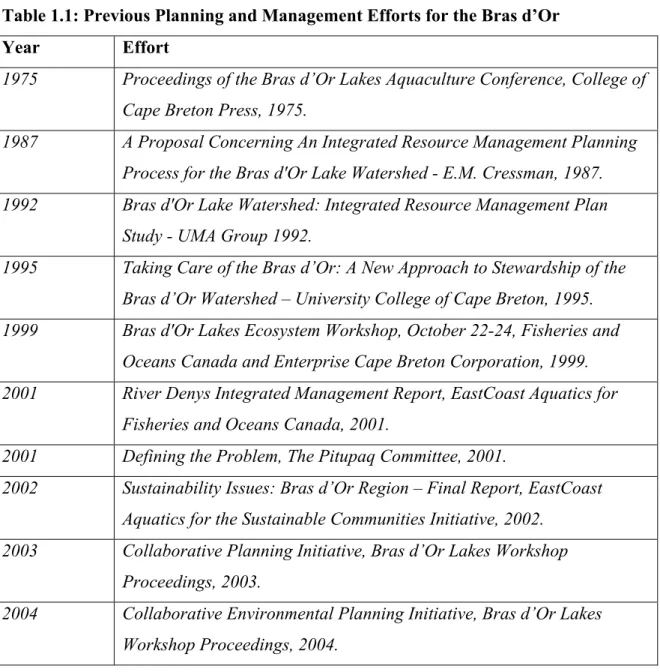
management efforts over this time are included in Table 1.1 below and detailed further in Chapter 3.
Table 1.1: Previous Planning and Management Efforts for the Bras d’Or
Year Effort
1975 Proceedings of the Bras d’Or Lakes Aquaculture Conference, College of Cape Breton Press, 1975.
1987 A Proposal Concerning An Integrated Resource Management Planning Process for the Bras d'Or Lake Watershed - E.M. Cressman, 1987. 1992 Bras d'Or Lake Watershed: Integrated Resource Management Plan
Study - UMA Group 1992.
1995 Taking Care of the Bras d’Or: A New Approach to Stewardship of the Bras d’Or Watershed – University College of Cape Breton, 1995. 1999 Bras d'Or Lakes Ecosystem Workshop, October 22-24, Fisheries and
Oceans Canada and Enterprise Cape Breton Corporation, 1999. 2001 River Denys Integrated Management Report, EastCoast Aquatics for
Fisheries and Oceans Canada, 2001.
2001 Defining the Problem, The Pitupaq Committee, 2001.
2002 Sustainability Issues: Bras d’Or Region – Final Report, EastCoast Aquatics for the Sustainable Communities Initiative, 2002.
2003 Collaborative Planning Initiative, Bras d’Or Lakes Workshop Proceedings, 2003.
2004 Collaborative Environmental Planning Initiative, Bras d’Or Lakes Workshop Proceedings, 2004.
2005 . Developing a Strategic Action Plan for the River Denys Basin Watershed, Masters Thesis. School for Resource and Environmental Studies, Dalhousie University, S. Barrington, 2005.
2005 Sustainable Communities Initiative, Bras d’Or Field Team Report on Community Meetings, 2005.
There are a number of government departments (municipal, provincial, federal, and First Nation) operating in the Bras d’Or lakes and watershed with responsibilities for the management of various aspects of the environment. In addition, in recent years a number of other organizations have formed to address specific concerns in this area. Examples of these include:
Unama’ki Institute of Natural Resources (UINR)
Nova Scotia Sustainable Communities Initiative (SCI) Cape Breton Field Team The Pitu’paq Committee
Science for the Integrated Management of the Bras d’Or Lakes (SIMBOL) Bras d’Or Collaborative Environmental Planning Initiative (CEPI)
Despite the many government departments with responsibilities for the management of the environment in the Bras d’Or area, a number of persistent environmental issues have been identified through the various studies and consultation exercises. Some of the main issues identified include fishery declines, sewage contamination, invasive species, and erosion and sedimentation from land-based development16,17,18. In response to this, the Bras d’Or Collaborative Environmental Planning Initiative (CEPI) has been formed and are beginning work toward the development of an overall management plan for the Bras d’Or lakes and watershed lands.
CEPI is a partnership of federal, provincial, municipal and First Nation governments, industry, non-governmental organizations, academia, and community members that are exploring how to better manage the activities occurring within the environment of the
16 . Bras d'Or Lake Watershed: Integrated Resource Management Plan Study - UMA Group 1992 17 . Bras d'Or Lakes Ecosystem Workshop, October 22-24, Fisheries and Oceans Canada and Enterprise
Cape Breton Corporation, 1999
Bras d’Or using a collaborative approach. The purpose of CEPI, as articulated in its Terms of Reference, is to develop an overall management plan for the Bras d’Or lakes and watershed lands and facilitate its implementation by governments and other relevant stakeholders. Much effort was spent at the beginning of this initiative, in which this author was involved, in engaging and developing a common agreement among the partners involved on this approach. It was recognized that building these relationships and understandings would help form a strong foundation for future efforts and be a prerequisite for the involvement of the range of partners required. It was hoped that by working collaboratively toward one vision under a management plan, that there would be efficiencies gained, priorities identified, and efforts undertaken that may not have been possible by working as separate organizations. CEPI has developed an organizational model to help facilitate the planning needed that includes a multi-sector and departmental Steering Committee to oversee the planning process, Task Teams to undertake issue specific work, a Senior Council consisting of senior level leaders from each government department and First Nation Band to provide endorsement and support, and a Secretariat to help organize and coordinate the process. CEPI suggests that an overall management plan for this area is required to better address these issues by providing a more
coordinated approach. A framework document entitled, Toward a Bras d’Or Lakes and Watershed Environmental Management Plan has recently been prepared by CEPI that highlights the specific approach and benefits that an overall management plan, developed in collaboration with all stakeholders, would have for addressing these issues. See
Appendix A for a summary of this framework document. This document, which is the roadmap for the overall plan, suggests that management, and by implication the
environmental issues, would be improved by focussing attention on a number of distinct areas. These areas can be broadly grouped as relating to reaching consensus (vision, issues, targets for environmental health, etc.), sharing (information, resources, expertise, etc.), and coordination (work planning, policy, enforcement, etc.), among the various bodies responsible for the management of the Bras d’Or19. All three of these aspects are related to working better together toward a common goal. Emphasis therefore is placed
19 Toward a Bras d’Or Lakes and Watershed Environmental Management Plan: Draft Discussion
Document. Prepared by the Bras d’Or Collaborative Environmental Planning Initiative’s Management Plan Task Team. 2006.
less on issue specific concerns and more on this process of working together. Consensus requires these groups to agree on specific areas where and how the work will be directed, sharing allows the partners to make use of all the resources available, and coordination will allow the work to be both strategically and efficiently carried out. The underlying assumption in this document is that improving the general management conditions through the various forms of consensus building, sharing and coordination will help address the environmental issues present and help prevent new ones from occurring.
Scope of the Current Management Plan for the Bras d’Or:
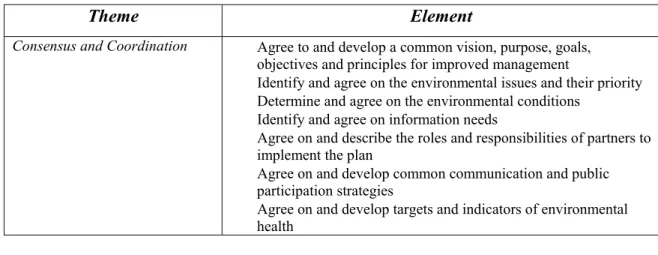
The elements described below in Table 1.2 have been agreed to by the CEPI as those things that when identified, agreed to, and developed, would comprise an overall management plan for the Bras d’Or Lake and watershed lands. These elements describe both the scope and approach to be taken by the CEPI and place an emphasis on a process of working together to address issues generally rather than specific methods to deal with any given issue. In discussions of the CEPI, of which this author was a part, it was thought that many of the issues were complex enough or would require multiple partners and approaches to address them that the initial focus should be on finding ways to work together toward common goals. In this way the main elements described can be seen in terms of building consensus, sharing, and coordination. Table 1.2 below describes each of these elements.
Table 1.2 Areas of Emphasis for Overall Management Plan for the Bras d’Or20
Theme Element
Consensus and Coordination Agree to and develop a common vision, purpose, goals, objectives and principles for improved management
Identify and agree on the environmental issues and their priority Determine and agree on the environmental conditions
Identify and agree on information needs
Agree on and describe the roles and responsibilities of partners to implement the plan
Agree on and develop common communication and public participation strategies
Agree on and develop targets and indicators of environmental health
20 Toward a Bras d’Or Lakes and Watershed Environmental Management Plan. Collaborative
Agree on and develop an evaluation and review mechanism Agree on and develop common policies
Agree on and develop common work plans Agree on and develop a common funding strategy
Agree on and develop an evaluation and review mechanism
Sharing Information
Expertise
Research capacity Planning processes Financial resources
Linkages between projects and overall objectives
Problem Statement:
The current planning efforts of the CEPI suggest that the various environmental issues for the Bras d’Or lakes and watershed lands will be better addressed through the
development of an overall management plan where effort will be directed toward a number of areas of working together. These areas can be seen in terms of consensus building, sharing, and coordination among the partners involved. This thesis wishes to evaluate this premise by assessing the relationship between the environmental issues, and the challenges for addressing them, and the main areas where effort will be directed in developing this plan. This will be done by assessing areas where the management of these issues should be improved and comparing these to the main elements of the plan as outlined in Table 1.2. If a lack of consensus building, sharing, and coordination, and the elements that comprise these, are in fact the areas where greater attention is required to address the environmental issues, the direction outlined for the overall management plan would then appear sound and effective for addressing the issues identified. If however, the areas where management needs to be improved to address the issues are not related to what is proposed in the scope and approach for the overall plan, then adjustments may be required to the scope and approach of this plan to ensure that it is relevant to addressing the issues identified. In addition, any lessons learned from previous planning and management studies that took place will be explored.
Key Question:
This thesis will try to answer the following key question:
Is the current scope and approach being proposed for a management plan in the Bras d’Or Lake and watershed broad enough to address the environmental issues identified?
Chapter 2: Approach and Methodology
Purpose:
The purpose of this thesis is to analyse whether the scope and approach of a management plan being developed for the Bras d’Or Lakes and watershed lands is broad enough to address the environmental issues identified. This will be done based on comparing insights from the existing environmental managers, as those with a legal role and
responsibility to manage the environmental issues, against the scope of effort that will be undertaken through the development of this overall management plan. In addition, lessons learned from previous management efforts will be examined in this context. This plan is currently being developed through a multi-stakeholder and intergovernmental planning and management process in the Bras d’Or called Collaborative Environmental Planning Initiative (CEPI). The CEPI suggest that the environmental issues within the Bras d’Or will be better addressed when effort is directed at a number of areas, generally grouped as consensus, sharing and coordination, as outlined in the framework document, Towards a Bras d’Or Lakes and Watershed Environmental Management Plan.
Recommendations from this research will be presented to CEPI for their consideration in the development of this management plan.
Methodology:
The research has been divided into the following main areas described below. Figure 2.1 provides an overview of this process.
Scope for Current Bras d’Or Management Plan: A review was made of the framework document developed by CEPI, entitled, Toward a Bras d’Or Lakes and Watershed Environmental Management Plan, which outlines the scope and approach of the overall management plan for the Bras d’Or. The key aspects of this plan and approach that are purported to improve the overall management of the Bras d’Or were described. A table was created that outlined the specific aspects where effort is to be directed in developing this plan.
Previous Planning and Management Efforts: A review was made of previous planning and management efforts directed at the Bras d’Or. These documents were gathered and analysed. As these efforts did not result in the development of a plan or the resolution of issues, possible reasons for such were explored. Tables were created that summarized each initiative, listed the environmental issues identified, actions proposed, and the likely outcomes.
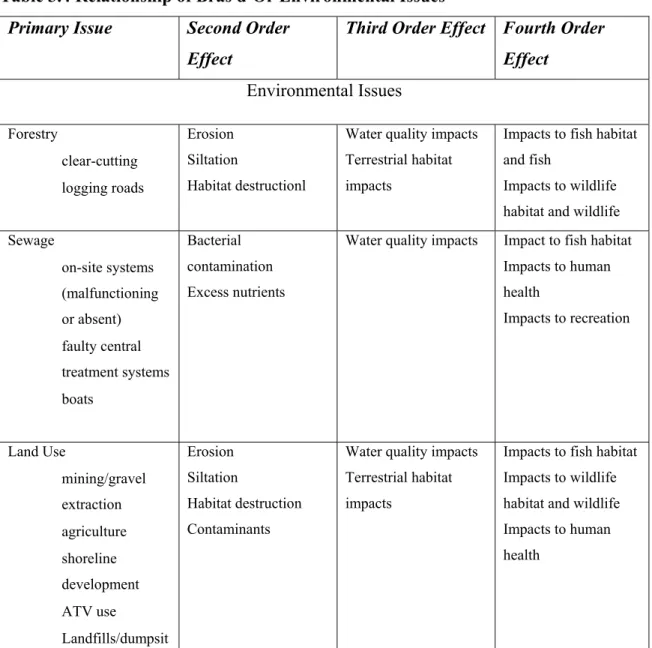
Environmental Issues: A review was made of the environmental issues identified for the Bras d’Or lakes and watershed lands from the planning studies and consultation exercises described above. These issues were summarized and then sorted to examine any obvious relationships, including their root causes and pathways of effect. Emphasis was placed on trying to identify those issues and activities that may be the cause other environmental issues. For example, forestry, erosion and siltation have all been identified as
environmental issues, but forestry would be identified as a key issue since it may cause erosion and siltation. This sorting was done with the consideration that management effort would be most effective if directed at the causes rather than the effects of these issues.
Environmental Mandates: A review was made of the existing government departments working to manage various components of the environment in the Bras d’Or lakes and watershed lands. Government departments included those from municipal, provincial, and federal levels, as well as First Nations Bands as they apply to reserve lands.
Particular attention was focussed on the legislative, policy, and program responsibilities of each of these departments as they relate to the issues identified. Organizing the management regime on an issue basis helped maintain focus on the issues in the Bras d’Or, given the broad range of responsibilities most government departments have. Information was gathered largely from contacting these departments and web-based searches of their legislation, policies and programs. Any gaps in legislation, regulations, policies and programs were noted. A summary table of these organizational
responsibilities was completed relative to each of the issues identified. Detailed descriptions of these mandates are included in Appendix B.
Issue and Environmental Mandate Verification: The results of the issue identification and environmental mandates research were summarized and given to staff people from the relevant government departments for verification. Any required changes to either the issues or mandates were made based on this feedback. A list of primary contacts from each of these departments was generated.
Survey: Interviews with managers and staff in various government departments were conducted to determine what the general management efforts area related to the issues and where in their opinion management efforts could be improved to better address the issues. As staff people with direct responsibility for these issues, it is suggested that they would have the greatest knowledge, experience and insight into them. In addition, insights into previous planning and management efforts that have taken place over the years within the Bras d’Or were sought for lessons learned to apply to the current process. A questionnaire and interview protocol was developed and used with the managers and staff by the author in person or by telephone. Each of the comments and recommendations made by the managers were compared in tables to the various elements described for an overall management plan. Comments and recommendations that did not fall under these areas were also noted. A summary of the number of comments that fell within and outside the scope and approach of the overall management plan was made. In addition, the areas emphasized for improved management by the managers was noted.
Management Analysis: The major outcomes from each of the stages taken during this research were reviewed to determine if the key question for this thesis was answered. Once the input from the staff people associated with each issue was gathered, it was compared to the scope and approach being pursued for the overall management plan for this area. This comparison assessed the effectiveness of the approach being pursued by CEPI to deal with the issues identified and identified relevant gaps in the current approach.
Conclusion and Recommendations: Based on a synthesis of the scope and approach for the management plan, review of previous planning and management efforts, the
environmental issues, the responsibilities of each government department for these issues, and the opinions of where management could be improved for each issue, specific
recommendations were developed to help advance the current CEPI process. Where improvements to management were described that did not correspond to areas to be addressed under the management plan, specific recommendations to alter the scope of this plan were made. In this way, this research helps assess and support the approach currently proposed for the future management of the Bras d’Or.
Figure 2.1 Generalization of Methodology Undertaken Determine Key Departments/Managers with Mandates
for Issues Determine
Improvements Required to Manage Issues
Determine Key Environmental Issues
Determine Scope and Approach for Management Plan
Review Previous Planning and Management Efforts
Determine Lessons Learned from Previous Work
Analysis of Improvements Required and Lessons Learned
Chapter 3: Environmental Concerns in the Bras d’Or
There is a long history of efforts to better manage the Bras d’Or Lake. Various studies, consultation exercises and initiatives to develop new management bodies over the past 30 years have taken place with the support of the local university, First Nation Bands, various government departments, and local businesses. This chapter reviews these previous efforts to provide a history and context for the current efforts. Included in this review is a summary of the approaches taken, issues identified, actions proposed, and outcomes achieved. From this review a list of the environmental issues, sorted on a cause and effect basis, is proposed. The history of these management efforts highlights the long-standing nature of some of these issues. While none of these efforts resulted in the successful development of an overall management plan, and many issues remain, an analysis of their approach and scope provides some useful insight into the direction that a current management plan and process may take. In addition, the history of these efforts highlights the changes to the context of planning in which the current efforts of CEPI occur.
Previous Efforts:
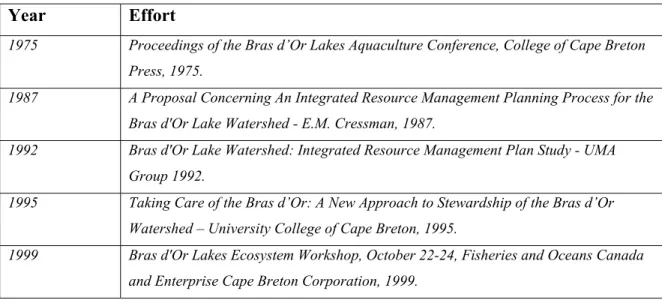
Table 3.1 summarizes the planning and management efforts that have taken place in the Bras d’Or over the past 30 years.
Table 3.1: Previous Planning and Management Efforts for the Bras d’Or
Year Effort
1975 Proceedings of the Bras d’Or Lakes Aquaculture Conference, College of Cape Breton Press, 1975.
1987 A Proposal Concerning An Integrated Resource Management Planning Process for the Bras d'Or Lake Watershed - E.M. Cressman, 1987.
1992 Bras d'Or Lake Watershed: Integrated Resource Management Plan Study - UMA Group 1992.
1995 Taking Care of the Bras d’Or: A New Approach to Stewardship of the Bras d’Or Watershed – University College of Cape Breton, 1995.
1999 Bras d'Or Lakes Ecosystem Workshop, October 22-24, Fisheries and Oceans Canada and Enterprise Cape Breton Corporation, 1999.
2001 River Denys Integrated Management Report, EastCoast Aquatics for Fisheries and Oceans Canada, 2001.
2001 Defining the Problem, The Pitupaq Committee, 2001.
2002 Sustainability Issues: Bras d’Or Region – Final Report, EastCoast Aquatics for the Sustainable Communities Initiative, 2002.
2003 Collaborative Planning Initiative, Bras d’Or Lakes Workshop Proceedings, 2003. 2004 Collaborative Environmental Planning Initiative, Bras d’Or Lakes Workshop
Proceedings, 2004.
2005 Barrington, S. Developing a Strategic Action Plan for the River Denys Basin Watershed, Masters Thesis. School for Resource and Environmental Studies, Dalhousie University, 2005.
2005 Sustainable Communities Initiative, Bras d’Or Field Team Report on Community Meetings, 2005.
The following boxes, as presented in chronological order, provide further detail on many of the efforts to both identify environmental issues within the Bras d’Or and propose methods to better address them. Included within each table below is a summary of the overall effort, the environmental issues identified, the actions proposed, and the apparent outcomes. Further tables are provided that summarize the environmental issues, their relationships, and pathways of effect.
The Proceedings of the Bras d’Or Lakes Aquaculture Conference, College of Cape Breton Press, 1975.
Summary:
A large multi-day conference was organized by the Bras d’Or Institute (of the College of Cape Breton) and the Atlantic Provinces Inter-University Committee on the Sciences, to develop a comprehensive picture of aquaculture in Altantic Canada and to discuss major concerns and problems which need more attention. Specifically the conference hoped to exchange scientific and technical information, report research results, and identify problem areas where more research must be done. The conference also hoped to explore how science and technology can relate to other aspects of the aquaculture business and learn what each interest group plans to do in the immediate future. Approximately 190 researchers, industry, and government staff attended this event with a strong focus on the Bras d’Or Lakes including calls for Coastal Zone
Management to help protect potential aquaculture operations.
Environmental Issues Identified:
In addition to specific technical issues associated with aquaculture, the workshop also discussed the following environmental issues:
Sewage from boats, campgrounds, outhouses, etc. Lack of effective land-use planning
Mining (gypsum)
Potential mining of metallic deposits Siltation
Potential petroleum development Pulping operations
Actions Proposed:
Two recommendations were made with respect to the Coastal Zone Management aspect of the discussion during this conference:
That the province of NS define the Bras d’Or coastal zone by its watershed limits rather than some fixed distance from the coast.
That the Bras d’Or Lake is considered a special management area because of its character and current rapid expansion of aquaculture. It should also be given special consideration as a pilot area for aquaculture.
There were also two resolutions introduced and passed relating to:
A clearing house be established to make all scientific data available to any interested parties Holding another workshop to exchange information between scientists and marine farmers.
Outcomes:
Uncertain
A Proposal Concerning An Integrated Resource Management Planning Process For The Bras d'Or Lake Watershed - E.M. Cressman, 1987
Summary:
This study provided a good outline of what an overall integrated resource management planning process should include for the Bras d'Or Lakes, including important principles to follow. It recognized the need for high levels of federal and provincial support and commitment before the actual planning process could begin, and a similarly high level of approval of a final plan. While the overall objectives of the process were defined as “ensuring the long term social and economic well being of the people of the planning area”, the focus was directed at the co-ordination of land and water uses.
Environmental Issues Identified:
Water quality / lack of sewage treatment Siltation of streams
Actions Proposed:
An organizational/governance framework to undertake planning was proposed which included: A federal/provincial agreement be reached to provide the basis for planning in the Bras d’Or Watershed before any efforts are undertaken;
A Steering Committee of senior federal and provincial representatives be established to direct the planning team as necessary;
A Local Advisory Committee be established to advise the Steering Committee (consisting of representatives of the municipalities, First Nations, and others);
A small (two planners and one support staff) Planning Team be assembled to conduct the planning process and produce a plan;
A Plan Management Team (including at least one Planning Team member and others from lead agencies) be established to implement, monitor and revise the plan as necessary.
Outcomes:
No direct outcomes
Bras d'Or Lake Watershed: Integrated Resource Management Plan Study - UMA Group 1992.
Summary:
A consultant was contracted by the Bras d'Or Institute at UCCB to prepare the following for implementing an integrated resource management program for the entire Bras d'Or:
Information Base Planning Framework Public Information Program Management Structure
This work was directed by a Task Force including representatives from: NSDOE, DFO, EC, ECBC, Bras d'Or Institute, Grand Narrows District Board of Trade, and the Highland Heights Inn.
As part of the Information Base, Development Issues and Opportunities were presented that included: Environmentally sensitive development opportunities and constraints (based on interviews with industry, community, special interest groups, and government officials)
Description of the current and projected economic conditions in the watershed
Economic and demographic indicators for various conditions in 11 sub-areas of watershed
Environmental Issues Identified:
Water Quality;
Impacts from renewable and non-renewable resource extraction
Actions Proposed:
The last section of the report provided a brief overview of a potential Planning Framework. It included: The overall objective ("To manage the watershed to meet the future demands of a growing economy while maintaining the health and productivity of the watershed's natural environment") and a number of objectives under which it should operate (including, "working within the statutory restrictions of existing government departments and agencies.")
A description of a Public Information Program
A description of a Management Group whose functions included:
A referral role to ensure the effective flow of information and maintenance of information systems, permit existing agencies to make more informed and timely decisions with a wider base of public, special interest group and private sector input.
Coordinate the collection and referral of information between the various and necessary jurisdictions in the watershed
Ensure that environmental and integrated resource planning aspects of development projects or resource activity are considered in the approval process.
No direct outcomes
Taking Care of the Bras d’Or: A New Approach to Stewardship of the Bras d’Or Watershed – University College of Cape Breton 1995.
Summary:
Enterprise Cape Breton Corporation (ECBC) funded the University College of Cape Breton (UCCB) to undertake a study looking at developing a new management system for the Bras d’Or Lakes. An Advisory Committee of several community leaders was formed. The group consisted of stakeholders from around the Lakes, representatives of UCCB, and a staff person each from the provincial and federal government. The report and approach proposed was endorsed by the First Nations Chiefs of Cape Breton.
A preliminary round of public consultations occurred at Baddeck, Eskasoni, Iona and St. Peter’s to identify issues and concerns regarding the watershed and its management. The two major issues identified were protecting water quality in the Lakes, especially from human sewage, and improving public access to the Lakes.
The roles of the community based management system for the Bras d’Or Lakes watershed were articulated, including
Promote public awareness of the environmental, social and cultural values of the watershed and importance of personal stewardship
Promote the programs and activities that support sustainable development of the watershed Plan for the controlled development and protection of the watershed
Provide a mechanism to coordinate government review and control of selected activities within the watershed
Monitor activities within the watershed Inform the public on the watershed Advise governments where necessary
Environmental Issues Identified:
Water Quality (especially from sewage)
Actions Proposed:
It was recommended that a Steering Committee, appointed by the Government of Nova Scotia in consultation with community leaders in the watershed establish a Commission. The Commission would have one member (locally elected) for each of seven geographic areas represented by major river basins (all voting), five members from each of the Mi’kmaq bands selected by each Chief (all voting), and four members from each of the municipalities, and one member each from the provincial and federal governments (non-voting).
Responsibilities for the Commission were detailed to be:
Development of Action Plans to address urgent and high priority issues; Drafting a Charter for the Bras d’Or Lakes watershed;
Planning for the future development and use of land and water resources; Promotion and Public Education;
Management for sustainable development, including an inventory of resources and values, setting of objectives, and cooperative decision making with government agencies;
Enforcement, including compliance monitoring, reporting and laying of charges; Public reporting; and,
Periodic review and adjustment of the watershed plan.
The Commission was intended to be a “one-window” agency that would expedite inter-agency cooperation and not be another layer of government. Achieving this was proposed through an appropriate delegation of authority for specified activities and a transfer of resources from federal, provincial and municipal
governments. The Environment Act (Bill 115, Section 105) was considered to provide the necessary legislative authority for the Minister of the Environment to assign responsibility for watershed management to organizations such as the Commission.
A number of final recommendations were made, including:
That the federal and provincial governments undertake surveys to determine the sources, types, extent and severity of water pollution in the Lakes;
That the government of Nova Scotia take the legislative steps required to establish the Commission with a specific mandate, authority and responsibilities;
That the federal government coordinate discussions among federal, provincial, municipal and First Nations to transfer the required authority to the Commission;
That UCCB and the five Cape Breton Bands develop programs to increase the technical abilities of the Mi’kmaq people;
That UCCB and the First Nations Bands conduct public information sessions to explain the Commission to the public;
The Commission, once established, give immediate attention to: Drafting Charter
Drafting plan for sustainable development
Determine the health of the natural resources to establish safe conservation standards Develop a remedial action plan to eliminate the discharge of sewage into the Lakes Address the issue of public access to the Lakes
That UCCB work with the Commission to provide knowledge and technical services, information technology, public education, research, etc.
That UCCB and the Cape Breton Chiefs be asked to serve as a Secretariat for the proposed Commission; and,
That the Commission arranges an independent audit of its effectiveness and performance.
Outcomes:
No direct outcomes were achieved, as a Commission with delegated authority was not established. The issue of delegating authority to another management body was determined to be unfeasible.
Bras d'Or Lakes Ecosystem Workshop, October 22-24, 1999, Fisheries and Oceans Canada and Enterprise Cape Breton Corporation.
Summary:
The main objective of this workshop was to determine the scientific priorities for the Bras d'Or Lakes and their watershed so that ecosystem considerations can be incorporated into any future integrated
management plans for the area. This workshop was organized by the Department of Fisheries and Oceans and the Enterprise Cape Breton Corporation and sought the input from First Nations, schools, universities, community organizations, industry and other government organizations at the federal and provincial level. This was to be done in the context of the recently passed Oceans Act (1997) and its programs, including Integrated Management.
Environmental Issues Identified:
Water Quality Siltation Benthic Habitat Physical Oceanography Measuring of biological events Lake productivity
Inventories of baseline information Aquaculture monitoring
Fisheries catch information
Actions Proposed:
Group work was undertaken to assess issues and develop a series of proposals for action in the four main theme areas.
Outcomes:
A series of research programs were established to address the objectives from this workshop between, DFO, NRCAN, and the Eskasoni Fish and Wildlife Commission. Results of this research have been published in a volume of the NS Institute of Science and presented at a number of public meetings in the area.
River Denys Integrated Management Report, 2001. EastCoast Aquatics for Fisheries and Oceans Canada.
Summary:
This report contracted for the Department of Fisheries and Oceans, proposes a scientifically based management system for the Denys Basin watershed focused on the freshwater streams and estuary. Different aspects of the watershed ecosystem were chosen for examination (water quality, sediment sources, etc.). The conditions of these components were then evaluated, primarily by examining aerial photos and from other studies in the area. Areas potentially impacted by human activity were identified. Target levels were then established for these ecosystem components and relevant indicator species. Atlantic Salmon, Brook and Brown Trout were selected for the freshwater streams, and American Oyster and Winter Flounder were selected for the Denys Basin itself.
Management actions would be necessary when target levels for the indicator species are impacted from their normal range (e.g. water temperature, turbidity, etc.). This method requires that specific environmental parameters be monitored to ensure that they fall within the target levels for the various indicator species.
Environmental Issues Identified:
Mining Logging ATV use Agriculture Shoreline development Gravel extraction Sewage
Actions Proposed:
A series of potential actions related to each ecosystem component were developed and prioritized. Based on the information assessed, a reduction in fecal contamination from farmland and residential sources is required to achieve shellfish openings. Significant stream habitat and riparian improvements will be required in order to re-establish nutrient cycling and fish populations. Finally, sediment sources will need to be stopped in the mid to lower portion of the watershed to stop the ongoing impact to both freshwater and estuary habitat. The top actions recommended in this report therefore were: reduce fecal coliform impacts, stop sediment sources, restore stream habitat and riparian zones, and develop guidelines for shoreline development.
Outcomes:
This work has been built upon, including gathering public input, in the development of a sub-watershed management plan for this area. Some restoration activities have taken within this area to decrease sediment sources and restore stream and riparian habitats.
Defining the Problem, 2001, The Pitu’paq Committee. Summary:
In July 2001 the political leaders of the five municipal units in Cape Breton came together to discuss the state of the Bras d’Or Lakes with respect to sewage contamination and to develop a plan of action. Several concerns were identified including those related to enforcement, tracking and management of on-site systems, and the need to address all potential sewage sources (on-site, boating, central treatment systems). As a result of this discussion, the municipal units identified ten commitments on their part, and ten reciprocal commitments that would be required on the part of provincial and federal governments. The Pitupaq Committee committed to:
View the sewage management issue affecting the Bras d’Or Lakes from three perspectives: Sewage treatment plants, on-site sewage disposal systems, and boating.
Act as a unified body to develop a plan for implementation and seek funding to support it - i.e (MOU among municipalities and First Nations).
Identify priority areas where on-site sewage disposal systems are malfunctioning. Co-operate with the responsible regulatory agencies to perform a current audit of sewage treatment plants and provide an action plan to address any identified deficiencies. Ensure treatment plant operators receive all required training.
Recommend to government agencies the regulatory changes they feel are required to ensure the health of the Bras d’Or Lakes with respect to sewage.
Ensure on-going education and awareness of the public with respect to the care and maintenance of on-site sewage disposal systems.
Public education directed at the risks associated with the dumping of raw sewage into the Bras d’Or Lakes from recreational and other marine craft.
Review and establish, where applicable, "Deed Transfer Regulations" which will provide for upgrading of on-site sewage disposal systems at the point of a property sale.
Commitment to create "waste management districts" to manage pump-out and on-going maintenance and repair of on-site sewage disposal systems with a view to stimulating private sector growth in this area while ensuring environmental protection.
By fall 2001, the five First Nation communities in Cape Breton became partners in this process.
Sewage from on-site systems
Sewage from faulty treatment systems Sewage from boats
Actions Proposed:
Participated in process to have Bras d’Or lakes designated as a non-discharge zone for sewage from marine vessels under the Canada Shipping Act in partnership with the Bras d’Or Sustainable Communities Initiative.
The current workplan (2007/08) of the Pitu'paq Committee consists of efforts directed at:
Whycocomagh Sewage Treatment Plant (assessing suitability of current system and potential for new system)
Certificates of Status at Point of Sale (assess potential to implement a system relating to condition of on-site septic system when a property is sold).
Green Municipal Fund Application (a proposal for funding to assess and evaluate sites for potential Wastewater Management Districts)
Joint Enforcement Team/Public Awareness CSA Designation (to ensure enforcement and public awareness requirements of the Canada Shipping Act designation are met)
Chapel Island Mission (develop a plan to help address sewage issues associated with annual Mission Day events)
Chapel Island Sewage Lagoon (assess status of sewage management system)
Outcomes:
The Lake was designated as a non-discharge zone for sewage from marine vessels in 2006. Joint patrols in Bras d’Or for one week in August to inform boaters of impending changes relating to the discharge of sewage.
Sustainability Issues Bras d’Or Region: Final Report, 2002. EastCoast Aquatics for the Sustainable Communities Initiative.
Summary:
A report was commissioned by the Nova Scotia Sustainable Communities Initiative to synthesize issues identified through forty-two planning reports, studies, public meetings and community workshop reports in the Bras d’Or Lakes area that involved community consultation and input. The issues identified were considered to be complex enough to warrant multiple partnerships, shared resources and in-depth planning and approaches.
Environmental Issues Identified:
Disposal of sewage into lakes
Erosion and siltation from forestry roads Water contamination
Declining fish stocks
Actions Proposed:
None, just a review of issues.
Outcomes:
Public consultation sessions were held to confirm identified issues.
Collaborative Planning Initiative, 2003 Bras d’Or Lakes Workshop Proceedings. Summary:
A workshop was held to develop a common understanding and approach among the three levels of government and First Nations to advance an overall environmental planning and management initiative for the Bras d’Or Lake and its watershed. This was done to address the present and future well being of the Lakes and the communities surrounding them. This workshop was held to begin the process to ensure that existing efforts are coordinated and supported, so problems can be addressed. The focus of the discussion was on the process of working together (collaboratively) to address the many issues present, rather than the specific environmental issues themselves.
Environmental Issues Identified:
Invasive Species
Actions Proposed:
Continue to seek involvement of government partners and engage broader public into this process. Support the Unama’ki Institute of Natural Resources (UINR) to help coordinate efforts toward the development of an overall management plan for this ecosystem.
Outcomes:
Agreement among government and First Nation partners to work together to advance initiative, engage broader public and support UINR to coordinate efforts.
Collaborative Environmental Planning Initiative, 2004 Bras d’Or Lakes Workshop Proceedings.
Summary:
The 2004 workshop was to engage citizens into the process of planning for the the Bras d’Or Lakes and ecosystem that was begun the previous year among government and First Nation leaders. During the workshop participants learned about the challenges facing the Bras d’Or through presentations on water quality, invasive species, land development, and forestry. The workshop discussed several initiatives which are taking place in the Bras d’Or including that of the Sustainable Communities Initiative, the Pitu’paq Committee, Science for the Integrated Management of the Bras d’Or Lakes, and the Unama’ki Institute of Natural Resources. Participants developed a vision for a healthy, sustainable Bras d’Or and then described areas where action is needed to achieve the vision. Participants then developed a range of potential actions related to the issues.
Environmental Issues Identified:
Water quality Forestry
Land based development Fisheries
Invasive species Climate change
Actions Proposed:
A wide range of potential actions were identified related to the issue areas and other areas of emphasis.
Outcomes:
Broader community more aware of Collaborative Environmental Planning Initiative. A wide range of priorities/actions have been developed for inclusion in overall management plan.
Barrington, S. 2005. Developing a Strategic Action Plan for the River Denys Basin Watershed – Masters Thesis, School for Resource and Environmental Studies, Dalhousie University.
Summary:
This work developed a draft environmental Action Plan for this area based on the conditions present and the views of all local residents. This work began by reviewing previous studies and information on this area to create socio-economic and ecological overviews. Local residents were contacted to capture their
knowledge and concerns. Assessing the local information from residents was important to supplement the published information and to ensure that the draft Plan was based on the characteristics and concerns of the whole community. A detailed questionnaire was sent to all permanent and seasonal homeowners (over 300 homes) and interviews were conducted with a range of residents in the area to ensure representative views from the whole area were considered in developing the draft Action Plan.
Environmental Issues Identified:
Sewage Drinking water
Chemicals (landfill dumpsites) Biodiversity
Decline in fish stocks Sedimentation Clearcutting Invasive species
Actions Proposed:
The Action Plan outlined a number of potential actions to take to address the various conditions and issues raised during the research phase of the study. Nine different groups of actions were proposed ranging from those that were of high importance and easy to implement to those that were of varying degrees of
importance and ease of implementation.
Outcomes:
Results of this work and previous work were presented to the community to identify priority actions. Based on this, a number of detailed action plans were developed within the final Denys Basin Sub-Watershed Management Plan.
Sustainable Communities Initiative, 2005. Bras d’Or Field Team Report on Community Meetings.
Summary:
The Bras d’Or Field Team of the Sustainable Communities Initiative held a series of community meetings throughout the Bras d’Or watershed during 2003 and 2004. Nine community meetings were held with five of them taking place in First Nation communities. The goals of the meetings were to introduce the SCI concept and the Bras d’Or Field Team to the communities and to validate the results of the sustainability issue research conducted by EastCoast Aquatics in 2002. A range of themes were explored that including culture and heritage, women, transportation, social services, development/economy, natural resources, etc. After reviewing the issues described in the EastCoast Aquatics research, participants were given the opportunity to add and then prioritize the issues under each theme area.
Environmental Issues Identified:
Sewage Water quality Declining fish stocks Forestry practices Land development Invasive species
Actions Proposed:
None, as the intent was only to confirm and prioritize issues.
Outcomes:
A “Natural Resources” task team was struck by the Bras d’Or Field Team of the SCI to examine several of the environmental issues.
Based on the review of these efforts, it is apparent that much time and effort has been directed at studying, consulting on and examining issues within the Bras d’Or area. A number of workshops, studies, discussions, and consultations have taken place in the Bras d’Or to identify issues and propose solutions over the past several decades. There has also been considerable thought put into developing management systems to address
these issues; the last formal one proposed but not adopted in 1995. However, there appear to be few direct outcomes related to addressing the environmental issues identified, with many of the same issues being identified as concerns over this time period. While it may not be possible to determine exactly why further progress against these issues was not made, several challenges appear to have existed for doing so. These challenges relate to the complexity of jurisdictions involved, the need for dedicated staff to oversee a planning and management process, the need for senior level buy-in to broad management approaches, and inabilities to transfer legislative authority to new
management bodies. These issues may also require substantial financial resources committed to be fully addressed. Many of these challenges, and the requirements to overcome them, have been proposed as actions in these previous efforts that described new management systems. Table 3.2 below highlights what may be needed to better address the issues identified. Although the direct outcomes from some of these previous efforts were not apparent, it should be considered that they may have had more indirect outcomes by influencing the need and direction of efforts that followed them.
Table 3.2 Summary of Recommendations for Improved Management from Previous Planning and Management Efforts
Reference Recommendation for Improved
Management
The Proceedings of the Bras d’Or Lakes
Aquaculture Conference, College of Cape Breton Press, 1975.
Use the entire watershed for management planning considerations
A Proposal Concerning An Integrated Resource Management Planning Process For The Bras d'Or Lake Watershed - E.M. Cressman, 1987
Ensure high level support for planning from federal and provincial governments before efforts are underway
Establish an organizational and governance framework to undertake and oversee planning
Ensure dedicated planners are available to undertake planning process
Bras d'Or Lake Watershed: Integrated Resource
Management Plan Study - UMA Group 1992. Include a public information program Establish a management group to ensure more integrated resource management decisions are made based on a wider base of input
Taking Care of the Bras d’Or: A New Approach to
University College of Cape Breton 1995. Nation members from each Band Develop a Bras d’Or Charter
Ensure promotion and public education Have secretariat function for Commission be served by local university and First Nation Chiefs.
Work within existing legislative authorities.
Summary of Environmental Issues:
In addition to providing a number of recommendations for improved management, the history of previous planning and management efforts in the Bras d’Or also provides a good review of the environmental issues identified for this area. Table 3.2 provides a summary of these environmental issues identified in the Bras d’Or based on the previous planning studies and efforts.
Table 3.3 Summary of Environmental Issues
Reference Environmental Issues
College of Cape Breton Presss, 1975. Proceedings of the Bras d’Or Lakes Aquaculture Conference.
Sewage from boats, campgrounds, outhouses Air pollution
Mining
Pulping operations Siltation
Cressman, 1987. A Proposal Concerning an Integrated Resource Management Planning Process for the Bras d’Or Lake Watershed.
Water quality
Lack of sewage treatment
Siltation of streams (road construction, logging) Development
UMA Group, 1992. Bras d’Or Lake Watershed: Integrated Resource Management Plan Study.
Water quality
Impacts from renewable and non-renewable resource extraction
University College of Cape Breton,
1995. Taking Care of the Bras d’Or. Water quality impacts from human sewage Department of Fisheries and Oceans and
Enterprise Cape Breton Corporation, 1999. Bras d’Or Ecosystem Workshop.
The need for scientific information related to: Water quality
Siltation Benthic habitat Physical oceanography Measuring of biological events Lake productivity
Inventories of baseline information Aquaculture monitoring
EastCoast Aquatics, 2001. River Denys
Integrated Management Report. Mining Logging ATV use Agriculture
Shoreline development Gravel extraction Sewage
The Pitu’paq Committee, 2001.
Defining the Problem. Sewage from on-site systems Sewage from faulty treatment systems Sewage from boats
EastCoast Aquatics, 2002. Sustainability Issues: Bras d’Or Region: Final Report. Prepared for the Bras d’Or Field Team of the NS Sustainable Communities Initiative.
Disposal of sewage into lakes
Erosion and siltation from forestry roads Water contamination
Declining fish stocks
Collaborative Planning Initiative, 2003. Bras d’Or Lakes Workshop
Proceedings.
Invasive species
Collaborative Environmental Planning Initiative, 2004. Bras d’Or Lakes Workshop Proceedings. Water quality Forestry Land-based development Fisheries Invasive species Climate change Barrington, S., 2005. Developing a Strategic Action Plan for the Denys Basin Watershed – Masters Thesis, School for Resource and Environmental Studies, Dalhousie University.
Sewage
Chemicals (landfills, dumpsites) Declining fish stocks
Sedimentation affecting fish and oyster habitat Clear-cutting
Drinking water Invasive Species Biodiversity Erosion from roads Sustainable Communities Initiative
(SCI), 2005. Bras d’Or Field Team Report on Community Meetings.
Sewage Water quality Declining fish stocks Forestry practices Land development Invasive species
Based on the various documents reviewed above, there has been range of issues identified for the Bras d’Or over the past thirty years. Several of the environmental issues identified in previous years such as sewage and siltation remain, while new ones such as declining