chapter 39
Contracting for pharmaceuticals and services
Summary 39.239.1 Overview of contracts 39.2
39.2 Critical contract terms in pharmaceutical procurement 39.3
Trade terms • Financial capability • Purchase quantities • Exchange rates and price comparisons • Payment currency • Validity of contract prices • Payment terms • Quality standards • Manufacturing approvals • Labeling and nomenclature • Packaging • Shelf life and expiry date • Bid bonds and performance bonds • Experience • Shipment date • Patent provisions • Penalties for default
39.3 Contracts for services 39.11 39.4 Feasibility assessment 39.11
Comparative cost • Total cost analysis from the supply chain perspective • Private-sector capacity • Performance indicators to compare options and monitor contracts 39.5 Developing a contract for services 39.14
Identifying qualified providers • Developing the service contract and managing the tender • Conducting and adjudicating the tender • Monitoring the contract References and further readings 39.16 Assessment guide 39.17
illustrations
Figure 39-1 Contract terms must be fully specified 39.4 Table 39-1 Summary of common trade terms in the 2010
Incoterms 39.5
Table 39-2 Bid comparison according to currency conversion rate 39.6
box
Box 39-1 Pharmacy benefit programs 39.3
country studies
CS 39-1 Public-private health services contracting experience in Cambodia 39.12
CS 39-2 Using innovative contracting to address regional challenges in Papua New Guinea 39.13
annexes
Annex 39-1 Sample conditions of bid document from Papua New Guinea 39.18
Annex 39-2 Sample pharmaceutical supply contract 39.20
copyright © management sciences for health 2012
38 Planning for pharmaceutical management 39 Contracting for pharmaceuticals and services 40 Analyzing and controlling pharmaceutical expenditures 41 Financial planning and management
42 Planning and building storage facilities Organization and management
Information management Human resources management
39.1 Overview of contracts
A health system is responsible for ensuring a continuous supply of high-quality goods and services to its clients at an affordable cost. This responsibility does not mean, however, that the organization needs to manufacture the supplies or provide all the services itself. Nevertheless, an argument is made—especially in developing countries—that the gov-ernment should be responsible for the effective and efficient functioning of the entire national supply chain, regardless of whether individual components are managed by govern-ment agencies or by the private sector. in most health sys-tems, pharmaceuticals and medical equipment are routinely supplied by private companies. increasingly, the storage and distribution of these goods are also being contracted out. industrialized countries often contract out the complete pharmaceutical program to serve designated categories of patients. Box 39-1 describes contracts for prescription services (pharmacy benefit programs). This chapter dis-cusses—
• Contracts for pharmaceutical procurement
• Contracts for the direct delivery of pharmaceuticals by suppliers
• Contracts for nonsupply services such as customs clearance, warehousing, and transport
• Assessment and monitoring of the quality and cost-effectiveness of contracts
Contracting for services is also discussed in Chapters 24 (port clearing), 25 (transport management), and 42 (ware-house construction).
The essential first step in contract management is to decide whether an outside contract is desirable. The author-ity whose budget will cover the cost of the contract must make this decision, considering its impact on the entire health system—not on only one specific component. For example, in an environment of government inefficiency, outsourcing pharmaceutical distribution to a contractor may actually save costs, but may also justify a higher expen-diture, if distribution services are more effective under the contractor and stock levels improve.
Producing supply items such as pharmaceuticals and other health care goods in-house is usually too expensive or impractical. Services, however, are different, and the total cost and performance of an in-house service as compared with a contracted service needs to be assessed. Furthermore, the choice is not a one-time decision. Regular monitoring of A contract for goods or services is a legally binding
agreement between a purchaser and a provider for a specified period of time. in the public sector, the pur-chaser is usually the government and the provider may be a private-sector company.
Some health systems contract out (outsource) customs clearance, pharmaceutical storage, procurement, and transport. in some cases, a health system may contract out pharmaceutical services through retail or not-for-profit pharmacies. Outsourcing services can, in some cases, reduce costs and improve effectiveness. The deci-sion whether to contract out or to provide services in-house must rely on a careful analysis of the effect on the entire supply chain, including costs, performance, the capacity of the private sector to provide the goods and services in question, and the capacity of the health sys-tem to monitor the contract. Outsourcing is most likely to succeed when real competition takes place, the health system is equipped to supervise the contract, and suffi-cient funds are available to pay the contractor.
This chapter considers—
• Pharmaceutical procurement contracts: Careful preparation of specifications and enforcement of
contract terms are a must for efficient procure-ment.
• Service contracts: Such arrangements may reduce or eliminate the need to maintain government storage and transport infrastructure. in a supply agency con-tract, an autonomous private or parastatal agency operates warehousing and transport services on the government’s behalf. in a direct delivery contract, the supplier delivers to regional or district stores and hospitals. Under a primary distributor contract, health facilities order from a contracted distributor and pay the manufacturer’s contract price for the medicines plus a distribution fee. Pharmacy benefit management programs provide prescription ser-vices to designated beneficiaries, either in person at contracted pharmacies or through direct delivery (that is, via mail) from a central location.
• Service contracting process: The process of contract-ing for services has four stages: (1) identify a service that could be provided by contract and establish the feasibility of contracting out; (2) prepare detailed tender specifications and contract terms; (3) short-list suitably qualified contractors, invite formal ten-ders, and appoint a contractor; and (4) monitor the contractor’s and the health system’s performance.
the contracted service and annual comparison with an in-house alternative are necessary to confirm that outsourcing remains the most cost-effective option.
A contract for the provision of goods or services is a legally binding agreement between a purchaser (or buyer) and a provider (or seller) for a period of time specified. in the health system context, the purchaser is generally the gov-ernment or a public or private health care system, and the provider a private-sector company or parastatal entity. The responsibilities and interests of the purchaser and the pro-vider, as well as remedies to address any potential future dis-agreement between the parties, are defined by the contract terms and conditions. Pharmaceutical contracts should be established in a formal written document.
The contracting process usually starts with the prepara-tion of a tender document, which specifies the technical requirements of the goods or services required and the terms and conditions of the contract. Tenders are then formally invited and evaluated. The service agreement becomes bind-ing after a tender is accepted, a letter of acceptance is issued, the contract is signed by both parties, and, in some special cases, the contract is registered with the appropriate gov-ernment representative. if either party subsequently fails to comply with the contract, penalties are imposed. Clear and comprehensive technical requirements and contract terms and conditions are essential; otherwise, disputes may arise and the contractor may not perform as expected. Changes to a contract should be authorized only when technical
evi-dence supports the change or when the change will not sig-nificantly affect services provided.
The design, implementation, and monitoring of contracts must also take into consideration the issue of corruption. Contracts related to pharmaceutical management, and espe-cially procurement, are susceptible to corruption because the supply chain can be complicated and lack transparency, and because drug volumes are usually large and unit costs high, thereby making such contracts very lucrative for sup-pliers (Cohen 2002).
Established service contracts should be reviewed to ensure that their terms and conditions continue to address the required scope of work and that they comply with current legislation and that all parties are performing as agreed. Outsourcing may not be cost-effective if the qual-ity of the contracted service cannot be monitored and enforced.
39.2 Critical contract terms in pharmaceutical
procurement
The discussion of tender management procedures in Chapter 21 introduced issues related to supply contracts. Tender specifications include many of the conditions of contract performance. Normally, by submitting a bid, the prospective seller is agreeing to the proposed contract terms (unless the seller stipulates otherwise in writing on Pharmacy benefit management companies (PBms) have
emerged in industrialized countries as a way to con-tain health care costs by implementing mechanisms to improve the cost-effectiveness of prescription medicine programs. A PBm contracts with employers, insurers, and others to provide benefits to those groups’ members. Often the PBm is paid a fixed amount for which it must provide contracted services, either by itself or by subcon-tracting with others.
Full-service PBm functions can include the following— • Establishing networks of pharmacies for use by plan
members
• Processing claims electronically and maintaining a database on drug use and cost
• Encouraging the use of generic products
• managing existing formularies, helping to establish customized formularies, or providing a national formulary
• Encouraging prescriptions for maintenance medica-tions to be filled less frequently with larger amounts, often by mail order
• Negotiating volume-based rebates from manufac-turers
• Performing drug-use reviews
• Developing disease management programs based on standard treatment guidelines and assessments of patient outcome
PBm mechanisms for decreasing costs include imple-menting consumer cost-sharing to encourage the use of generic drugs, requiring prior authorization for certain prescriptions, and establishing multitiered formulary copayments. Although studies have shown that some mechanisms, such as tiered formularies and prior autho-rization do positively affect costs and medicine usage, lit-tle information is available on how these PBm programs affect health outcomes.
Source: Abt Associates 2010. Box 39-1
the tender submission). Care should be taken to ensure that the terms of the final contract match the terms specified in the tender or bid document. if any conditions are altered, the desired performance or price may be compromised or losing bidders may feel that they were disadvantaged in the contracting process and take legal action.
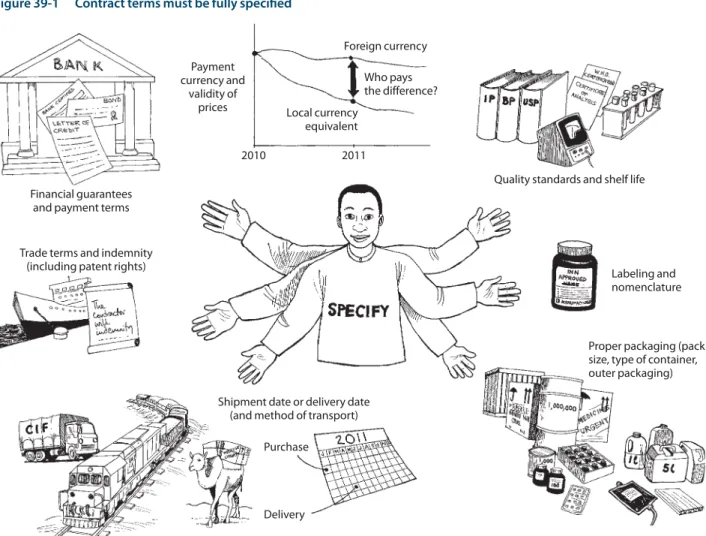
Although the tender documents specify the supplies and services expected, the purchaser and the provider should execute a discrete written contract. The most critical con-tract terms are discussed below (see also Figure 39-1).
Preparing an effective pharmaceutical procurement con-tract is a specialized function requiring a great deal of care. Critical details include the specification of the medicine; the quality standards required; analyses to be performed; batch records required; certificates of quality assurance that must be issued; the type of packing, documentation, lot numbering, and labeling requirements; return and dis-posal procedures and obligations; communication require-ments; shipment and delivery agreerequire-ments; the price and payment terms; and the last date of shipment. Again, the contract specifications should be consistent with those
pre-sented in the tender or bid document to ensure the fairness of the process. Failure by the supplier to comply with those requirements can cause substantial loss or extra expense to the buyer. From the supplier’s perspective, if the procure-ment office places a verbal order and subsequently refuses to confirm it or fails to pay for an order as agreed, the supplier will suffer loss or added expense. Thus, all orders should be requested in writing and signed by the authorized contract representative.
An interpretation or clarification of the various terms and conditions contained in a tender should become part of the overall tender document to avoid any ambiguity or conflict that may arise because of different interpreta-tions. Annex 39-1 shows a tender’s sample interpretation section. Questions should be solicited from the bidders at the beginning of the bid process. All questions and cor-responding answers should be distributed in writing to all prospective bidders, and written confirmation of receipt requested from each. Any additional questions that arise during the bidding process should be addressed in the same manner.
Figure 39-1 Contract terms must be fully specified
Payment currency and validity of prices Who pays the difference? Foreign currency Local currency equivalent
Quality standards and shelf life
Labeling and nomenclature
Proper packaging (pack size, type of container, outer packaging) Shipment date or delivery date
(and method of transport) Purchase
2010 2011
Delivery Trade terms and indemnity
(including patent rights) Financial guarantees
Trade terms
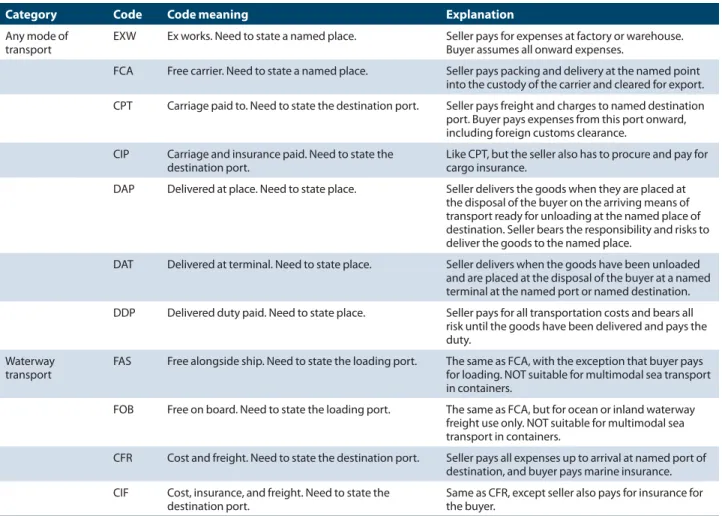
Trade terms are used in pharmaceutical supply contracts to define the division of costs and responsibilities dur-ing the shipment of commodities between the supplier and the buyer’s stores. Trade terms were standardized by the international Chamber of Commerce in 1953 when it first published Incoterms; these standards are reviewed and revised approximately every decade (international Chamber of Commerce 2010). Over the years, more precise defini-tions and new terms have been created to establish the exact point where the seller’s costs and responsibilities end and the buyer’s begin. However, old terms are still in common use, so it is important that both parties understand and agree on the contract terms. Table 39-1 summarizes the trade terms most commonly used for government supply programs. Procurement agencies should have a copy of the latest ver-sion of Incoterms.
The buyer usually specifies the applicable trade terms in the contract or tender document. The buyer must, therefore, understand the implications of various trade terms and the corresponding relative risks assumed by the buyer and the
seller in case of loss or damage. Of the trade terms listed in Table 39-1, CiP (carriage and insurance paid) is gener-ally preferable for pharmaceutical supply tenders. These terms make it easier to compare tender offers fairly and to budget for the true cost of products on the tender list. in cost-recovery programs, these terms also make it easier to determine the full replacement cost for each product. When using CiP terms, specifying precisely the final destination to which the cost of transport will be paid by the seller is essential.
in many countries, transportation routes are limited, and economical delivery of goods from overseas requires a detailed knowledge of these routes. if the chosen supplier is unfamiliar with local trade routes but the procurement office is knowledgeable about local routes, FAS (free along-side ship) or FOB (free on board) terms may be preferable, with the buyer making separate arrangements for shipping and insurance. According to FAS terms, the seller pays for packing and delivery to the place of loading. The buyer pays loading costs plus export customs and documentation charges. Under FOB terms, documentation charges are paid by the seller.
Table 39-1 Summary of common trade terms in the 2010 Incoterms
Category Code Code meaning Explanation
Any mode of
transport EXW Ex works. Need to state a named place. Seller pays for expenses at factory or warehouse. Buyer assumes all onward expenses. FCA Free carrier. Need to state a named place. Seller pays packing and delivery at the named point
into the custody of the carrier and cleared for export. CPT Carriage paid to. Need to state the destination port. Seller pays freight and charges to named destination
port. Buyer pays expenses from this port onward, including foreign customs clearance.
CIP Carriage and insurance paid. Need to state the
destination port. Like CPT, but the seller also has to procure and pay for cargo insurance. DAP Delivered at place. Need to state place. Seller delivers the goods when they are placed at
the disposal of the buyer on the arriving means of transport ready for unloading at the named place of destination. Seller bears the responsibility and risks to deliver the goods to the named place.
DAT Delivered at terminal. Need to state place. Seller delivers when the goods have been unloaded and are placed at the disposal of the buyer at a named terminal at the named port or named destination. DDP Delivered duty paid. Need to state place. Seller pays for all transportation costs and bears all
risk until the goods have been delivered and pays the duty.
Waterway
transport FAS Free alongside ship. Need to state the loading port. The same as FCA, with the exception that buyer pays for loading. NOT suitable for multimodal sea transport in containers.
FOB Free on board. Need to state the loading port. The same as FCA, but for ocean or inland waterway freight use only. NOT suitable for multimodal sea transport in containers.
CFR Cost and freight. Need to state the destination port. Seller pays all expenses up to arrival at named port of destination, and buyer pays marine insurance. CIF Cost, insurance, and freight. Need to state the
in general, sea freight cost is about 10 percent, and insur-ance about 1 percent of the FOB cost. Some buyers require that bidders provide both CiP or CiF and FOB prices to help determine whether shipping and insurance could be man-aged at a lower cost by the buyer. The eventual contract may also require that the FOB portion remain unchanged but that the CiP price be adjusted for actual freight and insur-ance costs. By this means the buyer can collect data on actual freight charges and compare costs under the different trade terms.
Financial capability
The bidder must submit documentary evidence demon-strating to the buyer’s satisfaction that the bidder has the financial capability to perform its obligations under the sup-ply contract if its bid is chosen. Such documentation should include the bidder’s financial accounts for the two most recently completed fiscal years.
Purchase quantities
The buyer may request tenders for either fixed or estimated quantities (see Chapter 21). The contract terms should spec-ify if estimated quantities represent a guaranteed minimum purchase or if there is no guarantee of quantities in the con-tract. The latter arrangement is standard practice in pharma-ceutical group-purchasing contracts in developed countries. From a supplier’s perspective, offering a specially discounted price for a quantity that is not a guaranteed purchase would not be beneficial. Price fluctuations of raw materials used in pharmaceuticals are such that suppliers tend to build higher buffers into their pricing structures, depending on the certainty of a purchase and the period over which they are expected to keep their prices valid.
Exchange rates and price comparisons
Often, bidding documents will require that bidders use a specified currency or currencies to express their bids. However, the international Bank for Reconstruction and Development (iBRD) guidelines for procurement (2010) suggest that if bidders are allowed to state their bids in the currency of their choice, in order to compare prices, all bid prices should be converted to a single currency selected by the buyer (local currency or fully convertible foreign cur-rency) and established in the bidding documents. Price comparisons can be based on the official rates of exchange prevailing on the day bids are opened, with the stipulation that if those rates subsequently change, the rates applicable at the time of the award of contract should be used. Table 39-2 illustrates how this rule would be applied to compare bids from four hypothetical suppliers. Whether or not the iBRD guidelines are used, the method for bid comparisons should be stated in the bidding documents.
The currency chosen for comparing bids can be a major influence on the award process. When bid evaluation is done in a currency within a high-inflation economy, price differences at the time of bid opening, the date of award, and the date of payment can be substantial. in such cir-cumstances, requesting bids in U.S. dollars or another com-monly accepted currency in international pharmaceutical trade, such as Japanese yen, British pounds, or the euro, may be advisable.
Payment currency
The contract must specify the payment currency, which should be the currency specified in the terms and condi-tions of the bid. The payment currency may be widely used in international trade or may be the supplier’s or buyer’s
Table 39-2 Bid comparison according to currency conversion rate
Value of bid in u.s. dollars
supplier Tender currency On date of bid submission opening bidOn date of On date of award On date of payment
A Euro 6.43 7.07 7.07 7.07
B Japanese yen 6.86 6.86 7.20 7.20
C U.S. dollar 7.14 7.14 7.14 7.14
D U.K. pound 7.57 7.57 7.19 6.84
Source: Westring (1985).
Note: Currency conversion rates used to evaluate tenders and guide awards should be consistent with the terms and conditions stipulated in tender/bid documents. The table shows how exchange rates could vary at different times in the bid invitation, submission, award, and payment process. Considering that bidders may submit their bids at different times before the specified closing date and that the buyer may delay the time between the award and the bid opening, the fairest process is to base the value of the bid on the conversion rate prevailing on the date of the bid opening. For example, on the date of bid submission, supplier A offered the lowest price (USD 6.43), but this offer was irrelevant because supplier B had the most favorable price when the bids were opened (USD 6.86). Sellers should not be held responsible for delays experienced on the part of buying agencies in evaluating bids, which can happen if a buying agency takes several months to determine an award. Therefore, although supplier A’s bid was the lowest on the date of the award, the value on the date of bid opening is the relevant one for bid selection. It would be purely speculative to attempt to anticipate changes in parity, which should be avoided in public procurement. Payment value should be based on the rate on the date of the bid opening, because that is the rate used to determine the award, and this process should be specified in the contract between the buyer and supplier. Problems can be reduced by specifying or limiting the currencies that suppliers can use when bidding.
own currency. if the buyer’s currency is used, a speculative risk exists for the supplier if the local currency is not freely convertible or if the conversion rate fluctuates significantly. many international suppliers either do not accept payment in local currency or include a “contingency factor” that raises prices.
When procurement offices can pay only in local currency, the need for a contingency factor may be avoided if the buyer is able to guarantee that payments will be converted into the supplier’s currency at the exchange rate prevailing when the contract was awarded.
Validity of contract prices
The validity period is the period of time after contract signing during which contract prices apply. The length of this period depends on the type of tender and contract. if the tender establishes a specific quantity to be shipped at a certain time, the bid prices are normally valid until the final shipment has been received by the buyer and pay-ment has been made. if the tender is based on estimated quantities with periodic orders, bid prices should be valid for a longer term. The standard in industrialized coun-tries is one year, although shorter and longer terms are sometimes required. As discussed in Chapter 21, in highly inflationary environments, it may be necessary to tender more frequently or include a price-escalation clause in the contract that adjusts prices for inflation at specific inter-vals (for example, quarterly). Such adjustments should be clearly specified; it may be useful to tie the adjustment to the actual rate of inflation or another economic indicator as reported by the national central bank or other authorita-tive source.
As previously discussed, the greater the supplier’s uncer-tainty regarding an actual purchase against a tender, the higher the risk factor the supplier builds into its pricing. To best protect themselves in an uncertain purchasing environ-ment, procurement agencies should consider undertaking a Pareto or ABC analysis and base their purchasing strate-gies on the items that comprise the bulk of their order value, rather than applying one rule for all items they purchase. (See Chapter 40 for an explanation of ABC analysis.) Payment terms
The contract must specify payment terms. Unless timely and secure payment is guaranteed, obtaining the best prices is difficult. many public-sector systems are either periodically short of funds or have a slow payment process. Suppliers generally require such supply systems to pay by irrevocable letter of credit, submitted before any shipments are made. Public-sector systems must realize that reputable suppliers conduct a risk analysis before submitting prices and that the supplier will usually build in a larger buffer if its experience
shows that the public system has continually delayed pay-ments.
Letter of credit. A letter of credit is an interbank docu-ment stating that a certain sum of money is available for the seller to claim from its bank as soon as it ships a con-signment and presents the required documents. A letter of credit generally involves a surcharge of 1 to 2.5 percent for the buyer. However, because it reduces the supplier’s credit risk, using a letter of credit can facilitate a better contract price offer. Contract agreements often allow for some price fluctuations caused, for example, by changes in freight and insurance costs. Accordingly, a supple mentary payment or refund may be necessary at the time of delivery.
Deferred payment (commercial terms). The buyer and the seller may contract for payment at the time of delivery (without a letter of credit), or payment may be deferred for a period of 30, 60, 90, 120, or 180 days. Both options are forms of credit buying, and the procurement office must be care-ful not to contract for more supplies than it can ultimately afford. if a country defaults on deferred payment terms, it may subsequently be forced to prepay or to pay solely by let-ter of credit or cash on delivery.
Deferred payment allows the buyer to retain use of funds for a longer period. in addition, it enables the buyer to withhold payment if the supplier provides substandard or incomplete deliveries.
When tenders are being evaluated, the cost of various pay-ment options should be carefully compared. Suppose two suppliers quote the same price. Supplier A requires a letter of credit to be submitted when goods are cleared from the port. Supplier B allows a credit period of 120 days from receipt of goods until payment. if the annual interest rate in the buyer’s country is 12 percent, this credit period represents a 4 per-cent savings compared with supplier A’s terms.
Quality standards
The contract terms should state that all pharmaceutical products are to be manufactured in conformity with rec-ognized pharmacopoeial standards. The most commonly used standards in pharmaceutical procurement are the lat-est editions of the British Pharmacopoeia (BP) or the United States Pharmacopeia (USP), but others, such as the European Pharmacopoeia (EA) or the International Pharmacopoeia (iP), may be appropriate in some circumstances. The major pharmacopoeias include specifications for most pharma-ceutical products, both raw materials and finished products in their final dosage form, organized by generic name (inter-national nonproprietary name, iNN), not by brand name.
As discussed in Chapter 21, the pharmacopoeial stan-dards should be specified in both the tender invitation and the contract. Suppliers should be required to state the phar-macopoeial standard applicable to each product offered. The contract should specify that batch certificates and the World
Health Organization (WHO) certificate of a pharmaceuti-cal product must be supplied for each product (see Chapter 19). in some procurement situations, it may be necessary to require that products and supplies be prequalified by WHO or approved by stringent regulatory authorities.
Manufacturing approvals
For each pharmaceutical product, tender conditions should specify that the bidder must attach the following documen-tation for evaluation—
• A copy of the product certificate authorizing the source facility to manufacture the particular pharma-ceutical product
• A copy of the statement of licensing status, which gives the source facility manufacturing authority
• A copy of the product license as issued for the export-ing country
• A copy of the product license as issued for the other countries (up to a maximum of five) in which the phar-maceutical is sold or distributed
• Copies of approval documents from WHO prequalifi-cation
• The product information
• A sample of the standard marking or label to be included on each dispensing unit
• An estimate of the percentage of capacity committed to other contracts
• A good manufacturing practices inspection certificate from the regulatory authority in the country of manu-facture (although WHO provides guidelines for the certification process, countries implement it through their drug regulatory authorities; therefore, the quality of GmP (Good manufacturing Practices) certification may be inconsistent)
Some health systems tender with commercial or nonprofit wholesale suppliers rather than manufacturers. The sup-pliers should provide the information and documentation (described above) required of the manufacturers.
Labeling and nomenclature
many otherwise identical medicines are marketed under several different brand names by multinational pharmaceu-tical corporations and by local enterprises (see Chapter 19). To avoid confusion in the selection, procurement, distribu-tion, and use of medicines, contract terms should require standard labeling for all products. General guidelines for labeling are as follows—
• The language for labeling should be clearly specified in the contract.
• All package labels should contain at least the following information—
– Generic name of the active ingredients – Dosage form (tablet, ampoule, vial)
– Quantity of active ingredient(s) in the dosage form – Number of units per package
– Batch number – Date of manufacture
– Expiry date (in clear language, not in code) – Pharmacopoeial standard
– instructions for storage
– Name and address of manufacturer
– “Not to be sold without a prescription” statement, if appropriate
– “Keep out of the reach of children” statement • The label on each ampoule or vial should contain the
following information—
– Generic name of the active ingredient(s) – Quantity of the active ingredient – Batch number
– Expiry date
– Name of manufacturer
• The full package label (as specified above in this list) should appear on the immediate container.
• Directions for use and precautions may be given in leaflets (package inserts). However, leaflets provide supplementary information and are not an alternative to labeling.
• For products requiring reconstitution before use (for example, powder for injection), instructions for the reconstitution should be on the label.
in some countries, unique identifiers are used to reduce theft and also to promote the essential medicines concept (see Chapter 43). However, such measures may increase cost.
Packaging
Proper packaging should be clearly specified in the tender documents and in the supply contract. General packaging guidelines are as follows—
• if pack size is important, it should be clearly speci-fied (for example, tablets and capsules packaged in amounts of 1,000; ampoules and vials packaged in amounts of 100).
• All packaging must be suitable for the climate zone and storage conditions in the destination country.
• Tablets and capsules should be packed in sealed, water-proof containers with replaceable lids that protect the contents against light and humidity. if individual
pack-aging for tablets or capsules is required, this condition must be stipulated. Tampering evidence requirements need to be specified.
• liquids should be packed in unbreakable, leakproof bottles or containers.
• Ampoules should preferably be one-ended and auto-breakable. Alternatively, packages should include an adequate supply of ampoule files to facilitate break-ing. light-sensitive products, such as ergometrine, should be packed in brown glass ampoules. individual ampoules should be packed in plastic or in cardboard trays (five to ten ampoules per tray) and trays in outer cartons (for example, 100 trays per carton).
• Containers for all pharmaceutical preparations should conform to the latest edition of an internationally rec-ognized pharmacopoeia (such as BP or USP). • Outer cartons should be of strong, export-quality
material able to withstand rough handling and the prevailing climatic conditions during transport and storage.
• if the receiving warehouse is equipped to handle pal-lets (see Chapter 44), the contract should require that cartons be shipped on pallets. The preferred pallet size should be specified. Additional security against theft and water damage is provided if pallets are shrink-wrapped in clear plastic.
• Each consignment must be accompanied by a detailed packing list, stating the number of cartons and the type and quantity of medicines in each carton. An outer carton should contain products with the same expiry date; this date should be printed on the carton as well as on the immediate containers. if required, outer cartons should also be labeled with a unique identifier (see Chapter 43), a commodity code, or both.
• Upon delivery, packaging becomes the property of the buyer.
• The supplier is responsible for replacing any packages and products found to be damaged at the point of delivery.
To ensure proper packing and labeling, suppliers—par-ticularly those that are new or unknown—should be instructed to submit samples along with their bids. By assess-ing and visually checkassess-ing the samples, buyers may avoid problems caused by poor packaging or labeling. Packaging specifications for medicine kits are discussed in Chapter 26. Shelf life and expiry date
Pharmaceutical products have varying shelf lives. The expiry date is specified by the manufacturer at the time of manufac-ture and can range from six months to more than five years. Supply contracts should specify the required minimum shelf life remaining at delivery for all pharmaceutical
prod-ucts. Because of the length of time required for local distri-bution, it is advisable to include a general condition that, at the time of arrival, at least two years of shelf life should remain. For products with a shelf life of less than two years, at least 75 percent of the shelf life should remain upon arrival.
Because the same generic products from different manu-facturers may have different shelf lives, suppliers should specify the shelf life for every product in their bids so that the procurement office can consider shelf life when evaluat-ing bids.
Bid bonds and performance bonds
in international trade, ascertaining the reliability of suppli-ers is sometimes difficult. To encourage supplisuppli-ers to live up to their obligations, financial guarantees may be required.
Bid bonds are earnest money or security deposits in the form of cash, certified check, bank draft, state bond, or other negotiable bank document (equal, for example, to 1 per-cent of the value of the offered bid) that are provided by the potential supplier at the time a bid is submitted. This secu-rity is forfeited if the successful bidder withdraws the offer or refuses to agree to the contract requirements. Bid bonds are refunded when the award is announced and all suppliers have accepted the contract terms. World Bank pharmaceuti-cal standard bidding documents recommend the use of bid bonds and performance bonds (World Bank 2008).
Performance bonds are security deposits in the form of negotiable fiscal documents that may be required at the time a contract is awarded. Their purpose is to guarantee that the supplier fulfills the contract obligations. An amount equiva-lent to 5 to 10 percent of the contract price is often used for this purpose. The deposit is separate from documenta-tion involved in the letter of credit and is returned only after goods have been received in the country and are found to meet all contractual standards and to be of acceptable qual-ity. The World Bank specifies a performance bond set at an amount stated in the contract, posted as a cashier’s check or irreversible letter of credit within twenty-eight days of contract award. The performance bond is released after the contractual requirements have been fulfilled (World Bank 2008).
Both bid and performance bonds provide protection for the buyer against supplier default. The potential finan-cial risk, however, may drive away many potential bidders, including some reliable international companies. For exam-ple, when the banking system of the purchasing country is poorly integrated into the international banking system, retrieving a performance bond after the contract is com-pleted may be difficult.
As an alternative to requiring bonds, the risk of supplier default can be reduced by inviting tenders only from suppliers of known reliability. it is not uncommon for
pharmaceutical procurement programs to require financial guarantees only from new or previously unreliable suppliers.
Performance bonds are particularly unappealing to sup-pliers in a tender that calls for “draw-down” by purchasing group members, in which the tender quantity is just an esti-mate and orders are placed throughout a contract period. in such cases, the supplier would presumably lose access to the performance bond funds for the entire contract period; most established pharmaceutical companies would not be interested in such a contract. Despite these reservations, performance bonds may be warranted in fixed-quantity open tenders with postqualification, where many bidders and suppliers may be largely unknown entities.
Experience
The bidder should provide documentary evidence accept-able to the purchaser—including sales figures for at least three years—to prove that it is a regular supplier of pharma-ceuticals to the domestic and international markets under the specific type of tender involved.
Shipment date
For fixed-quantity contracts, the contract and the letter of credit (if used) should specify the last date by which the supplier is to ship the consignment. The implication of this requirement is that the bill of lading (the standard ship-ping documentation) issued by the shipship-ping company and signed by the master of the carrying vessel must be dated on or before the last date of shipment specified in the letter of credit.
The bank that holds the letter of credit is prohibited from accepting a bill of lading dated after the last date for ship-ment under the contract unless the buyer has agreed to the delay and the letter of credit has been suitably extended. if orders are covered by import licenses, an extension from the appropriate office may also be needed.
in contracts based on estimated quantities with periodic orders during the contract, the contract should specify the maximum number of days between the receipt of an order by the supplier and the shipment of goods.
Patent provisions
in countries that recognize patent laws, most new phar-maceutical products were originally covered by patent for periods ranging from two to seventeen years. Since 1994, World Trade Organization (WTO) members have been obligated under the Agreement on Trade-Related Aspects of intellectual Property Rights (TRiPS) to recognize twenty-year patent periods. During this period, no seller may manu facture or market a patented product without the con-sent of the patent holder.
Each country’s policy regarding patent rights is governed by legal, political, and economic considerations, both local and international. if the country is a WTO member, it may be obligated by the TRiPS agreement, or it may be restricted by intellectual property conditions within bilateral trade agreements. The Declaration on TRiPS and Public Health (Doha Declaration) gives developing countries some flex-ibility in adhering to TRiPS, enabling them to take steps to protect the public health of their populations. least-developed countries have been given until at least 2016 to comply with pharmaceutical patent requirements. Chapter 3, on intellectual property and access to medicines, details the issues surrounding pharmaceutical patents and the TRiPS agreement.
Purchasing countries must decide which patent laws, if any, will be recognized in the procurement contract. The simplest practice for buyers is to place the responsibility for observance of patent rights in the country of origin on the supplier. Contracts can stipulate that the supplier will indemnify the buyer against all claims that may arise on account of patent rights, trademarks, proprietary designs, or royalties.
Penalties for default
The contract should specify the remedies available to each party in case of default by the other party, and the body of law and court under which disputes will be resolved.
Contracts with domestic suppliers are, of course, subject to the laws of the buyer’s country. Contracts with inter-national suppliers may also be written with that provision, but enforcing local law on an international supplier that has no local operations may be difficult. Even if a judgment is obtained, it may be impossible to recover damages.
Contracts are sometimes written providing that disputes will be resolved through arbitration, but this process is also unlikely to produce a favorable solution for a buyer that is injured through the default of an international supplier.
The contract should specify that the buyer will withhold payments in process and/or cancel any outstanding trans-actions in the event of supplier default. This remedy is suitable only in contracts in which some form of delayed payment applies and when the deliveries and payments are divided. if the contract specifies a single shipment with pay-ment by letter of credit up front, paypay-ment will have been made by the time problems are discovered. Annex 39-2 illustrates a typical contract for pharmaceutical supply.
Some countries have a system to delist suppliers who have clearly defaulted on a contract. A de listed supplier could potentially be barred from supplying a national agency for periods ranging from one to three years or more, depend-ing on the nature of the default. Delisted suppliers must undergo a new prequalifying process to be reconsidered as a supplier.
39.3 Contracts for services
For many years, private companies and governments in industrialized countries have used outside contractors to provide specialized services at lower cost and with higher quality than the company or government can achieve in-house. increasingly, many developing countries’ govern-ments are considering this model.
Contracting out, or outsourcing, in health care has tradi-tionally been used for nonclinical services, such as equip-ment maintenance, laundry, and catering. Outsourcing might be used in the pharmaceutical supply system in many ways. Chapter 8 discusses various ways in which contracts may be used to manage pharmaceutical warehousing and distribution services to the public sector, extending in some cases to total pharmaceutical service provision through the private sector. Chapter 24 points out options for contracting port-clearing services, and Chapter 25 discusses contracts for private- sector transport services.
Successful contracting of services can tap private-sector expertise and efficiency, yet still leave the government in overall control. in some cases, there may be additional bene-fits; for example, a private transport firm that is awarded the contract to deliver medicines to remote rural locations may be able to offer local agricultural cooperatives a favorable price to carry their produce on the return trip. Contracting out can also reduce the cost to the supply system of wastage and losses due to theft, by making the contractor responsible for losses. However, in considering an outsourcing option, the supply system management must also consider the over-all indirect costs and benefits to the entire system, not only compare the direct costs between options. A total cost anal-ysis can inform decisions regarding whether to outsource (see Chapter 40).
The main steps in contracting out nonsupply services are to—
• identify a single, well-defined service
• Carry out a feasibility study, including a total cost analysis
• Specify the contract terms clearly and precisely • Use a competitive tender to select the contractor • Pay the contractor
• monitor the contract
When considering service contracts, the first step is to determine whether the private sector has the capacity to provide an adequate level of service. if the capacity exists, the next step is to calculate the total cost of providing the service in-house and to establish, by means of a survey or formal tender, what the total cost of contracting or priva-tizing the service would be. if the private-sector service appears to be more cost-effective and is able to provide at least the same level of service, it should be seriously
con-sidered. The answers to five key questions may determine the feasibility and desirability of contracting for services (mcPake and Ngalande-Bande 1994)—
1. Will real competition take place? Are multiple providers in the market, or do one or two companies monopolize the service?
2. Will competition actually promote efficiency? When the background of the bidders is not known or when the service is new in the market, it may be difficult to assess the bidders’ ability to meet the terms of the con-tract at the price and quality required. if a concon-tractor fails to perform satisfactorily, the health service is left with an interrupted service and with the problem of finding an alternative supplier.
3. Can the health system effectively supervise the contract? Are there defined procedures for supervising con-tracts? Are these procedures included in the terms of the contract? Does the health system staff have the necessary skills, and is the information system able to provide indicators to monitor the contractor’s perfor-mance?
4. Will funding be sufficient for the contract? Budget con-straints might make fulfilling payment obligations to contractors impossible. For example, releasing funds regularly or on time may not be possible, which would likely lead to either suspension of services by the pro-vider or less than optimal performance.
5. Is advocacy sufficient within the government to adopt an outsourced model and will public reaction support the initiative? Often, many departments within the govern-ment must work together to accomplish change, partic-ularly when actions are taken to partner with the private sector. in addition, public sentiment may interfere with the government’s willingness to move ahead, especially if outsourcing will result in the loss of government jobs. An effective communications strategy must be pre-pared to address these critical stakeholder groups. Before contracting out any service, an options analy-sis should be conducted, and these questions should be answered.
39.4 Feasibility assessment
Contracting out may be one way of solving the problems of an unsatisfactory service, but only if the process can be managed properly. if it cannot, an unsatisfactory situation may be made worse. Senior health service managers are responsible for ensuring that a contracted service is feasible and cost-effective, that the private sector can offer reliable tenderers that are able to provide good-quality service, and that the contract can be monitored effectively. This
determination requires feasibility assessment, planning, implementation of the tender process, contract monitoring, and review. Again, the entire process must be conducted with transparency, especially if the political or business environment is conducive to corrupt practices.
Four main issues need to be considered to determine the feasibility of contracting out a service. First, the total cost of the existing service must be compiled and compared with the total projected cost of alternative forms of provision to determine whether contracting out is potentially cost- effective; second, a total cost analysis must be carried out from a broader supply chain perspective; third, the capac-ity of potential contractors to provide an acceptable qualcapac-ity
of service must be assessed; and fourth, the service perfor-mance required must be clearly defined so that satisfactory tender documents can be prepared.
Comparative cost
in the case of a new contract, the total cost of the in-house service should be accurately assessed before modeling costs with other options and before inviting any tenders. Figures can then be compared realistically with the cost of the ten-ders received (see also Chapter 21). Usually, two cost models of the in-house service are made, one including the capital cost of improving the service and the other excluding it. in in the mid-1990s, the Cambodian health care system was
having difficulty serving an adequate level of the popula-tion, especially the poor living in remote, rural areas. Nine rural districts participated in a study comparing the tradi-tional government model of health care with two different models using nongovernmental organizations (NGOs) as contractors. The contracts were awarded through an international competitive bid, based on the technical quality of the proposed services and price. The districts were randomly assigned to one of three models—
• Contracting out: NGO contractors had responsibil-ity for services, including hiring, firing, wage setting, and procuring and distributing essential medicines and commodities.
• Contracting in: NGO contractors worked within the government system to strengthen infrastructure through management support. They could not hire or fire workers, and medicines were distributed through normal government channels.
• Government: Government continued managing and supplying services.
Evaluation indicators were established, and extensive data were collected before and two and a half years after the intervention started. All districts had extremely poor health service coverage at baseline. The contracts included detailed and objectively measurable service coverage and equity goals. The control (government) districts were given the same goals. For example, for immunization, the target was to increase to 70 percent the percentage of children who are fully immunized, while targeting children from the poorest 50 percent of households. The contracts specified financial bonuses for achieving coverage higher than the target and equity rates, as well as penalties if the goals were unmet.
Results showed that contracted-out districts experienced significantly better improvements in virtually every pub-lic health service that was analyzed; for example, immu-nization rates increased by 158 percent in those districts compared with 82 percent and 56 percent increases in contracted-in and control districts, respectively. Additionally, the contracted districts provided more than proportionate benefits to poor households.
The average annual recurrent expenditure per person was USD 3.88 for the contracted-out districts, USD 2.40 for the contracted-in districts, and USD 1.65 for the con-trol districts. Although the direct expenditure was higher in contracted-out districts, many indirect costs were decreased; for example, people in these districts lost 15 percent less work time because of illness and time spent seeking health care, and even more important, their out-of-pocket expenses for health care were significantly reduced. Expenditures by the poorest 50 percent of peo-ple fell 70 percent, or USD 35, which is impressive. The addition of out-of-pocket expenses to the government expenditure made contracting out the most cost-effective choice.
On the basis of their experience, the study organizers concluded that successful contracting requires—
• Predetermined and objectively measurable perfor-mance indicators, with clear and detailed contract targets
• Government support at the central and local levels • An allowance for government health care workers to
be employed by the contractor for market wage rates • Contractors to be given the maximum management
autonomy to achieve specified contract targets Sources: Bhushan et al. 2002; Schwartz and Bhushan 2004. Country study 39-1
addition, the potential cash benefits and out-of-pocket costs associated with privatization must be considered. On the one hand, income may be generated when buildings and equipment that are no longer needed are sold. On the other hand, severance payments may have to be made to workers whose jobs are eliminated. Another approach to this issue is to require the contractor to take over existing buildings and equipment and to absorb the existing workforce.
in the case of an existing contracted service whose cost-effectiveness is being assessed, an analysis of a suitable comparable noncontracted service in another health unit or province is needed to compare the cost of the in-house service with the price of the contract.
Standard cost-accounting methods should be used, and the cost per unit of service should be computed. Costs need to be assigned to each of the service units. This determina-tion is sometimes difficult when such data are not routinely collected or compiled, or when all expenditures are catego-rized by line item and not by department or service. in such cases, a special study is required. After the data are analyzed, the cost per unit of service is calculated.
Contracting out may be justified if potential contrac-tors can provide good-quality service at a lower total cost. Keeping the cost of the existing service confidential is essen-tial; otherwise, tenderers may be tempted to underbid those costs without carrying out a proper analysis. They may then find that they are unable to provide an acceptable service at the bid price.
Total cost analysis from the supply chain perspective managers tend to look at the immediate gross cost savings rather than net cost savings after considering the value of
benefits; however, a careful benefits assessment should not be overlooked. Total cost analysis (Chapter 40) is one approach to analyzing costs and benefits of structured changes in a pharmaceutical supply system.
Outsourcing options are generally considered when the regular distribution system is regarded as ineffective and inefficient or when the organization is shifting the concen-tration of its core business to an area of activity other than direct distribution. However, the supply chain operation is undermined if a total analysis fails to consider both the costs and benefits to the entire interlinked system, not just the individual sectors whose functions are being outsourced.
Easily measurable effects relevant to the entire system include changes in stock-holding practices and inventory management at holding points, and the amount of wastage. more difficult to measure, but important, effects are related to indirect costs and benefits, such as the level of community satisfaction with health care in terms of the availability of and access to essential medicines and out-of-pocket costs. Country Study 39-1 shows how a contracted service that, at start-up, was more expensive than the in-house service ulti-mately resulted in cost savings.
Private-sector capacity
Capacities of the private sector can vary significantly between countries and within different regions in the same country. Some countries use a combination of public, pri-vate, and nonprofit providers to fulfill varying service needs (see Country Study 39-2). A structured survey of private-sector capacity (see Chapter 36) can be used to assess the capacity and willingness of the private sector to provide the required service. The survey will help managers determine
Around 2005, Papua New Guinea had nineteen prov-inces and one national capital district. The terrain and poor road conditions in the country made distributing pharmaceuticals and medical supplies to the provinces extremely difficult. The country had 650 health centers: half were accessible by road; 30 percent were accessible only by a combination of road and water; 18 percent had only air access; 2 percent had to be accessed by a com-bination of road, water, and walking. Certain provinces with especially challenging terrain had problems over the years with ineffective distribution of pharmaceutical and medical supply kits to health centers.
many provinces did not have enough private-sector con-tractors with sufficient capacity to efficiently distribute to
the entire province. Although local people or small com-panies did the actual distribution, they did not have the management capacity to meet the contract conditions that would result from a competitive tender. Therefore, larger companies based in the capital, Port moresby, or the port city of lae that had the necessary organiza-tional ability joined forces with these experienced local agents to bid for provincial distribution contracts man-aged by various international nonprofit agencies. Papua New Guinea’s innovative contracting successfully com-bined the talents of the few central companies capable of competing in a tender and managing the conditions of a contract with the local expertise needed to overcome logistical and geographic challenges in the field. Country study 39-2
whether there would be competition for the contract, what options are available, and how total costs might vary with each option.
Performance indicators to compare options and monitor contracts
Performance indicators for the service need to be identi-fied for two reasons. First, measuring the performance of the existing service is essential in order to establish where it succeeds and where it fails. Only by doing so can the pur-chaser prepare a realistic tender specification for the con-tracted alternative. Second, performance indicators are an essential component of contract monitoring; if the contrac-tor cuts costs, it may be at the expense of quality. After per-formance indicators for the type of service are identified, a checklist for their assessment is prepared. For example, indicators for the assessment of contracting for the manage-ment of essential medicines warehousing and distribution might include—
• Total costs to the public sector (see Chapter 40) • Service level to lower-level warehouses and health
facilities (see Chapter 44)
• Availability of indicator medicines at pharmacies and health facilities
• Average lead time for receiving orders • Average shelf life remaining upon delivery
• Average percentage of time out of stock for indicator medicines in facilities
• Number of complaints about short shipments or incor-rect items shipped
• Number of complaints about damaged or poor-quality goods received
39.5 Developing a contract for services
When contracting has been determined to be feasible and potentially cost-effective, five major steps are involved in developing a service contract—
1. identifying qualified providers
2. Preparing and completing all internal and public com-munications
3. Developing and managing the tender for services 4. Adjudicating and awarding contracts
5. monitoring performance Identifying qualified providers
A short list should be prepared of contractors adequately qualified to tender for the contract. Depending on the size of the contract and on local tendering regulations, this list
may be developed by informal inquiry, through structured interviews and inspections, or by means of a prequalifica-tion tender process. This step can be incorporated into the survey of capacity previously discussed. For example, a first step in identifying potentially qualified providers might be through an invitation to submit an expression of interest (EOi). Each EOi response would include informa-tion from the provider as to its ability to meet the contract requirements.
A formal set of procedures for identifying and evaluating potential contractors produces more objective results than information gathering that is more subjective and informal. Formal qualification procedures increase the transparency of the contracting process and promote the fair evaluation of all prospective contractors, while decreasing the likelihood of corruption. Questions to consider and to require support-ing documentation for include the followsupport-ing—
• Does the company have established experience in pro-viding this type of service?
• is the company financially sound, and are its accounts satisfactory?
• Does the company’s financial accounting comply with government procedures?
• Does the company have the necessary infrastructure and equipment?
• Are sound management systems in place? • Are internal quality-control measures in place? • Does the company manage any other government
con-tracts?
• Does the company’s management information system produce useful reports on services provided?
• Does the company have an adequate number of trained staff persons to handle the proposed contract? • Can the company provide documentation of its
perfor-mance according to the indicators deemed critical for the type of service?
• Are other clients satisfied with services received? • Do any conflicts of interest, such as family member
associations with key government officials, exist that could compromise the initiative or create public con-cern?
When a short list of qualified service providers has been prepared, the contract can be formally tendered.
Developing the service contract and managing the tender
After the decision to contract out a service has been reached, tender specifications and provisions of the service contract must be drawn up. The tender documents and provisions of the service contract should clearly specify the duties of both contracting parties. The issues to be covered include—
Scope of the service: This section must include a detailed description of the service required and the anticipated workload. For example, in the case of a transport con-tract, it should include a full definition of the routes, the delivery points, the delivery schedule, and responsibility for loading and unloading. The contractor must agree to work as part of the national or provincial health system and to be supervised by the relevant authorities. Performance standards and service quality: This section
should define the performance and quality standards that have been set for the service, including matters such as service level, response rates, security measures, documentation, and maintenance standards. The duties of the contractor in maintaining and monitoring quality standards should be defined. Restrictions on assign-ment of the contractor’s duties in the event of a change of ownership must be clearly defined to avoid any potential interference with service during such transitions. Contract management: This section should define the
cli-ent’s and the contractor’s responsibilities for overseeing the contract, assessing and monitoring performance, and reporting and payment procedures. Subcontracting requirements or prohibitions should be defined clearly. Staffing: The contract may specify the qualifications and
skills required for key positions needed to manage the contract and how many workers should be assigned to the contract, although the contractor usually has total responsibility for the selection, discipline, and termina-tion of staff. The contract terms should specify how issues such as staffing increases, overtime, working on holidays, and so on will be addressed. in some service contracts, contractors may try to cut costs by paying very low wages. This practice contributes to high staff turnover and poor service. if minimum wage legislation is in force, the contractor should be required to conform to it. Staff qualifications: Where appropriate, staff qualifications
and in-service training requirements should be specified. Property rights over equipment: in cases in which the
con-tractor takes over the service from the government, exist-ing buildexist-ings, equipment, or vehicles may be used by the contractor. The contract should clearly define the owner-ship and disposal procedures for these assets. A detailed inventory should be attached to the contract describing the assets and their age, condition, and value at transfer. if the property is to be sold to the contractor, terms of reimbursement must be negotiated.
Payment terms: This section should define how payments are to be calculated and when they are to be made. if payments are linked to the exchange rate (or another index), the calculation method should be clearly defined. Generally, payment is made after a unit of service has been completed. This practice provides an incentive for the contractor and protects the government against the contractor’s failure to perform. Payment in advance (for
example, monthly or quarterly), based on estimated costs, is sometimes acceptable, however, especially when the contractor is a nonprofit organization. Four main payment mechanisms are used for nonsupply contracts—
1. Cost reimbursement contracts provide for payment of incurred costs, to the extent described in the contract, in addition to a set fee for the service. 2. Fixed-price contracts establish a fixed price for the
entire contract. Such an approach may work for the service component of a central medical stores management contract, where medicines and sup-plies are paid for separately, but not for more vari-able services such as transport.
3. Percentage-of-turnover contracts pay on the basis of a fixed percentage of turnover (for example, a percentage of the value of medicines managed or transported).
4. Cost per quantity contracts pay on the basis of some measure of the quantity of medicines handled (for example, pharmaceutical transport may be charged per metric ton per kilometer or per cubic meter per kilometer).
Accounts and reports: The contract should define the reports necessary for effective management of the con-tract. These might include monthly accounting reports and reports of monthly deliveries.
Budget: The budget submitted by the contractor should be attached to the contract. it will help in the monitoring and auditing of the contract account and in budget plan-ning.
Contract duration: The contract start and completion dates should be specified.
Contract review procedures: Contracts may specify a for-mal mid–contract period review, to allow problems to be overcome and procedures to be changed by mutual agreement. The health system should in any case review contract performance regularly.
Grounds for contract termination: The grounds and proce-dures for contract termination by either party must be clearly specified. These grounds should be fair to both parties and defensible in court in the event of a dispute. Penalties for noncompliance with the contract: These
penal-ties should be clearly defined. For example, the contractor could be penalized for late delivery or loss of pharma-ceuticals in transit. The government could be made liable for interest charges in the event of late payments.
Health system indemnity: The contract should indemnify the health system against any claims arising from delayed deliveries, injury to patients or staff of the system or the contractor, drug reactions, product defects, and similar problems caused by the contractor’s negligence or inef-ficiency.