0
DISSERTATION
HANDBOOK
Module coordinator: Dr. Ziene Mottiar, [email protected]
Research Methods: Dr. Theresa Ryan, [email protected]
School of
Hospitality
Management and
Tourism, DIT
1
Table of Contents
1. Module aim and learning outcomes ... 2
2. Choosing a topic for your dissertation ... 2
3. Finding a supervisor ... 3
4. The Role of the Supervisor ... 3
5. Writing a proposal... 3
6. Structure of the Dissertation ... 4
7. Writing a Literature Review ... 4
8. Developing a Research Question and objectives ... 5
9. Choosing a Methodology ... 5
10. Writing a Methodology Chapter ... 6
11. Conducting Primary Research ... 7
12. Data Analysis – Findings and Analysis Chapters ... 7
13. Writing an Introduction ... 8
14. Conclusions and Recommendations ... 8
15. Title of Dissertation ... 8
16. Writing an Abstract ... 8
17. How many words should the dissertation be? How many words should each chapter be? .. 8
18. Ethical Issues to Consider... 9
19. Dissertation Schedule ... 10
20. Referencing & Structure of the Dissertation ... 10
21. Submission of the Dissertation ... 10
22. Supplemental Dissertations ... 12
23. Dissertation Marking Process ... 12
24. Dissertation marking sheet ... 12
25. Dissertation marking rubric ... 14
26. Resources and Support Materials ... 15
Figure 1: Are your Research Objectives SMART? ... 5
Figure 2: Suggested amounts of data collection ... 7
Table 1: Structure of the Dissertation ... 4
Table 2: Suggested chapter word counts ... 9
Table 3: Dissertation Schedule 2015/2016 ... 10
2
1. Module Aim and Learning Outcomes
This module shall enable students to research a particular area of interest through the preparation and completion of an undergraduate dissertation.
Learning Outcomes:
On completion the learner will be able to:
1. Complete an undergraduate dissertation, having investigated an individual subject/research area or tested a hypotheses outlined in a research proposal.
2. Conduct an analytical literature review appropriate to the research area under investigation. 3. Utilise appropriate research methodological techniques within the context of their research. 4. Present their findings, conduct an analysis of same, drawn conclusions and provide
recommendations within their research area.
2. Choosing a Topic for your Dissertation
At the beginning of each year students will be provided with access to a list of suggested dissertation topics generated by staff in the school. These are areas in which they have a particular interest and they see scope for dissertation research. You may also pick a topic of your choice and approach a supervisor to see if it is a feasible area to conduct dissertation research on.
When choosing your topic the key factor is to find an area that you are interested in as you will be spending a lot of time on this topic over the next seven months. The second factor to be sure of is that you are choosing an area in your own discipline. One of the objectives of the dissertation is to deepen your knowledge about your sector and it is for this reason that you must make sure that your research is focused on your particular area.
The best way for you to decide which topic you are going to focus on is to read extensively. Reading in the area will make it clear whether you are interested and will also help you to identify potential research questions.
3
3. Finding a Supervisor
Each student has a supervisor who will guide them through the dissertation process. If you choose a topic that is in a particular lecturer’s area you can approach them and ask them to be your
supervisor. Some supervisors may ask to meet with you or for you to submit your ideas to them for consideration. Each supervisor will fill half of their supervision spaces in this way. The remainder of places is filled on a first come first served basis. You will be informed at the induction session what date and time this will take place. Every effort will be made to match students and supervisors interests but this may not always be possible. If a student does not attend the session a supervisor will be allocated to them and they will be notified of this by email.
4. The Role of the Supervisor
The role of the supervisor is to act as a support for you in this process. Their primary role is to
discuss and help you to develop your ideas, read your work and provide feedback and help you make decisions such as which methods to employ. Most contact with a supervisor will occur in regular meetings and or through email communication. It is the student’s responsibility to organize these meetings in conjunction with the supervisor, and it is important that you contact your supervisor to agree regular meetings. To receive feedback on written work you need to have submitted it in advance of the meeting, you should ask you supervisor how long in advance this needs to be. It is important that as a student you take charge and responsibility for these meetings. You should have a list of issues that you want to discuss and always be sure to take notes of decisions that you have made so that you can get the greatest benefit from the time spent with the supervisor. You should keep these notes in a logbook. You will find a link to the logbook on your Dissertation Webcourses module which you can print.
Supervisors will read every chapter once and they will not read any material for the last two weeks pre-submission. This date will be specified in the annual schedule and given to students at the induction session. Supervisors will not correct grammatical or English language issues, so you must be sure to spell-check and proof read before you submit any work. You may wish to get it proofread externally, particularly if English is not your first language.
5. Writing a Proposal
It is very important that you start writing for your dissertation early on in the process and the
proposal provides you with the first opportunity to do this. It requires you to clarify your thoughts by succinctly outlining the key area of focus of the dissertation, an early attempt at what your research aim might be and your initial thoughts about what methodology you might employ. This must be
4 submitted to your supervisor and research methodology lecturer on the specified date and will form the basis of your discussions at your next meeting with your supervisor.
6. Structure of the Dissertation
The dissertation is usually structured in the following way (although the topic and methodology may necessitate small differences):
Chapter 1: Introduction
Chapter 2: Literature Review
Chapter 3: Methodology
Chapter 4: Findings
Chapter 5: Analysis
Chapter 6: Conclusions
List of References
Appendices
Table 1: Structure of the Dissertation
7. Writing a Literature Review
Prior to undertaking your primary research it is important to examine existing literature on the subject area. There are a number of reasons for undertaking a literature review including:
It gives you a good understanding of what other researchers have to say on the subject.
It helps you identify gaps or issues with existing research, this leads to your research question.
It can provide ideas on methods to use, or factors to consider in your own research.
It enables you to position your research in a larger context, so that you can show what new conclusions might result from your research.In general, a literature review has two key components. First, it should concisely analyse and summarises the findings or claims that have emerged from prior research on the subject. Second, it should reach a conclusion about how accurate and complete that knowledge is; it should present your considered judgments about what’s right, what’s wrong, what’s inconclusive or missing in existing literature.
It is very important when completing a literature review that you focus on the body of work and give an in-depth insight into this as a whole, rather than simply writing a summary list of what each individual work says. The material should be synthesised and used to develop arguments and key points. The ultimate purpose of a literature review is to set the foundation for your research (identify a gap in existing literature) which leads to your research question, and to position your findings in the context of a larger body of work.
5
8. Developing a Research Question and Objectives
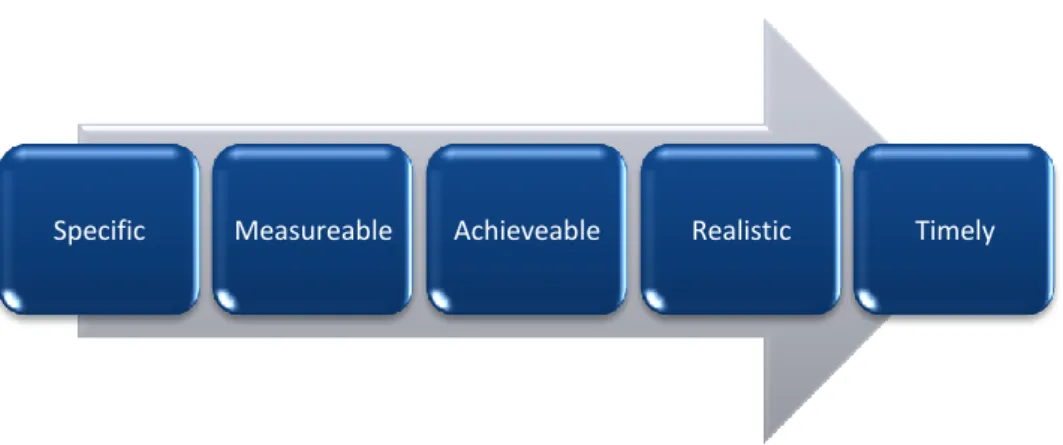
This is a vital piece of your work as it will guide your research. The research question is formed as a result of reading the literature and at the end of the literature chapter it is advisable to identify the gap in knowledge or understanding that your research will fill. The research question is then the question that your research is going to address. Research objectives break the research question into key areas which need to be addressed in order to answer the research question. These objectives should be clearly stated and measureable as they will be the basis on which you will develop your research tool and analyse your data. It is likely to take a number of iterations to achieve a strong set of objectives. A useful way to determine whether your objectives are appropriate is to think of the SMART principles.
Figure 1: Are your Research Objectives SMART?
9. Choosing a Methodology
When discussing research methodology we are referring to the approach or steps taken to answer the research question. The research methodology is different to the research methods as the methodology has many component parts that explain and justify the overall approach you took in gathering and analysing the primary data, while the methods are the tools you used to gather the data and are just one component part of the methodology. Your choice of methodology has
implications for each stage of your research including research methods, sampling analysis etc. so it is important to give it careful thought and consideration.
The choice of research methodology is driven by a number of factors:
The nature of the research question will tend to lend itself to particular research approaches e.g. qualitative, quantitative or mixed. For example a research question that seeks to measure or to quantify something lends itself to a quantitative methodology (e.g. to measure the extent to which Three Star Hotels in Dublin use social media marketing). While other research questions lend themselves to a qualitative approach. For example if you are seeking to understand
6 something such as motivations or perceptions etc. (e.g. to understand why or why not three Star hotels in Dublin use social media marketing). Alternatively your study might require you to measure and to understand, and in this case you would use a mixed methods approach which involves using both qualitative and quantitative techniques and methods.
The researcher will influence the methodology in so much as you should choose the
methodology that will enable you to carry out the research that you feel you are best able to do. This means deciding on your philosophical stance, how you believe knowledge is imparted and understood but also deciding on whether you are more comfortable dealing with statistics and measurements (quantitative) or are happier dealing with more qualitative data such as
interviews etc.
Time, costs and availability of research subjects.
10. Writing a Methodology Chapter
The methodology chapter of the dissertation is an important component that essentially maps out and justifies the approach that you will take when undertaking your primary research. The main objective here is to establish the credibility of the research and this is achieved by providing a full description and explanation of how the research was carried out, covering all the steps taken along the way.
A good way to begin a methods chapter is to write an introductory paragraph that describes both the design of the study and the organisation of the chapter, it is important to remind the reader of the research question and research objectives here also. The paragraphs that follow should provide an explanation of the methods you will utilise to gather the data necessary to address the research question. In addition to describing these methods, you also need to provide justification for selecting this method of research (why you felt this method or these methods in particular were most
suitable). When providing justification for the method of research you are using, you might also provide an explanation for deciding not to utilise certain commonly accepted research methods. Or, you might provide an explanation for purposely including or excluding certain groups from your research. It is very important that you use relevant literature throughout the chapter to support your decisions and justifications. You should also provide a discussion outlining the philosophical underpinning of the research.
The methodology chapter should include discussions of:
The research design, i.e. the plan for conducting and organising the research. Justification for the use of the methods selected.
Who participated and how they were selected (sample and sampling method). The ethical considerations arising from the study and how these were dealt with. Details of what data were collected and how.
Deciding on your methodology is fundamental to your dissertation, as your primary research and how you approach it, will determine the quality of your research findings.
7 How data were processed, analysed and managed.
How the reliability and validity of the research was ensured, particularly in the case of quantitative research.
Your pilot study.
Generalizability/Transferability of the findings. Limitations.
11. Conducting Primary Research
It is very important for you to give yourself enough time to collect your data. It can be slow collecting enough survey responses, and for example if you are doing a street survey, a bad weather day can seriously affect the number of people who will stop for you to survey. Similarly if you are conducting interviews many students find that it takes many e-mails and phone calls to secure ten interviews. The key is to begin early and plan ahead.
When you are drafting your research tool be sure that your questions are addressing your research objectives and the issues raised in your literature review. A good way to do this is to write the numbers of the questions which address each aim. This way you will be sure that when you start to analyse your data it will be relevant to the issues you want to address.
The guideline in terms of data collection is 100 surveys if you are conducting quantitative research, 8-10 interviews if it is qualitative research and if you are using a mixed methods approach
approximately 80 questionnaires and 3-4 interviews are suggested. These are simply guidelines and if you have any concerns about your particular research project speak to your supervisor and they will advise you.
You should include you questionnaire/interview protocol/focus group protocol in the Appendices of the dissertation.
Chosen Methodology Suggested amounts of data
collection
Quantitative 100 questionnaires
Qualitative 8-10 interviews
Mixed methods 80 questionnaires and 3-4 interviews
Figure 2: Suggested amounts of data collection
12. Data Analysis – Findings and Analysis Chapters
As you will see from the marking structure below the analysis chapter is the chapter with the highest marks and yet many students do not leave themselves with enough time to spend on this part of their work. Your Findings chapter presents your findings but in the analysis chapter your discussion should link back to the literature you have discussed in chapter 2 and the research questions that you have posed. In so doing you are engaging in a deeper level of analysis. If when you are writing the Analysis chapter you feel that you are repeating what you have written in the Findings chapter then it is likely that you are doing just that and are not engaging in analysis.
8
13. Writing an Introduction
This Chapter (along with the abstract) is normally the last chapter you write. This chapter should set the scene for the dissertation and provide the reader with a road-map of what is to follow. This chapter should include the background to your research, identification of your research
aim/question and research objectives, a brief overview of the relevant literature, a brief overview of the methodology and an outline of the dissertation chapters to follow.
14. Conclusions and Recommendations
The conclusions and recommendations chapter should briefly summarise your key findings, the conclusions that you have drawn from your research, the significance of your research (i.e. the “so what?” factor) and recommendations arising from your research (e.g. recommendations for future research; recommendations for practitioners), if such recommendations exist.
15. Title of Dissertation
Choosing the title of your dissertation is a task that you may leave to the end of the dissertation process. The title should be short (i.e. fewest words possible) and should catch the reader’s attention and convey the topic/perspective of your research.
16. Writing an Abstract
This is a very important part of your dissertation. It will give the reader a concise overview of your work and will quickly allow the reader to understand the purpose of your dissertation. Your abstract should be max. 300 words or one page in length and should be single-spaced. The abstract should include the following sections: the background/context of your research; the aim or purpose of your research; research design; findings/results; and key conclusions and recommendations.
17. How many words should the dissertation be? How many
words should each chapter be?
The dissertation overall is 10,000 words. The word count limit will be strictly enforced. All words from the introduction to the conclusion are included in this count. While a range of 10% above or below the word limit is acceptable, if the word count deviates from this, a penalty of 1% per 200 words will be imposed. The number of words should be indicated on the cover of the softbound dissertation.
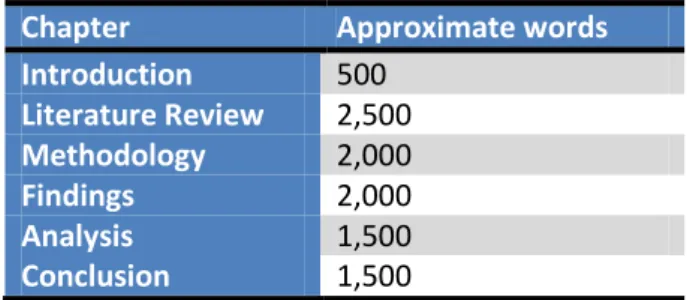
9 The number of words in each chapter will depend on the topic and the author. As a result of many queries from students below is a suggestion of how you might choose to allocate the words per chapter but this can differ from dissertation to dissertation and should not be read as an instruction. Please consult with your supervisor on this matter.
Chapter Approximate words
Introduction 500 Literature Review 2,500 Methodology 2,000 Findings 2,000 Analysis 1,500 Conclusion 1,500
Table 2: Suggested chapter word counts
18. Ethical Issues to Consider
You must ensure that your research is conducted in an ethical manner, that you have appropriate consent from participants and have considered any impact your questions may have, in particular on vulnerable or young people.
If you are engaging in research with people under 18 years of age you must have written consent from their parents/guardian. You also need to pay special attention to the wording of questions in surveys or interviews and all interviews should take place with another adult present. Any such research must be discussed in detail with your supervisor in advance of the research taking place to ensure that all ethical issues have been considered and managed. If students have any concerns regarding ethical issues in this regard please speak to either Dr. Ziene Mottiar or Dr. Theresa Ryan. If you are conducting research online, for example, conducting a web-based survey or observing an online community, you must consider a range of ethical issues specific to your dissertation topic/discipline. These issues may include: identifying whether your research is being conducted in a public or private domain; data security; implementing consent and withdrawal procedures; conducting research with children and young people (i.e. under-18 years of age), privacy, confidentiality and anonymity issues; copyright issues and ownership of data; and social responsibility.
You should always discuss any ethical issue(s) with your Dissertation Supervisor and consult the ‘Ethics in DIT’ webpage - http://www.dit.ie/researchandenterprise/integrityethicsindit/
The following are further examples of useful websites regarding ethical guidelines: Association of Internet Researchers (AoIR) http://aoir.org/
ICC/ESOMAR Code https://www.esomar.org
UK Economic and Social Research Council (ESRC) http://www.esrc.ac.uk/
10
19. Dissertation Schedule
Table 3: Dissertation Schedule 2015/2016
20. Referencing and Structure of the Dissertation
Consult the Reference Handbook which provides detailed guidelines regarding referencing and structure of document. This is available in the Dissertation webcourses.
21. Submission of the Dissertation
a) A detailed document outlining key dates will be emailed to all students at least 21 weeks prior to submission.
b) You will be sent a link to a Google document 2-3 weeks in advance of submission. At this link you need to complete your details and the working title of your dissertation. You will also see your
Dissertation Schedule 2015/2016
Semester
Date
Details
Additional Info.
One
18th September
Introduction session in KOS 1-2
29th September
Register for
topics/supervisors Meeting Room 1st floor Sackville place 1pm- 2pm
Most places are offered on the basis of first come first served – if you do not add yourself to the list a supervisor will be allocated to you.
5th October Submit research proposal to research methods lecturer and your Supervisor 2nd November Submit Research
Methodology Chapter to your Supervisor
11th December Submit Research Tool to your Supervisor
For example questionnaire, interview protocol etc.
Two
12th February Submit Findings Chapter to your Supervisor
26th February Submit Analysis Chapter to your Supervisor
1st March Last date for submitting work to your Supervisor
15th March Submit Dissertation to the School office
11 identifier code and need to take this down and keep a record of it as you will need it for the front cover of the softbound copies of your dissertation.
c) You must submit two soft (spiral bound) copies and one hardbound copy of your dissertation to the school office.
d) As well as submitting the hard and softbound copies of the document you should submit an electronic version. This should be the same version as the hardbound version that you will submit. You do this on the webcourses module. On the left hand side tool bar you will see a link for final submission of electronic version of dissertation. You attach the file here.
e) You must follow the Reference Handbook guidelines in terms of layout etc.
f) You should include the first page of the Safe Assign Report in the appendix of your soft bound copies of the dissertation
g) You should have your name, the title of the dissertation, your programme name and the year on the cover of the HARDBOUND copy.
h) To aid with blind marking you should NOTPUT YOUR NAME ANYWHERE ON THE SOFTBOUND COPIES. Instead your identifier will be the letter that is in the first column of the excel spread sheet mentioned in part b).
The declaration pages and acknowledgement pages should also not be included
in the softbound copies and there should be no reference to your name or
supervisor in this version of the document.
i) On the front cover of the softbound copies you should also put the number of words (from the introduction to the end of the conclusion) on the front cover bottom right corner.
j) So, on the front cover of the soft bound copy you should just have your letter identifier and the title of the dissertation and the number of words as specified above.
k) Lastly, you should submit an abstract of your dissertation. You do this on Webcourses. On the left hand side bar you will see where it says ‘Submit Abstract’. You should call the file that you upload here your surname followed by your first name e.g. Mottiar Ziene
12
22. Supplemental Dissertations
If you do not achieve a pass grade in your dissertation you will be required to resubmit it to be considered at the next exam board. You should contact your supervisor before 20th June and meet with them to determine the changes and additions that are required. You will be notified of the date of re-submission and on that date you should submit two soft bound copies of your dissertation to the school office and upload a soft copy to Safe Assign. To do this you may need to email
[email protected] to remove the original version that you uploaded.
23. Dissertation Marking Process
Dissertations are anonymised for the marking process. Each dissertation is marked by the supervisor and a second marker using the marking sheet below. If the marks are eight percent or less apart, and not in different marking banks (i.e. 1st, 2.1, 2.2 etc.), then the mark half way between the two markers is the final awarded mark. In all other cases the two markers meet to discuss the mark and agree a final mark. If it is not possible to get agreement regarding a final mark a third marker examines the piece of work (without knowing what marks others have awarded). Following this mark the three markers may then agree a final mark. If not the document is sent to the external examiner who makes a final decision. A sample of dissertations is also viewed by external examiners.
24. Dissertation Marking Sheet
Dissertations are marked using the following marking sheet. Please note the weighting of the marks and in particular the fact that the analysis section carries a significant weighting. Thus it is important that you do not run out of time and that you pay considerable attention to the analysis of your data.
13
SCHOOL OF HOSPITALITY MANAGEMENT AND TOURISM
Undergraduate Dissertation Assessment Sheet
Course
Student’s Name
Dissertation Title
Assessor:Please tick Advisor 2nd Reader External Examiner
Criteria Mark Max Mark Criteria Comment
Abstract &
Introduction
5
Clear, concise and synoptic abstract
Clear objectives, rationale & framework for study
Good chapter outline
Literature
Review
20
Identification of research question
Extent and understanding of existing literature
Number, breadth & relevance of citations
Synthesis and summary of literature
Relevance of literature to research question
Methodology
20
Description, suitability & rationale of research process
Philosophy of method defended
Transparent sampling procedures
Ethical consideration
Presentation of
Results
10
Diagrammatical description of data where appropriate
Relevant issues & themes identified
Data exploration and mining
Interpretation, Analysis &
Discussion
25
Identification and analysis of key findings
Argument using relevant referenced material
Connection & integration of literature
Limitations identified & discussed
Synthesis & critical thinking evident
Conclusion &
Recommendat-ions
10
Good summary & explanation of research
Link between objectives and outcomes
Evidence of student’s critical thinking
Organization &
Presentation
10
Clear & logical research structure & process evident
Excellent use of language, skilful presentation & accurate
application of academic conventions
Clarity of expression & ideas
Accurate spelling & use of grammar
Accuracy & presentation of reference list/ bibliography
Total
100
Total Marks Awarded Advisor Second Reader Agreed Mark
Signature_______________________________ Date___________________
14
25. Dissertation Marking Rubric
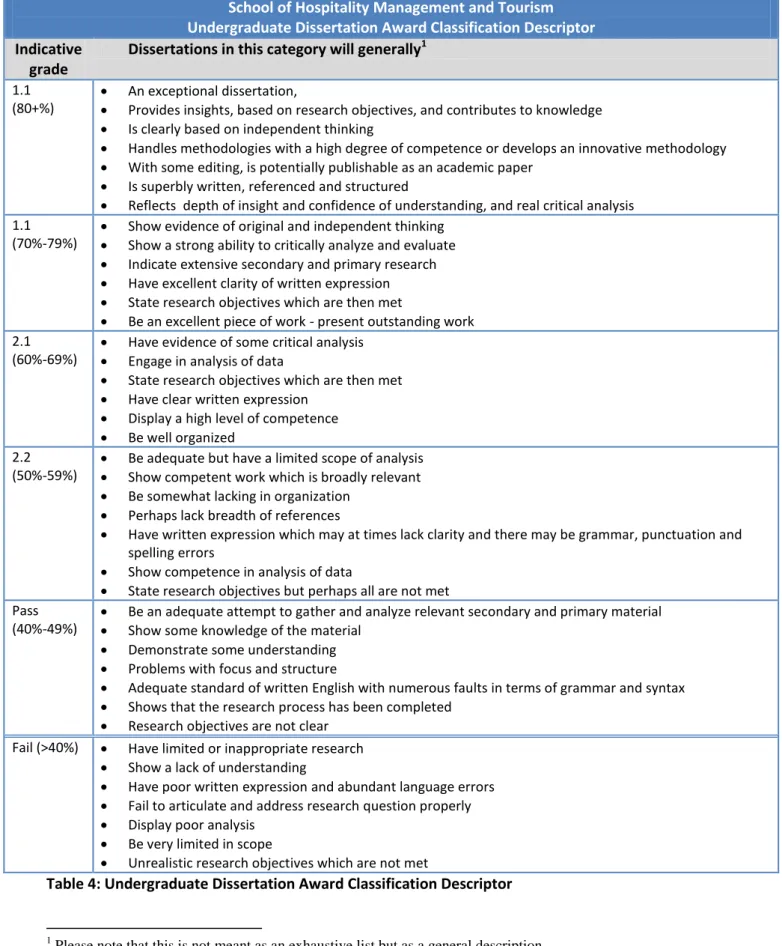
Below is the dissertation marking rubric which is used by examiners in the marking process to aid the completion of the marking sheet shown in section 24, it clearly shows the expectations for each band of mark. This table has been produced to act as an aid to students, supervisors and second readers of Undergraduate Dissertations.
School of Hospitality Management and Tourism Undergraduate Dissertation Award Classification Descriptor Indicative
grade
Dissertations in this category will generally1 1.1
(80+%)
An exceptional dissertation,
Provides insights, based on research objectives, and contributes to knowledge
Is clearly based on independent thinking
Handles methodologies with a high degree of competence or develops an innovative methodology
With some editing, is potentially publishable as an academic paper
Is superbly written, referenced and structured
Reflects depth of insight and confidence of understanding, and real critical analysis 1.1
(70%-79%)
Show evidence of original and independent thinking
Show a strong ability to critically analyze and evaluate
Indicate extensive secondary and primary research
Have excellent clarity of written expression
State research objectives which are then met
Be an excellent piece of work - present outstanding work
2.1 (60%-69%)
Have evidence of some critical analysis
Engage in analysis of data
State research objectives which are then met
Have clear written expression
Display a high level of competence
Be well organized
2.2 (50%-59%)
Be adequate but have a limited scope of analysis
Show competent work which is broadly relevant
Be somewhat lacking in organization
Perhaps lack breadth of references
Have written expression which may at times lack clarity and there may be grammar, punctuation and
spelling errors
Show competence in analysis of data
State research objectives but perhaps all are not met
Pass (40%-49%)
Be an adequate attempt to gather and analyze relevant secondary and primary material
Show some knowledge of the material
Demonstrate some understanding
Problems with focus and structure
Adequate standard of written English with numerous faults in terms of grammar and syntax
Shows that the research process has been completed
Research objectives are not clear
Fail (>40%) Have limited or inappropriate research
Show a lack of understanding
Have poor written expression and abundant language errors
Fail to articulate and address research question properly
Display poor analysis
Be very limited in scope
Unrealistic research objectives which are not met
Table 4: Undergraduate Dissertation Award Classification Descriptor
1
15
26. Resources and Support Materials
You will be provided with a detailed reading list in your research methodology module and lectures and assessments in this module provide your key support.
Guidance from supervisors is provided in terms of meetings and comments on your written work.
Support is also provided via the Dissertation Webcourses module and the Facebook page (Dissertations) where each week there will be tips and videos to help you through the process and to keep on track.
The dissertation co-ordinator can also be contacted by email: [email protected] for any queries or concerns that you may have throughout the process.