Open Access Dissertations Theses and Dissertations
8-2016
Promoting Teaming Metacognition
Lee Kemp RynearsonPurdue University
Follow this and additional works at:https://docs.lib.purdue.edu/open_access_dissertations Part of theEducation Commons, and theEngineering Commons
This document has been made available through Purdue e-Pubs, a service of the Purdue University Libraries. Please contact [email protected] for additional information.
Recommended Citation
Rynearson, Lee Kemp, "Promoting Teaming Metacognition" (2016).Open Access Dissertations. 840.
PURDUE UNIVERSITY GRADUATE SCHOOL Thesis/Dissertation Acceptance
This is to certify that the thesis/dissertation prepared By
Entitled
For the degree of
Is approved by the final examining committee:
To the best of my knowledge and as understood by the student in the Thesis/Dissertation Agreement, Publication Delay, and Certification Disclaimer (Graduate School Form 32), this thesis/dissertation adheres to the provisions of Purdue University’s “Policy of Integrity in Research” and the use of copyright material.
Approved by Major Professor(s):
Approved by:
Head of the Departmental Graduate Program Date Lee Kemp Rynearson
Promoting Teaming Metacognition
Doctor of Philosophy Heidi Diefes-Dux Chair Matthew Ohland Morgan Hynes Edward Berger Heidi Diefes-Dux David Radcliffe 7/6/2016
i
PROMOTING TEAMING METACOGNITION
A Dissertation Submitted to the Faculty
of
Purdue University by
Lee K Rynearson
In Partial Fulfillment of the Requirements for the Degree
of
Doctor of Philosophy
August 2016 Purdue University West Lafayette, Indiana
ii
ACKNOWLEDGEMENT
I would like to acknowledge and thank all members of my doctoral committee for their effort and support. This dissertation was enormously improved through their insight and advice. I am excited to continue the work begun here, and believe that the guidance received from members of the committee will bear its greatest fruit in studies yet to come.
iii
TABLE OF CONTENTS
Page
LIST OF TABLES ... viii
LIST OF FIGURES ... x
ABSTRACT ... xii
CHAPTER 1. INTRODUCTION ... 1
1.1 Background ... 1
1.2 Research Purpose and Research Questions ... 2
1.3 Research Context and Current Practices ... 4
1.3.1 ENGR131 ... 4
1.3.2 ENGR141 ... 8
1.4 Overview of Intervention Concept ... 12
1.4.1 Awareness ... 15
1.4.2 Motivation ... 15
1.4.3 Selection ... 17
1.4.4 Implementation ... 18
1.4.5 Reflection ... 19
1.5 Time and Logistical Limitations to the Intervention ... 19
1.6 Intervention Overview Summary ... 20
iv
Page
2.1 The Need for Engineering Teaming Skills Development ... 22
2.2 Review of Metacognition Research ... 26
2.3 The Taxonomy of Metacognition ... 32
2.3.1 Metacognitive Knowledge ... 33
2.3.2 Regulation of Cognition ... 35
2.3.2.1 Executive Functioning ... 36
2.3.2.2 Metacognitive Experiences ... 37
2.4 Targeted Elements of Metacognition ... 38
2.4.1 Awareness ... 39
2.4.2 Motivation ... 40
2.4.3 Selection ... 40
2.4.4 Implementation ... 41
2.4.5 Reflection ... 42
2.5 Methods for Metacognitive Development ... 42
2.5.1 Development of Metacognitive Knowledge ... 43
2.5.2 Development of Regulation of Cognition ... 44
2.5.3 Summary of Methods for Metacognitive Development ... 47
2.6 Psychological Safety ... 48
2.7 Developing Psychological Safety in Teams ... 50
CHAPTER 3. METHODS ... 54
3.1 Sample ... 54
v
Page
3.3 Interventions, Assessments, and Analyses ... 62
3.3.1 General Data Set Assembly ... 63
3.4 Interventions, Assessment, and Analysis Primarily Associated with RQ1 ... 64
3.4.1 Presentation of CATME Skills for Metacognition ... 64
3.4.2 Introduction of Teaming SM ... 65
3.4.3 SM Administrations 1, 2, 3 ... 66
3.4.4 Teaming Reflections 1, 2, 3 ... 68
3.4.5 Metacognitive Frequency Survey 1, 2, 3 ... 69
3.4.6 Data Cleaning for Research Question 1... 72
3.4.7 Analysis for Research Question 1 ... 73
3.5 Interventions, Assessments, and Analyses Primarily Associated with RQ2 ... 76
3.5.1 Psychological Safety Introduction & Norm Setting ... 76
3.5.2 Revised Code of Cooperation Assignment ... 77
3.5.3 Psychological Safety Reflection Prompts ... 78
3.5.4 Psychological Safety Survey 1, 2 ... 79
3.5.5 Analysis for Research Question 2 ... 80
3.6 Content, Assessments, and Analyses Primarily Associated with RQ3 ... 81
3.6.1 Standard Intro to Teaming and Diversity (ENGR131) ... 82
3.6.2 Standard Teaming Refresher (ENGR131) ... 82
3.6.3 Standard Intro to Teaming (ENGR141) ... 83
3.6.4 CATME BARS ... 83
vi
Page
3.7 Analyses Associated with Research Question 4 ... 87
3.8 Case Study Methods ... 89
CHAPTER 4. RESULTS ... 91
4.1 Research Question 1 Results ... 91
4.1.1 Results Overview ... 95
4.1.2 Kruskal-Wallace Testing ... 96
4.1.3 Summary ... 102
4.2 Research Question 2 Results ... 102
4.2.1 Results Overview ... 106
4.2.2 Kruskal-Wallace Testing ... 108
4.3 Research Question 3 Results ... 110
4.3.1 Results Overview ... 115
4.3.2 Kruskal-Wallace Testing ... 117
4.4 Research Question 4 Results ... 119
4.5 Case Study Results ... 121
4.5.1 Cases with High Psychological Safety Growth ... 121
4.5.1.1 Case 1 – ENGR131 Experimental ... 122
4.5.1.2 Case 2 – ENGR131 Control ... 123
4.5.1.3 Case 3 – ENGR141 Experimental ... 126
4.5.1.4 Case 4 – ENGR141 Control ... 127
4.5.2 Cases with Consistently High Psychological Safety ... 128
vii
Page
4.5.2.2 Case 6 - ENGR141 Experimental ... 130
4.5.3 Cases with High Initial Psychological Safety that Decreases ... 132
4.5.3.1 Case 7 - ENGR131 Experimental ... 132
4.5.3.2 Case 8 - ENGR141 Control ... 134
4.5.4 Case with Consistently Low Psychological Safety ... 136
4.5.4.1 Case 9 – ENGR141 Experimental ... 136
4.5.5 Case Study Coda ... 138
CHAPTER 5. Discussion & CONCLUSIONS ... 140
5.1 Research Question 1 Discussion and Conclusions ... 140
5.2 Research Question 2 Discussion and Conclusions ... 143
5.3 Research Question 3 Discussion and Conclusions ... 145
5.4 Research Question 4 Discussion and Conclusions ... 148
5.5 Summary of Conclusions ... 151 5.6 Study Limitations ... 152 5.1 Future Works ... 155 REFERENCES ... 158 APPENDICES Appendix A Surveys ... 169 Appendix B Forms ... 175
Appendix C Sample Slides ... 184
vii
i
LIST OF TABLES
Table ... Page
Table 3.1 Sample Characteristics ... 57
Table 3.2: ENGR131 Intervention and Assessment Schedule... 59
Table 3.3: ENGR141 Intervention and Assessment Schedule... 60
Table 3.4: Interventions and Assessments by Research Question ... 61
Table 3.5: Research Question Numbers and Text ... 62
Table 3.6: Metacognitive Frequency Survey ... 71
Table 3.7 Early and Late Submissions of Metacognitive Frequency Survey ... 73
Table 4.1: ENGR131 Metacognition Frequency Survey Response Rates ... 92
Table 4.2: ENGR141 Metacognitive Frequency Survey Response Rates ... 93
Table 4.3: ENGR131 Metacognitive Frequency Survey Results ... 94
Table 4.4: ENGR141 Metacognitive Frequency Survey Results ... 95
Table 4.5: Metacognitive Frequency Survey Growth (First to Third Administration) ... 96
Table 4.6: ENGR131 Psychological Safety Instrument Response Rates ... 103
Table 4.7: ENGR141 Psychological Safety Instrument Response Rates ... 104
Table 4.8: ENGR131 Psychological Safety Item Averages and Growth ... 105
ix
Table ... Page Table 4.10: ENGR131 Psychological Safety Initial and Final Measurements Comparison
... 108
Table 4.11: ENGR141 Psychological Safety Initial and Final Measurements Comparison ... 108
Table 4.12: CATME BARS Response Rates ... 111
Table 4.13: ENGR131 CATME BARS Aggregate Data ... 113
Table 4.14: ENGR141 CATME BARS Aggregate Data ... 114
Table 4.15: Spearman Rho Correlation between Metacognitive Frequency and CATME BARS Ratings Growth ... 120
Table 4.16: Psychological Safety Spearman Rho Correlation with Change in CATME BARS Ratings between First and Final Administration of CATME BARS ... 121
x
LIST OF FIGURES
Figure ... Page
Figure 1: Structure of Metacognitive Knowledge ... 31
Figure 2: Regulation of Cognition ... 32
Figure 4.1: ENGR131 Timely Scores, Administration 1, By Section ... 98
Figure 4.2: ENGR131 Timely Scores, Administration 3, By Section ... 99
Figure 4.3: ENGR141 Timely Scores, Administration 3, By Experimental Condition . 101 Figure 4.4: ENGR141 Per-Section CATME BARS Item Growth (3rd-1st Administration) ... 117
Appendix Figure Appendix Figure A.2: Psychological Safety Survey ... 173
Appendix Figure A.3: Teaming Motivation Survey ... 174
Appendix Figure B.4: Sample SM Worksheet ... 175
Appendix Figure B.6: ENGR141 Code of Cooperation Assignment ... 183
Appendix Figure C.7: ENGR131 & ENGR141 Discussion of CATME Skills ... 186
Appendix Figure C.8: ENGR131 & ENGR141 Introduction of Teaming SM Sample Slides ... 188
Appendix Figure C.9: ENGR131 & ENGR141 Psychological Safety Introduction & Norm Setting Sample Slides ... 190
xi
Appendix Figure ... Page Appendix Figure C.10: ENGR131 Week 7 Teaming and Psych Safety Reflection Slides ... 193 Appendix Figure C.11: ENGR141 Week 7 Teaming and Psych Safety Reflection Slides ... 194 Appendix Figure C.12: ENGR131 Week 13 & ENGR141 Week 10 Teaming and Psych Safety Reflection Slides ... 196 Appendix Figure C.13: ENGR141 Week 15 Teaming and Psych Safety Reflection Slides ... 197
xii
ABSTRACT
Rynearson, Lee K. Ph.D., Purdue University, August 2016. Promoting Teaming Metacognition. Major Professor: Heidi Diefes-Dux.
Improving students’ capacity to effectively perform teaming skills is a crucial outcome for engineering education, and has been the subject of considerable prior and ongoing research. Based upon review of research on teaming, it was hypothesized that greater awareness of appropriate opportunities to use teaming skills in authentic contexts would lead to greater teaming skills employment over time. Further, it was hypothesized that greater psychological safety in student teams would lead to more students choosing to employ appropriate teaming skills over time. An intervention to achieve such
increases could therefore be expected to promote student teaming skills performance improvement. Seeking to evaluate potential new methods for teaming skills instruction and development in engineering contexts, a suite of interventions was designed to support growth in student metacognition and promote psychological safety in student teams.
This dissertation took the form of a quantitative study implemented in nine sections of the Purdue First-Year Engineering classes ENGR131 (five sections) and ENGR141 (four sections). Multiple psychometric instruments were administered across a semester. Results were investigated to assess the efficacy of the experimental
xii
i
altering relationships between measured variables, and ultimately in raising teaming skills performance. The experimental interventions used in this study incorporate tools and techniques that do not appear to have been previously employed in engineering education. Results suggest that the instrumentation for metacognition was not
satisfactory, but that the intervention may have had effects on psychological safety in student teams. These findings are discussed along with directions for further inquiry in the design, implementation, and evaluation of teaming skills instruction.
1
CHAPTER 1. INTRODUCTION
1.1 Background
Researchers in engineering education have pursued evidence for the value of various engineering instructional techniques for decades, with the most notable and widespread success being the conclusive demonstration of the efficacy of active learning techniques in improving numerous undergraduate learning outcomes in comparison with traditional lecture-based methods (Johnson, 1991; Johnson, Johnson, & Smith, 1998; Prince, 2004, p. 625; Slavin, 1996). While active learning methods are understood to have broadly positive results, a need remains to gather evidence on methods in active learning that are efficacious in improving particular student outcomes, in keeping with Jamieson and Lohmann’s (2012) call for evidence-based educational innovation. Understanding which active learning methods are most effective in addressing a given learning outcome, under what circumstances, and why, would permit the design of undergraduate engineering learning experiences that reliably surpass the efficacy of generic ‘active learning’ efforts.
Researchers have begun efforts to develop deeper understandings of active learning, proposing models of learning incorporating results from many research fields (Vanasupa, Stolk, & Herter, 2009) and working to understand and differentiate more and less effective active learning paradigms (Chi, 2009). Incorporating research finding
2
from fields complimentary to engineering education is likely imperative to achieving the goal of understanding active learning design, as many known facets of learning, from student motivation to effective methods for memorization, have been primarily investigated by researchers outside of engineering education. However, interventions intended for engineering would be most strongly supported by evidence of their efficacy in classroom settings, not just lab environments, as are frequently found in some fields of research. This study is conducted in the authentic context of two first-year engineering (FYE) courses.
1.2 Research Purpose and Research Questions
The purpose of this study was to develop, deploy, and evaluate a classroom intervention promoting student performance of teaming skills in a first-year engineering (FYE) context, continuing and expanding the work of a pilot study in this area
(Rynearson & Hynes, 2015). This work contributes to the effort to develop more
effective active learning techniques by targeting specific learning outcomes and drawing from theory and educational research from inside and outside of the field of engineering education.
As will be discussed in the literature review, teaming skills are critical for engineers. Team projects are a common method employed to facilitate the growth of teaming skills and are often employed in FYE or senior design courses. Existing teaming instruction in the Purdue University FYE sequence provides information about the
importance of teaming, general information about teaming processes and practices, opportunities to put teaming into practice, and feedback to each student about their
3
teaming performance, and has been shown to be successful in cultivating teaming skills growth (Jimenez-Useche, Ohland, & Hoffmann, 2015). This dissertation’s experimental intervention overlays existing instruction with a focus on cultivating metacognitive knowledge and awareness and student psychological safety in working teams with the understanding that growth in these areas is likely to support higher overall teaming
performance. The experimental intervention was administered to a subset of participating engineering students, such that a control group was formed to allow comparison of
results. Therefore, this study addresses the following research questions:
1) To what extent did the experimental intervention promote the target aspects of
metacognition in FYE students in the experimental group in comparison to the control group?
2) To what extent did the experimental intervention promote psychological safety of student teams in the experimental group in comparison to the control group? 3) In the event that the intervention succeeds in supporting more metacognitive skills
growth and/or psychological safety in the experimental than the control groups, to what extent did the teaming performance of the experimental group then improve beyond that of the control group?
4) To what extent did the improvement in the targeted metacognitive capabilities or psychological safety correlate with improved individual student teaming
4
1.3 Research Context and Current Practices
This section provides an introduction to the context in which the study was undertaken, including practices in teaming skills improvement currently employed. A limited effort will be made to identify and reference best practices currently employed to support this contextualization. This section does not provide a comprehensive review of best practices in teaming skills development.
As previously mentioned, the study took place in authentic engineering classroom settings. These settings were provided by two Purdue University First-Year Engineering courses, Transforming Ideas to Innovation 1 (ENGR131) and Honors Creativity and Innovation in Engineering Design 1 (ENGR141). ENGR131 is a four-contact-hour, two-credit course meeting twice a week for one semester. ENGR141 is a six-contact-hour, three-and-a-half credit course meeting three times a week for one semester. Both are the first course in a two-course sequence, with ENGR131 being followed by Transforming Ideas to Innovation 2 (ENGR132) and ENGR141 being followed by Honors Creativity and Innovation in Engineering Design 2 (ENGR142). Aside from mentioning that these follow-up courses also offer numerous opportunities for students to benefit from
improved teaming skills, the follow-up courses do not require discussion.
1.3.1 ENGR131
ENGR131 is the largest FYE course offered to students of Purdue University and serves the majority of undergraduate engineering students in their first semester. The total number of students in the course was approximately 1800 in the fall 2015 semester, divided into sections of roughly 120 students each. Students in ENGR131 have relatively
5
strong academic preparation (manifested through SAT/ACT scores, high school class GPA and class rank, etc.) as would be expected of students in a highly selective engineering program. The Purdue Engineering Office of Future Engineers reports the incoming class in the fall of 2015 had an SAT middle 50% range of 1800-2080 and a high school GPA middle 50% range of 3.8-4.0 (Engineers, 2016). The Purdue University College of Engineering attracts a high proportion of international students, approximately 25% of enrollment (Jimenez-Useche et al., 2015).
ENGR131 covers topics including diversity and teaming skills, engineering major selection and career preparation, mathematical modeling, Microsoft Excel®, the
engineering decision making, the design process, and information literacy.
ENGR131 features teaming skills instruction early in the course and revisits the topic in-class around the midpoint of the course. Team activities and projects are incorporated and times for peer evaluation occur periodically throughout the course. Teams are instructor-formed using the CATME Team-Maker tool (Layton, Loughry, Ohland, & Ricco, 2010), based on criteria including each student’s daily schedule,
gender, Under-Represented-Minority (URM) status, and international/domestic status. In general, students from historically vulnerable populations are grouped with at least one like team member. Additionally, it is ensured that no two teammates share a first or last name for administrative convenience (though one student’s first name can be the same as another’s surname). Teams are predominantly composed of four students with some teams of three, and are permanent once formed except under extraordinary
circumstances. These practices are specifically recommended for student teams in engineering by Oakley, Felder, Brent, and Elhajj (2004) and Wankat and Oreovicz
6
(2014). In fall 2015, all experimental and control groups of ENGR131 participated in versions of the following activities:
1. In-class discussions of diversity and basic information about the motivation for teaming skills along with team working roles and processes. This coverage constitutes “guidance from the instructor on effective teamwork” as
recommended by Oakley, Hanna, Kuzmyn, and Felder (2007, p. 271) and also the discussion of “the importance of teamwork, problems experienced with student teams, ways to resolve these problems...” specified by Stephens (2001, p. 337). 2. The development of a 'Code of Cooperation' by each team laying out their
internal rules and expectations for working together and a 'team poster' with team picturesand associated information. The 'Code of Cooperation' exercise extends Stephens' recommendation to have teams “formulate a contract which specifies criteria for non-performance” (Stephens, 2001, p. 337) and falls in line with Felder's suggestion that faculty have students “prepare and sign a list of ground rules they all agree to observe” (Felder & Brent, 2001, p. 3).
3. Journal entries with question prompts relating to teaming issues outside of class. These journal entries, integrated into the ENGR131 curriculum and part of normal coursework, appear to be targeted at providing students with an initial
engagement with the topic prior to further classroom discussion. This is a fairly standard flipped-classroom active learning practice aimed at stimulating
engagement as discussed in Millard (2012).
4. Many active learning activities and exercises on various topics completed in teams. This heading covers the large volume of classwork for all sections already
7
comprised of team-based active learning materials independent of this study. The efficacy of in-class active learning practices has already been established, and these activities predominantly fall into Chi's 'interactive' category of active learning activities, which is most likely to lead to learning gains (Chi, 2009). 5. A roughly three-week team mathematical modeling project, substantially
undertaken in-class. This project maps to interactive active learning in Chi's taxonomy.
6. A roughly four-week design project, substantially undertaken in-class. This project is also an interactive active learning experience according to Chi's taxonomy.
7. A team 'practical' on engineering design, which is essentially a team examination of applied design process management and design capabilities in a timed format. Another class day is allocated for practice of this activity. These tasks are also interactive active learning in Chi's taxonomy.
8. Four CATME peer evaluations. CATME (Ohland et al., 2012) is recommended as a resource to help students improve their teaming skills (Hrivnak, 2013; Weimer, 2013) and has been found to help students improve their teaming behavior (Pung & Farris, 2011). It provides “mid-term peer evaluations with feedback” as recommended by Stephens (2001, p. 337). It should also be noted that students can, but are not required to, elicit faculty advice or feedback outside of this system, and that faculty can give direct feedback on their own. While such
8
intervention and no special efforts with regards to it differentiate the experimental and control sections.
As can be seen, ENGR131 has a schedule that already incorporates a large number of team-based activities instantiating existing best practices in teaming skills development. The existing teaming skills development opportunities offer a strong control to compare the results of this study’s experimental intervention against. As will be made clear in the methods section, the experimental intervention designed and implemented in this study included activities and practices not currently found in engineering teaming instruction.
1.3.2 ENGR141
ENGR141 is a smaller FYE course offered to students of the Purdue University Honors College to meet certain requirements of that academic body. The total number of students in the course was approximately 270 in the fall 2015 semester, divided into four sections of over 60 students each. Students in ENGR141 have higher average SAT/ACT scores and high school GPA's than students in ENGR131 and a higher probability of having been highly ranked in high school. Prospective students are selected for invitation to join the Honors College for these and other characteristics. Students who accept the invitation of the Honors College and pursue an engineering degree typically take ENGR141, but it is not mandatory. The international contingent of ENGR141 is much smaller than that of ENGR131, with fewer than 5% of fall 2015 semester students being of international origin. Honors College invitations to international students interested in engineering have been increased roughly five-fold in recent years to enroll more
9
international students in ENGR141. However, in the fall of 2015, students of ENGR141 were not representative of most undergraduate populations. Results from ENGR141 do present an interesting opportunity to assess the effects of the intervention on domestic students entering engineering with higher than average preparation.
ENGR141 is designed to be extremely challenging and is widely so regarded by students. ENGR141 introduces multiple topics simultaneously, gives several large assignments in a typical week, and calibrates overarching team project difficulty such that approximately 10% of teams are successful at a majority of project goals. Some students consider the workload and challenge of ENGR141 to be more extensive than the extra 1.5 academic credits if offers over ENGR131 merit. ENGR141 covers topics including teaming skills, the design process, project management, algorithm development and documentation, programming in Python and MATLAB, mathematical modeling including data cleaning, curve fitting, correlation, descriptive statistics and the development of models for novel situations. Additional course activities support
additional limited learning goals outside of these topics. Pedagogy in ENGR141 features much more extensive lectures (punctuated by discussion and active learning exercises) than ENGR131.
As with ENGR131, teaming skills instruction includes some relatively brief units early in the course followed by extended team activities and projects, dotted with times for peer evaluation and reflection throughout the course. As with ENGR131, teams are instructor-formed, predominantly composed of four students with some teams of three, and are permanent once formed. The CATME Team-Maker tool was not used in the fall of 2015 in ENGR141 in favor of an ENGR141-specific team formation tool that did not
10
account for out-of-class availability but did ensure women and URM students were placed with some like students. The ENGR141 team creation tool attempts to distribute students with previous programming experience, strong high school science experience, and strong high school math experience (based on student surveys) evenly across teams, such that all or nearly all teams had a variety of class-relevant strengths and experiences. It may be possible to gather and sort by this information using CATME Team-Maker, but ENGR141 administrators did not explore this option. In fall 2015, both the experimental and control groups of ENRG141 participated in versions of the following activities:
1. In-class lectures and discussions of the importance of teaming and basic information about team working processes, similar to those discussed for
ENGR131.
2. A reading or video assignment to promote student teaming motivation and understanding prior to classroom discussions of the topic.
3. The development of a 'Code of Cooperation' by each team laying out their internal rules and expectations for working together and an 'E-card' with team pictures and a team name. References supporting these activities appear in the description of similar items in ENGR131
4. Three CATME peer evaluations. A more detailed description of these activities and references supporting such peer evaluations are given in the discussion of ENGR131’s efforts.
5. In-class reflections and discussions on team processes. These in-class reflections and discussions (which are forms of active learning) offer opportunities to capitalize on feedback to benefit their teaming skills as recommended by
11
(Stephens, 2001). Additionally, these activities model appropriate reflective practice for students, a valuable skill employed by professional engineers (R. S. Adams, Turns, & Atman, 2003; Svarovsky & Shaffer, 2006).
6. A two-week out-of-class project to develop a straw tower as a team. Resource scarcity of the building materials means that teams not working together may be subject to critical design or construction errors by individuals or sub-groups. This project constitutes interactive active learning in Chi's taxonomy.
7. Eleven class sessions primarily dedicated to team learning of programming concepts and languages or additional practice in specific course skills. Teams are typically limited to working on a single computer with students rotating control of the computer. These working periods offer interactive active learning as laid out in Chi's taxonomy.
8. Two class days entirely composed of timed and graded team engineering
challenges supporting specific learning objectives. These challenges are not competitive between teams – the limited time and the need for individuals on teams to work together efficiently to accomplish their tasks in the given time have historically been sufficient motivation. These tasks constitute interactive active learning in Chi's taxonomy.
9. An eight-day in-class project on gathering, cleaning, analyzing, and building, and reporting on mathematical models from experimental data. This project
constitutes interactive active learning in Chi's taxonomy.
10.A fourteen-week primarily out-of-class team term project in robotics. This project constitutes interactive active learning in Chi's taxonomy.
12
11.Many additional assorted smaller active learning activities and exercises in the context of class lectures on various topics, the majority of which will fall into the constructive and interactive categories of Chi's taxonomy, the two most likely to lead to learning gains.
As can be seen, ENGR141 also has a full schedule that incorporates a large number of team-based activities instantiating best practices in teaming skills
development. As with ENGR131, existing teaming skills development opportunities are robust and offer a strong control to compare the results of the intervention against. As will be discussed in the next section, the goal of the intervention is not to replace or divert class time and attention away from these worthwhile activities wholesale, but to intervene in a limited fashion with the goal of making teaming skills acquisition and improvement during some activities (principally team working time) more efficient.
1.4 Overview of Intervention Concept
This section serves to orient readers to the basic ideas and structure of the study prior to in-depth discussions of specific aspects of the study in later chapters. At its most basic level the intervention works to induce students to get more practice in the authentic use of teaming skills, in keeping with the general principles of active learning. Through this practice, students’ teaming skills are expected to improve. As the classroom context for the intervention already includes substantial teaming skills learning and performance opportunities in accordance with known best practices, the study deployed and assessed new methods derived from research that may be effective beyond the results achieved through current methods. Control cohorts in both ENGR131 and ENGR141 provided a
13
method for distinguishing the effects of the intervention from other teaming skills development activities.
To induce students to get more practice in the authentic use of teaming skills, it was useful to examine a model of decision-making, the idea being that students could be put on the path to making decisions to employ teaming skills with greater frequency. The AIDA (Awareness, Interest, Desire, Action) Hierarchy of Effects model and its numerous descendants (Wijaya, 2015) in the field of marketing provided a starting point for a model. In AIDA and other traditional marketing models of decision making, the subject is seen as transitioning through a number of stages of decision making from being completely unaware of a product to having bought it. In some newer models discussed by Wijaya (2015), stages past purchase are added reflecting items such as customer satisfaction and customer use of social media in relation to the product, along with acknowledgements that customer decision-making processes are not always linear. Progression through the stages is sometimes referred to as the ‘sales funnel’, and it is expected that some proportion of potential customers will fail to advance at each stage.
Refocusing this decision-making hierarchy onto the employment of teaming skills, the main thrust of this study was to employ research in the cultivation of metacognition to promote the awareness or recognition of opportunities to employ teaming skills via active learning practices, and thereby to increase the base of the ‘sales funnel’ for student decisions to employ teaming skills. An additional target of this study was to employ research into psychological safety to better support student motivation to employ teaming skills by reducing the perceived risk of doing so. Other aspects of the intervention
14
standard instructional practices in both ENGR131 and ENGR141. Existing practices in both courses were retained for both the experimental and control groups as it would have been unethical to deliberately remove best practices likely to support learning from a classroom intervention. Overall, the study integrates new techniques based on research literature into practice and compares the results against strong existing modern
instruction.
The AIDA model, being aimed at sales to the general public, does not align precisely with processes that may be anticipated for an audience of students being asked to perform teaming skills. This study employed an adapted version of the model with the following five stages:
1. Awareness 2. Motivation 3. Selection 4. Implementation 5. Reflection
The rationale for each stage in the adapted model is given in the following sections. This five-step process primarily serves to contextualize aspects of the study rather than to determine granular aspects of it; the stages of the process are so broad as to require further review of the literature and selection of methods. However, it is helpful in understanding what different aspects of the intervention are intended to accomplish. Each stage will now be discussed in more detail, along with aspects of the experimental intervention and best-practices present in both experimental and control sections. Note that the stage names are henceforth italicized when referring specifically to a stage to
15
differentiate them from other uses of the words (e.g. awareness is the stage, awareness is generic).
1.4.1 Awareness
Students must have awareness of the opportunity to employ targeted teaming skills. In response to problems or opportunities in the team environment, it is possible for students to act with greater or lesser degrees of thought and intentionality. Reacting without thought to a situation may result in appropriate employment of teaming skills. However, a thinking reaction is required to result in the target behavior: the use of teaming skills in situations where teaming skills would otherwise not have been used. Therefore, student awareness of specific opportunities to employ teaming skills is a first step towards additional practice of teaming skills. As stated, this study employs research in the cultivation of metacognition to promote the recognition of opportunities to employ teaming skills via active learning practices. The primary method for this is the
development and deployment of worksheets (Strategy Evaluation Matrices) that could work to increase student awareness of teaming opportunities. The previously mentioned pilot study showed some promise in promoting awareness of opportunities to employ teaming skills (Rynearson & Hynes, 2015) using metacognition.
1.4.2 Motivation
Subsequent to recognizing the opportunity to deploy teaming skills, students must have motivation with regards to whether to take an action in response to the teaming problem or opportunity. ‘Motivation’ replaces ‘Interest’ from the AIDA model in this
16
instance, being more appropriate and descriptive for students in mandatory coursework. Experience with FYE student teams, including feedback on team dynamics and
performance via the CATME system, suggest that not all students regularly apply effort towards addressing issues and opportunities in their teams. For the purposes of this intervention it was generally seen as desirable to employ some variety of deliberate actions as a means to practice teaming skills. This could include actions such as actively listening and similarly quiet or less-visible skills.
There are many potential avenues to motivate students to more frequently decide to actively employ teaming skills. All sections of ENGR131 and ENGR141 employ some basic measures to motivate students, such as presenting information on the
importance of teaming in industry and the potential for strong teaming to produce better products, which could positively affect student grades. Beyond these common measures, the experimental intervention focused on improving intra-team psychological safety. Psychological safety will be explored in more depth in the literature review, but is essentially “a sense of confidence that the team will not embarrass, reject, or punish someone for speaking up” (Edmondson, 1999, p. 354). It was expected that improved student psychological safety would lead to reduced student concerns about potential negative team reactions to attempts to perform teaming skills. Thus, factors reducing
motivation to perform teaming skills would be reduced, effectively increasing motivation
and therefore the amount of teaming skills practice undertaken by students. Increased psychological safety also potentially contributes to teaming skills development through feedback and example. For example, all members of a team with a relatively dominant
17
member might benefit if one less-dominant member began to work to correct the conduct of the dominant member in view of the team.
Additionally, psychological safety may increase motivation to interact as a team through mitigating conflict. One reason that students may avoid employing teaming skills is in response to real or perceived conflict in their teams. Conflict can lead to team members interacting less as “team members try to disengage from those with whom they experience conflict, and further limit their interactions” (Langfred & Moye, 2014, p. 33). As psychological safety makes it more likely that team issues will be broached before they become crises, it has the potential to reduce team conflict and increase motivation to employ teaming skills in this way as well.
Psychological safety is supported by the experimental intervention through the development and deployment of student team Codes of Cooperation in the experimental sections, along with brief in-class presentations on psychological safety. Codes of Cooperation are already used by both ENGR131 and ENGR141, but the experimental sections’ altered Code of Cooperation assignments explicitly required teams to develop and commit to a plan to ensure strong psychological safety in their team environment.
1.4.3 Selection
Either concurrent with or subsequent to the second step, students must select an approach to the teaming problem or opportunity. This step is necessary in the model of student teaming decision making in addition to the steps in the AIDA model as there is more than one possible final action to take (all possible teaming actions, versus simply buying the advertised item). The student must therefore select the action to be
18
implemented. This step depends heavily on student knowledge of potential actions and their suitability for employment in response to the problem or opportunity the student is aware of. All sections of ENGR131 and ENGR141 are broadly introduced to appropriate teaming actions through course presentations and the use of the CATME BARS peer evaluation system (Loughry, Ohland, & Woehr, 2014). The worksheets employed in the experimental intervention (Strategy Evaluation Matrices) worked to scaffold the selection
of appropriate teaming activities in response to teaming problems or opportunities.
1.4.4 Implementation
Fourth, subsequent to selecting a teaming skill to perform, students must
implement the use of the teaming skill in their team environment. This step depends on things like student knowledge of and skills in communication, ability to regulate their attitude when interacting with teammates, and to empathize with the perspectives of others. These items were not assessed in the study, and an uneven distribution of these factors across the sample is a potential confounding factor. Implementation is lightly addressed by some current ENGR131 and ENGR141 class practices, such as in-class discussions of how teaming interactions might best be approached, and the Code of Cooperation assignments may, at a student team’s discretion, contain guidelines for when and how students should implement some teaming interactions. The experimental
intervention was expected to result in improvements in student ability in this area through additional in-class practice during the course of normal class operations rather than explicit practice in the form of role plays, exercises, or other activities.
19
1.4.5 Reflection
The final step is for students to reflect on their teaming skills performance. This step is not included in the AIDA model and may not be helpful for selling products. It is, however, helpful for learning. Reflective practice allows students to derive more benefit from past teaming skills performances through considering personal beliefs, stronger and weaker skills, and deciding on any changes in outlook or practice to be attempted in future iterations. This step is addressed by some current class practices in both ENGR131 and ENGR141, which already featured reflective practice to some extent. Various in-class and out-of-class prompts for reflection relevant to the intervention were implemented in support of the intervention’s goals in ENGR131 and ENGR141.
1.5 Time and Logistical Limitations to the Intervention
It is important to account for the amount of classroom time consumed in inducing and supporting additional teaming skills practice. While classroom interventions to improve teaming skills abilities have been deployed in engineering, including many already deployed in Purdue University FYE courses, interventions designed to push beyond current practice can be time-intensive, such as the five-course minor in
Engineering Communication and Performance reported on by Seat, Parsons, and Poppen (2001). As it is well known that engineering curricula are quite full and noting legislative action in Indiana to reduce the quantity of credits required to graduate (Wheldon, 2013), this intervention worked to act in the context of existing courses, consuming two or fewer in-class hours. This quantity of class time was determined to approach the maximum acceptable to faculty teaching the experimental sections of this study. This time
20
limitation did affect the selection and scheduling of intervention activities. Spending this amount of time on new material in an FYE course may be seen as plausible to FYE instructors more broadly, as the displacement of material and/or credits is much more limited than, for instance, a five-course minor. The concepts and methods employed in this experimental intervention could be scaled up such that they consumed more class time, potentially to greater effect.
1.6 Intervention Overview Summary
In summary, the intervention was designed to improve student teaming
performance by increasing the amount of teaming skills practice that students get in the course of normal teaming activities in ENGR131 and ENGR141. This additional practice comes from promoting awareness of opportunities for teaming practice through
metacognition and other activities that support students in progressing through the
sequence of awareness, motivation, selection, implementation, and reflection in teaming.
Awareness and selection were primarily supported by Strategy Evaluation Matrices developed for engineering teaming, motivation was primarily supported by Code of Cooperation assignments emphasizing psychological safety, and reflection, while already present in the target courses, was refocused on the target behaviors. Chapter 3 provides detailed descriptions of the interventions and assessments. Administration timelines can be seen in Table 3.2 and Table 3.3, and study activities by research question can be seen in Table 3.4. Existing best practices in student motivation, teaming skills knowledge and training, and reflection were generally retained, but were not areas of focus of this study.
21
The intervention was designed to consume fewer than two class hours for logistical reasons.
22
CHAPTER 2. LITERATURE REVIEW
In this chapter, reviews of research literature relating to the need for engineering teaming skills development, aspects of metacognition useful for developing teaming skills via the previously discussed 5-step sequence, methods for the development of metacognitive skills and knowledge, the concept of psychological safety and its effects on team performance, and fostering team psychological safety are conducted. Given the breadth of possible material on the topics reviewed, only key features of the research literature with respect to this study are provided, not comprehensive general literature reviews for each research area. As this study enacts research-to-practice, the focus of many sections of this review are on instructional implications that can be derived from the literature and methods that could be employed to achieve the educational goals of the intervention. Literature relating to assessment appears in Chapter 3, alongside the
specific methods employed in this study. Some review of best practices in teaming skills development appeared in Chapter 1 in the description of the study's context.
2.1 The Need for Engineering Teaming Skills Development
The intervention employed in this study sought to improve student teaming skills. This section motivates the need for and benefits of teaming skills for engineering
23
students. It has been broadly established that engineers require interpersonal,
communication, and teaming skills in industry, even when employed in predominantly technical roles. Prominent voices from industry articulated problems in these areas two decades ago, stating that “most major American universities overemphasize engineering science at the expense of engineering practice” including “cooperative
learning/teamwork” (McMasters & Matsch, 1996, p. 1). A more recent review by Martin, Maytham, Case, and Fraser (2005) stated that “Surveys...of industry perceptions of engineering graduates have consistently identified communication and teamwork as important attributes where “competency gaps” are frequently found.” (p. 168). Similar difficulties have recently been reported in Canadian engineering programs (May & Strong, 2011).
In response to the identification of these industry needs, movement began towards a greater emphasis on teamwork, among other aspects of engineering practice, in the education of engineers. The introduction of the notable CDIO engineering syllabus used in whole or in part by dozens of engineering schools around the world states that “there is a growing recognition that young engineers must possess a wide array of personal,
interpersonal, and system building knowledge and skills that will allow them to function in real engineering teams and to produce real products and systems.” (Crawley, 2001, p. 1) Mandating some emphasis on teamwork at virtually all American engineering schools, ABET has required engineering programs to present documented evidence that graduating students possess the abilities to “communicate effectively” and “function on multidisciplinary teams” (ABET, 2013, p. 3) to retain accreditation since the turn of the century. A recent review of First-Year Engineering curricula found that “Teaming skills
24
and communication were by far mentioned in most if not all syllabi and group
discussion” and that these items are still the “most cited characteristics from employers” (Reid, Hertenstein, Fennel, Spingola, & Reeping, 2013, p. 7).
In addition to the industrial and accreditation demand for teaming skills, engineering students with strong teaming skills may accrue benefits in their technical education. Cooperative and other forms of collaborative learning have become
widespread in higher education in general (Johnson & Johnson, 2009) and engineering is no exception. Research on the efficacy of active (including cooperative) learning in engineering is compelling, with authors such as Smith, Sheppard, Johnson, and Johnson (2005) stating that “cooperative learning and problem-based learning can advance academic success, quality of relationships, psychological adjustment, and attitudes toward the college experience” (p. 96). Prince (2004) states that “the best available evidence suggests that faculty should structure their courses to promote collaborative and cooperative environments” (p. 7). As engineering faculty increasingly respond to this evidence by adopting active learning methods that frequently require students to work in teams, students with strong teaming skills may find themselves more prepared for team-based classroom environments. It is very plausible that teaming-prepared students will learn more from such team-based learning experiences.
While educational psychology is still actively exploring methods and outcomes in collaborative learning, it has been shown that some between-team differences in
generating correct problem solutions in mathematics can be dependent on the nature of team interaction (Barron, 2003), with more teaming-capable teams outperforming comparable groups who failed to coordinate well. Additional educational psychology
25
literature has shown that students in collaborative learning teams acquire knowledge from teammates (Jeong & Chi, 2007), learn more when explaining work to peers (Coleman, 1998), and are more successful in creating abstract representations of situations of interest when discussing them with teammates (Schwartz, 1995). These works taken together suggest the idea that students who are more skilled at teaming behaviors may derive more learning from team-based learning activities - at least when the materials and tasks are well-suited for teamwork (Sears & Reagin, 2013). According to Sears and Reagin (2013), tasks well-suited for learning in teams tend to be:
More challenging or complex than an individual student is likely be able to accomplish on their own (increasing the need for students to work together).
Demonstrable or explicable, in the sense that it is possible for one student to demonstrate a good answer or a portion of it and convince other students.
Possessed of complimentary roles, giving each student reasons to participate and areas where their participation is expected. These complimentary roles may revolve around knowledge or resources assigned to specific students without which the overall task cannot be completed, or around specific actions to be taken by individual students (such as recorder or timekeeper).
It is noted that these conditions are found in much of the work undertaken by teams in ENGR131 and ENGR141, most notably the large team design projects.
Preparing students to work in teams successfully will also likely reduce the frequency and severity of individual students holding back learning activities by disrupting their group or team. The negative outcomes of such disruptive behavior are illustrated by Felps, Mitchell, and Byington (2006) in their work on the effects of 'bad
26
apples' on the atmosphere and performance of teams, along with Hsiung's work showing that dysfunctional cooperative learning teams could be identified through examination of individual exam scores (Hsiung, 2010).
It will be noted here that while dedicated courses in engineering teaming have been developed (Seat & Lord, 1999; Seat et al., 2001), the majority of engineering courses with learning objectives in teaming skills development integrate teaming content and practice into existing courses also covering other engineering topics, as in E. A. Adams (2014) and Ostafichuk, Hodgson, Sophie Bartek, and Naylor (2010). Team projects are commonly but not ubiquitously found in such integration efforts.
In summary, there exists both a compelling and documented need for engineering graduates with strong teaming skills in industry and reason to believe that teaming skills do and will increasingly benefit engineering students in learning technical engineering content. Many faculty integrate teaming skills development into engineering courses not solely dedicated to teaming. This background informs this study's efforts to develop, implement, and assess a new teaming skills development intervention.
2.2 Review of Metacognition Research
The intervention employed in this study targeted metacognitive development in students with a special focus on awareness and action relating to teaming skills use, as previously discussed. This section broadly reviews the development and status of research literature in metacognition, laying the groundwork for deeper discussion of specific aspects of metacognition of high relevance to this study in later sections.
27
Metacognition at the broadest level is often defined as 'thinking about thinking' and though various authors employ different vocabulary, the conceptions of
metacognition held by researchers “...all emphasize the role of executive processes in the overseeing and regulation of cognitive processes.” (Livingston, 2003, p. 3)
While the concept of metacognition has existed in human thought and writing at least as far back as Plato (Spearman, 1923, p. 52), metacognition as a research topic was pioneered in a series of papers by John Flavell in the 1970's (Flavell, 1970, 1976, 1979) and has been an active area of research since that time. Flavell's widely cited 1979 paper defined metacognition to be “knowledge and cognition about cognitive phenomena” and cognitive monitoring to be “monitoring of their (one’s) own memory, comprehension, and other cognitive enterprises” (p. 906) before going on to identify subcomponents of these ideas and provide extensive examples. In the years since then, “Flavell’s definition was followed by numerous others, often portraying different emphases on (or different under-standing of) mechanisms and processes associated with metacognition” (sic) according to Georghiades (2004, p. 365). Tarricone (2011b) provided extensive analysis of various “key models” (p. 127) of metacognition, including concept maps for each (2011b, pp. 132-154). In addition to Flavell, Tarricone identified the work of Brown (Brown, 1978, 1981) , Borkowski (Borkowski, 1985; Borkowski, Carr, & Pressley, 1987), and Kuhn (Kuhn, 1999, 2000a, 2000b) as providing “important conceptual contributions to metacognition” (p. 127). Brown’s work, appearing early in the development of metacognition as a research field, helped define the construct of metacognition alongside Flavell. Borkowski contributed concepts of metacognitive strategy knowledge, or knowing about methods for managing thinking, to the overall
28
definition of metacognition. Kuhn’s work situated metacognition as part of the broader area of meta-knowing.
Despite the introduction of different models, nomenclature, and emphases, the major elements of Flavell's 1979 characterizations survived with few fundamental
changes and the field of metacognitive research approached a theoretical consensus more detailed than but essentially very similar to what Flavell originally proposed. The model used in this study clearly descends from Flavell’s work, as is discussed later. Nelson wrote in 1998 that there was “an ongoing shift from theory to practice” (p. ix) in metacognition, noting in Hacker, Dunlosky, and Graesser (1998):
While it would be incorrect to think that the theories of metacognition are currently so highly developed that the applications to education are
straightforward, it would also be incorrect to assume that our current ideas about metacognition are so fragmented and poorly developed that any application to education would be premature (p. ix).
Embodying this idea, many works in metacognition subsequent to Nelson were either directly applied to education, as in Donald (2002), Gilbert (2005), Mithaug, Mithaug, Agrain, Martin, and Wehmeyer (2007), and Nessel and Graham (2006), or investigated metacognitive processes from the perspective of cognitive psychology as in Alter, Oppenheimer, Epley, and Eyre (2007) or Thompson, Prowse Turner, and
Pennycook (2011). Works applying metacognitive pedagogies in engineering education also began to appear (Boiarsky, 2004; Case, Gunstone, & Lewis, 2001; Cunningham, Matusovich, Hunter, & McCord, 2015; Newell, Dahm, Harvey, & Newell, 2004)
29
alongside uses of metacognition in related subject areas like programming (Breed, Mentz, & Van der Westhuizen, 2014) and science education (Zohar & Barzilai, 2013).
Summarizing the works in engineering education, Boiarsky’s paper discusses the use of reflection to support transfer of student knowledge between similar situations in engineering writing. Case, Gunstone, and Lewis used reflective journaling to help students improve their learning methods and increase conceptual understanding in chemical engineering coursework. Cunningham, Matusovich, Hunter, and McCord announced a project to develop scalable teaching and assessment methods for
metacognition in engineering but provided limited details. Newell, Dahm, Harvey, and Newell used an assignment analogous to ENGR131 and ENGR141’s Code of
Cooperation along with learning styles inventories and team discussions on potential sources of conflict to improve team environment and function in long-term chemical engineering projects for junior and senior-level students. However, Newell et al. (2004) did not target metacognitive awareness of teaming opportunities or metacognitive development.
Returning to the discussion of metacognition as a whole, the relatively mature status of metacognition is reflected by Tarricone's synthesis of previous works, which yielded a “final taxonomy of metacognition” (Tarricone, 2011b, p. 193). It is a synthesis of previous metacognition literature that presents a unified and detailed framework for understanding different elements of metacognition and the relationships between them. Therefore, “a comprehensive understanding of the construct” of metacognition
(Tarricone, 2011b, p. 220) is available for use by educators, including engineering educators interested in developing teaming skills performance. The highest level of the
30
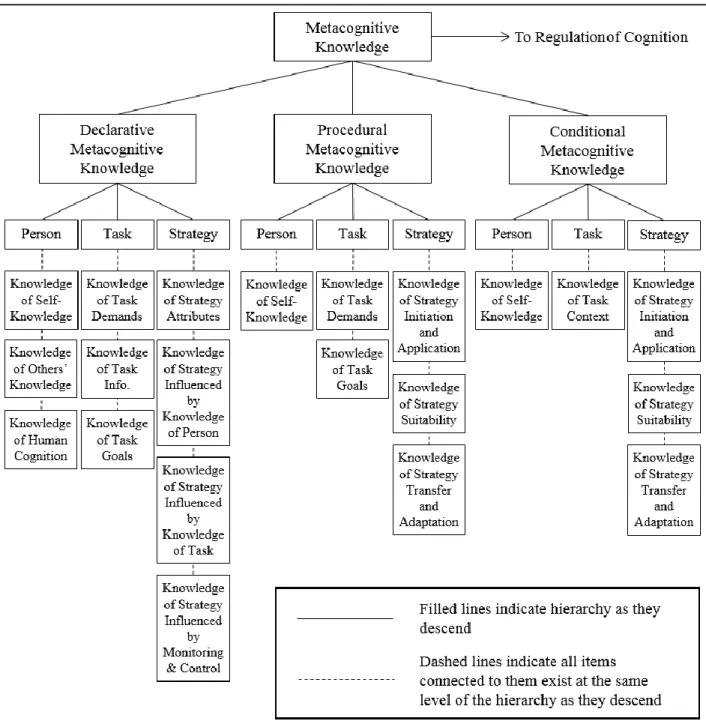
taxonomy includes “knowledge of cognition” and “regulation of cognition” (Tarricone, 2011b, p. 192). It is noted that the two top level categories are essentially the same as those laid out by Flavell in 1979. As might be expected of a construct detailing human thought, the taxonomy of metacognition is complex, with more than 80 identified elements. A figure showing the complete taxonomy is available online from the book's publisher (Tarricone, 2011a) and is too large to reproduce here in full. A partial
representation can be seen in Figure 1 and Figure 2. Note that the representations of the taxonomy given in these figures omit the final and most detailed level of the hierarchy, eliminate cross-references, and simplify some of the label text to permit more compact diagrams. These alterations may make it more difficult for the reader to determine the differences between elements of the taxonomy with similar names. This literature review briefly covers the structure of the taxonomy, before focusing on the elements of the taxonomy of central relevance to this study and how they might be employed to promote engineering teaming.
31
32
Figure 2: Regulation of Cognition
2.3 The Taxonomy of Metacognition
This section briefly summarizes the contents of the Taxonomy of Metacognition produced by Tarricone (2011b), used as the source for terminology and understanding of the structure of metacognition in this study. Some examples are provided to connect terms to real-world situations. Reference to the full, published taxonomy is
33
recommended for readers seeking a deeper understanding of the structure of
metacognition. Throughout sections 2.3, 2.4, and 2.5 the names of taxonomic categories of metacognition will appear in italics to assist in referencing Figure 1 and Figure 2.
The highest level of the taxonomy includes the categories of knowledge of
cognition (or metacognitive knowledge) and regulation of cognition (Tarricone, 2011b, p. 192). Metacognition in the broadest sense can feature either of these categories or the interplay of both. Given the large number of different types of metacognitive knowledge
and forms of regulation of cognition in the taxonomy, the potential breadth of this interplay is staggering. The category of metacognitive knowledge is introduced first.
2.3.1 Metacognitive Knowledge
It is important to differentiate knowledge of cognition, more compactly named
metacognitive knowledge, from purely cognitive knowledge. Cognitive knowledge is essentially any knowledge that is not about thinking or learning. Metacognitive knowledge must be about thinking or learning in some meaningful way. For instance, ‘Student A’s report shows that she is capable of synthesizing information from many different sources’ states a fact about Student A’s ability to think, and is therefore
metacognitive in nature. The statement ‘Student A’s report was submitted late’ does not express any facts about Student A’s thinking, and reflects the speaker’s cognitive
knowledge, not their metacognitive knowledge. Metacognitive knowledge can also be subjective or false (Tarricone, 2011b, p. 157). Thus both the idea that ‘human cognition is well-understood’ and the idea that ‘human cognition is not well-understood’ could both qualify as metacognitive knowledge.
34 Metacognitive knowledge can be declarative “knowing about knowing”,
procedural “knowing how to know”, or conditional “knowing when, where, and why” about persons, tasks, or strategies (Tarricone, 2011b, pp. 194-195). This review does not cover all categories of the taxonomy, but the examples provided below may be helpful in illustrating some of the high-level differences. For these examples, a hypothetical student has been given instruction in solving a particular type of equation, and thereafter has the following thoughts:
1. “The homework assignment that requires solving these equations is due tomorrow.”
This fact is not about thinking. It is cognitive knowledge.
2. “I do not understand the techniques taught in class. I am confused.”
These facts relate to the status of the student’s mind and thoughts – and have no conditional or procedural characteristics – so they are declarative metacognitive knowledge. They are about a person rather than a task or strategy, so they are declarative metacognitive knowledge of person.
3. “Figuring out these problems is really tough.”
This is also a fact about thinking, without procedural or conditional implications, and it is therefore declarative metacognitive knowledge. Recall that metacognitive knowledge can be subjective or false. As this fact relates to a cognitive task (figuring out these problems) rather than to a person or strategy, it is declarative metacognitive knowledge of task.
4. “If I just sit here and look at the examples like I’m doing right now, I am not going to be successful in figuring this out.”
35
Under the current cognitive conditions (confusion, lack of progress), the student observes the fact that the current thought strategy (reviewing examples) is not appropriate. The fact is metacognitive, conditional and relates to a specific strategy - it is conditional metacognitive knowledge of strategy.
5. “I need to know how to break the overall solution down into smaller steps.”
a. The student is thinking about what procedures are required to complete a cognitive task – thinking about how to know. This is procedural
metacognitive knowledge. As the fact relates to the nature of a task, is it
procedural metacognitive knowledge of task.
2.3.2 Regulation of Cognition
For an act of regulation to be metacognitive it must regulate, or at least influence, thought or the mind. Therefore, human acts of regulation such as maintaining heartbeat, pouring water into a glass to an appropriate level of fullness, or completing a multi-step process by rote are not typically metacognitive in a given moment. One example of
regulation of cognition is planning to study for an exam in a quiet environment to eliminate distractions. Note that the idea ‘studying in a quiet environment may limit distractions and improve cognitive function’ is metacognitive knowledge – it is the mental action taken to determine and enact the plan that constitutes the regulation of cognition. Another example of regulation of cognition could be becoming aware of personal anger, connecting that awareness with the metacognitive knowledge that anger that can skew decision-making, and abstaining from making decisions until the anger has subsided.
36
Further examples accompany discussion of the subcategories of regulation of cognition.
Recognition of cognition is composed of the child categories of executive functioning and
metacognitive experiences. Executive functioning is discussed first.
2.3.2.1 Executive Functioning
Executive functioning is composed of monitoring and control and self-regulation.
Monitoring and control is more active and task-centric, focusing on “evaluation and control” and “predicting, planning, cognitive monitoring, diagnosing, regulating, checking, and evaluating learning processes, difficulties, and outcomes” (Tarricone, 2011b, p. 166). Self-regulation is a metacognitive subset of the larger overall process of regulation and is more reflective, touching on “awareness, judgment, self-concept and self-efficacy” along with “motivational elements” (Tarricone, 2011b, p. 169). However, the distinction between monitoring and control and self-regulation is in some places the narrowest in the taxonomy, especially when focused on the person
dimension as opposed to that of task or strategy. Some elements of these two categories appear identical or interchangeable - compare “(monitoring and control) involves
metacognitive processes that facilitate and support the evaluation and control of the learning process” (Tarricone, 2011b, p. 166) with “self-regulation involves processes such as control, monitoring, and regulation of learning processes” (Tarricone, 2011b, p. 168). The difficulty in distinguishing between the two subcategories of executive functioning seems primarily due to the close interaction between the two subcategories. It should be noted that self-regulation extends considerably beyond the borders of
37
metacognition, including self-efficacy and self-esteem among other areas (Tarricone, 2011b, p. 168). The taxonomy only deals with the metacognitive aspects of self-regulation.
Examples of monitoring and control include assessing whether a studying
technique is effective, noting an error in thought and correcting it, and evaluating whether something has been learned sufficiently well or not. Examples of metacognitive self-regulation include noting that fatigue is inhibiting clear thought, updating one’s self-efficacy in problem-solving after completing a difficult task, or using internal dialogue to ‘tell’ oneself how to proceed.
2.3.2.2 Metacognitive Experiences
Metacognitive experiences interact closely with monitoring and control and can be further subdivided into metacognitive feelings and metacognitive judgements.
Metacognitive feelings are mental experiences distinct from emotions that are
metacognitive in nature. For example, a student feeling that she is (or is not) confused, that a task is familiar (or unfamiliar), or a task is difficult (or easy) are all metacognitive feelings. It should be noted that metacognitive feelings can be implicit (a person may be confused without consciously noting that this has occurred) or explicit, which is often linked to mental or physical vocalization of the metacognitive experience. Metacognitive feelings of particular relevance to teaming skills employment include feelings of