Personal Mobile Album/Diary Application
Development
Haeryong Cho, Min Choi
52 Naesudong-ro, Chungbuk National University Dept. of Information and Communication Engineering
South Korea [email protected]
`
Abstract—Mobile computing devices such as smartphones and
personal media players are challenging because of their intrinsic features, such as their battery capacity, the constraints of wireless networks, and device limitations. First, a fundamental challenge is related to the power inefficiency of location-aware functions. Location-based applications are killer applications on smartphones, but they consume large amounts of power when operated for a long period. Thus, an energy-efficient location-based service is proposed. Second, another challenge is related to the power inefficiency with respect to mobile cloud computing. Thus, the proposed framework reduces power dissipation by substituting less power-intensive sensors when the smartphone is in a static state, such as on a table in an office. This substitution is controlled by a finite state machine with a user movement detection strategy. The core technique employed by the proposed framework is based on a web service and SOAP because a web service is the best fit for a framework that does not depend on a specific smartphone OS platform. Thus, the proposed framework architecture was evaluated using an application for PI value computation. The results demonstrated that the mobile cloud computing platform delivered better performance by increasing the number of cloud nodes and the resource management strategy improved the power consumption.
Keywords-component; HTML5; Mobile Photo Album; Frame Management; Mobile Cloud;
I. INTRODUCTION
Mobile computing is a growing trend where microprocessors are embedded in everyday objects to allow them to communicate information. Mobile computing devices are completely connected and constantly available [1], which relies on the convergence of wireless technologies, advanced electronics, and the Internet. Current mobile consumer electronics are not simply mobile communication devices, because they can change the lifestyles of people and create new cultures. Thus, data exists anywhere that the user requires. Indeed, things that were previously unimaginable can now be achieved by mobile computing [2][3][4]. The present study introduces a mobile application framework for smartphones. A mobile application framework should be a low-power, location-based service (LBS). In mobile computing, mobility is the basis of everything. Thus, it is necessary to focus on the conservation of energy for LBS services on mobile devices. Therefore, the proposed mobile application framework is targeted at mobile computing, which involves numerous mobile devices. The proposed framework reduces power dissipation by substituting less power-intensive sensors when
the smartphone is in a static state, such as on a table in an office.
In addition, mobile-cloud computing represents a paradigm shift in the field of mobile computing. Within the space of a few years, we can expect a major shift from traditional mobile applications to mobile cloud computing. This will improve the application performance and efficiency by offloading complex and time-consuming tasks to powerful computing platforms. Only running simple tasks on mobile devices will extend the battery lifetime and improve the processing efficiency. Offloading based on parallelism is faster, but it can also be used to solve problems related to large datasets that involve non-local resources. If a set of computers is connected to a network, a vast pool of CPUs and resources is available, which can access files in the cloud. The present study proposes a novel approach that achieves mobile cloud convergence in a transparent and platform-independent manner. Users do not need to know how their jobs are actually executed in a distributed environment, thus it is not necessary to consider whether their mobile platforms are iPhones or Android. This is because the core technology used by the proposed framework is based on a web service and SOAP via the HTTP 80 port. Thus, this is a platform-independent smartphone application development framework, where the structure does not depend on the smartphone platform. It comprises a web service and a mobile web (HTML5-like) device API standard. Running complex tasks in the cloud as a web service reduces computational time requirements and the battery power usage. In addition, complex business logics and computations are offloaded to cloud computing platforms. This mobile cloud computing framework allows all applications to be accessed over the web via a smartphone.
BACKGROUND
Despite the market’s heterogeneity, the nexus of smartphones, wireless broadband, and network-based cloud computing presents an opportunity for application developers by drawing their attention toward new platforms.
COMSOL [7] reduces the upfront investment in equipment and technical expertise dramatically and high-performance computing is now ready for the mainstream. Exploratory speedup factors of 6´ and 11´ in the context of embarrassingly parallel COMSOL Multiphysics computations are a powerful business justification for Windows HPC. The ability to divide and conquer by distributing the memory
requirements for any problem size will allow the solution of novel problems.
Dandelion [9] provides a system implementation on the Maemo Linux smartphone platform and the Rice Orbit body sensor platform. Dandelion has been evaluated by implementing real-world applications, which showed that Dandelion effectively eliminates the programming gap and significantly reduces the development effort required. Furthermore, Dandelion incurs very low overheads.
Certain approaches may be useful for complex mobile applications, but these programming styles differ significantly from those used in smartphone application development, thereby making it difficult for smartphone developers to adopt these approaches. By contrast, Dandelion exploits the simplicity of smartphone-centered body sensor networks and focuses on supporting in-sensor data processing tasks. Based on this trade-off, Dandelion can support a transparent programming style.
Some systems support programming transparency with unified OS abstraction or a distributed runtime system, but they are mostly based on a virtual-machine approach that hides ISA variation. However, this approach is inefficient with resource-constrained sensors. By contrast, Dandelion achieves transparency by limiting the sensor functions to data processing and by introducing an extra compilation phase.
SMARTPHONE DEVELOPMENT METHOD
The current smartphone application development approach is highly dependent on specific mobile frameworks such as Android or iPhones. Thus, a new smartphone application can only run on one platform. This limitation results in the waste of development costs because “one source multi-use” is not allowed, although it is necessary to develop or compile the same applications for each platform. However, the future trend for smart application development is platform-independence. This is because device fragmentation exists even within the Android platform, where there are numerous Android devices on the market. PC’ s File System PC Era 1980-1990 Web 1.0 1990-2000 Web 2.0 2000-2010 Web 3.0 2010-2020 Web 4.0 2020-2030
Semantics of Social Connections
S e m a n ti cs o f In fo rm a ti o n C o n n e ct io n App Store
Figure 1. Web User Paradigm Based on App Store and Community Portals Figure 1 illustrates the paradigm shift in smart IT applications. Initially, the left-hand side of Figure 1 is available to almost all developers. At present, we are beginning to see Web 3.0 technology on our smartphones. This is beneficial for
consumers (although it may give them a sense that Big Brother really is looking over their shoulder), but one of the big questions is how Web 3.0 technologies will be made available to businesses and how businesses will then be able to embrace them. If technology is required, there must be the potential for a level playing field. Thus, the core technology of the framework proposed in the present study is based on a web service and SOAP via the HTTP 80 port.
• WAC(Wholesale Application Community) Initiation
• Samsung, LG, Sony Ericsson,Vodafone, AT&T, Verizon, Sprint,China Mobile, NTT DoCoMo, Telefonica, Deutsche Telekom, SKT, KT … (24companies)
• ·Binary Translation (BT) • MagicCode – MIPS platform based BT • Houdini – INTEL platform based BT • J2ObjC- source code level BT • HTML5 based Smart TV SDK • WYSIWYG Editor • JPEG Slide • Framework API • Scene Manager • HTML5
• Sencha Touch: HTML5 UI Framework • jQuery Mobile : HTML5 UII Framework
One Source Multi Use Platforms
WAC(Wholesale App. Community) HTML5 Smart Platform
Smart TV SDK Binary Transformation
Figure 2. “One Source Multi-Use” Platforms
This represents an OS-independent smartphone application development framework. The OS-independent platform means that the structure is not dependent on the smartphone platform. The framework comprises a web service and a mobile web (HTML5-like) device API standard. Running complex tasks in the cloud as web services reduces the computational time requirements and the battery power usage. In addition, complex business logics and computations are offloaded to cloud computing platforms. Current smartphone application development platforms include Android, iOS, and Windows Mobile. Each platform has its own application development environment, which is not compatible with others. Thus, an iOS application requires iOS and some Blackberry applications require a Blackberry. However,
platform-independent smartphone application development
environments are becoming popular. Thus, the proposed mobile cloud computing framework allows all applications to be accessed via the web using a smartphone. This type of framework provides a common accessible layer that is platform-independent, e.g., W3C mobile web standard. The proposed approach uses the web service architecture via the W3C mobile web standard layer. The advances in smart
devices have led to changes in the attributes of the available contents and services, thereby creating new opportunities for developers. The demand for content sharing among all types of smart devices is also increasing. However, this requires compatibility between smart devices. Figure 2 illustrates the “one source multi-use” development paradigm. The key enablers of “one source multi-use” are WAC, HTML5, smart TV, and binary translation. HTML5 is a key technique for implementing platform-independent smartphone applications. Binary translation is required to translate the binaries needed by a specific target platform to the binaries used by another target platform. Smart TV is internet-enabled TV, which can run smart applications via the Internet.
Mobile cloud convergence is a paradigm shift in the field of mobile and parallel computing. In the next few years, we can expect a major shift from traditional mobile application technology to mobile cloud computing. This will improve the application performance and efficiency by offloading complex and time-consuming tasks to powerful computing platforms. Only running simple tasks on mobile devices will increase the battery lifetime and improve the processing efficiency. Offloading using parallelism is faster, but it can also be used to resolve the problems related to large datasets of non-local resources. If a set of computers is connected in a network, a vast pool of CPUs and resources is available, which can access files in the cloud. This mobile cloud can be exploited using any platform.
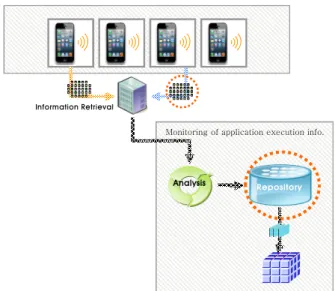
Analysis Information Retrieval
Repository
Monitoring of application execution info.
Figure 3. Mobile Cloud Smartphone Application Architecture
Third-party developers can exploit cloud computing facilities using Open API. Currently, it is easy to produce a new program by mashing up advanced functionalities, which would be almost impossible to create from scratch. Thus, startups can expand their company’s user base without having to spend any money to develop niche industry software and they still retain their source code proprietary. Open APIs can be problematic for developers, however, because the company that publishes the API has all the power. If the startup ever decides to change the terms of use for its API, for example, or
if they decide to charge a fee to license the API, the third-party developer has no choice but to accept it and deal with it. Although its branding closely mirrors what is found currently on Google’s Android Market web front, the new Google Play focuses on the other services of Google features because most people who visit Google’s web store are there to search for music, movies, or books. One of the biggest recent criticisms of Google has been that Google’s approach to a content ecosystem appears fragmented to the casual observer, which they have addressed by the major launch of Google Play. Google obviously hopes that an integrated ecosystem will allow the company to ensure that its Movies and Music services are adopted more widely, although the former has not quite lived up to expectations. The move to a single integrated Google Play puts Google in a better position to compete with iTunes, which is Apple’s single solution strategy that offers Mac and iOS users a full library of music, movies/TV shows, and application content to be purchased for these devices.
3.1 Platform-independent Mobile Application Design
At present, people post photos multiple times from their iPhones or Android-like smartphones. No HTML5-based application or methods are available for starting an album group or adding to an existing album. Instead, photos are placed in the photo gallery (or on the wall). Thus, users have difficulty keeping track of their photos. Therefore, albums are desirable feature and it should be simple to create an album, and to add to it. There are several native applications for creating photo albums on iPhones or Android. However, HTML5-based photo album applications do not allow additions to albums or the creation of an album group from smartphones. Therefore, a working version of an HTML5-based photo album application was designed and implemented in the present study. This section describes the design of the user interface (UI) of the photo album application, which is based on the perspective of a frame diary. Frame management in the form of a simple diary can provide numerous attractive designs for photos, such as background images (themes), layouts, frames, balloon stickers, and patterns. The proposed photo album allows virtually limitless customization with different layouts, so photos can be edited and framed as desired.
The diary maker component of the photo album application is referred to as an easy diary because it is simple to select a layout from various samples. Next, it is possible to add photos to the album from a smartphone gallery and to create an album group from a smartphone.
Figure 4 shows the template library screen of the HTML5 photo album application. The main screen is shown on the left-hand side of Figure . Four buttons can be used to select different functions: creating a new diary (the easy diary), searching a diary from the diary database, showing a diary in a calendar view, and showing photos in a grid view. If the easy diary is selected from these functions, the template chooser panel (template library) is shown, i.e., the top of Figure . The template library can be used to select any type of layout for the photos. If the user does not want to make a selection from the template library, they can select a new diary that is not based on a template. This feature is referred to as the frame diary. The photo album allows virtually limitless customization because any layouts can be obtained using the frame diary. The frame diary allows users to edit the frames as required.
Figure 5. Frame Management (Merge, Placement, etc.)
Figure 5 shows the customization phase where a layout is prepared without any limitations. Numerous sets of small grid panels are provided, which can be merged and separated into various forms. This customization procedure supports touch, drag, and drop via the interface. The HTML5 standards state that the drag and drop feature is supported but this is highly dependent on the web browser and the platform. Thus, this action is still not perfect for use. Therefore, the touch, drag, and drop interfaces were implemented manually using the Javascript language in the photo album application to ensure compatibility with any smart device.
3.2 Image Scaling Implementation
Pinch and spread allows the users of smartphones and tablets to enlarge an image by placing two fingers onto the screen and spreading them slightly apart. This can be used to enlarge (zoom in) or shrink (zoom out) an object. This works well with content that can be zoomed, such as a web page, map, or an image, as in the present study. A user can touch the screen with two fingers and spread the fingers to magnify a specific target, assuming that the content is usually displayed at full screen. The level of magnification is stepless and it depends only on how far the fingers can be spread. However, Apple has a patent and this is a key example of proprietary IT because it is trying to protect this method in its current case
against Samsung, which also includes a “pinch-to-zoom” feature in its Android mobile devices.
Thus, it was necessary to find an alternative technique for pinch and spread without violating intellectual property rights. Therefore, a workaround technique is proposed that imitates pinch and spread, which is achieved using image cropping and image scaling. Originally, image cropping referred to the removal of the outer parts of an image to improve framing, to accentuate the subject matter, or to change the aspect ratio. Depending on the application, this may be performed with a physical photograph, artwork, or film footage, or achieved digitally using image editing software. The term is used commonly in the film, broadcasting, photographic, graphic design, and printing industries. In the present study, this technique is used by application in the same manner as pinch and spread. Some libraries are available to support image cropping, such as Jcrop, which is a quick and easy way to add an image cropping functionality to web applications.
Figure 6. Pinch and Spread Implementation in the Proposed Application
Jcrop combines the ease of use of a typical jQuery plugin with a powerful cross-platform DHTML cropping engine, which is faithful to familiar desktop graphics applications. However, it was not possible to use the jCrop library because it is based on the jQuery library. The proposed method uses Sencha Touch as the HTML5 UI Framework, thus the image cropping functionality was developed from scratch.
Figure 6 shows the implementation of image cropping in the photo album application. This function was designed to allow developers to integrate an advanced image cropping functionality directly into any web-based application without sacrificing power and flexibility (or weeks of coding, testing and debugging). In the proposed method, six additional arguments are added to the image data structure to crop an image using HTML5 Canvas: sourceX, sourceY, sourceWidth, sourceHeight, destWidth, and destHeight. These arguments define the location and size of a rectangle that can be cut from an image. The scrollable panel contains the image data, which is initialized to a size of 400 ´ 400. However, the height and width are adjusted to each panel size, which might be larger or smaller depending on whether it is merged with other panels or not. The cls property represents the class definition in a cascading style sheet (CSS) file. CSS is used to control the style and layout of web pages. CSS3 is the latest standard for
CSS. The CSS style sheet language is used to describe the presentation semantics (the look and formatting) of a document written in a markup language. CSS is designed primarily to allow the separation of document content (written in HTML or a similar markup language) from document presentation, including elements such as the layout, colors, and fonts. This separation can improve the content accessibility, provide more flexibility, and control the specification of presentation characteristics, thereby allowing multiple pages to share formatting, which reduces the complexity and repetition of the structural content. Thus, it is simple to change the values of objects in an HTML5 web page at any time by setting the value to a specific property. Image cropping can be implemented by assigning a value to the properties scrollx and scrolly in the scroll panel view component because a portion of the original image is shown in the scrollable panel area.
3.2 Diary/Calendar Implementation
Numerous methods can be used to implement the calendar functionality in the proposed HTML5 application. The diary functionality was implemented manually in the proposed MVC application.
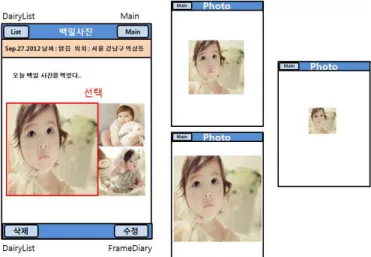
Figure 7. Calendar Prototype Design
The diary needs to function in the main application (it is only a subset of the entire program), thus it had to be changed from the original diary application. For example, Figure 7 shows the original calendar interface. However, the diary needed to be connected to the photo album functionality in the day diary page, which is why the calendar was implemented manually.
3.3 Experimental Results
All commodity/elementary services are implemented and deployed by a type of web service, which is platform-independent to allow rapid delivery during smartphone application development. To ensure the convenience of
smartphone application development, the following
common/elementary services are desirable: augmented reality, HPC, voice/image processing, ubiquitous computing, and E-learning. However, the limited time and budget in the present study meant that only a PI value computation web service could be produced as a prototype.
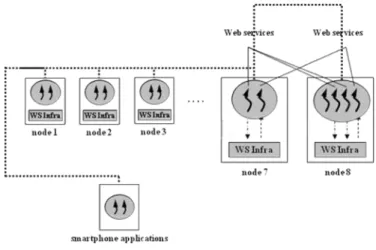
Figure 8. System Architecture
Figure 2 shows the applications that mobile devices need to locate their requisite services. To achieve this, the web service architecture includes Universal Description, Discovery and Integration (UDDI), which is a platform-independent XML-based registry for listing on the Internet that facilitates searches for web service applications. The proposed framework also uses UDDI to locate appropriate web services. Figure 3 shows the job distribution strategy used for PI value
computation by the proposed platform-independent
smartphone application development framework with a web service. In this offloading framework, the computation-oriented processes run on a remote cloud node as a web service whereas the remaining processes run on the mobile device. This framework improves the performance and extends the battery life of mobile devices.
Figure 9. Calendar Implementation
An important aspect of smartphone application development is rapid implementation and delivery. Thus, if an idea is implemented as a smartphone application by a developer, the initial development is recognized as the standard in the area. Rapid development and deployment demands a development method that utilizes common components rather than implementation from scratch. The utilization of reusable and composable elementary components facilitates the rapid production of new services and applications. In the proposed method, the mobile cloud architecture is based on a web service and common services and composable elements are provided as a form of web service. The proposed application was constructed with eight nodes from a cloud service using Core2 Duo 2 GHz machines, each with 2 GB RAM. The machines were connected via 1 Gbps Ethernet. Figure 2 provides an overview of the mobile cloud convergence framework, which was designed in three stages: the web service-oriented infrastructure, the commodity/elementary web services, and the operating environment. The prototype solution was installed on a Samsung Galaxy S, which is an Android phone with OS version 2.2. The four design principles implemented in Java are included in the Android framework. The prototype included a graphic user interface that allowed users to enable, disable, and finely configure the prototype. In current Android APIs, GPS is invoked through a major function call, requestLocationUpdates(), which requires at least four input parameters: LocationProvider, reporting frequencies in term of the time and distance, and PendingIntent or LocationListener. The prototype captured this function call and embedded intelligence inside the function, as well as other relevant functions. The experimental configuration comprised: (a) power supply, (b) digital multimeter (True RMS Multimeter), (c) smartphone (Samsung Galaxy S), and (d) laptop computer. The rated input voltage/current range of the Samsung Galaxy S was 1500 mA at 3.7 V. Assuming that the voltage difference was stable at 3.7 V without fluctuations, measuring the current change with a digital multi-meter equated to checking the power dissipation.
CONCLUSION
The present study considered energy-efficient LBS and mobile convergence, and a framework was proposed for smartphone application development. Smartphones are generally less powerful than other mobile computing devices. Therefore, it is necessary to offload computation-intensive processes by carefully partitioning the application functions that requires cloud computing. A web service is the best fit for a framework that does not depend on a specific smartphone OS platform. Thus, a novel framework architecture was proposed in this study and the system was evaluated by developing an application for PI value computation. The results showed that the proposed mobile cloud computing platform performed better by increasing the number of cloud nodes. This framework also reduced the power dissipation caused by LBS by substituting less power-intensive sensors when the smartphone was in static state, such as on a table in an office. The core elements of this framework are a movement detection algorithm that detects user movements and a power reduction strategy, which is controlled by a finite state machine (FSM). The state transitions of the FSM are triggered by movement detection or timer expiration.
REFERENCES
[1] H. Jang and S. Hong, “Study on the OSMU (One-Source Multi-Use) Management for Smart Devices, International Journal of Smart Home, Vol.7, No. 1, Jan. (2013)
[2] 2. Smith, T.F., Waterman, M.S.: Identification of Common Molecular Subsequences. J. Mol. Biol. 147, 195--197 (1981)
[3] 3. May, P., Ehrlich, H.C., Steinke, T.: ZIB Structure Prediction Pipeline: Composing a Complex Biological Workflow through Web Services. In: Nagel, W.E., Walter, W.V., Lehner, W. (eds.) Euro-Par 2006. LNCS, vol. 4128, pp. 1148--1158. Springer, Heidelberg (2006)
[4] 4. Foster, I., Kesselman, C.: The Grid: Blueprint for a New Computing Infrastructure. Morgan Kaufmann, San Francisco (1999)
[5] 5. Czajkowski, K., Fitzgerald, S., Foster, I., Kesselman, C.: Grid Information Services for Distributed Resource Sharing. In: 10th IEEE International Symposium on High Performance Distributed Computing, pp. 181--184. IEEE Press, New York (2001)
[6] 6. Foster, I., Kesselman, C., Nick, J., Tuecke, S.: The Physiology of the Grid: an Open Grid Services Architecture for Distributed Systems Integration. Technical report, Global Grid Forum (2002)
[7] 7. National Center for Biotechnology Information, http://www.ncbi.nlm.nih.gov
[8] 8. Pinch & Spread, Android Patterns,
http://www.androidpatterns.com/uap_pattern/pinch-spread
[9] 9. Apple vs. Samsung: The Patent Wars, Explained, http://mashable.com/2011/11/23/apple-samsung-patent-wars/
[10] 10. Frame Artist, https://itunes.apple.com/us/app/frame-artist-photo-templates/id515959813?mt=8
[11] 11. SmileBox, http://www.smilebox.com/
BIOGRAPHY
Haeryong Cho received B.S. degree in Information and Communication Engineering from Chungbuk National University in 2014. Now, he is persuing for M.S. degree of Information and Communication Engineering in Chungbuk National University. .
Min Choi received M.S. and Ph.D. degrees in Computer Science from Korea Advanced Institute of Science and Technology (KAIST) in 2003 and 2009, respectively. He also received a B.S. degree in Computer Science from Kwangwoon University in 2001. From 2008 to 2010, he worked for Samsung Electronics as a Senior Engineer.