Evaluation and Development of Tag-Based
Recommender Algorithms
Christoph Trattner
Norwegian University of Science and Technology, Trondheim and
Dominik Kowald AND Emanuel Lacic
Know-Center & Graz University of Technology, Austria
This article presentsTagRec, a framework to foster reproducible evaluation and development of recommender algorithms based on folksonomy data. The purpose of TagRecis to provide the research community with a standardised framework that supports all steps of the development process and the evaluation of tag-based recommendation algorithms in a reproducible way, in-cluding methods for data pre-processing, data modeling and recommender evaluation. TagRec currently contains 32 state-of-the-art algorithms for tag and item prediction, including a set of novel and very efficient algorithms based on the human cognition theories ACT-R and MINERVA2. The framework should be relevant for researchers, teachers, students and developers working on recommender systems and predictive modeling in general and those interested in tag-based rec-ommender algorithms in particular.
1. INTRODUCTION
In recent years social tagging has become an important instrument of Web 2.0, allowing users to collaboratively annotate and search content [Trattner et al. 2012; Helic et al. 2012; Helic et al. 2011]. In order to facilitate this process, current research has attempted to improve the performance and quality of tag recommendations. Furthermore, a number of algorithms has been created to recommend items to users based on folksonomy data. However, although various tag-based recommender approaches and studies exist showing the performance of the developed methods, most of them use different data pre-processing methods or evaluation protocols, making it difficult for researchers to understand the real
value of the methods developed. To tackle this issue, we inventedTagRec[Kowald et al.
2014], a framework providing researchers with a toolkit for developing and compareing
algorithms in a standardized way. The purpose ofTagRecis not only (a) to increase the
transparency in tag-based recommender research (see also [Said and Bellog´ın 2014]) but also (b) to decrease the workload associated with developing novel recommender algo-rithms by providing researchers with an easy to use and easy to extend framework.
Folks-onomy
Data
Pre-Processing Data Model
Recommen-dation Algorithms Evaluator / Data Post-Processing Metrics nDCG, UC, MRR, MAP, R@k, P@k, F1@k, D, S Client recommended tags / items Run-time [ms]
TagRec
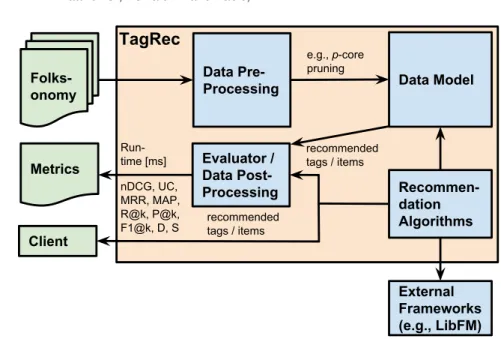
recommended tags / items e.g., p-core pruning External Frameworks (e.g., LibFM)Fig. 1. Current system architecture ofTagRec.
2. SYSTEM OVERVIEW
Fully implemented in the Java programming language, TagRec is open-source software
that can be downloaded free of charge from our Github1 repository. Figure 1 shows the
system architecture ofTagRec, which consists of four main components briefly described
below:
Data Pre-Processing. TagRecoffers various methods for data pre-processing: (1) pars-ing and processpars-ing of social taggpars-ing datasets, such as CiteULike, BibSonomy, Delicious,
LastFm, MovieLens and Flickr, into the system’s data format; (2) p-core pruning; (3)
training/test set splitting (e.g., leave-one-out, time-based or 80/20 splits) [J¨aschke et al. 2008] and (4) creating Latent Dirichlet Allocation [Krestel and Fankhauser 2010] top-ics for category-based algorithms, such as 3Layers [Kowald et al. 2014a; Seitlinger et al. 2013].
Data Model.The data model ofTagRecis generated from a folksonomy that represents the bookmarks (i.e., the combination of user-id, resource-id, timestamp and assigned tags) in a dataset. Furthermore, the data model is fully object-oriented and provides distinct classes and powerful methods for modeling and analyzing the relationship and interactions be-tween users, resources and tags (e.g., the number of times a specific tag has been assigned to a target resource or the time since the last usage of a specific tag in the tag assignments of a target user).
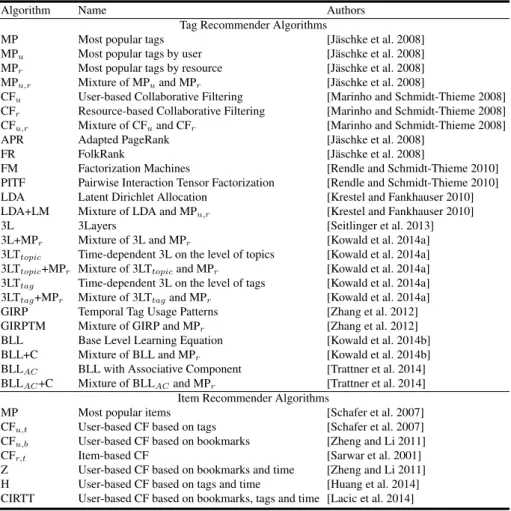
Recommendation Algorithms. Along with the state-of-the-art approaches for tag-based recommendations (e.g., Collaborative Filtering or FolkRank) [Marinho et al. 2011], the engine contains a set of novel and recently published algorithms based on models derived
Algorithm Name Authors Tag Recommender Algorithms
MP Most popular tags [J¨aschke et al. 2008]
MPu Most popular tags by user [J¨aschke et al. 2008]
MPr Most popular tags by resource [J¨aschke et al. 2008]
MPu,r Mixture of MPuand MPr [J¨aschke et al. 2008]
CFu User-based Collaborative Filtering [Marinho and Schmidt-Thieme 2008]
CFr Resource-based Collaborative Filtering [Marinho and Schmidt-Thieme 2008]
CFu,r Mixture of CFuand CFr [Marinho and Schmidt-Thieme 2008]
APR Adapted PageRank [J¨aschke et al. 2008]
FR FolkRank [J¨aschke et al. 2008]
FM Factorization Machines [Rendle and Schmidt-Thieme 2010]
PITF Pairwise Interaction Tensor Factorization [Rendle and Schmidt-Thieme 2010]
LDA Latent Dirichlet Allocation [Krestel and Fankhauser 2010]
LDA+LM Mixture of LDA and MPu,r [Krestel and Fankhauser 2010]
3L 3Layers [Seitlinger et al. 2013]
3L+MPr Mixture of 3L and MPr [Kowald et al. 2014a]
3LTtopic Time-dependent 3L on the level of topics [Kowald et al. 2014a]
3LTtopic+MPr Mixture of 3LTtopicand MPr [Kowald et al. 2014a]
3LTtag Time-dependent 3L on the level of tags [Kowald et al. 2014a]
3LTtag+MPr Mixture of 3LTtagand MPr [Kowald et al. 2014a]
GIRP Temporal Tag Usage Patterns [Zhang et al. 2012]
GIRPTM Mixture of GIRP and MPr [Zhang et al. 2012]
BLL Base Level Learning Equation [Kowald et al. 2014b]
BLL+C Mixture of BLL and MPr [Kowald et al. 2014b]
BLLAC BLL with Associative Component [Trattner et al. 2014]
BLLAC+C Mixture of BLLACand MPr [Trattner et al. 2014]
Item Recommender Algorithms
MP Most popular items [Schafer et al. 2007]
CFu,t User-based CF based on tags [Schafer et al. 2007]
CFu,b User-based CF based on bookmarks [Zheng and Li 2011]
CFr,t Item-based CF [Sarwar et al. 2001]
Z User-based CF based on bookmarks and time [Zheng and Li 2011]
H User-based CF based on tags and time [Huang et al. 2014]
CIRTT User-based CF based on bookmarks, tags and time [Lacic et al. 2014]
Table I. Current tag-based recommender algorithms implemented inTagRec.
from human cognition to predict tags or items in folksonomies. All algorithms imple-ment a common interface which makes it easy to develop and integrate new approaches. Moreover, we offer also connectors to external libraries such as LibFM to make use of frameworks in other programming languages such as C++. The predicted items and tags generated by the different algorithms can be forwarded either to the evaluation engine or directly to a client application.
Evaluator / Data Post-Processing. This component evaluates the algorithms based on training/test set splits of a dataset with respect to standard Information Retrieval (IR)
met-rics, such as Recall (R@k), Precision (P@), F1-score (F1@k), Mean Reciprocal Rank
(MRR), Mean Average Precision (MAP), Normalized Discounted Cumulative Gain (nDCG) and User Coverage (UC) [J¨aschke et al. 2009]. As for the item recommender algorithms, we also integrated other evaluation metrics such as Diversity (D) and Serendipity (S). Moreover, the evaluation engine offers data post-processing functionality that can, for ex-ample, limit the evaluation to users with a given minimum or maximum number of book-marks or to users with certain tagging behavior (e.g, categorizer vs. describer [K¨orner et al.
Dataset |B| |U| |R| |T| |T AS|
BibSonomy 400,983 5,488 346,444 103,503 1,479,970 CiteULike 379,068 8,322 352,343 138,091 1,751,347 Delicious 1,416,151 15,980 931,993 180,084 4,107,107 Flickr 864,679 9,590 864,679 127,599 3,552,540
Table II. Properties of the datasets used in our first evaluation experiment (i.e.,
recommend-ing tags), where|B|is the number of bookmarks,|U|the number of users,|R|the number
of resources,|T|the number of tags and|T AS|the number of tag assignments.
2010]).
3. RESULTS
In the following section we report the results of two evaluation experiments to (i)
demon-strate the functionalities implemented inTagRecand (ii) to reveal the differences of the
algorithms in terms of the predictive power and runtime. Both experiments were con-ducted in memory on a IBM System x3550 M4 Server, with one Intel(R) Xeon(R) CPU E5-2640 v2 @ 2.00GHz and 256GB RAM.
3.1 Evaluation Experiment 1: Recommending Tags
In the first experiment we evaluated and compared several tag recommendation approaches
implemented withinTagRecusing four real-world folksonomy datasets gathered from the
online bookmarking and sharing platforms BibSonomy2(2013-07-01), CiteULike3
(2013-03-10), Delicious and Flickr4(2010-01-07). The properties of the datasets are highlighted
in Table II. For the benchmarking experiment we split the datasets into one training and one
test set using the time-based leave-one-out pre-processing method implemented inTagRec
(i.e., the latest bookmark for each user was used for testing and the rest for training). To determine the predictive power of the approaches, we utilized a set of well-known
Infor-mation Retrieval metrics available in TagRec(R@k, P@k, F1@k, MRR, MAP, nDCG).
Parameters of the algorithms were set to the default values in TagRec, i.e., for CF the
neighborhood size was set tok= 20, for MPu, rand BLL+Cβ was set to .5, the number
of factors for PITF and FM were set to 256 based on 50 iterations, LDA as well as 3L and
3LT were calculated based on 1000 latent topics, and for FR and APR the parameterdwas
set to .7 and the number of iterations was set to 10.
Table III and Figure 2 presents the results of this experiment. As highlighted, 3LTtag+MPr
reaches the highest level of estimates in all four datasets followed by the other
combina-tions of 3LT and MPrand BLL+C. It is interesting to observe, that all these approaches are
simple algorithms based on human cognition theories and that they all outperform more complex models such as APR, FR or popular tensor factorization approaches such as FM or PITFM. However, it has to be noted that those approaches also incorporate the
vari-2http://www.kde.cs.uni-kassel.de/bibsonomy/dumps 3http://www.citeulike.org/faq/data.adp
4https://www.uni-koblenz.de/FB4/Institutes/IFI/AGStaab/Research/DataSets/
Measure MP LDA MPr MPu,r CF APR FR FM PITF GIRPTM BLL+C 3L+MPr 3LTtopic+MPr 3LTtag+MPr Bib . FMRR@101@5 .013 .097 .074 .192.008 .084 .054 .148 .166 .175 .171 .122 .138.133 .149 .148 .099 .119 .197.152 .201.158 .157.206 .158.207 .211.162 MAP@10 .009 .101 .070 .194 .173 .193 .194 .122 .150 .200 .207 .207 .208 .214 nDCG@10 .019 .142 .089 .240 .214 .244 .242 .172 .198 .248 .254 .254 .256 .261 Cite. F1@5 .007 .068 .033 .199 .157 .162 .161 .112 .130 .207 .215 .232 .233 .238 MRR@10 .005 .066 .024 .179 .175 .181 .181 .116 .148 .196 .205 .199 .200 .212 MAP@10 .005 .074 .029 .210 .203 .212 .212 .132 .168 .229 .241 .235 .236 .250 nDCG@10 .011 .107 .035 .252 .234 .257 .255 .177 .210 .270 .280 .275 .277 .289 Del. F1@5 .033 .168 .140 .236 .228 .211 .229 .157 .185 .253 .270 .268 .271 .278 MRR@10 .025 .157 .113 .215 .214 .206 .221 .141 .178 .236 .262 .243 .246 .263 MAP@10 .026 .187 .146 .257 .262 .246 .270 .168 .211 .286 .320 .301 .304 .323 nDCG@10 .049 .249 .179 .329 .316 .315 .341 .233 .278 .358 .388 .370 .374 .390 Flickr F1@5 .023 .160 - .435 .417 .328 .334 .298 .318 .509 .523 .568 .571 .585 MRR@10 .023 .165 - .360 .436 .352 .355 .298 .337 .445 .466 .450 .454 .477 MAP@10 .023 .193 - .468 .581 .453 .459 .381 .431 .590 .619 .599 .604 .636 nDCG@10 .038 .252 - .520 .612 .507 .513 .447 .491 .626 .648 .634 .639 .663
Table III. F1@5, MRR@10, MAP@10 and nDCG@10 of the tag recommender
ap-proaches in BibSonomy (Bib.), CiteULike (Cite.), Delicious (Del.) and Flickr.
able of time in their models which is not the case for all the other models except GIRPTM [Zhang et al. 2012] which was known to be the best time-based tag recommender approach
until the BLL+C [Kowald et al. 2014b] and 3LTtag+MPr[Kowald et al. 2014a] algorithms
were published.
Figure 5 shows the runtime comparison of the algorithms in the four datasets for the full time required to provide tag recommendations for all user-resource pairs in the test sets.
As highlighted, the frequency-based methods such as MP, MPu, MPr, MPu, ror GRPTM
and BLL+C perform best in that respect. All other methods perform significantly worse. Summed up, the best algorithm providing both good runtime and high predictive power is BLL+C [Kowald et al. 2014b].
3.2 Evaluation Experiment 2: Recommending Items
In the second experiment we benchmarked a selection of item recommendation approaches
implemented inTagRecagainst each other. As in the first evaluation experiment, we
uti-lized folksonomy datasets from the social bookmarking sites BibSonomy and CiteULike
(same datasets). Furthermore, we used a tagging dataset from the MovieLens platform5
(2011-01-01). The properties of the datasets are outlined in Table IV. To determine the predictive power of the approaches we used the time-based 80/20 splitting method within
TagRec, i.e., for each user we sorted her bookmarks in chronological order and used the 20% most recent bookmarks for testing and the rest for training. As benchmark evaluation
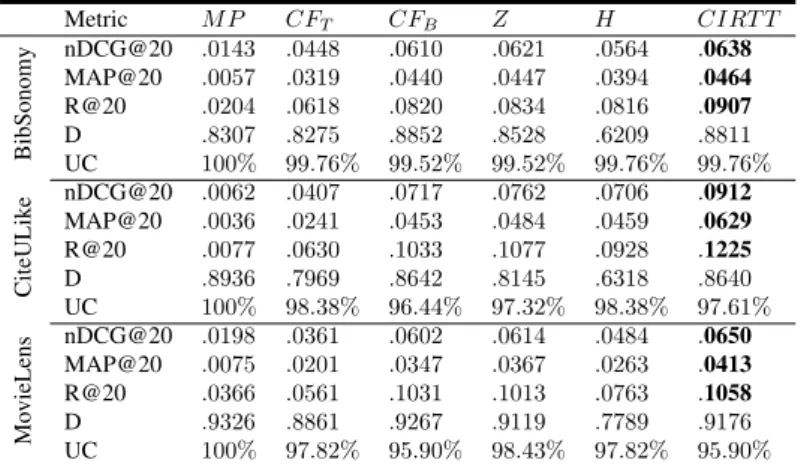
metrics R@k, P@k, F1@k, MAP, nDCG, UC (= User Coverage) and D (= Diversity) were
utilized. The results of this experiment are presented in Table V and Figure 4. As shown, the CIRTT [Lacic et al. 2014] algorithm, that re-ranks the recommended list with respect to similar items recently bookmarked by the users with important tags, reaches the best results in all settings. Moreover, CIRTT not only provides the highest levels of accuracy but also shows good performance in terms of the diversity measure. Another interesting
finding from that experiment is the fact that CFB performs significantly better than CFT,
although one might assume that semantic information present in the form of tags contains
0.0 0.1 0.2 0.3 0.4 0.5 0.6 Recall 0.0 0.1 0.2 0.3 0.4 0.5 0.6 Precision MP LDA MPr MPu,r CF APR FR FM PITF GIRPTM BLL+C 3L+MPr 3LTtopic+MPr 3LTtag+MPr (a) BibSonomy 0.0 0.1 0.2 0.3 0.4 0.5 0.6 Recall 0.0 0.1 0.2 0.3 0.4 0.5 0.6 Precision MP LDA MPr MPu,r CF APR FR FM PITF GIRPTM BLL+C 3L+MPr 3LTtopic+MPr 3LTtag+MPr (b) CiteULike 0.0 0.1 0.2 0.3 0.4 0.5 0.6 Recall 0.0 0.1 0.2 0.3 0.4 0.5 0.6 Precision MP LDA MPr MPu,r CF APR FR FM PITF GIRPTM BLL+C 3L+MPr 3LTtopic+MPr 3LTtag+MPr (c) Delicious 0.0 0.2 0.4 0.6 0.8 1.0 Recall 0.0 0.2 0.4 0.6 0.8 1.0 Precision MP LDA MPu,r CF APR FR FM PITF GIRPTM BLL+C 3L+MPr 3LTtopic+MPr 3LTtag+MPr (d) Flickr
Fig. 2. Recall/Precision plots of the tag recommender approaches in BibSonomy, CiteU-Like, Delicious and Flickr.
MP LDA MPr MPu,r CF APR FR FM PITF GIRPTM BLL+C 3L+MPr3LTtopic+MPr3LTtag+MPr
Algorithms 101 102 103 104 105 106 107 108 109
Log overall runtime [ms]
(a) BibSonomy
MP LDA MPr MPu,r CF APR FR FM PITF GIRPTM BLL+C 3L+MPr3LTtopic+MPr3LTtag+MPr
Algorithms 101 102 103 104 105 106 107 108 109
Log overall runtime [ms]
(b) CiteULike
MP LDA MPr MPu,r CF APR FR FM PITF GIRPTM BLL+C 3L+MPr3LTtopic+MPr3LTtag+MPr
Algorithms 101 102 103 104 105 106 107 108 109
Log overall runtime [ms]
(c) Delicious
MP LDA MPr MPu,r CF APR FR FM PITF GIRPTM BLL+C 3L+MPr3LTtopic+MPr3LTtag+MPr
Algorithms 101 102 103 104 105 106 107 108 109
Log overall runtime [ms]
(d) Flickr
Fig. 3. Overall runtime of the tag recommender approaches in milliseconds [ms] for Bib-Sonomy, CiteULike, Delicious and Flickr.
Dataset |B| |U| |R| |T| |T AS|
BibSonomy 82,539 2,437 28,000 30,919 339,337 CiteULike 36,471 3,202 15,400 20,937 99,635 MovieLens 53,607 3,983 5,724 14,883 92,387
Table IV. Properties of the datasets used in our second evaluation experiment (i.e.,
recom-mending items), where|B|is the number of bookmarks,|U|the number of users,|R|the
number of resources,|T|the number of tags and|T AS|the number of tag assignments.
Metric M P CFT CFB Z H CIRT T BibSonomy nDCG@20 .0143 .0448 .0610 .0621 .0564 .0638 MAP@20 .0057 .0319 .0440 .0447 .0394 .0464 R@20 .0204 .0618 .0820 .0834 .0816 .0907 D .8307 .8275 .8852 .8528 .6209 .8811 UC 100% 99.76% 99.52% 99.52% 99.76% 99.76% CiteULik e nDCG@20 .0062 .0407 .0717 .0762 .0706 .0912 MAP@20 .0036 .0241 .0453 .0484 .0459 .0629 R@20 .0077 .0630 .1033 .1077 .0928 .1225 D .8936 .7969 .8642 .8145 .6318 .8640 UC 100% 98.38% 96.44% 97.32% 98.38% 97.61% Mo vieLens nDCG@20 .0198 .0361 .0602 .0614 .0484 .0650 MAP@20 .0075 .0201 .0347 .0367 .0263 .0413 R@20 .0366 .0561 .1031 .1013 .0763 .1058 D .9326 .8861 .9267 .9119 .7789 .9176 UC 100% 97.82% 95.90% 98.43% 97.82% 95.90%
Table V. nDCG@20, MAP@20, R@20, D and UC values of the item recommender ap-proaches for BibSonomy, CiteULike and MovieLens.
more complete and precise information for finding similarities between users than a simple
binary representation of the data as it is available in the case of the CFBapproach.
As in the first experiment, we also conducted an evaluation of the recommender runtime to determine which of the approaches is capable of not only generating good recommen-dations but also in a time efficient manner. The results of this experiment are presented in Figure 5. As highlighted the best results are achieved via the MostPopular (MP)
ap-proach, followed by CFB and CFT. CIRTT showing the highest estimates of accuracy
places 4th just slightly behind the two simple Collaborative Filtering approaches and out-performing the more complex methods Z [Zheng and Li 2011] and H [Huang et al. 2014]. This suggests that CIRTT [Lacic et al. 2014] provides an excellent alternative to simple user-based Collaborative Filtering approaches showing good runtime qualities and high predictive power.
4. CONCLUSIONS & FUTURE WORK
In this work we presentedTagRec, a toolbox for transparent tag-based recommender
bench-marking and construction. TagRecis fully implemented in Java and contains a rich set of
state-of-the-art recommender algorithms for folksonomy data along with newly developed and published recommendation mechanisms based on models derived from the human cognition theories ACT-R [Anderson et al. 2004] and MINERVA2 [Hintzman 1984].
Al-1 2 3 4 5 6 7 8 9 Al-10 Al-1Al-1 Al-12 Al-13 Al-14 Al-15 Al-16 Al-17 Al-18 Al-19 20 Number of recommended items 0.00 0.01 0.02 0.03 0.04 0.05 0.06 0.07 nDCG MP CFT CFB Z HCIRTT (a) nDCG BibSonomy 1 2 3 4 5 6 7 8 9 10 11 12 13 14 15 16 17 18 19 20 Number of recommended items 0.00 0.02 0.04 0.06 0.08 0.10 nDCG MP CFT CFB Z HCIRTT (b) nDCG CiteULike 1 2 3 4 5 6 7 8 9 10 11 12 13 14 15 16 17 18 19 20 Number of recommended items 0.00 0.01 0.02 0.03 0.04 0.05 0.06 0.07 nDCG MP CFT CFB Z HCIRTT (c) nDCG MovieLens 1 2 3 4 5 6 7 8 9 10 11 12 13 14 15 16 17 18 19 20 Number of recommended items 0.00 0.02 0.04 0.06 0.08 0.10 Recall MP CFT CFB Z HCIRTT (d) Recall BibSonomy 1 2 3 4 5 6 7 8 9 10 11 12 13 14 15 16 17 18 19 20 Number of recommended items 0.00 0.02 0.04 0.06 0.08 0.10 0.12 0.14 Recall MP CFT CFB Z HCIRTT (e) Recall CiteULike 1 2 3 4 5 6 7 8 9 10 11 12 13 14 15 16 17 18 19 20 Number of recommended items 0.00 0.02 0.04 0.06 0.08 0.10 0.12 Recall MP CFT CFB Z HCIRTT (f) Recall MovieLens
Fig. 4. nDCG, MAP and Recall plots of the item recommender approaches in BibSonomy, CiteULike and MovieLens.
MP CFT CFB Z H CIRTT Algorithms 102 103 104 105 106 107
Log overall runtime [ms]
(a) BibSonomy MP CFT CFB Z H CIRTT Algorithms 102 103 104 105 106 107
Log overall runtime [ms]
(b) CiteULike MP CFT CFB Z H CIRTT Algorithms 102 103 104 105 106 107
Log overall runtime [ms]
(c) MovieLens
Fig. 5. Overall runtime of the item recommender approaches in milliseconds [ms] in Bib-Sonomy, CiteULike and MovieLens.
though, TagReccontains already a rich set of algorithms for item and tag predictions in
folksonomies, there is still a lot of room for improvements. For instance, what is currently not available within our framework are content-based recommender methods that take also page-text information into account. Also recent work on matrix-factorization are not yet included. Another significant contribution would be to enhance the evaluation pipeline with more evaluation metrics and protocols. To that end, we encourage the research
com-munity to considerTagRec, test it out and, if possible, make a contribution to our research.
It is our believe that good research practice should also include among other things -sharing of code to make experiments reproducible!
ACKNOWLEDGMENTS
This work was carried out during the first authors tenure at Norwegian University of Sci-ence and Technology, Trondheim, sponsored by the ERCIM Alain Bensoussan Fellowship Program. The research is supported by the Know-Center and the EU funded project Learn-ing Layers (7th Framework Program, Grant Agreement 318209). The Know-Center is funded within the Austrian COMET Program - Competence Centers for Excellent nologies - under the auspices of the Austrian Ministry of Transport, Innovation and Tech-nology, the Austrian Ministry of Economics and Labor and by the State of Styria. COMET is managed by the Austrian Research Promotion Agency (FFG).
REFERENCES
ANDERSON, J. R., BYRNE, M. D., DOUGLASS, S., LEBIERE, C.,ANDQIN, Y. 2004. An integrated theory of the mind.Psychological Review 111,4, 1036–1050.
HELIC, D., K ¨ORNER, C., GRANITZER, M., STROHMAIER, M.,ANDTRATTNER, C. 2012. Navigational effi-ciency of broad vs. narrow folksonomies. InProc.HT ’12. ACM, New York, NY, USA, 63–72.
HELIC, D., TRATTNER, C., STROHMAIER, M.,ANDANDREWS, K. 2011. Are tag clouds useful for navigation? a network-theoretic analysis.International Journal of Social Computing and Cyber-Physical Systems 1,1, 33– 55.
HINTZMAN, D. L. 1984. Minerva 2: A simulation model of human memory. Behavior Research Methods, Instruments, & Computers 16,2, 96–101.
HUANG, C.-L., YEH, P.-H., LIN, C.-W.,ANDWU, D.-C. 2014. Utilizing user tag-based interests in recom-mender systems for social resource sharing websites.Knowledge-Based Systems.
J ¨ASCHKE, R., EISTERLEHNER, F., HOTHO, A.,ANDSTUMME, G. 2009. Testing and evaluating tag recom-menders in a live system. InProc.RecSys’09. ACM, 369–372.
J ¨ASCHKE, R., MARINHO, L., HOTHO, A., SCHMIDT-THIEME, L.,ANDSTUMME, G. 2008. Tag recommen-dations in social bookmarking systems.Ai Communications 21,4, 231–247.
K ¨ORNER, C., KERN, R., GRAHSL, H.-P.,ANDSTROHMAIER, M. 2010. Of categorizers and describers: an evaluation of quantitative measures for tagging motivation. InProceedings of the 21st ACM conference on Hypertext and hypermedia. HT ’10. ACM, New York, NY, USA, 157–166.
KOWALD, D., LACIC, E.,ANDTRATTNER, C. 2014. Tagrec: Towards a standardized tag recommender bench-marking framework. InProc.HT ’14. ACM, New York, NY, USA, 305–307.
KOWALD, D., SEITLINGER, P., TRATTNER, C.,ANDLEY, T. 2014a. Forgetting the words but remembering the meaning: Modeling forgetting in a verbal and semantic tag recommender.arXiv preprint arXiv:1402.0728. KOWALD, D., SEITLINGER, P., TRATTNER, C.,ANDLEY, T. 2014b. Long time no see: The probability of
reusing tags as a function of frequency and recency. InProc.WWW ’14. ACM.
KRESTEL, R.ANDFANKHAUSER, P. 2010. Language models and topic models for personalizing tag recom-mendation. InProc.WI’10. IEEE, 82–89.
LACIC, E., KOWALD, D., SEITLINGER, P., TRATTNER, C.,ANDPARRA, D. 2014. Recommending items in social tagging systems using tag and time information.arXiv preprint arXiv:1406.7727.
MARINHO, L., NANOPOULOS, A., SCHMIDT-THIEME, L., J ¨ASCHKE, R., HOTHO, A., STUMME, G.,AND SYMEONIDIS, P. 2011. Social tagging recommender systems. InRecommender Systems Handbook, F. Ricci, L. Rokach, B. Shapira, and P. B. Kantor, Eds. Springer US, 615–644.
MARINHO, L. B.ANDSCHMIDT-THIEME, L. 2008. Collaborative tag recommendations. InData Analysis, Machine Learning and Applications. Springer, 533–540.
RENDLE, S.ANDSCHMIDT-THIEME, L. 2010. Pairwise interaction tensor factorization for personalized tag recommendation. InProc.WSDM ’10. ACM.
SAID, A.ANDBELLOG´IN, A. 2014. Rival: A toolkit to foster reproducibility in recommender system evaluation. InProc.RecSys ’14. ACM, New York, NY, USA, 371–372.
SARWAR, B., KARYPIS, G., KONSTAN, J.,ANDRIEDL, J. 2001. Item-based collaborative filtering recommen-dation algorithms. InProc.WWW ’01. ACM, New York, NY, USA, 285–295.
SCHAFER, J. B., FRANKOWSKI, D., HERLOCKER, J.,ANDSEN, S. 2007. Collaborative filtering recommender systems. InThe adaptive web. Springer, 291–324.
SEITLINGER, P., KOWALD, D., TRATTNER, C.,ANDLEY, T. 2013. Recommending tags with a model of human categorization. InProc.CIKM ’13. ACM, 2381–2386.
TRATTNER, C., KOWALD, D., SEITLINGER, P., KOPEINIK, S.,ANDLEY, T. 2014. Modeling activation pro-cesses in human memory to predict the reuse of tags.The Journal of Web Science (under review).
TRATTNER, C., LIN, Y.-L., PARRA, D., YUE, Z., REAL, W.,ANDBRUSILOVSKY, P. 2012. Evaluating tag-based information access in image collections. InProc.HT ’12. ACM, New York, NY, USA, 113–122. ZHANG, L., TANG, J.,ANDZHANG, M. 2012. Integrating temporal usage pattern into personalized tag
predic-tion. InWeb Technologies and Applications. Springer, 354–365.
ZHENG, N.ANDLI, Q. 2011. A recommender system based on tag and time information for social tagging systems.Expert Syst. Appl..
Christoph Trattner is currently working as ERCIM Alain Bensoussan Fellow at the Norwegian University of Sci-ence and Technology. Furthermore, he is affiliated with the Know-Center, Austria’s leading research competSci-ence for BigData analytics and data driven business where he leads the SocialComputing research lab. He holds a PhD (with hons), a MSc (with hons) and BSc in Computer Science and Telematics from Graz University of Technol-ogy (Austria). His research interests include Social and Semantic Computing, Web-Science, HCI, Recommender Systems, Networks, Data Mining and Machine Learning.
Dominik Kowald and Emanuel Lacic work as university assistants and software developers at Knowledge Tech-nologies Institute at Graz University of Technology (Austria) and the SocialComputing research lab at the Know-Center, Austria’s leading research competence for BigData analytics and data driven business. Both hold a MSc (with hons) and BSc in Computer Science and are interested in social tagging and recommender systems. They are currently pursuing a PhD in this context at Graz University of Technology under the supervision of Dr. Christoph Trattner.