c
AUTOMATED MULTIPARTY AUTHORIZATION IN OPEN DISTRIBUTED SYSTEMS
BY
CHENGQIANG ZHANG
DISSERTATION
Submitted in partial fulfillment of the requirements for the degree of Doctor of Philosophy in Computer Science
in the Graduate College of the
University of Illinois at Urbana-Champaign, 2009
Urbana, Illinois
Doctoral Committee:
Professor Marianne Winslett, Chair Professor Carl Gunter
Assistant Professor Nikita Borisov
Abstract
With the advent of the Internet, open distributed computing such as peer-to-peer file sharing and grid computing has become increasingly popular. As these systems exhibit an increasing level of online interactions and cooperations among individuals and orga-nizations, there is also an increasing need for dynamic and secure sharing of resources across the boundaries of different administrative domains. Traditional identity-based ac-cess control often bases its authorization solely on the authentication of a user to a known identity, and becomes unsuitable for open systems, where the interacting parties could be total strangers to each other, yet still have the need for rapid and secure resource sharing. Another aspect of authorization in open distributed computing is that it often involves interactions among multiple parties. Such interactions can have dependencies among each other, and have to be interleaved in a certain order for the authorization to succeed. Many existing authorization approaches assume that authorizations are between two parties (either a client and a server, or two symmetric parties with no client-server relationship), and cannot be readily applied to the problem of solving authorization issues among multiple parties. Other approaches either make assumptions that cannot be gener-alized, or lack important features like providing the participating parties with autonomy and customization. The goal of the thesis is to provide new approaches to automatic, secure, and efficient trust establishment among multiple parties in an open distributed environment.
Automated trust negotiation (ATN) is a promising approach to establishing trust be-tween two entities without any prior knowledge of each other. ATN uses gradual trust establishment by iterative credential exchanges, thus avoiding unsecured disclosure of sen-sitive information. Yet the fact that it applies to only two parties makes it inadequate to solve many real-world authorizations that involve online input from third parties. In-spired by ATN, we introduce multiparty trust negotiation (MTN) as a new approach to multiparty authorization. We propose a declarative language to specify MTN policies, a
generic negotiation protocol to orchestrate MTN without a centralized moderator, and two negotiation strategies to drive MTN with different tradeoffs between privacy and negotia-tion speed. Both the negotianegotia-tion strategies we propose guarantee that each participating party’s authorization policies are satisfied, and that the negotiation succeeds as long as a possible authorization exists.
While MTN provides an effective solution to trust establishment among multiple par-ties in an interactive way, it does not support features like delegation and redissemination control. What is still missing is a general authorization framework that can be used to model and reason about the runtime behavior of a diverse set of peers in an open system, and provides a rich set of features to satisfy their assorted authorization requirements. Motivated by these needs, we introduce the PeerAccess authorization framework. Peer-Access provides a declarative language to describe a peer’s access control policies, and supports delegation, disclosure control, and redissemination control. While it is easy to verify a proof of authorization encoded in PeerAccess, the multilateral and distributed nature of multiparty authorization makes it difficult to construct such proofs. To facili-tate distributed proof construction, we propose query routing rules to allow each peer to customize its proof search behavior based on knowledge about where to get a certain cre-dential. Configured with different query routing rules, PeerAccess is able to emulate the runtime behaviors of other trust management systems, which makes PeerAccess general enough to serve as a reasoning framework for authorization in heterogeneous distributed systems. Finally we extend PeerAccess’s release control constructs so that they can be used to reason about the dissemination control of aggregated information derived based on sources received from other parties, including both declassification and reclassification. This makes PeerAccess the first framework to provide systematic and flexible access con-trol for aggregated resources. Such capability is essential to multiparty authorization in an open distributed environment, without which a peer will be uncomfortable authorizing any qualified external party to access its sensitive information for any practical use, thus effectively closing up the system.
Acknowledgments
It is a true statement that I would not have been able to finish this research without the help of my advisor, Professor Marianne Winslett. You have not only taught me on how to do academic research, but also shown me a living example on how a person, by what she does and does not do, can make a difference in another person’s life, in a positive way. The long and sometimes heated discussions in your house have become a precious memory for me, and I wish I could have beaten your remodeling project by finishing my dissertation before you put that house on the market. Thanks Marianne for your guidance, patience, and encouragement.
I also must thank the other members of my dissertation committee, Professor Carl Gunter, Nikita Borisov, and Piero Bonatti. It was a rewarding experience doing research with you, and I truly appreciated your comments, questions, and suggestions at the various stages of my research, which greatly helped improve my dissertation. I am grateful to Professor Gul Agha, my former advisor, for allowing me to experiment with different research directions and helping me pursue my true interest. I also want to thank Professor Sally McKee, my master’s project advisor at the University of Utah. You were a great advisor to me and you still are, and I cherish your encouragement and friendship.
I would like to thank Sruthi Bandhakavi, for the collaboration work on declassifica-tion, which became an important part of my dissertation. I also want to thank other fellow students, Ragib Hasan, Adam Lee, Kazuhiro Minam, Soumyadeb Mitra, and Arash Termehchy, for the interesting discussions and valuable feedback for my work. The group lunches at Dos Reales on University Avenue, together with the fast dishes in Yen Jing Restaurant on Green Street, were an integral part of my graduate life.
My thanks to Donna Coleman for taking care of my travel reimbursement and arrang-ing my meetarrang-ings. I also thank other staff members of the Computer Science Department, particularly Barb Cicone and Mary Beth Kelley, for various administrative support. Barb, no I did not purposely prolong my stay in the graduate program just to see your retire-ment. My colleagues in Cisco Systems, Hom Bahmanyar, Anurag Dhingra, James Fu, Susan Hinrichs, Rakesh Manocha, John Qian, and Hari Shankar, were a great support for my graduate study; I appreciated your allowing me to stay in Champaign and work remotely from time to time. I also have to thank John Chambers for Cisco’s tuition reim-bursement program, which is one more reason to make Cisco a great place to work. John, please keep this amazing program by all means!
I am forever in debt to my parents, Quanxiu and Dafu Zhang. Your constant encour-agement and unconditional love have been my source of energy. I am also grateful to my grandparents, in-laws, aunts, uncles, my sister, and all members of the extended family. Your help and support have always been important to me; I made it to this milestone not just for myself, but for the whole family. I have always wanted to live up to your expectation, and I think I just got started.
Last but not the least, I thank my wonderful wife, Xiao, for supporting me through the whole process and making our life full of love and happiness. I could not imagine finishing my dissertation without your sacrifice; there is no doubt that we have made this together. While I am happy for the milestone, my greatest achievement in Urbana-Champaign was actually marrying you! My lovely boys, Kevin and Caden, you are on the list too. For the record, Daddy wants to make it clear that you two’s arrival by no means postponed my graduation; instead, you speeded it up.
Table of Contents
List of Figures . . . . ix
Chapter 1 Introduction . . . . 1
Chapter 2 Multiparty Trust Negotiation . . . . 11
2.1 Introduction . . . 11
2.2 The DARCL Policy Language . . . 14
2.2.1 Policy Examples . . . 17
2.2.2 Inference Rules . . . 19
2.2.3 Disclosure Sequences . . . 21
2.2.4 Semantics . . . 22
2.3 MTN Protocols and Strategies . . . 27
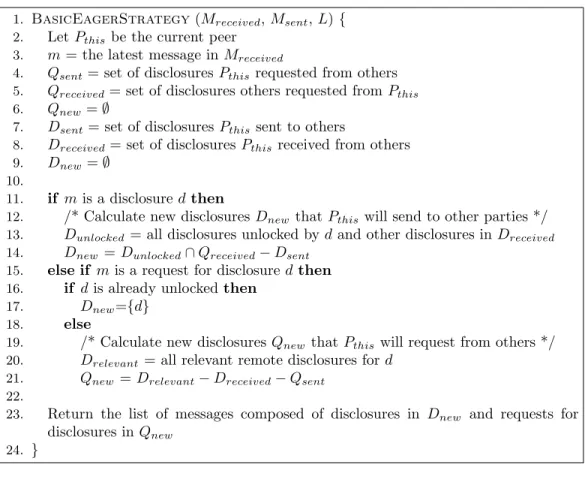
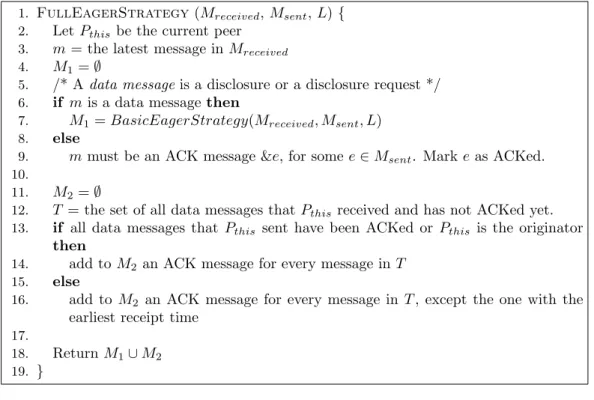
2.4 Eager Strategies . . . 30
2.4.1 Basic Eager Strategy . . . 30
2.4.2 Full Eager Strategy . . . 32
2.5 Cautious Strategy . . . 36
2.6 Summary . . . 40
Chapter 3 The PeerAccess Framework . . . . 42
3.1 Introduction . . . 42
3.2 Framework and Language . . . 44
3.3 Base Policies . . . 47
3.4 Release Policies . . . 50
3.5 PeerAccess Semantics . . . 57
3.6 Proof Theory . . . 64
3.7 Proof Hints and Queries . . . 69
3.8 Summary . . . 75
Chapter 4 Customizing Distributed Proofs of Authorization . . . . 76
4.1 Introduction . . . 76
4.2 Distributed Proofs of Authorization . . . 78
4.3 Query Routing Rules . . . 81
4.4 Proof Construction . . . 84
4.5 Customizing MultiTrust . . . 95
4.6 Discussion . . . 99
Chapter 5 Declassification and Reclassification . . . 102
5.1 Introduction . . . 102
5.2 Language and Framework . . . 105
5.3 Deduction System for Declassification and Reclassification . . . 108
5.3.1 Derivation Rules . . . 108 5.3.2 Declassification Axioms . . . 109 5.3.3 Semantics . . . 110 5.4 Examples . . . 110 5.5 Discussion . . . 114 5.6 Summary . . . 115
Chapter 6 Related Work . . . 117
6.1 Trust Negotiation . . . 117
6.2 Distributed Authorization Framework and Proof Construction . . . 120
6.3 Declassification and Reclassification . . . 125
Chapter 7 Conclusion and Future Work . . . 129
7.1 Contribution Summary . . . 130
7.2 Future Work . . . 135
List of Figures
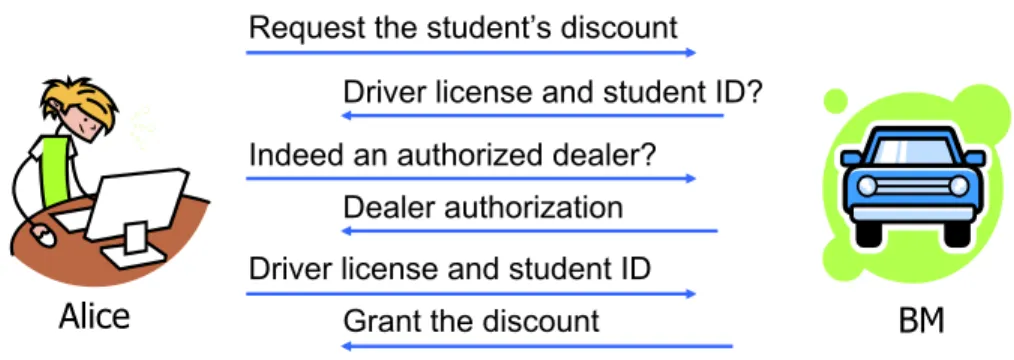
1.1 Example of trust negotiation . . . 4
2.1 Syntax of DARCL . . . 15
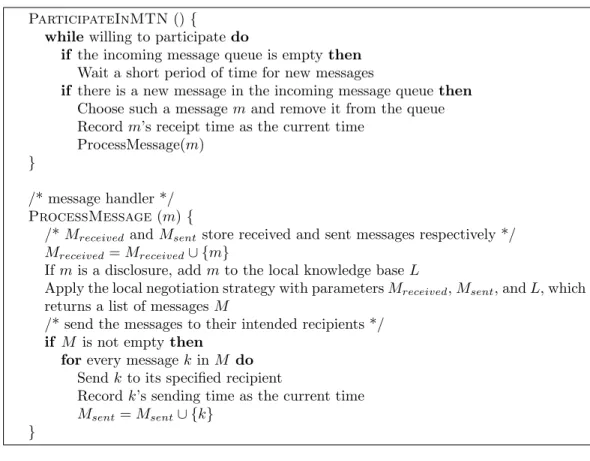
2.2 The diffusion negotiation protocol . . . 28
2.3 The basic eager strategy . . . 31
2.4 The full eager strategy . . . 33
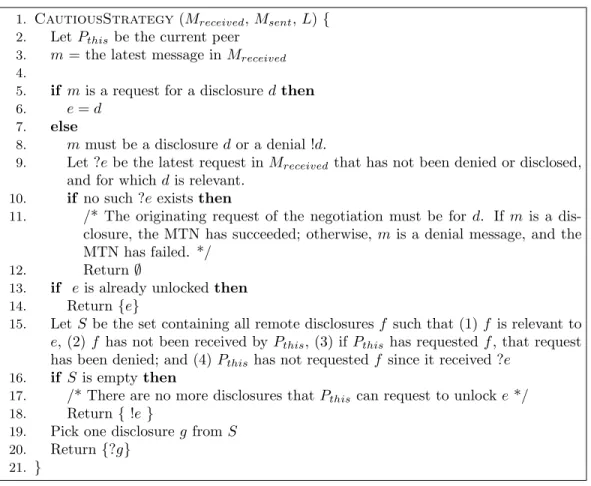
2.5 The cautious strategy . . . 37
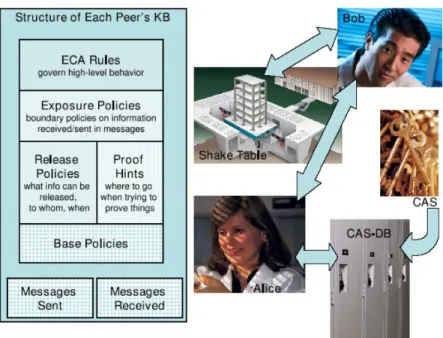
3.1 PeerAccess architecture and KB structure . . . 45
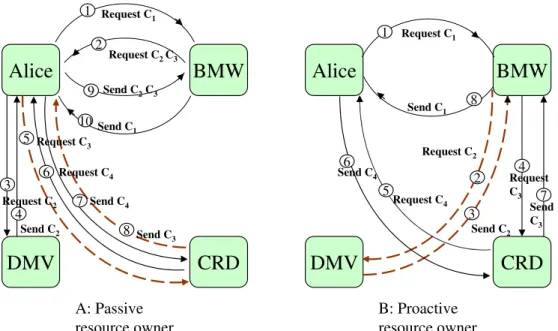
4.1 Ways to handle Alice’s query . . . 79
4.2 MultiTrust query answering algorithm . . . 86
4.3 MultiTrust algorithm to find a substitution and subgoals . . . 87
Chapter 1
Introduction
Since the emergence of the Internet, it has flourished with far reaching impact on every aspect of our society. With widely available network connectivity, more and more open distributed applications are getting popular, e.g., peer-to-peer (P2P) file sharing, media streaming and pod broadcasting, business-to-business (B2B) e-commerce, grid computing, and wireless emergency response and coalition systems. While these systems vary in many aspects, they share characteristics such as openness, distribution, and autonomy. A system is open in that, instead of restricting access to only a predefined set of requesters, it grants access to whoever satisfies the authorization policies and follows the right procedures. The components of a distributed system can be geographically distributed, so can the users. Each participating party in an open distributed system has autonomy in deciding whom he is willing to interact with and what access policies he enforces to protect his resources. Identity based access control (IBAC) has become unsuitable for open distributed sys-tems. Traditionally, IBAC requires preregistration of a user’s identity. Once a user’s identity is authenticated, the authorization decision will be made based on the identity alone. This presents several challenges in an open distributed environment. Since every user’s identity must be registered with the service provider, account management becomes hard to scale for services with a large number of users. While a user’s identify is relatively stable, his functional role within an organization and the according access privileges can change overtime. These changes need to be propagated to collaborating administrative domains from time to time, in order to maintain the consistency of privilege assignment. The communication and synchronization overhead involved can have significant impact on the performance of a system with a large number of users if such changes happen
frequently. On the client side, a user often needs to maintain multiple accounts in order to get access to resources in different administrative domains, which can become diffi-cult and unmanageable; e.g., different sites have different password strength requirements and aging policies, which forces one to have different passwords. It can be challenging to remember these different passwords; sometimes it is even difficult to remember the different account names on different systems. In the case where strangers need to talk to each other for dynamic resource sharing, e.g., a disaster recovery coalition that involves multiple teams equipped with mobile ad hoc networking devices, the interacting parties have no prior knowledge about each other, and cannot base their authorization decisions on identities that they do not even know.
Instead of basing the authorization solely on a requester’s identity, attributed based access control (ABAC) makes authorization decisions based on the requester’s attributes as attested to by X.509v3 attribute certificates [35] using public key cryptography [28]. Since the digital credentials are signed, they are verifiable and non-repudiable, which makes them a reliable proof for the attributes attested to. A digital driver license for Alice signed by the Department of Motor Vehicles (DMV) proves her name and date of birth. Her digital student ID proves her registration in the university. Suppose Best Motorvehicle World (BMW), an online auto dealer sells cars to only those with a valid driver license. In addition, it also gives a special discount to university students. Alice can show her digital driver license to prove that she is eligible for purchasing a car from BMW, and show her digital student ID signed by the university to prove that she is qualified for the discount. BMW uses the DMV and university’s public keys to verify that Alice’s driver license and student ID are indeed signed by the DMV and the university respectively. To further verify that Alice is owner of the two credentials, BMW can verify that Alice does have the private keys associated with her two public keys shown in the credentials. BMW has no prior knowledge about Alice, nor does Alice have a pre-registered account with BMW. Yet by showing digitally signed credentials, Alice proves that she satisfies the dealer’s authorization policy for a student discount. By eliminating the need for BMW
of any direct contact with the DMV or the university, ABAC shows a clear advantage here, solving the scalability problem associated with identity registration and information sharing across different management domains. Basic approaches in ABAC include trust negotiation and distributed proofs of authorization.
Automated trust negotiation (ATN) has become a promising approach to establishing trust between two parties without any prior knowledge about each other [83, 84, 74]. Both parties have access control policies to limit outsiders’ access to their sensitive resources, and neither takes it for granted that any other party can be trusted until a certain at-tributes, as specified in the access control policies, are proven. Let us revisit the previous car purchase example. Alice initially requests a student discount from BMW. As BMW’s policy says that only a licensed driver and registered student can be authorized for this discount, it asks Alice for her driver license and student ID. Since Alice’s driver license contains sensitive information such as age and address, she feels uncomfortable giving it to just anyone. To get some level of assurance, Alice asks BMW to disclose a certificate signed by the car company Tata to show that BMW is an authorized dealer for Nano, the brand of car that Alice is looking for. BMW shows Alice its dealer license from Tata, which assures Alice that it is indeed an authorized Nano dealer. Alice is now willing to show BMW her driver’s license and student ID. Having verified that Alice does satisfy the student discount requirement, BMW finally gives Alice the discount. The above ne-gotiation process in shown in Figure 1.1. As we can see, the trust nene-gotiation contains a sequence of bilateral credential disclosures. Less sensitive credentials are disclosed first, to build up enough trust to disclose more sensitive credentials. The negotiation ends when the provider’s authorization policies are satisfied, or it becomes clear that trust will not be established.
Real world authorization decisions often involve more than two parties. For example, when one submits an online application for purchase of automobile insurance, the insur-ance company needs to evaluate the buyer’s driving record and credit scores to reduce the risk of the sale. The authorization process can be decomposed into a number of two-party
Request the student’s discount Driver license and student ID?
Alice
Indeed an authorized dealer? Dealer authorization Driver license and student ID
Grant the discount BM Figure 1.1: Example of trust negotiation
negotiations, i.e., one negotiation between the insurance company and the buyer for the purchase, another between the insurance company and the DMV for the buyer’s driving record, and a third between the insurance company and the credit bureau for the buyer’s credit scores. However, decomposition is insufficient to reduce an automated multiparty authorization into standalone two-party trust negotiations, because individual negotia-tions may depend on one another, and therefore need to be interleaved in a certain order for the overall negotiation to succeed. For example, the negotiation between the insurance company and the buyer cannot finish until the insurance company gets the result from the negotiation between the insurance company and the credit bureau for the credit report, which in turn requires the insurance company to get the buyer’s authorization for a credit check. For such a multiparty authorization, we need a policy language expressive enough to describe the dependencies between the participating parties and their requests, and a systematic and automated way to decompose the authorization into multiple two-party negotiations and interleave them in an order that respects the dependencies. We also need a way to detect cycles of dependencies and handle them appropriately at runtime. Overall, we need a new authorization paradigm,Multiparty Trust Negotiation (MTN), where a ne-gotiation can be automatically carried out among multiple parties in accordance with each party’s authorization policies. To this direction, we define a policy language, Distributed Authorization and Release Control Language (DARCL), to specify authorization policies that are suitable for MTN. To orchestra the negotiation process among multiple parties without a centralized moderator, we propose the diffusion negotiation protocol, which
allows the participating parties to carry the negotiation in a distributed fashion. Building on top of the diffusion negotiation protocol, we propose different negotiation strategies to drive MTN with different trade off between privacy and negotiation speed, and examine the safety, completeness, and efficiency of these strategies.
While MTN provides an interactive, efficient, and secure solution to trust establish-ment, its interactive nature requires all the negotiating parties to be online. It does not provide direct support for much desired features like delegation and re-dissemination con-trol. From a theoretical perspective, we are also interested in a more general framework that can be used to not only specify distribute authorization policies, but also reason about the runtime behavior of a diverse set of peers. We found none of the theories developed for authorization include all the features that we needed to reason about the runtime behavior of real world open systems, or to account for all the actions that parties in such systems need to take at runtime. The need was particularly acute in the area of reasoning about helpful third parties at runtime, such as information brokers, credential and policy repositories, and third-party authorization services. A peer Alice may need to contact several such parties as she attempts to construct a proof that she is authorized to use a particular service, and she needs a principled way to determine who to contact, what to ask for, what kind of answers to expect, and when to give up. She needs a way to explain who she is and why she is asking for help, as her intended purpose may determine whether a third party is willing to help her, or may influence the answer that it gives her. Alice also needs a way to set limits on what can be done with the personal information that she gives out, and to determine what she is allowed to do with the information that others give to her. She needs to be able to interact successfully with parties that push information to her, and with parties that she must query to get information. Existing works ([10, 14, 16, 18, 33, 34, 37, 42, 49, 63, 77, 79, 84, 93], to mention just a few) study useful pieces of the picture, but we found that the separate pieces often did not fit to-gether to form a solution to real world situations. For example, real world peers do not exhaustively try to answer all queries they receive, as in [7]. A peer may behave quite
differently depending on who is asking for help and why they are asking for help. We want a way to talk about sticky policies [40, 58] (release policies that are permanently attached to the information they protect), but also want to be able to describe non-sticky policies within the same open system. Integrating all these features together, we propose the PeerAccess framework and language to model and reason about multiparty authorization in open distributed systems.
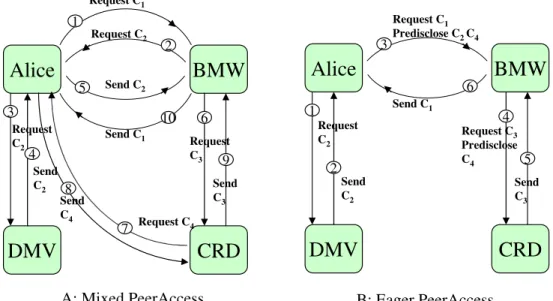
Before a service request can be authorized in an attribute-based distributed authoriza-tion system like PeerAccess, a certain credentials have to be collected to prove that the according access control policies are satisfied. Since the proof is encoded as well-structured logic formulas, verifying its correctness is straightforward. The process to construct such a proof, however, is often interactive, multilateral, and distributed, involving multiple par-ties iteratively requesting credentials from one another before presenting their own relevant credentials; we call this a distributed proof of authorization. Construction of such a proof can be carried out in multiple ways. A resource provider can passively wait for its clients to gather all the credentials required for them to gain access; others can take a proactive approach by directly requesting all credentials from the appropriate issuers on behalf of their client. To move away from these two extremes, which raise issues of efficiency and completeness, we propose query routing rules to customize distributed credential collection in open systems, which give peers autonomy in deciding whether and how they respond to authorization requests. We provide a distributed proof construction algorithm that peers can use to reason about authorizations based on the access control policies and query routing rules. This algorithm is configurable, sound, and complete with regard to the search space covered by query routing rules. By configuring different query routing rules, we can not only use flexible strategies to improve the performance of distributed proofs of authorization, but also emulate other distributed trust management frameworks and serve as a reasoning framework for multiparty authorization in heterogeneous distributed systems.
have commanded the attention of the security and privacy community. The diversity of the participating parties and the different sensitivity levels of resources to be shared complicate the management of information flow in multiparty authorization. The original owner controlled sticky release policies in PeerAccess are strong in many aspects; yet there is no mechanism provided to reason about the release policies for new information derived from information received from other peers. Released information can have various levels of sensitivity: facts that are public, sensitive private information that requires its original owner’s permission for its future dissemination, or even information that requires control over the release of the conclusions reached using that information. Some situations also call for declassification of information, which requires a two-pronged approach: the original owner retains control over the dissemination of sensitive information and sensitive conclusions reached using that information, but when the information is used to reach conclusions that are sufficiently non-sensitive, the original owner’s control can be removed for the dissemination of those conclusions. By introducing new release control constructs, PeerAccess is able to specify dissemination control policies and reason about release and declassification. We give case studies of the use of our language to control the release of aggregated open source software, multimedia content and medical information.
In this thesis, we provide new approaches to automating dynamic, secure, and efficient trust establishment among multiple parties in open distributed systems. We make a number of contributions to multiparty authorization, from both theoretical and practical perspectives.
In proposing MTN as a new approach to multiparty authorization, we make the fol-lowing contributions:
1. We propose MTN as a new authorization paradigm for open distributed systems, and show that it features the same level of security and flexibility as two party trust negotiation, yet provides the capability of establishing trust among multiple parties. 2. We define DARCL as the first distributed policy language that supports both autho-rization and release control in a unified way. DARCL policies can take the source and
destination of each credential disclosure into consideration, allowing policy-writers to specify finer-grained access control constraints than existing languages such as [23, 49, 37, 10]. This level of enhanced expressiveness is particularly useful in speci-fying MTN-based access control policies.
3. We present a lightweight distributed negotiation protocol for MTN, whose simplicity and decentralized nature make it well-suited for peer-to-peer environments.
4. We provide two MTN negotiation strategies with different tradeoffs between privacy and negotiation speed. Both the two strategies guarantee that every participating party’s authorization policies are satisfied, and that the negotiation succeeds as long as there exists a possible authorization.
In proposing PeerAccess as a language for specifying distributed authorization poli-cies and a framework to reason about the runtime behavior of peers in open distributed systems, we make the following contributions:
1. PeerAccess is a generic and extensible framework for multiparty authorization. We know of no preexisting approach that allows one to reason about the runtime be-havior of a very diverse set of peers, some of whom push information, some pull information, and some mix the two paradigms. We also present a formal semantics for the PeerAccess authorization language, and a proof theory that is both sound and complete.
2. PeerAccess allows one to model the local reasoning of individual peers who are unaware of the internal state of other peers, and also allows one to reason about possible future global evolution of the system (e.g., for safety or liveness analysis). PeerAccess supports peer autonomy in choice of run-time behavior, by encoding it as a set of meta policies. Autonomy support is an important feature in that it allows PeerAccess to closely model real world authorization scenarios in an open distributed environment, where a peer values autonomy and will often not cooperate unless its
autonomy is respected and has the freedom to make authorization decisions on its own resources.
3. PeerAccess provides a rich set of release constructs that can be used to specify re-lease and re-dissemination control policies. Particularly, our logic can be used to derive release policies for aggregated information at run time, and allows flexible dissemination control of aggregated information by supporting full enforcement and declassification of the original information sources’ release policies. To our knowl-edge, PeerAccess is the first authorization framework that provides systematic and flexible access control for aggregated information.
In proposing query routing rules as a practical approach to proof construction in open distributed systems, we make the following contributions:
1. Query routing rules are sufficiently flexible to model the proof construction behaviors of other trust management systems such as QCM [32]. This makes PeerAccess the first authorization framework that can be used to reason about the runtime behavior of other trust management systems, and to reason about the runtime behavior when different peers use different proof construction algorithms.
2. We give a distributed algorithm to construct proofs of authorization based on query routing rules. This algorithm limits the search space to that covered by the query routing rules, and guarantees completeness of search within this space, providing a significant performance gain over blind brute-force search in open distributed sys-tems.
3. We leave the decisions on how to handle a particular request to the meta level poli-cies, as opposed to embedding them in the authorization polipoli-cies, as query routing rules operate at the meta policy level and are orthogonal to the authorization poli-cies. This level of independence makes it possible for query routing rules to work with a variety of underlying policy languages.
The rest of the thesis is organized as follows. In Chapter 2, we propose MTN as an extension to ATN to support multiparty authorization. In Chapter 3, we introduce the PeerAccess framework, present its semantics and proof theory, and discuss its applications. In Chapter 4, we propose query routing rules as a way to customize distributed proof construction, and show how they can be used make PeerAccess emulate the runtime behavior of other trust management systems. In Chapter 5, we propose new release policies to add support for declassification and re-classification in re-dissemination control. We discuss related work in Chapter 6, and give our conclusions in Chapter 7.
Chapter 2
Multiparty Trust Negotiation
2.1
Introduction
A conventional authorization system isclosedin the sense that it only gives access to a pre-registered set of users, and all important properties of a user are known in advance, before the user requests authorization. In open distributed systems like the Web, however, often strangers have to interact with one another to receive or provide services. When two par-ties interact to reach an authorization decision, automated trust negotiation (ATN) is an effective approach to establishing trust without any prior knowledge of each other. Under ATN, each party has authorization policies based on digital credentials to limit outsiders’ access to its sensitive resources. When an outsider requests access to a sensitive resource, the ensuing trust negotiation includes a sequence of bilateral credential disclosures. Less sensitive credentials are disclosed first, to build up enough trust such that credentials that are more sensitive can be disclosed. The negotiation succeeds when it gets to the point both parties’ authorization policies for access are satisfied, or fails when it becomes clear that trust will not be established, or either party breaks off the negotiation. If trust is established, the resource requester is authorized to access the owner’s resource.1
While ATN is well suited for establishing trust between two strangers, it becomes in-adequate when more than two parties are involved, which is often the case in real world authorization scenarios. For example, an online purchase of automobile insurance involves interactions among the buyer, the insurance company, the DMV for the buyer’s driving records, and credit bureaus for the buyer’s credit scores. Similarly, a grid resource
allo-1
cation [62] can involve the requester, the resource owner, the Community Authorization Service (CAS) server, and one or more authorization proxies. One possible solution is to decompose a multiparty authorization process into a number of standalone two-party negotiations. Such a decomposition, however, can become difficult, as individual negotia-tions may depend on one another, and therefore need to be interleaved in a certain order for the overall negotiation to succeed. For example, the negotiation between the insurance company and the buyer cannot finish until the insurance company gets the result from the negotiation between the insurance company and the credit bureau for the credit report, which in turn requires the insurance company to get the buyer’s authorization for a credit check. In some cases, the dependencies can even form a cycle, which complicates decom-position. To solve all these issues, we propose a new authorization paradigm, multiparty trust negotiation (MTN), that can automatically carry out a negotiation among multiple parties in accordance with each party’s authorization policies.
We also propose Distributed Authorization and Release Control Language (DARCL), to specify authorization policies that are suitable for MTN. In addition, DARCL can be used to specify release control policies. Copyright, privacy, and security considerations often lead users to restrict the flow of sensitive information. Inappropriate disclosures can cause privacy breaches and serious damage such as identity theft. In such situations, a release control policy is used to specify the conditions under which a piece of information can be disclosed (sent) to another party. Release policies are related to authorization poli-cies, which govern access to arbitrary resources under a “pull” paradigm. For example, an authorization policy decides whether Alice can access a highly classified database, while a release control policy decides who will be told that Alice has such a privilege. Some policy languages clearly distinguish between these two kinds of policies [16], and put restrictions on how they can be used together; e.g., one cannot base an authorization decision on a release control condition. In our proposed DARCL policy language, authorization and release control are naturally integrated: an authorization can be based on a release condi-tion, and vice versa. Further, DARCL allows the policy writer to specify both the source
and destination of each disclosure, so that an authorization decision can be based not only on the content of received information, but also on its source. This feature allows DARCL to specify a certain MTN policies that other languages cannot. For example, DARCL makes it easy to say that before Alice gives Bob access to a certain resource, Bob has to disclose some of his qualifications to Alice, and a third party Carl has to vouch for Bob.
A trust negotiationprotocolspecifies high-level conventions for communication between negotiating parties, including permissible message types and formats, how to start and end a negotiation, and when it is one’s turn to send a message. In the most common form of two-party negotiation protocol [83, 84, 30, 42], each party takes turns sending messages until the negotiation succeeds or fails. It is harder to define a protocol that works for more than two parties. If we allow one peer to assume the role as a negotiation moderator, the moderator can organize the negotiation into multiple rounds. In each round, a peer sends requests to others and replies to requests it receives in previous rounds. The negotiation continues until at a certain round, the moderator declares the success or failure of the negotiation. Unfortunately, the centralized control of the moderator approach directly contradicts the autonomous nature of open distributed systems. For example, we need to be able to allow negotiating parties to leave and rejoin the negotiation on the fly, making the moderator’s job complex and hard to scale. Ideally, an MTN protocol should be distributed and free of centralized control.
We make the following contributions in this chapter:
1. We propose MTN as a new paradigm for establishing trust in open distributed systems, while leveraging the effectiveness of two-party ATN. We extend and redefine concepts and theories developed for ATN, so that we can use them to establish trust among multiple parties.
2. We define DARCL as the first distributed policy language that supports both autho-rization and release control in a unified way. DARCL policies can take the source and destination of each credential disclosure into consideration, allowing policy-writers to specify finer-grained access control constraints than with existing
lan-guages [23, 49, 37, 10].
3. We present a lightweight distributed protocol for MTN, whose decentralized nature makes it well-suited for peer-to-peer environments.
4. We provide two MTN negotiation strategies that are safe and complete, with differ-ent tradeoffs between privacy and negotiation speed.
The rest of the chapter is organized as follows. In Section 2.2 we define the DARCL policy language and related concepts. In Section 2.3 we define MTN protocols and strate-gies, and introduce the diffusion negotiation protocol. We present an eager negotiation strategy in Section 2.4 and a more cautious strategy in Section 2.5. Finally we summarize in Section 2.6.
2.2
The DARCL Policy Language
In this chapter, we model a distributed system as a finite set of peers, who each possess a finite knowledge base and communicate with each other by exchanging messages about their resources and services. Following the popular trend in trust management [37, 23, 47, 48], we propose a declarative policy language, DARCL, based on Datalog. The syntax of DARCL is given in Figure 2.1. A peer’s authorization policy for access to a resource or service consists of a set of DARCL rules specifying the conditions that must be satisfied before the access to the service can be granted.
rule ::=disclosure← disclosure ∧ · · · ∧ disclosure disclosure::= peer↑credential⊤peer
credential ::=peer.credential name(term, . . . , term)
term ::=peer|value
peer ::=variable|peer name value ::=variable|string
variable ::=x|y|. . .
peer name ::=Alice|Bob|. . . credential name ::= string
Figure 2.1: Syntax of DARCL
In DARCL, credentials are signed predicates, which can be used to represent at-tributes of subjects and authorizations for access to resources and services. DARCL abstracts away several properties of real-world credentials such as X.509 certificates, re-taining only those needed to reason about distributed authorization. In the credential
University.isRegisteredStudent(Alice), University is the issuer who signs the creden-tial, Alice is the subject, and isRegisteredStudent is the credential name. A credential can have more than one subject. In this chapter, values of DARCL credential names and peer names will have more than one letter, to distinguish them from variables such as x
and y; and peer names will not be used as string-valued terms. We can instantiatea vari-able in a DARCL formula by replacing all its occurrences with a constant. If a DARCL formula does not contain any variables, then it is ground.
We usepeer0↑C ⊤peer1 to denote adisclosure, the sending of a message from one peer
to another, where peer0 is thesource and peer1 is the destinationof the message, and C
is its content. The head of each DARCL rule contains a disclosure. A rule’s body can be empty, in which case the head of the rule is a fact. Intuitively, Alice↑C0⊤Bob in a
rule’s body means Alice has received C1 from Bob. DARCL rules must also satisfy three
additional constraints, which simplify rule specification and prevent certain nonsensical policies. LetS0↑C0⊤D0←S1↑C1⊤D1,. . . , Sn↑Cn⊤Dnbe a rule in Alice’s authorization policy.
1. For everyi∈[0, n], eitherSi orDi must be Alice; when the rule’s body is not empty, the sourceS0 of the disclosure in the rule’s head must be Alice. This is because Alice
can only base her authorization decisions on her local state, i.e., her own policies plus the credentials that have been sent to her. What kind of credential another party Bob sends to Carl is beyond Alice’s knowledge; similarly, Alice cannot force Bob to disclose a credential. To make the rule look simpler, we can omitSi (orDi) from the rule when it equals Alice. We, however, choose to keep them in this thesis so that it is easier for the reader to tell the source and destination of any disclosure. 2. If the issuer of the credential C0 in the head is not Alice and the rule’s body is not
empty, then C0 must be one of the credentials Ci in the body, 1≤ i≤n. In other
words, before Alice can disclose a credential signed by somebody else, she must have received it.
3. Every variable in the rule body must also occur in the head. Under this constraint, if the disclosure in the head of a rule is ground after variable instantiations, so are the disclosures in the body of the rule. As enforced in our inference rules shown later, at runtime every disclosed credential will be ground.
When the source and destination of a disclosure are the same peer, e.g.,Alice↑C ⊤Alice, we call it asingular-disclosure. We use the singular-disclosureAlice↑C ⊤Aliceto represent the fact that Alice possesses the credentialC. If the issuer ofCis not Alice,Alice↑C ⊤Alice
means Alice has received C. If Alice is the issuer of C, then Alice↑C ⊤Alice means Alice is willing to sign or has signed C, depending on whether it is in the head or body of the rule. For simplification, we abbreviate a singular-disclosure Alice↑C ⊤Alice as just C. This simplification causes no confusion, because restriction 1 tells us that C in Alice’s
knowledge base must stand for Alice↑C ⊤Alice, and not Bob↑C ⊤Bob. If a disclosure’s source and destination are different, we call it a remote disclosure. If an authorization rule’s head is a remote disclosure, then it is a release control rule. The collection of all a peer’s policies and credentials is its knowledge base.
In practice, credentials are often stored with their issuers or their subjects [53, 22]; in such a case, the source of a disclosure can be constrained to be the credential’s issuer or one of its subjects. Such constraints are easy to express in DARCL but not built into the language, because we want to support additional scenarios, such as when the distribution of credentials is outsourced to a third party.
2.2.1 Policy Examples
We use two examples to show how DARCL can be used to specify release control and authorization policies.
Example 1 Consider the following set of rules in Alice’s knowledge base: (1) Bob.trusts(Carrie) ← Bob↑Bob.trusts(Carrie)⊤Alice
(2) Alice↑Bob.trusts(Carrie)⊤Diana ← Bob.trusts(Carrie)
(3) Alice↑Bob.trusts(Carrie)⊤x ← Bob↑Bob.trusts(Carrie)⊤Alice∧ Carrie↑Bob.trusts(Carrie)⊤Alice
(4) Alice.trusts(x) ← Diana.trusts(x)
(5) Alice↑Alice.trusts(Diana)⊤x ← Alice.trusts(x)
Rule (1) is trivial: it says that if Bob tells Alice that he trusts Carrie, Alice knows that he trusts Carrie. Rule (2) says that if Alice knows that Bob trusts Carrie, Alice will tell Diana about it. Rule (3) says that if both Bob and Carrie tell Alice that Bob trusts Carrie, Alice will tell everybody about it; Alice’s intuition is that since both Bob and Carrie are open with her about it, they probably do not treat it as a secret. Rule (4) says that Alice will trust anyone that she knows that Diana trusts. Rule (5) says that Alice will tell everyone she trusts about the fact that she trusts Diana. The difference between
a singular-disclosure d = Alice.trusts(Diana) and a regular disclosure Alice↑d⊤Eddie
is clear: the former states that Alice trusts Diana, while the latter states to whom Alice discloses that fact. Note that if we restrict the rules to use singular-disclosures only, DARCL shrinks to a variant of existing Datalog-based authorization languages, such as those used in [23, 49, 37]. These languages deal with authorization but not release control, and cannot specify rules like (3).
Example 2 Suppose Alice, a Canadian national, would like to apply for a digital Mexi-can visa so that she Mexi-can enter Mexico as a tourist. For security considerations, the MexiMexi-can government has a new policy that requires its visa department, Embassy of Mexico (EM), not to issue a visa for any Canadian national unless the applicant presents a valid Cana-dian passport and passes the background check of Mexico’s security agency, Direccion Federal de Seguridad (DFS). To respect privacy, DFS will not release Alice’s background check result to EM unless DFS gets Alice’s permission to do so first. For convenience and security considerations, DFS, as a security agency, deals directly with EM, but not directly with any individual; therefore, any communication between Alice and the DFS has to go through EM. Alice is willing to give EM what it requests, provided that she can verify that EM has a digital certificate signed by the Mexican government (MG) to show that EM really is the official Mexican embassy. EM, on the other hand, is willing to show its certificate signed by MG to anyone. In summary, there are the following policies.
1. EM will issue the visa to Alice if (a) Alice discloses her digital passport and autho-rization for EM to do a background check through EM, and (b) EM receives DFS’s clearance for Alice.
2. If Alice gives EM her authorization for DFS to disclose any personal information to EM, EM will disclose this authorization to DFS.
3. EM is willing to show its certificate signed by MG to anyone.
allows DSF to release the result to EM.
5. Alice will give her digital passport and background check authorization to EM if EM has a valid certificate signed by MG.
In DARCL, these policies are as follows: EM:
EM↑EM.visa(x)⊤x ← x↑Canada.passport(x)⊤EM ∧
x↑x.OkT oRelease(DFS, EM)⊤EM ∧ DFS↑DFS.clear(x)⊤EM EM↑x.OkT oRelease(DFS, EM)⊤DFS ← x↑x.OkT oRelease(DFS, EM)⊤EM EM↑M G.officialEmbassy(EM)⊤x
DFS:
DFS↑DFS.clear(x)⊤EM ← EM↑x.okT oRelease(DFS, EM)⊤DFS ∧ DFS.clear(x)
Alice:
Alice↑Alice.okT oRelease(DFS, x)⊤x ← x↑M G.officialEmbassy(x)⊤Alice Alice↑Canada.passport(Alice)⊤x ← x↑M G.officialEmbassy(x)⊤Alice∧
Canada.passport(Alice)
We will revisit these examples in subsequent sections. 2.2.2 Inference Rules
Our next step is to show how authorization decisions can be made based on DARCL policies. Sometimes a peer can make an authorization decision based on only its local authorization policies. Other times, an authorization decision is collectively based on the peer’s local policies and the information it receives from other peers. Accordingly, DARCL has two types of inference rules, localand global. From a logical perspective, the local inference rules are used to derive new facts or rules within a peer’s knowledge base, while the global inference rules, together with the local inference rules, can be used to derive new facts based on more than one peer’s knowledge base. From authorization’s
perspective, local inference rules tell what authorization decisions a peer can make solely based on his authorization policies and the messages he has already received from others, and the global inference rule tells what messages a peer can send to other peers.
Local Inference Rules A peer Acan use the following local derivation rules.
• Instantiation. From a rule r in A’s knowledge base, derive an instance of r by replacing all occurrences of the same variable inr with another variable or literal. • Knowledge. FromB↑d⊤A orA↑d⊤B inA’s knowledge base, deriveA↑d⊤A. • Modus ponens. From a ruled0 ← d1 ∧ · · · ∧ dn and facts di, 1≤i≤nin A’s
knowledge base, derive d0.
Global Inference Rules
• Delivery. FromA↑d⊤B inA’s knowledge base, wheredis ground, deriveA↑d⊤B
inB’s knowledge base.
A derivation that uses only the local inference rules within a peer’s knowlegebase is called a local derivation. A derivation that uses both local and global inference rules is called aglobal derivation.
Returning to Example 1, let us see how we can use the inference rules to decide whether Alice can tell Edward that she trusts Diana. Suppose Diana trusts Edward and has told Alice about it; i.e., Alice’s knowledge base has Diana↑Diana.trusts(Edward)⊤Alice. By the knowledge rule, we derive Diana.trusts(Edward). Applying instantiation and modus ponens on rule (4), we getAlice.trusts(Edward). Repeating the same derivations on rule (5), we get Alice↑Alice.trusts(Diana)⊤Edward; i.e., Alice can tell Edward that she trusts Diana.
If we apply both the local and global inference rules to all policies in everyone’s knowl-edge bases and conduct global derivations, we can reason about every possible authoriza-tion that any peer can ever make. Continuing with Example 1, if we apply the global
inference rule onAlice↑Alice.trusts(Diana)⊤Edwardin Alice’s knowledge base, we de-rive Alice↑Alice.trusts(Diana)⊤Edwardin Edward’s knowledge base.
Although it is theoretically interesting to reason about authorizations globally, in practice there is no omniscient authority to reason about everyone’s policies in an open distributed system. Before Alice approves an authorization request from Bob, she may request credentials from Bob and other peers, which can trigger more rounds of credential requests and disclosures. MTN is such a process, where peers conduct multilateral mes-sage exchanges to collectively make an authorization decision without losing each peer’s autonomy; i.e., at any moment, each peer’s authorization decisions are still based on its current local policies.
2.2.3 Disclosure Sequences
We say a ground disclosure d=Alice↑C ⊤Bobisunlockedifdis already in Alice’s knowl-edge base, or d can be derived in Alice’s knowledge base using the local inference rules; otherwise, dis locked. Suppose d is locked, and will be unlocked if Alice receives disclo-sures d1, . . . , dn from other peers; we say d is unlocked by d1, . . . , dn. We say a ground disclosure e is a relevant disclosure for d if e derives e by the knowledge rule, or there exists an instantiation r′ of ruler that has das its head andeis a disclosure in the body ofr′. Ifeis a relevant disclosure ford, then every relevant disclosure foreis also a relevant disclosure for d.
A ground disclosure is safe if it is unlocked at the time it takes place. For example, Alice can safely disclose C to Bob ifAlice↑C ⊤Bobis unlocked in Alice’s knowledge base. We define adisclosure sequenceSeqas [d1, . . . , dn], where eachdi =Si↑Ci⊤Diis a remote disclosure representingSi disclosing Ci toDi, and each di+1 takes place afterdi. Seqis a safe disclosure sequence fordn(or simplysafe) if eachdi is safe at the time it takes place. More specifically, every di must either be unlocked before the first disclosure in S takes place, or be unlocked once di−1 has taken place. When Seq is safe, [d1, . . . , di] is a safe disclosure sequence for di, which gives us the following proposition.
Proposition 2.1 If [d1, . . . , dn] is a safe disclosure sequence, then there is a safe disclo-sure sequence for di with at most i disclosures, for every 1≤i≤n.
The existence of a safe disclosure sequenceS ford=Bob↑C ⊤Alicemeans that if the disclosures take place in the order given in S, resource owner Bob can eventually safely grant Alice access to resourceC, without violating any peer’s authorization policy. Suppose that in Example 2, DFS clears Alice’s background checking by signing DFS.clear(Alice); then there is the following safe disclosure sequence that leads to EM sending a signed visa to Alice.
[EM↑M G.officialEmbassy(EM)⊤Alice, Alice↑Canada.passport(Alice)⊤EM,
Alice↑Alice.okT oRelease(DFS, EM)⊤EM,
EM↑Alice.okT oRelease(DFS, EM)⊤DFS,
DFS↑DFS.clear(Alice)⊤EM, EM↑EM.visa(Alice)⊤Alice] The goal of MTN is to find such a safe disclosure sequence. 2.2.4 Semantics
We provide a localand global semantics for DARCL based on the least Herbrand model. Suppose a distributed system has a finite set N of peers, where each peer A has policy (knowledge base) PA. The current state of the system is captured by a distributed set of DARCL rules P ={(A,PA) |A∈ N }, which we also call a system configuration. We define an interpretation for P as I = {(A, IA) | A ∈ N }, where IA is a set of ground disclosures. The local semantics decides what a peer can disclose based on its local rules and facts, whereas the global semantics decides what a peer can eventually disclose and receive within the system.
We define a local modelI forP as follows.
1. A ground singular disclosure d=A↑δ⊤A is locally true inI atAiff d∈IA. 2. A ground remote disclosured=B↑δ⊤C is locally true inI atAiff{d, A↑δ⊤A} ⊆
3. A ground rule of the formd0 ← d1∧ · · · ∧dnis locally true inI atAiff eitherd0 is
locally true in I atA, or there existsdi, 1≤i≤n, such thatdi is not locally true inI atA.
4. A non-ground rule or disclosure is locally true inIatAiff each of its ground instances is locally true inI atA.
5. A system configuration P is locally true in I iff for every A∈ N, and every rule r
inPA,r is locally true in I atA. In this case, we callI alocal modelforP, and IA a local model forPA
Define the intersection of two interpretations I andI′ as
I∩I′={(A, IA∩IA′ )|A∈ N }
Theorem 2.1 Let I and I′ each be a local model for P. The intersection I∩I′ is still a local model for P.
Proof. We show that for everyA∈ N, and every rule r inPA,r is locally true inI∩I′
at A. The rule r can be a ground singular disclosure, a ground remoate disclosure, a ground rule, or a non-ground rule. We exam each of the these different cases.
1. Ground singular disclosure. Based on the definition of local model,r is in both
IA and IA′ , which means r is also inIA∩IA′ . So r is locally true inI∩I′ atA. 2. Ground remote disclosure. Suppose r =A↑δ⊤B; thus we have r, A↑δ⊤A} ⊆
IA andr, A↑δ⊤A} ⊆IA′ , which meansr, A↑δ⊤A} ⊆(IA∩IA′ ); i.e.,r is locally true inI∩I′ atA. It is the same case when r equals B↑δ⊤A.
3. Ground rule. Let r be d0 ← d1∧ · · · ∧dn; thus either d0 is locally true in I at
same case withI′. If d0 is locally true atA in both I and I′, then it is also true at
A in I∩I′. If di is not locally true inI orI′, it is not locally true inI∩I′ either. So either d0 is locally true in I ∩I′ atA, or some di is not locally true inI∩I′ at
A, which meansr is locally true inI∩I′ atA.
4. Non-ground rule. Since each of r’s ground instancesr0 is locally true in both I
and I′ at A, r0 is locally true in I∩I′ atA. Thusr is locally true in I ∩I′ atA.
Let P be the intersection of all P’s local models. Based on the above theorem, P is still a local model forP; we callP the canonical local modelforP.
Similarly, we define a global modelI forP.
1. A ground singular disclosure d=A↑δ⊤A is globally true in I, iff d is locally true inI atA.
2. A ground remote disclosure d=A↑δ⊤B is globally true in I, iffdis locally true in
I at both A andB.
3. A ground rule of the form d0 ← d1∧ · · · ∧dn is globally true in I, iff eitherd0 is
globally true inI, ordi is not globally true inI for some 1≤i≤n.
4. A non-ground rule or disclosure is globally true in I at A iff each of its ground instances is globally true in I atA.
5. A system configurationP is globally true in I iff for everyA∈ N, and every rule r
inPA,r is globally true in I. In this case, we call I aglobal model forP.
Let P be the intersection of allP’s global models. P is still a global model forP; we call P thecanonical global modelforP.
The local and global derivations are sound with respect to their corresponding seman-tics, and they are complete for inference of ground facts, which is sufficient for serving the purpose of MTN-based authorization.
Theorem 2.2 LetP be the current system configuration, and letdbe a ground disclosure. • Dislcosure dcan be derived at A using local inference rules, iff dis locally true inP
at A.
• Disclosure d can be derived uisng local and global inference rules, iff d is globally true in P.
Proof. We argue the soundness of local derivations by stepping through the local infer-ence rules one by one and showing that every derived rule/fact is in fact true according to the local semantics.
• Instantiation. If r is locally true at A, then all instances of r is locally true at A. • Knowledge. If a ground disclosureA↑d⊤B is locally true atA, we haveA↑d⊤A∈ A, which meansA↑d⊤A is also locally true at A. The same argument follows for
B↑d⊤A is locally true at A
• Modus ponens. If a ground rule d0 ← d1 ∧ · · · ∧ dn and all its body facts di, 1 ≤i≤n, are locally true at A, then d0 has to be locally true, otherwise we get a
conflict that at least onedi is not true.
The proof for the soundness of derivations using both local and global inference rules follows the above arguments. Additionally, the delivery rule for remote disclosureA↑d⊤B
fromA toB does not change the trueness ofA↑d⊤B ∈IB, based on the definition of the global semantics.
We start the proof of the completeness of local derivations by translating every disclo-sure S↑A.p(t1, . . . , tn)⊤D into a regular Datalog atom p′(A, S, D, t1, . . . , tn). By trans-lating all dislcosures, we translate evert DARCL rule r into a reguar Datlog ruler′. The translation can also go the other direction around, and establishes a one-to-one mapping of rules between A’s original rule set PA and the transalted rule set PA′ . For any local derivation of r atA, there is also a derivation inPA′ , and vice versa. LetHA′ be the least Herbrand model of PA′ , and let HA be the corresponding set of ground facts by reversing
translating each ground fact in HA′ . Based on the definition of the least Herbrand model and the definition of local models, it follows that HA is also a local model forPA. Given that PA is the intersection of all PA’s local models, we have that HA equals PA; i.e., PA is the least Herbrand model of PA. For any ground fact d that is true in PA, the corresponding fact d′ is also true in PA′ . Using the same line of argument employed to show the completeness of the least Herbrand model for Datalog, which PA′ is, we prove thatd′ has a derivation in PA′ . Translating this derivation, we get thatdhas a valid local derivation inP atA.
To prove the completeness of global derivations, we employ the same translation de-scribed above for facts and rules. We put all translated facts and rules from all peers in P into set U. Thus U is a set of regular Datalog rules. There are three inference rules inU, instantiation, knowledge, and modus ponens, corresponding to the three local infer-ence rules in P. The instantiation and modus ponens rules in U remain unchanged from P, while the knowledge rule has slight difference. More specifically, p′(A, S, D, t1, . . . , tn)
derives bothp′(A, S, S, t1, . . . , tn) andp′(A, D, D, t1, . . . , tn), which means both the sender
and receiver of a disclosure know about the disclosed fact. The global derivation rule inP is no longer needed inU, as rules in U are not directly tied to any peer’s knowledge base. Now we argue that every derivation ford′ inU translates into a valid global derivation for dinP, using the local and/or global inference rules. We prove this by examing each derivation steps, starting from the first. The translation of an instantiation or knowledge rule is trivial. Let us exam the case of modus ponens. Suppose we used the rule r′ =
d′0 ← d′1 ∧ · · · ∧ d′n and facts d′i, 1 ≤ i ≤ n′ to derive ground fact d′0. Suppose the source of the corresponding disclosure d0 is A, then the corresponding rule r must be in
A’s knowledge base already. For each d′i, the corresponding disclosure d can be either
A↑c⊤B or B↑c⊤A. In the latter case, if dis not aleady in A’s knowledge base, thend
must be in B’s knowledge base. Applying the delivery inference rule, we can derivedin
A’s knowledge base. Thus we have all factsdi, 1≤i≤n′, inA’s knowledge base, and can further apply modus ponens to derive d0 atA.
Let HU′ be the least Herbrand model of U, and HU be the reverse-translated set of ground disclsoures. Let H be an interpreation for P, where for each peer A in P,
HA = {B↑c⊤C | B↑c⊤C ∈ HU, A equals B or C}. Based on the definition of global models, we argue that for every rule r′ that is true in HU′ , the correspoding reverse-translated ruler is also globally true inH; thus H is a global model forP. Similarly, for anyP’s global model, its corresponding set of translated ground facts is also a model forU. Since P is the intersection of allP’s global models,H equals P, otherwise we would have a Herbrand model forU that is a proper subset ofHU′ , which contradicts the definition of the least Herbrand model. Finally, for any ground disclosuredthat is globally true in P, we know the corresponding ground fact d′ is in HU′ . Using the same line of argument for the completeness of the least Herbrand model for Datalog, we know thatd′ can be derived inU. Reverse translating the derivation ford′, we get a valid global derivation ford.
Based on the definition of safe disclosure sequences, we can easily convert a safe disclo-sure sequence for remote disclodisclo-sure dinto a global derivation ford, and vice versa. Thus we have the following corollary.
Corollary 2.1 For every remote disclosure d, there is a safe disclosure sequence for diff
d is globally true in P.
2.3
MTN Protocols and Strategies
In our model of an open system, peers negotiate with each other by sending messages, following the conventions specified by a negotiation protocol. Protocols can be specified at different levels. At the lowest level, a protocol defines how messages can be encoded and transferred through a particular medium. For our purpose of trust negotiation research, we are primarily concerned with high-level message-passing conventions regarding how to start a negotiation, when it is a particular peer’s turn to send a message, what the formats of the messages are, and how to tell whether a negotiation succeeds or fails. On top of a common negotiation protocol, a peer employs a negotiation strategy, which is its plan of action to achieve a certain goal, e.g., reaching a successful conclusion to the negotiation
ParticipateInMTN(){
whilewilling to participatedo
if the incoming message queue is emptythen
Wait a short period of time for new messages
if there is a new message in the incoming message queuethen
Choose such a messagemand remove it from the queue Recordm’s receipt time as the current time
ProcessMessage(m)
}
/* message handler */ ProcessMessage(m){
/*Mreceived andMsent store received and sent messages respectively */
Mreceived=Mreceived∪ {m}
Ifmis a disclosure, addmto the local knowledge baseL
Apply the local negotiation strategy with parametersMreceived,Msent, andL, which returns a list of messagesM
/* send the messages to their intended recipients */
if M is not emptythen forevery messagekin M do
Sendk to its specified recipient
Recordk’s sending time as the current time
Msent=Msent∪ {k}
}
Figure 2.2: The diffusion negotiation protocol
as soon as possible. More specifically, a negotiation strategy decides the content of each message, i.e., what messages to send back in reply to a received message.
We propose a completely distributed MTN protocol that allows the negotiation to proceed without any centralized control. PartyAstarts a negotiation by sending a ground request r= ?B↑R⊤Ato another partyB. We callAtheoriginatorandr theoriginating request of the MTN. After the originating request is sent, no peer sends any message as part of this negotiation, unless it first receives a message. Once a party receives a message, it sends a finite number (possibly zero) of messages to other parties, and then remains “silent” until it receives another message. This protocol for MTN falls into the general class of protocols that Dijkstra and Scholten describe asdiffusing computation[24], provided that the number of messages that each party sends within a single negotiation is finite, which always has to be true for the negotiation to be useful. We therefore call this MTN protocol the diffusion protocol. An MTNsucceeds when the requested disclosure in