ISSN: 2088-8708, DOI: 10.11591/ijece.v8i1.pp605-610 605
Cryptanalysis on Privacy-aware Two-factor Authentication
Protocol for Wireless Sensor Networks
Younsung ChoiDepartment of Cyber Security, Howon University, 64, 3-gil, Gunsan, Jeollabuk-do, 54058, Republic of Korea
Article Info ABSTRACT
Article history: Received Jun 28, 2017 Revised Nov 17, 2017 Accepted Dec 1, 2017
Das first proposed two-factor authentication combining the smart card and password to resolve the security problems of wireless sensor networks (WSNs). After that, various researchers studied two-factor authentication suitable for WSNs. In user authentication protocols based on the symmetric key approach, a number of elliptic curve cryptography (ECC)-based authentication protocols have been proposed. To resolve the security and efficiency problems of ECC-based two-factor authentication protocols, Jiang
et al. proposed a privacy-aware two-factor authentication protocol based on ECC for WSNs. However, this paper performs a vulnerability analysis on Jiang et al.’s authentication protocol and shows that it has security problems,
such as a lack of mutual authentication, a risk of SID modification and DoS attacks, a lack of sensor anonymity, and weak ID anonymity.
Keyword: Cryptanalysis Vulnerability analysis Wireless sensor networks
Copyright © 2018 Institute of Advanced Engineering and Science. All rights reserved. Corresponding Author:
Younsung Choi,
Department of Cyber Security, Howon University,
64, 3-gil, Gunsan, Jeollabuk-do, 54058, Republic of Korea. Email: [email protected]
1. INTRODUCTION
Wireless sensor networks (WSNs) can be used to perform real-time monitoring in various environments. Networked sensors can easily be stationed in various environments (e.g., for forest detection and harmful gas monitoring) [1]. Generally, the gateway node has sufficient power and capacity, while the wireless sensors lack sufficient CPU power, memory, computational capability, and storage capacity. Therefore, generally, a user needs to connect with sensors directly to acquire the sensed data [2]. Considering the resources of sensors, the user authentication protocol for WSNs should be efficient in terms of computation cost. Therefore, the power consumption of the cryptographic algorithms used should be reduced while addressing the security requirements. To resolve the difficulty of designing a secure two-factor authentication protocol, a privacy-aware two-factor protocol that addressed various security problems with the resource sensors and sensed data was designed in [3].
In 2009, Das first applied two-factor authentication combining the password and smart card to solve the security problems of WSNs. It presented a new direction for user authentication for WSNs [4]. However, the authentication protocol Das proposed does not provide user anonymity, session key negotiation, or mutual authentication. In addition, it is vulnerable to several attacks, such as gateway node bypassing, offline password guessing, sensor node capture, and denial-of-service attacks. Thus, various improved authentication protocols for WSNs were proposed to resolve the various security problems [5-7]. In addition, in user authentication protocols based on the symmetric key approach, a number of elliptic curve cryptography (ECC)-based authentication protocols have been proposed. Yeh et al. found that the protocol of Chen et al. does not provide a user password updating mechanism and is vulnerable to insider attacks. Thus, Yeh et al. proposed an ECC-based two-factor authentication protocol. However, in Yeh et al.’s scheme, the user and sensor cannot mutually authenticate each other [8]. To solve the problems of Yeh et al.’s scheme, Shi et al.
proposed an improved ECC-based authentication protocol. Compared with the protocol of Yeh et al., the protocol of Shi et al. provides more diverse security features and performs better in terms of computation and communication [9]. However, in 2014, Choi et al. revealed that the authentication protocol of Shi et al. is vulnerable to unknown key share, stolen smart card, and sensor energy exhausting attacks. To eliminate these security weaknesses, they also proposed an enhanced authentication protocol [1]. Unfortunately, the protocol of Choi et al. still cannot achieve anonymity and untraceability. To solve the various security weaknesses of ECC-based two-factor authentication protocols, Jiang et al. proposed a privacy-aware two-factor authentication protocol based on ECC for WSNs. Jiang et al. claim their protocol achieves various security and usability features necessary for real-life application environments [2]. However, this paper analyzes Jiang et al.’s protocol and shows that it has security vulnerabilities, such as a lack of mutual authentication, a risk of SID modification and DoS attacks, a lack of sensor anonymity, and weak ID anonymity. The remainder of this paper is organized as follows. Section 2 explains Jiang et al.’s privacy-aware two-factor authentication protocol based on ECC for WSNs. Section 3 shows that Jiang et al.’s authentication protocol has the security vulnerabilities noted above. Section 4 concludes this paper.
2. REVIEW OF JIANG ET AL.’ TWO-FACTOR AUTHENTICATION PROTOCOL
Jiang et al.’s protocol is based on ECC for WSNs. It consists of four phases: registration, login, authentication, and password change. Table 1 shows the notations used in this paper [2]. The ECC provides better efficiency than Rivest Shamir and Adleman (RSA), because it can achieve the same security strength with a smaller key size. Specifically, the 160-bit ECC and the 1024-bit RSA have the same security strength [10], [11]. The elliptic curve equation is defined in the form: Ep (a,b) :y2 = x3 + ax + b ( mod p ) over a prime
finite field Fp , where , b ∈ Fp , and 4a 3
+27b2 ≠ 0 ( mod p ).
Table 1. Notations
Notation Description Notation Description
Ui A user GWN A gateway node
Sj Sensor node SIDj Sensor node identity
H(∙) Hash function IDi The identity of Ui
PWi The password of Ui TS The current timestamp
SKij Shared session key PTCi Protected temporal credential of Ui DIDi, DIDGWN A dynamic identity of Ui and S TCi , TCj Temporal credential of Ui and S
TEi The expiration time of a user’s temporal credential
KGWN-U , KGWN -S
Master keys only known to GWN
|| The bitwise concatenation ⊕ The bitwise exclusive OR
2.1. Registration Phase
Prior to starting Jiang et al.’s authentication protocol, GWN selects the finite cyclic additional group G generated by a point P with a large prime order n over a finite field Fp on an elliptic curve. Then, GWN
randomly chooses a number x as its private key, computes the corresponding public key y = xP, and generates two master secret keys KGWN-U and KGWN -S. Then, GWN stores x and produces the system
parameters {E(Fp ), G, P, y}. Figure 1 shows the user registration process. It is assumed that the
communication channel between the participants is secure.
(R1-U) When a user Ui registers to GWN, Ui selects his/her own identity IDi and password PWi and randomly
chooses a number ri. Then, Ui calculates HPWi = H(PWi || IDi || ri ) and sends { IDi , HPWi } to GWN.
(R2-U) After receiving the request, GWN checks the legitimacy of IDi and refuses the request if IDi does not
adapt to the requirement of user identity or is the same as an already registered identity in the verification table. Then, GWN computes TCi = H(KGWN-U || IDi || TEi ) and PTCi = TCi⊕ HPWi .
GWN stores ( IDi , TEi ) in the verification table. Finally, GWN publishes the card, which embraces
{ H (∙), y , TEi , PTCi } to Ui.
(R3-U) Ui computes HPW’i = H(h(IDi || PWi || ri ) mod m ), where m is 28 ≤ m ≤ 216 integer, which
determines the capacity of the pool of < IDi , PWi > pairs against offline password guessing attacks
[12]. Then, Ui hoards ri and HPW ′i into the card.
The sensor registration process is described as follows: (R1-S) Sj presents its identity SIDj to GWN using a secure channel.
(R3-S) After receiving the response, Sj keeps TC.
Figure 1. Registration phase of Jiang et al.’s protocol
2.2. Login Phase
The following steps are performed in the system login phase.
(L1) When Ui wants to access Sj , Ui slots the smart card into a terminal and inputs IDi , PWi .
(L2) The smart card calculates HPW’i = H( h(IDi || PWi || ri ) mod m ). If the comparison HPW*i ? = HPW’i is
not the same, the card rejects the request. Otherwise, it continues to compute TCi = PTCi⊕ H(PWi ||IDi
|| ri ).
2.3. Authentication Phase
Subsequent to the login phase, the communicating agents ( Ui , Sj, and GWN ) mutually authenticate
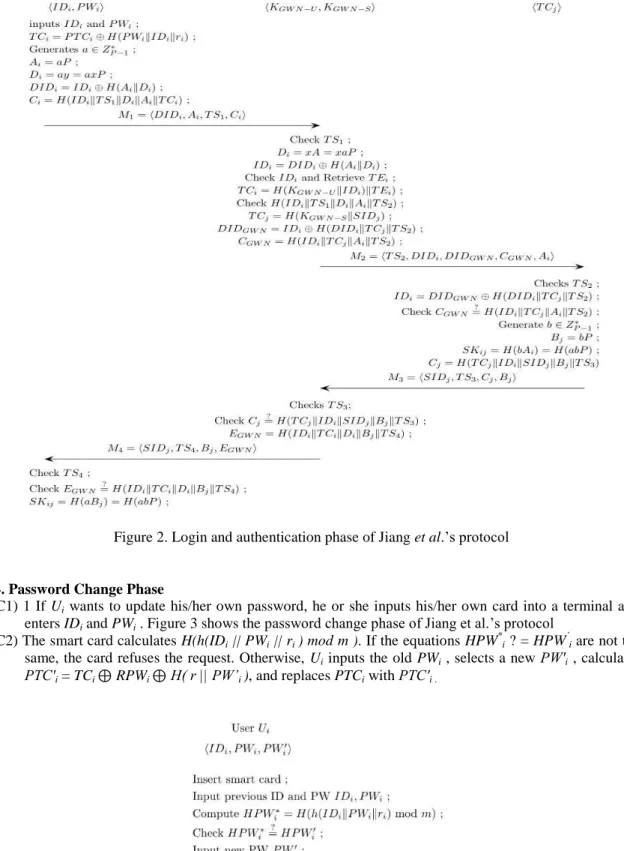
each other and establish a session key as follows. Figure 2 depicts these phases.
(A1) Ui selects a random number a ∈ Z*p-1 and calculates Ai = aP, Di = ay = axP, DIDi = IDi⊕ H( Ai || Di ),
and Ci = H( IDi || TS1 || Di || Ai || TCi ), where TS1 is the timestamp of the current computing platform.
Finally, Ui forwards { DIDi , Ai , TS1 , Ci } to GWN.
(A2) On receiving { DIDi , Ai , TS1 , Ci }, GWN verifies the freshness of TS1. If TS1 is not fresh, GWN refuses
the request; otherwise, GWN calculates Di = xA = xaP, IDi = DIDi⊕ H(Ai || Di ), and TCi = H ( KGWN-U
|| IDi || TEi ) and checks whether H( IDi || TS1 || Di || Ai || TCi ) is the same as Ci. If these two values are
not the same, GWN refuses the request; otherwise, GWN chooses a sensor Sj and calculates TCj =
H(KGWN-S || SIDj ), DIDGWN =IDi⊕ H(DIDi || TCj || TS5 ), and CGWN =H( IDi || TCj || Ai || TS2 ), where
TS2 is the timestamp of the current computing platform. Finally, GWN sends { TS2 , DIDi , DIDGWN ,
CGWN , Ai } to the Sj .
(A3) On receiving { TS2 , DIDi , DIDGWN , CGWN , Ai }, Sj checks the freshness of TS2 . If TS2 is invalid, Sj
rejects the request; otherwise, Sj computes IDi = DIDGWN⊕ H( DIDi || TCj || TS2 ) and checks whether
H( IDi || TCj ||Ai || TS2 ) and CGWN are equal. If these two values are unequal, Sj terminates the current
session; otherwise, Sj generates a random key b∈Z*P-1 and computes Bj = bP, SKij = H( bAi ) = H(abP) ,
and Cj = H(TCj || IDi || SIDj || Bj || TS3 ), where TS3 is the current timestamp. Sj then sends { SIDj , TS3 ,
Cj , Bj } to GWN.
(A4) After checking the legitimacy of TS3, GWN checks whether H( TCj ||IDi || SIDj || Bj ||TS3 ) and Cj are
the same. If these two values are not equal, GWN stops the current session; otherwise, GWN confirms that Sj is authenticated. Finally, GWN calculates EGWN = H(IDi ||TCi || Di || Bj || TS4 ), where TS4 is the
timestamp of the current computing platform, and sends { SIDj ,TS4 , Bj , EGWN } to Ui .
(A5) After checking the freshness of TS4, Ui computes and checks whether H( IDi || TCi || Di || Bj || TS4 ) and
EGWN are equal. If these two values are not the same, Ui stops the current session; otherwise, Ui confirms
that Sj and GWN are authenticated. Finally, Ui computes the shared session key SKij = H( aBj ) =
Figure 2. Login and authentication phase of Jiang et al.’s protocol 2.4. Password Change Phase
(PC1) 1 If Ui wants to update his/her own password, he or she inputs his/her own card into a terminal and
enters IDi and PWi . Figure 3 shows the password change phase of Jiang et al.’s protocol
(PC2) The smart card calculates H(h(IDi || PWi || ri ) mod m ). If the equations HPW*i ? = HPW’i are not the
same, the card refuses the request. Otherwise, Ui inputs the old PWi , selects a new PW′i , calculates
PTC′i = TCi ⊕ RPWi ⊕ H( r || PW’i ), and replaces PTCi with PTC′i .
Figure 3. Password change phase of Jiang et al.’s protocol
3. CRYPTANALYSIS ON JIANG ET AL.’S TWO-FACTOR AUTHENTICATION PROTOCOL
vulnerabilities, including a lack of mutual authentication, a risk of SID modulation and DoS attacks, a lack of sensor anonymity, and weak ID anonymity.
3.1. Lack of Mutual Authentication
Mutual authentication means that two or three parties authenticate each other. All of the parties (e.g., client/user, gateway, and sensors) are assured of the others’ identity. The user and gateway authenticate each other using IDiand TCi, while the gateway and sensors authenticate each other using TCj and CGWN.
However, mutual authentication between the user and sensors is not provided. The sensors can authenticate the user with the gateway’s help. However, the user cannot authenticate the sensors. Thus, the user cannot verify whether the sensor SIDj is normal.
3.2. Risk of SID Modification Attacks
The user receives { SIDj, TS2, Bj, EGWN } from GWN and checks the message’s accuracy and
freshness. However, there is no information indicating that SIDj in { SIDj, TS2, Bj, EGWN } is now
authenticated by GWN, so an attacker can perform a SID modification attack. When the attacker modifies the SIDj in { SIDj, TS2, Bj, EGWN} to SIDattacker, the user is unaware of the change. Therefore, the user mistakenly
believes that SIDattacker is a normal sensor node and thus computes the session key SKij for secure
communication with SIDattacker even though the attacker cannot know the SKij. Moreover, when SIDj requests
communication, the user cannot know whether SIDj is an authenticated sensor node, so they cannot
communicate with each other. 3.3. Lack of Sensor Anonymity
Anonymity is a desirable security feature, and it provides identification and key agreement of the user and sensors during the login and authentication phases. Thus, Jiang et al.’s authentication protocol provides the user’s dynamic identification DIDi to protect the user’s anonymity. Moreover, this protocol uses
DIDGWN to protect the gateway node’s identification. However, Jiang et al.’s authentication protocol does not
provide anonymity of the sensor node. Therefore, an attacker can know which sensor node is communicating with users. In addition, the attacker can abuse the sensor node’s identification, because SIDj can be easily
known by the attacker. Therefore, the anonymity of sensor nodes needs to be provided. First, Sj checks the
freshness of TS2. Then, if TS2 is valid, Sj computes IDi = DIDGWN⊕ H( DIDi || TCj || TS2 ) and checks
whether H( IDi || TCj ||Ai || TS2 ) and the received CGWN are equal.
3.4. DoS Attack
A DoS attack is an attempt to make a machine or network resource unavailable so regular users cannot use the system’s resources. Although the methods, motives, and targets of DoS attacks may vary, they generally involve efforts to temporarily or indefinitely interrupt or suspend the services of a host connected to the Internet. In Jiang et al.’s authentication protocol, sensor nodes can verify the freshness of a message using TS2. Therefore, when an attacker sends a previous message to the sensor node, the sensor node knows
whether this message is a current message or a previous message. However, after an attacker gets the previous message { TS2 , DIDi , DIDGWN , CGWN , Ai }, the attacker sends the message changing only TS2 to
the current timestamp. To check the legitimacy of the message, the sensor node needs to execute various computations, such as hash function (twice), verification function (twice), and timestamp checking (once). The sensor node has limited battery power and computational ability, so it is possible that a sensor node cannot perform its normal functions when an attacker executes a DoS attack on the sensor node.
3.5. Weak ID Anonymity
In Jiang et al.’s authentication protocol, the user can maintain the ID anonymity using DIDi. An attacker cannot compute IDi from DIDi, because the attacker does not know H( Ai || Di ) in DIDi= IDi⊕
H( Ai || Di ). However, IDi can be exposed in the sensor nodes gained by the attacker. The sensor nodes are
scattered in various places, so the attacker can find the sensor nodes and obtain their authority. Therefore, the attacker can compute the user’s identity using IDi = DIDGWN⊕H( DIDi || TCj || TS2 ), because the sensor
nodes know TCj ,which is shared in the sensor registration phase. Hence, the attacker can get IDi after gaining
the sensor nodes, and the anonymity of this protocol is not strong.
4. CONCLUSION
Jiang et al. proposed a privacy-aware two-factor authentication protocol using ECC for WSNs. They insist that their protocol achieves various security and usability features necessary for real-life application environments while maintaining acceptable efficiency. However, this paper analyzed Jiang et al.’s protocol
and showed that this protocol has security vulnerabilities, such as a lack of mutual authentication, a risk of SID modification and DoS attacks, a lack of sensor anonymity, and weak ID anonymity. To solve these vulnerabilities, a security-enhanced privacy-aware two-factor authentication protocol using ECC for WSNs needs to be proposed.
ACKNOWLEDGEMENTS
This work was supported by the National Research Foundation of Korea grant funded by Korea government (Ministry of Science, ICT & Future Planning) (NRF-2017R1C1B5017492) and this research was supported by financial support of Howon University in 2017.
REFERENCES
[1] Y. Choi et al., “Security enhanced user authentication protocol for wireless sensor networks using elliptic curves cryptography,” Sensors, vol. 14(6), pp.10081-10106, 2014.
[2] Q. Jiang et al., “A privacy‐ aware two‐ factor authentication protocol based on elliptic curve cryptography for wireless sensor networks,”. International Journal of Network Management., vol 27(3), 2017.
[3] S. Kumari et al., “User authentication schemes for wireless sensor networks: A review,” Ad Hoc Networks, vol 27, pp.159-194, 2015.
[4] M. L. Das, “Two-factor user authentication in wireless sensor networks”. IEEE Transactions on Wireless Communications, vol 8(3), pp.1086-1090, 2009.
[5] M. K. Khan, and K. Alghathbar, “Cryptanalysis and security improvements of two-factor user authentication in wireless sensor networks”. Sensors, vol 10(3), pp.2450-2459, 2010.
[6] T. H.. Chen, and W. K. Shih, “A robust mutual authentication protocol for wireless sensor networks”. ETRI
journal, vol 32(5), pp. 704-712, 2010.
[7] D. He et al., “An Enhanced Two-factor User Authentication Scheme in Wireless Sensor Networks.” Ad hoc &
sensor wireless networks, vol 10(4), pp361-371, 2010.
[8] H. L. Yeh, et al., “A secured authentication protocol for wireless sensor networks using elliptic curves cryptography.”, Sensors, vol 11(5), pp. 4767-4779, 2011
[9] W. Shi and P. Gong,. “A new user authentication protocol for wireless sensor networks using elliptic curves cryptography”. International Journal of Distributed Sensor Networks, 2013.
[10] D. Hankerson et al. “Guide to elliptic curve cryptography,”. Springer Science & Business Media, 2006.
[11] S. A. Chaudhry et al., “An improved and provably secure privacy preserving authentication protocol for SIP,”.
Peer-to-Peer Networking and Applications, vol 10(1), pp. 1-15, 2017.
[12] D. Wang, “Anonymous two-factor authentication in distributed systems: certain goals are beyond attainment,”
IEEE Transactions on Dependable and Secure Computing, vol 12(4), pp. 428-442, 2015.
BIOGRAPHY OF AUTHOR
Younsung Choi received the B.E. degree in Information and Communication Engineering from from Sungkyunkwan University in 2006. And he received the M.S. and PH. D degrees on Information Security in Electronic Computer Science and Engineering Divison from Sungkyunkwan University, in 2007 and 2015. He is now an assistant professor in Howon University. His current research interests include information security, cryptography and digital forensic.