A Primal Dual Active Set with Continuation Algorithm for the
`
0
-Regularized Optimization Problem
Yuling Jiao
∗Bangti Jin
†Xiliang Lu
‡September 3, 2014
Abstract
We develop a primal dual active set with continuation algorithm for solving the `0-regularized least-squares problem that frequently arises in compressed sensing. The algorithm couples the the primal dual active set method with a continuation strategy on the regularization parameter. At each inner iteration, it first identifies the active set from both primal and dual variables, and then updates the primal variable by solving a (typically small) least-squares problem defined on the active set, from which the dual variable can be updated explicitly. Under certain conditions on the sensing matrix, i.e., mutual incoherence property or restricted isometry property, and the noise level, a finite step global convergence of the overall algorithm is established. Extensive numerical examples are presented to illustrate the efficiency and accuracy of the algorithm and its convergence behavior.
keywords: primal dual active set algorithm, coordinatewise minimizer, continuation strategy, global convergence.
1
Introduction
Over the last ten years, compressed sensing [9, 15] has received a lot of attention amongst engineers, statisticians and mathematicians due to its broad range of potential applications. Mathematically it can be formulated as the following constrained`0 optimization problem:
min
x∈Rp
kxk0,
subject to kΨx−yk2≤,
(1.1)
where the sensing matrix Ψ∈Rn×pwith pnhas normalized column vectors{ψ i}, i.e.,
kψik= 1, i= 1,· · ·, p,
≥0 is the noise level, andkxk0denotes the number of nonzero components in the vectorx. Due to the
discrete structure of the termkxk0, it is very challenging to develop an efficient algorithm to accurately
solve the model (1.1). Hence, approximate methods for the model (1.1), especially greedy heuristics and convex relaxation, are very popular in practice. In greedy algorithms, including orthogonal matching pursuit [34], stagewise orthogonal matching pursuit [17], regularized orthogonal matching pursuit [30], CoSaMP [29], subspace pursuit [13], and greedy gradient pursuit [4,7] etc., one first identifies the support of the sought-for signal, i.e., the locations of (one or more) nonzero components, iteratively based on the
∗School of Statistics and Mathematics, Zhongnan University of Economics and Law, Wuhan, 430063, P.R. China; School
of Mathematics and Statistics, Wuhan University, Wuhan 430072, P.R. China. ([email protected])
†Department of Computer Science, University College London, Gower Street, London, WC1E 6BT, UK
‡Corresponding author. School of Mathematics and Statistics, Wuhan University, Wuhan 430072, P.R. China
current dual variable (correlation), and then updates the components on the support by solving a least-squares problem. There are also several variants of greedy heuristics, e.g., (accelerated) iterative hard thresholding [3,6] and hard thresholding pursuit [19], which are based on the sum of the current primal and dual variable. In contrast, basis pursuit finds one minimizer of a convex relaxation problem [11,37], for which a wide variety of convex optimization algorithms can be conveniently applied; see [2,12,33,39] for comprehensive overviews and the references therein.
Besides greedy methods and convex relaxation, the “Lagrange” counterpart of (1.1) (or equivalently, the`0-regularized minimization problem), which reads
min
x∈Rp
Jλ(x) =12kΨx−yk2+λkxk0, (1.2)
has been very popular in many applications, e.g., model selection, statistical regression, and image restora-tion. In the model (1.2), λ >0 is a regularization parameter, controlling the sparsity level of the regu-larized solution. Due to the nonconvexity and discontinuity of the functionkxk0, the relation between
problems (1.1) and (1.2) is not self evident. We shall show that under certain assumptions on the sensing matrix Ψ and the noise level(and with λchosen properly), the support of the regularized solution to (1.2) coincides with that of the true signal, cf. Theorem2.1.
The existence and a characterization of global minimizers to (1.2) were established in [26,31]. How-ever, it is still very challenging to develop globally convergent algorithms for efficiently solving problem (1.2) in view of its nonconvexity and nonsmoothness. Nonetheless, due to its broad range of applications, several algorithms have been developed to find an approximate solution to problem (1.2), including it-erative hard thresholding [5], forward backward splitting [1], penalty decomposition [27] and stochastic continuation [35, 36], to name just a few. Theoretically, these algorithms can at best have a local con-vergence. Very recently, in [25,26], based on a coordinatewise characterization of the global minimizers, a novel primal dual active set (PDAS) algorithm was developed to solve problem (1.2). The extensive simulation studies in [26] indicate that when coupled with a continuation technique, the PDAS algorithm merits a global convergence property. The idea of continuation is well established for iterative algorithms with the purpose of “warm starting” and globalizing the convergence. Unsurprisingly, this idea has been extensively pursued in sparsity optimization, especially the`1penalty [43,20,44,18]. The popular OMP
[34] can be viewed as a continuation in the sparsity level of the solution, where one active set is added at each step; see also [14]. However, to the best of our knowledge, the application of the continuation technique to the PDAS algorithm for the `0 optimization problem (1.2) and its rigorous convergence
analysis are new.
The PDAS algorithm solves the necessary optimality condition of a coordinatewise minimizer to (1.2), cf. (2.2) below, and thus it can at best converge to a coordinatewise minimizer. However, if the support of the coordinatewise minimizer is small and the sensing matrix Ψ satisfies certain mild conditions, then its active set is contained in the support of the true signal, cf. Lemma2.4. Hence, the support of the minimizer will coincide with that of the true signal if we choose the regularization parameterλproperly (and thus control the size of the active set) during the iteration. This naturally motivates the use of a continuation strategy on the parameterλ. The resulting PDAS continuation (PDASC) algorithm extends the PDAS developed in [26]. In this work, we provide a convergence analysis of the PDASC algorithm under commonly used assumptions on the sensing matrix Ψ for the analysis of existing algorithms, i.e., mutual incoherence property and restricted isometry property. The convergence analysis relies essentially on a novel characterization of the evolution of the active set during the primal-dual active set iterations. To the best of our knowledge, this represents the first work on the global convergence of an algorithm for problem (1.2), without using a knowledge of the exact sparsity level.
The rest of the paper is organized as follows. In Section 2, we describe the problem setting, collect basic estimates, and provide refined properties of a coordinatewise minimizer. In Section3, we give the complete algorithm, discuss the parameter choices, and provide a global convergence analysis. Finally, in Section 4, several numerical examples are provided to illustrate the efficiency of the algorithm and the convergence theory.
2
Regularized
`
0-minimization
In this section, we describe the problem setting, and derive basic estimates, which are essential for the convergence analysis. Further, we give sufficient conditions for a coordinatewise minimizer to be a global minimizer, which allows one to derive equivalence between (1.1) and (1.2), under certain circumstances.
2.1
Problem setting
Suppose that the true signalx∗ hasT nonzero components with its active set (indices of nonzero com-ponents) denoted byA∗, i.e.,T =|A∗|and the noisy datay is formed by
y= X
i∈A∗
x∗iψi+η.
We assume that the noise vectorη satisfieskηk ≤, with≥0 being the noise level. Further, we let
S={1,2, ..., p} and I∗=S\A∗.
For any index set A ⊆ S, we denote by xA ∈ R|A| (respectively ΨA ∈ Rn×|A|) the subvector of x (respectively the submatrix of Ψ) whose indices (respectively column indices) appear in A. Last, we denote byxo the oracle solution defined by
xo= Ψ†A∗y, (2.1)
where Ψ†Adenotes the pseudoinverse of the submatrix ΨA, i.e., Ψ†A= (Ψ t
AΨA)−1ΨtAif ΨtAΨAis invertible.
The oracle solutionxo is the least-squares solution on the true active setA∗.
In compressive sensing, there are two assumptions, i.e., mutual incoherence property (MIP) [16] and restricted isometry property (RIP) [10], on the sensing matrix Ψ that are frequently used for the convergence analysis of sparse recovery algorithms. The MIP assumes that the mutual coherence ν of the sensing matrix Ψ is small, where the mutual coherenceν of Ψ is defined by
ν = max
1≤i,j≤p,i6=j|ψ t iψj|.
A sensing matrix Ψ is said to satisfy RIP of levelsif there exists a constantδ∈(0,1) such that (1−δ)kxk2≤ kΨxk2≤(1 +δ)kxk2, ∀x∈
Rp withkxk0≤s,
and we denote byδs the smallest constant with respect to the sparsity levels. We note that the mutual
coherenceν can be easily computed, but the RIP constant δs is nontrivial to evaluate (see [38] for some
recent results on its computational complexity). Nonetheless, the mutual coherence ν can be used to provide a simple upper bound on the RIP constantδs [41, Proposition 21]. However, our assumptions
on the mutual coherence ν do not follow from that on the RIP constant δ, or vice versa, and thus we present theoretical results for both conditions.
The next lemma gives basic estimates under the MIP condition. Lemma 2.1. Let Aand B be disjoint subsets ofS. Then
kΨt Ayk`∞ ≤ kyk, kΨt BΨAxAk`∞ ≤ |A|νkxAk`∞, k(ΨtAΨA)−1xAk`∞ ≤ kxAk`∞ 1−(|A| −1)ν if (|A| −1)ν <1.
Proof. IfA=∅, then the estimates are trivial. Hence we will assume Ais nonempty. For anyi∈A, |ψtiy| ≤ kψikkyk ≤ kyk.
This shows the first inequality. Next, for anyi∈B, |ψitΨAxA|=| X j∈A ψitψjxj| ≤ X j∈A |ψitψj||xj| ≤ |A|νkxAk`∞.
This shows the second assertion. To prove the last estimate, we follow the proof strategy of [40, Theorem 3.5], i.e., applying a Neumann series method. First we note that Ψt
AΨA has a unit diagonal because all
columns of Ψ are normalized. So the off-diagonal part Φ satisfies Ψ∗AΨA=E|A|+ Φ,
where E|A| is an identity matrix. Each column of the matrix Φ lists the inner products between one
column of ΨA and the remaining |A| −1 columns. By the definition of the mutual coherenceν and the
operator norm of a matrix
kΦk`∞,`∞ = max
k∈A
X
j∈A\{k}
|ψjtψk| ≤(|A| −1)ν.
WheneverkΦk`∞,`∞ <1, the Neumann seriesP∞k=0(−Φ)k converges to the inverse (E|A|+ Φ)−1. Hence, we may compute k(Ψ∗AΨA)−1k`∞,`∞=k(E|A|+ Φ)−1k`∞,`∞ =k ∞ X k=0 (−Φ)kk `∞,`∞ ≤ ∞ X k=0 kΦkk `∞,`∞= 1 1− kΦk`∞,`∞ ≤ 1 1−(|A| −1)ν.
The desired estimate now follows immediately.
The following lemma collects some well known estimates on the RIP constantδs; see [29, Propositions
3.1 and 3.2] and [13, Lemma 1] for the proofs.
Lemma 2.2. Let Aand B be disjoint subsets ofS. Then
kΨt AΨAxAkT(1∓δ|A|)kxAk, k(ΨtAΨA)−1xAkT 1 1±δ|A| kxAk, kΨt AΨBk ≤δ|A|+|B|, kΨ†Ayk ≤ p 1 1−δ|A| kyk, δs≤δs0, if s < s0.
The next lemma gives some crucial estimates for one-step primal dual active set iteration on the active setA. These estimates provide upper bounds on the dual variable d= Ψt(y−Ψx) and the error
¯
xA=xA−x∗Aon the active setA. They will play an essential role for subsequent analysis, including the
convergence of the PDASC algorithm.
Lemma 2.3. For any setA⊆S with|A| ≤T, letB=A∗\AandI=S\A, and consider the following primal dual iteration onA
xA= Ψ†Ay, xI = 0, d= Ψt(y−Ψx).
(a) Ifν <1/(T−1), then dA= 0 and k¯xAk`∞ ≤ 1 1−(|A| −1)ν (|B|νkx ∗ Bk`∞+), |dj| ≥ |x∗j| − kx∗Bk`∞(|B| −1)ν−− |A|νk¯xAk`∞, ∀j∈B, |dj| ≤ |B|νkx∗Bk`∞++|A|νkx¯Ak`∞, ∀j ∈I∗∩I.
(b) If the RIP of sparsity levels:= max{|A|+|B|, T + 1} is satisfied, then dA= 0 and
k¯xAk ≤ δ|A|+|B| 1−δ|A| kx∗Bk+p 1 1−δ|A| , |dj| ≥ |x∗j| −δ|B|kx∗Bk −−δ|A|+1k¯xAk, ∀j∈B, |dj| ≤δ|B|+1kx∗Bk++δ|A|+1k¯xAk, ∀j∈I∗∩I,
Proof. We show only the estimates under the RIP condition and using Lemma2.2, and that for the MIP condition follow similarly from Lemma 2.1. If A = ∅, then all the estimates clearly hold. In the case
A6=∅, then by the assumption, Ψt
AΨA is invertible. By the definition of the updatexA and the datay
we deduce that dA= ΨtA(y−ΨAxA) = 0, and ¯ xA= (ΨtAΨA)−1ΨtA(ΨA∗x∗A∗+η−ΨAx∗A) = (ΨtAΨA)−1ΨAt(ΨBx∗B+η).
Consequently, by Lemma2.2and the triangle inequality, there holds
k¯xAk ≤ 1 1−δ|A| kΨt AΨBx∗Bk+kΨ † Aηk ≤ 1 1−δ|A| δ|A|+|B|kx∗Bk+ 1 p1 −δ|A| .
Next, it follows from the definition of the dual variabled, i.e.,
dj=ψtj(y−ΨAxA) =ψjt(ΨBx∗B+η−ΨAx¯A),
Lemma2.2, and the assumptionψt
jψj = 1 that for anyj∈B, there holds
|dj|=|ψtjψjx∗j+ψ t
j(ΨB\{j}x∗B\{j}+η−ΨAx¯A)|
≥ |x∗j| −(|ψtjΨB\{j}x∗B\{j}|+|ψtjη|+|ψjtΨAx¯A|)
≥ |x∗j| −δ|B|kx∗Bk −−δ|A|+1k¯xAk.
Similarly, for anyj∈I∗∩I, there holds
|dj| ≤δ|B|+1kx∗Bk++δ|A|+1k¯xAk.
This completes the proof of the lemma.
2.2
Coordinatewise minimizer
Due to the nonconvexity and discontinuity of the functionkxk0, the classical theory [24] on the existence
of a Lagrange multiplier cannot be applied directly to show the equivalence between the constrained problem (1.1) and the Lagrange counterpart (1.2). Nonetheless, both formulations aim at recovering the true sparse signalx∗, and thus we expect that they are closely related to each other. We shall establish
below that under certain circumstances (with the regularization parameterλproperly chosen) the oracle solutionxo is the only global minimizer of problem (1.2), and as a consequence, we derive directly the
equivalence between problems (1.1) and (1.2).
To this end, we first characterize minimizers of problem (1.2). Since the cost function Jλ(x) is
nonconvex and discontinuous, instead of a global minimizer, we study its coordinatewise minimizers, which was introduced in [42]. A vectorx= (x1, x2, . . . , xp)t∈Rpis called a coordinatewise minimizer to
Jλ(x) if it is the minimum along each coordinate direction, i.e.,
xi∈arg min t∈R
Jλ(x1, ..., xi−1, t, xi+1, ..., xp).
The necessary and sufficient condition for a coordinatewise minimizerxtoJλ(x) is given by [25, 26]:
xi∈S`
0
λ (xi+di) ∀i∈S, (2.2)
whered= Ψt(y−Ψx) denotes the dual variable, andS`0
λ is the hard thresholding operator defined by
Sλ`0(v) = 0, |v|<√2λ, ∈ {0,sgn(v)√2λ}, |v|=√2λ, =v, |v|>√2λ. (2.3)
Using the operatorS`0
λ , the condition (2.2) can be equivalently written as
|xi+di|> √ 2λ⇒di= 0, |xi+di|< √ 2λ⇒xi= 0, |xi+di|= √ 2λ⇒xi= 0 ordi= 0.
We note that these conditions as the optimality condition for the stationary point to (1.2) are well known in the literature (see e.g., [5]). In [5], it forms the basis of the iterative hard thresholding algorithm. Consequently, with the active setA={i:xi6= 0}, there holds
min
i∈A|xi| ≥
√
2λ≥ kdk`∞. (2.4)
It is known that any coordinatewise minimizerxfor problem (1.2) is a local minimizer [26, Theorem 3.1 (i)] [31, Section 3.1]. To further analyze the coordinatewise minimizer, we need the following assumption on the noise level:
Assumption 2.1. The noise level is small in the sense ≤βmini∈A∗|x∗i|, for some0≤β <1/2. The next lemma gives an interesting characterization of the active set of the coordinatewise minimizer. Lemma 2.4. Let Assumption 2.1 hold, and x be a coordinatewise minimizer with a support A and
|A| ≤T. If either (a)ν <(1−2β)/(3T−1) or (b) δ,δ2T ≤(1−2β)/(2
√
T+ 1) holds, thenA⊆A∗. Proof. LetI=S\A. Sincexis a coordinatewise minimizer, it follows from (2.2) that
xA= Ψ†Ay, xI = 0, d= Ψt(y−Ψx).
We shall prove the assertions by means of contradiction. Assume the contrary, i.e., A * A∗. We let
B = A∗\A, which is nonempty by assumption, and denote by i
A ∈ {i ∈ I : |x∗i| = kx∗Bk`∞}. Then
iA∈B. Further by (2.4), there holds
|diA| ≤ kdk`∞ ≤min
i∈A|xi| ≤i∈minA\A∗|xi| ≤ k¯xAk`
Now we discuss the two cases separately.
Case (a). By Lemma 2.1, ≤ βmini∈A∗|x∗i| ≤ βkx∗
Bk`∞ from Assumption 2.1 and the choice of the indexiA, we have k¯xAk`∞ ≤ 1 1−(|A| −1)ν (|B|νkx ∗ Bk`∞+) ≤ 1 1−(|A| −1)ν(|B|ν+β)kx ∗ Bk`∞, |diA| ≥ |x ∗ iA| − kx ∗ Bk`∞(|B| −1)ν−− |A|νkx¯Ak`∞ ≥ kx∗Bk`∞ 1−(|B| −1)ν−β− |A|ν 1 1−(|A| −1)ν(|B|ν+β) . Consequently, we deduce |diA| − k¯xAk`∞ ≥ kx∗Bk`∞ 1−(|A| −1)ν 1−(|A|+ 2|B|)ν−(|A|+|B|)ν2+ 2ν+ν2−β(ν+ 2) ≥ kx ∗ Bk`∞ 1−(|A| −1)ν [1−3T ν+ν−2β+ν(1−β−2T ν)] ≥ kx ∗ Bk`∞ 1−(|A| −1)ν [1−(3T−1)ν−2β]>0,
under assumption (a)ν <(1−2β)/(3T−1). This leads to a contradiction to (2.5). Case (b). By assumption,|A|+|B| ≤2T and by Lemma2.2, there hold
k¯xAk ≤ δ 1−δkx ∗ Bk+ 1 √ 1−δ ≤ δ 1−δkx ∗ Bk+ 1 1−δ, |diA| ≥ |x ∗ iA| −δkx ∗ Bk −−δkx¯Ak ≥ |x∗iA| − δ 1−δkx ∗ Bk − 1 1−δ.
Consequently, with the assumption onandδ < 1−2β
2√T+1, we get |diA| − k¯xAk ≥ |x ∗ iA| − 2δ 1−δkx ∗ Bk − 2 1−δ ≥ |x∗i A| 1− 2√T δ+ 2β 1−δ ! >0,
which is also a contradiction to (2.5). This completes the proof of the lemma.
From Lemma 2.4, if the support size of the active set A of a coordinatewise minimizer x can be controlled, then we may obtain information of the true active set A∗: it is a superset of A. However, a local minimizer generally does not yield such information; see following result. Hence the coordinatewise minimizer is more informative. The proof can be found also in [31], but we include a short sketch here for completeness.
Proposition 2.1. for any given index setA⊆S, the solutionxto the least-squares problemminsupp(x)⊆AkΨx−
yk is a local minimizer.
Proof. Letτ = min{|xi|:xi 6= 0}. Then for any small perturbationhin the sense khk`∞ < τ, we have
i.e., supp(h) ⊆A and supp(h)* A. First consider the case supp(h)⊆A. By the definition of x, and kxk0≤ kx+hk0, we deduce Jλ(x+h) = 12kΨ(x+h)−yk2+λkx+hk0 ≥ 1 2kΨx−yk 2+λ kxk0=Jλ(x).
Alternatively, if supp(h)*A, thenkx+hk0≥ kxk0+ 1. Since
lim
khk→0kΨ(
x+h)−yk=kΨx−yk,
we again haveJλ(x+h)> Jλ(x) for sufficiently smallh. This completes the proof of the proposition.
Now we can study global minimizers to problem (1.2). For anyλ >0, there exists a global minimizer
xλto problem (1.2) [26]. Further, the following monotonicity relation holds [23][22, Section 3.2].
Lemma 2.5. Forλ1> λ2>0, there holds kxλ1k0≤ kxλ2k0.
If the noise level is sufficiently small, and the parameterλ is properly chosen, the oracle solution
xo is the only global minimizer to J
λ(x), cf. Theorem 2.1, which in particular implies the equivalence
between the two formulations (1.1) and (1.2); see Remark2.1below. Theorem 2.1. Let Assumption2.1hold.
(a) Supposeν <(1−2β)/(3T−1) andβ≤(1−2(T−1)ν)/(T+ 3), and let ξ=1−2(T −1)ν−2β−β 2 2T imin∈A∗|x ∗ i| 2.
Then for any λ∈(2/2, ξ), the oracle solutionxo, cf. (2.1), is the only global minimizer toJ λ(x).
(b) Supposeδ,δ2T ≤(1−2β)/(2
√
T+ 1)andβ ≤(1−2δ−δ2)/4, and let ξ= 1 2(1−δ)− δ2 1−δ− β √ 1−δ− 1 2β 2 min i∈A∗|x ∗ i| 2.
Then for any λ∈(2/2, ξ), the oracle solutionxo, cf. (2.1), is the only global minimizer toJ λ(x).
Proof. Letxbe a global minimizer to problem (1.2), and its support be A. It suffices to showA=A∗. If|A| ≥T + 1, then by the choice ofλ, we deduce
Jλ(x)≥λ(T+ 1)> λT +122≥Jλ(xo),
which contradicts the minimizing property of x. Hence, |A| ≤T. Since a global minimizer is always a coordinatewise minimizer, by Lemma2.4, we deduceA⊆A∗. IfA6=A∗, thenB =A∗\Ais nonempty. By the global minimizing property ofx, there holdsx= Ψ†Ay. Using the notation ¯xA from Lemma2.3,
we have
Jλ(x) = 12kΨBx∗B+η−ΨA¯xAk2+λ|A|. (2.6)
Now we consider the cases of the MIP and RIP separately.
Case (a) MIP: LetiA∈ {i∈I:|x∗i|=kx∗Bk`∞}, theniA ∈B and|x∗i
A|=kx ∗
Bk`∞. Hence, by Lemmas
2.3and2.1, there holds
1 2kψiAx ∗ iA+ ΨB\{iA}x ∗ B\{iA}+η−ΨAx¯Ak 2 ≥1 2|x ∗ iA| 2− |x∗ iA| |hψiA,ΨB\{iA}x ∗ B\{iA}i|+|hψiA, ηi|+|hψiA,ΨAx¯Ai| ≥1 2|x ∗ iA| 2− |x∗ iA| (|B| −1)ν|x∗iA|++ |A|ν 1−(|A| −1)ν(|B|ν|x ∗ iA|+) .
Now with < βmini∈A∗|x∗i| ≤β|x∗i
A| from Assumption2.1, we deduce Jλ(x)≥|x∗iA| 2 1 2 − (|B| −1)ν+β+ |A|ν 1−(|A| −1)ν(|B|ν+β) +λ|A| =|x∗iA| 2 1 2 −(T −1)ν−β +|x∗iA| 2|A|ν 1− |B|ν+β 1−(|A| −1)ν +λ|A| ≥|x∗iA| 2 1 2 −(T −1)ν−β ,
where the last inequality follows from (|A|+|B| −1)ν+β <1. By Assumption2.1, there holds 2/2≤ β2/2 min
i∈A∗|x∗i|2. Now by the assumption β ≤(1−2(T−1)ν)/(T + 3), we deduce (T+ 1)β2+ 2β < (T+ 3)β ≤1−2(T−1)ν, and henceT β2<1−2(T −1)ν−2β−β2. Together with the definition ofξ,
this impliesξ > 2/2. Further, by the choice of the parameterλ, i.e.,λ∈(2/2, ξ), there holds Jλ(x)−Jλ(xo)≥ 1 2 −(T−1)ν−β− 1 2β 2 min i∈A∗|x ∗ i| 2−λT >0,
which contradicts the optimality ofx. Case (b) RIP: It follows from (2.6) that
Jλ(x)≥ 12kΨBx∗Bk 2− |hη,Ψ Bx∗Bi| − |hx ∗ B,Ψ t BΨAx¯Ai|+λ|A| ≥ kΨBx∗Bk( 1 2kΨBx ∗ Bk −)− kx ∗ Bkδk¯xAk+λ|A|.
By Assumption 2.1 and the assumptions on β andδ, we deduce√1−δkx∗Bk ≥. Now in view of the monotonicity of the functiont(t/2−) fort ≥, and the inequality kΨBx∗Bk ≥
√
1−δkx∗Bk from the definition of the RIP constantδ, we have
kΨBx∗Bk( 1 2kΨBx ∗ Bk −)≥ √ 1−δkx∗Bk(1 2 √ 1−δkx∗Bk −).
Thus by Lemma2.3, we deduce
Jλ(x)≥ 1−δ 2 kx ∗ Bk 2 −√1−δkx∗Bk − kx∗Bk δ2 1−δkx ∗ Bk+ δ √ 1−δ +λ|A| = 1−δ 2 kx ∗ Bk 2−√ 1 1−δkx ∗ Bk − kx ∗ Bk 2 δ 2 1−δ +λ|A| ≥ kx∗Bk2 1−δ 2 − δ2 1−δ− β √ 1−δ +λ|A|,
where the last line follows from < βkx∗Bk, in view of Assumption2.1. Appealing again to Assumption
2.1, 2/2 ≤β2mini∈A∗|x∗i|2/2 ≤ β2kx∗Bk2/2. Next it follows from the assumption β ≤(1−δ−δ2)/4 that the inequality
β2+√ β 1−δ ≤ β2+β √ 1−δ ≤ 2β 1−δ ≤ 1−2δ−δ 2 2(1−δ) = 1−δ 2 − δ2 1−δ
holds. This together with the definition ofξyieldsξ > 2/2. Further, the choice ofλ∈(2/2, ξ) implies
Jλ(x)−Jλ(xo)≥ kx∗Bk 2 1 −δ 2 − δ2 1−δ − β √ 1−δ− 1 2β 2 −λ|B|>0,
Proposition 2.2. Let the conditions in Theorem 2.1hold. Then the oracle solution xo is a minimizer
of (1.1). Moreover, the support to any solution of problem (1.1)isA∗.
Proof. First we observe that there exists a solution ¯xto problem (1.1) with|supp(¯x)| ≤T, upon noting that the true solutionx∗satisfieskΨx∗−yk ≤andkx∗k0≤T. Clearly, for any minimizer ¯xto problem
(1.1) with support|A| ≤T, then Ψ†Ay is also a minimizer withkΨΨ†Ay−yk ≤ kΨ¯x−yk. Now if there is a minimizer ¯xwithA6=A∗, by repeating the arguments in the proof of Theorem2.1, we deduce
1 2kΨΨ † Ay−yk 2+λkΨ† Ayk0=Jλ(Ψ†Ay)> Jλ(xo) =122+λT ⇒ kΨ¯x−yk> ,
which leads a contradiction to the assumption that ¯x is a minimizer to problem (1.1). Hence, any minimizer of (1.1) has a supportA∗, and thus the oracle solutionxo is a minimizer.
Remark 2.1. Due to the nonconvex structure of problem(1.1), the equivalence between problem(1.1)and its “Lagrange” version(1.2)is generally not clear. However under certain assumptions, their equivalence can be obtained, cf. Theorem2.1and Proposition2.2. Further, we note that very recently, the equivalence between (1.2)and the following constrained sparsity problem
minkΨx−yk subject to kxk0≤T was discussed in [32].
3
Primal-dual active set algorithm with continuation
In this section, we present the primal-dual active set with continuation (PDASC) algorithm, and establish its finite step convergence property.
3.1
The PDASC algorithm
The PDASC algorithm combines the strengthes of the PDAS algorithm [26] and the continuation tech-nique. The complete procedure is described in Algorithm 1. The PDAS algorithm (the inner loop of Algorithm1) first determines the active setA from the primal variablexand dual variabled, then up-dates the primal variablexby solving a least-squares problem on the active setA, and finally updates the dual variabled explicitly. It is well known that for convex optimization problems the PDAS algorithm can be interpreted as the semismooth Newton method [24]. Thus the algorithm merits a local superlinear convergence, and it reaches convergence with a good initial guess. In contrast, the continuation technique on the regularization parameter λallows one to control the size of the active setA, and thus the active set of the coordinatewise minimizer lies within the true active set A∗, under appropriate assumptions. For example, for the choice of the parameterλ0≥ kΨtyk`2∞/2,x(λ0) = 0 is the unique global minimizer
to the functionJλ0, and its active setAis empty.
In the algorithm, there are a number of free parameters: the starting value λ0 for the parameterλ,
the decreasing factorρ∈(0,1) (forλ), and the maximum numberJmaxof iterations for the inner PDAS
loop. Further, one needs to set the stopping criteria at lines 6 and 10. Below we discuss their choices. The choice of the initial valueλ0is not important. For any choiceλ0≥ kΨtyk2`∞/2,x= 0 is the unique global minimizer, and A = ∅. Both the decreasing factor ρand the iteration number Jmax affect the
accuracy and efficiency of the algorithm: LargerρandJmaxvalues make the algorithm have better exact
support recovery probability but at the expense of more computing time. Numerically, ρis determined by the number of grid points for the parameter λ. Specifically, given an initial value λ0 ≥ kΨtyk2`∞/2 and a small constant λmin, e.g., 1e-15λ0, the interval [λmin, λ0] is divided into N equally distributed
subintervals in the logarithmic scale. A large N value implies a large decreasing factor ρ. The choice
Jmax= 1 generally works well, which is also covered in the convergence theory in Theorems3.1and3.2
Algorithm 1Primal dual active set with continuation (PDASC) algorithm
1: Setλ0≥12kΨtyk2`∞, A(λ0) =∅,x(λ0) = 0 andd(λ0) = Ψty,ρ∈(0,1),Jmax∈N. 2: fork= 1,2, ...do
3: Letλk=ρλk−1,A0=A(λk−1), (x0, d0) = (x(λk−1), d(λk−1)).
4: forj= 1,2, ..., Jmaxdo
5: Compute the active and inactive setsAj andIj:
Aj=
n
i:|xji−1+dij−1|>p2λk
o
and Ij =Acj.
6: Check stopping criterion Aj=Aj−1.
7: Update the primal and dual variablesxj anddj respectively by
xjI j = 0, ΨtA jΨAjx j Aj = Ψ t Ajy, dj= Ψt(Ψxj−y). 8: end for
9: Setej= min(Jmax, j), andA(λk) =
n i:|xej i +d ej i|> √ 2λk o and (x(λk), d(λk)) = (xej, dej).
10: Check stopping criterion: kΨx(λk)−yk ≤.
11: end for
The stopping criterion for each λ-problem in Algorithm 1 is eitherAj =Aj−1 or j =Jmax, instead
of the standard criterionAj =Aj−1 for active set type algorithms [24]. The conditionj =Jmax is very
important for nonconvex problems. This is motivated by the following empirical observation: When the true signal x∗ does not have a strong decay property, e.g., 0-1 signal, the inner PDAS loop (for each
λ-problem) may never reach the conditionAj=Aj−1 within finite steps; see the example below.
Example 3.1. In this example, we illustrate the convergence of the PDAS algorithm. Let−1< µ <0, A∗={1,2}, and Ψ1= 1 p 1 +µ2(1, µ,0, ...,0) t, Ψ 2= 1 p 1 +µ2(µ,1,0, ...,0) t, x∗ 1=x∗2= 1. In the absence of data noiseη, the datay is given by
y= p 1
1 +µ2(1 +µ,1 +µ,0, ...,0)
t.
Now we let√2λ∈((1+1+µµ)22,
(1−µ2)2
(1+µ2)2), the initial guessA1={1}. Then direct computation yields
x1= 1 1 +µ2((1 +µ) 2,0)t, y−Ψx1= 1−µ 2 (p1 +µ2)3(−µ,1,0, ...,0) t, d1= 1 (1 +µ2)2(0,(1−µ 2)2)t. Hence d1 2 > √ 2λ > x1
1, and A2 = {2}. Similarly, we have A3 = {1} = A1, which implies that the algorithm simply alternates between the two sets{1} and{2}and will never reach the stopping condition Ak =Ak+1.
The stopping criterion at line 10 of Algorithm1is a discrete analogue of the discrepancy principle. This principle is well established in the inverse problem community for selecting an appropriate regularization parameter [22]. The rationale behind the rule is that one cannot expect the reconstruction to be more accurate than the data accuracy, i.e., the discrepancy . In the PDASC algorithm, if the active set is always contained in the true active setA∗ throughout the iteration, then the discrepancy principle can always be satisfied for someλk, and the solutionx(λk) resembles closely the oracle solutionxo.
3.2
Convergence analysis
Now we discuss the convergence of Algorithm1. First we note that for a fixed λvalue, since there are only a finite number of active sets, the PDAS algorithm is asymptotically periodic, and one naturally expects a finite-step convergence, if the desired convergence does occur. However, the convergence of the iteration itself does not follow directly, cf. Example3.1. We shall discuss the cases of the MIP and RIP conditions separately. The general proof strategy is as follows. It essentially relies on the precise characterization of the evolution of the active set during the iteration, especially a certain monotonicity relation of the active setA(λk) (via the continuation technique). In particular, we introduce two auxiliary
sets Gλ,s1 and Gλ,s2, cf. (3.1) below, to precisely characterize the evolution of the active setA during
the PDASC iteration.
First we consider the MIP case. We begin with an elementary observation: under the assumption
ν <(1−2β)/(2T−1) of the mutual coherenceν, there holds (2T −1)ν+ 2β <1.
Lemma 3.1. If ν < (1−2β)/(2T −1), then for any ρ ∈ (((2T −1)ν+ 2β)2,1) there exist s1, s2 ∈
(1/(1−T ν+ν−β),1/(T ν+β)),s1> s2, such that s2= 1 + (T ν−ν+β)s1 andρ=s22/s21.
Proof. By the assumption v < (1−2β)/(2T −1), T ν +β < 1−T ν +ν −β. Hence for any s1 ∈
(1/(1−T ν+ν−β),1/(T ν+β)), there holds s1>1 + (T ν−ν+β)s1 and 1 + (T ν−ν+β)s1> 1 1−T ν+ν−β, i.e., 1 T ν+β > s1>1 + (T ν−ν+β)s1> 1 1−T ν+ν−β.
Upon lettings2= 1 + (T ν−ν+β)s1, we deduce
1
T ν+β > s1> s2>
1
1−T ν+ν−β.
Now the monotonicity of the functionf(s1) =s2/s1 over the interval (1/(1−T ν+ν−β),1/(T ν+β)),
and the identities
1 + (T ν−ν+β)/(T ν+β)
1/(T ν+β) = (2T−1)ν+ 2β, 1 + (T ν−ν+β)/(1−T ν+ν−β)
1/(1−T ν+ν−β) = 1, imply that there exists ans1in the internal such thats2/s1=
√
ρfor anyρ∈(((2T−1)ν+ 2β)2,1).
Next for anyλ >0 ands >0, we denote by
Gλ,s,
n
i:|x∗i| ≥
√
2λso. (3.1)
The set Gλ,s characterizes the true sparse signal x∗ (via level sets). The lemma below provides an
important monotonicity relation on the active setAk during the iteration, which is essential for showing
Lemma 3.2. Let Assumption 2.1hold, ν <(1−2β)/(2T−1), ρ∈(((2T−1)ν+ 2β)2,1), and s 1 and s2 be defined in Lemma3.1. IfGλ,s1 ⊆Ak⊆A ∗, thenG λ,s2 ⊆Ak+1⊆A ∗.
Proof. LetA=Ak,B =A∗\A. By Lemma2.3, we have
|xi| ≥ |x∗i| − k¯xAk`∞ ≥ |x∗i| − |B|νkx∗Bk`∞+ 1−(|A| −1)ν , ∀i∈A, |dj| ≤ |B|ν 1 + |A|ν 1−(|A| −1)ν kx∗Bk`∞+ 1 + |A|ν 1−(|A| −1)ν , ∀j∈I∗, |di| ≥ |x∗i|+νkx ∗ Bk`∞− |B|ν 1 + |A|ν 1−(|A| −1)ν kx∗Bk`∞− 1 + |A|ν 1−(|A| −1)ν , ∀i∈B.
Using the fact≤βmini∈A∗|x∗i| ≤βkx∗Bk`∞from Assumption2.1and the trivial inequality |B|ν+β
1−T ν+ν+|B|ν ≤ T ν+β 1+ν , we arrive at |B|ν 1 + |A|ν 1−(|A| −1)ν kx∗Bk`∞+ 1 + |A|ν 1−(|A| −1)ν ≤ |B|ν+β 1−T ν+ν+|B|ν(1 +ν)kx ∗ Bk`∞ ≤(T ν+β)kx∗Bk`∞. Consequently, |dj| ≤(T ν+β)kxB∗k`∞, ∀j∈I∗, |di| ≥ |x∗i| −(T ν−ν+β)kx∗Bk`∞, ∀i∈B. It follows from the assumptionGλ,s1 ⊆A=Ak thatkx
∗
Bk`∞ < s1 √
2λ. Then for allj∈I∗, we have |dj|< s1(T ν+β)
√
2λ <√2λ,
i.e.,j∈Ik+1. This showsAk+1⊆A∗. For anyi∈I∩Gλ,s2, we have
|di|> s2
√
2λ−(T ν−ν+β)s1
√
2λ≥√2λ,
This implies i ∈ Ak+1 by (2.4). It remains to show that for any i ∈ A∩Gλ,s2, i ∈ Ak+1. Clearly, if A=∅, the assertion holds. Otherwise
|xi| ≥ |x∗i| − |B|ν+β 1−(|A| −1)νkx ∗ Bk`∞ > s2 √ 2λ−(T ν−ν+β)s1 √ 2λ≥√2λ,
where the last line follows from the elementary inequality |B|ν+β
1−(|A| −1)ν ≤T ν−ν+β.
This together with (2.4) also impliesi∈Ak+1. This concludes the proof of the lemma.
Now we can state the convergence result.
Theorem 3.1. Let Assumption 2.1hold, and ν <(1−2β)/(2T−1). Then for any ρ∈(((2T−1)ν+ 2β)2,1), Algorithm1converges in finite steps.
Proof. For eachλk-problem, we denote byAk,0and Ak, the active set for the initial guess and the last
Gλ,s1 ⊂Gλ,s2, and using Lemma3.2, for any indexkbefore the stopping criterion at line 10 of Algorithm
1is reached, there hold
Gλk,s1 ⊆Ak,0 and Gλk,s2⊆Ak,. (3.2)
Note that fork= 0, Gλ0,s2 =∅ and thus the assertion holds. To see this, it suffices to check kx
∗k
`∞ <
s2kΨtyk`∞. By Lemma2.1and the inequalitys2>1/(1−T ν+ν−β) we obtain that kΨtyk`∞ ≥ kΨtA∗ΨA∗x∗A∗k`∞− kΨtηk`∞
≥(1−(T−1)ν)kx∗k`∞− >kx∗k`∞/s2.
Now fork >0, it follows by mathematical induction and the relationAk,=Ak+1,0. It follows from (3.2)
that during the iteration, the active setAk,always lies inA∗. Further, forksufficiently large, by Lemma
2.5, the stopping criterion at line 10 must be reached and thus the algorithm terminates; otherwise
A∗⊆Gλk,s1,
then the stopping criterion at line 10 is satisfied, which leads to a contradiction.
Next we turn to the convergence of Algorithm1 under the RIP condition. Let 1−(2√T+ 1)δ >2β, an argument analogous to Lemma3.1 implies that for any√ρ∈((2δ√T+ 2β)/(1−δ),1) there exists1
ands2 such that
1−δ δ√T+β > s1> s2> 1−δ 1−δ−δ√T−β, s2= 1 + δ√T+β 1−δ s1, s2 s1 =√ρ. (3.3)
The next result is an analogue of Lemma 3.2.
Lemma 3.3. Let Assumption 2.1 hold, δ , δT+1 ≤ (1−2β)/(2
√
T + 1), and √ρ ∈ ((2δ√T + 2β)/(1−δ),1). Let s1 ands2 are defined by (3.3). IfGλ,s1 ⊆Ak ⊆A
∗, then G
λ,s2⊆Ak+1⊆A
∗. Proof. LetA=Ak,B =A∗\A. Using the notation in Lemma2.3, we have
|xi| ≥ |x∗i| − k¯xAk ≥ |x∗i| − δkx∗Bk+ 1−δ , ∀i∈A, |dj| ≤δkx∗Bk++δkx¯Ak ≤ δkx∗Bk+ 1−δ , ∀j∈I ∗, |di| ≥ |x∗i| −δkx ∗ Bk −−δkx¯Ak ≥ |x∗i| − δkx∗Bk+ 1−δ , ∀i∈B.
By the assumptionGλ,s1 ⊆Ak, we havekx
∗
Bk`∞ < s1 √
2λ. Now using the relations1<(1−δ)/(δ
√
T+β) and Assumption2.1, we deduce
δkx∗Bk+ 1−δ ≤ δ√T+β 1−δ kx ∗ Bk`∞< √ 2λ. Thus forj∈I∗,|d i|< √
2λ, i.e.,Ak+1⊂A∗. Similarly, using the relationss2= 1 +s1(δ
√
T+β)/(1−δ) ands1>(1−δ)/(1−δ−δ
√
T −β), we arrive at that for anyi∈Gλ,s2, there holds
|x∗i| −δkx ∗ Bk+ 1−δ > s2 √ 2λ−δ √ T+β 1−δ s1 √ 2λ=√2λ.
This implies that fori∈Gλ,s2 ∩A, |xi|>
√
2λ, and for i∈Gλ,s2 ∩I, |di|>
√
2λ. Consequently, (2.4) yields the desired relation (Gλ,s2∩A)⊆Ak+1, and this concludes the proof of the lemma.
Now we can state the convergence of Algorithm1under the RIP assumption. The proof is similar to that for Theorem3.1, and hence omitted.
Theorem 3.2. Let Assumption 2.1 hold, and δ , δT+1 ≤ (1−2β)/(2
√
T+ 1). Then for any √ρ ∈
(2δ√T+ 2β)/(1−δ),1, Algorithm1converges in finite steps.
Remark 3.1. Theorems3.1and3.2indicate that under designated assumptions, Algorithm1converges in finite steps, and the active set A(λk)remains a subset of the true active setA∗.
Corollary 3.1. Let the assumptions in Theorem 2.1 hold. Then Algorithm 1 terminates at the oracle solution xo.
Proof. First, we note the monotonicity relation A(λk) ⊂A∗ before the stopping criterion at line 10 of
Algorithm1 is reached. For anyA(A∗, letx= Ψ†Ay. Then by the argument in the proof of Theorem
2.1, we have
Jλ(x) = 12kΨx−yk2+λ|A|> 122+λT ⇒ kΨx−yk> ,
which implies that the stopping criterion at line 10 in Algorithm 1 cannot be satisfied until the oracle solutionxo is reached.
3.3
Connections with other algorithms
Now we discuss the connections of Algorithm 1 with three existing greedy methods, i.e., orthogonal matching pursuit (OMP), iterative hard thresholding (IHT) and hard thresholding pursuit (HTP). Connection with the OMP. To prove the convergence of Algorithm 1, we require either the MIP condition (ν < (1−2β)/(2T−1)) or the RIP condition (δT+1 ≤ (1−2β)/(2
√
T+ 1)) on the sensing matrix Ψ. These assumptions have been used to analyze the OMP before: the MIP appeared in [8] and the RIP appeared in [21]. Further, for the OMP, the MIP assumption is fairly sharp, but the RIP assumption can be improved [45,28]. Our convergence analysis under these assumptions, unsurprisingly, follows the same line of thought as that for the OMP, in that we require the active setA(λk) always lies
in the true active setA∗throughout the iteration. However, we note that this requirement is unnecessary
for implementing the PDASC algorithm, since the active setA(λk) can move inside and outside the true
active setA∗ during the iteration. The numerical examples in Section4 below confirm this observation. This makes the PDASC much more flexible than the OMP.
Connection with the IHT and HTP. The IHT due to Blumensath and Davies [6] also defines the active set by both primal and dual variables, but with a projection step, i.e., hard thresholding, in place of the least-squares step (cf. Step 7) in the PDASC algorithm. The HTP due to Foucart [19] can be viewed a primal-dual active set method in theT-version, i.e., at each iteration, the active set is chosen by the firstT components based on primal and dual variables. This is equivalent to a variable regularization parameterλ, where √2λis set to the T-th component of |xk+dk| at each iteration. The convergence of IHT and HTP were provided under RIP condition, with RIP constants being δ3T ≤1/
√
32 [6] and
δ3T ≤1/
√
3 [19], respectively. These results are stronger than our convergence result based on the RIP, i.e., Theorem3.2, but the former require an a priori knowledge of the exact sparsity levelT. In addition, the IHT has also been applied to the Lagrange formulation (1.2) [5], but the convergence seems unknown.
4
Numerical tests and discussions
In this section we present numerical examples to illustrate the efficiency and accuracy, and the convergence behavior of the proposed PDASC algorithm. The sensing matrix Ψ is of sizen×p, the true solutionx∗
is a T-sparse signal with an active set A∗. The dynamical range R of the true signal x∗ is defined by
R=M/m, withM = max{|x∗i :i∈A∗|}andm= min{|x∗i|:i∈A∗}. The datay is generated by
whereη denotes the measurement noise, with each entryηi following the Gaussian distributionN(0, σ2)
with mean zero and standard deviationσ. The exact noise level is given by=kηk2.
In Algorithm 1, we always takeλ0 = 12kΨ
tyk2
`∞, and λmin = 1e-15λ0. The choice of the number of
grid pointsN and the maximum numberJmaxof inner iterations will be specified later.
Step 7 of Algorithm 1 requires solving a linear system, which is the most expensive piece of the algorithm. A direct linear solver can be expensive for large-scale problems or even infeasible when the sensing matrix Ψ is given only implicitly. Hence, in practice one may employ iterative solvers for symmetric positive definite systems, e.g., (preconditioned) conjugate gradient (CG) method. In the following numerical examples, when the matrix Ψ is the partial DCT or composition of partial FFT with an inverse wavelet transform (for 1D signal or 2D MRI image), we employ the CG method to solve the resulting linear systems. In practice, only a few CG steps are needed, in view of the good conditioning of the linear systems and a good initial guess from the continuation strategy.
All the computations were performed on a dual core desktop with 3.40 GHz and 8 GB RAM using MATLAB version 2013b. The MATLAB package PDASCl0 for reproducing all the numerical results can be found athttp://www0.cs.ucl.ac.uk/staff/b.jin/companioncode.html.
4.1
The behavior of the PDASC algorithm
First we study the influence of the free parameters in the PDASC algorithm on the exact support recovery probability. To this end, we fix Ψ to be a 500×1000 random Gaussian matrix, andσ= 1e-2. All the results are computed based on 100 independent realizations of the problem setup. To this end, we consider the following three settings:
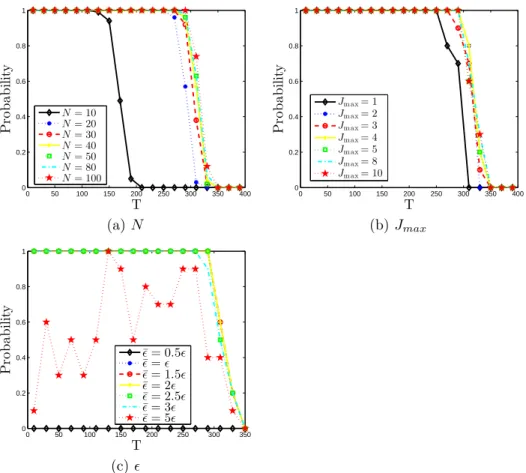
(a) Jmax= 5, and varyingN; see Fig. 1(a).
(b) N = 100, and varyingJmax; see Fig. 1(b).
(c) N = 100,Jmax= 5, and an approximate noise level ¯; see Fig. 1(c).
We observe that the influence of the parametersNandJmaxis very mild on the exact support recovery
probability. In particular, a reasonably small value for these parameters (e.g. N = 50, Jmax = 1) is
sufficient for accurately recovering the exact active setA∗. Unsurprisingly, a very small value of N can degrade the accuracy of support recovery greatly, due to insufficient resolution of the solution path. In practice, the exact noise level is not always available, and often only an approximate estimate ¯ is provided. The use of the estimate ¯ in place of the exact one in Algorithm 1 may sacrifice the exact recovery probability. Hence it is important to study the sensitivity of Algorithm 1 with respect to the variation of the parameter. We observe from Fig. 1(c) that the use of the estimate ¯does not affect the recovery probability much, unless it is grossly erroneous. The case of an overly underestimated noise level is especially dangerous, which may render the reconstruction completely useless due to an insufficient amount of regularization.
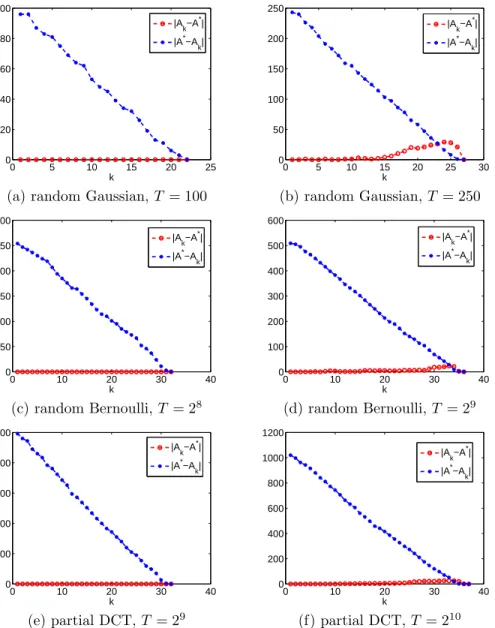
To gain further insight into the PDASC algorithm, in Fig. 2, we show the evolution of the active set (for simplicity letAk =A(λk)) . It is observed that the active setAk can generally move both “inside”
and “outside” of the true active setA∗. This observation is valid for random Gaussian, random Bernoulli and partial DCT sensing matrices. This behavior is in sharp contrast to the OMP, where the size of the active set is monotonically increasing during the iteration, by its construction. The flexible change in the active set might be essential for the efficiency of the PDASC algorithm.
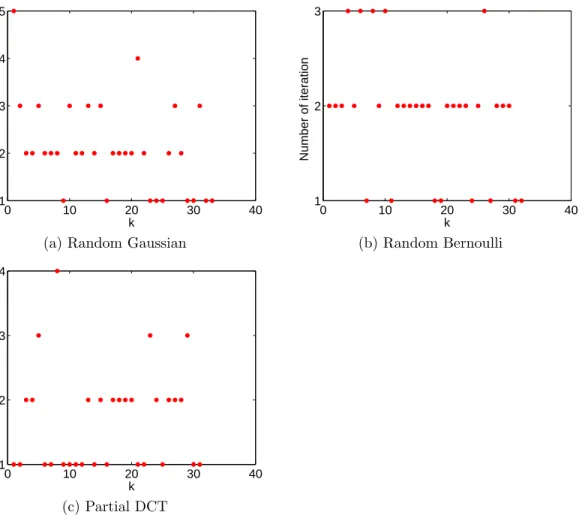
For each λk-problem, with x(λk−1) (x(λ0) = 0) as the initial guess, the PDASC generally reaches
convergence within a few iterations, typically two or three, cf. Fig. 3, which is observed for random Gaussian, random Bernoulli and partial DCT sensing matrices. This is attributed to the local superlinear convergence of the PDAS algorithm. Hence, when coupled with the continuation strategy, the overall PDASC procedure is very efficient.
0 50 100 150 200 250 300 350 400 0 0.2 0.4 0.6 0.8 1 T P ro b a b il it y N= 10 N= 20 N= 30 N= 40 N= 50 N= 80 N= 100 0 50 100 150 200 250 300 350 400 0 0.2 0.4 0.6 0.8 1 T P ro b a b il it y Jm ax= 1 Jm ax= 2 Jm ax= 3 Jm ax= 4 Jm ax= 5 Jm ax= 8 Jm ax= 10 (a)N (b)Jmax 0 50 100 150 200 250 300 350 0 0.2 0.4 0.6 0.8 1 T P ro b a b il it y ¯ 0= 0 .50 ¯ 0=0 ¯ 0= 1 .50 ¯ 0= 20 ¯ 0= 2 .50 ¯ 0= 30 ¯ 0= 50 (c)
Figure 1: The influence of the algorithmic parameters (N,Jmaxand) on the exact recovery probability.
4.2
Comparison with existing algorithms
In this part, we compare Algorithm 1 with five state-of-the-art algorithms in the compressive sensing literature, including orthogonal matching pursuit (OMP) [34], greedy gradient pursuit (GreedyGP) [4], accelerated iterative hard thresholding (AIHT) [3], hard thresholding pursuit (HTP) [19], compressive sampling matching pursuit (CoSaMP) [29].
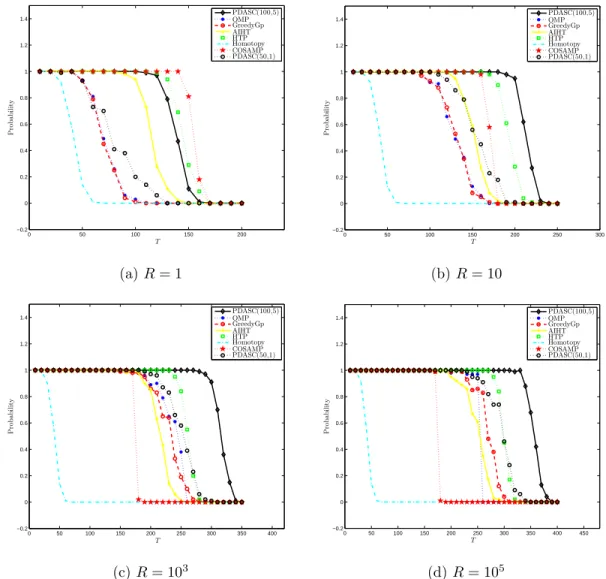
First, we consider the exact support recovery probability, i.e., the percentage of the reconstructions whose support agrees with the true active setA∗. To this end, we fix the sensing matrix Ψ as a 500×1000 random Gaussian matrix,σ= 1e-3, (N, Jmax) = (100,5) or (50,1), and all results are computed from 100
independent realizations of the problem setup. Since a different dynamical range R may give different results, we takeR= 1, 10, 1e3, 1e5 as four exemplary values. The numerical results are summarized in Fig. 4. We observe that when the dynamical rangeRis not very small, the proposed PDASC algorithm with (N, Jmax) = (100,5) has a better exact support recovery probability, and that with the choice
(N, Jmax) = (50,1) is also largely comparable with other algorithms.
To further illustrate the accuracy and efficiency of the proposed PDASC algorithm, we compare it with other greedy methods in terms of CPU time and reconstruction error. To this end, we fixσ= 1e-2, (N, Jmax) = (100,5) or (50,1). The numerical results for random Gaussian, random Bernoulli and
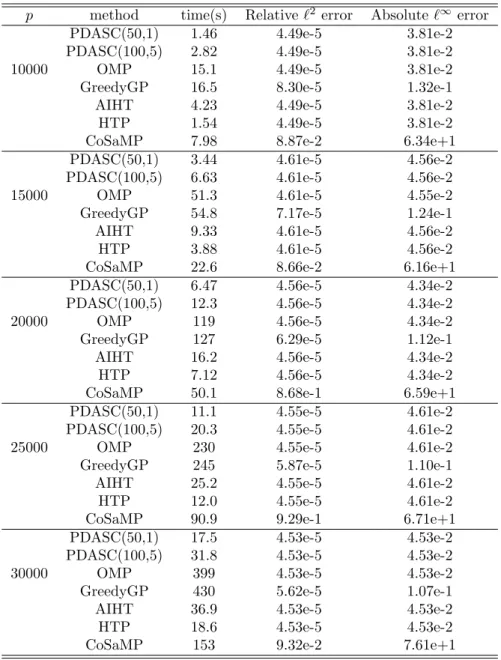
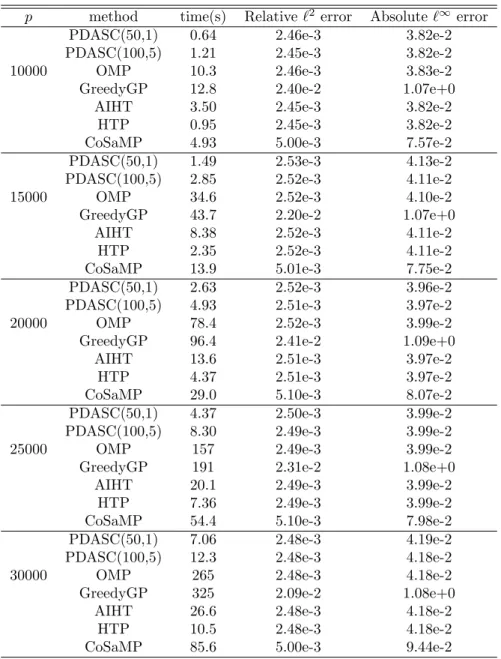
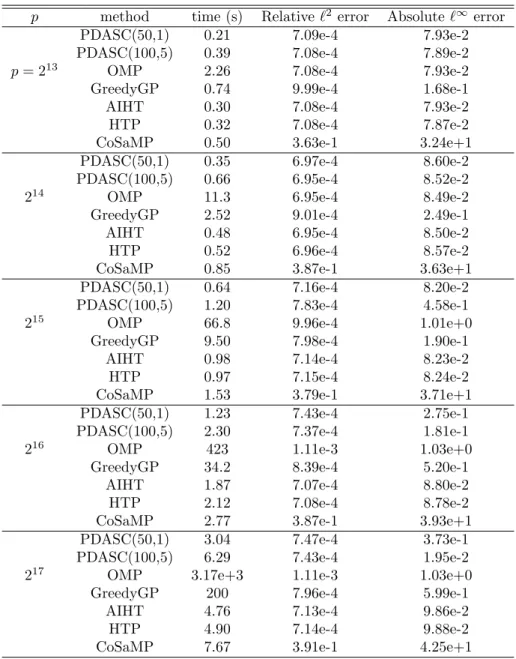
partial DCT sensing matrices with different parameter tuples (R, n, p, T) are shown in Tables 4.1-4.3, respectively. The results in the tables are computed from 10 independent realizations of the problem setup. It is observed that the PDASC algorithm yields reconstructions that are comparable with that by other methods, e.g., HTP and AIHT, but usually with less computing time. Further, we observe that it scales well with the problem size. By increasing the maximum number of inner iterations Jmax and
0 5 10 15 20 25 0 20 40 60 80 100 k |A k−A *| |A*−Ak| 0 5 10 15 20 25 30 0 50 100 150 200 250 k |Ak−A*| |A*−A k|
(a) random Gaussian, T = 100 (b) random Gaussian,T = 250
0 10 20 30 40 0 50 100 150 200 250 300 k |A k−A *| |A*−A k| 0 10 20 30 40 0 100 200 300 400 500 600 k |A k−A *| |A*−A k|
(c) random Bernoulli,T = 28 (d) random Bernoulli,T = 29
0 10 20 30 40 0 100 200 300 400 500 k |Ak−A*| |A*−A k| 0 10 20 30 40 0 200 400 600 800 1000 1200 k |A k−A *| |A*−Ak|
(e) partial DCT,T = 29 (f) partial DCT,T = 210
Figure 2: Numerical results for random Gaussian (top row, R = 100, n = 500, p= 1000, σ = 1e-3), random Bernoulli (middle row, R = 1000, n = 210, p= 212, σ= 1e-3) and partial DCT (bottom row, R= 1000,n= 211,p= 213, σ= 1e-3) sensing matrix. The parametersN andJ
max are set toN = 50
andJmax= 1, respectively.
the continuation stepsN, one can improve the reconstruction accuracy slightly, but the enhancement is small. This indicates that with the “good” initial guess provided by the continuation strategy, one inner iteration is sufficient to achieve the desired accuracy, due to the fast local convergence of the PDASC algorithm, and thus it is also very efficient for large-scale problems.
Lastly, we consider one-dimensional signals and two-dimensional images. In this case the explicit form of the sensing matrix Ψ may be not available, and we employ the CG method for the least-squares step at line 7 of Algorithm1. The most natural initial guess for the CG method for theλk-problem is the solution
x(λk−1) (projected on the current active set), and the stopping criterion for the CG method is as follows:
either the number of CG iterations is greater than a given (small) integer or the residual is smaller than a given tolerance. With the continuation strategy, a few (often one or two) CG iterations at the inner loop
0 10 20 30 40 1 2 3 4 5 Number of iteration k 0 10 20 30 40 1 2 3 Number of iteration k
(a) Random Gaussian (b) Random Bernoulli
0 10 20 30 40 1 2 3 4 Number of iteration k (c) Partial DCT
Figure 3: The number of iterations of PDASC at eachλk for random Gaussian (top left with R= 1000,
n= 500, p= 1000, T = 200, σ= 1e-3), random Bernoulli (top right with R= 1000,n= 210, p= 212,
T = 28,σ= 1e-3) and partial DCT (bottom withR= 1000,n= 211, p= 213,T = 28,σ= 1e-3) sensing matrix. The parametersN andJmax are set toN= 50 andJmax= 5, respectively.
of Algorithm1suffice the desired accuracy. Numerically we find that the choice (N, Jmax) = (50,1) and
one CG iteration for the least-squares problem works well in practice, and thus we present the results below only for this particular choice. This surprising “superconvergence” phenomenon awaits theoretical justification.
For the one-dimensional signal, the sampling matrix Ψ is of size 665×1024, and it consists of applying a partial FFT and an inverse wavelet transform (with two level of Daubechies 1 wavelet), and the signal under wavelet transformation has 247 nonzero entries andσ= 1e-4,N = 50, Jmax= 1. The results are
shown in Fig. 5and Table 4.4. The reconstructions by all the methods, except the AIHT and CoSaMP, are visually very appealing and in excellent agreement with the exact solution. The reconstructions by the AIHT and CoSaMP suffer from pronounced oscillations. This is further confirmed by the PSNR values which is defined as
PSNR= 10·log V
2 M SE
where V is the maximum absolute value of the reconstruction and the true solution, and M SE is the mean squared error of the reconstruction, cf. Table 4.4. One finds that except the CoSaMP, all other methods can yield almost identical reconstructions within similar computational efforts.
0 50 100 150 200 −0.2 0 0.2 0.4 0.6 0.8 1 1.2 1.4 T P ro b a b il it y PDASC(100,5) OMP GreedyGp AIHT HTP Homotopy COSAMP PDASC(50,1) 0 50 100 150 200 250 300 −0.2 0 0.2 0.4 0.6 0.8 1 1.2 1.4 T P ro b a b il it y PDASC(100,5) OMP GreedyGp AIHT HTP Homotopy COSAMP PDASC(50,1) (a)R= 1 (b)R= 10 0 50 100 150 200 250 300 350 400 −0.2 0 0.2 0.4 0.6 0.8 1 1.2 1.4 T P ro b a b il it y PDASC(100,5) OMP GreedyGp AIHT HTP Homotopy COSAMP PDASC(50,1) 0 50 100 150 200 250 300 350 400 450 −0.2 0 0.2 0.4 0.6 0.8 1 1.2 1.4 T P ro b a b il it y PDASC(100,5) OMP GreedyGp AIHT HTP Homotopy COSAMP PDASC(50,1) (c)R= 103 (d)R= 105
Figure 4: The exact support recovery probability for four different dynamical ranges: R= 1, 10, 103,
and 105.
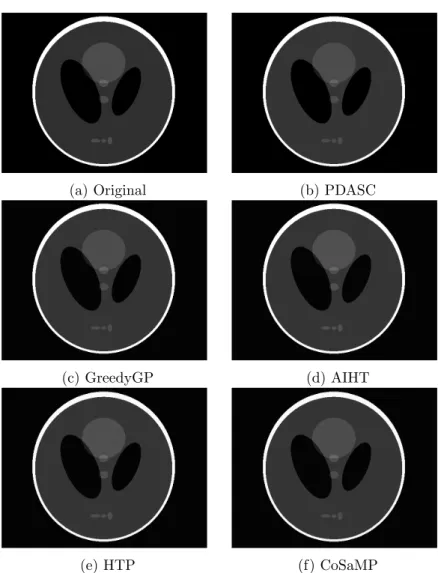
For the two-dimensional MRI image, the sampling matrix Ψ amounts to a partial FFT and an inverse wavelet transform, and it has a size 29729×262144. The image under wavelet transformation (with four level of Daubechies 1 wavelet) has 8450 nonzero entries and σ = 1e-3, N = 50, and Jmax = 1.
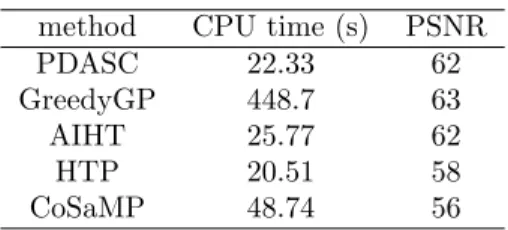
The numerical results are shown in Fig. 6 and Table 4.5. Since OMP is too costly for this example (more than one hour), we do not present the corresponding numerical result. All other methods produce similar results. Therefore proposed PDASC algorithm is competitive with state-of-the-art algorithms, and feasible for large-scale problems with implicit operators.
5
Conclusion
We have developed an efficient and accurate primal-dual active set with continuation algorithm for the`0
penalized least-squares problem arising in compressive sensing. It combines the fast local convergence of the active set technique and the globalizing property of the continuation technique. The global finite step convergence of the algorithm was established under the mutual incoherence property or restricted isometry
Table 4.1: Numerical results (CPU time and errors) for medium-scale problems, with random Gaussian sensing matrix Ψ, of sizep= 10000, 15000, 20000, 25000, 30000,n=bp/4c,T =bn/3c. The dynamical rangeRisR= 1000, and the noise varianceσisσ= 1e-2.
p method time(s) Relative`2 error Absolute`∞ error
PDASC(50,1) 1.46 4.49e-5 3.81e-2
PDASC(100,5) 2.82 4.49e-5 3.81e-2
10000 OMP 15.1 4.49e-5 3.81e-2
GreedyGP 16.5 8.30e-5 1.32e-1
AIHT 4.23 4.49e-5 3.81e-2
HTP 1.54 4.49e-5 3.81e-2
CoSaMP 7.98 8.87e-2 6.34e+1
PDASC(50,1) 3.44 4.61e-5 4.56e-2
PDASC(100,5) 6.63 4.61e-5 4.56e-2
15000 OMP 51.3 4.61e-5 4.55e-2
GreedyGP 54.8 7.17e-5 1.24e-1
AIHT 9.33 4.61e-5 4.56e-2
HTP 3.88 4.61e-5 4.56e-2
CoSaMP 22.6 8.66e-2 6.16e+1
PDASC(50,1) 6.47 4.56e-5 4.34e-2
PDASC(100,5) 12.3 4.56e-5 4.34e-2
20000 OMP 119 4.56e-5 4.34e-2
GreedyGP 127 6.29e-5 1.12e-1
AIHT 16.2 4.56e-5 4.34e-2
HTP 7.12 4.56e-5 4.34e-2
CoSaMP 50.1 8.68e-1 6.59e+1
PDASC(50,1) 11.1 4.55e-5 4.61e-2
PDASC(100,5) 20.3 4.55e-5 4.61e-2
25000 OMP 230 4.55e-5 4.61e-2
GreedyGP 245 5.87e-5 1.10e-1
AIHT 25.2 4.55e-5 4.61e-2
HTP 12.0 4.55e-5 4.61e-2
CoSaMP 90.9 9.29e-1 6.71e+1
PDASC(50,1) 17.5 4.53e-5 4.53e-2
PDASC(100,5) 31.8 4.53e-5 4.53e-2
30000 OMP 399 4.53e-5 4.53e-2
GreedyGP 430 5.62e-5 1.07e-1
AIHT 36.9 4.53e-5 4.53e-2
HTP 18.6 4.53e-5 4.53e-2
CoSaMP 153 9.32e-2 7.61e+1
property on the sensing matrix. Our extensive numerical results indicate that the proposed algorithm is competitive with state-of-the-art algorithms in terms of efficiency, accuracy and exact recovery probability, without a knowledge of the exact sparsity level.
Our numerical experiment indicates that the conjugate gradient method is very effective for solving the least-squares problems arising in the PDAS iterations. A complete analysis of the excellent convergence behavior is of significant interest. Further, the primal dual active set with continuation algorithm extends naturally to other popular nonconvex sparse models, e.g., bridge penalty, smoothly clipped absolute deviation and minmax concave penalty. However, the convergence analysis of the algorithm for these penalties remains unclear.
Table 4.2: Numerical results (CPU time and errors) for medium-scale problems, with random Bernoulli sensing matrix Ψ, of sizep= 10000, 15000, 20000, 25000, 30000,n=bp/4c,T =bn/4c. The dynamical rangeRisR= 10, and the noise varianceσ isσ= 1e-2.
p method time(s) Relative`2 error Absolute`∞ error
PDASC(50,1) 0.64 2.46e-3 3.82e-2
PDASC(100,5) 1.21 2.45e-3 3.82e-2
10000 OMP 10.3 2.46e-3 3.83e-2
GreedyGP 12.8 2.40e-2 1.07e+0
AIHT 3.50 2.45e-3 3.82e-2
HTP 0.95 2.45e-3 3.82e-2
CoSaMP 4.93 5.00e-3 7.57e-2
PDASC(50,1) 1.49 2.53e-3 4.13e-2
PDASC(100,5) 2.85 2.52e-3 4.11e-2
15000 OMP 34.6 2.52e-3 4.10e-2
GreedyGP 43.7 2.20e-2 1.07e+0
AIHT 8.38 2.52e-3 4.11e-2
HTP 2.35 2.52e-3 4.11e-2
CoSaMP 13.9 5.01e-3 7.75e-2
PDASC(50,1) 2.63 2.52e-3 3.96e-2
PDASC(100,5) 4.93 2.51e-3 3.97e-2
20000 OMP 78.4 2.52e-3 3.99e-2
GreedyGP 96.4 2.41e-2 1.09e+0
AIHT 13.6 2.51e-3 3.97e-2
HTP 4.37 2.51e-3 3.97e-2
CoSaMP 29.0 5.10e-3 8.07e-2
PDASC(50,1) 4.37 2.50e-3 3.99e-2
PDASC(100,5) 8.30 2.49e-3 3.99e-2
25000 OMP 157 2.49e-3 3.99e-2
GreedyGP 191 2.31e-2 1.08e+0
AIHT 20.1 2.49e-3 3.99e-2
HTP 7.36 2.49e-3 3.99e-2
CoSaMP 54.4 5.10e-3 7.98e-2
PDASC(50,1) 7.06 2.48e-3 4.19e-2
PDASC(100,5) 12.3 2.48e-3 4.18e-2
30000 OMP 265 2.48e-3 4.18e-2
GreedyGP 325 2.09e-2 1.08e+0
AIHT 26.6 2.48e-3 4.18e-2
HTP 10.5 2.48e-3 4.18e-2
CoSaMP 85.6 5.00e-3 9.44e-2
Acknowledgements
The authors are grateful to the anonymous referees for their constructive comments, which have led to an improvement in the quality of the paper. The research of Y. Jiao is partially supported by National Science Foundation of China No. 61179039, No. 11301545 and National Key Basic Research Development Program (973 Program) of China (Grant No. 2011CB707100), the work of B. Jin is supported by NSF Grant DMS-1319052, and that of X. Lu is partially supported by National Science Foundation of China No. 11101316, No. 91230108 and No. 11471253.
Table 4.3: Numerical results (CPU time and errors) for large-scale problems, with partial DCT sensing matrix Ψ, of size p= 213, 214, 215, 216, 217,n=bp/4c,T =bn/3c. The dynamical rangeRis R= 100,
and the noise varianceσisσ= 1e-2.
p method time (s) Relative `2 error Absolute`∞ error
PDASC(50,1) 0.21 7.09e-4 7.93e-2
PDASC(100,5) 0.39 7.08e-4 7.89e-2
p= 213 OMP 2.26 7.08e-4 7.93e-2
GreedyGP 0.74 9.99e-4 1.68e-1
AIHT 0.30 7.08e-4 7.93e-2
HTP 0.32 7.08e-4 7.87e-2
CoSaMP 0.50 3.63e-1 3.24e+1
PDASC(50,1) 0.35 6.97e-4 8.60e-2
PDASC(100,5) 0.66 6.95e-4 8.52e-2
214 OMP 11.3 6.95e-4 8.49e-2
GreedyGP 2.52 9.01e-4 2.49e-1
AIHT 0.48 6.95e-4 8.50e-2
HTP 0.52 6.96e-4 8.57e-2
CoSaMP 0.85 3.87e-1 3.63e+1
PDASC(50,1) 0.64 7.16e-4 8.20e-2
PDASC(100,5) 1.20 7.83e-4 4.58e-1
215 OMP 66.8 9.96e-4 1.01e+0
GreedyGP 9.50 7.98e-4 1.90e-1
AIHT 0.98 7.14e-4 8.23e-2
HTP 0.97 7.15e-4 8.24e-2
CoSaMP 1.53 3.79e-1 3.71e+1
PDASC(50,1) 1.23 7.43e-4 2.75e-1
PDASC(100,5) 2.30 7.37e-4 1.81e-1
216 OMP 423 1.11e-3 1.03e+0
GreedyGP 34.2 8.39e-4 5.20e-1
AIHT 1.87 7.07e-4 8.80e-2
HTP 2.12 7.08e-4 8.78e-2
CoSaMP 2.77 3.87e-1 3.93e+1
PDASC(50,1) 3.04 7.47e-4 3.73e-1
PDASC(100,5) 6.29 7.43e-4 1.95e-2
217 OMP 3.17e+3 1.11e-3 1.03e+0
GreedyGP 200 7.96e-4 5.99e-1
AIHT 4.76 7.13e-4 9.86e-2
HTP 4.90 7.14e-4 9.88e-2
CoSaMP 7.67 3.91e-1 4.25e+1
References
[1] H. Attouch, J. Bolte, and B. F. Svaiter. Convergence of descent methods for semi-algebraic and tame problems: proximal algorithms, forward-backward splitting, and regularized Gauss-Seidel methods.
Math. Program., 137(1-2, Ser. A):91–129, 2013.
[2] F. Bach, R. Jenatton, J. Mairal, and G. Obozinski. Optimization with Sparsity-Inducing Penalties.
Found. Trend. Mach. Learn., 4(1):1–106, 2012.
(a) PDASC (b) OMP
(c) GreedyGP (d) AIHT
(e) HTP (f) CoSaMP
Figure 5: Reconstruction results of the one-dimension signal.
[4] T. Blumensath and M. E. Davies. Gradient pursuits. IEEE Trans. Signal Proc., 56(6):2370–2382, 2008.
[5] T. Blumensath and M. E. Davies. Iterative thresholding for sparse approximations. J. Fourier Anal. Appl., 14(5-6):629–654, 2008.
[6] T. Blumensath and M. E. Davies. Iterative hard thresholding for compressed sensing.Appl. Comput. Harmon. Anal., 27(3):265–274, 2009.
[7] T. Blumensath and M. E. Davies. Stagewise weak gradient pursuits. IEEE Trans. Signal Process., 57(11):4333–4346, 2009.
[8] T. T. Cai and L. Wang. Orthogonal matching pursuit for sparse signal recovery with noise. IEEE Trans. Inform. Theory, 57(7):4680–4688, 2011.
[9] E. J. Cand`es, J. Romberg, and T. Tao. Robust uncertainty principles: exact signal reconstruction from highly incomplete frequency information. IEEE Trans. Inform. Theory, 52(2):489–509, 2006. [10] E. J. Candes and T. Tao. Decoding by linear programming. IEEE Trans. Inf. Theory, 51(12):4203–
4215, 2005.
[11] S. S. Chen, D. L. Donoho, and M. A. Saunders. Atomic decomposition by basis pursuit. SIAM J. Sci. Comput., 20(1):33–61, 1998.
(a) Original (b) PDASC
(c) GreedyGP (d) AIHT
(e) HTP (f) CoSaMP
Figure 6: Reconstruction results of the two-dimensional Logan-Shepp image.
[12] P. Combettes and J. Pesquet. Proximal splitting methods in signal processing. In H. H. Bauschke, R. S. Burachik, P. L. Combettes, V. Elser, D. R. Luke, and H. Wolkowicz, editors, Fixed-Point Algorithms for Inverse Problems in Science and Engineering, pages 185–212. Springer, Berlin, 2011. [13] W. Dai and O. Milenkovic. Subspace pursuit for compressive sensing signal reconstruction. IEEE
Trans. Inform. Theory, 55(5):2230–2249, 2009.
[14] T. T. Do, L. Gan, N. Nguyen, and T. D. Tran. Sparsity adaptive matching pursuit algorithm for practical compressed sensing. InSignals, Systems and Computers, 2008 42nd Asilomar Conference on, pages 581–587. IEEE, 2008.
[15] D. L. Donoho. Compressed sensing. IEEE Trans. Inform. Theory, 52(4):1289–1306, 2006.
[16] D. L. Donoho and X. Huo. Uncertainty principles and ideal atomic decomposition. IEEE Trans. Inf. Theory, 47(7):2845–2862, 2001.
[17] D. L. Donoho, Y. Tsaig, I. Drori, and J.-L. Starck. Sparse solution of underdetermined systems of linear equations by stagewise orthogonal matching pursuit.IEEE Trans. Inform. Theory, 58(2):1094– 1121, 2012.
Table 4.4: One-dimensional signal: n= 665, p= 1024,T = 247,σ= 1e-4. method CPU time (s) PSNR
PDASC 0.49 53 OMP 1.45 49 GreedyGp 0.76 49 AIHT 0.58 34 HTP 0.40 51 CoSaMP 0.91 26
Table 4.5: Two-dimensional image: n= 29729,p= 262144,T = 8450,σ= 1e-3. method CPU time (s) PSNR
PDASC 22.33 62
GreedyGP 448.7 63
AIHT 25.77 62
HTP 20.51 58
CoSaMP 48.74 56
[18] Q. Fan, Y. Jiao, and X. Lu. A primal dual active set algorithm with continuation for compressed sensing. preprint, arXiv:1312.7039, 2013.
[19] S. Foucart. Hard thresholding pursuit: an algorithm for compressive sensing. SIAM J. Numer. Anal., 49(6):2543–2563, 2011.
[20] E. T. Hale, W. Yin, and Y. Zhang. Fixed-point continuation forl1-minimization: methodology and
convergence. SIAM J. Optim., 19(3):1107–1130, 2008.
[21] S. Huang and J. Zhu. Recovery of sparse signals using OMP and its variants: convergence analysis based on RIP. Inverse Problems, 27(3):035003, 14 pp., 2011.
[22] K. Ito and B. Jin. Inverse Problems: Tikhonov Theory and Algorithms. World Scientific, Singapore, 2014.
[23] K. Ito, B. Jin, and T. Takeuchi. A regularization parameter for nonsmooth Tikhonov regularization.
SIAM J. Sci. Comput., 33(3):1415–1438, 2011.
[24] K. Ito and K. Kunisch. Lagrange Multiplier Approach to Variational Problems and Applications, volume 15 ofAdvances in Design and Control. SIAM, Philadelphia, PA, 2008.
[25] K. Ito and K. Kunisch. A variational approach to sparsity optimization based on Lagrange multiplier theory. Inverse Problems, 30(1):015001, 23 pp, 2014.
[26] Y. Jiao, B. Jin, and X. Lu. A primal dual active set algorithm for a class of nonconvex sparsity optimization. preprint, arXiv:1310.1147, 2013.
[27] Z. Lu and Y. Zhang. Sparse approximation via penalty decomposition methods. SIAM J. Optim., 23(4):2448–2478, 2013.
[28] Q. Mo and Y. Shen. A remark on the restricted isometry property in orthogonal matching pursuit.
IEEE Trans. Inform. Theory, 58(6):3654–3656, 2012.
[29] D. Needell and J. A. Tropp. CoSaMP: iterative signal recovery from incomplete and inaccurate samples. Appl. Comput. Harmon. Anal., 26(3):301–321, 2009.
[30] D. Needell and R. Vershynin. Uniform uncertainty principle and signal recovery via regularized orthogonal matching pursuit. Found. Comput. Math., 9(3):317–334, 2009.
[31] M. Nikolova. Description of the minimizers of least squares regularized with`0-norm. Uniqueness of
the global minimizer. SIAM J. Imaging Sci., 6(2):904–937, 2013.
[32] M. Nikolova. Relationship between the optimal solutions of least squares regularized with `0
-norm and constrained by k-sparsity. preprint, available at http://hal.archives-ouvertes.fr/ hal-00944006/, 2014.
[33] N. Parikh and S. Boyd. Proximal algorithms. Found. Trends Optim., 1(3):123–231, 2014.
[34] Y. Pati, R. Rezaiifar, and P. Krishnaprasad. Orthogonal matching pursuit: Recursive function approximation with applications to wavelet decomposition. In Signals, Systems and Computers, 1993. 1993 Conference Record of The 27th Asilomar Conference on, volume 1, pages 40–44. IEEE. [35] M. C. Robini and I. E. Magnin. Optimization by stochastic continuation. SIAM J. Imaging Sci.,
3(4):1096–1121, 2010.
[36] M. C. Robini and P.-J. Reissman. From simulated annealing to stochastic continuation: a new trend in combinatorial optimization. J. Global Optim., 56(1):185–215, 2013.
[37] R. Tibshirani. Regression shrinkage and selection via the lasso. J. Roy. Statist. Soc. Ser. B, 58(1):267–288, 1996.
[38] A. M. Tillmann and M. E. Pfetsch. The computational complexity of the restricted isometry property, the nullspace property, and related concepts in compressed sensing. IEEE Trans. Inf. Theory, 60(2):1248–1259, 2014.
[39] J. Tropp and S. Wright. Computational methods for sparse solution of linear inverse problems.Proc. IEEE, 98(6):948–958, 2010.
[40] J. A. Tropp. Greed is good: algorithmics results for sparse approximation.IEEE Trans. Inf. Theory, 50(2):2231–2242, 2004.
[41] J. A. Tropp. Just relax: convex programming methods for identifying sparse signals in noise. IEEE Trans. Inform. Theory, 52(3):1030–1051, 2006.
[42] P. Tseng. Convergence of a block coordinate descent method for nondifferentiable minimization. J. Optim. Theory Appl., 109(3):475–494, 2001.
[43] S. Wright, R. Nowak, and M. Figueiredo. Sparse reconstruction by separable approximation. IEEE Transactions on Signal Processing, 57(7):2479–2493, 2009.
[44] L. Xiao and T. Zhang. A proximal-gradient homotopy method for the sparse least-squares problem.
SIAM J. Optim., 23(2):1062–1091, 2013.
[45] T. Zhang. Sparse recovery with orthogonal matching pursuit under RIP. IEEE Trans. Inform. Theory, 57(9):6215–6221, 2011.