140
Optimize Assembly Production Line using Line
Balancing
Abdul Talib Bon
1, Asyran Abdul Rahman
2 Department of Production and Operation ManagementFaculty of Technology Management And Business Universiti Tun Hussein Onn Malaysia
Eddi Azhar Bolhassan
3, Mohd Ashadi Ali Nordin
4 Department of Production and Operation ManagementFaculty of Technology Management And Business Universiti Tun Hussein Onn Malaysia
Abstract. This study aimed to production activity and the assembly
line at the Company X. This study was conducted using qualitative and quantitative methods which are used to interview the production manager for information and collecting secondary data is used to determine the layout is flexible or not. Using mixed model assembly line balancing problem, are proved to be useful in identifying and solving line problems. The solution procedures such as optimum seeking procedures, heuristic, simulation and other approaches have many ways in detail to solve the line balancing problem.
Keywords: Production actvity, Assembly line, Flexible layout,
Optimum.
I. INTRODUCTION
Company X Furniture Sdn Bhd shortly known as Company X was established in 2004, and located in Batu Pahat, Johor, Malaysia. The Company X is specially known for its expertise in manufacturing bedroom-set furniture. Company X produce and supply wardrobe and bedroom set and its fast selling products makes it become one of the fastest growing brands in Malaysia and have good reputation in the bedroom furniture manufacturing in oversea. The success of its company is mainly the quality of wardrobe which made of melamine board. The Company X has a large marketing network which consisting of more than 400 dealers across Malaysia. They have a large number of buyers from Singapore, England, Korea, Japan and etc. The products sold meet a high demand in the market because they provide the flexibility of stack up, parts interchangeability and configurable solutions that meet their market demands well. Their mission and vision are to bring out perfect lifestyles, maximizing the use of space, producing products that are simple and elegant, innovative to satisfy market demands, and to be leading brand of household furniture manufacturer. The Company X concept is by creating warm and dream bedroom which let customers fell love and happiness and feel secure, warm and energetic to face life.
To meet the demand of the market continuously, the organization keeps upgrading their hardware and software to enhance their design and production. The Company X enables the customers to choose their favorite compartment style due to well diversity of their products. Their unique designed series including super anti-skip silent wheel, 3D series, I Bed series and I-Home series are popular in Malaysia market and well received in oversea market as well. The products that Company X produce are set of bedroom furniture consist of king size bed, queen bed size, bed size table, dresser, mirror, wardrobe, dresser stool. These set of bedroom furniture consists of six types of models. These models are consisting of different sizes of furniture and the production flow is same for every product except for door of wardrobe. For door production line, it consists of cutting, drilling, assembly, and packing, to make the end product. Other products consist of cutting, drilling, laminating, edging, assembly, packing process.
Assembly lines are flow-line production systems which are of great importance in the industrial production of high quantity standardized commodities and more recently even gained importance in low volume production of customized products. Due to high capital requirements when installing or redesigning a line, configuration planning is of great relevance for practitioners. An assembly line is a flow-oriented production system where the productive units performing the operations, referred to as stations, are aligned in a serial manner. The workpieces visit stations successively as they are moved along the line usually by some kind of transportation system.
A. Assembly Line Balancing
141
consecutively launched down the line and are moved from station to station. At each station, certain operations are repeatedly performed regarding the cycle time (maximum or average time available for each work cycle).
Manufacturing a product on an assembly line requires partitioning the total amount of work into a set V = {1,...,n} of elementary operations named tasks. Performing a task j takes a task time tj and requires certain equipment of machines and/or skills of workers. The total work load necessary for assembling a work piece is measured by the sum of task times tsum. Due to technological and organizational conditions precedence constraints between the tasks have to be observed.
B. Preliminary Assembly Line Balancing Problem (ALBP)
An assembly line is a production sequence of stations connected together by a material handling system, where parts are assembled together at stations to form an end product. In this system there are work elements to be performed each of which is called a task. A task is the smallest indivisible work element in the assembly process. Several tasks are performed at a physical location by a single worker and other tasks are similarly performed by other workers at different stations. A station is a location along the line at which tasks are performed by completing the assembly operations. Task performance time, ti is the duration of task i, and cycle time C is the amount of time available at each station. Equivalently cycle time is defined as the amount of time elapsed between two successive units entering or leaving the assembly line. Accordingly, station time Sj is defined as the sum of task times of the tasks assigned to station j on the line.
After the line begins to give the first product, a partially assembled product remains at each station during each cycle, while the set of tasks assigned to this station is performed on it. The material handling system then moves all partially assembled parts forward to next station and a new cycle begins. Thus all the units at every station advance to their next station in sequence at the same time. This time point is the end of cycle time. Thus, if tasks are completed on a unit before the cycle time ends, the unit waits idle until the end of cycle time. Because of this synchronization in movement, these type of assembly lines are sometimes called as "synchronous lines". Since there must exist at least one station and at least one task at each station, cycle time is bounded by the following relation :
Since there must exist at least one station and at least one task at each station, cycle time is bounded by the following relation :
Tasks are not completed arbitrarily, rather there exists a precedence relationship between the tasks, dictating the completion of some tasks before others can be started. The assembly line balancing problem (ALBP) can be stated as assigning tasks to an ordered sequence of stations such that the precedence relations among the tasks are satisfied and some performance measure is optimized. The most commonly used objectives can be classified into two categories. In the first category one desires to minimize the number of stations given the cycle time. In this category we minimize number of stations subject to the following constraints:
i. all tasks must be performed
ii. the work content in any station is less than or equal to the cycle time C.
iii. precedence relations are not violated.
II. RESEARCH METHODOLOGY
A. Methods of Data Collection
Methods of data collection are referring hybrid method. Hybrid methods include the methods of qualitative and quantitative methods. Qualitative methods refer to the interview instrument as methods of data collection, and quantitative methods used for the collection of secondary data to obtain information on the standard time of each production process Stand Base. After a standard time for each process is obtained, we enter the data into the software POM.
B. Qualitative methods (interviews)
Our interview to obtain information from the production line at the Company X plant. We communicate directly with production line manager.
C. Quantitative methods (secondary data)
142
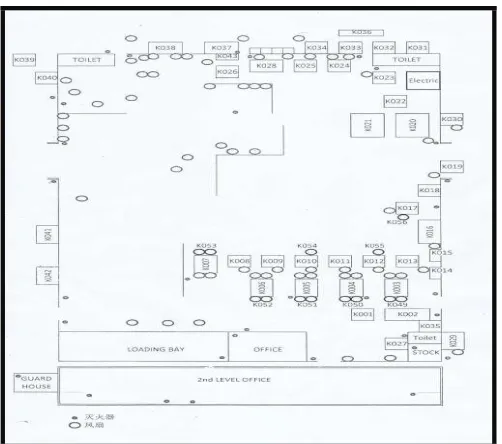
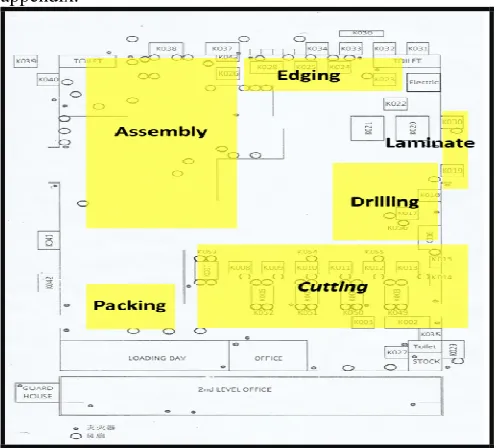
Fig. 1 Plant Layout [image:3.612.325.571.133.312.2]From the observation, there are six departments in Company X Furniture Sdn. Bhd. Cutting, Drilling, and Edging Departments have different machines for different sizes of woods. Meanwhile, Laminate department only processing few types of woods. Assembly department is divided into two; assembly of drawer and assembly of main body. From that, assembly is the department with the longest cycle time; it takes around 5 minutes to assembly a single wardrobe. Therefore, assembly is the bottleneck of the company.Figure 1 in appendix show the precedence graph for a wardrobe.
Fig. 2 Precedence graph
Fig. 3 Efficiency at the factory line
[image:3.612.40.289.515.665.2]143
[image:4.612.40.288.94.318.2]appendix.
Fig. 4 Layout of the production floor consisting of six workstations
The layout of factory is process layout. All the machines are place in fix location and not going to move. All machines performing similar type of operations are grouped at one location. Therefore, the raw material then travels, from area to area, where the proper machines are located for each operation. One of the problems we found from this process layout is the long distance between departments especially assembly department and packing department. The long distance between the two departments may consume a lot of time to travel finished goods between them.
According to the assistant manager, not all of the raw materials are assembled once they are processed. Some raw materials are kept as work-in-process inventories after they are processed. It will only assembled after receive order from customers. Therefore, we found that the inventory filled up huge space of the factory.
It can be conclude that the major problem of process layout in Company X is the travel time for move the working part from one machine to another.
III. ANALYSIS AND RESULTS
According to precedence graph of the process this company might use the straightforward assembly line. The step of product they produce use the same step starting from raw material, cutting, drilling, laminating, edging, assembly,
packing and end product for wardrobe. By the way the process to made the door little bit different start from raw material, cutting process, drilling, assembly, packing and end product. These step actually in use of all type of product their produce. This means this company use product layout(also called a flow-shop layout) is one in which equipment or work processes are arranged according to the progressive steps by which the product is made. The path for each part is, in effect, a straight line. The formula that we use to calculate the workstation cycle time (C), using the formula
C = Production time per day/ Required output per
day (in units)
Besides that, we also need to determine the theoretical minimum number of workstations (Nt) required to satisfy the workstation cycle time constraint using the formula (note that this must be rounded up to the next highest integer).
Nt= Sum of task times (T )/ Cycle time (C)
Select a primary rule by which tasks are to be assigned to workstations, and a secondary rule to break ties. Assign tasks, one at a time, to the first workstation until the sum of the task times is equal to the workstation cycle time, or no other tasks are feasible because of time or sequence restrictions. Repeat the process for Workstation 2, Workstation 3, and so on until all tasks are assigned. Evaluate the efficiency of the balance derived using the formula
Efficiency = Sum of task times (T )/ Actual number of workstations (Na) × Workstation cycle time (C) If efficiency is unsatisfactory, rebalance using a different decision rule.
Table 1 Task and Description
Task Task time (s)
Description Task must precede
A 60 Cut the raw material -
B 90 Drill raw material A
C 140 Laminate raw material B
D 100 Edging the product C,
E 300 Assembly the product D
F 180 Packing the product E
[image:4.612.319.573.518.647.2]144
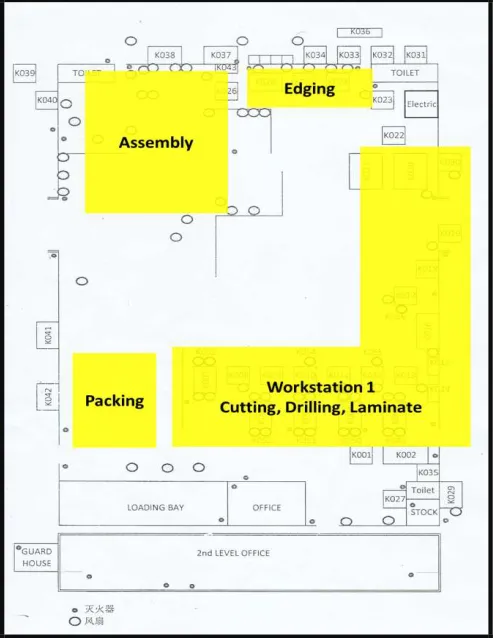
Table 2 New Line balancing [image:5.612.43.286.105.288.2]The no of workstations are reduced to four. Station 1 would consist of Cutting Drilling and Laminate. The efficiency is increased to 72%. There is now less idle time.
Fig. 5 Layout of the production floor after line balancing
IV. CONCLUSIONS
145
REFERENCES[1] Amen, M., 2000. 'Heuristic Methods for Cost-Oriented Assembly Line Balancing: A survey', International Journal of Production Economics, 68 (1), 1-14.
[2] Halil, S. (2003). Balancing Straight And U-Type Assembly Lines
With Stochastic Process Times. Bilkent University.Master Thesis.
[3] N Ismail, G. R. Esmaeilian, M. Hamedi, and S. Sulaiman (2011). Balancing of parallel assembly lines with mixed-model product,”
International Conference on Management and Artificial Intelligence IPEDR
Vol.6 IACSIT Press, Bali, Indonesia pp (120-124).
[4] Ronnachai Sirovetnukul & Parames Chutima, The Impact Of
Walking Time On U-Shaped Assembly Line Worker Allocation Problems.Chulalongkorn University, Bangkok, Thailand. Thesis.
[5] Ghosh, S., and R. Gagnon. "A Comprehensive Literature Review
and Analysis of Design, Balancing and Scheduling of Assembly System." International Journal of Production Research 27, no. 4 (1989), pp 637-670.
[6] Konz, S. "Facility Design". John Willey, 1985.
[7] Meyers, F. E. Manufacturing Facilities Design and Material
Handling. Upper Saddle River, NJ: Prentice Hall, 2000.
[8] Sule, D. R. Manufacturing Facilities: Location, Planning, and
Design. Boston: PWS Publishing Company, 1994.
[9] Rekiek, B., and Delchambre, A. "Assembly Line Design, The
balancing of Mixed-Model Hybrid Assembly Lines with Genetic Algorithms." Springer Series in Advanced Manufacturing, 2006.
[10] Assembly Line Balancing Links: www.slideshare.net/
JosephKonnully/assembly-line-balancing. Retrived on 24/5/2013
[11] Assembly Line BalancingLinks: www.prenhall.com/
weiss_dswin/html/balance.htm. Retrived on 24/5/2013
[12] Assembly Line Balancing Links: www.csupomona.edu/
~hco/POM/04AssemblyLineBalancing.ppt.
[13] Production Layout|Skills| Links: www.linkedin.com/