12525
-Fine-Grained Dredged Marine Soil
Solidification: Determination of Optimal
Dosage
Chee-Ming Chan
1, a *and
Amira Azhar
2,b *1Faculty of Engineering and Technology, Universiti Tun Hussein Onn Malaysia (UTHM),
2
Faculty of Civil and Environmental Engineering, Universiti Tun Hussein Onn Malaysia (UTHM), Malaysia
a
[email protected], [email protected]
ABSTRACT
Dredged marine soils (DMS) are the sediments and debris removed during the dredging processes. In Malaysia, DMS are considered a waste and currently not being recycled or reused. This is due to the poor engineering properties of the material, i.e. low strength and high compressibility. Therefore some form of pre-treatment measures, such as solidification of DMS needs to be taken before DMS can be reused. Soil solidification involves the use of solidification agents or binders admixed with the soil to improve its load-bearing performance. This paper describes a lab-based attempt to determine the optimal binder-filler dosage for solidifying 2 DMS samples from Malaysian waters. The DMS were collected from dredge sites in Melaka and Kelantan, while the binder used was ordinary Portland cement (C) and the filler bottom ash (BA) retrieved from a local coal power plant. The standard unconfined compression test was conducted to gauge the material’s improved strength admixed with a range of cement and bottom ash blends. The optimal dosage of BA or filler for effective solidification of the DMS was found to be 25 %. With higher BA dosages strength of the treated DMS would increase till it peaked at the optimal dosage. After exceeding the optimal BA dosage, the strength was observed to decrease rather dramatically. In conclusion, BA can be effectively used as a filler material at an optimal dosage to reduce the amount of cement required for solidification of DMS.
KEYWORDS:
dredged marine soils, coal bottom ash, solidification, filler, optimal dosage, strengthINTRODUCTION
Dredged marine soils (DMS) are the sediments and debris removed during the dredging processes [1]. In Malaysia, DMS are considered as waste and routinely disposed of at designated dump site offshore. In general, DMS are dumped back into the ocean with at least 50 m depth from mean sea level due to their bad odour and possible risks to human health [2]. Due to the material’s poor engineering properties, as well as economic, logistical, legislative or environmental constraints, DMS are not being considered a sound geomaterial for reuse at present. Nonetheless, if suitably treated and improved, DMS could potentially make major contributions for sustainable development by reducing the amount of primary resource needed for activities such as construction and habitat creation [3].
solidification involves the use of solidification agents or binder materials in an originally soft, weak soft soil to improve its geotechnical properties such as compressibility, strength, permeability and durability. As the primary components involved in the solidification process are the soils and binders, the binders used are normally of cementitious materials to form glue-like subtances for binding the soils [5]. The soils used in this study were DMS retrieved from Melaka and Kelantan waters, while the binder used was ordinary Portland cement and the filler bottom ash collected from a local coal power plant.
Bottom ash (BA) is a waste product from coal combustion, produced from the burning of coal in a dry bottom coal boiler. It consists of non-combustible materials as leftovers from the burning. Raw bottom ash is essentially a granular material that consists of a mixture of sand, stone, glass, porcelain, metals and ash from burnt materials. Bottom ash constitues about 20 % of these non-combustible materials. Bottom ash is generally porous, glassy and dark gray in colour with grain size similar to that of sand or gravelly sand [6]. The chemical composition of bottom ash varies depending on the type of coal that was burned. Bottom ash has unique engineering properties and characteristics, depending on both the parent material as well as the burning process. Most bottom ash can be used as aggregates but some may not meet the requirements for specific purposes, such as the laying of graded base courses, due to poor gradation of the particles. Overall bottom ash is applicable for various construction purposes, e.g. as the granular base or road sub-base, as aggregates in concrete, and as a lightweight fill material for embankments [7].
The source of the BA used in the present study was Tanjung Bin Power Plant in Johor. The plant needs around 18,000 tons of coal per day to generate the required electricity. This inadvertently produces a large volume of coal ash as waste material in the combustion process [8]. The generated coal ash waste is deposited either in a dry landfill or in an ash pond [9]. This leads to the requirement for large storage or dumping grounds, consequently incurring additional operation costs and expenses of the power plant. On the other hand, the disposal of BA in open pits or grounds could increase the pH concentration of surrounding soils and adversely affect the environmental quality and agricultural productivity. Hence the utilization of BA is one of the alternatives to protect the environment and to reduce the expenses of the coal power plant [10]. In soil treatment, to increase the samples strength, economic value and environmental impact, ashes can be used to substitute cement [10]. As in this study, the bottom ash was admixed with the DMS as a filler material with the aim of substituting the amount of cement required for solidification of the soil.
MATERIALS AND METHOD
Materials
The DMS samples for this study were collected from 2 dredge sites, i.e. Marina Melaka and Tok Bali, Kelantan (Figure 1). As can be seen in the figure, the sampling locations were on the west and east coasts of Peninsular Malaysia respectively. Note that as the dredged sites are located near-shore, the locality and anthropogenic activities in the surrounding area have significant impact on the properties and characteristics of the sediments. This is particularly relevant in terms of the contaminants found in the soil, for instance.
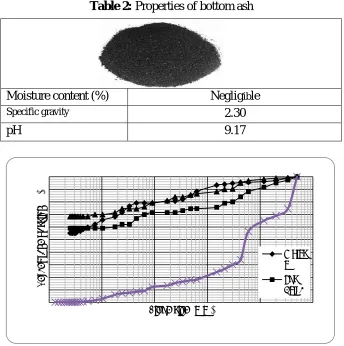
As mentioned earlier, the sole binder used in the study was ordinary portland cement (C) and bottom ash (BA) was used as a filler to strengthen the treated DMS structure. Bottom ash was also introduced in the treatment process in an attempt to reduce the usage of cement in DMS mixing. Bottom ash generally consists of angular particles with a very porous surface texture. The particle size of bottom ash range from that of gravel to fine sand (10-4.75 mm)with small amount of silt-clay particles. However as reported by Abubakar & Baharudin [9], bottom ash is usually a well-graded material, though with variation in the actual particle size distribution depending on the source. The bottom ash was first sieved to remove large chunks and other debris. The cement powder and bottom ash were all dried in the oven at 105oC for 24 hours to eliminate any entrapped water in the materials prior to mixing. The dried raw materials were then stored in airtight containers. Table 2 shows the properties of bottom ash while Figure 2 shows the particle size distribution of bottom ash and the DMS samples.
Figure 1:
Dredging locations of dredged marine soils
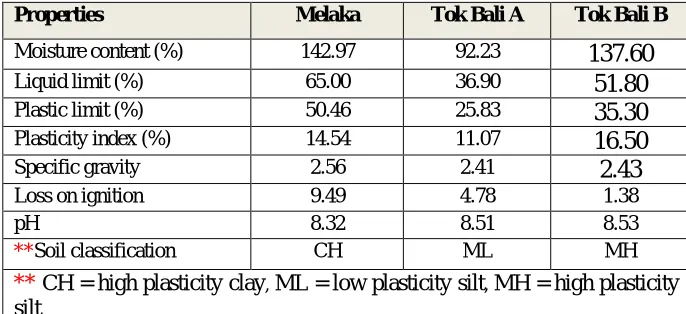
Table 1:
Physical and chemical properties of dredged marine soil samples
Properties Melaka Tok Bali A Tok Bali B
Moisture content (%) 142.97 92.23
137.60
Liquid limit (%) 65.00 36.90
51.80
Plastic limit (%) 50.46 25.83
35.30
Plasticity index (%) 14.54 11.07
16.50
Specific gravity 2.56 2.41
2.43
Loss on ignition 9.49 4.78 1.38
pH 8.32 8.51 8.53
**Soil classification CH ML MH
** CH = high plasticity clay, ML = low plasticity silt, MH = high plasticity silt
Tok Bali
(Kelantan)
Marina Melaka (Melaka)
[image:3.612.142.485.536.693.2]Table 2:
Properties of bottom ash
Figure 2:
The particle size distribution of DMS and bottom ash
METHODS
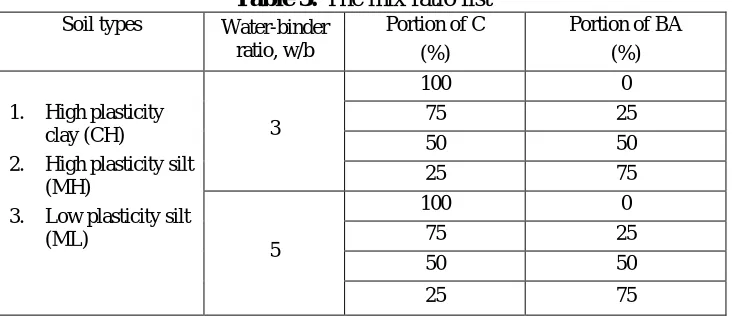
The DMS sample was first mixed thoroughly in a kitchen mixer and left to stand for 24 hours to ensure uniform distribution of the moisture. The moisture content of the remoulded soil was also taken to calculate the dry mass of the soil, a parameter required in the determination of the binder and filler quantities. The mix portions of soil, cement and bottom ash was based on the water-binder (w/b) or water-cement ratio. The w/b ratios examined in the present study were fixed at 3 and 5. The amount of cement and bottom ash admixed with the soil were derived from the w/b ratios, as can be referred to in the mix ratio list in Table 3. Detailed description on the derivation of w/b ratio can be found in Azhar et al. [11].
With the cement and bottom ash contents (in mass) derived based on the pre-determined w/b ratios, the admixtures were carefully poured into the soil in the mixing bowl and gently mixed by hand. The manual mixing was necessary to avoid spillage of the cement powder with excessive agitation in the mixer. Next the mixture was thoroughly mixed mechanically for 5 minutes, with the mixing speed increased gradually to ensure uniform blending of the materials.
Moisture content (%)
Neglig
ible
Specific gravity
2.30
pH
9.17
Pe
rc
ent
ag
e
pa
ssi
ng
(%)
Sieve size (mm)
The mixture was then transferred to a cylindrical split mould in 3 equal layers. Each layer was lightly pressed and kneaded with a miniature compaction tool. The collar of the mould was next removed and the top end of the specimen was trimmed off to form cylinders of 38 mm in diameter and 76 mm in height. Upon removal from the split mould, the specimens were weighed, and measured before being wrapped in cling film to prevent moisture loss. These wrapped specimens were stored in airtight plastic containers at room temperature of 25 ± 5°C for 28 days prior to the strength measurements.
[image:5.612.134.500.312.471.2]At the above curing age, a pair of specimens each was subjected to the unconfined compression test, carried out as per the procedure outlined in BS 1377-7:1990, Clause 7 [12]. The load was applied at a rate of 1.5 mm per minute and the test was terminated when the stress-strain curve starts to decline. The degree of reaction between soil-binder admixture and hardening rate also can be predicted from unconfined compressive strength test by analysing the strength gain with curing time. The emphasis of the present study, however, was to demonstrate and ascertain the optimal bottom ash portion for effective solidification of the dredged marine soils at certain w/b ratios, where cement was used as the primary binder.
Table 3:
The mix ratio list
Soil types Water-binder ratio, w/b
Portion of C (%)
Portion of BA (%)
1. High plasticity clay (CH)
2. High plasticity silt (MH)
3. Low plasticity silt (ML)
3
100 0
75 25
50 50
25 75
5
100 0
75 25
50 50
RESULTS AND DISCUSSIONS
Figure 3:
Unconfined compressive strength (q
u) - portion of cement plots
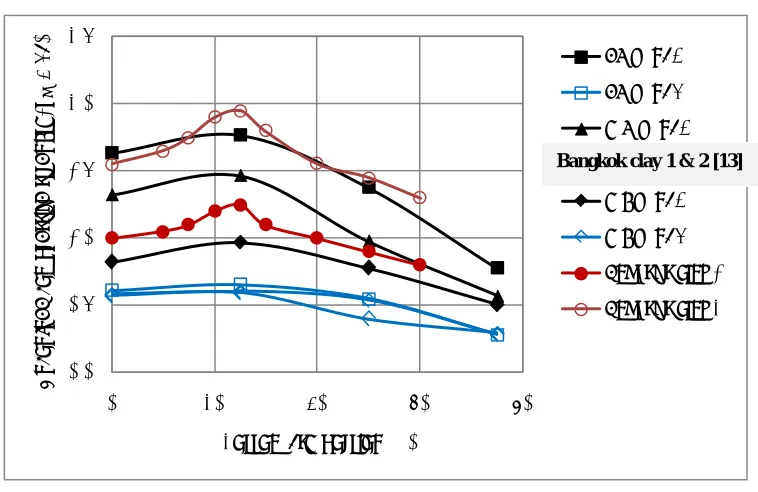
Figure 4:
Unconfined compressive strength (q
u) - portion of bottom ash plots
As expected, without any solidification or pre-treatment, the natural soil has very low undrained shear strength. Indeed nave shear test conducted on the retrieved DMS recorded strengths no more than 10 kPa. It therefore confirmed the need for solidification to improve the strength of the DMS if it was to be reused for any load-bearing purposes.
0.0 0.5 1.0 1.5 2.0 2.5
0 20 40 60 80
U nc on fn ed co m pr es siv e st re ng th
, qu
(M
Pa
)
Bottom ash portion (%)
CH w/b=3 CH w/b=5 MH w/b=3 MH w/b=5 ML w/b=3 ML w/b=5 Bangkok clay 1 Bangkok clay 2
0.0 0.5 1.0 1.5 2.0 2.5
0 20 40 60 80 100 120
Un co nf ne d c om pr es siv e st re ng th
, qu
(M
Pa
)
Cement portion (%)
CH w/b=3 CH w/b=5 MH w/b=3 MH w/b=5 ML w/b=3 ML w/b=5 Bangkok clay 1 Bangkok clay 2
*Bangkok clay 1 & 2
[13]
[image:6.612.128.507.391.637.2]Figures 3 & 4 show the relationship between unconfined compressive strength (qu) and the
portions of cement and bottom ash for both w/b=3 and w/b=5 respectively. The results by Horpibulsuk et al. [13] on Bangkok clay admixed with cement and bottom ash are also included in the plots for comparison. In Figure 3, for the ultimate qu attained, expediency of the cement-BA
solidification was found to be CH>MH>ML in the w/b = 3 specimens. It is also interesting to note that the strength gain rate with cement dosage was almost parallel for all 3 specimens. As for the w/b = 5 ones, the strength improvement was not distinguishable from the soil types as the plots almost folded into one. This indicates the overwhelming and negative effect excessive water content in the mixture had on solidification.
For the Bangkok Clay specimens, immediately apparent is the fact that increased cement dosages added to the soil resulted in strength improvement (Figure 3). Nonetheless the 75 % of cement portion in the cement-BA blend seemed to be the optimal dosage, exceeding which qu was observed to
decline rather severely. Note that the rate of qu decline in both Bangkok Clay specimens was similar
to that of the qu rise prior to 75 % cement addition. The same, however, could not be said of the
specimens examined presently. The plots in Figure 3 clearly show a reversal of qu beyond 75 %
cement portion in the soil for all cases, regardless of the w/b ratio or soil type. The strength loss was sudden and occurred at a far higher rate than the strength gain rate recorded for cement dosages ≤75 %. Considering that incremental cement dosages in the soil would theoretically induce continuous strength gain (with sufficient water for adequate mixing and hydration), the strength reduction beyond a certain threshold dosage must point to the influnce of the other admixture, i.e. bottom ash. Hence these unusual results in both the Bangkok Clay and present DMS specimens suggest an optimal mix ratios of cement and bottom ash for the best strength improvement.
Figure 4 shows the same strength gain plots but with relation to the bottom ash portion. The ultimate qu recorded followed the same order as in Figure 3, where CH>MH>ML, and that the
specimens with w/b = 5 underwent limited strength improvement in all soil types. Note though that there was no strength reversal but a shared drop in qu when the bottom ash portion exceeded 25 %.
The rate of qu decline with BA > 25 % was more dramatic than the rate of increment with BA≤25 %.
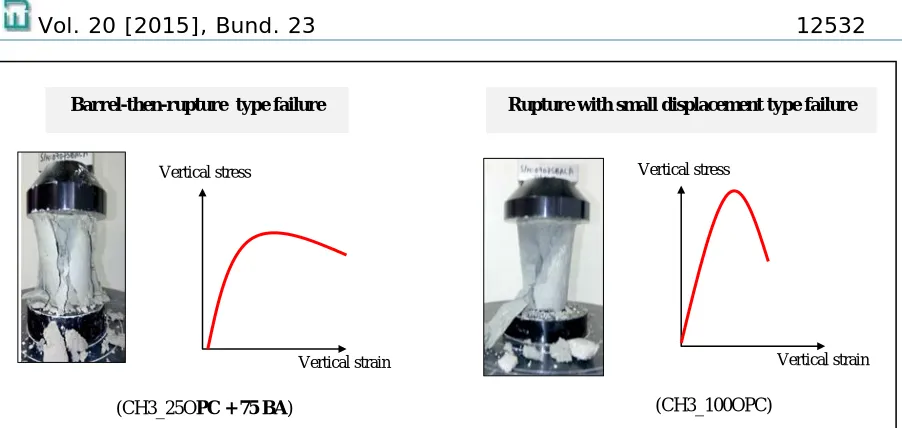
Figure 5:
Failure patterns of solidified specimens
One plausible explanation for this anomaly is the adverse effect of simply having too much bottom ash in the soil-cement-BA mixture. It is postulated that the reactivity of cement was subdued via 3 mechanisms by the excessive amount of bottom ash in the mixture: (1) the large amount of bottom ash increased the surface area for solidification to take effect, hence limiting the binding efficacy on the soil particles instead; (2) the relatively high porosity of bottom ash caused water entrapment in the voids, resulting in less water availability in the mixture for effective cement hydration; (3) the excessive finer bottom ash particles coated the soil-cement aggregates and prevented further cementation to take place in the mixture. Indeed, some entrapped cement grains could also be prevented from contact and reaction with the water, resulting in retarded strength improvement of the mixture [13]. In short, the optimal bottom ash for a cement-BA blend for fine-grained soils, irrespective of the w/b ratio, was found to be cement : BA = 75 : 25, or 25 % of bottom ash in all cases.
CONCLUSIONS
The study was conducted on 3 dredged marine soil samples of the fine-grained family, i.e. high plasticity clay, low and high plasticity silts. Solidification was effected by adding a cement and bottom ash blend to the soil at w/b = 3 and 5. The unconfined compressive strength measurements at day 28 revealed the optimal bottom ash portion for best solidification results to be 25 %, regardless of the soil type and w/b ratio. qu was found to be in decline when BA >25 %, most probably due to the
inhibition of cementation by the much larger exposed surface area for binding, water entrapment by the porous bottom ash, as well as surface coating of the soil-cement aggregates.
ACKNOWLEDGEMENT
Thanks are due to Marine Department of Malaysia for access to the sampling sites, and Malaysian Maritime & Dredging Corporation Sdn. Bhd (MMDC) for assistance in the sampling operations. Funds were provided by Research Grant LEP 2.0, MOHE.
Barrel-then-rupture type failure Rupture with small displacement type failure
(CH3_25OPC + 75 BA) (CH3_100OPC)
Vertical stress
Vertical strain
Vertical stress
REFERENCES
1. A. Maher, W.S. Douglass, F. Jafari and J. Pecchioli, The Processing and Beneficial Use of Fine-Grained Dredged Material: A Manual for Engineers. Centre for Advance Infrastructure and Transportation. New Jersey, Washington: RUTGERS Centre for Advanced Infrastructure and Transportation, (2013)
2. N. Bray & M. Cohen, Dredging for Development (6th ed.). Netherlands: International Association of Dredging Companies (IADC) & International Association of Ports and Harbors (IAPH), (2010)
3. CEDA. Dredged Material as a Resource : Options and Constraints, June edition (2010)
4. S. Vitton, Introduction to soil stabilization. Understanding the basic of soil stabilization: An Overview of Material and Technique”, (2006)
5. G.P. Makusa, Soil Stabilization Methods and Materials in Engineering Practice. Luleå University of Technology, (2012)
6. C. H. Benson & S. Bradshaw, User Guideline For Coal Bottom Ash And Boiler Slag In Green Infrastructure Construction. Recycled Materials Resource Center University of Wisconsin-Madison Madison, WI 53706 USA, (2011)
7. Association of Canadian Industries Recycling Bottom Ash (CIRCA) , Origin and Application of Bottom Ash-Technical fact sheet, (2010)
8. A. Muhardi, A. Marto, K. A. Kassim, A. M. Makhtar, L. F. Wei & Y. S. Lim, Engineering characteristics of Tanjung Bin coal ash. Electronic Journal of Geotechnical Engineering, 15 K (2010) 1117–1129
9. A. Abubakar & K. S. Baharudin, Potential Use of Malaysian Thermal Power Plants. International Journal of Sustainable Construction Engineering & Technology, 3(2) (2012) 25–37
10. P. Ramadoss & T. Sundararajan, Utilizing of Lignite-Based Bottom Ash as Partial Replacement of FineAggregate in Mansory Mortar. Arabian Journal for Science and Engineering, (2013)
11. A. Azhar, C. M. Chan & A. T. Abd. Karim, Solidification Potential of Fine-Grained Dredged Marine Soils : Water-Binder Ratio Effects. Journal of Civil Engineering Research, 4 (3A), (2014) 48–53
12. BS 1377, Methods of Test for Civil Engineering Purposes, (1990)
13. S. Horpibulsuk, W. Phojan, A. Suddeepong, A. Chinkulkijniwat & M. D. Liu, M. D. Strength development in blended cement admixed saline clay. Applied Clay Science (2011).