Journal of Chemical and Pharmaceutical Research, 2015, 7(2):618-625
Research Article
ISSN : 0975-7384
CODEN(USA) : JCPRC5
Quantification of the main active ingredients of plant extracts to establish
optimal conditions for extraction
A. S. Bondarenko
1*, N. Y. Bevz
2, Ie. V. Gladukh
1and D. P. Soldatov
11Department of Industrial Pharmacy, National University of Pharmacy, Kharkiv, Ukraine
2Department of Pharmaceutical Chemistry, National University of Pharmacy, Kharkiv, Ukraine, Ukraine, Kharkiv,
4, Blukher str
_____________________________________________________________________________________________
ABSTRACT
The article presents the results of studies of liquid extracts from Plantago major, Hedera helix and Salvia officinalis obtained by percolation using Timatic Micro extractor of Italian manufacturer Tecnolab. During the experiment have been quantified active ingredients, namely polysaccharides by gravimetric analysis and flavonoids and hydroxycinnamic acids by absorption spectrophotometry. The results obtained have made it possible to determine the optimal conditions of medicinal plants extraction: raw material particle size, time of compression and decompression, in which the most extraction of active ingredients from plant material occurs. According to the quantification of the active ingredients it has been found that their highest yield is observed in the extraction of plant material of 0.5-1 mm fraction size and compression and decompression time of 4 and 2 min, respectively.
Key words: Plantago major, Hedera helix, Salvia officinalis, extraction, quantification.
_____________________________________________________________________________________________
INTRODUCTION
Cold diseases or acute respiratory infections (ARI) are the most common diseases, which stipulates their medical and social significance. Average number of them in the world, according to WHO, is about 2 cases per year for every person on the planet. In the structure of child morbidity they are assigned to lead. ARI account for more than 90% of human infections [1]. The characteristic symptoms of this diseases are sore throat, rhinitis, cough and fever [2]. Consequences of these diseases may manifest in some complications and in some cases – chronic diseases of respiratory system and temporary disability and significant medical expenses [3, 4].
For the rational therapy choice attention should be paid to the effectiveness and safety of medicines. Over the past decades, significant demand have gained herbal products. Herbs incorporates complexes of biologically active substances that possess versatile action on different parts of the pathological process, and thereby cause a wide spectrum of activity [5].
As the plant material have been chosen leaves of Plantago major, Hedera helix and Salvia officinalis, of which were prepared liquid extracts. Selection of these medicinal plants is stipulated by the content of active ingredients and their pharmacological properties.
As it is known, the leaves of the Plantago major contain polysaccharides and flavonoids, among the latter determine, rutin, apigenin, luteolin. Also Plantago contains mucous substances, bitters, tannins, organic acids, phenolic acids and derivatives thereof, vitamins and minerals. Expectorant action of plantain leaves is due to the presence of polysaccharides [7, 8, 9].
The components of Hedera helix are triterpene saponins (2,5-6%), other groups of identified compounds are phenols (flavonoids, anthocyanins, phenolic acids and coumarins), amino acids, steroids, vitamins, volatile and non-volatile oils. Saponin glycosides of Hedera helix determine its secretolytic effect, hydroxycinnamic acids exhibit immunostimulatory and anti-inflammatory effect. In addition to specific effects it has restorative and tonic effect on the whole body [10].
Sage leaves contain 2.5% of essential oil, which consists of cineole, pinene, thujone, borneol and other terpene compounds and phenolic substances – flavonoids (luteolin derivatives and apigenine), tannins, derivatives of hydroxycinnamic acids (rosemary, coffee, chlorogenic, ferulic), sugars and polysaccharides, vitamins B and PP, triterpene saponins – derivatives of ursolic and oleanolic acids. Hydroxycinnamic acids, flavonoids and tannins of this medicinal plants exhibit anti-inflammatory, antimicrobial and astringent effect [11].
It is known that the extraction process is influenced by several factors: the ratio of raw material and extractant, the particle size of raw material, extraction time, temperature, pressure, nature of extractant, multiplicity of extraction and others.
EXPERIMENTAL SECTION
In the work used herbal drugs purchased in pharmacies; purified water; ethyl alcohol 96%, 70% and 20%; 2% aluminum chloride solution in 70% alcohol, 5% solution of glacial acetic acid in 70% alcohol. All materials and reagents meet SPhU requirements.
Equipment used for research: extractor Timatic Micro 0.5 l of Tecnolab (Italy); centrifuge OPn-8; moisture analyzer Sartorius MA 150 (Germany); Evolution 60S spectrophotometer of Thermo Fisher Scientific (USA); Laboratory Balance Certus CBA-300-0,005 (Ukraine) and Laboratory analytical balance "AXIS" ANG 200 (Poland).
Assay of polysaccharides in the mixture and the extracts was performed by gravimetric method based on
methodology given in the State Pharmacopoeia of Ukraine, ed. 1 Extras. 4 for raw material «Plantago major leavesN» [12].
Method. About 5 g (accurate weight) of crushed into powder raw materials (750) (2.9.12) placed in a flask with a
ground glass stopper of a capacity 250 ml, added 100 ml of water P, refluxed for 30 minutes, cooled and decanted into 250 ml volumetric flask through a glass funnel with 5 layers of gauze, pre-moistened with water P. Extraction continues in two portions, the first – 100 ml of water P, the second – 50 ml of water P, each time refluxing for 30 min. Each extract is cooled and decanted into the same flask. Filter is washed with water P and dilute the volume of solution with water P to the mark.
5 ml of obtained solution (or 5 ml of the extracts samples in the determination of polysaccharides in extracts) is placed in a centrifuge tube, add 15 ml of 96% alcohol P stirred and heated in a water bath at 30 °C for 5 min, then the solution is left to stand for 1 h and centrifuged at a speed of 5000 rev / min for 30 min. The supernatant is filtered under vacuum at residual pressure of 13 kPa to 16 kPa through a glass filter with 16 micron apertures, previously dried at a temperature of 100 °C to 105 °C to constant weight. The precipitate is quantitatively transferred to filter and washed with 10 ml of 96% alcohol P. The filter with precipitate is air-dried, then dried to constant weight at a temperature of 100 °C to 105 °C.
_____________________________________________________________________________
(
W
)
х
−
⋅
⋅
⋅
⋅
⋅
−
=
100
V
s
m
100
100
250
)
m
(m
1 2 , %where: m1 – mass of filter, g;
m2 – mass of filter with residue, g;
ms – mass of the material sample, g;
V – volume of pipette, ml;
W – the loss in weight at drying, %.
Content of sum of polysaccharides in the extract (x, mg/ml) has been calculated by the formula:
V
1000
)
m
(m
12
−
⋅
=
х
, mg/mlwhere: m1 – mass of the filter, g;
m2 – mass of the filter with residue, g;
V – volume of pipette, ml.
The content of sum of polysaccharides in the extract (x, %) in terms of raw materials, has been calculated using the formula:
(
W
)
V
х
extr−
⋅
⋅
⋅
⋅
⋅
−
=
100
V
s
m
100
100
)
m
(m
. 1 2 , %where: m1 – mass of filter, g;
m2 – mass of filter with residue, g;
Vextr. – volume of resulting extract, ml;
ms – mass of the material sample, g;
V – volume of pipette, ml; W – loss in weight at drying,%.
Determination of hydroxycinnamic acids in the mixture and liquid extracts by absorption spectrophotometry. Method. Approximately 2.0 g of raw material (accurate weight), crushed to the size of the particles that pass
through a sieve with apertures of 2 mm in diameter, placed in a flask with a grounded joint of 250 ml capacity and added 70 ml of water P. The flask connected to reflux condenser and heated in a boiling water bath for 15 minutes. Extraction is carried out twice more. Extracts cooled, filtered through a paper filter and quantitatively transferred into a volumetric flask of 250 ml and dilute to the mark with water P (solution A).
In a volumetric flask of 25 ml placed 1 ml of solution A and diluted with 20% ethanol to the mark. Compensation solution was 20% ethanol.
At quantitative determination of biologically active substances in liquid extracts in the 50 ml volumetric flask placed
0.5 ml of extract (0.5 g of extract) and diluted with 20% ethanol to the mark. Compensation solution was 20% ethanol.
Absorbance of the test solution was determined on a spectrophotometer at wavelength 327 nm in a cuvette with a layer thickness of 10 mm.
Content of sum of hydroxycinnamic acids (x,%) in the raw material in terms of chlorogenic acid, calculated using the formula:
(
W
)
V
m
А
А
х
sсm
⋅
⋅
⋅
−
⋅
⋅
⋅
=
100
100
25
250
% 1 1 , %% 1 1сm
А
– specific absorbance of chlorogenic acid, which equals 531;V – volume of pipette, ml;
ms – mass of the sample material, g;
W – the loss in weight at drying, %.
Content of sum of hydroxycinnamic acids (x, mg/ml or mg/g) in extracts, in terms of chlorogenic acid, has been calculated using the formula:
100
1000
50
% 1
1
⋅
⋅
⋅
⋅
=
V
А
А
х
сm , mg/ml;100
1000
50
. % 11
⋅
⋅
⋅
⋅
=
extr сm
m
А
А
х
, mg/gwhere: A – absorbance of the test solution at 327 nm wavelength;
% 1 1сm
А
– specific absorbance of chlorogenic acid, which is equal to 531;V – volume of pipette, ml; mextr. – weight of extract, g
Content of sum of hydroxycinnamic acids (x,%) in extracts, in terms of raw material (mixture) has been calculated by the formula:
(
W
)
m
V
А
V
А
х
s сm extr−
⋅
⋅
⋅
⋅
⋅
⋅
⋅
⋅
=
100
100
100
100
50
% 1 1 . , %where: A – absorbance of the test solution at 327 nm wavelength;
% 1 1сm
А
– specific absorbance of chlorogenic acid, which is equal to 531;Vextr. – volume of resulting extract, ml;
V – volume of pipette, ml;
ms – mass of the sample material, g;
W – the loss in weight at drying, %.
Determination of flavonoids in the mixture and in liquid extract by absorption spectrophotometry.
Method. Approximately 2.0 g of raw material (accurate weight), crushed to the size of the particles that pass
through a sieve with apertures 2 mm in diameter, placed in a flask with a grounded joint of capacity 250 ml, added 50 ml of 70% ethanol and weighed to the nearest 0.01 g .Connected the flask to reflux condenser and heated for 1.5 h with periodic shaking. The flask was then cooled, weighed and adjusted to the initial weight with 70% ethanol. The resulting extract filtered through filter paper, discarding the first 25 ml of the filtrate (solution A).
In a volumetric flask of 25 ml placed 1 ml of solution A (1 ml of extract or 1.0 g of extract in the determination of flavonoids in liquid extracts), added 1 ml of 2% solution of aluminum chloride and diluted with solution of 5% glacial acetic acid in 70% alcohol to the mark. As a blank solution (compensation solution ) utilized a solution consisting of 1 ml of solution A (1 ml extract or 1.0 g of extract in the determination of flavonoids in liquid extracts), taken with 5% glacial acetic acid solution in 70% alcohol to the mark in a volumetric flask of capacity 25 ml.
Absorbance of the test solution is determined after 30 minutes on a spectrophotometer at the wavelength of 400 nm in a cuvette with a layer thickness of 10 mm.
The content of flavonoids (x, %) of the raw material in terms of luteolin, has been calculated using the formula:
(
W
)
V
m
А
А
х
sсm
⋅
⋅
⋅
−
_____________________________________________________________________________
where: A – absorbance of the test solution at the wavelength of 400 nm;
% 1 1сm
А
– Specific absorbance of luteolin and aluminum chloride complex, which is equal to 549.41 at a wavelengthof 400 nm;
V – volume of pipette, ml;
ms – mass of the sample material, g;
W – the loss in weight at drying, %.
The content of flavonoids (x, mg/ml or mg/g) in extracts, in terms of luteolin, has been calculated using the formula:
100
1000
25
% 1
1
⋅
⋅
⋅
⋅
=
V
А
А
х
сm , mg/ml;100
1000
25
. % 11
⋅
⋅
⋅
⋅
=
extr
сm
m
А
А
х
, mg/gwhere: A – absorbance of the test solution at the wavelength of 400 nm;
% 1 1сm
А
– specific absorbance of luteolin and aluminum chloride complex , which is equal to 549.41 at a wavelengthof 400 nm;
V – volume of pipette, ml; mextr. – weight of tested extract, g
The content of flavonoids (x, %) in extracts, in terms of raw material (mixture) has been calculated by the formula:
(
W
)
m
V
А
V
А
х
s сm extr−
⋅
⋅
⋅
⋅
⋅
⋅
⋅
⋅
=
100
100
100
100
25
% 1 1 . , %where: A – absorbance of the test solution at the wavelength of 400 nm;
% 1 1сm
А
– specific absorbance of luteolin complex with aluminum chloride, which is equal to 549.41 at a wavelengthof 400 nm;
Vextr. – volume of resulting extract, ml;
V – volume of pipette, ml;
ms – mass of the sample material, g;
W – the loss in weight at drying, %.
The calculation of the degree of depletion of active ingredients mixture.
The degree of depletion of raw materials has been calculated by the formula:
100%
b
a
х
=
×
,where: a – the quantitative content of active substances in the extract, in terms of the raw materials, %; b – quantitative content of active ingredients in raw material, %
We have developed total aqueous liquid extracts (1:10) on the basis of three herbs: Plantago major, Hedera helix and
Salvia officinalis in a ratio of 5:1:1 (5 parts of plantain leaves, 1 part of ivy leaves, and 1 part of sage leaves) [13].
As active ingredients of the selected plants that possess secretolytic, expectorant and anti-inflammatory action, are well extracted with water as extractant we have chosen purified water. Ratios of raw materials and extract (1:10) and the main components of the mixture (5:1:1) have been selected as a result of processing the literature and marketing analysis of drugs for the treatment of colds and cough with the raw materials that are on the pharmaceutical market of Ukraine.
sample. According to the data obtained it has been found that the optimal extraction time is 3 hours (1 hour infusion and 2 hour actually percolation of plant material) [13, 14].
The operation principle of the extractor Timatic Micro is based on a dual action of pressure – increasing (up to 6 bar) and reducing the pressure and percolation of medicinal plants at room temperature, which allows saving natural properties and characteristics of the active components of the extract.
Raw material was crushed through appropriate sieves and three fractions were obtained with particle size 3-5, 1-3, 0.5-1 mm. Raw materials of appropriate fractions were mixed at a ratio of 5:1:1. Sample mixture (67.00 g) placed in the filtration bag with apertures of 100 microns. Filtration bag with raw material loaded in the extraction chamber and filled with the calculated amount of extractant. Extraction chamber closed with lid and set the appropriate extraction program. The obtained extracts were poured, in them determined the content of polysaccharides, flavonoids and hydroxycinnamic acids.
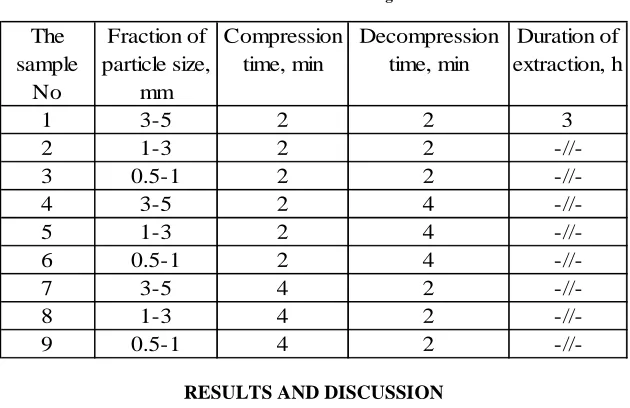
At further ascertainment of optimal conditions for extraction has been determined dependence of the yield of active substances on the size of raw materials fraction , compression and decompression time .
[image:6.595.141.456.326.530.2]The main parameters of performed extractions are given in Table 1.
Table 1. Parameters studied during extractions
The
sample
No
Fraction of
particle size,
mm
Compression
time, min
Decompression
time, min
Duration of
extraction, h
1
3-5
2
2
3
2
1-3
2
2
-//-3
0.5-1
2
2
-//-4
3-5
2
4
-//-5
1-3
2
4
-//-6
0.5-1
2
4
-//-7
3-5
4
2
-//-8
1-3
4
2
-//-9
0.5-1
4
2
-//-RESULTS AND DISCUSSION
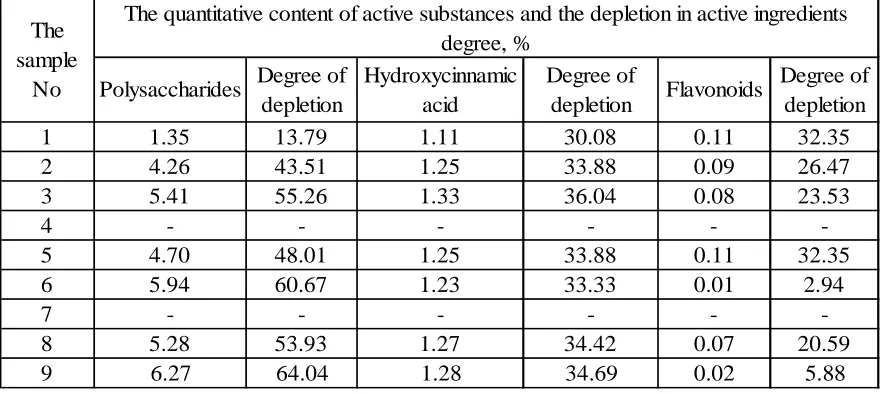
With the methods described above in the mixture was determined quantitative content of polysaccharides (9.79%), hydroxycinnamic acids (3.69%) and flavonoids (0.34%) that were used later to calculate the degree of mixture depletion, given in Table 3.
_____________________________________________________________________________
Table 2. Data of determination of polysaccharides, flavonoids and hydroxycinnamic acids in extracts in mg/ml, mg/gPolysaccharides
by V, mg/ml
by m, mg/g
by V, mg/ml
by m, mg/g
by V, mg/ml
1
1.3
1.0753
1.0753
0.1022
0.1037
2
4.1
1.1770
1.2053
0.0833
0.0842
3
5.16
1.2269
1.2693
0.0770
0.0778
4
-
-
-
-
-5
4.24
1.1560
1.1281
0.0994
0.1006
6
5.58
1.1981
1.1525
0.0104
0.0105
7
-
-
-
-
-8
4.86
1.1927
1.1676
0.0632
0.0642
9
5.92
1.2922
1.2072
0.0169
0.0164
The quantitative content of active substances mg/ml, mg/g
Hydroxycinnamic acids
Flavonoids
The
sample
No
The results of determination of the main active ingredients in liquid extracts in terms of raw materials and the degree of depletion are shown in Table 3.
Table 3. Data on the determination of active substances in the extracts in terms of raw materials, % and the degree of mixture depletion in active ingredients, %
Polysaccharides
Degree of
depletion
Hydroxycinnamic
acid
Degree of
depletion
Flavonoids
Degree of
depletion
1
1.35
13.79
1.11
30.08
0.11
32.35
2
4.26
43.51
1.25
33.88
0.09
26.47
3
5.41
55.26
1.33
36.04
0.08
23.53
4
-
-
-
-
-
-5
4.70
48.01
1.25
33.88
0.11
32.35
6
5.94
60.67
1.23
33.33
0.01
2.94
7
-
-
-
-
-
-8
5.28
53.93
1.27
34.42
0.07
20.59
9
6.27
64.04
1.28
34.69
0.02
5.88
The quantitative content of active substances and the depletion in active ingredients
degree, %
The
sample
No
From the data of Tables 1, 2, 3 it is clear that at extraction of medicinal plants with a particle size of 3-5 mm (sample number 1) the smallest yield of active ingredients is observed, so this raw material fraction was removed from further research. Also did not determine quantitative content of active ingredients in samples number 4 and number 7. The highest yield of polysaccharides observed in the extraction of medicinal plants of fraction size 0.5-1 mm and compression and decompression time of 4 and 2 min, respectively (sample number 9). The highest content of hydroxycinnamic acids has been detected in the extract of a particle size of medicinal plants 0.5-1 mm, time of compression and decompression of 2 minutes (sample number 3). Flavonoids in the developed extracts have been found in small amounts (0,01-0,11%).
CONCLUSION
[image:7.595.78.521.374.571.2]plant material, compression and decompression time has been studied. As a result of the research we have suggested for further development of herbal syrup to conduct extraction of plant material with the following parameters: duration of extraction 3 h, the particle size of raw materials 0.5-1 mm, compression time 4 min and decompression time 2 min (sample number 9). It is at these extraction parameters occurs the highest yield of polysaccharides that are responsible for the primary pharmacological effect in syrup for treatment of colds and elimination of such symptom as cough.
REFERENCES
[1]LA Volyanska; LB Romaniuk. Child Health 2011, 5 (32), 43-46.
[2]M Simasek; DA Blandino. American Family Physician, 2007, 75(4), 515-520.
[3]OA Golubovska; AB Shkurba; AM liver. Ukraine. Health of the Nation, 2012, 1 (21), 129-140.
[4]IA Zupanets; Black VP; TC Sakharov and others. Clinical Pharmacy (pharmaceutical care) Pharmacy Publisher: Golden Pages, Kharkiv, 2011; 704.
[5]TV Kornopoltseva; GW Chehirova; TA Aseeva. Chemical and Pharmaceutical Journal, 2009, 43 (10), 44-46. [6]OO Salii; PA Golovkin. Pharmaceutical Journal, 2001, 4, 56-59.
[7]NAM Olennikov; LM Tanhaeva. Chemistry of plant raw materials, 2006, 1, 49-54. [8]AB Samuelsen. Journal of Ethnopharmacology, 2000, 71, 1-21.
[9]J Barnes; LA Anderson; JD Phillipson. Herbal Medicines, 3rd edition, Pharmaceutical Press, London, 2007; 474-476.
[10]Yu Lutsenko; W Bylka; I Matlawska; R Darmohray. Herba Polonica, 2010, 56(1), 83-96.
[11]VM Cosman; OH Pozharitskaya; AN Shikov; VG Makarov. Chemistry of plant raw materials, 2012, 1, 153-160.
[12]The State Pharmacopoeia of Ukraine, 1st ed., Reported. 4, State Enterprise "Ukrainian Research Center Pharmacopoeial quality of drugs", Kharkov, 2011; 540.
[13]AS Bondarenko; EO Hladuh; RL Prytula; BB Shmatenko. Issues Military Health, 2012, 33, 276-278.