International Journal of Emerging Technology and Advanced Engineering
Website: www.ijetae.com (ISSN 2250-2459, Volume 2, Issue 8, August 2012)48
Neural Network for Classification of Multi-User Chirp
Modulation Signals using Wavelet Higher Order Statistics
Features
Said E. El-Khamy
1, Hend A. Elsayed
2, Mohamed R. M. Rizk
31,2,3 Electrical Engineering Department, University of Alexandria, Alexandria, Egypt
Abstract — Signal classification has many important
applications in both of the civilian and military domains. This paper presents a classification of multi-user chirp modulation signals using wavelet higher order statistics features and neural network classifier (NN). In this paper, even higher order moments and cumulants up to order eight from the discrete wavelet transform (DWT) coefficients are proposed as effective features. These features are used for classification of eight multi-user chirp modulation signals using neural network classifier. Simulation results show that the proposed technique is able to classify these eight chirp signals in additive white Gaussian noise (AWGN) channels with high accuracy and the performance using features extracted from wavelet transform outperforms that extracted from the signals themselves. Also the features extracted from only details coefficients outperforms the features extracted from the total wavelet coefficients and from the approximation coefficients only and different decomposition levels for wavelet are used.
Keywords — Classification, Discrete Wavelet Transform, Higher Order Moments and Cumulants, Multi-User Chirp Modulation Signals, Neural Network.
I. INTRODUCTION
Signal classification plays an important role in various applications in military applications where it can be employed for electronic surveillance and monitoring and in civil applications where it can be used for spectrum management, network traffic administration, signal confirmation, software radios, and intelligent modems. The early researches were concentrated on analog signals, but the recent contributions focus on digital signals. Primarily, this is due to the increasing usage of such types of signal in novel communication applications. In this paper, we present signal classification for eight multi-user chirp signals in additive white Gaussian noise channels where all the used chirp signals are selected to have the same power as well as the same bandwidth. Chirp modulation signals have been used for different applications some of these as beacons,aircraft ground data links via satellite repeaters, and used in sonar and radar.
The signal classification problem has attracted many researchers. This classification in additive white Gaussian noise channel using neural network is made using fourth order cumulant as features for classification M-ary phase shift keying modulation signals in [1]. Higher order moments and cumulants (up to eighth) are used as features for classification of different digital modulation signals in [2]-[4] and features are extracted from different discrete transforms based on mel frequency cepstral coefficients as in [5].
Features are extracted based on the discrete wavelet transform of the received signal and higher order statistical moment in [6] to classify the Electrocardiogram betas signals. In [7] combination of the higher order moments and higher order cumulants up to order eighth are used for classification of multi-user chirp modulation signals using neural network, support vector machine, k-nearest neighbor, maximum likelihood classifiers.
Signal classification is divided into two main steps which are the feature extraction and the classifier. In this classifier, the input signals are passed through an additive white Gaussian noise (AWGN) channels, and the received signals are normalized to have zero mean and unit variance and the output normalized signals are passed to the feature extraction step. Features are extracted by the selected combination of the higher order moments and higher order cumulants up to order eighth from the discrete wavelet transform of the signal. The neural network classifier uses these features to classify the input signals to get the signal type.
International Journal of Emerging Technology and Advanced Engineering
Website: www.ijetae.com (ISSN 2250-2459, Volume 2, Issue 8, August 2012)49
The signal is low pass filtered to give an approximation signal and high pass filtered to give a detail signal.
This paper is organized as follows. Section II describes the multi-user chirp modulation signals, section III describes higher order statistics, and section IV describes features extraction from DWT. Section V describes the neural network classifier. Section VI shows the simulation results. Finally, Section VII concludes the paper.
II. MULTI-USER CHIRP MODULATION SIGNALS
The linear frequency sweep of a multi-user chirp signals are characterized by the same bandwidth. Each signal is characterized by two different slopes, one slope for each of the two halves of the signal duration. The general expression for these multi-user chirp- modulated (M-CM) signals can be expressed as [9],
(1)
(2)
where, K is the user number, K = 1, 2….. M, M is the total number of users, E is the signal energy in the whole
bit duration T,
c
2
f
cisthe carrier angular frequency,f
isthe frequency separation between successive users att=T/2,
k is the slope within the first half of signalduration, i.e.
0
t
T
/
2
and
k
is the complementslope within the second half of signal duration, i.e.
T
t
T
/
2
.The signal slopes in the two halves of itsduration are given by,
f
T
K
M
T
f
K
K K
.
2
/
,
2
/
(3)The bandwidth of the different M-CM signals is the
same and is given by
B
M
f
and their time-bandwidthproduct is given by
BT
MT
f
.III. HIGHER ORDER STATISTICS
The auto-moment of the random variable may be defined as follows [10]-[12]:
The
th
p
order moments of a discrete signal s is definedas:
q q p pq
E
s
s
M
[
(
*)
(4) Example,
]
)
)(
[(
42
E
s
2s
* 2M
(5)
Assume a zero-mean discrete based-band signal
sequence of the form
s
k
a
k
jb
k. The thp
ordercumulants is defined as:
]
,...,
,
,...,
[
) ( * * ) (
terms q terms q ppq
Cum
s
s
s
s
C
(6)
q v j j v j j v qn q E s E s
s s
Cum[ ,..., ] ( 1) ( 1)! ...
1 1
1
(7)
Where the summation is being performed an all partitions
)
,...,
(
v
1v
qv
for the set of indices (1,…, n).
The higher order statistics have the ability to suppress additive colored Gaussian noise of unknown power spectrum, identify non minimum phase system or reconstruct non minimum phase signal and extract information due to deviation from Gaussianity. A non Gaussian signal can be decomposed into its higher order cumulant functions where each one of them may contain different information about the signals. This can be very useful in signal classification problems where distinct classification features can be extracted from higher order spectrum domain.
IV. FEATURES EXTRACTION FROM DISCRETE WAVELET
TRANSFORM
The features are extracted using the even higher order moments and cumulants up to eight from the discrete wavelet transform coefficients and approximation coefficients and details coefficients of the eight chirp signals. We used six features for classification and compare its performance with using the features from the signals. The selected features are those which show significant differences between the different chirp signals.
In this paper, features are extracted using the even higher order moments and cumulants up to eight from wavelet transform coefficients and approximation coefficients and details coefficients of the eight chirp signals we used six features for classification and compare its performance with using the features from the signals themselves as in [7].
2
/
0
)
cos(
2
)
(
21
t
t
t
T
T
E
t
S
K
c
K
T t T T t T t K T t T E t
SK c K )) /2
2 ( ) 2 ( ) 2 ( cos( 2 ) ( 2
International Journal of Emerging Technology and Advanced Engineering
Website: www.ijetae.com (ISSN 2250-2459, Volume 2, Issue 8, August 2012)50
V. NEURAL NETWORK CLASSIFIER
We have used a MLP neural network with back-propagation (BP) learning algorithm as the classifier. A MLP feed forward neural network consists of an input layer of source nodes, one hidden layer of computation nodes (neurons) and an output layer. The number of nodes in the input and the output layers depend on the number of input and output variables, respectively and the number of nodes in the hidden layer is 17 neurons. And the classifier is allowed to run up to 5000 training and with MSE is taken to be 10-6, the activation functions used for hidden layer and for output layer respectively are Hyperbolic tangent sigmoid and Linear transfer function [3].
VI. SIMULATION RESULTS
In this work, we evaluate the performance of automatic digital signal type classifier of the of the considered multi-user chirp modulation signals using neural network and wavelet higher order statistics features. We used eight chirp signals called Sig1, Sig2, Sig3, Sig4, Sig5, Sig6, Sig7, and Sig8 that are generated using equations (1) and (2) by
putting M=8. Assume
T
=1 sec,f
c
1
kHz
and thetime-bandwidth product
1500
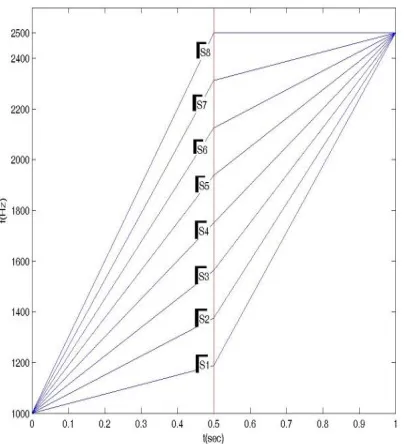
.Plots of the instantaneous frequencies of these eight chirp signals are shown in figure. 1.
Figure 1. Instantaneous frequency of Multi-User Chirp modulation signals over the carrier frequency.
[image:3.612.337.554.371.663.2]We used 150 realizations for each signal and each signal has 4096 samples length (1 second); these realizations are then divided into 100 realizations for training data sets and 50 realizations for testing data sets. White Gaussian noise is added to these signals and features are extracted using even order moments and cumulants up to eight using equations in [7] and [10] appendix from wavelet transform coefficients and approximation coefficients and details coefficients of the eight chirp signals after passing these signals to white Gaussian noise using db2 and one, two, and three decomposition level to get wavelet coefficients. The absolute values of the autocorrelation function of total wavelet coefficients of the discrete wavelet transform of the eight chirp signals is shown in figure 2. From this figure, we note that the autocorrelation function of total wavelet coefficients is the same for most of the signals used, so we can’t use this second order correlation as features for classify these signals. We use the even higher order moments and cumulants up to order eight.
Figure 2. The absolute values of the autocorrelation function of total wavelet coefficients of the discrete wavelet transform of the eight
[image:3.612.63.266.465.687.2]International Journal of Emerging Technology and Advanced Engineering
Website: www.ijetae.com (ISSN 2250-2459, Volume 2, Issue 8, August 2012)51
From the results, we show that the second order moments and cumulants for all signals are the same, for this reason, we don't use it as features. And the fourth order moments are the same for each signal so we use one of them for each signal. Also for the fourth order cumulants, the sixth and eight order moments and cumulants, we used one for each.
i.e. M40=M41=M42=M4, C40=C41=C42=C4,
M60=M61=M62=M63=M6, C60=C61=C62=C63=C6,
M80=M81=M82=M83=M84=M8 and
C80=C81=C82=C83=C84=C8.
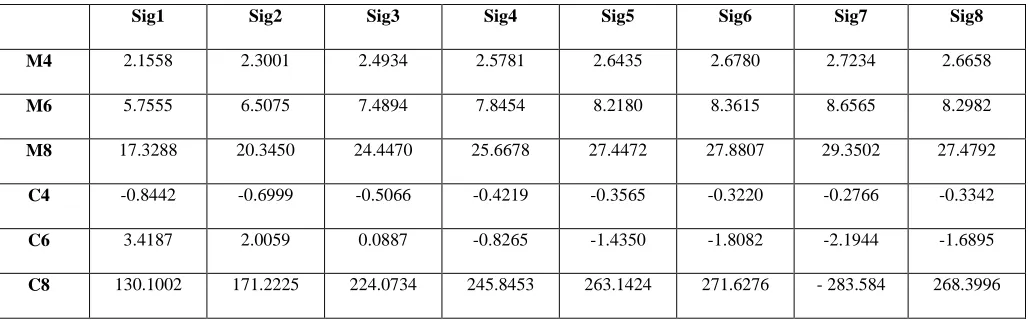
Table I shows the features for the eight chirp signals using total wavelet coefficients, Table II shows the features for the eight chirp signals using approximation wavelet coefficients, Table III shows the features for the eight chirp signals using details wavelet coefficients with one decomposition level. These values are computed under the constraints of zero mean, unit variance and noise free.
So we use six features for classification. The six features used are F4 (M4, C4, M6, C6, M8 and C8) are shown in Table I. This method is compared with using the features F2 (M6, C6, M8 and C8), the features F1 (M4 and C4) as in [13], features F3 (M6 and C8) for classification and F5 (M4, C4, M6, C6, M8 and C8) without using the higher order moments and cumulants from the signals themselves without using DWT.
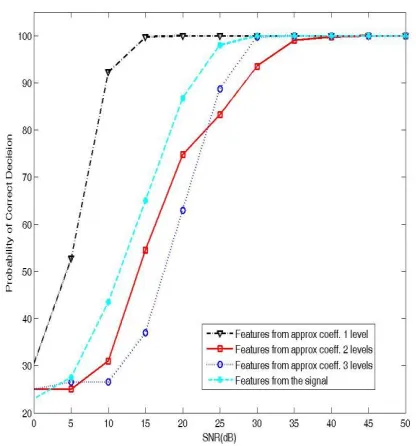
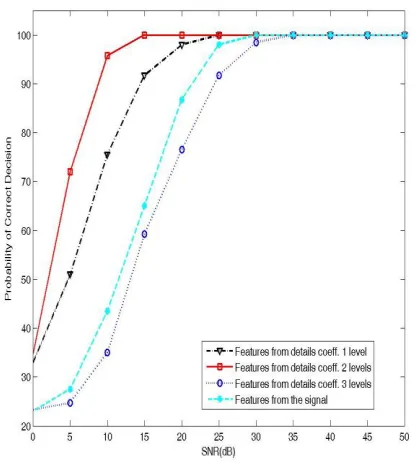
Figure 3 shows the performance of the eight signals using the features extracted from the total wavelet coefficients using one decomposition levels and different features F1, F2, F3, F4, and F5. From this figure, we note that the features F4 gets better performance than F1, F2, F3, and F5. Figure 4 shows the performance of the multi-user chirp modulation signals using total wavelet features and one, two, and three decomposition levels. From figure 4, we note that the performance using one decomposition level better the using two and three decomposition levels. Figure 5 shows the performance of the eight signals using the features extracted from the approximation wavelet coefficients using one decomposition levels and different features F1, F2, F3, F4, and F5. From this figure, we note that the features F4 gets better performance than F1, F2, F3, and F5. Figure 6 shows the performance of the multi-user chirp modulation signals using approximation wavelet features and one, two, and three decomposition levels. From figure 6, we note that the performance using one decomposition level better the using two and three decomposition levels. Figure 7 shows the performance of the eight signals using the features extracted from the total wavelet coefficients using one decomposition levels and different features F1, F2, F3, F4, and F5. From this figure, we note that the features F4 gets better performance than F1, F2, F3, and F5. Figure 8 shows the performance of the multi-user chirp modulation signals using details wavelet features and one, two, and three decomposition levels.
TABLE I
FEATURES FOR EIGHT MULTI-USER CHIRP MODULATION SIGNALS USINGMOMENTSANDCUMULANTSFROM TOTAL WAVALET COEFFICIENTS OF
DWT
Sig8 Sig7
Sig6 Sig5
Sig4 Sig3
Sig2 Sig1
2.6658 2.7234
2.6780 2.6435
2.5781 2.4934
2.3001 2.1558
M4
8.2982 8.6565
8.3615 8.2180
7.8454 7.4894
6.5075 5.7555
M6
27.4792 29.3502
27.8807 27.4472
25.6678 24.4470
20.3450 17.3288
M8
-0.3342 -0.2766
-0.3220 -0.3565
-0.4219 -0.5066
-0.6999 -0.8442
C4
-1.6895 -2.1944
-1.8082 -1.4350
-0.8265 0.0887
2.0059 3.4187
C6
268.3996 - 283.584
271.6276 263.1424
245.8453 224.0734
171.2225 130.1002
[image:4.612.54.568.504.668.2]International Journal of Emerging Technology and Advanced Engineering
Website: www.ijetae.com (ISSN 2250-2459, Volume 2, Issue 8, August 2012)52 TABLE II
FEATURES FOR EIGHT MULTI-USER CHIRP MODULATION SIGNALS USINGMOMENTSANDCUMULANTS FROM APPROXIMATION COEFFICIENTS OF
DWT.
TABLE III
FEATURES FOR EIGHT MULTI-USER CHIRP MODULATION SIGNALS USINGMOMENTSANDCUMULANTSFROMDETAILSCOEFFICIENTS OF DWT
From figure 8, we note that the performance using two decomposition level better the using one and three decomposition levels. Figure 9 shows the performance of the multi-user chirp modulation signals using the approximation, details, total wavelet coefficients and two decomposition levels. In figure 9, we show the comparison between the performances of the multi-user chirp modulation signals using multilayer perceptron neural
network classifier and the three different features extraction using higher order moment and cumulant from the approximation, details, total discrete wavelet transform coefficients using two decomposition levels. From this figure, we note that the features extracted from details get the better performance than the features extracted from approximation and total coefficients.
International Journal of Emerging Technology and Advanced Engineering
Website: www.ijetae.com (ISSN 2250-2459, Volume 2, Issue 8, August 2012) [image:6.612.338.545.149.388.2]53 Figure 3. The performance of the multi-user chirp modulation signals
[image:6.612.70.267.152.402.2]using total wavelet features and one decomposition levels and different features.
[image:6.612.338.546.443.666.2]Figure 4. The performance of the multi-user chirp modulation signals using total wavelet features and different decomposition levels.
Figure 5. The performance of the multi-user chirp modulation signals using the approximation coefficients and one decomposition levels and
different features.
Figure 6. The performance of the multi-user chirp modulation signals using the approximation coefficients and different decomposition
[image:6.612.73.265.460.672.2]International Journal of Emerging Technology and Advanced Engineering
Website: www.ijetae.com (ISSN 2250-2459, Volume 2, Issue 8, August 2012) [image:7.612.65.270.149.379.2]54 Figure 7. The performance of the multi-user chirp modulation signals
using details coefficients and one decomposition levels and different features.
[image:7.612.340.545.150.373.2]Figure 8. The performance of the multi-user chirp modulation signals using and details coefficients and different decomposition levels.
Figure 9. The performance of the multi-user chirp modulation signals using the approximation, details, total wavelet coefficients and two
decomposition levels.
VII. CONCLUSIONS
In this work, we presented neural network for classification of multi-user chirp modulation signals using wavelet higher order statistics features. In this method, we note that the dependence of the classifier performance on the features used, the discrete wavelet coefficients, and the number of decomposition levels. The performance using features F4 is better than using features F1, F2, F3, and F5, the performance using features extracted form details coefficients is better than using features extracted from the approximation and total wavelet coefficients and using two decomposition is better than one and three.
REFERENCES
[1] Pedzisz, M., Mansour, A., ‖Automatic modulation recognition of MPSK signals using constellation rotation and its 4th order cumulant,‖ Digital Signal Processing 15 (2005) 295–304.
[2] Ebrahimzadeh, A., Seyedin, S. A., "Intelligent Digital Modulation Type Identifier,‖ Proceedings of the 7th WSEAS International Conference on Neural Networks, Cavtat, Croatia, June 12-14, 2006, pp. 139-143.
[3] Ebrahimzadeh, A., Ebrahimzadeh, M., "An Expert System for Digital Signal Type Classification", Journal of Electrical Engineering, Vol. 58, NO. 6, 2007, 334–341.
[image:7.612.63.271.438.669.2]International Journal of Emerging Technology and Advanced Engineering
Website: www.ijetae.com (ISSN 2250-2459, Volume 2, Issue 8, August 2012)55
[5] Al-Makhlasawy, R. M., Hamouda, W., Abd Elnaby, M. M., El-Khobby, H. A., and Abd El-samie, F. E., ―Automatic Modulation Recognition Using Cepestral Analysis and Neural Networks in Wireless Systems‖, 29th National Radio Conference (NRSC 2012), Cairo, Egypt, April 10-12, 2012.
[6] Yu, S. N., and Chen, Y. H.,‖ Selection of Higher Order Subband Features For ECG Geat Classification‖, 16th European Signal Processing Conference (EUSIPCO 2008), Lausanne, Switzerland, August 25-29, 2008.
[7] El-Khamy, S. E., Elsayed, H. A., and Rizk, M. M., "Classification of Multi-User Chirp Modulation Signals Using Higher Order Cumulant Features and Four Types of Classifiers," 28th National Radio Conference (NRSC’2011), Cairo, Egypt, April 26-28, 2011. [8] El-Khamy, S. E. and Al-Ghoniemy, M. B., ―The wavelet transform:
A review and application to enhanced data storage reduction in mismatched filter receivers,‖ in proceedings of the thirteenth national radio science conference, Cairo, Egypt, March 19-21, 1996.
[9] El-Khamy, S. E., Shaaban, S. E. and Thabet, E. A., "Multi-user chirp modulation signals (M-CM) for efficient multiple access communication systems," in proceedings of the thirteenth national radio science conference, March 19-21, 1996, Cairo, Egypt. [10] Fargues, M. P., Hatzichristos, G., "A Hierarchical Approach to the
Classification of Digital Modulation Types In Multipath Environments,‖ Department of Electrical and Computer Engineering Naval Postgraduate School Monterey, CA 93943-5000, May 1, 2001.
[11] C. L. Nikias and J. M. Mendel, "Signal Processing with Higher Order Spectra," IEEE Signal Processing Magazine, July 1993. [12] Nikias, C. L. and Petropulu, A. P., "Higher-Order Spectra Analysis,"
A Nonlinear Signal Processing Framework, PTR Prentice-Hall, Englewood Cliffs, NJ, 1993.