i
CLASSIFICATION OF EEG SIGNALS FOR HUMAN COMPUTER INTERFACE (HCI) APPLICATION
NOOR NADIAH BT MOHD AZALI
A project report submitted in partial fulfillment of the requirement for the award of the
Master of Electrical Engineering
Faculty of Electrical and Electronic Engineering Universiti Tun Hussein Onn Malaysia
iv
ABSTRACT
v
ABSTRAK
vi
CONTENTS
TITLE i
DECLARATION ii
ACKNOWLEDGEMENT iii
ABSTRACT iv
ABSTRAK v
CONTENTS vi
LIST OF TABLES ix
LIST OF FIGURES xi
LIST OF SYMBOLS AND ABBREVIATIONS xiii
LIST OF APPENDICES xiv
CHAPTER 1 INTRODUCTION 1
1.1 Project Background 1
1.2 Problem Statement 2
1.3 Aim and Objective 2
1.4 Scope of Works 3
1.5 Outline of Thesis 4
CHAPTER 2 LITERATURE REVIEW 5
2.1 Brain Activity Patterns 5
vii 2.3 Evoked Potentials (EP) & Event Related Potentials (ERP) 10
2.4 Signal Acquisition 13
2.5 Data Measurement 14
2.6 EEG Analysis 14
2.7 Classification Task 15
2.7.1 Linear Classifiers 16
2.7.2 Support Vector Machine 17
CHAPTER 3 METHODOLOGY 19
3.1 System Overview 19
3.2 EEG Signal Acquisition 20
3.3 Data Recording 22
3.3.1 Data Recording for Colour Visualization 25 3.3.2 Data Recording for Colour Visualization 27
3.4 Pre-Processing 28
3.4.1 Fast Fourier Transform and Power Spectrum 30
3.4.2 Truncating 33
3.4.3 Removing DC Mean Component 34
3.5 Classification Using SVM 37
3.6 Summary 37
CHAPTER 4 RESULT AND ANALYSIS 39
4.1 Introduction 39
viii
4.3 Result for Pre-Processing Stage 41
4.4 Result for Classification Task 42
4.4.1 Training and Testing 43
4.4.2 Confusion Matrix 45
4.5 Analysis 46
4.6 Result for Colour Visualizing Model 48
4.6.1 Combination of Four Colours 48
4.6.2 Combination of Three Colours 50
4.6.3 Combination of Two Colours 51
4.7 Result for Imagining Task 52
4.7.1 Combination of All Imagining Task 53 4.7.2 Combination of Three Imagining Task 54
4.7.3 Combination of Two Imagining Task 56
4.8 Summary 57
CHAPTER 5 CONCLUSION 57
5.1 Summary 60
5.2 Conclusion 61
5.3 Recommendation 62
REEFERENCES 63
ix
LIST OF TABLES
2.1 Brainwave state and level of consciousness 7
2.2 Related work done associate with brainwave state 9
2.3 Related work done associate with EP and ERP 18
3.1 Neurosky Output Protocol 21
3.2 Type of colour used for different direction 21
3.3 Typical frequency band for brainwave used for classification 32
4.1 Model for data recording 41
4.2 Combination of analysis done for colour 46
4.3 Combination of analysis done for imagine mental task 47
4.4 Confusion matrix for all colour 48
4.5 True or false positive and negative matrix for all colours 49 4.6 Overall percentage of accurate classification for combining all colour 49 4.7 Confusion matrix show the combination of three colours. 50 4.8 Confusion matrix for combination of two colours. 51
4.9 Accuracy for combining between two colours . 52
4.10 Confusion matrix for combining between all mental task 53 4.11 True, false, positive and negative matrix for combining between all
mental task 53
4.12 Overall percentage of accurate classification for combining all mental task 54 4.13 Confusion matrix for combining between three mental task 55 4.14 Overall percentage of accurate classification for combining three mental
x
4.15 Confusion matrix for combining between two mental task 56 4.16 Overall percentage of accurate classification for combining two mental
tasks 57
xi
LIST OF FIGURES
2.1 Types of BCI used related to brain activity monitored 6
2.2 Example of different type of brainwaves 8
2.3 P300 wave occur approximately 300ms after given stimulus 11 2.4 The standard 10/20 electrode placement system for EEG 13
2.5 Linear classifier in 2D 16
2.6 Linear classifier in 3D 17
2.7 Support vectors in a linearly seperable data 17
2.8 Margin in SVM 18
3.1 Overall diagram showing method used in the classification of EEG
signal to control wheelchair for severe impairment users. 19
3.2 Neurosky Mindwave Mobile 20
3.3 Settings in the GUI 23
3.4 Flowchart for data recording 24
3.5 Type of colour chosen for different direction 25 3.6 Adding new direction based on colour (manage direction) 26 3.7 Four types of colour assigned to different direction 26 3.8 Type of various imagining task chosen for different direction 27 3.9 Four types of instruction for mental task assigned to different direction 28 3.10 Files saved after one complete cycle of data recording 28
3.11 Types of data recorded every one second 29
3.12 Raw data recorded 5120 times for 10 second 30
3.13 Implementation of numpy library in phyton to find FFT and power
spectrum 31
xii
direction 32
3.15 Truncation applied in the code for maximum frequency of 100Hz 33
3.16 Result of truncating the output to 100Hz 34
3.17 Eliminating DC mean component 34
3.18 DC mean component eliminated 35
3.19 Block diagram summarize pre-processing stage 36
xiii
LIST OF SYMBOLS AND ABBREVIATIONS
HCI - Human Computer Interface BCI - Brain Computer Interface EEG - Electroencephalography TGCD - ThinkGear Connection Driver SVM - Support Vector Machine EP - Evoked Potentials ERP - Event Related Potentials SMR - Sensorimotor Rhythm
ERD - Event-Related Desynchronization ERS - Event-related synchronization KNN - K-Nearest Neighbour
LDA - Linear Discriminant Analysis DFT - Discrete Fourier Transfrorm FFT - Fast Fourier Transform GUI - Graphical User Interface
xiv
LIST OF A APPENDICES
APPENDIX TITLE PAGE
A Code used to processed raw data in python 67
B Code used to train SVM in python 69
C Code used to classify task and colour using SVM 73
1
CHAPTER 1
INTRODUCTION
1.1 Research background
Human Computer Interface (HCIs) is common nowadays. Interfaces such as joystick are usually used to steer electric wheelchair. There is a huge demand, however, for HCI’s that can be used in situations where this typical interface is not an option. Brain Computer Interfaces (BCI) is one of the alternatives available to cater this problem.
Input devices based on cues or actions generated from the head (e.g., facial, brain, gaze, tongue and bite) can be possible media for such users at all levels of injury [1].The use of brain waves is the best alternative for users with severe motor impairment (e.g. spinal cord injury) to control wheelchair since they are lack muscle control and in worst cases they are unable to control the movement of arms and legs. To do so, electroencephalography (EEG) signal patterns can be used to capture the different pattern of brain waves. The EEG signal need to be acquired, classified and grouped into different actions such as forward, reverse, right and left.
2 introduced and the necessary equipment are now become available with minimal cost. Thus, it is now possible to utilize the brainwave as one of the HCIs.
1.2 Problem statement
Standard joystick provided for electric wheelchair is unable to accommodate users with severe impairments. According to Simpson [2] the disabilities may due to several reasons such as cerebral palsy or cognitive impairment. Patient cannot use a power wheelchair because they lack of requisite motor skills and strength. Fehr, Langbein and Skaar [3] concluded that “individuals indicate with severe disabilities which compromise respiratory drive and/or limit the dexterity of the head and hands have few options for steering a power wheelchair”.
1.3 Aim and objective
This project builds upon previous project - Enhancing Wheelchair Maneuverability for Severe Impairment Users [4]. Two modules were proposed in previous project in order to enhance wheelchair manoeuvrability. The first one was the alternative hybrid input interface to issue control easily and second one is semi-autonomous driving assistance to assist the user’s mobility in difficult situation.
3 The main aim of this system is to utilize the most economical means of extracting the brainwave so that it will be available as one of the HCI used to maneuver the wheelchair for severe impairment user. To achieve the aim of this research, the following objectives are formulated:
i. Capture frontal EEG activities by a single-channel mobile EEG system. ii. Extract the raw EEG wave and record the data for further analysis.
iii. Classified the brainwave according to the user’s intention to move the wheelchair.
iv. Evaluate the performance of the system by analyzing the accuracy of the classification system.
1.4 Scope of works
This research will only concentrate to:
i. Communicate wirelessly with NeuroSky Mindwave portable biosensor EEG via Bluetooth using ThinkGear Connection Driver (TGCD).
ii. Build Graphical User Interface for signal acquisition and data recording using Visual C#.
iii. Classification process will take place offline using SVM.
4 1.5 Outline of thesis
The contents of this Report are distributed by the following chapter:
i. Chapter 1: Introduction. The first chapter contemplates this introduction. ii. Chapter 2: Literature Review. Comprehensive and published works by
accredited scholars and researchers in BCI and wheelchair maneuverability will be reviewed in this chapter.
iii. Chapter 3: Methodology. This chapter will cover in detail about devices used to obtain the raw EEG, data gathering method, classification procedures and step taken to analyze system performance.
5
CHAPTER 2
LITERATURE REVIEW
2.1 Brain Activity Patterns
In 1929, Hans Berger discovers that electrical activity can be recorded by amplifying signal captured (30 − 100𝜇𝑉) using electrodes placed on scalp. He named it as Electroencephalogram or EEG, procedures to measure the brain activity over time by placing electrodes at certain area of the brain. Since his discovery, the research area in brain activity evolved and can be further divided as discussed in this section.
Malmivuo, J. & Plonsey,R [5] classify the electrical activity that can be monitored in the brain into three group: spontaneous activity, evoked potentials and bioelectric events produced by single neurons.
i. Spontaneous activity – called EEG. Measured on the scalp and cycles through several different brainwave states (Beta, Alpha, Delta, Theta, Gamma) as further discussed in section 2.2.
6 known as Event Related Potential. But there are time when this two should be properly distinguished as discussed in section 2.3.
iii. Bioelectric events produced by single neurons – the spiking rate of single neurons can be recorded by placing microelectrodes implanted in the brain.
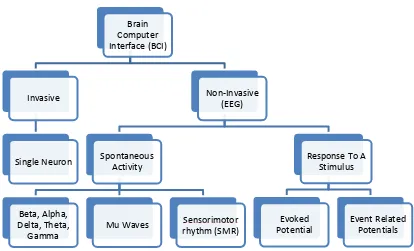
There are two types of BCI system, invasive and non-invasive. Invasive system used to record bioelectric events produced by single neurons, while non-invasive system used to record EEG signals whether it comes from spontaneous activity or evoked potentials. To conclude, the BCI used related to the brain activity pattern can be summarized as Figure 2.1 below.
Figure 2.1: Types of Brain Computer Interface used related to brain activity monitored. Brain Computer Interface (BCI) Invasive Single Neuron Non-Invasive (EEG) Spontaneous Activity Beta, Alpha, Delta, Theta, Gamma
Mu Waves rhythm (SMR) Sensorimotor
Response To A Stimulus
Evoked Potential
[image:18.612.148.562.368.619.2]7
2.2 Brainwave States
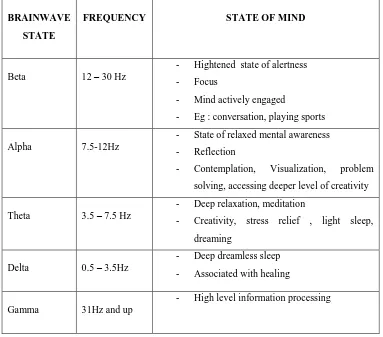
[image:19.612.124.507.261.598.2]There are several brainwave states operate simultaneously at a time with one of the states being dominant [6]. The waves are EEG component which occur spontaneously. Relationship between brainwave states and level of consciousness are represented in Table 3.
Table 2.1: Brainwave state and level of consciousness BRAINWAVE
STATE
FREQUENCY STATE OF MIND
Beta 12 – 30 Hz
- Hightened state of alertness
- Focus
- Mind actively engaged
- Eg : conversation, playing sports
Alpha 7.5-12Hz
- State of relaxed mental awareness
- Reflection
- Contemplation, Visualization, problem
solving, accessing deeper level of creativity
Theta 3.5 – 7.5 Hz
- Deep relaxation, meditation
- Creativity, stress relief , light sleep,
dreaming
Delta 0.5 – 3.5Hz
- Deep dreamless sleep
- Associated with healing
Gamma 31Hz and up
- High level information processing
8 Sensorimotor Rhythm (SMR) can be detected by monitoring the brain activity recorded over the sensorimotor cortex which is modulated by actual movement, motor intention or motor imaginary. These modulations are manifests by decrease in alpha (also known as Mu rhythm) and beta frequency bands accompanied by increase in the gamma frequency band. It is also known as Event-Related Desynchronization (ERD).
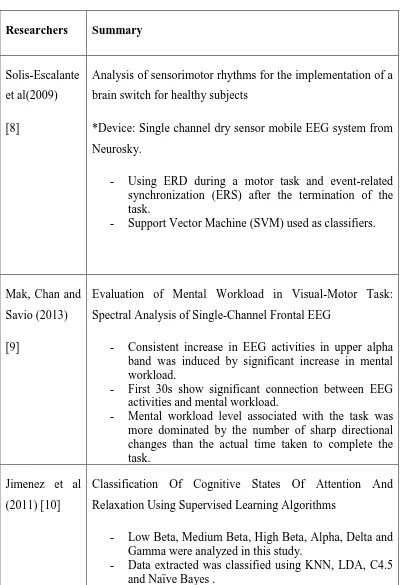
9 Information gathered from these brainwaves make it possible to develop application related to the state of mind as listed out in Table 2.2 below.
Table 2.2: Related work done associate with brainwave state. Researchers Summary
Solis-Escalante et al(2009) [8]
Analysis of sensorimotor rhythms for the implementation of a brain switch for healthy subjects
*Device: Single channel dry sensor mobile EEG system from Neurosky.
- Using ERD during a motor task and event-related synchronization (ERS) after the termination of the task.
- Support Vector Machine (SVM) used as classifiers.
Mak, Chan and Savio (2013) [9]
Evaluation of Mental Workload in Visual-Motor Task: Spectral Analysis of Single-Channel Frontal EEG
- Consistent increase in EEG activities in upper alpha band was induced by significant increase in mental workload.
- First 30s show significant connection between EEG activities and mental workload.
- Mental workload level associated with the task was more dominated by the number of sharp directional changes than the actual time taken to complete the task.
Jimenez et al (2011) [10]
Classification Of Cognitive States Of Attention And Relaxation Using Supervised Learning Algorithms
- Low Beta, Medium Beta, High Beta, Alpha, Delta and Gamma were analyzed in this study.
10
Researchers Summary
Hyunjin et al (2013) [11]
Emotion Recognition Of Serious Game Players Using A Simple Brain Computer Interface
- Using neurosky mindwave to extract delta, theta, alpha, beta and gamma frequency band power as well as attention and meditation levels.
- Accuracy reached 66.04% to classify emotional states (activated, engaged, pleasant and neutral.
Vourvopoulos, A, Liarokapis, F (2011) [12]
Brain-Controlled NXT Robot: Tele-operating a Robot through Brain Electrical Activity
- Use attention and meditation level obtained from Neurosky Mindset to control speed of robot.
- Use Emotiv Epoc Headset to determine direction of robot.
Chin-Teng Lin et al (2010) [13]
A Real-Time Wireless Brain–Computer Interface System for Drowsiness Detection
- Alpha and Theta Rhythms are used to detect drowsiness
2.3 Evoked Potentials (EP) & Event Related Potentials (ERP)
11 pathways [16]. Example of EP testing is Visual Evoked Potentials (VEP) which is effectively used to confirm a diagnosis of multiple sclerosis [17]. To conclude, EP can be considered associated with physical stimulus while ERP involve other aspect such as memory, expectation and attention, among others.
12 Several works done by harnessing EP and ERP is shown in Table 2.3 below.
Table 2.3: Related work done associate with EP and ERP Researchers Summary
Farwell et al (2001) [18]
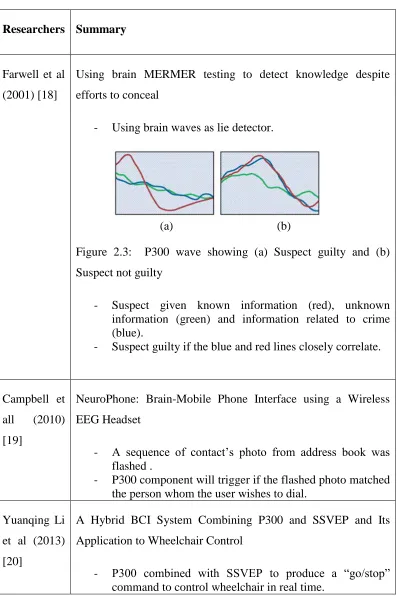
Using brain MERMER testing to detect knowledge despite efforts to conceal
- Using brain waves as lie detector.
(a) (b)
Figure 2.3: P300 wave showing (a) Suspect guilty and (b) Suspect not guilty
- Suspect given known information (red), unknown information (green) and information related to crime (blue).
- Suspect guilty if the blue and red lines closely correlate.
Campbell et all (2010) [19]
NeuroPhone: Brain-Mobile Phone Interface using a Wireless EEG Headset
- A sequence of contact’s photo from address book was flashed .
- P300 component will trigger if the flashed photo matched the person whom the user wishes to dial.
Yuanqing Li et al (2013) [20]
A Hybrid BCI System Combining P300 and SSVEP and Its Application to Wheelchair Control
13 2.4 Signal Acquisition
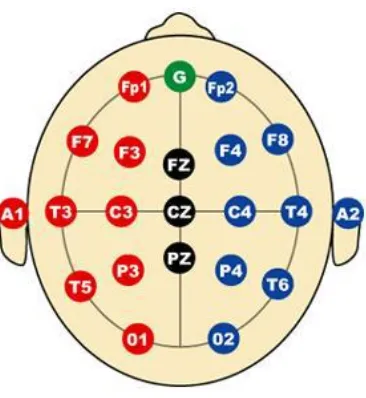
[image:25.612.246.429.219.418.2]The brain activities can be recorded by placing electrodes on the scalp. The electrodes placements for EEG measurement follow International Standard Procedures 10/20 System as shown in Figure 2.4.
Figure 2.4: The standard 10/20 electrode placement system for EEG (McGill, EEG-Introduction)
14 2.5 Data Measurement
EEG band power values from Mindwave Mobile are indications of relative amplitudes of the individual EEG bands. Usually, volt-squared per Hz (𝑉
2
𝐻𝑧) unit is used to indicate
power spectrum band. However, since the value from mindwave mobile have undergone a number of complicated transforms and rescale operations from the original voltage measurements, there is no longer a simple linear correlation to units of Volts.
In their currently output form, they are useful as an indication of whether each particular band is increasing or decreasing over time, and how strong each band is relative to the other bands. EEG power band are displayed in exponential values since it represent a power spectrum, which mean the lower-frequency bands (such as delta and theta) will be exponentially larger values than the higher-frequency bands (alpha and beta)
Beside EEG band power values, raw EEG wave samples can also be obtained from Mindwave Mobile using Mindset Communication Protocol. The output is sampled at 512 Hz, which mean there are 512 data can be plot in one second. The formula for converting raw values to voltage is:
𝑟𝑎𝑤𝑉𝑎𝑙𝑢𝑒×(40961.8 )
2000 (2.1)
This is due to a 2000 times gain, 4096 values range and 18V input voltage.
2.6 EEG Analysis
15
𝑋
𝑘= ∑
𝑁−1𝑥
𝑛𝑛=0
𝑒
−𝑖2𝑘𝜋𝑛
𝑁
, 𝑘 = 0, … , 𝑁 − 1
(2.2)and the inverse of it
𝑥𝑛 =𝑁1∑𝑁−1𝑋𝑘
𝑛=0 𝑒𝑖2𝑘𝜋
𝑛
𝑁 (2.3)
Typically, the fast Fourier Transform (FFT) is used to compute the DFT and its inverse. FFT is an algorithm that can compute the DFT and produce exactly the same result but much faster compared to evaluating the DFT directly. This is the reason why FFT is much more preferred to analyze EEG signals.
2.7 Classification Task
There are several types of classification used in BCI research. One of the common methods is Neural Network. However, although neural network are great at nonlinear problems, EEG wave are generally presumed to be linear [22].
A linear classifier, Support Vector Machine, SVM was chosen for this research as it is the simplest classifier that might work.
For pattern recognition mapping,
𝑋 ⟼ 𝑌, (2.4)
𝑥 ∈ 𝒳 (2.5)
𝑦 = 𝒴 (2.6)
16 For a simplest case, 2 class classification,
𝑥 ∈ ℛ𝑛,𝑦 ∈ {±1}. (2.7)
For training and prediction model, input/output sets 𝒳, 𝒴.
Training set (𝑥1,𝑦1,), … , (𝑥𝑚,𝑦𝑚,) (2.8)
For generalization, given a previously seen 𝑥 ∈ 𝒳, find 𝑦 = 𝒴. In other word, want to
learn classifier: 𝑦 = 𝑓(𝑥, 𝛼), (2.9)
Where 𝛼 are the parameters of the functions. For example, to choose model from the set of hyperplanes in ℛ𝑛, then
𝑓(𝑥, {𝑤, 𝑏}) = 𝑠𝑖𝑔𝑛(𝑤. 𝑥 + 𝑏) (2.10)
2.7.1 Linear Classifiers
A linear classifier has the form
𝑓(𝑥) = 𝑤𝑇𝑥 + 𝑏 (2.11)
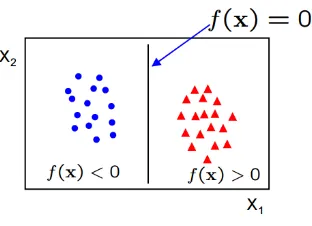
[image:28.612.250.406.520.633.2]In 2D the discriminant is a line as shown in Figure 2.5. w is the normal and known as the weight vector while b is the bias.
Figure 2.5: Linear classifier in 2D
17
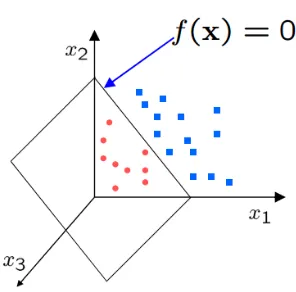
Figure 2.6: Linear classifier in 3D
For a K-NN classifier, it was necessary to `carry’ the training data. For a linear classifier, the training data is used to learn w and then discarded. Only w is needed for classifying new data.
2.7.2 Support Vector Machine
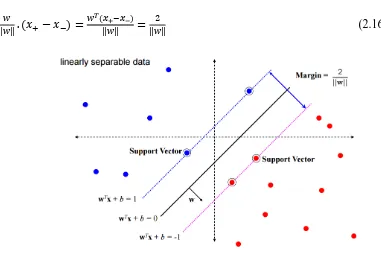
SVM maximize the margin around the separating hyperplane. The decision function is fully specified by a subset of training samples, the support vectors as shown in Figure 2.7.
[image:29.612.162.489.447.673.2]18
𝑤𝑇𝑥 + 𝑏 = 0 (2.12)
𝑐(𝑤𝑇𝑥 + 𝑏) = 0 (2.13)
Since equation 2.12 and 2.13 define the same plane, we have the freedom to choose the normalization of w.
𝑤𝑇𝑥
++ 𝑏 = +1 (2.14)
𝑤𝑇𝑥
−+ 𝑏 = −1 (2.15)
Choose normalization such that the resulting is as shown in equation 2.14 for positive and equation 2.15 for negative support vectors respectively. Then the margin is given by
𝑤
‖𝑤‖. (𝑥+− 𝑥−) =
𝑤𝑇(𝑥+−𝑥−)
‖𝑤‖ =
2
[image:30.612.115.496.352.623.2]‖𝑤‖ (2.16)
Figure 2.8: Margin in SVM
19
CHAPTER 3
METHODOLOGY
3.1 System Overview
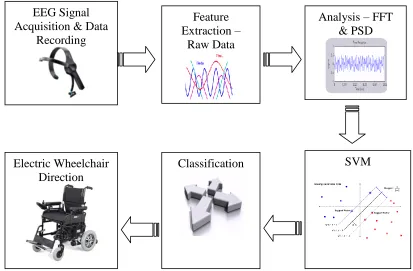
[image:31.612.127.540.393.664.2]Method used in the classification of EEG signals to control wheelchair for severe impairment users is shown in Figure 3.1.
Figure 3.1: Overall diagram showing method used in the classification of EEG signal to control wheelchair for severe impairment users.
EEG Signal Acquisition & Data
Recording
Feature Extraction –
Raw Data
a
Electric Wheelchair Direction
Analysis – FFT & PSD
20 EEG signal acquisition process will be done by using Neurosky Mindwave Mobile (M003). Graphical User Interface is used to collect raw data from the Mindwave Mobile to determine whether the data obtained can be mapped out to classify different direction based on user’s intention. Fast Fourier Transform will be used to obtain the frequency component in time domain signal from raw data. Data obtained (both in frequency domain and power spectrum) will be tested offline in Phyton using SVM. The output will be classified to four directions: forward, backward, left and right based on user’s intention.
3.2 EEG Signal Acquisition
[image:32.612.168.477.427.610.2]The main component of Neurosky Mindwave Mobile as shown in Figure 3.2 consist of EEG electrode which is placed at FP1 in 10/20 International Standard Electrode Placement System, and an ear clip to picks up environment noise generated from the body movement and other electrical devices such as laptop and power outlet. The ear clip functions as a ground and reference in order for the Mindwave Mobile to filter out noise and focus on brainwave.
Figure 3.2: Neurosky Mindwave Mobile.
EEG electrode
Flexible ear arm
Ear Clip/ground electrodes
Adjustable Head Band
21 This device was design to be connected with computer using Bluetooth and able to generate output as listed in Table 3.1 below.
Table 3.1: Neurosky Output Protocol
No Output Description
1 Raw EEG data Returns raw EEG data, sampled at 1HZ
2 Delta Power The ”delta band” of EEG (0.5 - 2.75Hz).
3 Theta Power The ”theta band” of EEG (3.5 - 6.75Hz).
4 Low Alpha Power The ”low alpha” band of EEG (7.5 - 9.25Hz).
5 High Alpha Power The ”high alpha” band of EEG (10 - 11.75Hz).
6 Low Beta Power The ”low beta” band of EEG (13 - 16.75Hz).
7 High Beta Power The ”high beta” band of EEG (18 - 29.75Hz).
8 Low Gamma Power The ”low gamma” band of EEG (31 - 39.75Hz).
22 10 Attention eSense Returns the eSense Attention integer value,
between 0 and 100
11 Meditation eSense Returns the eSense Meditation integer value, between 0 and 100
12 Poor Signal Returns poor signal level, 0 is good signal, 200 is off-head state.
13 Blink Strength Returns an integer value between 0-255, indicating the blink strength.
Only raw data used and processed in this research. An attention value was recorded as benchmark. Data will only be recorded when attention value reach certain level.
3.3 Data Recording
[image:34.612.152.534.65.337.2]23
Table 3.2: Type of Colour used for different direction
Direction Colour Imaginary Task
Forward Cyan Running
Right Green Kicking
Left Black Juggling
Reverse Yellow Singing a song
[image:35.612.115.534.456.673.2]When GUI started, the first thing to check is whether the mindwave is connected or disconnected. It will be only connected if Mindwave Mobile is on. For signal strength, if the status is bad, probably headset is not worn and if poor means the distance might be too far. GUI can only start recording if the signal is good.
Figure 3.3: Settings in the GUI Signal Strength
Mindwave Status
Mindwave Status
24 Figure 3.3 shows setting tab in the GUI. User can set how many cycle the data need to be recorded. If it is set to two cycles or more, the data will be append into existing data with the same name. After few times of testing, it is decided that only one cycle for each recording will be done because the recording process itself need a lot of concentration and tiring. Interval can be set based on output of ‘Power Band’ (Delta, Theta, etc) because it gives one output every one second. Literally, if it set to 10, the data will be recorded approximately for 10 seconds. The last one is attention threshold. The value is set to15, means that data will start recording when subject’s attention level reach 15% or more.
Figure 3.4: Flowchart for data recording. No Yes
Yes No
No
Yes Start
Established connection, check status
Start button enabled & clicked
Connected & Signal Good?
Attention values ≥ 15?
Start counting down for 3 seconds
Display instruction & start recording for 10 seconds
All set of direction has been recorded?
End Yes
Yes
63
REFERENCES
[1] R.A, B. (2002). Computer Input Device Selection Methodology for Users with High-level Spinal Cord Injuries. The 1st Cambridge Workshop on Universal
Access and Assistive Technology
[2] Simpson R. C., Lo Presti E. F., Cooper R. A. (2008) How Many People Would Benefit from a Smart Wheelchair? Journal of Rehabilitation Research and Development. 45(1): pp 53–72.
[3] Linda Fehr, W. Edwin Langbein, Steven B Skaar (2000), Adequacy of power Wheelchair Control Interfaces for Persons with Severe Disabilities: A clinical survey, Journal of Rehabilitation Research and Development, 37 (3). pp 353-360
[4] Md Razali Tomari (2013), Enhancing Wheelchair Manoeuvrability for Severe Impairment Users, International Journal Advanced Robotic System, 10 (92). [5] Malmivuo, J. & Plonsey,R (1995). Bioelectromagnetism- Principles &
Applications of Bioelectric and Biomagnetic Fields. New York: Oxford
University Press. Retrieved December 14, 2014 from http://www.bem.fi/book/13/13.htm
[6] Immara Institute. Brainwave States. Retrieved December 12, 2014, from http://immrama.org/brainwave-technology-for-health-wellness/brainwave-states-alpha-theta-delta-beta-gamma/
[7] Bernier, R., Dawson, G., Webb, S., & Murias, M. (2007, August). EEG Mu Rhythm and Imitation Impairments In Individuals With Autism Spectrum
Disorder. Brain and Cognition, 64(3), 228–37.
[8] Teodoro Solis-Escalante *, Gernot Mu¨ller-Putz, Clemens Brunner, Vera Kaiser, Gert Pfurtscheller (2009). Analysis of sensorimotor rhythms for the implementation of a brain switch for healthy subjects. Biomedical Signal &
64 [9] Joseph N. Mak, Rosa H. M. Chan, Savio W. H. Wong (2013). Evaluation of Mental Workload in Visual-Motor Task: Spectral Analysis of Single-Channel
Frontal EEG. Industrial Electronics Society, IECON 2013 - 39th Annual Conference of the IEEE , pp.8426-8430, 10-13 Nov. 2013
[10] Jimenez, C.O.S., Mesa, H.G.A., Rebolledo-Mendez. G. de Freitas, S., "Classification of cognitive states of attention and relaxation using supervised learning algorithms," Games Innovation Conference (IGIC), 2011 IEEE International, pp.31-34.
[11] Hyunjin Yoon; Sang-wook Park; Yong-Kwi Lee; Jong-Hyun Jang. Emotion recognition of serious game players using a simple brain computer interface.
ICT Convergence (ICTC). 2013 International Conference on. 14-16 Oct. 2013. IEEE. pp.783-786.
[12] Vourvopoulos, A. , Liarokapis, F., "Brain-Controlled NXT Robot: Tele-operating a Robot through Brain Electrical Activity," Games and Virtual Worlds for
Serious Applications (VS-GAMES), 2011 Third International Conference , pp.140-143, 4-6 May 2011.
[13] Chin-Teng Lin, Che-Jui Chang, Bor-Shyh Lin, Shao-Hang Hung, Chih-Feng Chao, and I-Jan Wang, “A Real-Time Wireless Brain–Computer Interface System for Drowsiness Detection,” IEEE Trans. on Biomedical Circuit and system, pp. 214 – 222, 2010.
[14] Luck, Steven J. (2005). An Introduction to the Event-Related Potential Technique. The MIT Press.
[15] Polich, J. (2007). Updating P300: An integrative theory of P3a and P3b. Clinical Neurophysiology, 118(10), 2128-2148.
[16] MS (National Multiple Sclerosis). Evoked Potentials (EP). Retrieved December 14, 2014 from http://www.nationalmssociety.org/Symptoms-Diagnosis/Diagnosing-Tools/Evoked-Potentials
[17] Reinhold Scherer, Josef Faller, David Balderas, Elisabeth V. C. Friedrich, Markus Proll, Brendan Allison, and Gernot Muller-Putz (Feb 2013). Brain-Computer interfacing: more than the sum of its parts. Soft Computing, 17(2):317–331.
65 [19] Andrew T. Campbell, Tanzeem Choudhury, Shaohan Hu, Hong Lu, Matthew K. Mukerjee!, Mashfiqui Rabbi, and Rajeev D. S. Raizada (2010). NeuroPhone: Brain-Mobile Phone Interface using a Wireless EEG Headset, In Proceedings of
the second ACM SIGCOMM workshop on Networking, systems, and applications on mobile handhelds (MobiHeld '10). ACM, New York, NY, USA, pp 3-8.
[20] Yuanqing Li, Jiahui Pan, Fei Wang, Zhuliang Yu, "A Hybrid BCI System
Combining P300 and SSVEP and Its Application to Wheelchair
Control," Biomedical Engineering, IEEE Transactions. Vol 60, no.11,
pp.3156-3166, Nov. 2013
[21] Lotte, F., Congedo, M., L´ecuyer, a., Lamarche, F., & Arnaldi, B. (2007, June). “A review of classification algorithms for EEG-based brain-computer
interfaces”. Journal of neural engineering, 4(2),Available from
http://www.ncbi.nlm.nih.gov/pubmed/17409472
[22] Klaus-Robert Müller, C. W. (June, 2003). Linear and Nonlinear Methods for Brain–Computer Interfaces. “ IEEE Transaction On Neural Systems and Rehabilitation Engineering”, 165-169.
[23] Jagdish Tripathy, F. K. (2006). “Influence of Colour Hue on Fractal EEG Dimensions”. International Conference on Biomedical and Pharmaceutical Engineering.
[24] Cooley, J. W., & Tukey, J. W. (1965). An algorithm for the machine calculation of complex Fourier series. American Mathematical Society , pp. 297-301.
[25] Discrete Fourier Tranform (numpy.fft). (02 November, 2014). Retrieved 10 June,
2015, from SciPy.org:
http://docs.scipy.org/doc/numpy/reference/routines.fft.html#module-numpy.fft [26] Ball, T. K. (2009). Signal quality of simultaneously recorded invasive and
non-invasive eeg. Neuroimage , 3, pp. 708-716
66 [28] Pedregosa, F. e. (2011). Scikit-learn: Machine Learning in Python. Journal of
Machine Learning Research (12), 2825-2830.
[29] Merril, N. (15 May, 2014). Classifying EEG Data With Machine Learning. Retrieved 8 June, 2015, from UC Berkeley School of Information: http://people.ischool.berkeley.edu/~nick/svm-tut.html
![Figure 2.3: P300 wave occur approximately 300ms after given stimulus [17].](https://thumb-us.123doks.com/thumbv2/123dok_us/8764526.895700/23.612.230.444.164.326/figure-p-wave-occur-approximately-ms-given-stimulus.webp)