COMPARISON STUDY OF SORTING TECHNIQUES
IN STATIC DATA STRUCTURE
ANWAR NASER FRAK
COMPARISON STUDY ON SORTING TECHNIQUES IN STATIC DATA STRUCTURE
ANWAR NASER FRAK
A dissertation submitted in partial fulfilment of the requirement for the award of the Degree of Master of
Computer Science (Software Engineering)
Faculty of Computer Science and Information Technology Universiti Tun Hussein Onn Malaysia
DEDICATION
To my beloved father and mother
This dissertation is dedicated to my father, who taught me that the best kind of knowledge to have is that which is learned for its own sake. It is also dedicated to my beloved mother, who taught me that even the largest task can be accomplished if it is done one step at a time.
ACKNOWLEDGMENT
First and foremost, I would like to thank the almighty God (ALLAH S.W.T) for all the abilities and opportunities He provided me through all my life and His blessings that enables me to do this research.
It is the greatest honor to be able to work under supervision of Dr. Mohd Zainuri Bin Saringat. I am grateful to be one of the luckiest persons who had a chance to work with him. I am thankful and gratified for all of his help, assistance, inspiration and guidance on the all aspects beside his patience and understanding
ABSTRACT
ABSTRAK
TABLE OF CONTENTS
TITLE i
DECLARATION ii
DEDICATION iii
ACKNOWLEDGMENT iv
ABSTRACT v
ABSTRAK vi
TABLE OF CONTENTS vii
LIST OF FIGURES xii
LIST OF TABLES xiv
LIST OF APPENDICES xvii
CHAPTER 1 INTRODUCTION 1
1. 1 Background of Study 1
1.2 Motivation 2
1.3 Research Objectives 3
1.4 Research Scope 3
1.5 Thesis Outline 3
CHAPTER 2 LITERATURE REVIEW 4
2.1 Overview 4
2.2 Data Structures 4
2.3 Static Array data structures 5 2.3.1 Advantages of using Array 6 2.3.2 Disadvantages of using Array 6
2.4 Execution time 6
2.5 Running Time Analysis 7
2.6 Time complexity 7
2.6.1 Worst-Case analysis 8
2.6.3 Average Case analysis 8
2.7 Big-O Notation 9
2.8 Sorting 10
2.8.1 Quicksort 10
2.8.2 Selection sort 11
2.8.3 Insertion sort 11
2.8.4 Bubble sort 12
2.8. 5 Merge sort 12
2.9 Simple Linear Regression 12
2.10 Related work 14
2.11 Summary 16
CHAPTER 3 RESEARCH METHODOLOGY 17
3.1 Overview 17
3.2 Proposed Framework 17
3.3 Phase 1: Implementing the Sorting Techniques 20
3.4 Phase 2:Calculating the Complexity of Sorting Techniques 20
3.5 Phase 3: Comparative Analysis 20
3.6 Summary 21
CHAPTER 4 IMPLEMENTATION AND ANALYSIS 22
4.1 Overview 22
4.2 Implementations of Sorting Technique 22
4.2.1 Description of Test Data Sets 23
4.2.2 Create and Open File 23
4.2.3 Insert data file into array 24
4.2.4 The implementatio Menu 25
4.3 Calculating the Complexity of Sorting Algorithms 27
4.3.1 Complexity of bubble sort techniqu 27
4.3.2 Complexity of insertion sort technique 28
4.3.3 Complexity of selection sort technique 29
4.3.4 Complexity of merge sort technique 30
4.4 The Results of Efficiency Measurements Four Group Data 33 4.4.1 The Execution Time Results of Bubble Sort
Technique 33 4.4.1.1 The Execution Time Results of
Bubble Sort Group 1 (100 -1,000) 34 4.4.1.2 The Execution Time Results of Bubble
Sort Group 2 (2,000-10,000) 36 4.4.1.3 The Execution Time Results of
Bubble Sort Group 3 (11000-20000) 38 4.4.1.4 The Execution Time Results of
Bubble Sort Group 4 (21,000-30,000) 40 4.4.2 The Execution Time Results of Insertion
Sort Technique 42 4.4.2.1 The Execution Time Results of
Insertion Sort Group 1 (100-1,000) 42 4.4.2.2 The Execution Time Results of Insertion
Sort Group 2 (2,000-10,000) 44 4.4.2.3 The Execution Time Results of Insertion
Sort Group 3 (11,000-20,000) 46 4.4.2.4 The Execution Time Results of Insertion
Sort Group 4 (21,000-30,000) 48 4.4.3 The Execution Time Results of Selection
Sort Technique 50 4.4.3.1 The Execution Time Results of Selection
Sort Group 1 (100-1,000) 50 4.4.3.2 The Execution Time Results of Selection
Sort Group 2 (2,000-10,000) 52 4.4.3.3 The Execution Time Results of Selection
Sort Group 3 (11,000-20,000) 54 4.4.3.4 The Execution Time Results for Selection
Sort Group 4 (21,000-30,000) 56 4.4.4 The Execution Time Results of Merge Sort
4.4.4.1 The Result of Execution Time for Merge
Sort Group 1 (100-1,000) 58
4.4.4.2 The Execution Time Results for Merge Sort Group 2 (2,000-10,000) 60
4.4.4.3 The Execution Time Results of Merge Sort Group 3 (11,000-20,000) 62
4.4.4.4 The Execution Time of Merge Sort Group 4 (21,000-30,000) 64
4.4.5 The Execution Time Results of Quick Sort Technique 66
4.4.5.1 The Execution Time Results of Quick Sort Group 1 (100-1,000) 66
4.4.5.2 The Execution Time Results of Quick Sort Group 2 (2000-10000) 68
4.4.5.3 The Execution Time Results of Quick Sort Group 3 (11,000-20,000) 70
4.4.5.4 The Execution Time Results of Quick Sort Group 4 (21000-30000) 72
4. 5 Comparative Analysis 74
4.6 Summary 82
CHAPTER 5 CONCLUSION 83
5.1 Introduction 83
5.2 Achievements of Objectives 83
5.2.1 Implementation of Five Sorting Techniques 84
5.2.2 Calculation of Complexity 84
5.2.3 Comparative Analysis of Results Based on Efficiency 84
5.3 Contribution 85
5.4 Summary and Future Work 86
REFERENCES 87
LIST OF FIGURES
2.1 Big O Notation Graph 9
3.1 The Four Phases of the Study 18
3.2 Research Framework 19
4.1 The Menu of Implementation 26
4.20 The Experimental Result of Quick Sort of Group 3 70
4.21 The Experimental result of Quick sort of Group 4 72
4.22 The Compared of estimated value of Sorting Group1 75
4.23 The Comparison of estimated value of sorting Group2 76
4.24 The Compared of estimated value of sorting Group3 77
4.25 The Comparison of estimated value of sorting Group 4 77
4.26 The Comparison of average estimated value of five sorting Techniques 78
4.27 Comparison of the average of ratio between sorting 80
LIST OF TABLES
2.1 Time Complexity Algorithm 8
2.2 work related 15
4.1 Data set groups 23
4.2 Create and open file complexity 24
4.3 Complexity Insert file data to array 25
4.4 Bubble Sort Complexity 28
4.5 Insertion Sort Complexity 29
4.6 Selection Sort Complexity 30
4.7 Merge Sort Complexity 31
4.8 Quick Sort Complexity 32
4.9 The Experimental Result Of Execution Time of Bubble
Sort For Data Set Group 1 (100-1000) 35
4.10 The Experimental Result Of Execution Time of Bubble
Sort For Data Set Group2 (2000-10000) 37 4.11 The Experimental Result Of Execution Time of Bubble
Sort For Data Set Group 3 (11000-20000) 39
4.12 The Experimental Result Of Execution Time of Bubble
Sort For Data Set Group 4 (21000-30000) 41
4.13 The Experimental Result Of Execution Time of Insertion
4.14 The Experimental Result Of Execution Time of Insertion
Sort For Data Set Group 2 (2000-10000) 45
4.15 The Experimental Result Of Execution Time of
Insertion Sort For Data Set Group 3 (11000-20000) 47 4.16 The Experimental Result Of Execution Time of
Insertion Sort For Data Set Group 4 (21000-30000) 49 4.17 The Experimental Result Of Execution Time of
Selection Sort For Data Set Group 1 (100-1000) 51 4.18 The Experimental Result Of Execution Time of
Selection Sort For Data Set Group 2 (2000-10000( 53 4.19 The Experimental Result Of Execution Time of
Selection Sort For Data Set Group 3 (11000-20000) 55 4.20 The Experimental Result Of Execution Time of
Selection Sort For Data Set Group 4 (21000-30000) 57 4.21 The Experimental Result Of Execution Time of Merge
Sort For Data Set Group1 (100-1000( 59
4.22 The Experimental Result Of Execution Time of Merge
Sort For Data Set Group 2 (2000-10000) 61
4.23 The Experimental Result Of Execution Time of Merge
Sort For Data Set Group 3 (11000-20000( 63
4.24 The Experimental Result Of Execution Time of Merge
Sort For Data Set Group4 (21000-30000) 75
4.25 The Experimental Result Of Execution Time of Quick
Sort For Data Set Group1 (100-1000) 67 4.26 The The Experimental Result Of Execution Time of
Quick Sort For Data Set group2 (2000-10000) 69 4.27 The Experimental Result Of Execution Time of Quick
4.28 The Experimental Result Of Execution Time of Quick
Sort For Data Set Group4(21000-30000) 73 4.29 The Comparative Analysis of Four Groups Based on
Estimated Value 74
4.30 Comparison of the Ratio of the Variation Between the
Speed of the Five Techniques 79 4.31 The Comparative Analysis Between Group 1,Group 2,
Group 3,Group 4 of Data Set 80
LIST OF APPENDICES
APPENDIX TITLE PAGE
A Create file 90
B Implementation sorting techniques 95
CHAPTER 1
INTRODUCTION
1. 1 Background of Study
Data structure is one of the most important techniques for organizing large data. It is considered as a method to systematically manage data in a computer that leads towards efficiently implementing different data types to make it suitable for various applications (Chhajed et al., 2013). In addition, data structure is considered as a key and essential factor when designing effective and efficient algorithms (Okun et al., 2011; Black, 2009). There are various studies that demonstrate the importance of data structures in software design (Yang et al., 2011; Andres et al., 2010).
So far, several researchers have focused on how to inscribe and improve the
algorithm and ignoring data structures, while the data structures significantly affect the performance and the efficiency of the algorithm (Al-Kharabsheh et al., 2013). Sorting is one of the basic function of computer processes which has been widely used on database systems. A sorting algorithm is the arrangement of data elements in some order either in ascending or descending order. The algorithm can also be helpful to group the data on the basis of a certain requirement such as Postal code or in the classification of data into certain age groups. Thus, sorting is a rearrangement of items in a requested list dedicated in order to produce solution for a desired result. A number of sorting
algorithms have been developed such as Quick sort, Merge sort, Insertion sort and Selection sort (Andres et al., 2010).
different mechanism to reorder elements which increase the performance and efficiency of the practical applications and reduce the time complexity of each one. It is worth noting that when various sorting algorithms are being compared, there are afew parameters that must be taken into consideration, such as complexity, and
execution time. The complexity is determined by the time taken for executing the algorithm (Goodrich, Tamassia & Mount, 2007). In general, the time complexity of an algorithm is generally written in the form of Big O(n) notation, where O represents the complexity of the algorithm and the value n represents the number of elementary operations performed by the algorithm (Jadoon et al., 2011).
Hence, this study investigates the efficiency of five sorting techniques, namely Selection sort, Insertion sort, Bubble sort, Quick sort, Merge sort and their behaviour on small and large data set. To accomplish these major tasks, proposed methodology comprises of three phases are introduced implementation of sorting technique, calculation of their complexity and comparative analysis. Each phase contains different steps and delivers useful results to be used in the next phase. After that, performance of these five sorting techniques were evaluated by three performance measures which are time complexity, execution time (run time) and size of dataset used.
1.2 Motivation
Selection sort, Merge sort and Quick sort using static array data structure and to compare and analyse the results based on their runtime and complexity.
1.3 Research Objectives
Based on the research background, the three objectives of this research are as follows:
i. implement five sorting techniques, namely Bubble sort, Insertion sort, Selection sort, Merge sort and Quick sort using static array data structure ii. calculate the complexity of the implemented sorting techniques as in (i) iii. compare and analyse result on the time taken and efficiency for the five
sorting techniques based on the algorithms’ complexity.
1.4 Research Scope
This thesis focuses only on testing the effectiveness of five different sorting techniques, namely Bubble sort, Insertion sort, Selection sort, Merge sort and Quick on four groups of datasets with various data sizes which are 100 to 1,000 (Group 1), 2,000 to 10,000 (Group 2), 11,000 to 20,000 (Group 3) and 21,000 to 30,000 (Group 4). The performance of these five sorting techniques is evaluated by three performance measures which are time complexity, execution time (run time) and size of datasets.
1.5 Thesis Outline
CHAPTER 2
LITERATURE REVIEW
2.1 Overview
The overall goal of this chapter is to establish the significance of the general field of study. First, an overview of data structures with its main activities are presented and followed by the description of sorting techniques. It also covers some evaluation measures such as execution time, algorithm complexity and the use of Least Squares Regression for finding estimation values among various groups and ends with a summary of the chapter.
2.2 Data Structures
Data structure is a systematic organization of information and data to enable it to be used effectively and efficiently especially when managing large data. Data structures can also be used to determine the complexity of operations and considered a way to manage large amounts of data such as the index of internet and large corporate databases )Chhajed et al., 2013). According to Okun et al. (2011), an effective and efficient algorithm is required when designing highly efficient data structures. In the realm of software design, there are several studies that have attested the importance of data structures (Yang et al., 2011; Andres et al., 2010; Okun et al., 2011).
presenting a memory address. Thus, the data structures are based on computing the addresses of data items with arithmetic operations, (Okun, et at., 2011).
Furthermore, there are two types of data structures which are static data structure such as array and dynamic data structure such as linked list. Static data structure has a fixed size and the elements of static data structures have fixed locations. But in dynamic data structures, the elements are added dynamically. Therefore, the locations of elements are dynamic and determined at runtime (Yang et al., 2011).
2.3 Static Array Data Structures
An array is the arrangement of data in the form of rows and columns that is used to represent different elements through a single name but different indicators, thus, it can be accessed by any element through the index (Andres et al., 2010). Arrays are useful in supplying an orderly structure which allows users to store large amounts of data efficiently. For example, the content of an array may be changed during runtime whereas the internal structure and the number of the elements are fixed and stable (Yang et al., 2011).
An array could be called fixed array because they are not changed structurally after they are created. This means that the user cannot add or delete to its memory locations (making the array having less or more cells), but can modify the data it contains because it is not change structurally. Andres et al., (2010) illustrated that there are three ways in which the elements of an array can be indexed.
i. zero-based index. It is the first element of the array which is indexed by subscript 0.
ii. one-based indexing. It is the first element of the array which is indexed by the subscript 1.
2.3.1 Advantages of using Array
Each data structure has the weakness points and strength points. Listed below are advantages of array as mentioned by Andres et al. (2010):
i. arrays allow faster access to any item by using the index. ii. arrays are simple to understand and use.
iii. arrays are very useful when working with sequences of the same type of data. iv. arrays can be used to represent multiple data items of same type by using
only single name but different indexes.
2.3.2 Disadvantages of using Array
Even though arrays are very useful data structures, however, there are some disadvantages as mentioned by Andres et al. (2010) which are listed below:
i. array items are stored in neighbouring memory locations, sometimes there may not be enough memory locations available in the neighbourhood.
ii. the elements of array are stored in consecutive memory locations. Therefore, operations like add, delete and swap can be very difficult and time consuming.
2.4 Execution Time
Execution time is the time taken to hold processes during the running of a program. The speed of the implementation of any program depends on the complexity of a technique or algorithm. If the complexity is low, then the implementation is faster, whereas when the complexity is high then the implementation is slow (Puschner & Koza, 1989). Keller (2000) argues that the execution time is the time for a program to process a given input. Keller believes that time is one of the important computer resources for two reasons: the time spent for the solution and the time spent for program implementation and for providing services.
2.5 Running Time Analysis
Running time is a theoretical process to calculate the approximate running time of a technique. For example, a program can take seconds or hours to complete an execution, depending on a particular technique used to lead the program (Bharadwaj & Mishra, 2013). Moreover, the runtime of a program describes the number of operations it executes during implementation and also the execution time of a technique. Furthermore, it should look forward to the worst case, an average case and best case performance of the technique. These definitions support the understanding of techniques complexity as mentioned by Bharadwaj & Mishra (2013).
2.6 Time Complexity
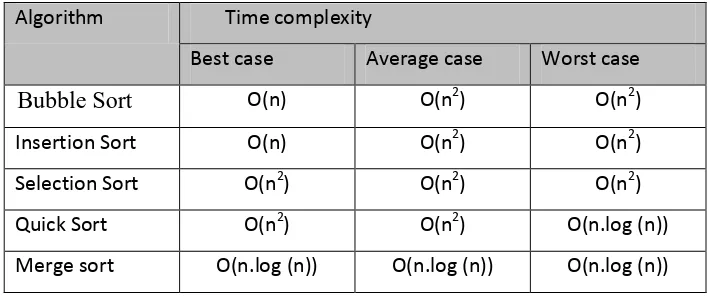
According to Estakhr (2013), the time complexity of an algorithm quantifies the amount of time taken by an algorithm to run as a function with the length of a string representing the input. The time complexity of an algorithm is commonly expressed using Big(O) notation, which excludes coefficients and lower order terms. When expressed this way, the time complexity is said to be described asymptotically as the input size goes to infinity. The time complexity is commonly estimated by counting the number of elementary operations performed by the algorithm, where an elementary operation takes a fixed amount of time to perform. Thus, the amount of time taken and the number of elementary operations performed by the algorithm differ by at most a constant factor (Michael, 2006).
Table 2.1 :Time Complexity of Sorting Algorithms
Algorithm Time complexity
Best case Average case Worst case
Bubble Sort O(n) O(n2) O(n2)
Insertion Sort O(n) O(n2) O(n2)
Selection Sort O(n2) O(n2) O(n2)
Quick Sort O(n2) O(n2) O(n.log (n))
Merge sort O(n.log (n)) O(n.log (n)) O(n.log (n))
2.6.1 Worst-Case Analysis
The worst case analysis anticipates the greatest amount of running time that an algorithm needed to solve a problem for any input of size n. The worst case running time of an algorithm gives us an upper bound on the computational complexity and also guarantees that the performance of an algorithm will not get worse (Szirmay & Márton, 1998).
2.6.2 Best-Case Analysis
The best case analysis expects the least running time the algorithm needed to solve a problem for any input of size n. The running time of an algorithm gives a lower bound on the computational complexity. Most of the analysts do not consider the best case performance of an algorithm because it is not useful (Szirmay & Márton, 1998).
2.6.3 Average Case Analysis
all potential sets of input data. The average case analysis is much more difficult to carry out, requiring tedious process and typically requires considerable mathematical refinement that causes worst case analysis to become more prevalent (Papadimitriou, 2003).
2.7 Big-O Notation
Big-O notation is used to characterize upper bound of a function that states the maximum value of resources needed by an algorithm to do the execution (Knuth, 1976). According to Black (2007), Big(O) notation has two major fields of application namely mathematics and computer science. In mathematics, it is usually used to show how closely a finite series approximates a given function. In computer science, it is useful in the analysis of algorithms. There are two usages of Big (O) notation which are infinite asymptotic and infinitesimal asymptotic. This singularity is only in the application and not in precept; however, the formal definition for the Big(O) is the same for both cases, only with different limits for the function evidence.
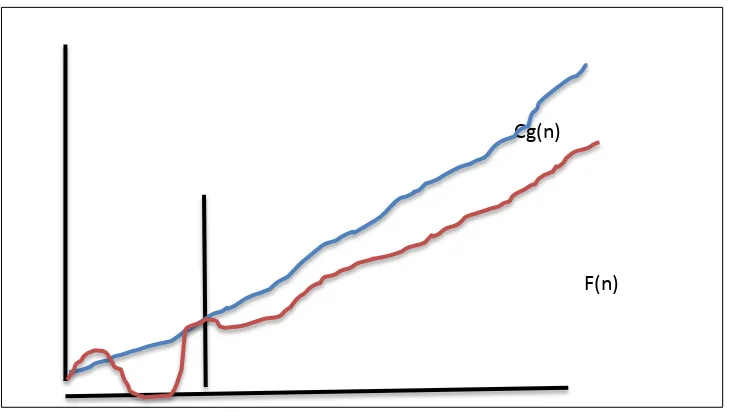
Let f(n) and g(n) be functions that map positive integers to positive real numbers. Say that f(n) is O(g(n)) (or if (n) ∈ O (g (n))) if there exists a real constant c > 0 and there be an integer constant n0 ≥1 such that f (n) ≤ c. g (n) for every
[image:25.595.131.503.516.722.2]integer n ≥ n0 as shown in Figure 2.1.
Figure 2.1: Big O Notation Graph.
Cg(n)
2.8 Sorting
Sorting is the process of rearranging the set of elements which can be sorted alphabetically, descending or increasing order; or based on a certain attribute such as city population, area, or zip code (Coxon, 1999).
According to Horan & Wheeless (1977), there are many sorting algorithms that have been developed and analysed throughout the literature. This indicates that sorting is an important area of study in computer science. Sorting a large number of items can take a substantial amount of computing resources. The efficiency of a sorting algorithm is based on the number of items being processed. For small collections, a complex sorting method may not be as useful compared to a simpler sorting method. This section discusses sorting techniques and compares them with respect to their running time. Sorting algorithm is one of the most basic research areas in computer science. The aim is to make data easier to be updated. Sort is a significant process in computer programming. It can be used to sort sequence of data by an ordering procedure using a type of keyword. The sorted sequence is most helpful for later updating activities such as search, insert and delete.
2.8.1 Quick Sort
Pooja (2013) stated that quick sort is the fastest internal sorting algorithm among other developed algorithms. Unlike merge sort, quick sort needs less memory space for sorting an array. Therefore, it is vastly used in most real time applications with large data sets. Quick sort uses divide and conquer method for solving problems. It works by partitioning an array into two parts, then sorting the parts independently. It finds the elements called pivot which divides the array into halves in such a way that elements in the left half are smaller than the pivot, and elements in the right half are greater than pivot.
selecting the leftmost or rightmost element as a pivot causes the worst-case running time of O (nlogn) when the array is already sorted.
2.8.2 Selection Sort
Selection sort is notable for its programming simplicity and in certain situation can over perform other sorting algorithms. It works by finding the smallest or highest element from the unsorted list and swaps with the first element in the sorted list and then finds the next smallest element from the unsorted list then swap with the second element in the sorted list. The algorithm continues this operation until the list being sorted (Bharadwaj & Mishra, 2013). Selection sort requires a constant amount of memory space with only the data swaps within the allocated spaces. However, like some other simple sorting methods, Selection sort is also inefficient for large datasets or arrays (Bharadwaj & Mishra, 2013). Al-Kharabsheh, et at. (2013) stated that Selection sort has O(n2) time complexity, making it inefficient on large lists and performs worse than the similar Insertion sort but better than Bubble sort.
2.8.3 Insertion Sort
2.8.4 Bubble Sort
Bubble sort is a simple and the slowest sorting algorithm which works by comparing each element in the list with progress elements and swapping them if they are in undesirable order. The algorithm continues this operation until it makes a pass right through the list without swapping any elements, which shows that the list is sorted. This process takes a lot of time and especially slow when the algorithm works with a large data size. Therefore, it is considered to be the most inefficient sorting algorithm with large dataset (Astrachan, 2003).
According to Batcher (1968), Bubble sort has a complexity of O(n2), where n indicates the number of elements to be sorted. However, although other simple sorting algorithms such as Insertion sort and Selection sort have the same worst case complexity of O(n2), the efficiency of Bubble sort is relatively lesser than other algorithms.
2.8. 5 Merge Sort
According to Mehlhorn (2013), Merge sort has a complexity of O(n log n). The O(n log n) worst case upper bound on merge sort stems from the fact that merge is O(n). The application of the Merge sort produces a stable sort, which means that the applied preserves the input order of equal elements in the sorted output. Merge sort, invented by Von Neumann and Morgenstern (1945) works by divide and conquer method and it is based on the division of the array into two halves at each stage and then goes to a compare stage which finally merges these parts into one single array. This is also a comparison-based sorting algorithms such as Bubble sort, Selection sort and Insertion sort. In this method, the array is divided into two halves. Then recursively sort these two parts and merge them into a single array. When working with small array, Merge sort is not a good choice as it requires an additional temporary array to store the merged elements with O (n) space.
2.9 Simple Linear Regression
Regression analysis is a statistical function used to find the estimated value
special preparations analysed to determine the relationship between the dependent variable and independent variable (Armstrong, 2012).
It is a least square estimator of a linear regression model with a single explanatory variable. In other words, it is a simple straight line which passes through a series of dots that make total residuum any distance between the real point and the estimated point.
In general, the regression model provides estimated value of conditional expectation of the dependent variable given the independent variables. The goal of estimation value is called the regression function. In regression analysis, it is also motivating to describe the variation of the dependent variable around the regression function which can be described by a probability distribution. Regression analysis used to predict or find a relationship between the independent variable and dependent variable moreover, its impact on the dependent variable. Thus regression analysis finds a causal relationship between the variables. The linear regression equations are as mentioned by Waegeman et al. (2008):
Y = a + b * X (1) Where
Y : is the dependent variable X : is the independent variable a : is the constant (or intercept) b: is the slope of the regression line
The equation of squares regression is
SR = { ( 1 / N ) * Σ [ (xi - x) * (yi - y) ] / (σx * σy ) }2 (2) σx = sqrt [ Σ ( xi - x )2 / N ]
σy = sqrt [ Σ ( yi - y )2 / N ]
Where
N: is the number of observations used to fit the model. Σ: is the summation symbol
Xi: is the x value of observation i Yi: is the y value of observation i Y: is the mean y value
σy: is the standard deviation of y
In mathematics, a ratio is a relationship between two numbers indicating how many times the first number contains the second. The equation of ratio according to Ching (1996): 2 technique value estimation 1 technique value estimation Speed (3)
2.19 Related Work
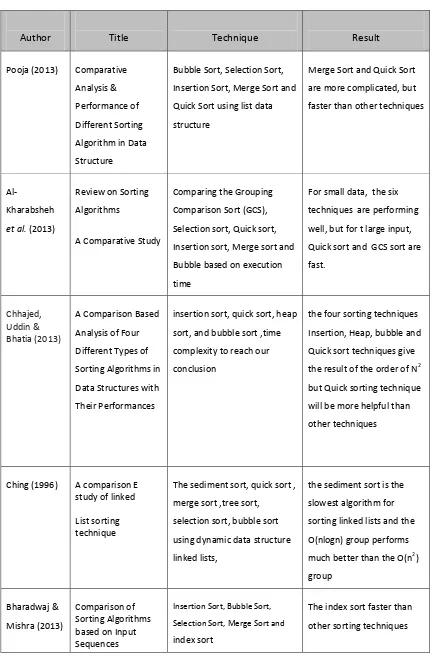
A considerable amount of literature has been published on sorting techniques. While looking into large and growing body of literature, it is appeared that sorting techniques have been proven to be successful for data structures. Thus, the data structures have an impact on the efficiency of these sorting techniques (Ching, 1969). Al-Kharabsheh et al. (2013) discussed and reviewed the performance of sorting techniques where comparison of the algorithms were based on the time of implementation. It was found that for small data, the six techniques perform well, but for large input data, only Quick sort and GCS sort are considered fast. Pooja (2013) examined several sorting algorithms and discussed the performance analysis of these sorting algorithms based on their complexity while testing them with list data structure. It was found that the merge sort and quick sort have high complexity but faster in large lists.
Table 2.2: Summary of some Selected Studies on Sorting Algorithms.
Author Title Technique Result
Pooja (2013) Comparative
Analysis &
Performance of
Different Sorting
Algorithm in Data
Structure
Bubble Sort, Selection Sort,
Insertion Sort, Merge Sort and
Quick Sort using list data
structure
Merge Sort and Quick Sort
are more complicated, but
faster than other techniques
Al-Kharabsheh
et al. (2013)
Review on Sorting
Algorithms
A Comparative Study
Comparing the Grouping
Comparison Sort (GCS),
Selection sort, Quick sort,
Insertion sort, Merge sort and
Bubble based on execution
time
For small data, the six
techniques are performing
well, but for t large input,
Quick sort and GCS sort are
fast.
Chhajed, Uddin & Bhatia (2013)
A Comparison Based
Analysis of Four
Different Types of
Sorting Algorithms in
Data Structures with
Their Performances
insertion sort, quick sort, heap
sort, and bubble sort ,time
complexity to reach our
conclusion
the four sorting techniques
Insertion, Heap, bubble and
Quick sort techniques give
the result of the order of N2
but Quick sorting technique
will be more helpful than
other techniques
Ching (1996) A comparison E study of linked
List sorting technique
The sediment sort, quick sort ,
merge sort ,tree sort,
selection sort, bubble sort
using dynamic data structure
linked lists,
the sediment sort is the
slowest algorithm for
sorting linked lists and the
O(nlogn) group performs
much better than the O(n2)
group
Bharadwaj &
Mishra (2013)
Comparison of Sorting Algorithms based on Input Sequences
Insertion Sort, Bubble Sort,
Selection Sort, Merge Sort and
index sort
The index sort faster than
2.11 Summary
CHAPTER 3
RESEARCH METHODOLOGY
3.1 Overview
This chapter discusses the methodology of this project. Firstly, it presents the preliminary stage of this research by introducing the proposed framework. This research focuses on five sorting techniques and applying them to static array data structure which consists of four groups of data sets. Then, the research activities and all main phases of this project are discussed. Finally, it presents a summary of this chapter.
3.2 Proposed Framework
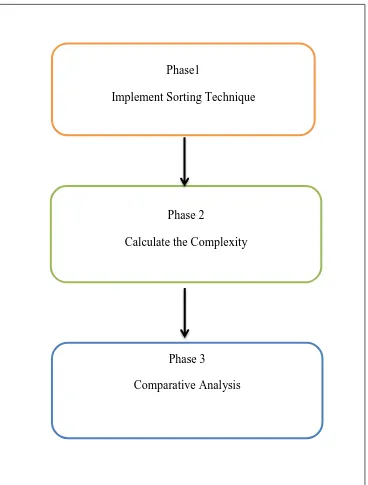
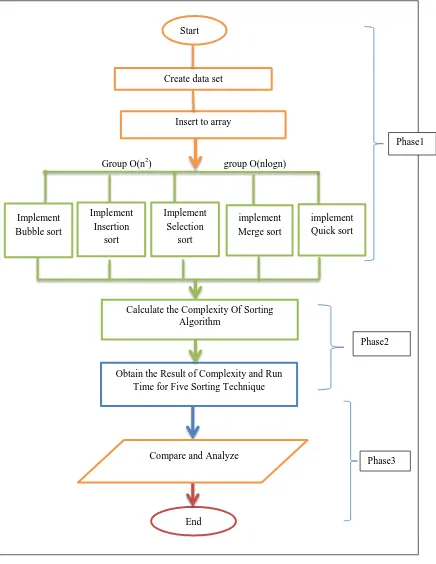
The proposed framework involved three phases, namely implementation of sorting technique, calculating the complexity and comparative analysis as shown in Figure 3.1. The first phase is implementation of five sorting techniques, which are Bubble sort, Insertion sort, Selection sort with O (n2) complexity, Merge sort and Quick sort with O (n log n) complexity. The second phase is calculating the complexity of these five sorting techniques. The third phase is comparing and analysing theses sorting techniques with performance measurement execution time per second, and size of
Figure 3.1: The Three Phases of the Study.
Figure 3.2 depicts the process map which comprises of all three phases, where each phase contains its different steps and delivers results to be used in the next phase.
Phase1
Implement Sorting Technique
Phase 2
Calculate the Complexity
Phase 3
Figure 3.2: Process Map.
The explanations of the phases are discussed in the following section.
Group O(n2) group O(nlogn) Start
Create data set
Insert to array
Implement Bubble sort
Implement Insertion
sort
Implement Selection
sort
implement Merge sort
implement Quick sort
Obtain the Result of Complexity and Run Time for Five Sorting Technique
End
Phase1
Phase2
Phase3 Calculate the Complexity Of Sorting
Algorithm
3.3 Phase 1: Implementing the Sorting Techniques
Phase 1 encompasses the implementation of five sorting techniques. The five sorting techniques are Bubble sort, Insertion sort, Selection sort with O (n2) complexity, Merge sort and Quick sort with O(n log n) complexity using C++ programming language respectively. The input data are random integers between 100 and 30,000. It is further divided into four groups in order to ease the analysis process. Group 1 consists of 100 to 1,000, group 2 consists of 2,000 to 1,0000, group 3 consists of 11,000 to 20,000 and group 4 consists of 21,000 to 30,000. Data processing is done on the same computer.
The implementation of each case study datasets are grouped into six phases. Firstly, datasets are grouped by creating a new file. Secondly, random integer numbers are read, subsequently in the third phase, these integer numbers are written in the created file. In fourth phase, the integer numbers are inserted in an array and in the fifth phase, choice menu() function is used to represent the list of choices for different sorting techniques which is followed by the last phase where the datasets are used in the clock function to calculate the run time.
3.4 Phase 2: Calculating the Complexity of Sorting Techniques
In this phase, the sorting algorithms are tested using four groups with different data sizes. Then, the program calculate the complexity of each sorting technique which are Bubble sort, Insertion sort , Selection sort, Merge sort and Quick sort using Big (O) concept. This concept is used to measure the complexity of algorithms and it is useful in the analysis of algorithms for efficiency.
3.5 Phase 3: Comparative Analysis
is that, it can help in finding fitting linear regression and square regression to grasp how the ideal value of the dependent variable (execution time) changes when any one of the independent variables (number of elements) is varied, while the other independent variables are still stable based on Equation 2, stated in Section 2.9.
Thus, Regression analysis is used to find the estimated value of the variable given the independent variable. The details of each component are explained further in Chapter 4. The results are compared and analyzed after they were obtained from the implementation of the sorting techniques and the analysis, based on three measurements with complexity, execution time per second and input data set of four groups of data by linear regression. In this quantitative comparison, estimated value is used because it can find fitting linear regression for better overall performance. The estimation value and ratio value are considered as comparison criteria between sorting technique that have O (n log n) and O (n2) to determine which one is more efficient. In doing the comparison among these sorting techniques, this work will examine:
i. the estimated value for each sorting technique and for each group of dataset based on equation 1 as stated in Chapter 2, Section 2.9.
ii. the average for estimation value of five sorting techniques.
iii. the average of the ratio between the sorting techniques based on equation 3 as illustrated in Chapter 2, Section 2.9.
iv. the average of speed ratio of sorting technique between four groups based on equation 3 shown in Chapter 2, Section 2.9.
3.6 Summary
CHAPTER 4
IMPLEMENTATION AND ANALYSIS
4. 1 Overview
This chapter presents the results of the implemented sorting algorithms which are Bubble sort, Insertion sort, Selection sort, Merge sort and Quick sort, and a comparative analysis is carried out based on the results. The outcome of this study is discussed in detail based on the methodology presented in Chapter 3. This chapter is divided into two sections. The first section gives the details about the implementation of these sorting techniques by using four groups of data sets, in the form of arrays. Later, the complexity is calculated based on Big-O concept and measurements in time execution per second were taken based on the function of clock time in the C++ program. The second section illustrates the comparative analysis of these sorting techniques from each data set group of each sorting algorithm. All the sorting algorithms are divided into two groups – first group using complexity level O(n2) which includes Bubble, Insertion and Selection and second group using complexity level O(n log n) which includes Merge and Quick based on simple linear regression analysis technique.
4.2 Implementation of Sorting Techniques
30,000. All the five sorting algorithms were executed on machine with Operating System equipped with Intel (R) Core (TM) 2 Duo CPU E8400 @ 3.00 GHz (2 CPUs) and installed memory (RAM) of 2038 MB. The CPU time was taken in per second. The executed data set to the static data structure were as illustrated in the following subsections.
4.2.1 Description of Test Data Sets
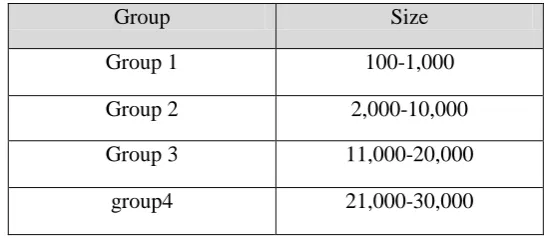
[image:39.595.179.453.381.500.2]A data set is a random integer number with several files of integers, selected at random to be used to test the five sorting methods. The files are of different sizes, ranging between 100 and 30,000. Then the number used for these data set are divided to four groups of different intervals as shown in Table 4.1.
Table 4.1: Data Set Groups
Group Size
Group 1 100-1,000
Group 2 2,000-10,000
Group 3 11,000-20,000
group4 21,000-30,000
4.2.2 Create and Open File
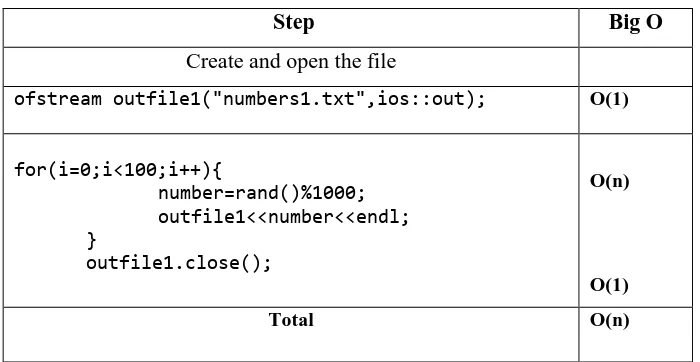
In this section, the data set is created randomly by generating the number of integers and stored in a variable called number. Then the number is saved in an output file.
Table 4.2: Create and Open File Complexity
4.2.3 Insert Data File in to Array
This section presents the insert data file as array. The complexity level is O(n) and when it is closed, the process is repeated only once. Thus the total complexity is O(n+1) = O(n). Table 4.3 shows the complexity of inserting data file into array.
Step Big O
Create and open the file
ofstream outfile1("numbers1.txt",ios::out); O(1)
for(i=0;i<100;i++){
number=rand()%1000; outfile1<<number<<endl; }
outfile1.close();
O(n)
O(1)
REFERENCE
Al-Kharabsheh, K. S., AlTurani, I. M., AlTurani, A. M. I., & Zanoon, N. I. (2013). Review on Sorting Algorithms A Comparative Study. International Journal of Computer Science and Security (IJCSS), 7(3), 120.
Andres, B., Koethe, U., Kroeger, T., & Hamprecht, F. A. (2010). Runtime-flexible multi-dimensional arrays and views for C++ 98 and C++ 0x. arXiv preprint arXiv:1008.2909.
Astrachan, O. (2003, February). Bubble sort: an archaeological algorithmic analysis. In ACM SIGCSE Bulletin (Vol. 35, No. 1, pp. 1-5). ACM.
Batcher, K. E. (1968, April). Sorting networks and their applications. InProceedings
of the April 30--May 2, 1968, spring joint computer conference (pp.
307-314). ACM.
Bharadwaj, A., & Mishra, S. (2013). okun. International Journal of Computer Applications, 78(14), 7-10.
Bishop, C. M. (2006). Pattern recognition and machine learning. springer. Black, P. E. (2007). big-O notation. Dictionary of Algorithms and Data
Structures, 2007.
Black, P. E. (2009). Dictionary of Algorithms and Data Structures, US National Institute of Standards and Technology
Chhajed, N., Uddin, I., & Bhatia, S. S. (2013). A Comparison Based Analysis of Four Different Types of Sorting Algorithms in Data Structures with Their Performances. International Journal of Advance Research in Computer Science and Software Engineering, 3(2), 373-381.
Coxon, A. P. M. (1999). Sorting data: Collection and analysis (Vol. 127). Sage Publications.
Estakhr, A. R. (2013). Physics of string of information at high speeds, time complexity and time dilation. Bulletin of the American Physical Society, 58.
Goodrich, M., Tamassia, R., & Mount, D. (2007). DATA STRUCTURES AND
ALOGORITHMS IN C++. John Wiley & Sons.
Gurram, H. K., & Jaideep, G. (2011). Index Sort. International Journal of Experimental Algorithms (IJEA), 2(2), 55-62.
Horan, P. K., & Wheeless, L. L. (1977). Quantitative single cell analysis and sorting. Science, 198(4313), 149-157.
keller, Complexity. http://www.cs.hmc.edu
Knuth, D. E. (1976). Big omicron and big omega and big theta. ACM Sigact News, 8(2), 18-24.
Liu, Y., & Yang, Y. 2013, December. Quick-merge sort algorithm based on Multi-core linux. In Mechatronic Sciences. Electric Engineering and Computer (MEC), International Conference on (pp. 1578-1583). IEEE
Mehlhorn, K. (2013). Data structures and algorithms 1: Sorting and searching(Vol. 1). Springer Science & Business Media.
Miss. Pooja K. Chhatwani, Miss. Jayashree S. Somani, 2013. Comparative Analysis & Performance of Different Sorting Algorithm in Data Structure Lecturer. Information Technology, Dr. N. P. Hirani Institute of Polytechnic. Pusad,Maharashtra, India
Okun, V., Delaitre, A., & Black, P. E. (2011). Report on the third static analysis tool exposition (SATE 2010). vol. Special Publication, 500-283.
Papadimitriou, C. H. (2003). Computational complexity (pp. 260-265). John Wiley and Sons Ltd..
Puschner, P., & Koza, C. (1989). Calculating the maximum execution time of real-time Tomita, E., Tanaka, A., & Takahashi, H. (2006). The worst-case real-time complexity for generating all maximal cliques and computational
Sipser, Michael (2006). Introduction to the Theory of Computation. Course Technology Inc. ISBN 0-619-21764-2.
Szirmay-Kalos, L., & Márton, G. (1998). Worst-case versus average case complexity of ray-shooting. Computing, 61(2), 103-131.
Waegeman, W., De Baets, B., & Boullart, L. (2008). ROC analysis in ordinal
regression learning. Pattern Recognition Letters, 29(1), 1-9.
Yang, Y., Yu, P., & Gan, Y. (2011, July). Experimental study on the five sort algorithms. In Mechanic Automation and Control Engineering (MACE),