Caveat emptor
“Probiotics” might not be what they seem
Brenda A. Huff ,
MD,
CCFPABSTRACT
OBJECTIVE
To assess whether commercially prepared probiotic products contain viable organisms, as claimed by their
manufacturers, particularly whether products labeled as containing
Lactobacillus
did so. To identify and quantify as many
species as feasible and to compare them with the contents listed on labels.
DESIGN
Randomized, double-blind trial.
SETTING
Community hospital in Chilliwack, BC.
MAIN OUTCOME MEASURES
Trial of 10 randomly chosen brands of probiotic preparations bought over-the-counter in British
Columbia’s lower mainland. Only products claiming to contain
Lactobacillus
were included in this study. Viable organisms in
each probiotic brand and quantities of
Lactobacillus
in each product.
RESULTS
None of the 10 products tested matched their labeled microbiologic specifications. Two brands grew nothing
aerobically or anaerobically. No
Lactobacillus
grew in fi ve brands, although their labels stated that this was the main species.
Eight brands contained viable cells, but only 10% of the number stated by their manufacturers.
CONCLUSION
Most product labels did not adequately identify or quantify microbes. Use of probiotics should not be
recommended at this time.
RÉSUMÉ
OBJECTIF
Vérifi er si le contenu des produits probiotiques commerciaux renfermant des organismes vivants est conforme aux
prétentions des fabricants, notamment si les produits étiquetés comme renfermant du lactobacille en contiennent vraiment.
Identifi er et quantifi er le plus de produits possible et comparer les résultats obtenus au contenu indiqué sur l’étiquette.
TYPE D’ÉTUDE
Essai randomisé à double insu.
CONTEXTE
L’hôpital municipal de Chilliwack, C.-B.
PRINCIPAUX PARAMÈTRES ÉTUDIÉS
Choix au hasard de 10 marques de produits probiotiques en vente libre dans le plateau
continental de Colombie-Britannique. Seuls les produits censés contenir du lactobacille ont été inclus. Présence d’organismes
viables et quantité de lactobacilles dans chaque produit.
RÉSULTATS
Aucun des produits étudiés ne correspondait aux spécifi cations microbiologiques de l’étiquette. Dans deux cas,
les cultures aérobiques et anaérobiques ont été stériles. Cinq autres n’ont donné aucune croissance de lactobacille, même si
ce devait être l’espèce principale selon l’étiquette. Les huit marques avec des cellules viables contenaient seulement 10% des
quantités annoncées par le fabricant.
CONCLUSION
La plupart des étiquettes n’indiquaient pas adéquatement l’identité et la quantité des microbes. À l’heure
actuelle, on ne devrait pas promouvoir l’usage des probiotiques.
This article has been peer reviewed.
robiotics is a broad term that refers to the concept of feeding live microbial organisms to human beings with the goal of preventing and treating disease. Th e word probiotic is derived from a Greek term and means “for life.” Th e fi rst ref-erence to health benefi t dates back to the early 1900s when the Nobel prize–winning Russian physician Elie Metchnikoff hypothesized that Bulgarian peas-ants lived long, healthy lives because they consumed
fermented milk products.1
In the last century, many proponents of probi-otic treatment have cited various benefits: “main-tains healthy digestion,” “assists in general well-being,” “builds immunity, adding years to your life.” Much of
the enthusiasm for probiotic treatment is among pro-ponents of what might be termed alternative medi-cine. With any commonly used Internet search engine you will get more than 16 000 sites referencing the
word. It is hardly a surprise that sales are soaring.2
Although probiotic preparations have been avail-able commercially for years, data on their benefi ts
and mechanism of action remain scarce.3 Possible
mechanisms include the synthesis of antimicro-bial substances, competition for nutrients required for growth of pathogens, modification of toxins or toxin receptors, and stimulation of nonspecifi c
immune responses to pathogens.4
In recent decades, Bifi dobacterium, Saccharomyces
boulardii, and Lactobacillus have been investigated for their probiotic potential. One of the most commonly
studied probiotic organisms is Lactobacillus casei subsp
rhamnosus (LGG).5 Studies attempt to show benefi t in
prevention and treatment of various illnesses (such as diarrhea, urinary tract infections, irritable bowel syn-drome, yeast infections, cancer, and hypertension) but
fail to demonstrate sound evidence.6
A few rigorously controlled scientific trials have been conducted. Recently, a systematic review of pub-lished, randomized, double-blind, placebo-controlled trials demonstrated clinically signifi cant evidence that probiotic organisms (in particular LGG) are benefi cial in reducing the duration of acute infectious diarrhea
in children.7 Other trials have demonstrated benefi t
from probiotic treatment in ameliorating symptoms
of antibiotic-associated diarrhea among children.8 In
these studies meticulous care was taken to keep the probiotic organisms in their “live” form. Statistical het-erogeneity was noted across the studies. Th ere were diff erences in both the dosage and duration of treat-ment. Importantly, products cited in these particu-lar studies contained at least 10 times more probiotic
organisms than commercially available products do.9
While no obvious adverse eff ects from these prod-ucts have been reported in any study, information is
limited.10 Geralk Tannock in Horizon Scientifi c Press
says “the pathogenicity of lactobacilli is generally low; one case has been reported in which a probiotic
lac-tobacillus was found associated with a liver abscess.”11
So what are physicians’ attitudes toward their patients’ use of probiotic products? A recent survey,
published in the Canadian Medical Association Journal
asked whether physicians recommend probiotic treat-ments to their patients to prevent antibiotic-associated
diarrhea.12 Of the 68% who responded, 32% reported
that they recommend probiotic products to their patients when prescribing antibiotics.
Some concerns, especially in a UK study
pub-lished in the British Medical Journal,13 have been
noted about the contents of commercial probiotic preparations. The microbial content of 13 differ-ent brands bought over-the-counter in Britain was investigated. Th is study revealed species that were not listed on their labels and numbers of viable cells far lower than those stated by their manufacturers.
Many people are buying probiotic products off the shelf, and some physicians are, at least in part, recommending these products to their patients. Th is project was undertaken to answer the following ques-tions. Are North American commercial probiotic
preparations viable? Do they contain Lactobacillus
as stated on their labels? What is the quantity of lac-tobacilli in each product? Do these products contain species not listed on their labels?
METHODS
I purchased, at random, 10 diff erent brands of pro-biotics from six diff erent retail stores in BC’s lower
Dr Huff is a second-year family medicine resident in Chilliwack, BC.
robiotics is a broad term that refers to the concept of feeding live microbial organisms to human beings with the goal of preventing and treating disease. Th e word probiotic is derived
mainland. Most medical studies used Lactobacillus
species; therefore I chose only products claiming to contain this bacterium. I complied with instruc-tions on the containers and refrigerated as directed. Th e preparations were aseptically transferred from their original containers to sterile screw-topped tubes. A microbiologist then took the specimens to the
labo-ratory to be cultured. Both the person transferring the powder and the microbiologist were blinded to
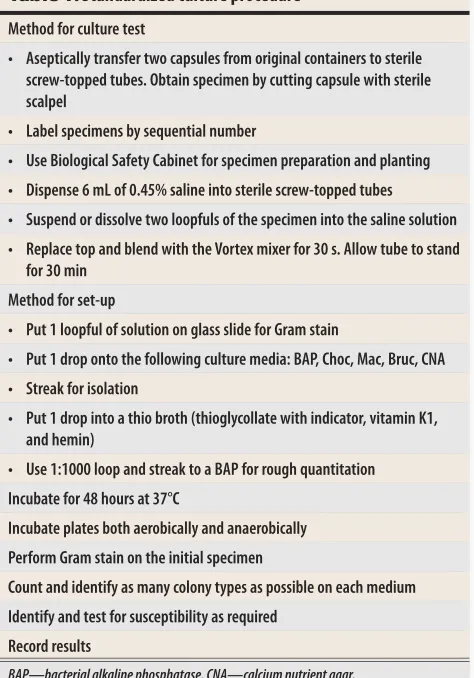
the contents of the preparations (Table 1).
Th e objective was to determine whether the ucts did, in fact, contain viable bacteria. Each prod-uct was cultured twice under appropriate conditions. The cultures were examined to determine whether
Lactobacillus species grew as stated on each container. Colonies on each Petri dish were quantifi ed. I compared my results with the quantity labeled on each product. Species other than those listed on the product containers were identifi ed and recorded. Due to the limitations of this study, I was unable to
identify all species contained in each sample. All products were manufactured in North America.
RESULTS
None of the products matched their labeled micro-biologic specifi cations qualitatively or quantitatively (Table 2). Two of the 10 probiotic products cultured (specimens A and D) grew nothing. Four brands (A,
D, E, and I) did not grow the Lactobacillus species
listed on their labels. Four brands (B, C, E, and G)
contained species not listed on the label (Enterococcus
faecium, Bifi dobacterium, Streptococcus oralis). Some of the species not listed on the label were found to be resistant to ciprofl oxacin. Th is was an incidental fi nd-ing of unclear importance.
Each brand quantifi ed the bacterial species listed on its label diff erently. Specimen E did not quantify at all. Some products quantifi ed per capsule, others quanti-fi ed all species into one number, and yet others used percentages. Th e number of probiotic organisms per capsule, as claimed by manufacturers, ranged from 2 to 20 billion. My results ranged from 20 to 80 million.
DISCUSSION
Using lactic bacteria to treat human disease is not a new concept. Recent studies report evidence in favour of probiotic products for treating specifi c conditions. Standardized scientific analysis pre-cisely defi ning and quantifying each probiotic strain is still required. In theory, if probiotic treatment is proven benefi cial in reducing illness, the cost of medical care will be reduced, stays in hospital will be shorter, and fewer days will be lost from work.
Th is study found that commercially available over-the-counter products were inaccurately labeled. Some products tested contained only dead bacteria. Most labels did not adequately identify the microbes
in their products. Lactobacillus was listed among the
contents of each product but was found in only half the samples and in numbers one tenth their stated concentration. There were inconsistencies in the nomenclature and quantifi cation of these products.
Table 1. Standardized culture procedure
Method for culture test
• Aseptically transfer two capsules from original containers to sterile screw-topped tubes. Obtain specimen by cutting capsule with sterile scalpel
• Label specimens by sequential number
• Use Biological Safety Cabinet for specimen preparation and planting • Dispense 6 mL of 0.45% saline into sterile screw-topped tubes • Suspend or dissolve two loopfuls of the specimen into the saline solution • Replace top and blend with the Vortex mixer for 30 s. Allow tube to stand
for 30 min Method for set-up
• Put 1 loopful of solution on glass slide for Gram stain
• Put 1 drop onto the following culture media: BAP, Choc, Mac, Bruc, CNA • Streak for isolation
• Put 1 drop into a thio broth (thioglycollate with indicator, vitamin K1, and hemin)
• Use 1:1000 loop and streak to a BAP for rough quantitation Incubate for 48 hours at 37°C
Incubate plates both aerobically and anaerobically Perform Gram stain on the initial specimen
Count and identify as many colony types as possible on each medium Identify and test for susceptibility as required
Record results
Ta b le 2 . Culturing r esults SP EC IM EN CH AR AC TE RI ST IC S A B C D E (C HI LD RE N’ S FO RM UL A) F G H I J Viable or ganisms in sample No gr owth Lac tobacillus species and Bifi dobac terium species Lac tobacillus species and En ter oc oc cus faecium No gr owth E faecium Lac tobacillus species Str ept oc oc cus oralis and Lac tobacillus species Lac tobacillus species , possibly 2 types E faecium Lac tobacillus species Lac tobacillus cultur ed in samples No Yes Yes No No Yes Yes Yes No Yes
Species iden
tifi ed not list ed on label None Bifi dobac terium E faecium None E faecium None S oralis None E faecium None Quan tit y per capsule as sta ted on label 2 billion 4 billion viable cells 1.5 billion liv e cells 4 billion ac tiv e cells Not list ed 10 billion ac tiv e cells 6 billion ac tiv e cells 6 billion ac tiv e cells † 6 billion liv e cells (en teric coa ted) 3 billion viable cells Ac tual quan tit y per capsule No gr owth 50 million 20 million No gr owth 20 million 80 million 50 million 50 million 20 million 30 million Micr oor ganisms manufac tur ers claimed to be in pr oduc t L acidophilus • L rhamnosus • L acidophilus • E faecium • L acidophilus • B bifi dum • B longum • L rhamnosus • L acidophilus • L acidophilus • B bifi dum • B infan tis • L rhamnosus • L acidophilus • B bifi dum • L rhamnosus • S thermophilus • L acidopholus • B longum • L casei • Bulgariars • L rhamnosus • L casei • L acidophilus • B longum • L acidophilus • L rhamnosus • B ifi do ba ct er iu m • E faecium L rhamnosus Manufac tur er UAS Labora tories in Minnet onk a, Minn SISU en terprises in Burnab y, BC Ky o-D ophillus , “T he Friendly Trio —f or optimal friendly bac teria for balanc ed in testinal fl ora ” in Vanc ouv er , BC Swiss Herbal Remedies Lt d, “P robiotic cultur e an ti-cholest Plus Fos” in Richmond Hill , On t Nutrition No w Childr en ’s PB8 in Vanc ouv er , BC Na tural Fac tors Pr obiotic Formula in Burnab y, BC Tr ophic Canada Lt d in Tor on to , On t Na tural Fac tors in Burnab y, BC Swiss Na tural Sour ces in Tor on to , O nt Swiss in Burnab y, BC *
Per mL of initial dilution. †No e
xpir
y da
te
Extra species not listed on the label were identifi ed. It was impossible to identify all organisms in each product due to lack of funding.
No current government regulations apply to
over-the-counter probiotic products.14 The
pub-lic has no guarantee that these products contain viable organisms or that they contain the species listed on their labels. Many of the products tested contained species other than those listed, none of which are known to be harmful. Without govern-ment regulation, however, products that contain harmful bacteria could be on the market.
Growing public interest in wellness has fueled demand for more probiotic products. In an attempt to support our patients, and in light of the low toxic eff ects, many physicians do not advise against using these products.
Th is study has some limitations. It is possible that mostly unsuitable brands were chosen, although the choice was random. Th e testing was carried out in only one laboratory, although the method was explicit and standardized.
CONCLUSION
Th is study indicates that many commercial probi-otic preparations do not contain the active ingre-dients listed on their labels. Consumers essentially are buying products that have no proven benefi t and are not what they claim.
Acknowledgment
I off er special thanks to Dr Dale Purych, medical micro-biologist at Chilliwack General Hospital in the Fraser Valley Health Authority in British Columbia.
Competing interests
None declared
Correspondence to:Dr Brenda Anne Huff , Box 234, New
Aiyansh, BC V0J 1A0; e-mail bhuff @nisgaahealth.bc.ca
References
1. Metchnikoff E. Th e prolongation of life. New York, NY: CP Putnam’s Sons; 1908.
2. Guandalini S, Pensabene L, Zikri MA, Dias JA, Casalli LG, Hoekstra H, et al. Lactobacillus GG administered in oral rehydration solution to children with acute diarrhea: a multicenter European trial. J Pediatr Gastroenterol Nutr 2000;30(1):54-60.
3. Koop-Hoolihan L. Prophylactic and therapeutic uses of probiotics: a review. J Am Diet
Assoc 2001;101:229-38.
4. Elsevier N, et al. Functional signifi cance of the bowel microfl ora in gastrointestinal health: proceedings of a roundtable discussion. Am J Gastroenterol 2000;95(1 Suppl):7-26. 5. Saavedra JM. Probiotics plus antibiotics: regulating our bacterial environment. J Pediatr
1999;135:535-7.
6. Alvarez-Olmos MI, Oberhelman RA. Probiotic agents and infectious diseases: a modern perspective on a traditional therapy. Clin Infect Dis 2001;32:1567-76.
7. Szajewska H, Mrukowicz JZ. Probiotics in the treatment and prevention of acute infectious diarrhea in infants and children: a systematic review of published randomized, double-blind, placebo-controlled trials. J Pediatr Gastroenterol Nutr 2001;33(Suppl 2):S17-25. 8. Vanderhoof JA, Whitney DB, Antonson DL, Hanner TL, Lupo JV, Young RJ. Lactobacillus
GG in the prevention of antibiotic-associated diarrhea in children. J Pediatr 1999;135:564-8. 9. Armuzzi A, Cremonini F, Bartolozzi F, Canducci F, Candelli M, Ojetti V, et al. Th e
eff ect of oral administration of Lactobacillus GG on antibiotic-associated gastrointesti-nal side eff ects during Helicobacter pylori eradication therapy. Aliment Pharmacol Th er
2001;15(2):163-9.
10. Urbancsek H, Kazar T, Mezes I, Neumann K. Results of a double-blind, randomized study to evaluate the effi cacy and safety of Antibiophilus in patients with radiation-induced diar-rhoea. Eur J Gastroenterol Hepatol 2001;13:391-6.
11. Lardkin M. Probiotics strain for credibility. Lancet 1999;353(9193):1884.
12. Edmunds L. Th e underuse of probiotics by family physicians. CMAJ 2001;164(11):1577. 13. Hamilton-Miller JM, Shah S, Smith CT. “Probiotic” remedies are not what they seem. BMJ
1996;312(7022):55-6.
14. McNeely D. Infectious disease probiotics. Patient Care Can 2002;13(1):19.
2. Guandalini S, Pensabene L, Zikri MA, Dias JA, Casalli LG, Hoekstra H, et al. Lactobacillus
EDITOR’S KEY POINTS
• Probiotic preparations contain live microbial organisms used to pre-vent and treat disease. Some evidence suggests they reduce the duration of diarrhea. Although sales have soared, there are some concerns about the accuracy of manufacturers’ claims for commer-cial preparations.
• This study was designed to determine whether commercially avail-able probiotic products with Lactobacillus contained the amount alleged on the packaging.
• Ten randomly chosen examples of probiotic preparations were cul-tured in the laboratory; several grew no colonies at all, some had very small colony counts, and some capsules contained bacilli not listed on the label.
• Family physicians should make their patients aware that commercial probiotic preparations probably do not contain what their labels say they do. Caveat emptor.
POINTS DE REPÈRE DU RÉDACTEUR
• Les préparations probiotiques contiennent des micro-organismes vivants censés prévenir et traiter des maladies. Certaines observa-tions suggèrent qu’elles réduisent la durée des diarrhées. Malgré une forte progression des ventes, des doutes ont été émis concernant les précisions fournies par les fabricants.
• Cette étude avait pour but de vérifi er si des préparations commer-ciales de probiotiques avec lactobacille contenaient les quantités annoncées sur l’emballage.
• Dix préparations probiotiques choisies au hasard ont été cultivées en laboratoire; plusieurs sont demeurées stériles, d’autres ont donné un très petit nombre de colonies et certaines capsules renfermaient des bacilles non indiqués sur l’étiquette.