Website: www.ijetae.com (ISSN 2250-2459, Volume 2, Issue 1, January 2012)
245
Cloud computing: A security problem or solution
Saurabh Sharma
1, Randeep Kaur Chhabra
2, Prof. Ashok Verma
31, 2 PG Student, MTech (CSE), Gyan Ganga Institute of Technology & Sciences, Jabalpur, Madhya Pradesh, INDIA
3Head of Department of Computer Science & Engineering,Gyan Ganga Institute of Technology & Sciences Jabalpur, Madhya Pradesh, INDIA
[email protected] [email protected]
Abstract—The move to cloud computing is the next stage of an unstoppable trend in the breakdown of the enterprise perimeter, both technically and organizationally. This new paradigm presents a number of security challenges that still need to be resolved but sufficient change in the IT environment has already happened - so that most organizations are working in a transitional state where security exploits are happening across the enterprise boundary. In this situation, the compartmentalization introduced by migrating to cloud services could result in much improved security.
Keywords-Authentication, Trust and Assurance, Confidentiality, Identity and Access Management, services security.
I. INTRODUCTION
It is clear that cloud computing has number of attractive aspects that are driving adoption (Grossman, 2009). Benefits such as cost reduction, improved provisioning and access to resources beyond that which would normally be possible in a private environment are just some of the items that are frequently mentioned. This drive to adoption is being echoed by many CIOs and is being reflected by real purchasing decisions. In a report last year by investment bankers Goldman Sachs (Goldman Sachs, 2010) 58% of enterprises consider Software as a Service (SaaS) when purchasing an application and 39% preferred the SaaS option.
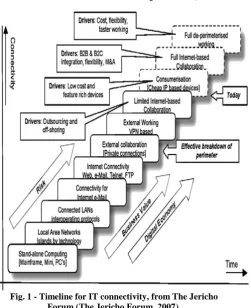
But cloud computing as ‗software as a service‘ has not just happened overnight, and is very much part of a continued trend to extend IT capability and business processes beyond the traditional boundary of the enterprise. Understanding this trend is important in understanding the changing risks and so we shall explore them in more detail.
1.1.PROGRESSION OF CONNECTIVITY
Website: www.ijetae.com (ISSN 2250-2459, Volume 2, Issue 1, January 2012)
[image:2.595.50.302.127.436.2]246 Fig. 1 - Timeline for IT connectivity, from The Jericho
Forum (The Jericho Forum, 2007).
1.2.THE ‗FLAT‘ CORPORATE NETWORK
Despite the trend, enterprise security architectures have still very much continued to focus on the perimeter. In many cases this focus of security on the perimeter and ease of developing end user applications has also led to clients and servers being made intimately part of the same network in one homogenous flat structure. How this occurred is not surprising, as in the evolution of end user computing, a significant amount of application development moved towards applications designed to be run on client PCs and then, through the development of client-server architectures, these migrated onto local servers. This local ownership resulted in a management battle in the mid 2000‘s where a goal of the IT department became the retrieval of those servers from ‗under the desk‘ of local departments and back under management in the data centre (for example (Friedman and Rosenberg, 1999).
But even in the data centre, the legacy of departmental computing remains. As stated earlier, in many cases the way that local departmental applications were developed has tended to require administrative privileges on local PCs and in addition they also require very ‗flat‘ network relationships from client to server in order for the applications to run. In our experience, additional barriers such as firewalls between client and server within the corporate network have not been common, and where it
has been tried there have often been technical difficulties in achieving a good level of network segregation. 1.3.THE SOCIAL ENGINEERING PATH
A combination of fallible end-users connecting to the Internet, local administration rights and flat network relationships has provided a ready path for unauthorized access. The attackers have therefore found ways of exploiting the end user as a vector to access data on servers and systems that were otherwise reasonably protected. The method of attack has steadily escalated into a kind of ‗arms race‘ (Moore and Anderson) where the attackers have exploited a particular attack, combining technical exploits and targeted social engineering such as Spear Phishing (Herley, 2010) which the security profession has attempted to counter on a case by case basis. There are many white papers that describe the methods by which malware is infiltrated into the network inside the corporate perimeter, but in general the main approach described is as illustrated in Fig. 2 To date the most sophisticated form of such attack has been termed ‗Advanced Persistent Threat‘, which (in the view of almost every security professional) is impossible to protect against with current porous-perimeter architectures, the only realistic strategy being early detection and response (The Security for Business Innovation Council, 2011).
The common steps in Advanced Persistent Threat Attack (APT) are similar to standard malware infiltration but with additional direction and intelligence, as described below (The Security for Business Innovation Council, 2011):
1. Reconnaissance to build knowledge of the organization 2. Social engineering and/or spear phishing to target end users
3. Exploitation of vulnerabilities in an end point
4. Lateral expansion using peer relationships to roam the network
5. Escalation of privileges Additional spear phishing or decrypting administrators‘ passwords
6. Compromise of internal systems
7. Ex-filtration of data or other objective (such as planting false information)
8. Cleanup
Website: www.ijetae.com (ISSN 2250-2459, Volume 2, Issue 1, January 2012)
247 The above examples therefore illustrate some of the risks in transition from closed to open networks that we are facing. Whilst data itself remains open on the corporate network, and inside attack can be initiated through end user access (through the Internet, email or portable media) we have a significant and growing exposure that requires a new architectural approach to be able to manage it.
II. THE RISKS DURING TRANSITION
In the view of the authors we are currently at a dangerous stage of transition from a security model based on protection that relies on a strong corporate network perimeter moving over to a data-centric model where data and information repositories themselves are protected and data is organizationally segregated from systems management.
The security dangers arise because of undeveloped thinking and understanding of the security changes during this transition period and hence an almost undetected threat is starting to be realized within many enterprises. Because many IT and security professional are still focused on the perimeter, investment in deperimeterization security technologies such as data-centric security has not yet caught up. This is not strictly just a problem for those deploying security because, until very recently, most technology vendors were also still focused on attempting to plug holes in the perimeter rather than addressing the new challenges.
As described above, we have seen the security consequences of this breakdown, as end users are able to directly access Internet web sites from within their own enterprise LAN, and openly receive email at the desktop from all Internet sources, both legitimate and malicious (such as spam). A whole industry exists to attempt to lock-down endpoints and filter incoming traffic but at best (as illustrated by the APT example) this has been only partially successful.
In most cases, security professionals and their IT colleagues have been able to do a relatively good job in protecting applications within the enterprise from direct external attack. With only a few notable exceptions, work on firewalls, proxies and improved secure applications development have gone a long way to creating robust and protected applications. However, whereas locking down applications and servers in their managed data centers has been achievable, attempts at locking down the clients has proved to be politically and technically impossible in many cases. A simple Internet search of technical IT support forums (IT Management, 2011) shows a very active debate still rages on whether full local administrative access of PCs, with the ability to load executable software, is acceptable or a security disaster because of pervasive malware. So consider that clients operating on same network as applications and servers can be a fundamental security weakness.
III. THE SECURITY BENEFITS OF CLOUD COMPUTING
In the view of the authors, some aspects of cloud computing provide key elements of the necessary architectural change to segregate clients from mass data and applications. As mentioned earlier, a quick analysis of the means of data access being used in APT espionage and similar data theft approaches; shows that there would be a benefit in better segregating shared data and applications from the network that the client sits upon. Externalized cloud computing software as a service (Saas) applications have this advantage because they do not expose the full network stack to the clients who access the application; in an analogous situation banks do not put their internal corporate networks at risk by giving customers access to banking applications, all that is exposed- even on identity theft - is the individual account of a single customer. Arguably, Saas cloud computing therefore offers some protection against the ‗lateral movement‘, privilege escalation, and reconnaissance of APT. In the example of Fig. 2 above, there could be no further movement between stages 3 and 4 of the attack in a well-engineered cloud hosted application and the malware would remain localized on the end user‘s initially infected PC.
There are further advantages of cloud computing where Saas is provided as a utility service to many client companies. In this circumstance the cloud service provider is not uniquely connected with the target client owner of the data and so social engineering of service company staff is unlikely to be as relevant to a particular data set and therefore will be less effective as an internal data access attempt on enterprise staff. In fact it should be possible to segregate the data of customers from the information flow of the cloud provider itself as the different areas of data support completely different enterprise business processes.
Aggregation through cloud services should also bring other advantages such as economy of skill where larger teams of security professionals are more cost effective for the service provider than they would be for their clients, and also the benefits brought by centralization of security processes, resilience and redundancy (Zissis et al., 2011). Providing services across multiple clients also gives a cloud services provider the ability to see a wider picture of attacks and security events than a single client and thus should be able to better operate an early warning response to particular attack, or give better context of whether there is particular targeting of a single client. Such benefits have already been recognized by some Internet Service Providers.
Website: www.ijetae.com (ISSN 2250-2459, Volume 2, Issue 1, January 2012)
248 Indeed commercial services even exist to support enterprise network security configuration and patch-management that are delivered from the Internet cloud.
IV. RISKS RELATING TO CLOUD COMPUTING
Of course, moving to cloud services falls well short of completely solving the security problem; instead it refocuses security concerns onto other key areas of security engineering. A large cloud services provider is arguably a bigger target and more attractive for those who wish to cause maximum disruption through attacks such as distributed denial of service. The externalization of the application also increases the attack surface to which it is exposed and requires robust software integrity created through the use of secure development methodologies (for example the importance of input validation and/or filtering techniques to resist attacks such as SQL injection). We should therefore be concerned where developers do not follow the necessary best practice (SAFECode, 2011).
Much of the concern around cloud security is related to third party management e the fact that the cloud service provider is not a directly managed from within the client organization. As such the normal security issues of outsourcing appear, i.e. being concerned with the integrity, control and sustainability of the supplier and the totality of risks that the client is taking when relying on a third party. None of these concerns are new to information security; however what should be new is the wish for the cloud service to be much more of a utility in the way that it operates. A true utility should have a service relationship with many clients and not expect to have 1:1 audit relationships with each one of them. This requires a universally accepted audit certification (see below) that ideally can be reported into the client‘s Enterprise Risk Management and its Governance, Risk and Compliance Reporting.
Other cloud security risks include the adequacy of segregation
of data between clients as well as its geographic (and regulatory) location, technical issues such as the presence or absence of encrypted (secure) communications and virtualization security, and fundamental architectural concerns such as a dependence on the Internet and missing choke-points that can be used to monitor system and end-user security behaviors.
The final category of concerns relate to integration with existing enterprise security processes. Many organizations have invested significantly in access control and identity management systems so that their joiners/leavers process will ensure the timely provisioning and de-provisioning of computer facilities when someone changes job or leaves. Internal networks have also used technologies such as Microsoft‘s Active Directory to provide a secure single sign-on to services and applications.
Both of these integration successes are challenged by cloud computing services that more often than not have their own separately managed user identifier and access password. Further loss of integration can also occur where encryption keys come under management of the third party and not the client, and also if monitoring of user access is not available for behavioral monitoring. Concerns over integration of data management further come about through corporate obligations to manage all instances of company data, such as when e-discovery is required in legal cases.
V. FOCUS AREAS FOR INVESTMENT IN CLOUD SERVICES SECURITY
In this paper we are discussing the potential information security benefits of cloud and advocate that the Cloud model can actually make a positive contribution to the Security posture of Service Consumers. However, we have also stated that it cannot be ignored that security challenges still remain which can lead to hesitation in wider adoption or even fundamentally undermine the business case. We now look at three concerns that in our opinion are priority areas for security improvement in the Cloud environment: 1. Identity and Access Management
2. Data Security 3. Trust and assurance
5.1.IDENTITY AND ACCESS MANAGEMENT (IAM)
Website: www.ijetae.com (ISSN 2250-2459, Volume 2, Issue 1, January 2012)
249 In a typical FIM system we can identify at least three parties:
1. A principal attempting to access a resource
2. The relying party (RP) who provides the service and relies on a IdP
3. Identity Provider (IdP) who provides specific information
about the Principal.
Within FIM we make a distinction so that we can also distinguish between Centralized and Decentralized systems with their own characteristics:
- Centralized systems: That uses a single IdP that is aware of all Principals and serves all RPs. These have posed challenges associated with concerns over a single entity having full control and the need to have all participants accept and integrate with this single entity. For this reason, centralized systems have often gained limited adoption, a good illustration of these being the case of Microsoft Passport (Menn, 2004). In the authors‘ opinion such systems are appropriate in very specific use-cases in which a dominant IdP exists by default, such as in the case of government related services where a central entity has the need to view all subjects and evaluate their access requirements.
- Decentralized systems: Are cases in which multiple IdPs are present, each covering a limited set of users and appropriate trust relationships are defined that allowed for Identification to be performed by the IdP that holds information on the Principal. Whilst in theory this appears to be a viable option, semantic challenges arise when having to deal with links between all IdPs and RPs involved in a given circle of trust. For example, interoperability e the need for all parties to talk with the same protocol and interpret the same policies, and also the inheritance of trust between the different providers how parties taking part in a circle of trust can know that all participants are trustworthy. However, a solution appears to appearing to address this integration and interoperability challenge, and SAML is emerging as the popular choice due to wide adoption in end user organizations as well as cloud providers. Version 2 of this standard builds on previous work and combines the aspects of SAMLv1, Shibboleth and Liberty
Alliance‘s Liberty-ID FF 1.2 (PingIdentity, 2011). The Liberty Alliance (Liberty Alliance, 2011), originally drafted standards and acted as an industry body for delivery of identity standards has now disbanded and transformed into the Kantara Initiative (Kantara Initiative, 2011) with the aim of validating and certifying interoperability between different vendors of products supporting SAML. Shibboleth originally built on top of the SAML 1.0, now leverages SAML 2 and has enjoyed continued success particularly in academic environments.
In spite of emerging standards, the process of managing Identities in cloud environments still presents a level of architectural complexity. We therefore see the emergence of Identity as a Service (IDaaS) as a potential opportunity to address complexity in IAM both in cloud and even internal environments that may require access by third parties. Technology providers sitting in the middle between Service Providers, Identity Providers and Users can readily provide an adequate integration layer that is able to process and interpret multiple forms of Identity and Authorization management and act as translators to recognized standards, such as SAML.
The use of such a service in itself can facilitate the management of identity throughout its lifecycle including the provisioning/de-provisioning and the capture of relevant event information that is required for monitoring and audit purposes as well as the provision of self-service mechanisms for use by end users.
Overall, we believe, that as far as technology and standards are concerned, the current state of the art now addresses the major identity management challenges raised in the past. However barriers still remain over how to integrate with existing processes and also how to deal with the more general issues commonly raised in over cloud computing such as dependency and trust in the Service Provider.
5.2.DATA SECURITY
Adoption of cloud computing in any of its forms has the clear implication of relinquishing ownership of technology infrastructure (with clear benefits, we should add). However, one important item is left that cloud consumers own e and that is the Data.
This presents us with a new challenge, because very commonly it has been the case that security controls are placed closer to the infrastructure level. As we move to more service based technologies it becomes harder to data owners to actually be able to enforce or impose controls at the infrastructure or even at the application layer. The shared nature of cloud services also make it impractical for individual users to dictate controls that should be implemented in different technology stacks and raises the need for controls to be closer to the asset that they can influence i.e. security controls need to be more data-centric. With this in mind we look at data-centric controls from two perspectives: Preserving confidentiality and Architectural issues.
5.2.1.PRESERVING CONFIDENTIALITY
Website: www.ijetae.com (ISSN 2250-2459, Volume 2, Issue 1, January 2012)
250 Clearly we don‘t want to have the actual keys exposed at the provider together with the data, in the same way we want flexibility in how data can be accessed without having to go through a central gateway that recognizes Or knows all required keys e use of public key cryptography is not practical as each item would need to be encrypted with as many keys as users that require access to it.
A practical alternative is the use of tokenization - essentially,
Replacing bits of data that are considered sensitive (e.g. credit card information, social security number) with a dummy token. The process of translating from token to real data can either be implemented at the client endpoint or by using a separate cloud provider. Tokenization has been mooted as an alternative that avoids the key management concerns reviously described but is not without its downsides:
- We are storing redundant data (mapping of token to real value)
- We still require a centralized point that performs this translation.
Another attractive concept is that of homomorphism encryption which presents the possibility of being able to process encrypted data in the cloud, and have meaningful results provided by that processing without actually having to decrypt the data, therefore preserving confidentiality. Whilst holding great promise this is an on-going research area, that although developing quickly, is not yet considered to be practical enough for implementation in real world applications
(Gentry, 2009) (Sadeghi et al., 2010).
A further encryption approach being considered for cloud computing is Digital Rights Management (also called Information Rights Management). This is particularly valuable in certain cases, such as dealing with unstructured data like of various types, where it may not be feasible to know in advance exactly which fields need to be tokenized. In these cases, Digital Rights Management is possible solution in that it has access policies that directly envelope the data itself and define who and how information containing within can be handled. However, although promising, Digital Rights Management is not yet a simple solution to implement particularly when involving multiple parties under different domains and effectively achieving interoperability between all (Koenen et al., 2004). It is clear that more work is needed in these areas.
5.2.2.DATA ARCHITECTURES
Further, cloud services can use Database Models different from the more familiar Relational Databases, which in itself makes it complex to understand and to deploy known models of data control used in more traditional systems.
Commonly referred as to as ―NoSQL‖ databases (Leavit, 2010), these types of data storage are currently very young in their deployment and have primarily focused on usability with security functionality being fairly immature, in the authors‘ opinion. However, this is an area where significant research is taking place and we expect developments to arise in the short to medium term (Roy et al., 2010) (Yuefa et al., 2009). Whatever the data architecture it is also important to consider data on the client devices themselves, the major challenge being how much (or how little) the device can be trusted to store sensitive data e even transiently. A further analysis of the approaches being used or considered to protect device data and create trusted device enclaves is outside of the scope of this paper, but the challenges arguably also exist for non-cloud service architectures. One last development we believe to be of interest, is the area of geo-affinity of data, that this, the ability to specify the data and processing can only take place in a specific geography (e.g. for legal or regulatory reasons) and be able to demonstrate that this is indeed the case. In this space, it is worth mentioning an on-going collaboration between Intel, VMware and RSA aims to deliver this capability by validating the actual boot process (attestation via TPM (Trusted Computing Group, 2011), validating geo-location and further report to a centralized console (in or out of the cloud) (Intel, RSA, VMware, 2011).
5.3.TRUST AND ASSURANCE
The last challenge we would like to discuss is arguably the most important and covers the trust aspects of cloud service adoption. Essentially a large part of the concern arises due to the loss of control that comes with adoption of cloud-based services and we can break this concern into two main areas:
1 - Factors under control of service provider 2 - Factors external to the service provider. 5.3.1. Factors under control of service provider
As we progress through the typical the typical service stack of
Infrastructure as a Service (IaaS), Platform as a Service (PaaS)
And Software as a Service (SaaS), the level of abstraction perceived by cloud consumers increases e essentially, as users of cloud services we lose visibility of what is happening ―under the hood‖ and the mechanisms available to cloud users to secure information also become more limited. In true cloud services, because of multi-tenancy, there is also limited control over how resources are shared amongst multiple tenants and in the capabilities each may be given to monitor.
Website: www.ijetae.com (ISSN 2250-2459, Volume 2, Issue 1, January 2012)
251 The current norm, is for providers to base themselves on perceived industry standards such as SAS70 or security specific certification, such as ISO27001 (Amazon, 2011) (Salesforce.com, 2011), as a way to demonstrate to adequacy of security provisions implemented. It is well understood that providers are in most cases handling large numbers of customers running on the same underlying infrastructure and it is therefore not practical to facilitate traditional client audits or reviews that would give the expected level of assurance to each organization consuming cloud services. However, as far as some clients are concerned, there is also a perception that transparency is lacking (Amazon Cloud Outage Highlights Need for Transparency. 2011) and regardless of being able to overcome the technical challenges we have already described, the matter of having sufficient trust to embrace cloud services in large scale is still an issue to be resolved.
In a study of assurance provided by cloud providers (Chakraborty et al., 2010), the authors performed a review of publicly available information, such as Service Level Agreements, policy statements and similar data to evaluate the
Level of Security, Privacy and business integrity provided by 25 cloud providers. The findings are generally important but a particular point to note is that large providers tend to base security claims purely on their size as an organisation. In another finding it was identified that IaaS and SaaS providers generally were more willing to make commitments from a security perspective.
In conclusion, the ability to demonstrate attainment of security related certification and audit by 3rd parties is helpful. However this is not sufficient to overcome concerns about trust. Overall there is a need for providers to be more clear and
Public in their provisions and guarantees in regard to information security. The Common Assurance Maturity Model
(CAMM) (CAMM, 2011) is a consensus framework for assessment of information security maturity in third party organizations that could play a role here. Of interest, CAMM together with some well known lobby organizations in the security world such Cloud Security Alliance (CSA), ISACA and the Credit Card industry‘s PCI have issued a joint positional paper discussing Assurance in the 21st century which describes the need for a common approach amongst the multitude of organizations providing guidance and frameworks for assurance (Business Assurance for the 21st Century, 2011).
5.3.2.FACTORS EXTERNAL TO SERVICE PROVIDER
Whatever the views of the service provider client, legislation and regulatory concerns can also hinder the ability to adopt cloud services (Mowbray, 2009). The risk of having sensitive data accessed by the service provider (without the client being made aware) is always present and difficult to address without end users applying specific controls, such as data encryption. Assuming this is even architecturally feasible (as discussed earlier). Larger providers now have the capability to allow users to specify the specific geographies where data must be stored; however this only resolves part of this problem. Ultimately this is an issue that goes beyond he Information Security aspects of Cloud computing and requires legal judgment and assessment. It is a complex problem requiring an understanding of precisely what information is being placed with the cloud provider together with the possible impact of two dimensions of legal view; firstly, that of the regulators and laws of the client country or country of the data subject and secondly, the legal regime of the cloud hoster. For example whether information disclosure by the hoster could be mandated or information potentially made unavailable due to a legal investigation in the country where the provider is based. 5.4.WAYS FORWARD
It is clear that a multitude of options are arising that aim to deal with the three key issues we set out to discuss in this section of our paper. In the majority of cases, the challenges do not lack solutions but are even likely have too many available e this in itself represents a challenge. Development of standards across all areas of cloud will likely drive the need for interoperability. However whether winning standards and services will be as a result of the simple selection of best of breed capabilities or through other commercial dynamics coming to play is far from certain.
Website: www.ijetae.com (ISSN 2250-2459, Volume 2, Issue 1, January 2012)
252 VI. CONCLUSIONS
Cloud security is regularly cited as an inhibitor for the more rapid adoption of cloud services. We agree that the new cloud services architectures need careful security treatment, but the current situation of transition between internal and external security architectures has introduced many serious internal security challenges that are proving impossible to resolve with long-standing security approaches. We therefore argue that cloud services are themselves a potential security solution.
If all cloud security challenges are not solved is it worth migrating to cloud as a security solution? The authors would argue yes for two reasons; Firstly, the transition to deper-imeterisation is already well in train and no reversal seems either possible or likely. A new architectural security response is therefore essential and overdue.
Secondly, the cloud services security solutions are more technical in nature and rely less on the good security behaviors of large numbers of end users. By any measure end user awareness and campaigns to influence security behaviors will only have a limited benefit, particularly against highly sophisticated social engineering (Herley, 2010).
We believe that investment in security for cloud services in the areas of assurance, identity management and data-centric security should become the focus of vendor effort. Undue attempts at patching the growing number of holes in the corporate network security perimeter will be of lesser value. Meanwhile, security and IT teams in end-user companies should significantly redesign their security architecture so as to be able to manage, and benefit from, the increased compartmentalization introduced by the cloud computing paradigm.
VII. R E F E R E N C E S
[1] Amazon cloud outage highlights need for transparency [online] s. l. CRN; 2011.
[2] Armbrust M, Fox A, Griffith R, Joseph AD, Katz R, Konwinski A, et al. 4, s.l.: A view of cloud computing, Vol. 53; 2010. Communications of the ACM.
[3] Business assurance for the 21st century. Common Assurance [Online], http://common-assurance.com/resources/Business_ ssurance_for_the_21st_Century-final.pdf; July 21, 2011.CAMM.
[4] Common assurance maturity model,
htp://www.commonassurance. org; July 21, 2011 [Online]. [5] Chakraborty R, Ramireddy S, Raghu TS, Rao HR. 4, s.l. The
information assurance practices of cloud computing vendors, Vol. 12. IEEE; 2010. IT Professional29e37.
[6] Friedman Ellen, Rosenberg Jerry. The case for server consolidation: or back to the glass house? The Computer Measurement Group, www.cmg.org; 1999.
[7] Gentry Craig. Fully homomorphic encryption using ideal lattices In: New York, USA: Proceedings of the 41st annual ACM symposium on theory of computing, 2009; 2009. Vol. Report 2009/616.
[8] Goldman Sachs. Tectonics: Unstoppable shift to SaaS continues. New York: Goldman Sachs; 2010.
[9] Grossman R. 2, s.l: IEEE. The case for cloud computing, Vol. 11. IEEE ITPropp; 2009. 23e27.
[10]Herley C. The plight of the targeted attacker in a world of scale. s. l.. In: Proceedings of the 9th workshop on the economics of information security; 2010
[11]Intel, RSA, VMware. Preview of RSA/Intel/VMware geo-location in
[12]Public clouds, http://www.youtube.com/watch? v¼MCVUThIUApI; July 20, 2011. YouTube. [Online]. [13]IT Management. Microsoft TechNet [Online] August 5, 2010,
http:// social.technet.microsoft.com/Forums/en-
US/itmanager/thread/0978808f-67d5-4c1e-aef6-9191c23192fe/; July 29, 2011.
[14]Kantara initiative [Online], http://kantarainitiative.org/; July 20, 2011.
[15]Koenen RH, Lacy J, MacKay M, Mitchell S. The long march to interoperable digital rights management. 6, s.l. IEEE 2004;Vol. 92:883e97.
[16]Leavit N. 2, s.l. Promise, will NoSQL database live up to their, Vol. 43. IEEE; February 2010. 12e14.
[17]Liberty alliance [Online],http://www.projectliberty.org/; July20, 2011.
[18]Menn Joseph. Microsoft ends passport push. Financial Times. December 30, 2004.
[19]Economics and internet security: a survey of recent analytical, empirical and behavioral research. Moore, TYler and Anderson, Ross. Cambridge, Massachusetts: Computer Science Group, Harvard University. TR-03e11.
[20]Mowbray M. 1, s.l. The fog over the grimpen mire: cloud computing and the law, Vol. 6. HP; 2009. Scripted.
[21]Nu´ n˜ ez David, Agudo Issac, Drogkaris Prokopios, Gritzalis Stefanos. Identity management challenges for intercloud applications. In: Crete, Greece: 1st international workshop on security and trust for applications in virtualized environments (STAVE 2011); 2011. Vol.
[22]PingIdentity. SAML Tutorial. Ping Identity [Online], https://www. pingidentity.com/resource-center/SAML-Tutorials-and- Resources.cfm; July 29, 2011.
[23]Roy Indrajit, Setty Srinath TV, Kilzer Ann, Shmatikov Vitaly, Witchel Emmett. Airavat: security and privacy for MapReduce. In: NSDI‘10 proceedings of the 7th USENIX conference on networked systems design and implementation. Berkeley, California USA: Usenix association; 2010. [24]Sadeghi Ahmad-Reza, Schneider Thomas, Winandy Marcer.
Token-based cloud computing: secure outsourcing of data and arbitrary computations with lower latency. In: TRUST‘10 proceedings of the 3rd international conference on trust and trustworthy computing. Berlin: Springer Verlag; 2010. Vol. [25]The Jericho Forum. Business Rationale for
de-perimeterisation. s. l, www.jerichoforum.org; 2007.
[26]The Security for Business Innovation Council. When advanced persistent threats go main stream: building information security strategies to combat escalating threats. s.l. RSA Inc; 2011.
[27]Trusted Computing Group. [Online] [Cited: July 20, 2011] http:// www.trustedcomputinggroup.org/.
[28]Yuefa Dai, Wu Bo, Yaqiang GU, Zhang Quan, Chaojing Tang. Data security model for cloud computing. In: Proceedings of the 2009 international workshop on information security and application. Qingdao, China: s.n.; 2009.
Website: www.ijetae.com (ISSN 2250-2459, Volume 2, Issue 1, January 2012)
253 AUTHOR‘S PROFILE
Saurabh Sharma is a Master of Technology Candidate of the Department of Computer Science, Gyan Ganga Institute of Technology and Sciences, Jabalpur, Madhya- Pradesh, India. He received a Bachelor of Engineering degree in 2006 from Guru Ramdas Khalsa Institute of Science and Technology, Jabalpur. He also having 3.5 years Experience in IT sector and Worked on Technology Like JAVA, J2EE Technology & Web Technology.
He is especially interested in cloud Computing & Its Security Mechanism.