RESOURCE ALLOCATION IN COORDINATED MULTIPOINT LONG TERM EVOLUTION –ADVANCED NETWORKS
NORSHIDAH BINTI KATIRAN
A thesis submitted in fulfilment of the requirements for the award of the degree of Doctor of Philosophy (Electrical Engineering)
Faculty of Electrical Engineering Universiti Teknologi Malaysia
v
ABSTRACT
vi
ABSTRAK
vii
TABLE OF CONTENTS
CHAPTER TITLE PAGE
DECLARATION ii
DEDICATION iii
ACKNOWLEDGEMENTS iv
ABSTRACT v
ABSTRAK vi
TABLE OF CONTENTS vii
LIST OF TABLES xi
LIST OF FIGURES xii LIST OF ABBREVIATIONS xv LIST OF SYMBOLS xvii LIST OF APPENDIX xx 1 INTRODUCTION 1
1.1 Overview 1
1.2 Problem Statement 2
1.3 Research Objectives 3
1.4 Scope of Research 4
1.5 Significance of Research 5
1.6 Research Contributions 5
1.7 Thesis Organization 7
2 BACKGROUND AND RELATED WORKS 9
2.1 Overview 9
viii
2.2.1 LTE-Advanced 10
2.2.2 CoMP Transmission 12
2.2.3 Multicarrier Modulation and Multiple Access 17
2.2.4 Downlink Radio Resources 19
2.3 Challenges of CoMP 21
2.3.1 Clustering 21
2.3.2 Synchronization 22
2.3.3 Channel Knowledge 23
2.3.4 Backhaul 23
2.4 Optimization Methods 24
2.4.1 Swarm Intelligence 24 2.4.2 Particle Swarm Optimization 25
2.5 Related Works 26
2.5.1 Low-Complexity Resource Allocation 28 2.5.2 Optimized Resource Allocation 30
2.5.3 Cross-Layer Design 32
2.6 Chapter Summary 34
3 RESOURCE ALLOCATION DESIGN APPROACH
IN COORDINATED MULTIPOINT (CoMP)
LTE-ADVANCED NETWORK 36
3.1 Overview 36
3.2 Proposed Resource Allocation Algorithm 37 3.2.1 Low-Complexity Resource Allocation (LRA) 40 3.2.2 Optimized Resource Allocation (ORA) 41 3.2.3 Cross-Layer Design of Optimized Resource
Allocation (CLD-ORA) 42
3.3 Network Model 43
3.3.1Multiuser Downlink Physical Layer Model 45
3.4 Performance Metrics 47
3.4.1 Network Sum-Rate 47
3.4.2 Average Transmit Power 48
3.4.3 Fairness Index 49
ix
3.4.5 Network Energy Efficiency 50
3.5 Simulation Model 50
3.6 Chapter Summary 53
4 LOW-COMPLEXITY RESOURCE ALLOCATION
FOR COORDINATED MULTIPOINT (CoMP)
LTE-ADVANCED NETWORK 54
4.1 Overview 54
4.2 Problem Formulation 55
4.3 LRA Design Approach 57
4.3.1 User Selection Module 58
4.3.2 Subcarrier Allocation Module 59
4.3.3 Power Allocation Module 61
4.4 Simulation Scenario 64
4.5 Simulation Study of LRA 65
4.5.1 Network Sum-Rate 65
4.5.2 Average Transmit Power 69
4.5.3 Fairness Index 71
4.5.4 Network Spectral Efficiency 73
4.5.5 Network Energy Efficiency 74
4.5 Chapter Summary 74
5 OPTIMIZED RESOURCE ALLOCATION
FOR COORDINATED MULTIPOINT (CoMP)
LTE-ADVANCED NETWORK 76
5.1 Overview 76
5.2 Problem Formulation 77
5.3 Lagrangian Method 78
5.3.1 Karush-Kuhn Tucker (KKT) Theorem 80 5.3.2 Application of Lagrange and KKT theorem in
Network Proportional Fairness
Utility Maximization 81
5.4 Optimization Tools 82
x 5.4.2 Particle Swarm Optimization (PSO) 84
5.5 ORA Design Approach 87
5.6 Simulation Scenario 88
5.7 Simulation Study of ORA 89
5.7.1 PSO Performance 90
5.7.2 Network Sum-Rate 92
5.7.3 Average Transmit Power 98
5.7.4 Fairness Index 101
5.7.5 Network Spectral Efficiency 103
5.7.6 Network Energy Efficiency 104
5.8 Chapter Summary 105
6 CROSS-LAYER DESIGN OPTIMIZED RESOURCE ALLOCATION FOR COORDINATED MULTIPOINT (CoMP) LTE-ADVANCED NETWORK 106 6.1 Overview 106
6.2 Proposed CLD for CoMP LTE-Advanced 107
6.2.1 CLD-ORA Design Approach 109
6.3 Simulation Scenario 114
6.4 Simulation Study of CLD-ORA 115
6.4.1 Network Throughput 115
6.4.2 Fairness Index 119
6.5 Chapter Summary 122
7 CONCLUSION AND FUTURE WORKS 123 7.1 Overview 123
7.2 Significant Achievement 124
7.3 Future Works 127
REFERENCES 129
xi
LIST OF TABLES
TABLE NO. TITLE PAGE
2.1 LTE-Advanced system attributes 10 2.2 Summary of related low-complexity algorithm 30 2.3 Summary of related optimized algorithm 31 2.4 Summary of related MAC scheduling scheme 34 3.1 Parameters of CoMP LTE-Advanced network 45 4.1 User positions with respect to the cell center 66 4.2 Throughput achieved by individual user 68
5.1 PSO parameter settings 90
xii
LIST OF FIGURES
FIGURE NO. TITLE PAGE
2.1 The key enabling technologies in LTE-Advanced 11
2.2 An MIMO system 12
2.3 Downlink CoMP (JT) transmission 14
2.4 Downlink CoMP (DCS) transmission 16
2.5 Downlink CoMP (CS/CB) transmission 17
2.6 Spectral characteristic of OFDM transmission scheme [2] 18
2.7 LTE downlink frame structure 20
2.8 OFDMA reference symbols to support MIMO transmission 21 2.9 Physical meanings of the parameters, functions and
constraints in resource allocation for wireless networks 27 3.1 Block diagram of the proposed resource allocation
algorithm 37
3.2 Decision of resource allocation strategy 39
3.3 Flow chart of LRA 40
3.4 Flow chart of ORA 41
3.5 Flow chart of CLD-ORA 42
3.6 Downlink CoMP LTE-Advanced network model 43
3.7 Metrics used for performance evaluation 47
3.8 Simulation model 52
3.9 Achievable spectral efficiency versus SNR
4.1 LRA framework for CoMP LTE-Advanced 57
4.2 Block diagram of the user selection module in LRA 59
4.3 Block type of subcarrier allocation 60
xiii
4.6 Algorithm for power allocation module in LRA 62
4.7 LRA flowchart 63
4.8 Simulation model 64
4.9 Sum-rate achieved by LRA and OPO algorithms 66
4.10 Cell-edge performance with , and
67
4.11 Network sum-rate for LRA with various
configurations 69
4.12 Average transmit power 70
4.13 Average transmit power with various configurations 70
4.14 Fairness index versus cell load 72
4.15 Fairness index achieved by each cell 72
4.16 Spectrum efficiency achieved by the network with LRA and
OPO 73
4.17 Network energy efficiency versus cell load 74
5.1 ORA flowchart 85
5.2 Solving ORA using PSO algorithm 86
5.3 ORA framework in downlink CoMP system 88
5.4 Multiuser CoMP network topology 89
5.5 Performance comparison of CPU execution time by using
PSO and subgradient method 92
5.6 Network sum-rate for the different algorithms versus the
number of iterations for , and 94
5.7 Sum-rate achieved by the different algorithm 95
5.8 Cell-edge achievable rate comparison with ,
and 96
5.9 Network sum-rate for ORA algorithm versus cell load with various
configurations 98
5.10 Average BS transmit power versus the number of iterations 99 5.11 Average BS transmit power versus cell load 100 5.12 Average transmit power per BS versus cell load with various
configurations 100
xiv 5.14 Cell-edge JFI obtained by each cell with ,
and 102
5.15 Spectrum efficiency achieved by the network with LRA, SRM, ORA and WSRM 103
5.16 Network energy efficiency achieved by the network with LRA, SRM, ORA and WSRM 104
6.1 General cross-layer architecture for LTE-Advanced networks 108
6.2 Proposed CLD-ORA framework 109
6.3 Detail framework of CLD-ORA 110
6.4 PFS algorithm 111
6.5 Overview of the proposed CLD-ORA operation 112
6.6 CLD-ORA flowchart 113
6.7 LTE physical resource structure 114
6.8 Network throughput comparison of PFS and RR schemes implemented in CLD-ORA 116
6.9 Cell-edge throughput achieved by individual cell 117
6.10 Throughput comparison for LRA, SRM, ORA and CLD-ORA with different cell load 119
6.11 JFI comparison of CLD-ORA with PFS and RR schemes 120
6.12 Cell-edge JFI comparison of CLD-ORA with PFS and RR schemes 121
xv
LIST OF ABBREVIATIONS
APP - Application layer
BS - Base Station
CEU - Cell-edge User
CLD - Cross-Layer Design
CLD-ORA - Cross-Layer Design of Optimized Resource Allocation CoMP - Coordinated Multipoint
CS/CB - Coordinated Scheduling/Coordinated Beamforming CSI - Channel State Information
DCS - Dynamic Cell Selection
GA - Genetic Algorithm
ICI - Inter-Cell Interference
ICIC - Inter-Cell Interference Coordination JFI - Jain’s Fairness Index
JP - Joint Processing
JT - Joint Transmission
KKT - Karush-Kuhn-Tucker
LRA - Low-Complexity Resource Allocation
LTE - Long Term Evolution
LTE-A - Long Term Evolution – Advanced
MAC - Medium Access Control
MIMO - Multiple-Input Multiple-Output MU-MIMO - Multi-User MIMO
NEE - Network Energy Efficiency NSR - Noise-to-Signal Ratio
OAM - Operation and Management
xvi OFDMA - Orthogonal Frequency Division Multiple Access
OPO - Orthogonal Projection Operator ORA - Optimized Resource Allocation PDCP - Packet Data Control Protocol PF - Proportional Fairness
PFS - Proportional Fair Scheduling
PHY - Physical layer
PRB - Physical Resource Block PSO - Particle Swarm Optimization QoS - Quality of Service
RB - Resource Block
RF - Radio Frequency
RLC - Radio Link Control
RR - Round-Robin
RRM - Radio Resource Management
SC - Selective Combining
SE - Spectral Efficiency
SNR - Signal-to-Noise Ratio
SINR - Signal-to-Interference plus Noise Ratio SISO - Single-Input Single Output
SRM - Sum-Rate Maximization
SVD - Singular Value Decomposition TTI - Transmission Time Interval
UE - User End
UMTS - Universal Mobile Terrestrial System
WF - Water-Filling
xvii
LIST OF SYMBOLS
- selected user set
- network bandwidth
- cell
- acceleration coefficients
- number of swarm particles
- signal transmitted by cell
, - reference signals for four antenna ports MIMO transmission
- fitness
- global best position
- channel matrix of UE over subcarrier
- channel matrix of UE in cell over subcarrier - interference caused by UE in cell over subcarrier
- interference received over subcarrier in cell
- total number of BSs in the CoMP network - fairness index achieved by cell-edge UEs - total number of UEs in the CoMP network
- total number of UE in cell - total number of UE in cell - corresponding UE in cell - corresponding UE in cell
- number of other cells in the CoMP network
- path loss between BS and UE
- maximum number of iteration
xviii - total number of receive antennas
- number of subcarriers fixed for each user in LRA
- total number of transmit antennas - corresponding subcarrier of UE - number of transmit antennas at UE device - number of transmit antennas at the BS - white noise at the receiver in cell - personal best position of particle
- maximum BS transmit power
- average transmit power
- total power allocated for user over the set of subcarriers
- power allocated to UE in cell over subcarrier
- optimal power allocated to UE in cell over subcarrier - power allocated to UE in cell over subcarrier
, - random numbers uniformly distributed on (0,1) - total achievable rate of cell-edge UEs in cell
- achievable rate of UE in cell over subcarrier
- achievable rate of UE
- minimum rate requirement of UE
- total achieved rate in a previous time window of fixed duration
- achievable rate for the -th user over -th RB at time TTI
- rank of
- unitary matrix of UE in cell over subcarrier
- right singular vector of on spatial layer
- vector matrix of UE in cell over subcarrier
- left singular vector of on spatial layer
- inertia weight
- precoding matrix at cell
xix - current position of particle
- Lagrange multiplier
- subcarrier allocation indicator
- singular matrix of user in cell over subcarrier
- singular value of on spatial layer
- singular value of on spatial layer
- subset of subcarriers allocated for user in cell
- noise power over subcarrier in cell
- Lagrange multiplier
xx
LIST OF APPENDIX
APPENDIX TITLE PAGE
A List of Publications 143
CHAPTER 1
INTRODUCTION
1.1 Overview
The Third Generation Partnership Project (3GPP) Long Term Evolution (LTE)-Advanced is envisaged as the fourth generation cellular standard, and is aligned with existing third generation deployments, e.g., Universal Mobile Telecommunications System (UMTS). The goals of LTE-Advanced are to improve the peak throughput by increasing the numbers of transmit and receive antennas. One of the key enabling technologies of LTE-Advanced is coordinated multipoint (CoMP) that targets to improve the cell-edge performance as well as overall network spectral efficiency through base stations (BSs) coordination.
The continually increasing number of users and the rise of resource-demanding services require a higher link rate. Due to the limited resources at the base station (BS) such as bandwidth and power, intelligent allocation of these resources is crucial for delivering the best possible quality of service (QoS) to the consumer with the least cost. This is especially important with the high data rates envisioned for the future wireless standards.
2
1.2 Problem Statement
In wireless communication systems, two major detrimental effects that degrade network performance are the channel’s time-varying nature and interference [1], [2]. Because of effects such as multipath fading, shadowing and path loss, the signal to interference plus noise ratio (SINR) at a receiver output can fluctuate [3], [4]. The other major challenge for the system design is the limited resources such as bandwidth and power. Frequency reuse is a common method used to improve the wireless system capacity [5]–[8]. However, it causes interference to users located at the cell-edge area known as inter-cell interference (ICI) that degrades the link quality. Since different users have different channels and locations at different times, resource allocation should be designed to take advantage of the time, frequency and spatial diversities [9], [10].
One of the tasks carried out by BS in LTE-Advanced network is to manage network resources for uplink and downlink transmissions to meet the expectation of the users. It should take into account the quality of service (QoS) requirements of the respective users’ applications. Moreover, coordinated multipoint (CoMP) allows BS coordination through backhaul link such that interference generated to neighboring cells can be minimized [1], [11]–[16]. However, there exists a performance and signaling overhead tradeoff that needs to be considered. Therefore, different cooperation levels should be applied in CoMP network in order to reduce the amount of signaling over the backhaul link [17]–[22] .
3 To optimize the system’s overall performance, the resource allocation schemes often allocate most of the radio resources to the users with good channel conditions [24]–[32]. However, this allocation can be very unfair, because the users with poor channel conditions will not have the chance to get the resources at all, although the users in the same class may pay the same cost for their services. For instance, allowing users with good channel quality to transmit may result in high throughput, but meanwhile sacrifice the transmissions of other users. Therefore, there is a need to trade-off between system performances and fairness among users.
Moreover, it is beneficial to incorporate the upper-layer (e.g., MAC layer) resource allocation together with the physical layer to exploit various diversities of wireless channel [33]–[37]. The approach is known as cross-layer design (CLD). The conventional single-layer design approach at physical layer and MAC layer for example, fails to exploit the dynamic nature of the physical layer and is suboptimal in multiuser wireless channels. This motivates the need for CLD in order to achieve good system-level performance.
1.3 Research Objectives
The main goal of the work is to develop resource allocation strategies for CoMP LTE-Advanced network that provides high QoS. The resource allocation approach should be able to take advantage of diversities offered in multiuser wireless networks, specifically in frequency, spatial and time domains. In order to achieve the main goal of the work, the specific objectives of the research include:
i) To develop low-complexity resource allocation algorithm that can achieve high throughput.
4 iii) To include cross-layer design (CLD) in the proposed optimized resource allocation algorithm to further enhance network performance.
The low-complexity resource allocation algorithm is assumed suboptimal since it gives reasonable network performance using simple algorithm. The resource allocation takes advantage of frequency, spatial and time diversities to benefit additional network improvement. The optimized resource allocation algorithm tries to achieve high network throughput while ensuring fair allocation among users. The CLD approach employs prioritize scheduling in the optimized resource allocation.
1.4 Scope of Research
The proposed algorithm allocates system bandwidth and power among users in multi-antenna CoMP LTE-Advanced network. The work exploits diversities in different domains, specifically in frequency, spatial and time available at physical layer and MAC layer. Furthermore, cooperative communications such as CoMP efficiently take advantage of the broadcasting nature of wireless networks. The basic assumption is that BSs in CoMP network share useful information such as CSIs and data streams, form a virtual antenna array thus providing diversity that can significantly improve system performance.
In addition, the proposed resource allocation algorithm is optimized to select a set of users to be scheduled together with optimal subcarrier and power allocation. The ORA algorithm tries to achieve its desired performance goal by considering two practical constraints; the available BS power and the individual user minimum rate requirement.
5 The performance of the proposed resource allocation algorithm is carried out through simulation using MATLAB simulation environment. The network model and the proposed resource allocation algorithm is developed and evaluated through mathematical analysis.
1.5 Significance of Research
In wireless systems, interference is a major factor that limits the total network capacity. In this work, the allocation of system bandwidth and power among users in the network are coordinated such that the interference generated to other cells is minimized. This is also known as inter-cell interference coordination (ICIC), which is able to increase the overall network throughput.
The proposed optimized resource allocation that exploits CLD approach can also be adopted in multi-cellular network such as multi-tier mesh WiFi network. However, the mesh nodes (base stations) should be able to coordinate among themselves. The proposed algorithm is also applicable in highly dense populated cellular network as it is able to achieve high throughput performance while ensuring fairness.
1.6 Research Contribution
6 i. Low-complexity Resource Allocation (LRA) algorithm
The initial resource allocation algorithm, LRA has been formulated for total network throughput maximization. The Frobenius norm of users’ channels is adopted as the utility function because it reflects the total channel gain. LRA consists of three modules; user selection module, subcarrier allocation module and power allocation module. These modules are performed sequentially to reduce computational complexity. LRA is a simple algorithm suitable for practical system implementation.
ii. Optimized Resource Allocation (ORA) algorithm
The ORA has been proposed to improve throughput performance in LRA while ensuring fairness. The ORA algorithm is formulated to maximize the network proportional fairness utility under practical constraints. The algorithm optimally allocates available bandwidth and power among participating users in the network. The Lagrangian method is used to find the closed-form solution for the constrained optimization problem.
iii. Cross-Layer Design of ORA (CLD-ORA)
The ORA algorithm has been further enhanced to CLD-ORA approach. The approach combines parameter from MAC layer together with the proposed ORA algorithm to exploit time diversity through scheduling. The scheduling algorithm allocates the time resources (e.g., resource blocks) among active users in the network based on proportional fair scheduling.
7
1.7 Thesis Organization
This thesis consists of seven chapters which cover the three main contributions of the research. The background, problem statement, objectives, scopes and contributions of the research are presented in Chapter 1.
Chapter 2 highlights the literature review on CoMP technology, resource allocation strategy, scheduling scheme, optimization techniques, cross-layer design and the related work to this research. This chapter also presented several key design issues and related works in bandwidth allocation and power allocation for LTE-Advanced network. Additionally, current resource allocation approaches addressing the issues of throughput performance and fairness among users for CoMP LTE-Advanced network have also been analyzed and several research gaps have been identified to become the niche for this research work.
Chapter 3 primarily emphasizes on the design architecture of the proposed resource allocation algorithm. It covers the basic design concept and the network model. The algorithm of the proposed resource allocation algorithm is described in detail using flowchart, block diagram and pseudocode for ease of understanding. In addition, it also includes the simulation platform, parameter configurations and the performance metrics used.
Chapter 4 presents the detail on the first contribution which is the initial resource allocation algorithm with low-complexity, LRA. This includes the design approach of the proposed resource allocation scheme. More importantly, this chapter also provides the simulation study and performance analysis of LRA in comparison to other low-complexity algorithm.
8 sum-rate, average transmit power, fairness, spectrum efficiency and energy efficiency.
Chapter 6 presents the third contribution which is CLD-ORA. In this chapter, the framework of the proposed resource allocation scheme is presented. Basically, CLD-ORA is an advancement of ORA presented in the previous chapter. Scheduling algorithm employed at MAC layer has the responsibility for allocating time resources among users. Simulation study and performance analysis of CLD-ORA are also provided in this chapter.
9
CHAPTER 2
BACKGROUND AND RELATED WORKS
2.1 Overview
In order to ensure efficient resource allocation in CoMP network, there is a need to take advantage of frequency, spatial and time diversities. Many research works on resource allocation in CoMP focused on one or combinations of any two of the diversities stated above. Previous research efforts in [38]–[40] only assumed single-antenna BSs, hence the spatial diversity is not being exploited when the resource allocation is performed. On the other hand, the resource allocation approach in [41] only considered frequency and spatial diversities, while [42] assumed frequency and time diversity in the study. Hence, in order to provide more efficient resource allocation, there is a need to exploit frequency, spatial and time diversities.
10
2.2 Coordinated Multipoint (CoMP) in LTE-Advanced
2.2.1 LTE-Advanced
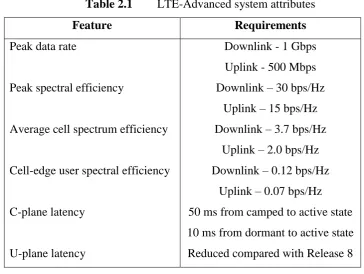
[image:27.595.136.501.307.581.2]The LTE Release 8 targets to provide a high data rate, reduced latency and seamless integration with existing systems. In 2008, further requirement advancements of the LTE Release 8 were approved to permit LTE to be accepted as a radio technology for International Mobile Telecommunications-Advanced (IMT-Advanced), known as LTE-Advanced. A representative list of LTE-Advanced requirements for the radio access network is given in Table 2.1 [43]–[48].
Table 2.1 LTE-Advanced system attributes
Feature Requirements
Peak data rate
Peak spectral efficiency
Average cell spectrum efficiency
Cell-edge user spectral efficiency
C-plane latency
U-plane latency
Downlink - 1 Gbps Uplink - 500 Mbps Downlink – 30 bps/Hz
Uplink – 15 bps/Hz Downlink – 3.7 bps/Hz
Uplink – 2.0 bps/Hz Downlink – 0.12 bps/Hz
Uplink – 0.07 bps/Hz 50 ms from camped to active state 10 ms from dormant to active state Reduced compared with Release 8
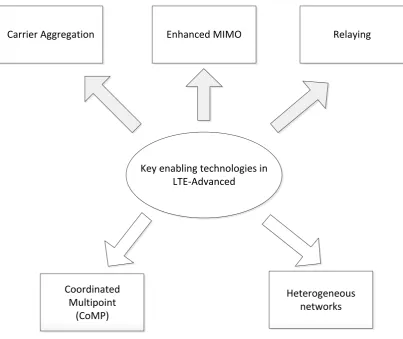
11 and supports heterogeneous deployment. Enhanced downlink spatial multiplexing extends the number of simultaneous data streams from four to eight. Relaying technique extends the network coverage area, hence improving the cell-edge performance. On the other hand, CoMP enhances the cell-edge data rates as well as the overall network data rates through base station (BS) coordination. Heterogeneous networks comprise of a traditional macrocell-based network augmented with various types of low-power nodes that address the capacity and coverage challenges resulting from the growth of data services.
Key enabling technologies in LTE-Advanced
Carrier Aggregation Enhanced MIMO Relaying
Coordinated Multipoint
(CoMP)
[image:28.595.116.520.259.598.2]Heterogeneous networks
12
2.2.2 CoMP Transmission
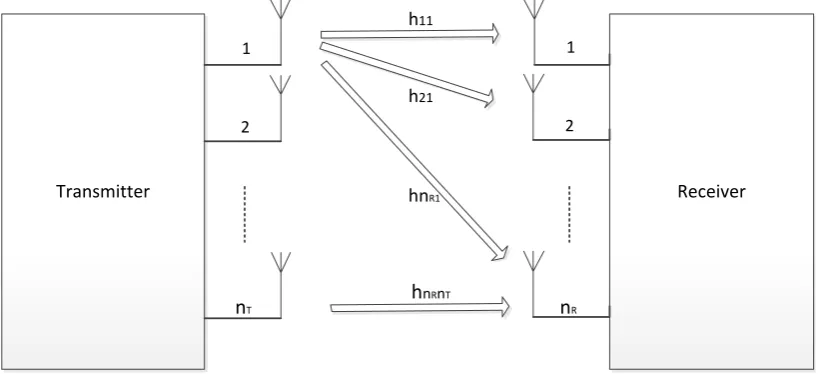
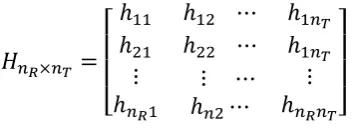
The capacity of a MIMO system employing transmit and receive antennas can be improved by the factor of min . Interestingly, it can be realized without using extra transmission power or bandwidth. MIMO systems have been actively studied and successfully implemented for the emerging broadband wireless access networks [3], [49]–[56]. Two types of downlink MIMO transmission techniques are supported; diversity techniques and spatial-multiplexing techniques [3]. The diversity techniques intend to improve the transmission reliability by transmitting the same data stream from multiple antennas. Meanwhile, spatial multiplexing can be used to support multi-user MIMO, whereby multiple data stream are simultaneously transmitted to different users using the same time-frequency resource [3]. The conceptual diagram of a MIMO system is presented in Figure 2.2.
Transmitter Receiver
1
2
nT
1
2
nR
h11
h21
hnR1
[image:29.595.114.524.369.556.2]hnRnT
Figure 2.2 An MIMO system
13
(2-1)
Among the key challenges encountered by wireless communication systems designers are fading and interference. Fading limits the coverage and reliability of any point-to-point wireless connection, meanwhile interference restricts the reusability of the resource [1], [4], [11], [16], [54]. The conventional multi-user MIMO forms a MIMO interference channel. Its spatial degrees of freedom are defined by the number of transmit antennas at each BS. If several BSs form a cooperating cluster, the network can have additional spatial degrees of freedom. This concept known as cooperative MIMO, network MIMO, virtual MIMO or CoMP which offer substantial performance gain and becomes an attractive research topic in wireless communication.
Recently, CoMP technology has been proposed in 3GPP LTE-Advanced as a promising way to boost the system spectrum efficiency and the cell-edge performance. Downlink CoMP implies dynamic coordination among multiple geographically separated transmission points or base stations (BSs) [57]. The backhaul link allows the exchange of information which is used to coordinate the BS transmissions such that interference generated to neighboring cells is minimized. In other word, the backhaul link is used for radio resource management (RRM) purposes including ICIC [58]. Two schemes are adopted in downlink CoMP transmission; joint processing (JP) and coordinated scheduling/ beamforming (CS/CB).
a) Joint Processing (JP)
[image:30.595.212.389.71.135.2]14 other UEs, or both [59]. Data intended for a UE is shared and jointly transmitted from all BSs in the CoMP network and the received signals at the UE will be coherently or non-coherently added up together [57].
Cell 1
Cell 2
Cell 3
UE1
[image:31.595.205.433.160.337.2]Backhaul network
Figure 2.3 DownlinkCoMP (JT) transmission
Further explanation on CoMP (JT) transmission scheme can be described as follows. As illustrated in Figure 2.3, assume that UE 1 is receiving signals from Cell 1 , Cell 2( ) and Cell 3 ( ). It is also assumed that is the channel gain from
to UE 1. Therefore, the received signal at UE 1, can be expressed as [59]:
(2-2)
15
(2-3)
where is the noise power. By applying CoMP (JT) transmission scheme, UE 1 now is being concurrently served by , and and the received signal at UE 1 is given by [59]:
(2-4)
The SINR of UE 1 is given as [59]:
(2-5)
Based on equation (2-5), it can be concluded that is set as the
upper-bound of and CoMP (JT) will constantly give a SINR improvement compared to single-cell transmission.
16
Cell 1
Cell 2
Cell 3
UE1 Backhaul
network Fast
selection
[image:33.595.204.432.69.262.2]Not scheduled
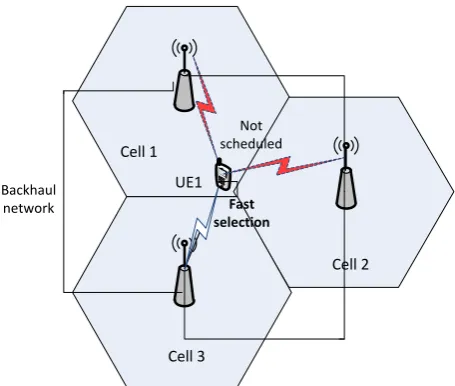
Figure 2.4 DownlinkCoMP (DCS) transmission
b)Coordinated Scheduling/Beamforming (CS/CB)
17
Cell 1
Cell 2
Cell 3
UE1
Interference coordinaation beamforming Backhaul
[image:34.595.232.468.69.263.2]network
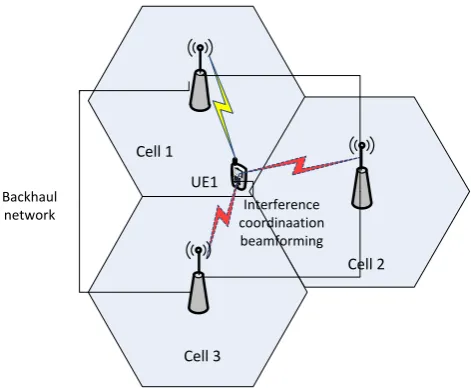
Figure 2.5 Downlink CoMP (CS/CB) transmission
2.2.3 Multicarrier Modulation and Multiple Access
18
Figure 2.6 Spectral characteristic of OFDM transmission scheme [3]
19
2.2.4 Downlink Radio Resources
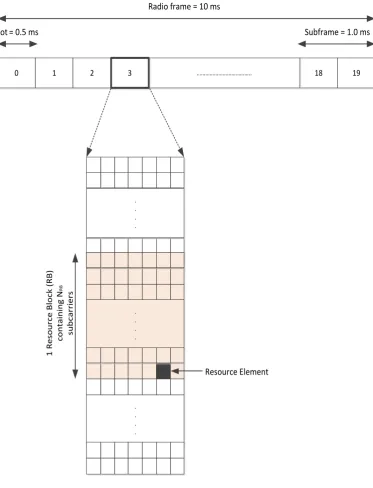
A radioframe consists of 10 subframes, each with 1 ms duration. Each subframe is made up of two 0.5 ms consecutive slots. Each slot is further spit into
OFDM symbols for the downlink transmission. It is assumed that each slot is
made up of seven OFDM symbols and resource element is one subcarrier in a single OFDM symbol. A resource block (RB) is expressed as consecutive subcarriers in the frequency domain and OFDM symbols in the downlink. Thus, a RB is
consists of resource elements, with 180 kHz frequency span and one
slot in time span. For the case of 15 kHz subcarrier spacing, is set to 12 [77], [78].
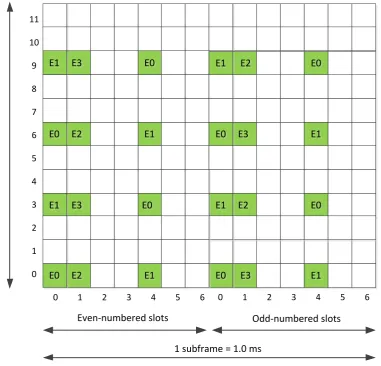
One of the fundamental technologies in LTE is the multiple antennas (i.e., MIMO) operation. The reference symbols enable the receiver to separate different antennas from each other. In order to prevent the corruption of channel estimation needed for MIMO stream separation, each reference symbol should be used by a single transmit antenna only, as illustrated in Figure 2.7. The reference symbols and empty resource elements are mapped to alternate between antennas. For the case of four antenna ports, the corresponding reference signals are denoted as and
20
0 1 2 3 ……….. 18 19
Radio frame = 10 ms
Slot= 0.5 ms Subframe = 1.0 ms
[image:37.595.137.511.128.617.2]. . . . . . . . . . . . 1 R e so u rc e B lo ck ( R B ) co n ta in in g N R B su b ca rr ie rs Resource Element
21
E1 E3 E0
E1 E3 E0
E0 E2 E1
E0 E2 E1
E1 E2 E0
E1 E2 E0
E0 E3 E1
E0 E3 E1
E1 E2 E0
E1 E2 E0
E1 E3 E0
E1 E3 E0
E0 E3 E1
E0 E3 E1
E0 E2 E1
E0 E2 E1
11 10 9 8 7 6 5 4 3 2 1 0 1 R B = 1 2 s u b ca rr ie rs
0 1 2 3 4 5 6 0 1 2 3 4 5 6
Even-numbered slots Odd-numbered slots
[image:38.595.135.517.81.447.2]1 subframe = 1.0 ms
Figure 2.8 OFDMA reference symbols to support MIMO transmission
2.3 Challenges of CoMP
2.3.1 Clustering
22 In general, the issue of clustering is approached from two different perspectives; static clustering and dynamic clustering. Static clusters are designed based on geographical criteria and kept constant over time. For instance in [84], it was shown that both in a hexagonal cell layout and under a realistic deployment, static clustering performs close to UE-specific clustering, while requiring negligible signaling overhead. Meanwhile, in the case of dynamic clustering, the system continuously adapts the clustering strategy to varying parameters such as UE locations and radio frequency (RF) conditions. Several dynamic clustering schemes that offer significant advancement are proposed in [79]–[81], [83]. The authors of [82] show that dynamically-clustered cooperative networks outperform both statically-clustered cooperative networks.
2.3.2 Synchonization
23
2.3.3 Channel Knowledge
Accurate channel estimation is the basis for any CoMP transmission scheme. Channel estimation affects precoding accuracy and defines an upper bound for possible performance gains. Specifically, CoMP (JP) faces several further challenges compared to conventional single link systems such as a high number of channel components to be estimated, strong multi-cell interference due to frequency reuse one and a high sensitivity of joint precoding with respect to estimation errors combined with the need for frequency-selective channel information [14].
Two dimensional Wiener filtering and subspace concept are two well-known channel estimation techniques [87]–[91]. The effective channel concept is presented which restricts the number of effective channel components to be estimated to the number of supported data streams. In 3GPP, similar concepts are discussed under the label of implicit versus explicit channel estimation and feedback [55], [92], [93]. The latter is more or less the direct feedback of the quantized channel components, while implicit includes pre- or postcoders like beamformers from an LTE Release 8 codebook.
2.3.4 Backhaul
24 The extent of these different types of backhaul data depends on the particular CoMP transmission scheme used and the chosen network topology. For instance, an inter-site BS cooperation can be considered as the worst case scenario, since a single backhaul link must support all incoming and outgoing backhaul traffic generated by BS cooperation. Meanwhile, if BS cooperation involves BSs located at the same site (intra-site BS cooperation), the information exchanged between cooperating BSs are not delivered through backhaul. When selecting a CoMP scheme, not only the related backhaul requirements must be considered, but also the achievable enhancement in spectrum efficiency and cell-edge performance.
2.4 Optimization Methods
Optimization methods are extensively applied in many areas such as engineering, economics, management, physical sciences, etc. The ultimate role of optimization methods is to select the best or a satisfactory one from amongst the possible solutions to an optimization problem [95]. The process of using optimization methods principally involves the formulation of the optimization problem and the selection of appropriate numerical method.
A metaheuristic method is an iterative generation process which combines different concepts for exploring (global search) and exploiting (local search) the search space [95]. Learning strategies are used to construct information to search near-optimal solutions. Examples of metaheuristic methods include evolutionary algorithms, tabu search, differential evolution and swarm intelligence.
2.4.1 Swarm Intelligence
129
REFERENCES
[1] A. S. Md Zain, A. Yahya, M. F. A. Malek, and N. Omar, “Improving Performance-limited Interference System with Coordinated Multipoint Transmission,” Procedia Eng., vol. 53, pp. 428–434, Jan. 2013.
[2] M. S. Obaidat, A. Anpalagan, I. Woungang, D. T. Ngo, D. H. N. Nguyen, and T. Le-Ngoc, Handbook of Green Information and Communication Systems. Elsevier, 2013, pp. 147–182.
[3] G. K. Yong, S. C., Jaekwon, K., Won, Y. Y. and Chung, MIMO-OFDM
Wireless Communications with MATLAB. 2010.
[4] R. W. Peters, Steven W and Heath, “Cooperative algorithms for MIMO interference channels,” Veh. Technol. IEEE Trans., vol. 60, pp. 206–218, 2011.
[5] A. Mahmud, K. A. Hamdi, and N. Ramli, “Performance of fractional frequency reuse with comp at the cell-edge,” 2014 Ieee Reg. 10 Symp., pp. 93– 98, Apr. 2014.
[6] J. P. Perez, F. Riera-Palou, and G. Femenias, “Combining fractional frequency reuse with coordinated multipoint transmission in MIMO-OFDMA networks,”
2013 IFIP Wirel. Days, pp. 1–8, Nov. 2013.
[7] J. Li, H. Zhang, X. Xu, X. Tao, T. Svensson, C. Botella, and B. Liu, “A Novel Frequency Reuse Scheme for Coordinated Multi-Point Transmission,” 2010
IEEE 71st Veh. Technol. Conf., pp. 1–5, 2010.
[8] J. Hwang, S. M. Yu, S.-L. Kim, and R. Jantti, “On the Frequency Allocation for Coordinated Multi-Point Joint Transmission,” 2012 IEEE 75th Veh.
Technol. Conf. (VTC Spring), vol. 1, pp. 1–5, May 2012.
[9] K. R. Han, Zhu and Liu, Resource allocation for wireless networks. Cambridge university press, 2008.
130 [11] L. Sun, Shaohui and Gao, Qiubin and Peng, Ying and Wang, Yingmin and Song, “Interference management through CoMP in 3GPP LTE-advanced networks,” Wirel. Commun. IEEE, vol. 20, no. 1, pp. 59–66, 2013.
[12] M. Sawahaschi, Y. Kishiyama, A. Morimoto, D. Nishikawa, and M. Tanno, “Coordinated Multipoint Transmission/Reception Techniques for LTE-Advanced,” IEEE Wirel. Commun., vol. 17, no. 3, pp. 26–34, 2010.
[13] C. Yang, S. Han, X. Hou, and A. F. Molish, “How do we design CoMP to achieve Its Promised Potential?,” IEEE Wirel. Commun., vol. 20, no. 1, pp. 67–74, 2013.
[14] G. P. Marsch, Patrick and Fettweis, Coordinated Multi-Point in Mobile
Communications: from theory to practice. Cambridge University Press, 2011.
[15] D. Lee, H. Seo, L. G. Electronics, B. Clerckx, S. Electronics, E. Hardouin, O. Labs, D. Mazzarese, and H. Technologies, “Coordinated Multipoint Transmission and Reception in LTE-Advanced : Deployment Scenarios and Operational Challenges,” Commun. Mag. IEEE, vol. 50, no. 2, pp. 148–155, 2012.
[16] D. Gesbert, S. Hanly, H. Huang, S. Shamai Shitz, O. Simeone, and W. Yu, “Multi-cell MIMO cooperative networks: A new look at interference,” Sel.
Areas Commun. IEEE J., vol. 28, no. 9, pp. 1380–1408, 2010.
[17] Q. Zhang, C. Yang, and A. F. Molisch, “Cooperative downlink transmission mode selection under limited-capacity backhaul,” 2012 IEEE Wirel. Commun.
Netw. Conf., pp. 1082–1087, Apr. 2012.
[18] Q. Zhang, C. Yang, and A. F. Molisch, “Downlink Base Station Cooperative Transmission,” IEEE Trans. Wirel. Commun., vol. 12, no. 8, pp. 3746–3759, 2013.
[19] P. Rost, “Robust and Efficient Multi-Cell Cooperation under Imperfect CSI and Limited Backhaul,” IEEE Trans. Wirel. Commun., vol. 12, no. 4, pp. 1910–1922, Apr. 2013.
[20] C. Choi, L. Scalia, T. Biermann, and S. Mizuta, “Coordinated multipoint multiuser-MIMO transmissions over backhaul-constrained mobile access networks,” 2011 IEEE 22nd Int. Symp. Pers. Indoor Mob. Radio Commun., pp. 1336–1340, Sep. 2011.
[21] A. Zhang, Qian and Yang, Chenyang and Molisch, “Downlink Base Station Cooperative Transmission Under Limited-Capacity Backhaul,” IEEE Trans.
Wirel. Commun., vol. 12, no. 8, pp. 3746–3759, 2013.
[22] T. Biermann, L. Scalia, C. Choi, H. Karl, and W. Kellerer, “CoMP clustering and backhaul limitations in cooperative cellular mobile access networks,”
131 [23] D. Hossain, Ekram and Le, Long Bao and Niyato, Radio resource
management in multi-tier cellular wireless networks. John Wiley and Sons,
2013.
[24] K. LIU, Y. LI, H. JI, and X. WU, “Spectrum efficiency sub-carrier and energy efficiency power allocation for downlink multi-user CoMP in multi-cell system,” J. China Univ. Posts Telecommun., vol. 21, no. 3, pp. 29–34, Jun. 2014.
[25] X. Chen, X. Xu, H. Li, X. Tao, T. Svensson, and C. Botella, “Improved resource allocation strategy in SU-CoMP network,” J. China Univ. Posts
Telecommun., vol. 18, no. 4, pp. 7–12, Aug. 2011.
[26] W. Cui, K. Niu, N. Li, and W. Wu, “Decentralized beamforming design and power allocation for limited coordinated multi-cell network,” J. China Univ.
Posts Telecommun., vol. 20, no. 4, pp. 52–58, Aug. 2013.
[27] D. Choi, S. Member, D. Lee, and J. H. Lee, “Resource Allocation for CoMP With Multiuser MIMO-OFDMA,” IEEE Trans. Veh. Technol., vol. 60, no. 9, pp. 4626–4632, 2011.
[28] J. Li, T. Svensson, C. Botella, T. Eriksson, X. Xu, and X. Chen, “Joint Scheduling and Power Control in Coordinated Multi-Point Clusters,” 2011
IEEE Veh. Technol. Conf. (VTC Fall), pp. 1–5, Sep. 2011.
[29] L. Chen, L. Cao, X. Zhang, and D. Yang, “A coordinated scheduling strategy in multi-cell OFDM systems,” 2010 IEEE Globecom Work., pp. 1197–1201, Dec. 2010.
[30] M. G. Kibria, H. Murata, and J. Zheng, “Distributed Weighted Sum-Rate Maximization in,” in IEEE ICC 2014 Wireless Communications Symposium, 2014, pp. 5137–5141.
[31] S. Mehdi, H. Andargoli, and K. Mohamed-pour, “Resource Allocation for Downlink Multicell OFDMA Systems by Interference Limitation,” in
Electrical Engineering (ICEE), 2011 19th Iranian Conference on, 2011.
[32] S. Han, B.-H. Soong, and Q. D. La, “Subcarrier allocation in multi-cell OFDMA wireless networks with non-coherent base station cooperation and controllable fairness,” 2012 IEEE 23rd Int. Symp. Pers. Indoor Mob. Radio
Commun., pp. 524–529, Sep. 2012.
[33] M. Carneiro, Gustavo and Ruela, Jos{’e} and Ricardo, “Cross-layer design in 4 G wireless terminals,” IEEE Wirel. Commun., vol. 11, no. 2, pp. 7–13, 2004. [34] M. Srivastava, Vineet and Motani, “Cross-layer design: a survey and the road
132 [35] F. Foukalas, V. Gazis, and N. Alonistioti, “Cross-layer design proposals for wireless mobile networks: A survey and taxonomy,” IEEE Commun. Surv.
Tutorials, vol. 10, no. 1, pp. 70–85, 2008.
[36] P. C. Shakkottai, Sanjay and Rappaport, Theodore S and Karlsson, “Cross-layer design for wireless networks,” Commun. Mag. IEEE, vol. 41, no. 10, pp. 74–80, 2003.
[37] S. Liu, Pei and Tao, Zhifeng and Lin, Zinan and Erkip, Elza and Panwar, “Cooperative wireless communications: a cross-layer approach,” Wirel.
Commun. IEEE, vol. 13, no. 4, pp. 84–92, 2006.
[38] I. G. Fraimis, V. D. Papoutsis, and S. A. Kotsopoulos, “A Decentralized Subchannel Allocation Scheme with Inter-cell Interference Coordination (ICIC) for Multi-Cell OFDMA Systems,” in IEEE Global Communications
Conference, Exhibition and Industry Forum (GLOBECOM), 2010.
[39] L. Lu, Q. Daiming, J. Tao, and D. Jie, “Coordinated User Scheduling and Power Control for Weighted Sum Throughput Maximization of Multicell Network,” in IEEE Global Communications Conference, Exhibition and
Industry Forum (GLOBECOM), 2010.
[40] Y. Yiwei, D. Eryk, H. Xiaojing, and M. Markus, “Downlink Resource Allocation for Next Generation Wireless Networks with Inter-cell Interference,” IEEE Trans. Wirel. Commun., vol. 12, no. 4, pp. 1783–1793, 2013.
[41] G. A. Ana, S. F. Matilde, and R. C., “Constrained Power Allocation Schemes for Coordinated Base Station Transmission using Block Diagonalization,”
EURASIP J. Wirel. Commun. Netw., 2011.
[42] Z. Lu, Y. Yang, X. Wen, Y. Ju, and W. Zheng, “A cross-layer resource allocation scheme for ICIC in LTE-Advanced,” J. Netw. Comput. Appl., vol. 34, no. 6, pp. 1861–1868, Nov. 2011.
[43] E. Dahlman, S. Parkvall, and J. Sköld, 4G: LTE/LTE-Advanced for Mobile
Broadband. Elsevier, 2014, pp. 371–385.
[44] R. Ghosh, Amitabha and Ratasuk, Essentials of LTE and LTE-A. Cambridge University Press, 2011.
[45] R. Ghosh, Arunabha and Zhang, Jun and Andrews, Jeffrey G and Muhamed,
Fundamentals of LTE. Pearson Education, 2010.
[46] A. Holma, Harri and Toskala, LTE for UMTS: Evolution to LTE-advanced. John Wiley and Sons, 2011.
[47] A. Ghosh, R. Ratasuk, N. Mondal, Bishwarup Mangalvedhe, and T. Thomas, “LTE-advanced: next-generation wireless broadband technology,” Wirel.
133 [48] S. Kanchi, S. Sandilya, D. Bhosale, A. Pitkar, and M. Gondhalekar, “Overview of LTE-A technology,” in 2013 IEEE Global High Tech Congress
on Electronics, 2013, pp. 195–200.
[49] E. Biglieri, A. Calderbank, Robert Constantinides, Anthony Goldsmith, and H. V. Paulraj, Arogyaswami Poor, MIMO wireless communications. Cambridge University Press, 2007.
[50] D. Wang, J. Wang, S. Member, X. You, Y. Wang, M. Chen, and X. Hou, “Spectral Efficiency of Distributed MIMO Systems,” IEEE J. Sel. Areas
Commun., vol. 31, no. 10, pp. 2112–2127, 2013.
[51] K. Kusume, G. Dietl, T. Abe, H. Taoka, and S. Nagata, “System Level Performance of Downlink MU-MIMO Transmission for 3GPP LTE-Advanced,” 2010 IEEE 71st Veh. Technol. Conf., pp. 1–5, 2010.
[52] T. L. Narasimhan, P. Raviteja, and a. Chockalingam, “Large-scale multiuser SM-MIMO versus massive MIMO,” 2014 Inf. Theory Appl. Work., pp. 1–9, Feb. 2014.
[53] L. Liu, R. Chen, S. Geirhofer, K. Sayana, Z. Shi, and Y. Zhou, “Downlink MIMO in LTE-Advanced :,” IEEE Commun. Mag., no. February, pp. 140– 147, 2012.
[54] M. Chiani, M. Z. Win, and H. Shin, “MIMO Networks : The Effects of Interference,” IEEE Trans. Inf. Theory, vol. 56, no. 1, pp. 336–349, 2010. [55] O. Y. Bursalioglu, S. a. Ramprashad, and H. C. Papadopoulos, “Towards
improving LTE SU/MU-MIMO performance: Issues in channel estimation, interpolation and feedback,” 2012 Conf. Rec. Forty Sixth Asilomar Conf.
Signals, Syst. Comput., pp. 699–706, Nov. 2012.
[56] Y. Kim, H. Ji, H. Lee, and J. Lee, “Evolution beyond LTE-advanced with Full Dimension MIMO,” 2013 IEEE Int. Conf. Commun. Work., pp. 111–115, Jun. 2013.
[57] “3GPP TS 36.189 V.11.1.0 (2011-12) 3GPP Technical Specification Group Radio Access Network; Coordinated Multipoint operation for LTE Physical Layer Aspects (Release 11).”
[58] “3GPP TS 36.420 V.10.0.1 (2011-03); 3GPP Technical Specification Group Radio Access Network; EUTRAN; X2 General Aspects and Principles (Release 10).”
[59] Y. Nam, L. Liu, Y. Wang, C. Zhang, J. Cho, and J. Han, “Cooperative Communication Technologies for,” in International Conference on Acoustics,
Speech and Signal Processing (ICASSP), 2010, pp. 5610–5613.
134
Mediterranean Electrotechnical Conference, Beirut, Lebanon, 2014, no. April,
pp. 344–349.
[61] B. Wang, B. Li, and M. Liu, “A Novel Precoding Method for Joint Processing in CoMP,” 2011 Int. Conf. Netw. Comput. Inf. Secur., pp. 126–129, May 2011. [62] D. Hui and K. Zangi, “Error Compensated MMSE-Based Multi-User Precoding for Coordinated Multi-Point Transmission,” 2012 IEEE 75th Veh.
Technol. Conf. (VTC Spring), pp. 1–5, May 2012.
[63] L. Qiang, Y. Yang, F. Shu, and W. Gang, “SLNR precoding based on QBC with limited feedback in downlink CoMP system,” 2010 Int. Conf. Wirel.
Commun. Signal Process., pp. 1–5, Oct. 2010.
[64] P. Baracca and D. Aziz, “Clustering and Precoding Design for CoMP-CB in Downlink Heterogeneous Networks,” in 11th International Symposium on
Wireless Communications Systems, 2014, pp. 59–63.
[65] R. a. Abdelaal, K. Elsayed, and M. H. Ismail, “Cooperative scheduling, precoding, and optimized power allocation for LTE-advanced CoMP systems,” 2012 IFIP Wirel. Days, pp. 1–6, Nov. 2012.
[66] Y. Xu, R. Q. Hu, Q. Li, and Y. Qian, “Optimal intra-cell cooperation with precoding in wireless heterogeneous networks,” 2013 IEEE Wirel. Commun.
Netw. Conf., pp. 761–766, Apr. 2013.
[67] J. Thompson, “Out of Group Interference Aware Precoding for CoMP : An Ergodic Search Based Approach,” in IEEE 22nd International Symposium on
Personal, Indoor and Mobile Radio Communications (PIMRC), 2011, pp.
1470–1474.
[68] Y. Xu, H. Zhou, and Y. Wang, “A Novel Precoding Scheme in Coordinated Multi- point Transmission Systems,” in IEEE GLOBECOM Workshops, 2011, pp. 426–430.
[69] Z. Xiaona, Y. Long-xiang, D. Meiling, and W. Zhihua, “Distributed Precoding for Multicell-MISOO Downlink CoMP,” in IEEE 13th International
Conference on Communication Technology, 2011, vol. 2, pp. 436–440.
[70] Z. Xu, C. Yang, G. Y. Li, Y. Liu, and S. Xu, “Energy-Ef fi cient CoMP Precoding in Heterogeneous Networks,” IEEE Trans. Signal Process., vol. 62, no. 4, pp. 1005–1017, 2014.
[71] G. Morozov and A. Davydov, “CS/CB CoMP scheme with semi-static data traffic offloading in HetNets,” 2013 IEEE 24th Annu. Int. Symp. Pers. Indoor,
Mob. Radio Commun., pp. 1347–1351, Sep. 2013.
[72] H. Sun, W. Fang, J. Liu, and Y. Meng, “Performance evaluation of CS/CB for coordinated multipoint transmission in LTE-A downlink,” 2012 IEEE 23rd
135 [73] Q. Wang, S. Jin, Q. Sun, X. Li, Y. Huang, and X. Gao, “On downlink coordinated scheduling for inter-cell interference alleviation with inter-BS cooperation,” 2012 IEEE Globecom Work., pp. 1178–1182, Dec. 2012.
[74] W. Ning, T. Zhang, C. Feng, W. Zhao, and Y.-N. Li, “An opportunistic feedback scheme for downlink coordinated scheduling/beamforming,” 2012
Comput. Commun. Appl. Conf., pp. 76–80, Jan. 2012.
[75] Y. Yang, B. Bai, W. Chen, and L. Hanzo, “A Low-Complexity Cross-Layer Algorithm for Coordinated Downlink Scheduling and Robust Beamforming Under a Limited Feedback Constraint,” IEEE Trans. Veh. Technol., vol. 63, no. 1, pp. 107–118, 2014.
[76] Z. Xiong, H. Yang, M. Zhang, Y. Meng, and Y. Pan, “Feedback and Scheduling for Coordinated Beamforming of CoMP in LTE-Advanced System,” 2013 IEEE 78th Veh. Technol. Conf. (VTC Fall), pp. 1–5, Sep. 2013. [77] “3GPP TS 36.201 V.11.1.0 (2012-12) Technical Specification; 3GPP Technical Specification Group Radio Access Network; E-UTRA; LTE Physical Layer; General description (Release 11).”
[78] “3GPP TS 36.211 V.12.2.0 (2014-06) Technical Specification; 3GPP Technical Specification Group Radio Access Network; E-UTRA; LTE Physical Channels and Modulation (Release 12).”
[79] A. Papadogiannis and G. C. Alexandropoulos, “The value of dynamic clustering of base stations for future wireless networks,” Int. Conf. Fuzzy Syst., pp. 1–6, Jul. 2010.
[80] W. Fang, “Dynamic cell clustering design for realistic coordinated multipoint downlink transmission,” 2011 IEEE 22nd Int. Symp. Pers. Indoor Mob. Radio
Commun., pp. 1331–1335, Sep. 2011.
[81] W. Xu, J. Huang, F. Yang, and H. Zhang, “Dynamic Cell Clustering for CoMP in LTE-A and Its Calibrated System Level Performance,” in IEEE 5th International Symposium on Microwave, Antenna, Propagation and EMC
Technologies for Wireless Communications (MAPE), 2013, pp. 71–77.
[82] B. a. Bash, D. Goeckel, and D. Towsley, “Clustering in cooperative networks,” 2011 Proc. IEEE INFOCOM, pp. 486–490, Apr. 2011.
[83] E. Katranaras, M. A. Imran, and M. Dianati, “Energy-aware clustering for multi-cell joint transmission in LTE networks,” 2013 IEEE Int. Conf.
Commun. Work., pp. 419–424, Jun. 2013.
136 [85] D. L. Mils, “A Brief History of NTP Time: Memoirs of an Internet Timekeeper,” ACM SIGCOMM Comput. Commun. Rev., no. April, pp. 9–21, 2003.
[86] M. Kiess, W., Zalewski, S. and Mauve, “Improving System Clock Precision With NTP Offline Skew Correction,” in Mediterranean Ad Hoc Networking
Workshop, 2007.
[87] H. Jinfeng and L. Jian, “A Novel Channel Estimation Algoriithm for 3GPP LTE Downlink System using Joint Time-Frequency Two-Dimensional Iterative Wiener Filter,” in 12th IEEE International Conference on
Communication Technology (ICCT), 2010, pp. 289–292.
[88] W. W. Chee, C. L. Law, and L. G. Yong, “Channel Estimator for OFDM Systems with 2-dimensional filtering in the transform domain,” in IEEE 53rd
Vehicular Technology Conference (VTC), 2001, pp. 717–721.
[89] L. Y. Jung and Y. H. Da, “Subspace Channel Estimation Assisted by Block Matrix Scheme for ZP-OFDM System,” in 6th International Conference on
Wireless and Mobile Communications (ICWMC), 2010, pp. 16–20.
[90] L. Y. Jung and Y. H. Da, “A Novel Subspace Channel Estimation with Fast Convergence for ZP-OFDM Systems,” IEEE Trans. Wirel. Commun., vol. 10, pp. 3168–3173, 2011.
[91] J. Vinogradova, N. Sarmadi, and M. Pesavento, “Subspace-based Semiblind Channel Estimation Method for Fast Fading Orthogonally coded MIMO-OFDM Systems,” in 4th IEEE International Workshop on Computational
Advances in Multi-Sensor Adaptive Processing (CAMSAP), 2011, pp. 153–
156.
[92] L. Falconetti and C. Hoymann, “Codebook based Inter-Cell Interference Coordination for LTE,” 21st Annu. IEEE Int. Symp. Pers. Indoor Mob. Radio
Commun., pp. 1769–1774, Sep. 2010.
[93] K. Kusume, K. Khashaba, G. Dietl, and W. Utschick, “Hybrid Single/Multi-user MIMO Transmission Based on Implicit Channel Feedback,” in IEEE
International Conference on Communications (ICC), 2011.
[94] Z. Jian, T. Q. S. Quek, and L. Zhongding, “Coordinated Multipoint Transmission with Limited Backhaul Data Transfer,” IEEE Trans. Wirel.
Commun., pp. 2762–2775, 2013.
[95] J. Sung, C. H. Lai, and X. J. Wu, Particle Swarm Optimization: Classical and
Quantum Perspectives. CRC Press, Taylor & Francis Group, 2012.
137 [97] R. Deepak and T. Kirti, “Bio-Inspired Optimization Techniques-A Critical
Comparative Study,” ACM SIGSOFT Softw. Eng. Notes, vol. 38, no. 4, 2013. [98] S. Binitha and S. S. Sathya, “A Survey of Bio-Inspired Optimization
Algorithms,” Int. J. Soft Comput. Eng., vol. 2, no. 2, 2012.
[99] I. Ahmed, M. Ieee, and S. P. Majumder, “Adaptive Resource Allocation Based on Modified Genetic Algorithm and Particle Swarm Optimization for Multiuser OFDM Systems,” no. December, pp. 20–22, 2008.
[100] I. Ahmed, S. Sadeque, and S. Pervin, “Margin adaptive resource allocation for multiuser OFDM systems by modified Particle Swarm Optimization and Differential Evolution,” CONIELECOMP 2011, 21st Int. Conf. Electr.
Commun. Comput., pp. 227–231, Feb. 2011.
[101] R. Annauth and H. C. S. Rughooputh, “OFDM Systems Resource Allocation using Multi- Objective Particle Swarm Optimization,” vol. 4, no. 4, 2012. [102] H. Zhu and J. Wang, “Chunk-based Resource Allocation in OFDMA Systems
- Part II: Joint Chunk, Power and Bit Allocation,” IEEE Trans. Commun., vol. 60, no. 2, pp. 499–509, 2012.
[103] X. Wang and G. B. Giannakis, “Resource Allocation for Wireless Multiuser OFDM Networks,” IEEE Trans. Inf. Theory, vol. 57, no. 7, 2011.
[104] J. Bai, Y. Yin, and Y. Wang, “Dynamic Resource Allocation in OFDMA Systems,” in Cross Strait Quad-Regional Radio Science and Wireless
Technology Conference (CSQRWC), 2011, pp. 839–842.
[105] D. Kivanc, G. Li, and H. Liu, “Computationally Efficient Bandwidth Allocation and Power Control for OFDMA,” IEEE Trans. Wirel. Commun., vol. 2, no. 6, pp. 1150–1158, 2003.
[106] M. Ergen, S. Coleri, and P. Varaiya, “QoS Aware Adaptive Resource Allocation Techniques for Fair Scheduling in OFDMA based Broadband Wireless Access Systems,” IEEE Trans. Broadcast., vol. 49, no. 4, pp. 362– 370, 2003.
[107] I. Kim, I. S. Park, and Y. H. Lee, “Use of Linear Programming for Dynamic Subcarrier and Bit Allocation in Multiuser OFDM,” IEEE Trans. Veh.
Technol., vol. 35, no. 4, pp. 1195–1207, 2006.
[108] Z. Shen, J. G. Andrews, and B. L. Evans, “Adaptive Resource Allocation in Multiuser OFDM systems with Proportional Rate Constraints,” IEEE Trans.
Wirel. Commun., vol. 4, no. 6, pp. 2726–2737, 2005.
138 [110] G. Song and Y. Li, “Cross-Layer Optimization for OFDM Wireless Networks - Part II: Algorithm Development,” IEEE Trans. Wirel. Commun., vol. 4, no. 2, pp. 625–634, 2005.
[111] S. Zhu, G. Lv, and H. Hui, “A Low-Complexity Heuristic Adaptive Resource Allocation Algorithm for Multiuser OFDM under Rate Constraints,” in 4th
International Conference on Communications and Networking in China, 2009.
[112] Y. Gao, H. Xu, T. Hui, and Z. Ping, “A QoS-Guaranteed Adaptive Resource Allocation Algorithm with Low-Complexity in OFDMA Systems,” in
International Conference on Wireless Communications, Networking and
Mobile Computing, 2006.
[113] S. Y. Yeo and H. K. Song, “Low Complex and High Reliable Resource Allocation for Multiuser OFDM System,” in Congress on Image and Signal
Processing, 2008, pp. 95–99.
[114] S. Schwarz, C. Mehlfuhrer, and M. Rupp, “Low Complexity Approximate Maximum Throughput Scheduling for LTE,” in Conference Record of the
44th Asilomar Conference on Signals, Systems and Computers, 2010, pp.
1563–1569.
[115] W. Ben Hassen, M. Afif, and S. Tabbane, “A Low Complexity Resource Allocation Scheme using AMC for MIMO-OFDMA systems,” in 21st
International Conference on Telecommunications (ICT), 2014, pp. 160–165.
[116] Z. Huiling and D. Karachontzitis, S. Toumparakis, “Low Complexity Resource Allocation and Its Application to Distributed Antenna System,”
IEEE Wirel. Commun., pp. 44–50, 2010.
[117] N. Ul Hassan and M. Assaad, “Low Complexity Margin Adaptive Resource Allocation in Downlink MIMO-OFDMA System,” IEEE Trans. Wirel.
Commun., pp. 3365–3371, 2009.
[118] H. Ayad, K. E. Baamrani, and A. A. Ouahman, “A Low Complexity Resource Allocation Algorithm based on the Best Subchannel for Multiuser MIMO-OFDMA System,” in International Conference on Multimedia Computing and
Systems, 2011.
[119] C. Po-Chien, M. Chun-Ying, and H. Chia Chi, “Chunk-based Resource Allocation Under User Rate Constraints in Multiuser MIMO-OFDMA Systems,” in 12th International Conference on Telecommunications, 2012, pp. 857–861.
[120] S. Karachonzitis and T. Dagiuklas, “A Chunk-based Resource Allocation Scheme for Downlink MIMO-OFDMA Channel using Linear Precoding,” in
IEEE Symposium on Computers and Communications (ISCC), 2011, pp. 931–
139 [121] C. Chen, C. Lv, Y. Jiang, and T. Wang, “A Scheduling Technique for the Downlink of Multiuser MIMO Channels,” 2010 Int. Conf. Comput. Intell.
Softw. Eng., pp. 1–5, Sep. 2010.
[122] G. Gupta, A. K. Chaturvedi, and S. Member, “User Selection in MIMO Interfering Broadcast Channels,” IEEE Trans. Commun., vol. 62, no. 5, pp. 1568–1576, 2014.
[123] C. Cho, J. W. Kang, and S.-H. Kim, “Opportunistic maximum rate user selection with low complexity in MIMO interference channel,” 2012 IEEE
23rd Int. Symp. Pers. Indoor Mob. Radio Commun. -, pp. 732–637, Sep. 2012.
[124] R. Kudo, Y. Takatori, T. Murakami, and M. Mizoguchi, “User Selection for Multiuser MIMO Systems Based on Block Diagonalization in Wide-Range SNR Environment,” 2011 IEEE Int. Conf. Commun., pp. 1–5, Jun. 2011. [125] X. Xie and X. Zhang, “Scalable user selection for MU-MIMO networks,”
IEEE INFOCOM 2014 - IEEE Conf. Comput. Commun., pp. 808–816, Apr.
2014.
[126] Y. Seki, O. Takyu, and Y. Umeda, “Performance evaluation of user selection based on average SNR in base station cooperation multi-user MIMO,” 2010
IEEE Radio Wirel. Symp., pp. 685–688, Jan. 2010.
[127] R. Zhang, “Cooperative Multi-cell Block Diagonalization with per-BS Power Constraints,” IEEE J. Sel. Areas Commun., vol. 28, no. 9, 2010.
[128] D. Choi, D. Lee, and J. H. Lee, “Resource Allocation for CoMP with Multiuser MIMO-OFDMA,” IEEE Trans. Veh. Technol., vol. 6, no. 9, 2011. [129] C. Jingya, L., Tommy, S., Carmen, B., Thomas, E., Xiaodong, X. and Xin,
“Joint Scheduling and Power Control in Coordinated Multipoint Clusters,” in
IEEE Vehicular Technology Conference (VTC), 2011.
[130] C. Li, C. Lei, Z. Xin, and Y. Dacheng, “A Coordinated Scheduling Strategy in Multicell OFDM Systems,” in IEEE Global Communications Conference,
Exhibition and Industry Forum (GLOBECOM), 2010.
[131] C. Gustavo, P. Inesc, R. Jose, and R. Manuel, “Cross-Layer Design in 4G Wireless Terminals,” IEEE Wirel. Commun., no. April, pp. 7–13, 2004.
[132] S. Sanjay and S. R. Theodore, “Cross-Layer Design for Wireless Networks,”
IEEE Commun. Mag., no. October, pp. 74–80, 2003.
[133] V. D. S. Mihaela and S. S. N. Davis, “Cross-Layer Wireless Multimedia Transmission: Challenges, Principles and New Paradigms,” IEEE Wirel.
Commun., no. August, pp. 50–58, 2005.

![Figure 2.6 Spectral characteristic of OFDM transmission scheme [3]](https://thumb-us.123doks.com/thumbv2/123dok_us/8763835.895349/35.595.134.505.76.531/figure-spectral-characteristic-ofdm-transmission-scheme.webp)