
An Open STEP-NC Controller Via LabVIEW platform
D.M.Elias
1, a, Yusri Yusof
1,band Mohammad Minhat
2,c 1Faculty of Mechanical and Manufacturing Engineering
University Tun Hussein Onn Malaysia (UTHM)
86400 Parit Raja, Batu Pahat, Johor, Malaysia
2
Faculty of Manufacturing Engineering
University Teknikal Malaysia Melaka (UTeM),
Karung Berkunci No.1752, Pejabat Pos Durian Tunggal,
Melaka, Malaysia.
a
[email protected], [email protected], [email protected]
Keywords: STEP-NC, STEP, open system, Interpreter, STEP-NC controller
Abstract. In future technology in the field of advanced manufacturing, an open architecture controller in CNC system is studied. In this paper, the LabVIEW software platform is chosen and software realization methodology for the CNC system is determined for this application. This research project aims to meet the requirement of open architecture to create a CNC system based on new ISO standards of ISO 14649 and ISO 10303. As a result, open 3-Axis Mill CNC system
controller based on component software reuse technology successfully developed. Two case studies
of ISO 14649 (example 1 and example 2) were carried out through this developed system.
Introduction
Today, the CNC system already outdated and unchanged of using G/M code or ISO 6983 as a programming language for more than 60 years. The G/M codes of the tool path are generated through CAD/CAM. However, the CNCs of different vendors implement different versions of G-codes, which lack any portability and lead to proprietary CAx chains [1]. The CAM software is needed in order to generate G/M code from the CAD data, and it depends on the different vendor of the machine, from different manufacturers. The resulting machine code will differ in terms of cutting tools and other auxiliary components depending on the type of CNC machine. The Post-Processor found in a CAM will serve to produce G/M code, machine tools and data for a specific CNC machine. According to [2], the flow of process data is uni-directional and there is no feedback to the CNC system controller. These capabilities of current technology have made the programming task increasingly more difficult and needs more effort on development of the open controller.
The contemporary CNC system required and demanded to have modular structure, open architecture and ability of reconstruction in both software and hardware in order to meet the latest technology development, market and organizational structure in manufacturing system. The
LabVIEW or Laboratory Virtual Instrumentation Engineering Workbench software is a reuse
technology that can meet the requirement of the open architecture system, especially the components that are in accord with interface standards can be easily integrated to the system act as plug and play method. Thus, the system can be developed independently according to new ISO standards (ISO 14649 or STEP-NC, and ISO 10303 or STEP). With the possibility for reusing software components, the performance of the overall system increases simply by redesign the hardware platform of the existing CNC machine.
this controller involved a new hardware and software design for the Denford 3-axis CNC mill
machine that offers interoperability, portability, adaptability, and open system.
Related Work
After a long time, various efforts have been undertaken to make CNC technology towards a more sophisticated system with the use of networking between machine and PC. Open Architecture Control (OAC) is a well known term in the field of machine control. Since the early nineties several initiatives world-wide have worked on concepts for enabling control vendors, machine tool builders and end-users to benefit more from flexible and agile production facilities [3]. Open system project involved as the ESPRIT III project OSACA (Open System Architecture for Controls within Automation systems) of the European Commission the necessary specifications for an open control system were worked out and first prototypes of the system platform were realized [4]. It consists of a system platform which contains hardware and system software and a set of modules of application software with control specific functionality [4]. Another project called Open Modular Architecture Controllers (OMAC) was in USA. An effort was undertaken within OMAC to define API specification for eventual submittal to an established standards body [3] and OMAC changes its name to the Organization for Machine Automation and Control [5]. Furthermore, OSACA and OMAC have made some efforts in order to realise an open architecture control, and third party software can be used at the controller working within a standard Windows operating system [6]. In open system, there is a major opportunity to improve the programming of CNC equipment through intelligent programming of today’s highly sophisticated CNC machine tools [7].
Now, CNC multi-workstation configuration process has been changed to support the manufacturing industry, particularly in automotive manufacturing from low-volume to high-volume of volatile production components. This configuration provides a more flexible production of larger quantities involving more complex geometries, from the smallest to biggest a part, from the various combinations of materials and it is difficult to achieve through current standard. In future the manufacturing should more flexible and intelligent and with the concept found expression in DA-BA-SA (Design-Anywhere, Build-Anywhere, Support- Anywhere), which has become the catch phrase of e-Manufacturing [8]. STEP-NC as a new language has solution to replace the G and M codes that are used since 1950s in CNC.
In the STEP-NC control system, Physical file part 21 is generated by CAD software will be converted into Java classes. Then, a STEP-NC interpreter designed to process data from the physical file part 21 in ISO 14649 to generate the tool-path for machining [9]. The main focus of the this open control systems to enable the STEP-NC data model with bi-directional control at low-cost and improves interoperability, efficiency, portability, and flexibility of the machining processes [10].
STEP-NC data Model
Two standards (ISO 10303-21 and ISO 14649) [11, 12] were used in this system. In ISO 14649 part 10 (general process data), part 11 (process data for milling), and part 111 (tool for milling), were chosen as data models in this research, in order to integrate between the interpreter and the STEP-NC controller. This will provide sufficient data for the realisation of a high-level machine tool controller.
Open Architecture Controller
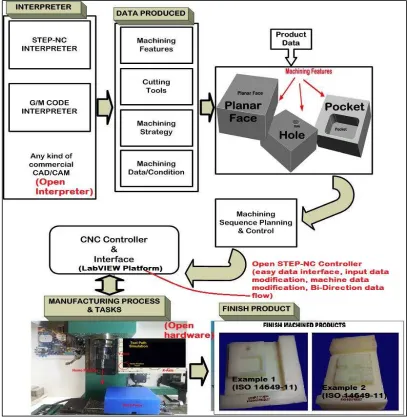
and the support by the input data model, which is in the “offline” mode. The system developed system design using the LabVIEW platform as main software. The interpreter is a support module for the STEP-NC controller and adopted input data from any CAD or CAM software to produce tool-path data consisting of machining features, cutting tools, machining strategy and machining data.
[image:3.595.85.496.275.692.2]Interpreter. This module plays an important role in supporting the data input of the CNC machine. It is generated from the "STEP-NC Interpreter,” which contains the ISO 14649 data model, and is converted into the format of the machine code. The second interpreter is the "G/M Code Interpreter,” which derived from the ISO 6983, is converted into the machine code according to the planning process. Both interpreters have machining features, cutting tools, machining strategy and machining data / conditions, and are stored in the data base as input data to the CNC controller. Figure 2 shows the process of converting the CAD data into a machine code called generic tool-path for machining process.
Figure 2: The Interpreter [10]
The tool-path can be simulated through the simulation function before machining takes place on the real machine. The error of the tool-path, i.e. whether it follows the exact design from the interpreter, can be recognized through the simulator. The simulated data will be sent to the controller for either the operations stop or the finish of machining process for further action. The
second last function is the Step function, where users can run the machine step-by-step to avoid the
occurrence of any possible error in the tool-path. The third function allows users to run the machine
continuously until completion through the Start button. With the combination of the ISO 14649 data
model and the G-programming, the interoperable CNC machining is produced. It has a variety of
functions which offer greater control in flexibility, an open system, interoperability and portability.
Hardware Interface. The system set-up and configuration is carried out through intermediate software called the “Measurement and Automation Explorer.” The user can interface with hardware through software platform with front page of the HMI (Human Machine Interface) and it is an open
hardware. Once the hardware is connected to the controller, it will be displayed on the devices and
interface window. The display data must be as in the real hardware. The selected display can be set up based on the system design and it is not necessary for all the data to be set up.
The Software-Hardware Integration Module is responsible as a media between the STEP-NC controller (PC base) and the motor controller. It receives the axis location, the feed rate and the
spindle speed data file from the STEP-NC controller. The signal from the PC in PWM (pulse width
modulation) and sent it through the 68 pins terminal block of motion card (UMI-7764). This communication port can be changed easily according to software and hardware configuration.
The detailed configuration criteria should be set up according to hardware configuration data of the machine. It can be detailed set-up and easy to modify by the user. The user must know the hardware and software data configuration correctly before doing any set up, so that the machine can accurately function according to the machine set-up.
Summary
In this development of open CNC system together with STEP-NC data model, the controller for 3-axis milling machine tool was successful developed and tested. An example 1 and 2 in ISO 14649-11 were used for system validation through 3-axis CNC mill machine.
The open system package of this system offer as follows:
i. The LVSTEPNC provides a strong link between the STEP-NC data model, the machine
controllers and the machine language so that it can function properly. In this way, the developed system can successfully generate an inter-connection between the software and the hardware.
ii. It also provides a bi-directional communication between the machine and the controller. In
These data are updated in the data base and can be downloaded to the system. The portability and adaptability of the system are guaranteed.
iii.The standard of OMAC and OSACA for the external interfaces according to corresponding
international standards is archived. The internal interfaces follow the agreement, consequently, the openness of controllers constructed is guaranteed.
Acknowledgment
The authors would like to acknowledge the researchers from Faculty of Manufacturing and Mechanical Engineering (FKMP),Universiti Tun Hussein Onn Malaysia (UTHM) and Universiti Teknikal Malaysia Melaka (UTeM) who are contribute in this project.
References
[1] X. Xu, Realization of STEP-NC enabled machining. Robotics and Computer-Integrated
Manufacturing. 222 (2006) 144-153.
[2] S.T. Newman, A. Nassehi, X.W. Xu, R.S.U. Rosso Jr, L. Wang, Y. Yusof, L. Ali, R. Liu,
L.Y. Zheng, S. Kumar, P. Vichare, and V. Dhokia, Strategic advantages of interoperability
for global manufacturing using CNC technology. Robotics and Computer-Integrated
Manufacturing. 246 (2008) 699-708.
[3] G. Pritschow, Y. Altintas, F. Jovane, Y. Koren, M. Mitsuishi, S. Takata, H. van Brussel, M.
Weck, and K. Yamazaki, Open Controller Architecture – Past, Present and Future. CIRP
Annals - Manufacturing Technology. 502 (2001) 463-470.
[4] W. Sperling and P. Lutz, Designing Aplications for an OSACA control in Proceedings of
the International Mechanical Engineering Congress and Exposition, 1997, USA.
[5] OMAC. Organization for Machine Automation and Control 2013 [cited 2013 June].
Available from: http://omac.org/.
[6] J. Wang, X. Xu, J. Sun, and J.C. Tan, STEP-NC based Intelligent Computing and
Machining. International Journal of Innovative Computing Information and Control. 58
(2009) 2449-2462.
[7] S. Newman, R. Allen, and R. Rosso, CAD/CAM solutions for STEP-compliant CNC
manufacture. International Journal of Computer Integrated Manufacturing. 167 (2003) 590 -
597.
[8] S.-H. Suh, S.K. Kang, D.-H. Chung, and I. Stroud, STEP-NC System, in: Theory and Design
of CNC Systems, Springer London, 2008, p.p 395-430.
[9] D.M. Elias, Y. Yusof, and M. Minhat, Interoperable CNC Machine via Function Block and
STEP-NC Data Model for Milling Operation. Applied Mechanics and Materials. Vols.
229-231(2012) pp 2365-2369.
[10] D.M. Elias, Y. Yusof, and M. Minhat, CNC machine system via STEP-NC data model and
LabVIEW platform for Milling operation, in Open Systems (ICOS), 2013 IEEE Conference on, 2013.
[11] ISO10301-21, International Standards Organization., Industrial automation systems and
integration - Product data representation and exchange - Part 21:Implementation methods: Clear text encoding of the exchange structure, (2002).
[12] ISO14649-11, International Standards Organization. , Industrial automation systems and
![Figure 2: The Interpreter [10]](https://thumb-us.123doks.com/thumbv2/123dok_us/8767403.897167/4.595.119.489.74.227/figure-the-interpreter.webp)
