International Journal of Emerging Technology and Advanced Engineering
Website: www.ijetae.com (ISSN 2250-2459, Volume 2, Issue 10, October 2012)586
Data hiding in Motion Vectors of Compressed Video Based On
their Associated Prediction Error
Deepika R.Chaudhari
1, Ranjit Gawande
2 1,2M.E.Student, Dept.of Computer Engineering, Matoshri college of Engineering, A.P. India.
Abstract - This paper apply stenography algorithm in a video stream. In previous stenography methods spatial or transformeddomain is used for data hiding. But in proposed method we are using compressed video to hide the secrete data; we use motion vectors to encode and reconstruct both the forward predictive (P)-frame and bidirectional (B)-frames in compress video. Motion vectors are calculated using macro block prediction error, which is different from the approaches based on the motion vectorattributes such as the magnitude and phase angle, etc. A greedy adaptive threshold is searched for every frame to achieve robustnesswhile maintaining a low prediction error level. Secrete Message bits are replace with the least significant bits of motion vectors. Thisalgorithm was tested on different types of videos. Based on the aforementioned criteria, the proposed method is found to performwell and is compared to a motion vector attribute-based method from the literature.
Index Terms — Data hiding, motion vectors, Motion Picture Expert Group (MPEG), steganography
I. INTRODUCTION
The widespread of the Internet and World Wide Web has changed the way digital data is handled. The easy access of images, musical documents and movies has modified the development of data hiding, by placing emphasis on copyright protection, content-based authentication, tamper proofing, annotation and covert communication. Data hiding deals with the ability of embedding data into a digital cover with a minimum amount of perceivable degradation, i.e., the embedded data is invisible or inaudible to a human observer. Data hiding consists of two sets of data, namely the cover medium and the embedding data, which is called the message. The digital medium or the message can be text, audio, picture or video depending on the size of the message and the approaches were proposing still image watermarking capacity of the cover. Early video data hiding techniques extended to video by hiding the message in each frame independently [1]. Methods such as spread spectrum are used, where the basic idea is to distribute the message over a wide range of frequencies of the host data. Transform domain is generally preferred for hiding data since, for the same robustness as for the spatial domain; the result is more pleasant to the Human Visual System (HVS).
For this purpose the DFT (Discrete Fourier Transform), the DCT (Discrete Cosine Transform), and the DWT (Discrete Wavelet Transform) domains are usually employed [2-4].
Recent video data hiding techniques are focused on the characteristics generated by video compressing standards. Motion vector based schemes have been proposed for MPEG algorithms [5]. Motion vectors are calculated by the video encoder in order to remove the temporal redundancies between frames. In these methods the original motion vector is replaced by another locally optimal motion vector to embed data. Only few data hiding algorithms considering the properties of H.264 standard [8-10] have recently appeared in the open literature. In [8] a subset of the 4×4 DCT coefficients is modified in order to achieve a robust watermarking algorithm for H.264. In [6] the blind algorithm for copyright protection is based on the intra prediction mode of the H.264 video coding standard.
This Paper targets the First the video is divided into blocks and next the message is came in to existence therefore the message is encoded in the least significant part of the block and is given as 16*16, 16*8, 8*8, 8*16 respectively. Therefore here in this scenario the data hiding is not a major task and also the data decoding is also not a major task but the main thing we are supposed to concentrate is on the clarity level or the mean square error (MSE) that is noise and also the loss of the data and both come under the artifact. Sometimes we may also call as a quantization errors therefore quantization is nothing but the setting the predefined values or may also be defined as the rounding off making it to the nearest value respectively. Therefore there is no problem at the time of the quantization at the encoding stage but the main challenge is at the receiver end at the time of the decoding of the data that is nothing but the dequantization of the data at the decoding stage so these comes under the quantization error. Due to this there is a lack of pixels and may lead to clarity loss etc.
International Journal of Emerging Technology and Advanced Engineering
Website: www.ijetae.com (ISSN 2250-2459, Volume 2, Issue 10, October 2012)587
Our proposed method is given in Section IV followed by the results and analyses in section V. Finally, the paper is concluded in Section VI.II. BACKGROUNDS AND SOME NOTATIONS The Overview of the lossy video compression to define our notation and evaluation metrics. At the encoder, the intra-predicted (I)-frame is encoded using regular image compression techniques similar to JPEG but with different quantization table and step; hence the decoder can reconstruct it independently. The I-frame is used as a reference frame for encoding a group of forward motion compensated prediction (P)- or bi-directionally predicted (B)-frames. In the commonlyused Motion Picture Expert Group (MPEG-2) standard , the video is ordered into groups of pictures (GOPs) whose frames can be encoded in the sequence: [I,B,B,P,B,B,P,B,B]. The temporal redundancy between frames is exploited using block-based motion estimation that is applied on macro blocks Bij of size b x b In P or B and searched in target frame(s). Generally, the motion field in video compression is assumed to be translational with horizontal component and vertical component and denoted in vector form by d(x) for the spatial variables x=(x,y) in the underlying image. The search window is constrained by assigning limited n-bits for d ; in other words, both
Which corresponds to
pixels if the motion vectors are computed with half-pixel accuracy. An exhaustive search in the window of size
can be done to find the optimal motion vector satisfying the search criterion which needs many computations, or suboptimal motion vectors can be obtained using expeditious methods such as three steps search, etc.; this is based on the video encoding device processing power, the required compression ratio, and the reconstruction quality. Since d does not represent the true motion in the video then the compensated frame P using
(x+d(x)) must be associated with a prediction error
E(x)=(P-P)(x) in order to be able to reconstruct P=P+E with
minimum distortion at the decoder in case of a P-frame.
Similar operation is done for the B-frame but with the average of both the forward compensation from a previous reference frame and backward compensation from a next reference frame E is of the size of an image and is thus lossy compressed using JPEG compression reducing its data size.
The lossy compression quantization stage is a nonlinear process and thus for every motion estimation method, the pair (d,E) will be different and the data size D of the compressed error E will be different. The motion vectors d are lossless coded and thus become an attractive place to hide a message that can be blindly extracted by a special decoder.
The decoder receives the pair (d, Ê) applies motion compensation to form and decompresses Ê to obtain a reconstructed Er. Since E and Er are different by the effect of the quantization, then the decoder in unable to reconstruct identically but it alternatively reconstructs Pr=P+ErThe reconstruction quality is usually measured by the mean squared error P-Pr represented as peak signal-to-noise ratio (PSNR), and we denote it by .
III. PROBLEM DEFINITION
Here now in the present scenario that too in the present context we are going to deal with the data hiding process that is both the combination of the encoding and the decoding process where the primary issue is data hiding and the secondary issue is effects which is used for the corruption of the true data.
International Journal of Emerging Technology and Advanced Engineering
Website: www.ijetae.com (ISSN 2250-2459, Volume 2, Issue 10, October 2012)588
And these restorations is considered and calculated by the following terms as mean signal to noise ratio and bit error rate respectively. Signal to noise ratio is nothing by the interference of the external disturbance or the external noise that is termed as the tampered data and the original quality is lost by the help of this interference of the external disturbance and bit error rate is the next scenario in which the loss of the original data nothing but the loss of the pixels in the original image or the frame sequences at the time of the quantization that is compression and at the time of transmission of the data takes place and can be shown with the following figures.So at this time we may face two scenarios one is reduced quality in the video frames and the other one is increased data rate.
[image:3.612.382.499.133.235.2] [image:3.612.104.228.388.702.2]Increased data rate leads to the high payment of the price takes place that is cost effective. And the second one is the Reduced quality as we have discussed earlier that is peak signal to noise ratio and the bit error rate. Therefore these are reduced as near to zero for good accuracy and the successful implementation of the algorithm.
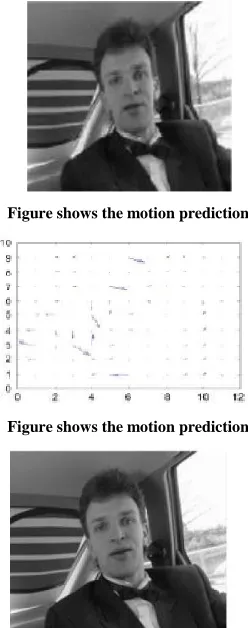
Figure shows the motion prediction
Figure shows the motion prediction
Figure shows the frame of original video
Figure shows the Error Prediction
IV. PROPOSED CONCEPT
Our data-hiding algorithm is applied at the encoder side, uses the regular pair(d,E)produced, tampers d to become dh and thus replaces them by the pair(dh,Eh) for each P and B-frame in the GOP as shown in Algorithm 1. The secret message is organized as a bit stream
message length. A subset of d is selected to be the CMV. The selection of (line 6 of Algorithm 1) is performed if their associated macro block prediction error measured in PSNR is below an initial threshold value. The least significant bit (LSB) of both components, are replaced by bits of the message. After data embedding (lines 7 to 13 of Algorithm 1), we validate the used value of by calling Algorithm 2. The algorithm tests the robustness of the hidden message to the quantization effect of the JPEG compression. For the prediction error Eh. It performs the compression by the encoder followed by the decompression performed by the decoder (lines 1 and 2 of Algorithm 2). If the reconstructed prediction error maintains the same criterion
can be identified by the data extractor for the given value of
If any macro block associated with fails to maintain the criterion (line 5 of Algorithm 2), then will not be identified by the data extractor and the message will not be extracted correctly. Hence, we propose to use an
International Journal of Emerging Technology and Advanced Engineering
Website: www.ijetae.com (ISSN 2250-2459, Volume 2, Issue 10, October 2012)589
V. ALGORITHMSAlgorithm 1: Data Hiding in GOP
Algorithm 2: Validate
The decoder receives the pair(dh,Eh) and it can decode without loss and decompresses to obtain a lossy reconstructed version . During normal operation for viewing the video, the decoder is able to reconstruct
by suitable compensation from reference frame(s) using and adding to it.
Acting as a new kind of motion estimation, Algorithm 1 will have two effects on the new compressed video: change in data size and reconstruction quality which are thoroughly analyzed. The data extractor operates to extract the hidden message as a special decoder and our proposal is straightforward, as shown in Algorithm 3. After data extraction from the consecutive GOPs the hidden message m is reconstructed back by concatenation of the extracted bit stream.
Algorithm 3: Data Extraction
VI. FINALISED CONCLUSION
International Journal of Emerging Technology and Advanced Engineering
Website: www.ijetae.com (ISSN 2250-2459, Volume 2, Issue 10, October 2012)590
And after completely working on the encoding and decoding process the next step is we are supposed to concentrate is on the errors after the decoding process at the receiver followed by the encoding process at the transmission side. Here we mainly give importance to the mean square error reduction or the noise reduction and reducing the quantization errors respectively. Therefore mainly two things are under the consideration or giving a quite more importance one is the secured data transmission in the video and also by the by maintaining the clarity of the video sequences respectively. Therefore we have dealt with the hiding but quantization at the encoder is nothing but the compression after the message is hided in the motion of the frames. The compression is Classified in to two types they are lossy compression and the loss less compression respectively, here in the above algorithm or implementation of the above paper we are going for the lossy compression rather than the lossless compression.REFERENCES
[1 ] Hussein A. Aly ―Data Hiding in Motion Vectors of Compressed Video Based on Their Associated Prediction Error, IEEE Trans On Information Forensics And Security, Vol. 6, No. 1, Mar 2011. [2 ] F. A. P. Petitcolas, R. J. Anderson, and M. G. Kuhn, ―Information
hiding—A survey,Proc. IEEE, vol. 87, no. 7, pp. 1062–1078, Jul. 1999.
[3 ] J. Zhang, J. Li, and L. Zhang, ―Video watermark technique in motion vector,in Proc. XIV Symp. Computer Graphics and Image Processing, Oct. 2001, pp. 179–182.
[4 ] C. Xu, X. Ping, and T. Zhang, ―Steganography in compressed video stream, in Proc. Int. Conf. Innovative Computing, Information and Control (ICICIC’06), 2006, vol. II, pp. 803–806.
[5 ] P.Wang, Z. Zheng, and J. Ying, ―A novel video watermark technique in motion vectors, in Int. Conf. Audio, Language and Image Processing (ICALIP), Jul. 2008, pp. 1555–1559.
[6 ] S. K. Kapotas, E. E. Varsaki, and A. N. Skodras, ―Data hiding in H.264 encoded video sequences, in IEEE 9th Workshop on Multimedia Signal Processing (MMSP07), Oct. 2007, pp. 373–376. [7 ] D.-Y. Fang and L.-W. Chang, ―Data hiding for digital video with
phase of motionvector, in Proc. Int. Symp. Circuits and Systems (ISCAS), 2006, pp. 1422–1425.
[8 ] X. He and Z. Luo, ―A novel Steganographic algorithm based on the motion vector phase,‖ in Proc. Int. Conf. Comp. Sc. and Software Eng., 2008, pp. 822–825
[9 ] Generic Coding of Moving Pictures and Associated Audio Information: Video, 2 Edition, SO/IEC13818-2, 2000.