BIROn - Birkbeck Institutional Research Online
Zhu, Hua and Li, Wei and Lyons, Agnieszka (2017) Polish shop(ping) as
translanguaging space. Social Semiotics 27 (4), pp. 411-433. ISSN
1035-0330.
Downloaded from:
Usage Guidelines:
Please refer to usage guidelines at or alternatively
Full Terms & Conditions of access and use can be found at
http://www.tandfonline.com/action/journalInformation?journalCode=csos20
Download by: [86.176.228.60] Date: 29 June 2017, At: 12:15
Social Semiotics
ISSN: 1035-0330 (Print) 1470-1219 (Online) Journal homepage: http://www.tandfonline.com/loi/csos20
Polish shop(ping) as Translanguaging Space
Zhu Hua, Li Wei & Agnieszka Lyons
To cite this article: Zhu Hua, Li Wei & Agnieszka Lyons (2017) Polish shop(ping) as
Translanguaging Space, Social Semiotics, 27:4, 411-433, DOI: 10.1080/10350330.2017.1334390 To link to this article: http://dx.doi.org/10.1080/10350330.2017.1334390
© 2017 The Author(s). Published by Informa UK Limited, trading as Taylor & Francis Group
Published online: 25 Jun 2017.
Submit your article to this journal
Article views: 176
View related articles
Polish shop(ping) as Translanguaging Space
Zhu Huaa, Li Weiband Agnieszka Lyonsc
a
Department of Applied Linguistics and Communication, Birkbeck, University of London, London, UK;bUCL Institute of Education, University College London, London, UK;cDepartment of Linguistics, Queen Mary University of London, London, UK
ABSTRACT
This article investigates how spatial layout, the display of goods, body movement and gaze work alongside verbalised linguistic codes in creating a Translanguaging Space, using data from a linguistic ethnography project in a family retail shop in East London. We argue that while positioning itself as a “Polski Sklep” (Polish shop) in London, the shop is a Translanguaging Space–a space created by Translanguaging practices and for Translanguaging practices –and Translanguaging involves the deployment and orchestration of various sense-making repertories beyond linguistic ones. We are particularly interested in showing how physical boundaries are played out and emphasised, together with multimodal resources, to mark the place as a Polish shop in London. We use the notion of
communicative zones to analyse the connectivities whereby participants communicate with and involve each other in encounters, and examine how multimodal resources are orchestrated in communicative zones of service encounters, mobilised to interweave communicative zones and assembled in tune with the depth of involvement. We show a Translanguaging Space in the making in which participants, including the shop owners and the customers, orchestrate a variety of multilingual and multimodal resources without any a priori hierarchy to create a Polish shop in London, a space to experience Polish shopping in the diaspora.
KEYWORDS Body movement; communicative zone; linguistic ethnography; positioning; service encounters; Translanguaging Space
1. Translanguaging Space
Space matters. In his seminal work, Hall (1959) observed that despite being silent and rarely talked about, space speaks. It marks physical boundaries that separate human actors and their actions and constitutes an important dimension of communication. His subsequent classification of intimate, personal, social and public zones in proximity (1966) demonstrated how a combination of (inter)personal relationships and purposes of interactions can lead to different distances between people. Further studies on space communication have focused on orientation (e.g. who is facing whom), territorial behav-iour and movement within a physical setting as interaction signal (e.g. moving towards a speaker may indicate the desire to interact) in addition to proximity (for a review, see Argyle1975). In multimodality studies developed in the early 2000s, space is recognised
© 2017 The Author(s). Published by Informa UK Limited, trading as Taylor & Francis Group
This is an Open Access article distributed under the terms of the Creative Commons Attribution License (http://creativecommons.org/ licenses/by/4.0/), which permits unrestricted use, distribution, and reproduction in any medium, provided the original work is properly cited.
CONTACT Zhu Hua [email protected] VOL. 27, NO. 4, 411–433
as a mode of semiotic resources, in the same way as gestures, images, sounds, objects, touch, etc. (for a review, see Jewitt2016).
However, space is not just about its physical, tangible properties. The idea of“social”or “socially produced” space is well argued by the French cultural theorist Lefebvre (1991) and underlies many of subsequent works on space and place (e.g. the collection by Low and Lawrence-Zúñiga2003). Fundamental to Lefebvre’s idea of social space is the assumption that space does not exist in itself–it is produced through an interconnected triad, i.e.“perceived,” “conceived”and“lived”space. Soja (1996) built on Lefebvre’s triads and developed his own“trialectics”of spatiality. He argued against the binary notions such as objectivity vs. subjectivity, material vs. mental, real vs. imaged and space vs. place. He proposed the terms“Firstspace,” “Secondspace”and “Thirdspace.” While Firstspace and Secondspace speak to the measurable and subjective/imagined aspects of space,“ Third-space”represents a different way of thinking by being always“both/and”and therefore breaking down binary oppositions. Bhabha (1994) conceptualises the Thirdspace as an ambiguous area that develops when two or more individuals/cultures interact. It “ chal-lenges our sense of the historical identity of culture as a homogenizing, unifying force, authenticated by the originary Past, kept alive in the national tradition of the People” (Bhabha1994, 37). And it does so through what Bhabha calls “disruptive temporality of enunciation” which implies that culture has no fixity and even the same signs can be appropriated, translated, rehistoricised and read anew. As a result, the hierarchical claims to the innate originality or purity of cultures are invalid.
As applied linguists, we are interested in the relationship between language, defined broadly (see below), and space. In particular, we are interested in how words and other semiotic resources contribute to sociocultural organisation of space that the above men-tioned cultural theorists largely ignore. One line of work is on“embodied”where“human experience and consciousness take on material and spatial form” (Low and Lawrence-Zúñiga 2003, 2). For example, Duranti (1992) examined how a rich and interconnected system of semiotic resources such as sighting (the act of seeing someone or something or the act of being seen by others) and spatial positioning in ceremonial greetings contribute to maintaining the hierarchical social order of Western Samoan communities. Scollon and Scollon’s notion of geosemiotics (2003) aims to offer an integrative view of multiple semiotic systems in forming the“place”which is conceptualised as a social category in the same manner as space.1Most recently, Pennycook and Otsuji (2014) proposed the term“spatial repertories,”i.e. linguistic resources available in a particular place, to examine the ways in which“linguistic resources, activities and urban space are bound together”(161).
and multimodal ones, interact and co-produce new meanings. It is also a space where speakers “bring together different dimensions of their personal history, experience and environment, their attitude, belief and ideology, their cognitive and physical capacity into coordinated and meaningful performance”(Li Wei2011, 1223).
Translanguaging embraces the notion of multimodality; indeed, the original con-ceptualisation of Translanguaging in the Welsh classrooms by Cen William and Colin Baker focused on input and output languages and the four modalities of listening, speaking, reading and writing. García and Li Wei (2014) broadened the scope of modal resource by taking the social semiotics view that language in the conventional sense of speech and writing is one of an array of modal resources to make signs. From a Translanguaging perspective, language is not simply a set of structural forms that can be assigned a name tag such as Arabic, Chinese, English or French, but a reper-toire of multilingual, multimodal, multisensory and multi-semiotic resources that language users orchestrate in sense- and meaning-making. Proposing that space is not given but created by Translanguaging practices is consistent with the key assump-tion of Lefebvre’s (1991) notion of “social space,” i.e. that space is socially produced and that interaction is a social practice. Apart from its focus on the process of com-munication, what makes the notion of Translanguaging Space different from other conceptualisations of language and space is that it aims to break down the boundaries between spatial and other semiotic resources, as it sees spatial positioning and display of objects as semiotic and socially meaningful. In this paper, we use Translanguaging Space as the main analytical and theoretical notion in understanding communicative practices in a Polski Sklep in London and seek to address the empirical challenge, i.e. demonstrating the making of Translanguaging Space. Specifically, we aim to investi-gate how the participants in our study make use of the spatial layout, the display of goods, positioning, body movement and gaze, alongside conventional linguistic codes in creating a Translanguaging Space for themselves.
2. The study
The article is based on our investigations in a shop run by a Polish family in Newham, London, over a period of four months (September–December 2014) as the first phase of the project,Translation and Translanguaging: Investigating linguistic and cultural transform-ations in superdiverse wards in four UK cities (TLANG)funded by the Arts and Humanities Research Council (AHRC) in the UK. While the overall aim of the TLANG project is to under-stand how people communicate multilingually across diverse languages and cultures, the principal research objective for this specific phrase was to understand language, business and cultural practices in a local shop run by a multilingual, migrant family. The project adopts linguistic ethnography as the overall methodological framework, a methodology that aims at “tying ethnography down” with concrete examples of interactional data and “opening linguistics up” through rich ethnographic analysis and interpretation (Rampton et al.2004).
Most Polish migrants arrived in the UK after Poland’s 2004 accession to the European Union. According to the 2011 census data, there were 521,000 Polish-born residents in the UK, making it the third largest foreign-born community after Irish and Indian. Polish is the second most spoken language in England and the third in the UK after English and Welsh, with 1% of Britain’s population speaking Polish.
The data for the present study were collected over in three stages. Observations were carried out with extensive field notes in the first four-week period of data collection. This con-tinued in the following four-week period with audio (and some video) recordings of inter-actions in the shop. In the third stage, the key participants (KPs), the couple who own and run the shop, were asked to record their interactions at home. Additionally, we conducted interviews with the KPs, collected social media data, and took photographs of the shop and its surrounding area. In summary, the data we collected include: field notes (over 60,000 words), interviews (1 hour and 18 minutes), audio recordings (45.5 hours), video recordings (2 hours), social media (279 messages) and linguistic landscaping (819 photos).
3. Social (inter)actions in service encounters
Goffman (1961) uses “encounter” as a unit of social organisation to refer to a“focused gathering”or a“situated activity.”It involves
…a single visual and cognitive focus of attention; a mutual and preferential openness to verbal communication; a heightened mutual relevance of acts; an eye-to-eye ecological huddle that maximizes each participant’s opportunity to perceive the other participants’ monitoring of him…presence tends to be acknowledged or ratified through expressive signs, and a“we rationale”is likely to emerge, that is, a sense of the single thing thatwe
are doing together at the time. (Goffman1961, 18, emphasis original)
Conduct”). In our analysis, we will also add the physical layout of the shop, the display of goods and other semiotic resources and explore how the participants in the service encounters employ them as part of their Translanguaging practices.
Service encounters are a type of focused encounter in which a service or good is elicited or provided. There are ample studies of service encounters using linguistic pragmatic-dis-cursive approaches. As reviewed in Félix-Brasdefer (2015), these studies tend to examine the characteristics of face-to-face counter interactions in terms of their pragmatic and interpersonal functions or intercultural contexts, including forms and sequence of talks, transactional and relational talk, address terms, politeness strategies, etc. In contrast, multi-modal studies of service encounters are only at their beginning (e.g. embodiment in an auto-shop, Streeck2013). Loth, Huth, and de Ruiter (2015) analyse customer behaviours when seeking bartenders’ attention in their over 100 recordings of the encounter in pubs. While they have identified a number of modalities involved, such as customer body position and posture, head and gaze direction, facial expressions, attention focus, hand movements and who they are speaking to, they found that a combination of spatial distance from the bar and looking at the bartender was most likely to trigger response from bartenders.
In this paper, we are particularly interested in how Translanguaging practices including the use of multimodal resources are coordinated and orchestrated in contributing not only to different kinds of involvement in Goffman’s sense, but also the depth of involvement– intensity of involvement can vary during an activity. We emphasise the participants’ capacity to assemble and coordinate multilingual and multimodal communicative resources including positioning and body movement, and gaze in meaning-making and managing the depth of involvement.
4. Making of a Polski Sklep (Polish Shop) in London
The shop had been operating in the area for around eight years by the time we started our project. It is owned by our two KPs, a Polish couple, to whom we shall refer as E (female) and T (male) in this article. They came to the UK in 1997. Initially they planned to go back to Poland after a few years, so they had some temporary jobs such as bartending, working on a building site, and cleaning. But then they decided to stay in the UK. They bought a house, opened a shop and started buying flats to let. At home, they speak Polish with some English words and phrases, and they have mainly Polish friends. They have a 10-year-old daughter, Z, after whom the shop is named.
their own position in the community, as E’s and T’s knowledge of Russian enabled them to broaden their customer base. T also learnt German to a relatively high level. He took his Matura, i.e. national exams for completion of secondary education, in German.
The shop sells almost exclusively Polish goods to customers who are mainly of Polish or Eastern European backgrounds. Additional services provided by the shop include renting Polish DVDs, providing information about Polish schools and other Polish-run businesses, and publicising for them, offering goods on credit and sending packages to Poland. In many ways, it serves as a community hub and site of transnational family ties (Zhu Hua, Li Wei, and Lyons2015).
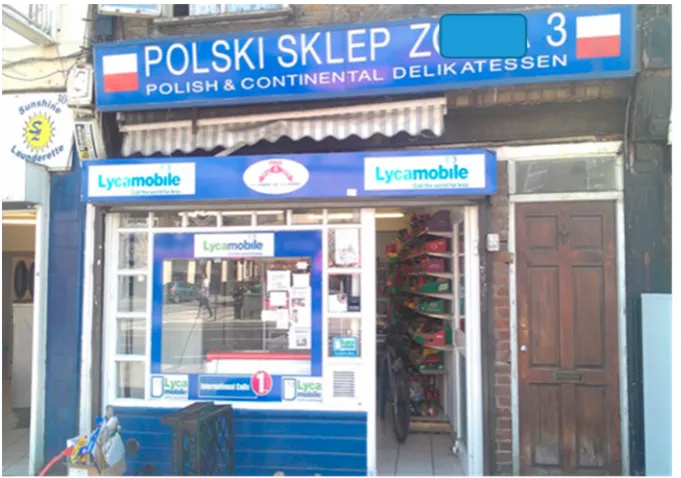
The boundary of the shop is clearly marked by semiotic resources in its external signage and window display (Figure 1). The connection with the owners’home country and the family is evident in the story behind the shop sign. It has dual branding:“Polski Sklep” in Polish and “Polish & Continental delicatessen” in English, targeting Polish as well as English-speaking customers. However, the two brands are not equal. The prominence of Polish is evident in its font size and placement:“POLSKI SKLEP Zxxxx 3” is written in a font that is around twice as big as the English part and placed above the English. There are also Polish flags on both sides of the sign to reinforce the Polishness of the shop.
[image:8.493.76.417.388.627.2]The shop is named after the owners’daughter, Z, and carries a numeral 3, the sequential order of shops opened by the couple, i.e. the third shop they owned and ran. Rather than using different names for their shops, the owners chose to maintain this connection, despite the fact that their other two shops have since closed. The sign was made in Poland and brought into the UK when E and T had goods delivered from Poland by an employee. This decision was motivated by financial reasons but it did not work out very well as T is very conscious of the fact that there is a typo in the word delicatessen with
the letter“c”being misspelt as“k.”Nevertheless, as“delikatessen”happens to be a per-missible word in German, it seems to be fitting for the continental connection.
The exterior of the shop also displays various connections. T and E were paid to use Lyca-mobile logo and decor (blue colour) and to display LycaLyca-mobile advertisements on the shop window. The advertisements are in English:“Call the world for less.”The presence of these advertisements marks the site as one of many similarly visually designed shop fronts along the same street. Apart from Lycamobile advertisements, the shop window hosts a range of customer notifications and advertisements (Figure 2). These change from day to day or week to week, depending on how long the customers pay for the service.
[image:9.493.112.376.212.626.2]Different languages feature in a range of formats in this shop window: there are hand-written notices in Polish and in English, printed notices or leaflets in Polish or English, and a
business card of a hair salon in English. The contents of the advertisements are in line with the community centre function of the shop: transport to the airport, rooms to let, goods to sell, a Polish Saturday school and English lessons, as well as an English leaflet offering help with financial problems. The target audience seems to be people who are on the move in a number of ways: moving house (looking for temporary accommodation; needing to transport their large items) or travelling to other countries with families (transport to the airport–the advertisement specifically mentions the availability of“foteliki dla dzieci” –child car seats). The shop serves as a focal point for those who look for connection with what they know, be it their culture, people who speak their language or reliable services. Although they are placed next to each other, nearly all of the advertisements we have observed are in one language (either English or Polish) only and are not multilingual in themselves. This may be the result of a combination of the target audience, the literacy level of the advertiser and the lack of awareness of, or skills for, multilingual advertisement. But together in the shop window, they constitute a mosaic, with varied images and colours as well.
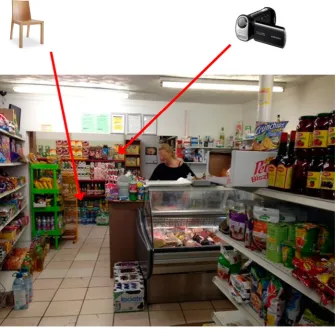
[image:10.493.77.414.300.629.2]The picture inFigure 3was taken near the shop front and is what customers would see when they walk pass the first shelf. The shop is divided into front and back sections with a partition wall in between. The focal point of the shop is its cold meat and till counters at
the centre of the shop, where E stands in the picture. It is an enclosed territory, accessible only to the shop owners. Some bottles of alcohol are displayed on the top shelf behind the counter. When we carried out observation, the camera was placed on the jam shelf just behind the counter and the researcher would be sitting in the “back office” space at the other side of the shop.
The interior of the shop is clearly oriented towards Polish customers and marked as a Polish space. There are no labels on shelves and in most cases, no English wording on the packaging. The use and presence of English is only visible in safety notices and regulations about purchas-ing alcohol and cigarettes above the counters. The positionpurchas-ing of these notices in English gives the impression that they are being imposed in a top-down manner (Figure 4). The size of the signs, standard according to regulations, in relation to other displays in the shop means that they are hardly noticed by the customers. English is also present in the form of texts brought to the shop by other organisations placed on and around the till (in a fashion similar to that of Lycamobile advertisements), as inFigure 5.
The internal layout together with the brands of goods and kinds of services provided in the shop contribute to making of this Polish shop. But it is not just any“Polski Sklep”. It is a Polish shop in London, serving the local Polish community and Eastern Europeans. The Lycamobile decor, advertisements in English, presence of English texts within the shop and the mention of a recent trip to Scotland in a customer’s counter interaction (see Extract 1) all remind us of the London context.
5. Orchestration of multimodal resources in communicative zone of service encounters
[image:11.493.102.391.53.244.2]Encounters may take various forms and involve multiple parties simultaneously. Our analy-sis focuses on the connectivities whereby participants communicate with and involve each other in encounters. What emerged from our analysis is that participants operate in com-municative zones that are identifiable by both the physical layout of the space and the
participants’interactive practices. Similar to the notion of“interactional space”(e.g. Havi-land1993), our idea of“communicative zones”emphasises focused activities of communi-cation and the connectivities jointly created by the participants, as well as their capacity to recognise the affordances of the physical conditions and constraints of the environment. Participants interact both with other participants and the environment. Boundary fluidity of the communicative zones is therefore significant and meaningful, as zones are con-stantly expanded or retracted beyond the physical constraints through interactions by the participants. Boundaries can also exist in virtual reality. For example, texting someone creates a temporal communicative zone between the sender and the recipient. Tills offer apparent affordances of business transactions and therefore are conducive to creating communicative zone between shop owners who have access to tills and custo-mers who are seeking service. The spatial layout of the shop in our study (as shown in
Figure 3), however, differs from many shops in that its till is not at the entrance, but located further back inside the shop. Customers browse in front and back sections of the shop and then walk up to the till to be served. The spatial movement,“walking up to the till”hence signals the customer’s intention to initiate a counter interaction and to enter a specific communicative zone. In the field notes, we have noticed the greetings that take place alongside the spatial movement.
The next customers were an older couple. The woman was Ukrainian and the man was English. They seemed to know where to find the products they were looking for (butter and butter milk) and having picked them up, came up to the counter. The woman said“Dzieńdobry” [Good afternoon] with an accent. (AL, 3/9/14)
As they walked in, most of them greeted E (usually initiated by customers) when they got closer to the counter. (ZH, 3/9/14)
[image:12.493.102.392.52.225.2]The making of communicative zones requires the coordination and synchronisation of multimodal resources. The following analysis of transcripts of a video recording illustrates the local constitution and organisation of multimodal resources at the counter where the till is and where cold meat is also displayed.Figure 6is a multimodal transcript using the ELAN software. It records two modes (gaze and verbal modes) along with four still images.
Extract 1 is a transcript of the verbal mode. The turn number and timing in the transcript match those in the multimodal transcript inFigure 6.
Extract 1. Transcript of verbal interaction in service encounters. Speakers: T: shop owner; C: first customer; Cn: second customer.
Turn Time Who Transcript (Polish) Translation
1 0:08 T Można wyjąć You can take it out
2 0:10 T To dla pani This is for you
3 0:11 C Mhm Uhum
4 0:13 T Dziękuję Thank you
5 0:14 C Dziękuję Thank you
6 0:16 T Ile? How many?
7 0:18 Cn Te pomidorki These tomatoes [dim.]
8 0:21 Cn Jest Lycamobile? Have you got Lycamobile?
9 0:22 T Nie mam I don’t have any
10 0:23 Cn Hmm Hmm
11 0:24 T I nie wiem kiedy będzie And I don’t know when I’ll have it 12 0:37 T Cośdla Pani jeszcze? Anything else for you?
13 0:39 Cn Proszę? Pardon?
14 0:40 T Cośjeszcze dla Pani? Anything else for you?
15 0:41 Cn To wszystko That’s all
16 0:42 Cn I Lycamobile And Lycamobile
17 0:43 T (short laughter) 18 0:44 Cn (short laughter)
19 0:45 T Musimy zamówić We have to order some 20 0:46 T Na razie nie ma At the moment there are none
21 0:47 Cn Acha Uhum
22 0:48–0:49 T Miodzik pani jeszcze ma? [Nie skończyłsię?
Have you still got honey? [hasn’t it finished? 23 0:49 Cn [Mam jeszcze jeszcze sięnie skończył
bo mnie nie było
[I have [some] still it hasn’t finished yet because I was away
24 0:52 T Aah Aah
25 0:53 T Tak? To gdzie pani była? Really? where were you then? 26 0:54 Cn Byłam w Szkocji I was in Scotland
27 0:56 T Tak?–a nie ma pani drobnych? Were you? And have you got any change? 28 0:57 T Cztery /unintel./ Four /unintel./
29 0:58 Cn Oj nie wiem popatrzę Oh I don’t know I’ll check
30 1:02 T W Szkocji? In Scotland?
31 1:03 Cn Mhm Mhm
32 1:04 T Na wycieczkę? For a trip?
33 1:05-1:07 Cn Nie tam mam córkęzwiedziłam ale raz jużzwiedziłam
No I have a daughter there I did sightseeing I’d already done sightseeing
34 1:08 T Ładne tereny? Nice area?
(Transcription conventions: [: overlapping turns; /unintel./: unintelligible; (): non-verbal; dim.: diminutive)
Figure 6.A multimodal transcript of service encounters.
ZH
U
HUA
ET
corner of her eye as if to check T’s progress. When the receipt was handed over, she took it with her right hand and picked up the bag from the counter with her left hand at the same time. She turned away and walked towards the door as soon as she got the bag. All these went orderly and efficiently. It followed the minimal script of a business transactional interaction: the cash and receipt were exchanged, words of thank you reciprocated, the shopping bag collected and record stored. The encounter was entirely transaction-focused, with no deep involvement, no exchange of gaze or any other interactive cue.
This is in some way quite different from T’s exchange with the next customer (referred here as Cn) who was standing right at the counter and waiting to be served. T began to serve her immediately after he put the receipt away. Having seen the tomatoes on the counter, he asked “how many” while reaching for a small plastic bag to put the tomatoes in. Watching T bagging the tomatoes, Cn asked him whether he had Lycamobile cards (Image 2). T first answered briefly and then expanded his answer by saying that he did not know when he would have them. All these verbal exchanges were accompanied by several swift acts on his part: he walked to the scales at the back of the counter to have the tomatoes weighed, walked back to the till, entered the weight into the till and calculated the price on the till. He then took out a bigger plastic bag under the counter and put the tomatoes in. Meanwhile, he asked his routine transaction-final question (Turn 14),“anything else for you?”But this turned out to be a turning point in the service encounter. Instead of answering a routine question with a routine answer (e.g. “no, thanks, that’s all”), the customer teasingly said “Lycamobile” which she knew from the previous turns (Turn 8–11) that T did not have. Her unexpected response changed the rhythm of the con-versation. T smiled and laughed. The customer responded with a smile and a short laughter a second later. Simultaneously with her smile, she also turned her head slightly and looked at the next customer who was queuing (a ratified unaddressed reci-pient, Goffman’s term, 1981) as if to check whether she appreciated her sense of humour too. In the subsequent exchanges, T was obliged to explain once again that they have run out of the phone cards. He then took a turn to ask the customer whether she still had honey. The business transaction became more personalised and T showed interest in the customer’s recent trip. The engagement was extended and moved in and out between social and service transactions. The other two custo-mers positioned themselves as the next custocusto-mers in waiting to join the communica-tive zone (Images 3 and 4). They were looking around. T was only engaged with the second customer through his eye contact.
required less handling of objects from T, T spent more time looking at the customer he was interacting with (although he did not look at the other customers in the queue at all). His gaze was synchronised with the customer’s gaze again. As we see from the second half of the horizontal transcript in Figure 6, there was an exchange of eye contact between T and the customer as they were building rapport.
In this example of service encounter, the rule of one customer at a time is followed. T, the shop owner, manages the marking of the communicative zone through his gaze and handling of objects. The customers can signal their readiness for joining commu-nicative zones through positioning (e.g. standing next to the counter) or objects (e.g. putting tomatoes on the counter), but eye contact with the shop owner is a matter of“privilege”. It only happens to those who are being served, not those waiting in a queue. This kind of marking of the communicative zone relies on co-operation and mutual understanding by all the participants and may well be culturally specific. As we see in the above analysis, gaze from the parties involved is synchronised with each other, and in response to the verbal exchanges.
In sum, the above analysis illustrates a busy shop owner’ skills in getting tasks at hand done and in Translanguaging, i.e. mobilising his multiple linguistic and modal resources, to keep his business transactions going. It also shows how his employment of resources and that of the customers are coordinated, synchronised and responsive to each other.
6. Interweaving of communicative zones in service encounters
Sometimes communicative zones embed within or interweave with each other. A case in point is an example of how a virtual communicative zone enabled by digital technology interweaves with the face-to-face communicative zone of a service encounter. Below is an instance of E, the shop owner, being engaged in two communicative zones. Figure 7 is a multimodal transcript of this instance of service encounter, focusing on four modes: phone handling, gaze, body position and verbal interaction along with four still images. The transcript of the verbal inter-action is provided in Extract 2.
Extract 2. Transcript of verbal interaction in“E on her phone”. Speakers: E: shop owner; C: customer.
Turn Time Who Transcript (Polish) Translation
1 0:32 E Proszębardzo Here you are
2 0:33 E Będzie 3.70 It will be 3.70
3 0:46 C Dziękuję Thank you
4 0:47 E Tak. Dziękuje bardzo Yes. Thank you very much
Figure 7.A multimodal transcript of“E on her phone.”
L
SEMIO
TICS
routine counter interaction by saying“Here you are. It will be 3.70” (Turns 1 and 2). There did not seem to be much involvement in the interaction on either E’s or C’s part. They hardly looked at each other. While waiting for the customer to get the money, E looked towards the entrance, cleaned some lint off her clothes and glanced over her phone (Image 3). After the customer said “thank you” in a very soft voice (possibly noticing E’s lack of involvement), E returned the acknowledge-ment, with eye contact and a gentle smile, reciprocating the involvement but also sig-nalling the closure of the exchange. After the transaction was complete and the customer started walking towards the door, E sat back down and resumed her phone-centred activity (Image 4).
In the episode, there were two communicative zones: one is a face-to-face com-municative zone at the counter and the other digital comcom-municative zone to which the mobile served as a gateway. These two zones overlapped with each other. E was in two communicative zones at once. She was deeply involved with the digital com-municative zone at the expense of showing little engagement with the customer, who clearly picked up E’s intention to keep the interaction minimal. Elsewhere we have reported the extensive use of mobile technology in connecting with cus-tomers, between wife and husband, and family “back home” and hence blurred boundaries between work and life in the workspace (Zhu Hua, Li Wei, and Lyons
2015). In the example discussed here, we see how boundaries are blurred at a cost: although there were brief transitions from one communicative zone to another when she put down her phone temporarily and operationalised a break from her virtual communicative zone, the virtual communicative zone was dominant.
7. Depth of involvement
Extract 3. Transcript of verbal interactions in T’s chat. Speakers: T: shop owner; A: researcher.
Turn Time Who Transcript (Polish) Translation
1 0:00–0:02 T To sobie przewróci na drugąstronęi będzie [za trzysta funtów
So she will flip it over and [for three hundred pounds
2 0:01–0:02 A Tak tak Yeah yeah
3 0:03 T będzie spała [z dziurkąpod will be sleeping [with a small hole under
4 0:04 A Dokładnie Exactly
5 0:05 T (laughter) na [drugąstronę (laughter) on [the other side
6 0:05–0:06 A Na dole tak Underneath yeah
7 0:07 T /unintel./ /unintel./
8 0:08–0:16 A Nam jak dostarczyli yy lodówkęto tam była taka mała ryska wiesz jak jest w plastiku takim przezroczystym bardzo nie wiem jak on siętam nazywa ale taki niby ten high life plastik taki lepszy
When we had our fridge delivered there was a little scratch you know like in that see-through plastic I don’t really know what it’s called but that kind of high life plastic that better one
9 0:17 T Acha Uhum
10 0:18–0:23 A Yy i one czasem majątakie ryski wśrodku to nie to nie jest pęknięcie całe taka nie wiem [pęknięcie wewnętrzne
Umm and they sometimes have these scratches inside don’t they it isn’t a full crack but that kind of [internal crack 11 0:22–0:23 T [Mhm mhm no no [Uhum uhum yeah yeah
12 0:24–0:28 A No to mamy takie cośi jużmieliśmy zadzwonić żeby cośtam nam wymienili w wielkiej lodówce
So we have that kind of thing and we were just about to call so that they replace it in the huge fridge
13 0:29 T No I see
14 0:29–0:31 A tylko nie chcemy znowużeby ktośprzyjeżdżał i nam całąlodówkęwymieniałnie
it’s just that we don’t want anyone to come and replace the whole fridge do we 15 0:32–0:34 T Acha tak jak nie chcecie wymiany to można
dostaćrefund
Uhum so if you don’t want an exchange you can get a refund
16 0:35 A No Yeah
17 0:36–0:40 T Możecie refund może nie wymianęale mały refund jak byście sięzgodzili
You can get a refund maybe not an exchange but a small refund if you agreed
18 0:40 A No Yeah
19 0:41 T Wiesz You know
20 0:46–0:48 A Mały refund? Dobry polski Small refund? Good Polish
21 0:49–0:50 T No? proszę? Huh? Pardon?
22 0:51 A Ładnie po polsku powiedziałeś You said it in Polish nicely 23 0:52–0:54 T Acha mały refund (laughter) Oh yeah small refund (laughter)
Figure 8.A multimodal transcript of T’s chat.
ZH
U
HUA
ET
time it was T who played the role of an attentive listener. In a similar manner to A in the earlier part of the conversation, T uttered back channelling discourse markers (Uhum, yeah, I see).
When A’s story was nearly complete around 33 seconds, T noticed two jars on the counter and reached out for the top jar. In the next 15 seconds (up to 50th second), T’s gaze was turned to the objects: he picked up the top jar, put it to the edge of the counter, picked up the bottom jar, began to examine it while walking towards the jam shelf (Image 4), moved back behind the counter, put the bottom jar back onto the counter, and then put the top jar back on the top of the bottom jar (50th second). Mean-while, he was trying to go with the flow of the conversation and commented on A’s story (Turns 15 and 17). In Turn 20 around 46–48th seconds, A made a metalinguistic comment on T’s codeswitching in the phrase“mały refund”(meaningsmall refund) teasingly. At this point, T seemed to have lost track of the conversation. Realizing this, he moved closer to A before signalling for repair verbally (Turn 21). His gaze temporarily turned away from jars, the object he was occupied with, to A, while A was offering a repair. T then repeated the phrase and laughed. The sequence of the repair co-occurred with T’s resuming his hand-ling with the jars, moving away back into the direction of the counter and gazing away. No further threads of the topic were offered and the conversation came to end at this point. In the example, we saw changes in the depth of involvement in a communicative zone of a causal chat between acquaintances. Multimodal resources were coordinated to accomplish these changes in several ways: T’s gaze was mainly focused on his interlocutor when he was engaged with the topic of the conversation. However, his gaze turned to the objects when he was less involved in the conversation to the effect that the objects has become“gaze holder” and even his interactional partners. His pre-occupation with the jars, coupled with the change in the direction of gaze, was commensurate to the decrease in the level of conversational involvement on his part, as further evident in the repair sequence. His body movement and spatial positioning were synchronised with the change of the topics: he tended to move closer to A when a new topic emerged or when he was seeking a repair and to move back to the counter towards the end of a topic.
8. Summary and conclusion
communicative zone. The idea of“communicative zones”highlights the fact that the par-ticipants interact both with other parpar-ticipants and the environment. They recognise the affordances of the physical conditions and constraints of the environment. In the mean-time, fluidity of the communicative zones is significant and meaningful, as zones are con-stantly expanded or retracted beyond the physical constraints through interactions by the participants.
Whilst our KPs do engage in switching between languages occasionally, the deploy-ment of multimodal and multi-semiotic resources beyond speech and writing is particu-larly significant. Our analysis shows that a variety of multimodal semiotic resources are mobilised and assembled together into a Translanguaging Space. We have noted spatial layout (e.g. the location of the till counter and its accessibility to the owner), the display of goods, artefacts and texts (e.g. the cold meat counter, absence of labels on the shelf and hence assuming familiarity, safety notice in English), objects handling (e.g. jars, mobile phone as gateways to a virtual communicative zone), positioning (e.g. walking up to the till signalling customer’s intention to be served), body movement (e.g. turning around, head movement), gaze (e.g. looking away, looking at objects or inter-locutors) and conventional verbal interaction (not only what is said, but also how some-thing is said, e.g. overlapping in turns, discourse markers). They became what Kress (2010) calls “motivated signs” in the local constitution of social interactions (see also Budach, Kell, and Patrick2015on objects as signs) and part of the spatial repertoire (Pen-nycook and Otsuji2014). The Translanguaging Space concept emphasises the intercon-nectiveness of these signs and resources in the production of the space.
In this Translanguaging Space, we also see participants“bring together different dimen-sions of their personal history, experience and environment, their attitude, belief and ideol-ogy, their cognitive and physical capacity into coordinated and meaningful performance” (Li Wei2011, 1223). Examples are many. There is an overt orientation to Polishness, a pre-ference made clear by the shop owners in the story behind the shop sign, the family con-nection in the shop name, and the preferred use of Polish with other languages when convenient or required in service encounters. But the Polishness is underpinned by its local connections. Lycamobile decor, advertisements in English, presence of English texts within the shop and the mention of a recent trip to Scotland in a customer’s counter inter-action all tell us that this is not just any“Polski Sklep”but a Polish shop in London.
Orchestration takes place not just at individual level. It involves collaboration and attu-nement of all the participants. Continuing the metaphor of orchestra, players in an orches-tra play their instruments and notes individually, but also attune responding to each other’s playing. In a communicative zone, all participants tend to reciprocate each other’s employment of resources retrospectively or progressively even when there is little involvement going on. As we have seen in the examples above, initiating a request for the service is a joint effort. Gaze was not exchanged between T and the cus-tomers in waiting; E stood up and got ready behind the till in anticipation, albeit reluc-tantly, when the customer began to walk to the till. Interestingly, in T’s casual chat with A, as soon as he realised that he was not following the conversation, he stopped handling the jar, moved closer to A before verbally asking for clarification.
We have therefore seen a Translanguaging Space in the making in which a variety of multilingual and multimodal resources are orchestrated to go with the depth of involve-ment without any a priori hierarchy. Building on the long tradition in applied linguistics arguing for a more prominent role of so-called non-verbal communicative practices, e.g. gaze, gesture, and silence (Pennycook1985; Jaworski1993), we have highlighted the sig-nificance of the full range of spatial repertoires, including in particular the sigsig-nificance of the spatial layout and the display of goods. Together with positioning, body movement and gaze, and the more conventional speech signs, they create a Polish shop in London, a space for our KPs and the customers visiting the shop to experience Polish shop-ping in the diaspora.
Note
1. Space is often used in contrast with place. While a“place”can be a country, a city, a street or a shop, associated with geographic location and material form, “space” is constructed through“interaction between the human beings who occupy it and make reference to it” (Liebscher and Dailey-O’Cain2013, 16). However, in some works, e.g. from human geogra-phy,“place”is regarded as interpreted and space as given. Cresswell’s introductory text to place (2015) refers to several works which use space and place in a way that “stands the normal distinction on its head”(70), including Michel de Certeau’sThe Practice of Everyday Life(1984).
Acknowledgements
We are grateful for the help of Daria Jankowicz-Pytel with data transcription. Many thanks to Emi Otsuji, Alastair Pennycook and Christina Higgins for their reviews.
Disclosure statement
No potential conflict of interest was reported by the authors.
Funding
Notes on contributors
Zhu Huais Professor of Applied Linguistics and Communication at Birkbeck College, University of London, UK. Her research interests are multilingual and intercultural communication.
Li Weiis Chair of Applied Linguistics and Director of the UCL Centre for Applied Linguistics, at the UCL Institute of Education, University College London (UCL), UK. His research interests are in the broad areas of bilingualism and multilingualism.
Agnieszka Lyonsis a Lecturer in Applied Linguistics at Queen Mary, University of London, UK. Her research interests are mediated and multimodal communication and discourse analysis.
References
Argyle, M.1975.Bodily Communication. London: Routledge. Bhabha, H. K.1994.The Location of Culture. London: Routledge.
Budach, G., C. Kell, and D. Patrick.2015.“Objects and Language in Trans-contextual Communication.”
Social Semiotics25 (4): 387–400.
Certeau, M. de.1984.The Practice of Everyday Life. Berkeley: University of California. Cresswell, T.2015.Place: An Introduction. Oxford: Wiley Blackwell.
Duranti, A. 1992. “Language and Bodies in the Social Space: Samoan Ceremonial Greetings.”
American Anthropologist94: 657–691.
Félix-Brasdefer, J. C.2015.The Language of Service Encounters. Cambridge: Cambridge University Press.
García, O., and Li Wei 2014.Translanguaging: Language, Bilingualism and Education. Basingstoke: Palgrave Macmillan.
Goffman, E. 1961.Encounters: Two Studies in the Sociology of Interaction. Indianapolis, IN: Bobbs-Merrill.
Goffman, E.1963.Behavior in Public Places: Notes on the Social Organization of Gatherings. New York: The Free Press.
Goffman, E.1981.Forms of Talk. Philadelphia: University of Pennsylvania Press. Hall, E.1959.The Silent Language. Garden City, NY: Doubleday.
Hall, E.1966.The Hidden Dimension. New York: Doubleday.
Haviland, J. B.1993.“Anchoring, Iconicity, and Orientation in Guugu Yimithirr Pointing Gestures.”
Journal of Linguistic Anthropology3 (1): 3–45.
Hazel, S., K. Mortensen, and G. Rasmussen, eds.2013.“A Body of Resources–CA Studies of Social Conduct.”A special issue ofJournal of Pragmatics65: 1–156.
Jaworski, A.1993.The Power of Silence. London: Sage.
Jewitt, C., ed.2016.The Routledge Handbook of Multimodal Analysis. London: Routledge.
Kress, G.2010.Multimodality. A Social Semiotic Approach to Contemporary Communication. London: Routledge.
Lefebvre, H.1991.The Production of Space. Oxford: Blackwell.
Liebscher, G., and J. Dailey-O’Cain.2013.Language, Space, and Identity in Migration. London: Palgrave. Li Wei. Forthcoming. Translanguaging as a Practical Theory of Language.Applied Linguistics. Li Wei.2011.“Moment Analysis and Translanguaging Space: Discursive Construction of Identities by
Multilingual Chinese Youth in Britain.”Journal of Pragmatics43: 1222–1235.
Li Wei, and Zhu Hua.2013.“Diaspora: Multilingual and Intercultural Communication Across Time and Space.”AILA Review26 (1): 42–56.
Loth, S., K. Huth and J. P. de Ruiter.2015.“Seeking Attention: Testing a Model of Initiating Service Interactions.” In A Multidisciplinary Approach to Service Encounters, edited by María de la O Hernández-López and Lucía Fernández Amaya (Studies in Pragmatics, 14), 229–247. Amsterdam: Brill.
Low, S., and D. Lawrence-Zúñiga.2003.The Anthropology of Space and Place. Oxford: Blackwell. Newham.com.2017.A Newham Timeline. Accessible May 3, 2017.http://www.newham.com/work/
Pennycook, A. 1985. “Actions Speak Louder than Words: Paralanguage, Communication, and Education.”TESOL Quarterly19 (2): 259–282.
Pennycook, A., and E. Otsuji.2014.“Metrolingual Multitasking and Spatial Repertoires:‘Pizza Mo Two Minutes Coming.’”Journal of Sociolinguistics18 (2): 161–184.
Rampton, B., K. Tusting, J. Maybin, R. Barwell, A. Creese, and V. Lytra.2004.UK Linguistic Ethnography: A Discussion Paper. UK Linguistics Ethnography Forum.http://www.lingethnog.org.uk.
Scollon, R., and S. W. Scollon.2003.Discourses in Place: Language in the Material World. London: Routledge.
Smith, G.2006.Erving Goffman. New York: Routledge.
Soja, E. 1996. Thirdspace: Journeys to Los Angeles and Other Real-and-Imagined Places. Oxford: Blackwell.
Streeck, J.2013.“Interaction and the Living Body.”Journal of Pragmatics46: 69–90.