Journal of Criminal Law and Criminology
Volume 7 | Issue 2
Article 13
1916
Notes and Abstracts
Follow this and additional works at:
https://scholarlycommons.law.northwestern.edu/jclc
Part of the
Criminal Law Commons
,
Criminology Commons
, and the
Criminology and Criminal
Justice Commons
This Note is brought to you for free and open access by Northwestern University School of Law Scholarly Commons. It has been accepted for inclusion in Journal of Criminal Law and Criminology by an authorized editor of Northwestern University School of Law Scholarly Commons.
Recommended Citation
NOTES AlNDl ABSTRACTS.
ANTHROPOLOGy-PSYCHOLOGY-LGAL-MEDICINE.
Handwriting, from a Psychopathic Viewpoint-Malvolio (reading forged letter): "M - But then there is no consonancy in the sequel; that suffers under probation; A should follow, but 0 does."
TWELFTH NIGHT-ACT 2, SCENE V.
It is a trite saying that no person can twice write his name so that the result of each effort will be, in all respects, an absolutely exact counterpart of the other. From this premise numerous cross-examiners have sought to deduce that every conceivable variance in the circumstances and conditions surrounding a writer, materially. affects his handwriting, so that it may become unrecognizable, from even a slight cause.
The original proposition is as true as the attempted deduction is false. The points of comparison are not confined, merely to pictorial forms, but include many other items-mostly unobservable except with the aid of proper instruments; the total number of points can be placed in the hundreds right at the start, with but moderate attention to details; and the number may be greatly increased by industry and skill on the part o the observer. Probably the greater number of these items could be changed, without the difference becoming noticeable to the naked eyes of anybody-particularly one not accustomed to examining such things.
ToD destroy the identity of the writing, for even a layman's eyes, there must 'be some cause that will produce at once some radical change in the general pictorial effect of the writing. Of course, there are plenty of such causes, but they are usually of so pronounced effects, as to become at once palpable, and, therefore, to be readily susceptible of investigation and verification. The far greater number of causes tending to vary handwriting are of an entirely different character, and their effects are generally less prominent than the others, and often not visible at all to the ordinary observer. It is to this class of conditions that more careful attention should be directed-first, because of its important bearing on the question of identity-and secondly, because it may be possible to learn therefrom the mental condition of the writer at the time when he executed the writing; this last reason does not take us into the fanciful realms of necromancy, character reading, or any other of the mystic arts, but leads us directly into the ever-widening field of psydhology as connected with human mechanism.
In order to understand the true inwardness of the situation, we must consider handwriting not only from a physical standpoint, but, also from a mental point of view-not only as a physical act, but also'as a mental effort; in the latter connection, both psychology and psychiatry afford us material help, whence it may. be designated as the psychopathic study of handwriting.
ANALYSIS.
Handwriting is the visible joint product of four human attributes:
A.-Knowledge of the subject matter. This is obtained through the
HANDWRITING-PSYCHOPATHIC VIEWPOINT
B.-Volition concerning the subject matter. This factor may vary from
strong to weak.
,C.-Memory of other efforts. This may be direct or cross, and it may be
accurate or faulty.
(Memory and Volition come through what may be termed the connective
senses.)
D.-Action to the desired end. This is the most important factor, in that
we here have to do more directly with its results, and it covers the largest field of inquiry. It is obtained through the medium of the motive senses, and these normally operate through three combined and co-ordinated means, which may be imperfectly classified as Muscular, Mental and Nervous.
1.-Muscular action. This may be interfered with and rendered more or
less abnormal by any physical ailments or deficiencies sufficient to cause: (a) Inability to produce good standard forms of characters.
(b) Ordinary stiffness that affects the characters.
(c) Labored results, as of inaptitude.
(d) More or less lasting limitations of, and interference with, the powers
of action.
(e) Spasms of single muscles or sets of muscles (disturbed motility).
(f) Mere physical weakness. 2.-Mental action.
This may become more or less abnormal, from mental ailments or de-ficiencies, when they are sufficient to
cause-(a) An obsession to write.
(b) An accelerated effiux and confusion of ideas. (c) A delusional or illusional disturbance of ideas. (d) Confusion and exaggeration of expression.
(e) Confusion and exaggeration of forms (agraphia).
(f) Confusion or omission of letters or syllables in words.
(g) Voluntary introduction of extra, unnecessary and improper marks or
lines, in connection with letters and words, through extra impulses. (h) Irregular and inconsistent style and slant in writing (ataxia). (i) Inability to keep the writing down to ruled line.
(j) Weakened power of association. (k) Retardation of ideas.
(I) Loss of memory.
(m) Difficulty in transfer of ideas to motor sphere (as in morphinism). (n) Hypnotic writing.
(o) Natural "mirror writing" (except when done by a left-handed person).
(p) Dual personality.
3. Nervous action. This may become more or less abnormal in consequence
of physical conditions, diseases, excesses or indulgences, or strong mental or physical o ,=itements, where they are sufficient to cause:
(a) Ordinary tremors.
(b) Reflex action producing tics, or involuntary, spasmodic marks, in con-nection with letters or words, through temporary extra impulses.
HANDWRITING-PSYCHOPATHIC VIEWPOINT
RESULTS.
It is at once apparent that in the preliminary elements of Knowledge, Volition and Memory alone, there is room to run the whole gamut of varia-tions from strength to weakness, as to any given writer, and some evidence of such variations may be found in the writing of such person; nevertheless, the identity of the handwriting will remain and be recognizable.
When it comes to the element of Action, however, we have a more complex situation before us. Preliminarily, the question of the co-ordination of the three factors arises, and is capable of many variations; but, after we get past that point, we enter into a region aboundin with many possible abnormalities, those affecting the Muscular Action being the matters with which we are most familiar, but with which we are not -now so much concerned.
In considering the Mental and Nervous Action we have the assistance of a large number of "symptoms"; some of these are due to the condition of increased activity technically known as mania-some to that form of decreased activity technically designated as melancholia-and some to those peculiar con-ditions designated as hypnotic states, dual personalities, and that which produces reversed (or mirror) writing.
The presence in a given handwriting of any of these mental and nervous symptoms indicates a psychosis, or mental disease, of some sort, the existence of which must be taken into account in considering the practical question of the mental condition of the writer. In the nratter of eyesight, it is said that the person does not live whose two eyes exactly match each other in their powers of vision; yet only when the difference between them becomes so great that they cannot practically work together without causing harm to the owner are they convicted of astigmatism and sentenced to work thereafter through spectacles. So, also, while indications of a psychosis may be found in many a person's writing, yet only when the psychotic condition is so pronounced, or has such an effect, that (comparatively speaking) it becomes a source of danger, is it to be regarded as rendering the possessor incompetent.
But even before the point of incapacity is reached-and whether it be reached or not-these indicia are still ready to serve us in identifying the handwriting of one person, and distinguishing it from that of another, even though possibly the latter may be an imitation of the former. The author, during the course of his long experience in the examination of handwriting, has repeatedly derived invaluable assistance from such details as the foregoing; in the single items of voluntary and involuntary tics, morphinism, dual per-sonality, and exaggerated dynamic action, he has found more than enough to compensate him for all the years of labor and study- involved, but they form too long a story for the present paper.
CONCLUSION.
Wherever there is a question as to the identity or authenticity of a speci-men of handwriting, it is well worth while, therefore, to consider (in connection with the other more usual details) the general mental condition of the writer, paying particular attention to those things which are indicia of the various psychosis, as well as to abnormal physical limitations or powers.
TO AMEND CODE OF CRIMINAL PROCEDURE
lines of investigation) to consider carefully the handwriting of the person in question in order to ascertain therefrom, whether or not the person is suffer-ing from a psychosis, and if so, the probable extent of the effects of such condition.
These two suggested lines of investigation are based upon present-day technical college courses, to which are added outgrowths therefrom, derived through practical experience. In using them it must always be remembered that, although the presence of a single evidence of psychosis may serve to "tag" a person, it does not necessarily prove him to be legally incompetent; the presence of one swallow does not necessarily prove that summer is here.
VEBSTER A. MELCHER, Philadelphia, Pa.
COURTS-LAWS.
Bill to Abolish Capital Punishment in the District of Columbia.-The
following bill (S. 4056) was introduced by Senator La Follette on January 28, 1916. It was read twice and referred to the Committee on the District of
Columbia:
Be it enacted by the Senate and House *of Representatives of the United States of America in Congress assembled, That section eight hundred and one,
chapter nineteen, of the Code of Law for the District of Columbia is hereby amended by striking out the words "death by hanging," and substituting therefor the words "imprisonment for life," and by striking out the words "for life, or" so as to read:
"SEC. 801. PUNISIE[Z.NT. The punishment of murder in the first degree shall be imprisonment for life. The punishment of murder in the second degree shall be imprisonment for not less than twenty years."
SEC. 2. That section eight hundred and eight, chapter nineteen, of the said code, is hereby amended by striking out the provisos after the words "thirty years."
SEC. 2 takes from jury right to impose penalty for rape.
SEC. 3. That section nine hundred and nine of the said code i§ hereby amended by striking out the words "any crime punishable by death" and substituting therefor the words "murder in the first degree."
SEc. 4. That section nine hundred and twenty-six, chapter twenty, and sections eleven hundred and ninety-eight, eleven hundred and ninety-nine, twelve hundred, twelve hundred-and one, twelve hundred and two, and twelve hundred and three, chapter thirty-five, of the said code, are hereby repealed.
SEC. 5. That this Act shall be in force from and after its passage:
Provided, That if at the time of the passage of this Act there are persons
confined in the jail who have been adjudged to suffer death, the Supreme Court of the District shall commute their sentences to imprisonment for lif6.
SEc. 909 relates to punishment of accessories. SEC. 926 relates to time of execution.
SEcs. 1193-1203 relates to method, and place of execution, and who must, may, and may not attend.
288 BILL TO AMEND PENAL LAW
counsel for the people must commence and the defendant or his counsel con-clude the argument to the jury.
The difficulty with this provision is practically the same as that with the provision of the present law. Now the counsel for the defendant has no oppor-tunity to rebut any of the arguments presented by the prosecution in its sum-ming up. If this bill became a law the prosecution would not have any oppor-tunity to answer any of the-arguments presented by the defendant. Some provision should be made whereby both sides shall have the opportunity to rebut the opposition. If the prosecution begins summing up, the defendant then succeeds, and the prosecution ought to have a few minutes to rebut the ments presented, just as the defense has had an opportunity to rebut the argu-ments of the prosecution. If the defendant sums up first, then the defendant ought-to have a few minutes after the summing up speech of the prosecution to present arguments in rebuttal.
Under the present system, in spite of its large number of presumptions in favor of the defendant, and the disadvantage to the prosecution caused by the fact that it does not know the defense until the actual day of trial, whereas the defendant is already cognizant 6f the prosecution's case, the grave disadvan-tages to the defense because of the great means, power and prestige of the prosecution, induce me to favor having the defense sum up first, and then sum up last after the speech of the prosecution, but be limited only to answering the arguments presented by the prosecution. It seems very unreasonable to deprive the defendant of all opportunity to reply. In practice there is great hardship in this deprivation. It may be said that it is unjust under modern conditions to deprive the prosecution of all knowledge of the defense until the actual trial. But though this is true, the hardship is not so great as that caused by depriving the defendant of a rebuttal argument to the jury. The argument to the jury is one of the most effective weapons of either side.
But if we had a public defende- and the defense and the prosecution were upon the same level of power, the presumption and defenses now given to the defendant might be abrogated and both sides come in on an equality. Then the summing up by defendant last, as I have suggested, would give the defense a slight advantage in the whole case over the prosecution. Since the prosecu-tion has the burden of proof, and since, with a public defender, equality of power would reign, the prosecution should sum up last The order would be this: prosecution sums up; defense sums up and rebuts arguments advanced by prosecution; prosecution rebuts arguments advanced by defense. This pro-cedure might be best even under the present system, thus giving both sides the opportunity for rebuttal, and the prosecution the last word in consideration of the assumption of the burden of proof, and other disadvantages.-R. F.
To amend the penal law in relation to murder in the first degree (N. Y. Assembly Bill Int. 363, Pr. 363).-This is a bill which seeks to make murder punishable by death or life imprisonment and which gives the jury power to designate in their verdict whether the prisoner shall be punished by death or by imprisonment for life.
So far as the alternative for murder in the first degree between death and life imprisonment is concerned, I have no objection to offer. But so far as the jury is empowered to decide whether the person is to be sent to death or
SPEEDY DETERMINATION OF APPEALS 289
to know what should be done with the particular convicted man. My idea is to put technical things into the hands of technical men, and a jury should have nothing to say concerning the length of imprisonment any more than the judge should have anything to say about it. The prisoner should be sent after conviction to an institution and there examined and sent to a criminal insane asylum or to the asylum for idiots or imbeciles, or to prison, and there watched in his progress or regress. The board of parole should have authority, upon all the evidence of the career of the prisoner previous and subsequent to conviction, to decide what should be done with the man. I am not at present advocating an absolutely indeterminate sentence; but under the present law, which provides for a partially indeterminate sentence, I should give the power to the board of parole to decide to keep the prisoner in for the maximum limit or less. I should leave it to the board of parole to say whether a convict should be put to death or be sent to life imprisonment.-R. F.
A bill to establish a bureau for the study of the criminal, pauper, and
defective classes.-In the Senate of the United States Mr. Robinson introduced the following bill on March 10, 1916. It was read twice and referred to the committee on the judiciary. It is known as S. 4990: Be it enacted by the Senate and House of Representatives of the United States of America in Con-gress assembled, That there shall be established in the Department of Justice a bureau for the study of the abnormal classes, and the work shall include both laboratory investigations and the collection of sociological and pathological data, especially such as may be found in institutions for the criminal, pauper, and defective classes. Said bureau and work shall be in charge of a director, who shall be appointed by the President, by and with the advice and consent of the Senate, and shall receive a salary of $3,000 per annum. He shall make a report once a year, directed to the attorney general, which, with the approval of that officer, shall be published. For the aid of the director there shall be one psychologist at $2,000 per annum, one translator at $1,400 per annum, two clerks at $1,200 each, and one stenographer and typewriter at $1,000.
Sec. 2. That the director, if necessary for the proper discharge of his duties, may place himself in communication with state and municipal and other officials of this and other countries.
Sec. 3. That for the proper equipment of and carrying on the work of said bureau, the temporary employment of specialists, and the purchase of instru-ments of precision, books and periodicals, and rental of rooms, if necessary, there is hereby appropriated, out of any money in the Treasury, not otherwise appropriated, the sum of $5,000, or so much thereof as may be required.-R. H. G.
Speedy Determination of Appeals in San Francisco.-In November, 1914, Mr. Presiding Justice Lennon and Justices Kerrigan and Richards of the District Court of Appeal for the First District, at San Francisco, formulated a plan to facilitate the disposal of business in that tribunal. The system adopted by them included the examination of the records on appeal and briefs in each case before placing causes on the ca'lendar for oral argument, and, when the nature of the case permitted, rendering a decision from the bench at the conclusion of the argument, the transcribed notes of -the- official reporter becoming the written opinion of the court.
290 SPEEDY DETERMINATION OF APPEALS
the innovation concerns so important a function as the adjudication of appealed cases. "The Docket" for November, 1915, contains an article entitled "Output of the Court for 1914," which, in addition to an instruc-tive comment upon the methods employed and required by law for the transaction of the business of courts of last resort, contains a tabulated statement, made up from an actual count of 100 opinions, of the work done by the Supreme Court and Appellate Courts of California and other states. This statement credits the Supreme Court of California for the year 1914 with the decision of 312 cases involving written opinions-making an average of 45 such cases for each of the seven judges composing that court. The District Courts of Appeal of California, considered as one court, are credited with the rendition of 441 decisions involving written opinions during the year mentioned-an average of 49 for each of the nine judges -composing those three courts.
This summation of the work done by the Supreme and Appellate Courts of California suggested to "The Recorder" the thougtit that it might be interesting to know if there had been any material acceleration in the rate of decision of causes under the, system adopted for the District Court of Appeals for the First District by Presiding Justice Lennon and his associates, Justices Kerrigan and Richards, in November, 1914, outlined above.
The suggestion prompted an investigation of the records of that court, which disclosed that during a period of approximately thirteen months, from November 4, 1914, to December 2, 1915, the court under the new system considered and disposed of 216 cases with opinions-an average for each of the judges -of the court -during the time stated of 72 written opinions. Fifty-five -of these cases were originally appealed to the Supreme Court and by that court assigned to the District Court of Appeal for the First District for decision. In addition to the 216 cases involving written opinions that court disposed of 73 matters involving applications- for various writs and motions to dismiss appeals.
During this period the court iheld three examinations, written and ofal, for admission to the bar, at which a total of 222 persons were examined, and granted 76 applications for admission upon motion and the presenta-tion of a license from sister states. Ninety-one students from the several universities and law schools -of the state were at various times admitted to the bar upon presentation of their diplomas.
Incidentally it should be stated that this court during the last four years has raised the standard applied to law students examined by it; that it has required both a -written and oral examination, and has facilitated the latter by conducting different branches of it concurrently, each of the three justices examining the applicants upon subjects designated by the presiding justice.
Notwithstanding this amount of work, each of the justices.was enabled to secure a reasonable vacation.
PRISON REORGANIZATION 291
Number of cases decided with opinions " -16
Including:
Civil cases, affirmed ill
Civil cases reversed 41
Criminal cases affirmed - 33
Criminal cases reversed 9
Judgments modified 2
Writs denied 15
Writs granted 5
Number of proceedings heard and disposed of from the bench. 73 Including:
Appeals dismissed 25
Motions to dismiss denied 5
Writs denied 38
Writs granted 3
Judgments affirmed by stipulation 2
Total matters heard and disposed of 989
Number of applicants for examination 922
Total of attorneys admitted 298
Including:
Admitted upon examination- 131 On license Irom other states 76 From Leland Stanford Jr. University 27
University of California 19
Hastings College of the Law_ 17 University .of Santa ,Clara_ 3
University of St. Ignatius 8
San Francisco Law School_ 14
Y. M. C. A. Law School" 3
A rule of the court requires that not less than four calendars shall be called in a year; but from November, 1914, to November, 1915, the court called seven calendars of 30 cases each. Mr. Presiding Justice Lennon has recently announced that during the year 1916 the court will endeavor to call at least eight calendars of 36 cases each, a total of 288 cases, or approximately 96 opinions for each judge, or, in other words, practically a case for every business day in the year. And this will be in addition to the regular monthly law and motion calendar, and the examination of applicants for admission to the bar that 'the court is required by law to hold.-From The Recorder, San Francisco, December x8, 1915.
SOME PRISON IDEALS
The bill is the one which Representative Young submitted to the Special Committee on Commissions, and which he and the special committee have championed so effectively in its course through the Legislature.
Its principal features are: One parole board of three members, to take over the work of the two existing parole boards for the state institutions; an advisory prison board of five members, of whom three shall be men and two shall be women; and a director of prisons, to be appointed by the governor, with the advice and consent of the counsel, for a three-year term, who shall receive such annual salary, not exceeding $6,000, as shall be fixed by the governor, with the advice and consent of the council.
The director shall appoint not more than two deputies, and may remove them at any time. They shall receive such salaries as he shall determine, subject to the approval of the governor and council.
The Advisory Prison Board shall be appointed by the governor as follows: One member for five years, one for four years, one for three years, one for two years and one for one year from June 1, 1916, and thereafter one member shall be appointed annually to serve for five years. They shall receive no com-pensation for their services, but shall be reimbursed by the Commonwealth for actual expenses incurred.
The Board of Parole shall be appointed by the governor as follows: One member for three years, one for two years and one for one year from June 1, ,and thereafter one member shall be appointed annually to serve for three years.
Its members shall each receive an annual salary of $1,200 as full compensation for their duties relative to permits to be at liberty from the State Prison, the Massachusetts Reformatory, the prison camp and hospital and the reformatory for women, and shall be reimbursed for actual expenses. In addition, the members may receive as compensation and for expenses incurred such sums as may be approved by the governor with the consent of the council. The governor shall annually- designate one member as chairman. The director of prisons shall furnish the Board of Parole with clerical and other necessary assistance.-From the Boston Transcript.
Some Prison Ideals-(From an address 'by Mr. Adolph Lewisohn of New York City.)
* * * * "We have the honor and the pleasure today of having with us the former President of this Committee, now its Honorary President, Mr. Thomas Mott Osborne. We all feel that he is doing splendid work at Sing Sing, not only for those particular men who are confined there, but in furnishing a model of how best to conduct prison work. I hope the time is not far distant when the State will make the Beekman tract avail-able. It is a large plot of ground in the interior of the State, where pris-oners could be employed in the open air, preferably at farming, road building, etc., and we think that this Work should be done under Mr. Osborne's supervision and leadership. I know we will then get splendid results.
SOME PRISON IDEALS 293
agree: that the prisoner must not be exploited by contract labor; that there must be humane and sensible treatment of the prisoner, 'With the end in view that when he comes back to the community he will be able to take care of himself and his family, and likely to become a good and useful member of society. Personally, I have some views on the subject which may, perhaps, be considered extreme and which others may not share. I would like to see the total number of prisoners greatly reduced. I would only put those people into prison who are likely to be dangerous to society. As it is now, most of the prisoners are only temporarily confined, and if, as it is claimed, they are a menace to society, putting them into prison does not solve the problem if they are not treated justly and humanely, because when they come out they are as dangerous as before. This will be true as long as prisons are conducted in the way they are now being conducted. We spend a tremendous amount of money every year, all over the country, building court houses and prisons, in the maintenance of courts, the judges, the attendants, criminal lawyers, district attorneys, prison wardens, keepers, and all other such expenses connected with this work I would not be astonished if it amounted fo several hundred millions of dollars a year. I would like to cut this expense in half and use the money thus saved for the prevention of crime. I would like to give every person a good education; have plenty of Y. Ml. C. A.'s and Y. W. C. A's; educational alliances; plenty of public baths-not $22,000.00 worth, but a large number; free concerts; music school settlements; play grounds; parks; recreation for the people, young and old; instruction in home gardening, good housing facilities, and many other things like that. I think if we would do all these things, we would reduce the number of prisoners greatly.
"When a prisoner is sent to prison he is made dependent and it becomes the duty -of the community to see to it that he is properly treated and taken care of. It is for the self-protection of the community to try to so arrange that when the prisoner comes out of prison he will be able to take care of himself; also to see that his -health is not impaired as otherwise, as is now the case very frequently, he becomes a danger to the community by spreading disease. Besides the practical side of the matter, there is also the humane side. We are neglecting our duty as long as we remain indifferent to these matters. It is, in my mind, as cruel to neglect the proper care of the prisoners, as was the sinking of the "Lusitania" with
its number of civilians on board.
fur-POLICE REFORM
nished to the prisoners at Sing Sing? They are narrow, small, dark and damp, so that it is almost certain the prisoner will contract disease of some kind to carry out with him on his release. It certainly is a crime against the prisoner and against the rest of the population.
"There might be some difference of opinion regarding the handling of the pris6ners-but to leave the insane with the sane, to put prisoners in unsanitary cells and subject them to inhumane treatment is utterly inex-cusable-and criminal. We have no right to ignore these matters on the ground of the plea, 'Am I my brothers keeper?' "-Adolph Lewisohn, Pres. Nat. Com. on Prisons and Prison Labor, New York City.
POLICE.
Appointments in the Indian Police Force and in the Police Force of Ceylon.-Age limits, 19 and 21 on the first of June of the year in which the examination is held. Salary, 250 pounds to 850 pounds and upwards.
The subjects of examination are: Class 1 (Obligatory) English, Mathe-matics A (Elementary), French or German. Class 2 (Optional) MatheMathe-matics B (Intermediate), Mathematics C (Higher), English History and Geography, German or French, Latin, Greek, Science (Physics and Chemistry. Two thou-sand marks are assigned for each subject, and not more than two subjects in Class 2 may be taken up. In addition to the above subjects, candidates may take up Freehand Drawing, to which 400 marks will be allotted.
N. B.-For the year 1914 and subsequent examinations English History and Geography will be included in the Obligatory Subjects. Examinations may be expected annually in the month of June. Fee, two pounds if examined in London; three pounds if examined elsewhere.
Appointments in the Indian Police Service were thrown open to competition in the year 1893. Similar appointments in the Police Services of Ceylon, Hong Kong, The Straits Settlements, and the Federated Malay States are now filled by open competition. From forty to fifty appointments are made annually.
JosEPH MATTHEW SULLIVAN,- Boston, Mass.
CAMPAIGN OF CRIME PREVENTION
and difficulty in investigation. It should have its representatives in every town and county throughout the country, in close touch with local staffs, as well as a headquarters staff and provincial district staffs in the large centers of population. The feeling fostered by the imperfections of the present system, or want of system, would thus disappear, and much grave and organized crime would be prevented by the mere fact of its more assured detection." At last we have an English writer who is frank enough to admit some of the glaring faults of the English police system. In a small country like Great Britain active co-operation is a comparatively simple affair. The means of escape are few and the country small and compact; every stranger is known, and there is a hearty co-operation on the part of the public with the authorities. Not so in the United States of America, with its complex population of dif-ferent nationalities; the country is so large that the means of escape are innumerable and an easy task to the intelligent criminal. In Massachusetts we have the State Police called the District Police; this is an independent force appointed by the governor, and the members are assigned to duty in the different counties. They actively co-operate and assist the local police in detecting criminals and convicting felons, and there has never been, in my memory, the slightest friction between them and the various police depart-ments. A detective who allows personal pride to militate against the detection of crime and the conviction of thieves is, to my mind, a very poor type of officer and a misfit in his position. The state of Rhode Island has been sadly in need of just such a system as has been in vogue in Massachusetts for generations. It is absolutely necessary that police intelligence should keepl pace with the strides which I am sorry to say criminal intelligence is making every day. A great deal of poor detective work could be avoided if we could get the station house police out of their useless rut; the average station house can do a great deal of good to the community if it aevoted more attention to thieves, and less to unfortunate prostitutes, ten-cent card players, and other trifling misdemeanants who are really their own worst enemies and at heart not a menace to society.
JoszEp MAirEmy SULLiVAN, Boston, Mass.
"New York's Campaign of Crime Prevention"-[In the Boston Evening Transcript for February 5, 1916, is a four-column article under the above title, by Arthur Woods, the Police Commissioner for NeW' -York City, whose administration thus far has been characterized by a practical ideal-ism and good results. The following is abstracted from the article re-ferred to.-Ed.]
296 CAMPAIGN OF CRIME PREVENTION
Procedure is something like this: Psychological experts, recruited from the universities, look over the lineup of prisoners every morning, and advise the officers of the department. Along with the evidence of brass-knucks, guns and other deodands, and testimony of eye-witnesses, the police then submit to the magistrates in the police courts a psychological analysis of the prisoners. Psychologists also give general information to officers of the department as to the mental discretion or loose proclivities in prisoners. Lectures are given at headquarters by Dr. Louis E. Bisch, associate in psychology at Columbia University, explaining "Mental and Moral Defectives," etc. Two trained psychologists are under salary, and they are counselled by a voluntary advisory board of experts.
Because one murderer got across a ferry one-half hour ahead of our policemen on his trial, we missed catching him-so far. The police did quick work, but it should have been one-half hour quicker; so we have been endeavoring to speed up the whole department, to cut down the time for sending out general alarms, and to reduce the number of general alarms, so that only really important fugitives shall be occupying the attention of the police. In outlying districts we have placed sentry boxes-since some beats are so long that one man can scarcely cover them by patrol. He stands in the sentry box. Neighboring citizens have its telephone number, and use it when they need a policeman just as they use a firm alarm box. On getting an alarm the policeman on sentry duty mounts his motorcycle and dashes to the scene. If he wants help he phones to another sentry.
On the technique of detection and aids in pursuit, I might remark that we for one thing are becoming more and more a finger print office. Paris could have caught the Mona Lisa thief had she relied more on the finger print than on the Bertillon system of identification. We still maintain the Bertillon system of measurements because all cities are not equipped with finger print records. Did all the police agencies outside of New York employ the finger print system of identification it would not be necessary to employ another method. Finger print identification is the surest, quickest, cheapest and the simplest way of identifying criminals that has ever been devised. As long, however, as the photograph method and the Bertillon system of measurements is used in cities other than New York. It becomes necessary for the New York detective bureau to continue both of these methods in order that we may exchange information with other cities and cause the arrest in one city of a man wanted in another city which does not employ the finger print system.
CAMPAIGN OF CRIME PREVENTION 297
themselves, and inculcated in other youngsters a realization of what things should not be done because they make for disorder.
Now what -have we done to interest the policeman in his vocation, and to induce him to make himself useful and advance his professional prospects?,
Formerly, if a patrolman had a grievance, it was difficult to bring it to the notice of the commissioner. At present members of the force desir-ing to interview the police commissioner may .do so upon application directed to the police commissioner. Knowing that they are ibeing treated as individuals and not as uniformed figures scarcely distinguished from one another the men are working with more interest. They come and tell me troubles of all varieties. Some are in debt, others want advice 'how to handle themselves in particular situations, and many even have come to confess that they -have lied at police trials and want to get it off their conscience.
Among new advantages is permission of patrolmen to apply for trans-fer. For instance, if a man is doing duty in a precinct away from his home, and another patrolman Who resides near where the first patrolman is doing duty, is performing duty near where the second patrolman resides, a mutual exchange may be asked for. Members upon their own application are transferred to precincts as near their home as possible. No "pull" is needed to effect this. Requests are filed according to date of application and acted upon as soon as possible. Giving a man a district he knows
lessens minor disorders. .
Formerly when a policeman was ailing it was impossible for him to receive full pay until such time as he was physically capable of performing a full tour of patrol. Such men may now return to duty and be assigned to raided premises, clerical work, station house attendance and other light work, with full pay till fit to resume patrol.
An important recent change was that of placing patrolmen on proba-tion for a period instead of fining them. It was contended that where a patrolman committed a breach of discipline and was fined, a hardship was worked upon the immediate family dependant upon him for support. The probation )eriod is a period within which by noteworthy performance of,
duty one may earn a suspension of any fine that might have been inflicted. We have found serviceable an Honor Roll Relief Fund, which gives aid to the widows, orphans and dependants of members of the force killed in the discharge of their duty. Formerly individual collections were taken up in station houses from members of the force and an uneven distribution of relief resulted.
Physical comfort and betterment have been looked after. Shower baths, toilets and wash basins have been provided on the floors of the dormitories occupied by the men, instead of in the cellar. Most station houses are today provided with gymnasiums, including handball courts. Many are furnished with libraries, and we expect to so equip all the larger
ones.
298 INCREASE IN COST OF CRIME
ordinary. In these awards recognition is for merit outside the old classi-fication, which recognized valor only. Suggestions tending to improve the efficiency of the department also receive merit awards, In several precincts a system is being tested which provides certain merits and demerits -for various phases of police work. For instance, a. patrolman who lessens the number of complaints on his post, who makes arrests showing intelligence or risk, 'receives a certain number of merits in each case. For failure to prevent crime, failure to make arrests, improper patrol, etc., demerits are marked against him.
In the establishment of efficiency records, it was provided that the men receiving the three highest number of merits monthly, should be excused (1) from three tours of patrol duty; (2) from two hours of patrol duty, and (3) from one tour of patrol duty. In addition to these excusings, at the end of the year the officer will receive an additional six days' vacation.
One-half the time lost in court -on a tour off duty is returned to the patrolman by excusing him for that period from the next tour of reserve duty. A night or day off is given to every patrolman in case of a good arrest for a felony involving personal risk. This is in addition to any other award. Another incentive lies in promoting men to acting detective sergeants and increasing salaries of members of the force assigned to the special squads, inspection district offices, and heads of the detective bureau branches.
STATISTICS.
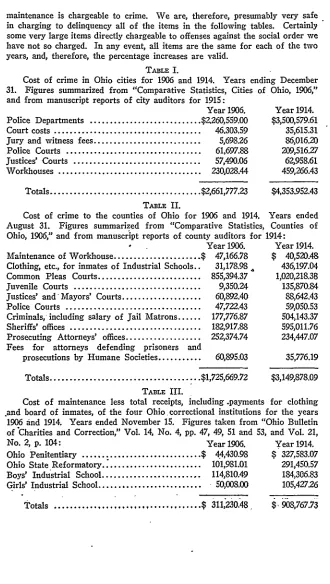
An Eight-Year Increase in the Cost of Crime in Ohio.-The following figures relative to the cost of delinquency in Ohio have been prepared from the "Comparative Statistics for the Counties and Cities of Ohio," published and held as manuscript by the Bureau of Inspection and Supervision of Public Offices. The report of 1906 is the first of this sort published in Ohio. The manuscript reports from city and county auditors for 1914 constitute the latest complete returns for a year. The data for state expenses for the four correctional institutions were found in the "Ohio Bulletin of Charities and Correction," Vol. 14, No. 4, and Vol. 21, No. 2.
The year, in each case, for cities ended December 31; for counties, August 31; and for state institutions, November 15. The figures, in each case, cover a full year, the largest part of which was in the calendar year designated. There is no overlapping of the city, county, and state expenses. The expenditures are net in every case, all income being already deducted.
INCREASE IN COST OF CRIME
maintenance is chargeable to crime. We are, therefore, presumably very safe in charging to delinquency all of the items in the following tables. Certainly some very large items directly chargeable to offenses against the social order we have not so charged. In any event, all items are the same for each of the two years, and, therefore, the percentage increases are valid.
TABLE I.
Cost of crime in Ohio cities for 1906 and 1914. Years ending December
31. Figures summarized from "Comparative Statistics, Cities of Ohio, 1906,"
and from manuscript reports of city auditors for 1915:
Year 1906. Year 1914. Police Departments ... $2260,559.00 $3,500,579.61 Court costs ... 46.303.59 35,615.31
Jury and witness fees ... 5,698.26 86,016.20
Police Courts ... 61,697.88 209,516.27 Justices' Courts ... 57,490.06 62,958.61 Workhouses ... 230,028.44 459,266.43
Totals ... 2,661,777.23 $4,353.952.43 TABLE II.
Cost of crime to the counties of Ohio for 1906 and 1914. Years ended August 31. Figures summarized from "Comparative Statistics, Counties of Ohio, 1906," and from manuscript reports of county auditors for 1914:
Year 1906. Year 1914. Maintenance of Workhouse... ... $ 47,166.78 $ 40,520.48 Clothing, etc., for inmates of Industrial Schools.. 31,178.98 436,197.04 Common Pleas Courts ... 855,394.37 1,020,218.38 Juvenile Courts ... 9,350.24 135,870.84 Justices' and Mayors' Courts ... 60,892.40 88,642.43 Police Courts ... 47,722.43 59,050.53 Criminals, including salary of Jail Matrons ... 177,776.87 504,143.37 Sheriffs' offices ... 182,917.88 595,011.76 Prosecuting Attorneys' offices ... 252,374.74 234,447.07 Fees for attorneys defending prisoners and
prosecutions by Humane Societies ... 60,895.03 35,776.19
Totals ... $1,725,669.72 $3,149,878.09 TABLE III.
Cost of maintenance less total receipts, including .payments for clothing .and board of inmates, of the four Ohio correctional institutions for the years 1906 and 1914. Years ended November 15. Figures taken from "Ohio Bulletin of Charities and Correction," Vol. 14, No. 4, pp. 47, 49, 51 and 53, and Vol. 21,
No. 2, p. 104: Year 1906. Year 1914.
Ohio Penitentiary ... $ 44,430.98 $ 327,583.07 Ohio State Reformatory ... 101,981.01 291,450.57
Boys' Industrial School ... 114,810.49 184,306.83
Girls' Industrial School ... 50,008.00 105,427.26
[image:17.612.45.375.62.646.2]INCREASE IN COST OF CRIME
TABLE IV.
Summary -statement of city, county and -state expenses for delinquency for 1906 and 1914, with percentage increase of each for the eight-year period. Total expenses for delinquency show an increase of seventy-nine per cent in eight years:
Percentage
Increase in Year 1906 Year 1914 Eight Years. Ohio cities ... $ 2,661,777.23 $4,353,952.43 64 Ohio counties ... 1,725,669.72 3,149,878.09 82 Four Correctional Institutions of
Ohio ... 311,230.48 908,767.73 192
Totals ... 4,698,677.43 $8,412,598.25 79
Some of these figures are susceptible of explanation through changes in law and practice. The juvenile court was very new in Ohio in 1906. In 1914 such courts were organized in all the counties. In 1906 the Ohio Penitentiary was under the contract labor system. In 1907 an actual profit of $3,400 was shown. It has been a matter of no little expense to change from a penal to a correctional basis.
The population of Ohio, as calculated by the United States Bureau of the Census for July 1, 1906, was 4,533,064, and for July 1, 1914, 5,026,898. In these eight years the population of the entire Atate increased, therefore, about eleven per cent. The actual average daily populations of the state institutions increased twelve6.and one-half per cent in the'same time, but the commitment rates increased ,eighteen per cent. This indicates a speeding up of the correctional work, or rather a shortening of the average residence, probably because of the increased commitment rate without proportionate increase in facilities for caring for the large numbers.
With an increase of eleven per cent in the population of the state, we find an increase of seventy-nine per cent in the aggregate expenses of cities, counties and state, for crime, in these eight years.
During the same period the aggregate jail population for twelve months increased forty-two per cent, from 18,591 for the year ending June 30, 1906, to 26,307 for the year ending June 30, 1914. The actual commitments to work-houses increased fifty-four per cent, and the jail commitments sixty-two per cent. The foreign born among those arrested constituted nineteen and one-half per cent of thm total arrests in 1906 and in 1914.
CIVIL SERVICE EXAMINATION
TABLE V.
Increases, and percentage increases in jail populations, total numbers of sentences, sentences to the Ohio Penitentiary and Ohio State Reformatory, and the charges with felonies as compared with the increase in the population of Ohio in eight years:
1906. 1914. Increase.
Populatio Ohio ... 4,533,064 5,026,9 10.9% Jail populations ... 18,591 26,307 42.
%
Total sentences ... 4,894 7,036 44. 7%
Sentences to Ohio Penitentiary and
Ohio State Reformatory ... 974 1,595 64. % Charged with felonies ... 4,039 8,079 100. %
T. H. HAINES, M. D.,
Bureau of Juvenile Research, Columbus, Ohio.
MISCELLANEOUS.
Handwriting Expert Testimony.-Mr. William J. Kinsley, of New York, the eminent authority on disputed documents, died very suddenly on March 25, in his fifty-first year. Mr. Kinsley's work in this field has covered the time during which this specialty has secured a permanent place in American courts. Mr. Kinsley was engaged on cases in nearly every state in the Union, as well as in Canada, and was well known to the legal profession throughout the whole country. His name was first brought into prominence in connection with the celebrated Molineux case in New York, in which he took a prominent part. On account of the fact that this particular case and s6me others of similar character and importance, depended largely upon handwriting testi-mony, there was instituted in the public prints a skilled, persistent, vindictive attack upon this particular class of evidence covering a period of several years, covering the time when these cases were in process of trial and appeal. By this means the opinions of thousands of lawyers and laymen were affected in a prejudicial way regarding handwriting specialists. Mr. Kinsley, by his high character and his c6nscientious and skillful work, overcame this prejudice, and largely because of his work and influence the document specialist is a well-recognized character, at least in the eastern courts.
ALBERT S. OSBORN, New York City.
Civil Service Examination for Promotion to Chief Probation Officer in the Children's Court, New York City, May 12, 1916.-1. Prepare recom-mendations to the chief justice of the Children's Court on each of the follow-ing problems, givfollow-ing your reasons in support of your recommendations:
(a) The employment of a female deputy chief probation officer. (b) The use of Hollerith tabulating machines in the Children's Court. (c) The treatment of high-grade mental defectives.
(d) The reduction of the amount of time spent by probation officers in
court to a minimum.
2. Outline clearly what co-operation you would establish as chief proba-tion officer of the Children's Court with each of the following authorities:
302 CIVIL SERVICE EXAMINATION
(b) Department of correction.
(c) Department of charities.
(d) Clearing house for mental defectives.
3: Prepare for the use of your probation officers a skeleton outline of the
principal classes of offenders arraigned in the Children's Court of this city, and in connection with each class of offenders give helpful notes regarding the best means of determining whether each is a fit subject for' probation. Give reasons in support of your answer.
4. Discuss the advantages or disadvantages of each of the following recommendations:
(a) That the preliminary investigation before conviction be made by an investigator and the work of the probation officers be confined to the super-vision of the children after conviction.
(b) That children placed on probation be required to make restitution for property stolen or destroyed.
5. Discuss how you would endeavor to promote the efficiency of your
probation officers in each of the following ways:
(a) By stimulating their interest in probation work.
(b) By grading their comparative efficiency at regular intervals.
(c) By giving, them necessary service instruction.
6. Write a report to the chief justice of the Children's Court outlining a system for the effective supervision of the field work of the probation officers of the Children's Court. Sign this report "John Doe, chief probation officer."
If you sign any other name, title or initial you will be disqualified.
7. Prepare a set of regulations for your probation officers outlining the powers and the duties which are conferred upon them by law.
LEONHARD FELIX FULD,
Civil Service Commission, New York City.
Civil Service Examination for Promotion to Deputy Chief Probation Officer (Male) in the Children's Court, N. Y. City-Duties.-Weight 6.-(To be finished at 4 p. m.)
1. (a) Outline a plan for the assignment of cases to your Probation Officers covering the following points:
a-Religion. b-Sex. c-Residence.
d-Other considerations.
(b) What methods would you employ to stimulate among your Pro-bation Officers a live interest in the work of .proPro-bation?
Give reasons for your answer.
2. State how each of the following cases is generally dealt with at present and make. constructive recommendations for improvement by amend-ment of the law or by change in judicial or administrative procedure:
a-A boy after receiving his working papers loafs in the company of evil associates instead of looking for work.
b-A boy,whose conduct on probation has not been satisfactory and
who would be benefited by a term of three or four weeks.in an
UNIVERSITY COURSE
c-Parents who are anxious to have their children committed to an institution to be relieved of the expense of maintaining them. d-The ascertainment of the criminal record of a child convicted in
another Borough of the City.
3. Define clearly for the use of your Probation Officers each of the fol-lowing terms, giving in connection with each such information regard-ing it as you believe will be of particular value to your Probation Officers:
a-Juvenile delinquency.' b-Improper guardianship.
c-Truancy.
d-Mental defective.
4. Prepare an outline of an annual report of the work of the probation department of the Children's Court in one of the Boroughs of the City, showing clearly the facts, statistics, and recommendations which you would include in such a report.
5. Write a report to the Presiding Justice of the Children's Court, pre-senting in outline form, for the guidance of your Probation Officers, a code of instructions covering the following points:
1. Preliminary investigation before sentence:
a-Principal co-operating agencies and kind of assistance to be derived from each.
b-Six most important points to be covered in the investiga-tion with reason for each.
c-Instructions regarding form of report.
2. Treatment of probationers:
a-Principal co-operating agencies and purpose of enlisting as-sistance of each.
b-Visits and purpose of each. a-Probationer's residence. b-School.
c-Church. d-Employer.
e-Probation Officer's office. f-Other visits.
3. Termination of probation:
a-Before time fixed by Court. b-At tim6 fixed by Court. c-Extension of time of probation.
LEONARD FELIx FuLD,
Civil Service Commission, New York City.
University Course in Care of Dependents, Defectives and Delinquents. Minnesota has been most fortunate in securing high types of men and women to head the various State penal and charitable institutions. The State University has not been unmindful of that fact and is now carrying out a plan for adding this strength to its educational resources. During the present semester several of the superintendents of institutions and members of the Board of Control are co-operating with the Professor of
304 UNIVERSITY COURSE
Sociology in a joint course, State Care of Dependents, Defectives and Delinquents in Minnesota," given every Friday afternoon at the University.
A considerable group of graduate and advanced under-graduate students have enrolled for the course. The class includes probation officers, teachers, nurses, and charity organization workers in addition to regular students preparing for medicine, teaching, and various phases of actual work. By a ruling of the Board of Regents this and other University courses bearing upon their technical equipment have been opened free of charge to all state, county or municipal officers. The opportunity for the student to come thus into direct contact with the men who are actually .handling the State's burden is invaluable. Scarcely less so is the oppor-tunity for the State institutions to get an intelligent hearing by future citizens and social workers. Such a scheme helps to pave the way to a better understanding between State and local, between public and private agencies, and ought to bring about a better co-ordination of relief and correctional -agencies throughout the whole State.
Some 'idea of the variety and sweep of the institutional work in Min-nesota may be gleaned from the following rough syllabus -of topics covered in the course:
Program for Sociology Course 104.-State Care of Dependents, Defectives, and Delinquents in Minnesota.
February 4.-General Introduction: The trend from private and local to state centralized care. History and causes of the development of State Care in the United States. Gradual extension of the prin-ciple of public supervision over local and private charity. The next step: prevention of correlated agencies? (Dr. A. J. Todd.) February 11.-The development of State centralized administration in
Min-nesota. The older systems of local unpaid boards. The State Board of Charity. The State Board of Control. The State Board of Visitors for Public Institutions. Relations between state board and local officials. Economies effected by centralization. Other gains in efficiency? Standardization, its benefits and limits. Present tendencies. (Mr. R. W. Wheelock, Member State Board of Control, Minneapolis.)
February 18-State Care of the Insane: "The State as Alienist." Why the State assumed care of the insane. History of Minnesota hos-pitals. Reasons for location (regional and other). Are they eco-nomically and strategetically placed?. Classified population of state hospitals. Cause of insanity. Is it increasing? Proper methods of preliminary diagnosis and commitment. Jury trial? Abuse of habeas corpus? Guardianship? Methods of treatment. Institu-tional vs. boarding-out system. Out-patient and clinical care. Ratio of success. The cost and who should bear it. (Dr. R. M. Phelps, Superintendent State Hospital, St Peter.)
UNIVERSITY COURSE 305
After-care of the insane on parole. (Mr. E. W. Allen, Agent for after-care of insane, Board of Control.) Summary on present methods of handling problems of the insane and a forecast of more effective method (prevention, research, etc.) (Dr. Phelps.) March 3.-State Care of the Feeble Minded. What is feeble-mindedness?
Its prevalence. Causes. Social consequences. Earlier methods of care. Confusion -with the insane. Present State provision for this class. Present methods of commitment, detention and dis-charge satisfactory?, Methods of treatment: cottage, farm-colony, ungraded classes for retarded. Border line problems. Defective delinquents; alcoholics, recidivists; epileptics. Ratio of success? Cure? Preventive methods: comprehensiv' segregation, steriliza-tion, marriage restricsteriliza-tion, care of mothers, etc. Needs: custodial care for the "unstable," etc. (Dr. A. C. Rogers, Supt. State School for Feeble-Minded and Colony for Epileptics, Faribault.)
March 10.-First hour: State Care of the Deaf and Dumb. Brief history of state care in Minnesota. Extent and causes of this type of defect. Present state equipment. Population of institution. Methods. Progress in last 20 or 30 years? Justification for insti-tutional care. Special ungraded classes in public schools or cen-tral institution? Preventive methods. (Dr. J. N. Tate, Sup't School for the Deaf, Faribault.)
March 10.-Second hour: Demonstration of Binet-Simon test. (Dr. F. Kuhlmann, Psychologist, School for the Feeble-Minded, Faribault.) March 17.-State Care of the Blind: Brief history of state care in Minne-sota. Causes of blindness. Prevalence. State equipment: institu-tions; home instructors and visitors; adult vacation schools; cir-culating libraries, branch libraries as social centers, etc. State-aided day schools. Co-operation between states and federal gov-ernment. Methods of care. Pensions. Family care. Special classes: feebleminded blind, parasitic blind. Preventive measures: legislative enactment and state board of health regulations. (Dr.
J. J. Dow, Supt. School for the Blind, Faribault.)
March 24.-State Care of the Sick. Work of the advisory Commission of the State Sanatorium for Consumptives. (Dr. H. L. Taylor, Chair-man St. Adv. Comm. St. Paul.) State Sanatorium for Consump-tives. (Dr. G. W. Beach, Superintendent St. Sanatorium ,for Con-sumptives, State Sanatorium, Cass Co., Minnesota, State Hos-pital for Crippled and Deformed Children. (Dr. C. C. Chatterton, St. Paul.) Need for a State hospital for aged chronic sick and crippled cases. (State Board of Control.)
March 31.-EPenitentiary treatment of the Adult Delinquent. Brief his-tory of the State's prison. Present equipment. Population: classes, defectives, insane, etc. Methods of treatment; occupation, dis-cipline, recreation, dietary, -health, education. "State account system" as compared with "State-use" or contract system. Out-door work. Ratio. Recidivists, and causes -of recidivism. (Mr.
UNIVERSITY COURSE
care and parole of adult delinquents. General principles under-lying rational parole methods. Care of prisoners' dependents. (Mr. C. E. Vasaly, Chairman State Board of Parole, St. Paul.) April 7.-Reformatory treatment of the Adult Delinquent. Brief history
of State Reformatory at St. Cloud. Present equipment and popula, tion. Methods of treatment: grades, marks, trades, education, health. How far is reform possible? Defective delinquents. Parole and after-care. Custodial care for the unstable. Needs for making treatment of this class more effective. (Mr. H. K. W. Scott, Sup't State Reformatory, St. Cloud.)
April 14.-State Care of the Delinquent Boy: Brief History of the Train-ing School for*Boys, Red WTrain-ing. Population and classes. Why they are there. Dependents, defectives, neglected? Suggested improvements in methods -of commitment from juvenilq or probate courts. Methods of treatment: education, discipline, occupation, recreation, health. Ratio of success. After-care on parole. Needs of the school. Custodial care for unstable. (Mr. J. T. Fulton, Sup't State Training School for Boys, Red Wing.)
April 28-9State Care of the 'Delinquent Girl. Brief history of the State School at Sauk Center. Population, classes, types: why and whence committed. Methods of care'; education, the home mak-ing spirit, recreation, vocations, discipline, health. After care on parole. Needs of the School. (Mrs. Fannie French Morse, Sup't Home School for Girls, Sauk Center.)
May 5.-State Care of the Dependent Child: Brief 'history of the State Public School. Population: ages, classes. Methods of commit-ment: where from. Methods of care: cottage plan, education, recreation. Length of stay. Placing-out: methods and results. General principles as conclusions from experience; state vs. private institutions. State aid to dependent mothers. Suggestions for more effective State-wide organization of care of dependent chil-dren. (Mr. C. A. Merrill, Sup't State Public School, Owatonna.) May 12-The internal administration of a public institution. Brief review
of past methods. Centralized vs. local control from the standpoint of the institution head. General principles of institutional organi-zation. Scientific budget making: -The limitations imposed by sound State fiscal policy; factors in institution budgets-different types of patients, cottage, or congregate system, skilled or unskilled staff, standard of treatment demanded by public. Remodelling vs. new buildings. How far should institutions be self-supporting? (Dr. A. F. Kilbourne, Sup't State Hospital for the Insane, Rochester.)
May 19.-Institutional Work as a Career. Various demands external and internal upon a superintendent and his staff Need for trained workers. Type of education necessary. Where is it to be had? Salaries. Tenure of office. Politics and civil service. Promotion. Pensions. Leaves of absence for professional study. (Dr. A. C. Rogers, Faribault, will lead the discussion.)
A. J. TODD,