Journal of Criminal Law and Criminology
Volume 1 | Issue 6
Article 10
1911
Book Reviews and Notes
Follow this and additional works at:
https://scholarlycommons.law.northwestern.edu/jclc
Part of the
Criminal Law Commons
,
Criminology Commons
, and the
Criminology and Criminal
Justice Commons
This Book Review is brought to you for free and open access by Northwestern University School of Law Scholarly Commons. It has been accepted for inclusion in Journal of Criminal Law and Criminology by an authorized editor of Northwestern University School of Law Scholarly Commons.
Recommended Citation
BOOK REVIEWS AND NOTES.
A new and revised edition, Black's Law Dictionary, has
ap-peared from the press of the West Publishing Company. (St. Paul, 1910, pp. 1314, price $6.00.) The first edition of this work was published in 1891. The present edition contains a large number of new definitions, particularly in the department of medical juris-prudence, the science of which has made great advance during the last twenty years and given rise to a new and extensive terminol-ogy. This is notably true of the terminology of insanity, pathologi-cal and criminal psychology, toxicology, psychiatry, etc. Many of the old definitions have been rewritten, others corrected in the light of new discoveries and riper knowledge and still others, now of little importance, have been omitted. The definitions for the most part are taken from the commentaries of the leading institu-tional writers and from the decisions of the courts. Citations to leading cases are given though the text is not unnecessarily en-cumbered with quotations from decisions. The work makes no pre-tense of being an encyclopedia; it is a dictionary with all the limi-tations which a dictionary must possess. In addition to the matter which properly belongs to a dictionary there is a table of abbrevi-ations covering seventy-five pages.
Du DnOIT DES GnOUPEMENTS EN MATIE E CRIMINELLE. By Joseph
Madon. Librairie de la Soci6t, du Recueil J. B. Sirey, Paris, 1909. Pp. 158.
This is a discussion of the kinds of groups which can in French law start a criminal process and the conditions under which such process can be started. In the last chapter these groups are classi-fied into those whose interests are involved in the process, as for example, trade unions, and those which are disinterested, as for ex-ample, various philanthropic organizations.
DAS VEMBRECHEN UND SEINE BEFAMPFUNG. AN INTRODUCTION TO CRIMINAL PSYCHOLOGY FOIL PHYSICIANS, JURISTS AND So-CIOLOGISTS; A CONTRIBUTION TO THE REFORM OF PENAL LEG-ISLATION. By Prof. Dr. G. Aschaffenburg. Heidelberg, Carl Winter's Universititsbuchhandlung, 1906. Pp. XX, 277.
This is the second and revised edition of Professor Aschaffen-burg's well-known treatise on criminal psychology and sociology
and the repression of crime. The first edition appeared in 1903. Inasmuch as an English translation of this work is soon to
ELLWOOD: SOCIOLOGY-DECANTE: PROSTITUTION
appear in the "Modern Criminal Science Series," published by Lit-tle, Brown and Company, for the American Institute of Criminal
Law and Criminology, a review of the work will be deferred until the appearance of the English edition.
SocI OGY AND MODERN SOCIAL PRioLmEMs. By Charles A. Ell-wood, Ph. D. American Book Company, New York, 1910. Pp.
1931.
This book contains a chapter, twenty-eight pages in length,
devoted to crime. In it are discussed very briefly the definition of
crime, the extent of crime in the United States, the causes of crime and the remedies for crime. Two of the topics touched upon, namely, the classification of criminals and the question as to whether crime
is increasing, Professor Ellwood has discussed at much greater
length in recent articles in this journal.
MAURICE PARMELEE. University of Missouri.
LA LUTTE CONTRE LA PROSTITUTION. By R. Decante. Paris, 1909.
Giard & Briere. Pp. IV, 834.
The author divides his volume into three parts. Part I (72 pages), entitled "The History of Prostitution," reviews in a some-what cursory fashion the experience of earlier peoples, as well as that of Europe in the nineteenth century. Nothing new is added to our knowledge unless the statement on page 35 that syphilis was imported into Europe from America, be so considered. Part II (185 pages), entitled "Prostitution as It Is," contains an excellent resum6 of the present situation in France and the various regulative methods for controlling the evil. The chapter on com-parative legislation is again too sketchy to be of particular value. Less than a page is given to the United States and the statements are wholly inadequate. Part III, entitled "Prostitution from the Social View-Point" (97 pages), contains an. interesting
discus-sion of the causes of prostitution, the grounds for regulation and projected reforms. "Seduction and low wages are in my opinion the two principal causes of prostitution," says the author. His general standpoint is sane. Mere condemnation of the traffic and punishment of the prostitute are useless; so far, at least,
reglementa-tiom with the view of safeguarding the public health has failed. It is
better to attack the problem then from the constructive side; raise wages, teach sex hygiene, etc.
The volume will be helpful in showing French experience and in its stimulating discussion of fundamental principles.
CRIMINAL CODE OF ZURICH-KRAUSE: CRIMINALITY DAS STRAFGESETZBUCH FUR. DEN KANTON ZultIcii. NEUE AUSGABE,
1897. Fur Juristen und Nichtjuristen, besonders auch fur
Geschworene erliutert durch Dr. Rudolf Benz. Vierte
umgear-beitete Auflage von Dr. Emil Zurcher. Zurich: Verlag Schulthess
& Comp., 1908. Pp. 269.
The penal code of the Canton of Zurich dates from the year 1871, and at that time it was considered a model of good and clear lhgislation. Since then, however, it has been overtaken in the
endeavor to serve the most vital interests of life by other Swiss and foreign legislation, though it still remains unequaled in its beau-tiful, clear, universally comprehensible language. It was not Prof. Zurcher's intention to show up its defects, though of course he, too, is impatiently awaiting a thorough and speedy reform of the Swiss penal law. Immediately after it came into force, Dr. Benz, who has since died, published a commentary on it, which not only made clear the excellent intentions of the legislator, but also served as a guide to the execution of the law, especially for jurors. The second edition, which appared in 1885, aimed at giving an account of the application of the law by the courts. The third edition, of 1897, and the present one (the fourth), have, of course, been care-fully supplemented, with the result that to-day there is probably no European penal code that can be as easily understood by the people at large as that of the Canton of Zurich.
South Easton, Mass. ADALBERT ALBwECHT.
SITTLICHKEIT UND 1rIIMINALITAT. Von Karl Krause. Wien und
Leipzig: Buchhandlung L. Rosner, 1908. Pp. 385.
For years Mr. Kraus has been known as the editor and pub-lished of "Die Fackel," a Viennese periodical, and certainly one of the most interesting journalistic publications of the German diaspora. He is considered by many Germans to be the most emi-nent living satirist in the sense of Swift and Rabelais. This means, of course, without raising Mr. Kraus to the same plane as these two giants, that his wit is not displayed for wit's sake, but that there lies in it a criticism of society as sharp, caustic and deadly as criticism can well be. His polemic force is often convincing, always a really literary pleasure. In the above volume he takes his aim first of all at the sexual falsehood and sham saintliness of mod-ern society, and describes the desperate efforts made by the anti-quated Austrian penal law to protect this falsehood and sham saintliness. Treating in detail several of the greatest Austrian sensational trials of recent years, he shows, above all, how much mischief a bureaucracy (particularly a police), that is too firmly convinced of its own importance, may do by sniffing about among the private affairs of citizens and dragging people before the courts
DECISIONS ON JUDICIAL PSYCHIATRY
and into publicity, who do not do the slightest harm to anyone. A glance at the regions of sexual perversity (especially homo-sexualism) and the state-taxed prostitution, shows clearly that anti-quated laws, framed without criminal-political or psycho-physi-ological insight, not only do not protect public morality, but even pave the way for "chantage," blackmail, etc. Even if some of Mr. Kraus's proposed reforms are too radical, if his large and genuine humanity imagines the difficult tasks of the legislators to be simplr than they are, yet his combative book has certainly done much good. Probably never, for instance, has the scandal-mongering press with its speculation on the basest sexual instincts been arraigned in such stinging terms and judged with such iron severity. For this reason alone the book should merit recognition, quite apart from the many practical suggestions that it contains, which,.it is hoped, will not be lost on the present reformers of the Austrian penal law.
South Easton, Mass. ADALBErT AL-BREIHMT.
ANTICHTIGE ENTSCHEIDUNGEN AUF D3i)Z GEBIETE DER ECHTLICHE
PSYCBIATRi. Halle: C. Marhold's Verlagsbuchhandlung,
1910. Pp. 46.
These reports published in the Psychatrische Wochenschrift were compiled by Professor E. Schultze. They constitute a very brief statement of the important decisions interpreting the German criminal code, the rules of procedure, the military code, the civil code and the code of civil procedure, insurance law, liability law, rules of compensation, and the law on voluntary jurisdiction, arranged in the order of the paragraphs on which light is shed. For a review of the German methods and rulings, these reports are of the greatest value, and even without a study of the laws them-selves, the reviewing of the very concise accounts reveals many startling differences from American usage. A comprehensive review of all these reports and the main laws will form a most valuable comparative study. This note must suffice to draw the attention to the existence of this material.
As an example of the type of notes, the following will serve: Pp. 211 and 214 of the criminal code, judgment of March 26, 1909, of the Imperial Court IV (D. R., decision No. 3251). Where killing
is carried out in affect or passion, punishment for murder is excluded,
even when the killing was decided with reasoning. The accused carried out the act with intent only when he acts with a sufficiently clear consideration of the intended result of the killing, of the motives for and against the act, and of the act required to bring about the intended result. He acts in a passion or under affect, if his act is governed by a degree of emotional excitement which exceeds the natural excitement of one who is about to kill another, and
ROE: PANDERERS AND WHITE SLAVES
which excludes the consequential weighing of the above circum-stances.
The report contains about one hundred similar decisions on the
most varied issues. A. M.
PANDEREIRS ANiD THEIR WHITE SLAVES. By Clifford G. Roe.
Flem-ing H. Revell Company, Chicago, 1910. Pp. 224.
In no department has society been less successful than in its control of sexual immorality. Nowhere else is there a greater con-trast between the ideals of the group and the actual facts. In Europe, by supervision, the state has attempted to prevent the
spread of venereal diseases, but limiting its supervision to women prostitutes, has signally failed. In America prostitution has been by law strictly forbidden, in actual practice tolerited. This sit-uation has rendered possible the worst sort of alliance between those seeking to defy laws and those charged with the duty of en-forcing them. That this condition should be changed, Mr. Roe makes clear.
Whatever be the decision with reference to the girl who volun-tarily enters a life of immorality-though even here society is slowly recognizing that a certain group of feeble-minded should be protected against themselves-there can be no question that every effort should be made to protect the innocent girl from being forced into such a life and to enable all who would leave it to do so. In America, until recently, it has been assumed that involuntary pros-titution was non-existent and evidence to the contrary was viewed with suspicion or held to represent some very unusual case. Some have, however, suspected that such cases were only too common. Knowledge of European methods of recruiting the ranks raised the suspicion that they were not unknown here. Revelations first in New York and later in Chicago and elsewhere have done much to shatter our smug complacency.
In the volume under review, the author, formerly assistant state's attorney in Chicago, tells how he was forced to investigate the situation because of cases appearing in court. The result was an awful revelation of wickedness. There is no rhetorical efferves-cence in his description of the conditions prevailing in Chicago. His book is a cold-blooded recital of case after case where young, ignorant, foolish girls, by appeals to love, vanity, pleasure or by violence, have been gotten into the power of some man (or woman) and then sold to a house of prostitution where by keeping all street clothes away from them, together with cruel abuse until the spirit was broken, they would remain voluntarily. Evidence is produced to show that these girls are charged with the price paid for their abduction, charged extravagant prices for clothing, charged with
GALSWORTHY: JUSTICE
money later advanced to their abductors, etc., and that by threats and actual violence kept at the house. In some cases it is evident that the police have connived at the practice. It is Mr. Roe's
be-lief that the supply of prostitutes does not meet the demand-hence such methods. Moreover he thinks the system is wide spread with pretty definite mutual understanding, if not alliance.
Efforts to break up this system have hitherto failed; (1) be-cause of the false modesty which prevented publicity of the facts that the public might be aroused, and even more important-that young girls might be warned; and, (2) because of the inadequacy of old laws. In Illinois, the second difficulty has been remedied by
adequate legislation. CARL KELSEY.
University of Pennsylvania.
"JusTIcE, A TRAGEDY IN Foun AcTs." By John Galsworthy. Charles Scribner's Sons, New York, 1910. Pp. 109.
This play is described by its publishers as "the play that changed the English penal system."
The tragedy is that of a young law clerk of rather weak char-acter who commits his first offense, that of forgery, under the terrible stress of a situation in which he has been helpless to rescue the woman he loved from the continuous brutalities of an inhuman husband. • He is sent to prison for three years, almost loses his mental balance from solitary confinement, is given a "ticket-of-leave" at the end of two years, but in his attempts to find work again, is pursued by the disgrace of being a "jail bird," and finally forges a "reference" in order to get a position where his past will not be known. This, however, leeps him constantly "afraid," and just as his former law employers are about to give him another chance in their office he is arrested by a detective for this second offense. As he is being taken away he escapes for a moment from his captor, throws himself from a height and breaks his neck.
In his trial before the court, in the second act, his counsel, speaking to the jury, uses these significant words which evidently sum up the thought of the author: "Believe me, gentlemen, there is nothing more tragic in life than the utter impossibility of chang-ing what you have done. Once this cheque was altered and pre-sented, the work of four minutes-four mad minutes-the rest has been silence. But in those four minutes the boy before you has slipped through a door, hardly opened, into that great cage which never again quite lets a man go-the cage of the law. His further acts are merely evidence of the weak character which is clearly enough his misfortune. But is a man to be lost because he is bred and born with a weak character? Gentlemen, men like the prisoner are de-stroyed, daily under our law for want of that human insight which
QUINTON: CRIME AND CRIMINALS
sees them as they are, patients and not criminals. If the prisoner be found guilty and treated as though he were a criminal type, he will, as all experience shows, in all probability, become one. I beg you not to return a verdict that may thrust him back into prison and brand him forever." V. J. SCHMIT.
DAS VERBRECIERIPROBLEM£ IN ANTIROPOLOGISCHER UND
SOZIALOGIS-CHEFi BELEUCHTUNG. PART ONE Or A CRITICAL-HISTORICAL
CONTRIBUTION TO CRIINAL SOCIOLOGY. By Dr.
Samuel
Et-tinger. Bern, Druck von Scheitlin, Spring & Cie, 1909. Pp. 218.This book constitutes Volume LXIII in the "Berner Studien Zur Philosophie und ihrer Geschichte," a series edited by Professor Lud-wig Stein of the University of Berne. After an introductory chap-ter, three chapters are devoted to an exposition and criticism of the theories of what the author calls the "criminal biological school." The principal writers discussed are Lombroso, Garofalo, Marro and Kurella. Dr. Ettinger repudiates Lombroso's theories as to the "criminal type" and "born criminal" but believes that physical degeneracy sometimes leads to crime. The fifth, which is the last chapter, discusses and criticizes Fern's theories and prepares the way for part two which is to be devoted to criminal sociology.
University of Missouri. MAURICE PARMELEE.
CRm AND CRIMIALS, 1876-1910. By R. F. Quinton, M. D. New York: Longmans, Green & Co., 1910. Pp. 259.
This is an important contribution to our knowledge of re-cent improvements in English legislation, penitentiary methods and schemes of prevention by a gentleman who has had long experience as a prison officer, both as physician and governor (warden). Crime seems to be really diminishing in England. During the past thirty years the population has grown from 25,000,000 to 35,000,000, while the numbers in convict prisons have gone down from 10,000 to 3,000 and in the local prisons from 20,000 to 18,000. Perhaps anti-social acts which are too refined to be caught in the coarse meshes of criminal codes have increased; to ascertain that fact would require a different kind of investigation to which the author makes no al-lusion. We could furnish only too many American illustrations. But vulgar, recognized crimes have diminished in England. The charac-ter of criminals, in great part, has improved; there are fewer des-perate, quarrelsome, dangerous men. The public schools seem al-ready to have had some influence on the manners of the social strata from whom delinquents come.
SIGHELE: LE CRIME A DEUX
the changes in prison administration. He makes clear that the de-terrent features have been gradually mitigated; that the labor is no longer mere torture; that hygienic conditions are excellent; that abuses are rare; all of which tends to show that the factor of fear was formerly greatly overestimated. The criticism of the short sen-tence is just and trenchant; the tendency under the law of "preven-tive detention" to prolong the sentence of habitual criminals is properly commended; the Borstal system is described and explained in a thorough fashion and the essential factors in the history of the reform of prison management in Great Britain are carefully an-alyzed. The interpretation of the characteristics of various sorts
of delinquents shows the insight of a medical man.
There are limitations in the book. It is provincial and insular. Hardly a hint of knowledge of Continental reforms is found. The criticism of American conditions, of Elmira and of our prisons, while not entirely without justification, should have been omitted or submitted for criticism to some informed and fair-minded American before printing, as the Honorable James Bryce did with his "Ameri-can Commonwealth." The value of the volume, and it is very great, lies in the exposition of methods known at first hand by one who has held a responsible position in the administration. C. R. H.
LE CRtimE A DEux, EssAi DE PSYCHO-PATHOLOGIF. SOCWLE, par Scipio Sghele, Associ6 de l'Institut International de Sociologie. Nouvelle edition, traduite sur la 3 edition italienne. Paris:
Giard et Bri~re, 1910. Pp. 235.
This work forms the 14th volume of the International Library of Sociology, edited by Ren6 Worms. The author is well known for his studies of collective criminality and the present work has been through several editions in Italian and French. Sighele belongs to the school of criminologists whose material is drawn from the
or-dinary sources of reports on crime and whose self-imposed task has been to make generalizations upon this basis. We find no evidence in his work of any careful, first-hand studies of criminals, but on the contrary, the author quotes liberally from other writers, accept-ing always the given details as sufficient evidence for his own pur-pose. Probably Sighele may be fairly regarded as an exponent, then, of the literary type of criminologists and the sub-title of this work as an essay in social psycho-pathology gives an indication of the essenrIial superficiality of the study which would cover such a broad and complicated field. No doubt the author himself would be
one of the first to acknowledge these very points.
The main thesis of the work is that there is a very close analogy between the kind of social suggestibility which is taking place con-stantly in the midst of normal society and that which obtains in
SIGHELE: LE CRIME A DEUX
criminal circles. Now, as he says, there has been a great deal written about crime which has been committed as the result of gen-eral bad associations and suggestions and particularly when the number of associates are numerous, while, on the other hand, there has been little said about the association for criminal purposes of only a small number of individuals and particularly when there have been only a couple of people engaged in the crime. To name the chapters of this work is to give the best indication of the ground it covers. Under the head of criminal couples he discusses lovers, mem-bers of the same family, friends and other couples who engage in crime. Under the head of degenerate couples he discusses prosti-tutes and their lovers; sexual perverts and libericides and finally he has a chapter on the evolution of suicide and crime in the drama of love.
All through the work there is a constant harking back to the subject of suggestibility. In the association of a couple there is always, he asserts, two types, incubus and succubus-the person who suggests and the person who accepts the suggestion, the corruptor and the corrupted, the strong willed and the weak willed, the leader and the follower. And this is just the same as in any relationship be-tween normal couples. The author cites with evident satisfaction Gabriel Tarde's critique on himself in which Tarde says that it is well that this demonstration of the relationship of criminally and otherwise associated couples has been made,--"one thing is quite cer-tain; look out for the household where there is neither driver nor, driven; divorce is not far off."
In the association of two people for criminal purposes, Sighele states that the person who finally commits the crime, the same as the one who commits suicide, is nearly always one who has at first re-pulsed the idea. The instigator has only put into the mind of his companion a germ which has increased in growth little by little and finally gained mastery over previous inhibitions. He denies Ferri's dictum that the first condition of crime is always the absence of moral repugnance and fear of the outcome, because such innate feelings are often at first present with those who commit crime under the in-fluence of another's personality. Also these suggestible ones are very often subject to real remorse after the act, a reaction which dis-tinguishes them at once from the born criminal.
BASSI: GIUSTIZIA IN ITALIA
says that no one among the classical writers of penology has made the least allusion to the fact that complicity constitutes an aggra--v-ating circumstance and consequently ought to receive an augmented punishment. There has been a remarkable tendency, he says, to consider the phenomenon of complicity in a mechanical or commer-cial method. Two individuals who have united to commit a crime have committed something more than the equivalent of a simple sum in* addition; the act is really the product of the association. The idea that if a certain crime is committed which ordinarily demands, say twenty years' imprisonment, one of the associates to receive ten years and the other ten years is entirely lacking in correspondence to the real necessities of the case.
Then with regard to the possible difference in dangerousness to society of those who corrupt and those who are easily corrupted, Sighele makes also, what may seem to most of us, a novel point. He insists that the excuse, "I committed a crime because I was led into it by another," may be true, but does not from the standpoint of society make a convincing argument that the pleader is a safe person to be at large. Indeed he specifically states that "the world, un-happily, may correctly define itself, as the theologians have already defined it, in two words-those who may corrupt and those who may be corrupted. From a utilitarian point of view those who have been easily corrupted should not be treated very differently from those who have corrupted."
The author's studies of degeneracy are, of course, very incom-plete as compared with those of Nordau, Krafft-Ebing and others and the problem, as well as that of suicide, is again attacked particu-larly from a literary point of view. The chief value of the work, it seems to the reviewer, is in the author's conception that crimes com-mitted by couples are deeds of particularly atrocious nature and in consequence require specially vigorous punishment.
Chicago, Illinois. WILLTAM HEALY.
"IL PROBLEMA DELLA GIusTIzxA Ix ITALIA." By Ercole Bassi.
Tipo-grafia Co6perativa Comense: Como, 1909. Pp. 150.
Judge Bassi's little book is a frank criticism of the condition of the judicial system in Italy and a suggestive summary of reforms by a magistrate of long experience. After a brief historical survey of the development of the judicial system in the Italian peninsula he boldly faces the question of needed reforms of present conditions.
BASSI: GIUSTIZIA IN ITALIA
exercise their functions freely and with a feeling of security of their judicial future." As to the method of selection for the magis-tracy he favors that of examinations for the lower posts as provided by the Zanardelli law. Such examinations, however, must be sup-plemented by an inquiry into the antecedents of the applicant and
of the condition, moral and social of his family and associates. A second essential for an improved judiciary in Italy is to at-tract good men to it both by more adequate remuneration and by regulations which will secure permanency and advancement on the bench during good conduct and efficiency. In order to meet this much needed increase in salaries without the objection of increased ap-propriations, Signor Bassi presents a carefully considered reduction in the number of judges, a readjustment of their powers and juris-diction and certain modifications regarding appeals. He makes an impressive plea for the independence of the Italian magistracy and boldly attacks the methods that now prevent or militate against its freedom.
Insisting that the present Italian judiciary is better than the reputation it enjoys among many of the people, he points out that, nevertheless, it has given just ground for grave suspicions of par-tiality. He brings out the fact that lawyers who are members of Parliament or are politically influential are over-burdened with clients and calls attention that not infrequently the Minister of Justice is interpellated in the national Chamber by Deputies who are also law-yers, regarding decisions from the Bench. One of the weapons of coercion in the hands of the executive is the power of transferring judges from post to post, which power is limited only in a few cases.
As part of the imperfection of the Italian judicial machinery the author finds that the jury system in his country, even in its limited application, has been a failure. He points out that in Eng-land such system has had a natural development, while among Ital-ians it has been transplanted from abroad only comparatively re-cently while the country is still unprepared for it. Popular and civic education is still too backward to make such a system helpful in the production of just verdicts. "The system," he writes, "has multiplied verdicts which are the negation of justice, and has left men unpunished though guilty of grave crimes as shown by clear evidence or even by their confessions." The author makes a special plea for legislation in the interest of juvenile offenders, points to the excellent work done by our juvenile courts and urges reforms along the lines of our probationary and first-offender's laws. He attacks the scandal of expert testimony which seems as great an evil in Italy as with us, and suggests the creation of boards of experts appointed either by county officers or by the courts.
CRIMINAL STATISTICS IN BELGIUM
The little book is very suggestive even for reformers of such legal procedures as have little in common with the Italian system. It is written in the clear, concise and interesting style of a man who besides being a learned magistrate is a student of social questions and an enthusiastic Alpinist! GINO C. SPERANZA.
New York City.
MINISTERE DE LA JUSTICE STATISTIQUE JUDICIAIRE DE LA BELGIQUE.
STATISTIQUE PENALE, 1908. Bruxelles, 1909.
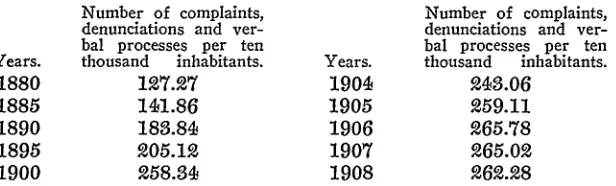
The penal statistics of Belgium are divided into two parts. One is called the "statistics of the administration of justice," giving ac-count of the disposition of cases by the different courts; the other is called "criminal statistics," dealing with crime as a social phenome-non and not as an object of activity on the part of the magistrate. The following table of statistics is taken from the report.
TABLE I. POLICE JURISDICTION.
Number of complaints, Number of complaints, denunciations and ver- denunciations and ver-bal processes per ten bal processes per ten Years. thousand inhabitants. Years. thousand inhabitants.
1880 127.27 1904 243.06
1885 141.86 1905 259.11
1890 183.84 1906 265.78
1895 205.12 1907 265.02
1900 258.3 1908 262.28
It would be inexact to conclude from this table that there has been an increase since 1880 in the relative number of complaints, de-nunciations and verbal processes, for the excess is due to infractions created by new laws, such as that relating to public drunkenness in
1887, the law of 1890 against adulteration of food, the law relating
to precautions against hydrophobia and the fish and forest laws. Another table shows that the number of cases passed on by the cor-rectional tribunals since 1904 has risen from 40,864 to 41,627 in 1909 thus indicating a very small increase. The number of cases brought before the court of appeals has, however, increased by a much larger percentage, the number in 1908 being 3,860 as against only 1,955 in 1885. The reason for this increase does not appear from the re-port of the statistician. The number of election offenses and cases of vagabondage has materially decreased since 1904 and there has been but a slight increase in the number of police offenses (131,523 in 1904; 138,513 in 1908).
The following table gives the number of persons, men and women,
[image:13.617.71.379.264.357.2]CRIMINAL STATISTICS IN BELGIUM Men. Women.
First First Grand
Years. offenders. Recidivists. Total. offenders. Recidivists. Total. Total.
1904 20,419 19,273 39,692 8,6Io 4,285 12,895 52,887 1905 20,024 19,334 39,358 8,548 4,141 12,689 52,047
I9o6 21,307 20,410 41,717 8,432 4,448 12,88o 54,597
1907 20,446 20,522 40,968 8,120 4,417 12,537 53,505 1908 19,919 2oo16 39,935 8,184 4,208 12,392 52,327
It will be noticed from the above table that the number of fe-male recidivists as compared with first offenders is much greater than in the case of male offenders. The relative number of men and women convicted each year is quite constant. For every ten thousand in-habitants there were convicted in 1904: 114 men, 37 women; in 1905: .12 men, 36 women; in 1906: 117 men, 36 women; in 1907: 114 men,
34 women; in 1908: 110 men, 34 women.
The number of convictions for public drunkenness were in 1904, 22,246; in 1905, 21,847; in 1906, 22,86-8; in 1907, 24,450; in 1908, 23,618. These statistics show a general increase since 1904. Women in Belgium resist much better the allurements of alcohol than men. Among first offenders, 22 per cent of those convicted for destruction of property and 37 per cent of those convicted for crimes and of-fenses against public order were drunkards. Among recidivists the proportions reached 55 and 66 per cent for the year 1908. Belgian statistics show that the maximum of masculine criminality is reached between the ages of 21 and 25. For the first offenders the age be-tween 18 and 21 is an especially critical time. From 18 to 30 is also a dangerous period. As to recidivists, the figures are largest between 25 and 35. The number of recidlivists compared with the number of first offenders is less for ages 16 to 25 and more for ages
25 to 60. In 1908 feminine criminality reached its maximum
be-tween the ages of 30 and 35. It is to be noted that at no age do the recidlivists outnumber the first offenders. The difference between these two groups of women criminals is very marked.
Washington, D. C. A. MAcDoxALD.
THE FEDERAL PENAL CODE, Ix FoRCE JANUARY 1, 1910; TOGETHER
WITH OTHER STATUTES HAVING PENAL PROVISIONS IN FORCE
DEcEMBER 1, 1908. By George F. Tucker and Charles W. Blood. Boston: Little, Brown and Company, 1910. Pp. LIII, 507.
fed-TUCKER AND BLOOD: FEDERAL PENAL CODE
eral authority is a crime until it has been expressly made such by statute. Crimes against the United States fall into two classes: (1) Those against the national authority without regard to the place where committed. Such are the offenses of counterfeiting the coin and public securities of the United States, offenses against the postal and revenue laws, treason, violation of the neutrality laws, etc.; (2) those committed without the jurisdiction of any particular state but within a place subject to the jurisdiction of the United States. Such are the offenses of murder, arson, robbery, burglary, etc., when committed in a territory, federal district or other place ceded by a state to the United States; or upon the navigable waters of the United States.
From time to time, beginning in 1790, certain offenses against the national authority were made crimes by acts of Congress, but no attempt was made to collect and arrange these statutes in such a way as to give the body of the criminal law the character of a code. In the Revised Statutes of 1878, it is true, the existing penal statutes were arranged under a single title, but no attempt was made to har-monize, inconsistent and conflicting provisions. It thus came about that the body of federal criminal law found itself in a condition more or less chaotic and full of inconsistencies and even of conflict-ing provisions. In the preparation of the present code an effort was made to eliminate inconsistencies, arrange the law systematically, reclassify offenses, change the punishments prescribed so as to bring them more into harmony with enlightened views of penology and to introduce greater *definiteness, especially in respect to the description of offenses and in regard to jurisdiction. In prescribing penalties the principle has been followed of imposing the maximum punishment and leaving to the discretion of the judge the fixing of the minimum penalty. All federal penal laws are arranged in fifteen chapters and there is an appendix, prepared by the annotators, con-taining all other statutes having penal provisions and these are ar-ranged under sixty-seven titles. Punishment by hard labor, pre-scribed by many. existing statutes, was done away with, mainly be-cause many federal prisoners were confined in state penitentiaries where punishment by hard labor was not recognized and hence it was impossible to enforce the penalty in such cases. Except in re-spect to phraseology and methods of punishment the provisions of the new code are substantially the same as those' found in the Re-vised Statutes. Some important changes, however, were made and a few of these may be noted. Thus the provision for punishing the forging of bonds, public records, etc., is made to apply to contracts and the having in one's possession. of forged instrumerits with the intent to utter or publish the same as true is penalized. Likewise the unlawful entering of any military reservation, army post, fort
TUCKER AND BLOOD: FEDERAL PENAL CODE
or arsenal for any purpose prohibited by law is added to the list of crimes against the government. So resistance to internal revenue of-ficers, not formerly a crime, has been added. So is the offense of accepting a bribe by a member of Congress before qualifying. The same provision is also extended so as to include Resident Commis-sioners from the insular possessions. The giving of advance in-formation by federal officials concerning crop reports or the issuing of false crop reports are among the new offenses created. So is the acceptance of a bribe by a juror, referee or witness in proceed-ings before a federal court or commissioner. The law against coun-terfeiting is enlarged so as to include the offense of connecting or pasting together parts of different bills or other instruments issued under the authority of the United States. The making of false returns
by postmasters for the purpose of securing an increase of
compensa-tion is added to the list of offenses against the postal laws. So is the offense of prosecuting false claims for the loss of registered pos-tal matter. Among the most important of the new offenses created is the shipping from one state to another of intoxicating liquors ad-dressed to other persons than the bona fide consignee, or the ship-ping of such articles not plainly marked so as to show the name of the consignee, the nature of the contents of the package and the quantity contained therein. This provision was, of course, added for the purpose of prohibiting the practice of shipping intoxicants into prohibition states, addressed to fictitious persons, thus making the local railroad agent a virtual dispenser of liquor to whomsoever might desire it.
GARRAUD: CRIMINAL PROCEDURE AND PRACTICE
into two classes and the death penalty for piracy is abolished and life imprisonment substituted. All accessories before the fact are classed as principals and are liable to trial for the substantive crime. In the case of accessories after the fact one-half the penalty imposed on the principal is prescribed.
Since the enactment of the code the parole law has been passed and hence the sections relating to the pardoning power will need to be changed. The work of the annotators has been well done though they do not always indicate the changes that have been made except where new sections have been added. The usefulness of the work, for students at least, would have been increased if, instead of stating that a given section has been "greatly enlarged" or is "largely new mat-ter," they had fully indicated the nature of the chan'e. As it is the student who desires to know the exact changes made must in many cases compare the sections of the code with those in the Re-vised Statutes. Under each section, however, is to be found the cita-tions to the more important cases, together with full explanatory notes of the important points decided. There is a table of cases and an elaborate index to the subject matter of the code, both of which add to the usefulness of the work. J. W. G.
TRAITE THEORIQUE ET PRATIQUE D'INSTRUCTION CRIMINELLE ET DE PROCEDURE PENALE. By R. Garraud, advocate at the Court of Appeals, and professor of criminal law at the University of Lyon. Vol. I, 1907, pp. 1-686; vol. II, 1909, pp. 1-676. Paris: Larose and Tenin.
The past few years in France have seen a new sun arising in the firmament of the literature of criminal law and practice, and with this work it arrives at the zenith. For fifty years the name of Faustin Helie occupied this dominant position. He will be remembered by Anglo-American lawyers as the authority relied upon by Sir James Stephen in his masterly comparison of the French and English sys-tems in the "History of the Criminal Law of England." In 1836 ap-peared Helie and Chauveau's "Th6orie du Code P6nal," which lived to its 6th edition in 6 volumes, in 1888. In 1845 appeared Helie's "Trait6 d' instruction criminelle," in 9 volumes; this first edition is now one of the raresb books in Europe; the second edition of 1867 was the classic authority in French practice for 30 years more. In 1888 had appeared a new "TraitM th6orique et pratique du droit p6nal francais," by Garraud, professor of criminal law at Lyon; by 1898, its 6-volume second edition demonstrated its right to supplant Chauveau and Helie. And now, after long further labors, has begun to appear the same author's treatise on "Criminal Procedure and Practice," which will thus complete his occupation of the field.
GARRAUD: CRIMINAL PROCEDURE AND PRACTICE
style, the sources and the point of view. The practitioner is served by copious citations of judicial decisions; the student and the legisla-tor by ample discussion and by citations of essays, treatises and leg-islative reports on the detailed topics. The history of the law is given due treatment at every suitable point; and the preliminary chapters of the present work contain an unexcelled survey of the com-parative history of criminal procedure in Europe. One of the agree-able features of the best French law-books of today is their catholi-city of view in the use of sources. The old prejudices left by the Franco-Prussian war have disappeared. Such men as Garraud, Bris-saud, Esmein, Saleilles, take note with scholarly impartiality of the researches of German learning, just as Brunner, Kohler and other Germans take account of the work of their French brethren. The ancient French self-satisfaction that Paris is the center of the world's science is now to be observed but scantily; just as the intolerant Ger-man notion of the last generation, that only GerGer-man research is worth considering, is also disappearing-except in a few men like Berolzheimer, in whom it is unforgiveable. But the French scholars, as a whole, still retain the palm for style. Proportion of elements, condensation of thought, and lucid sequence of ideas, seem to be their inherent gift. And we cannot forbear from expressing-here as else-where and ever-our personal regret that Germany's hospitable re-ception of our embryo Ph. D.'s during the last generation has blinded a large part of the American learned world to the solid merits of modern French scholarship in every field and to its at least equal claims upon our consideration. We wish to do all we can to upset the fetish that German scholarship has a monopoly of merit in any field, and that a young man nowadays can afford to give it a prior claim over French or Italian contributions.
M. Garraud's work is divided into four books. Book I treats of Public Prosecution and Civil Wrongs and herein of their respective boundaries and modes of beginning the proceedings. This subject, no doubt, has for us in the future a vast importance. Our historic gulf fixed between civil wrongs and criminal offenses is now recognized to be unnatural in its effect on procedure and to do great practical in-justice. The next generation will have to attack this problem and seek some solution congenial to habits while conducive to speedier and more effective justice. Read Mr. Train's chapter ("The Prisoner at the Bar") on the amazing experience of the citizen whose silver teapot was stolen by the cook and you will appreciate what a roar-ing farce is sometimes produced by our present principle.
Book II deals with evidence. Title I discusses the general prin-ciples, with a comparison of other systems, and is full of interesting novelties to the American lawyer. Title II takes up specific kinds of evidence,-the judge's view, experts, ordinary witnesses, documents,
GARRAUD: CRIMINAL PROCEDURE AND PRACTICE
confessions, presumptions and circumstantial evidence. This in-cludes in part the procedure before the examining magistrate ("juge d'instruction").
Book III deals with Jurisdiction, Parties and incidental matters of procedure.
Book IV is to cover Procedure before trial. Title I deals with the various bodies of police, their functions as to arrest and ex-amination.
Here ends volume II of the work. In the remaining volumes will presumably be included the examining magistrate's procedure; the trial proper; sentences; appeals; new trials; the execution of sen-tences, etc.
The work is full of topics which tempt the reviewer to extracts and discussions of the comparative methods and problems of modern France and modern America-the jury, the examining magistrate, public trials, expert testimony, the police and the like-but space does not permit. Throughout all, the author shows a judicial spirit, a lively appreciation of existing abuses and a full acquaintance with the most recent proposals of science and practice. We note, among other things (Vol. I, p. 543), that he is fully acquainted with the latest literature in "Criminalistics," as the Germans call it, and cites as authorities the books and journal of Prof. Hans Gross, whose work on "Criminal Psychology" has just appeared in the transla-tion series of the American Institute of Criminal Law and Criminal-ogy. He also gives copious references to the recent literature (French, Swiss, German and Italian) on the psychology of testi-mony-the cause recently championed among us by Prof. Muenster-berg-and on this point he writes sympathetically but concludes cautiously (Vol. I, p. 552) that "the researches into the psychology of testimony do not yet (and perhaps never will) permit or enable us to lay down rules accurate enough to be used in testing objectively the testimony given in litigation."
As an example of the point of view of an enlightened but French practitioner, we give a short extract from the author's discussion (Vol. II, p. 213) of the accused's compulsory examination ("interro-gatoire") by the magistrate:
"The magistrate's examination should never degenerate into a snare for the accused or an exhibition of the judge's skill. The ob-ject should be to get at the truth, in good faith. There may be some ground for the recent proposals to abolish the judge's questioning of the accused at the jury trial itself where his guilt is to be finally passed upon; but where the committing magistrate is acting merely to discover whether there is ground for indictment, it is idle to propose to abolish the magistrate's examination.
"But a marked contrast has always existed between the
GARRAUD: CRIMINAL PROCEDURE AND PRACTICE
tional system of the Continent and the Anglo-American partisan-complaint system, as to the mode of conducting an examination. Where the criminal prosecution is left to be a partisan encounter, the judge becomes merely the umpire to determine what points they respectively score. The complainant party is therefore the examiner
of the accused. Even this right is refused him by some systems; in England, for example, once the jury trial has begun, the accused can be examined by no one, if the accused has elected to plead not guilty. If during the trial the accused makes a statement the judge warns him that if made it will be taken down and used against him. There is no inconsistency in this practice of abstaining from the extraction
of admissions while nevertheless using them if voluntarily made. It is simply the application of the principles of civil procedure in a crim-inal trial; the complaint has the burden of proof, but the defendant's
admission will relieve him of it.
"In the inquisitional system, on the other hand, where the State is regarded as fulfilling a duty to investigate crime, the proceedings
are in no sense reminiscent of the ancient legal duel between the parties, which the judge ends by declaring one or the other to be victorious. They are rather a function of justice where Society, stepping in, undertakes the task of ascertaining the truth. This contrast in the spirit of the situation leads to important differences. "On the one hand the judge assumes the active part of an in-quirer (as 'inquisitio' signifies) and seeks to extract a confession-which is ordinarily the best evidence of guilt. But, on the other hand,
the mere confession alone is not treated as enough to call for a judg-ment of guilty; the object not being to pass upon the parties' con-duct of their case, but to get at the facts, the trustworthiness of the admissions must be established by further inquiry.
"Plainly this inquisitional system is the preferable one. The principal purpose of the examination is to give the accused an
GARRAUD: CRIMINAL PROCEDURE AND PRACTICE
-J
practice which we supposed had long disappeared in modern civiliza-tion, namely, the accused's oath. The judge's questioning of the ac-cused (so natural to our minds) being repugnant to English instincts, only one solution appeared to them practicable, i. e., to abolish the old English rule forbidding the accused to testify in his own behalf; and so the accused was made competent, but in his own discretion. -.
Such is the expedient introduced in the Criminal Evidence Act of 1898. So that now two new principles, complementary to each other, obtain in English procedure: (1) The accused, if he so elects, may .' become a witness for himself and take oath; (2) the 'accused, thu :i,' becoming a witness, submits to a double examination, first, by his own counsel, and next by the prosecuting counsel (cross-examination)."
Our author may not have penetrated in its fullest extent the spirit of Anglo-American practice in the examination of the ac-cused; that is impossible to demand; but his comparisons are valuable for us and are an example of that dispassionate and rational study of other systems which is nowadays so much needed in our own coun-try. In view of the radical proposals recently made at the second annual'meeting of the Wisconsin branch of the American Institute of Criminal Law and Criminology on the subject of the privilege against
self-crimination (JOunxAL, Vol. I, p. 808), we believe that a study
of the system so lucidly and authoritatively described by M. Garraud merits the careful attention of our bench and bar.
In conclusion, we beg to express the respectful wish that the learned author could be induced to describe for this Jour.NAL the pres-ent problems of criminal procedure as the French people them-selves see them and the proposed expedients for improvement.
J. H. W.