Berggren, Nick and Eimer, Martin (2019) Attentional access to multiple target
objects in visual search. Journal of Cognitive Neuroscience , ISSN
0898-929X. (In Press)
Downloaded from:
Usage Guidelines:
Please refer to usage guidelines at or alternatively
Running Head: Visual access to multiple targets
Attentional access to multiple target objects in visual search
Nick Berggren and Martin Eimer
Department of Psychological Sciences, Birkbeck College, University of London, Malet Street, London WC1E 7HX, UK
Phone: 0044 20 76316522 Fax: 0044 20 76316312
ABSTRACT
Most investigations of visual search have focused on the discrimination between a search target and other task-irrelevant distractor objects (selection). The attentional limitations that arise when multiple target objects in the same display have to be processed simultaneously (access) remain poorly understood. Here, we employed behavioural and electrophysiological measures to investigate the factors that determine whether multiple target objects can be accessed in parallel. Performance and N2pc components were measured for search displays that contained either a single target or two target objects. When two target objects were present, they either had the same or different target-defining features. Participants reported whether search displays contained a single target, two targets with shared features, or two targets with different features. There were performance costs as well as reduced N2pc amplitudes for two-target/different relative to two-target/same displays, suggesting that access to multiple target objects defined by different features was impaired. These behavioural and electrophysiological costs were also observed in a task where all search display objects were physically different, but not during colour or shape singleton search, confirming that they do not reflect a low-level perceptual grouping of physically identical targets. These results demonstrate strong feature-specific limitations of visual access, as proposed by the Boolean Map theory of visual attention. They suggest that multiple target objects can be accessed in parallel only when they share task-relevant features, and demonstrate that mechanisms of visual access can be studied with electrophysiological markers.
Introduction
Visual environments usually contain one or several objects that are important for thought and behaviour, among others that can be safely ignored. In such situations, visual attention has to perform two tasks. First, it has to distinguish potentially task-relevant objects from other currently irrelevant objects. The ability to detect possible target objects and to separate them from distractors that are simultaneously present in a visual scene is usually
referred to as “selection”. Selection is a core function of top-down attentional control, and a large number of visual search studies have investigated the factors that are involved in such target selection processes. In such experiments, participants have to report the presence or absence of a particular target object under conditions where the separation of targets and distractors is either easy or more challenging. The difficulty of target selection is manipulated by contrasting feature and conjunction search (e.g., Treisman & Gelade, 1980), by varying target-distractor similarity (e.g., Duncan & Humphreys, 1989), or the number of possible target-defining features (e.g., single-colour versus multiple-colour search; Irons, Folk, & Remington, 2012). Current theories of visual search, such as the Guided Search model (e.g., Wolfe, 2007), have the explicit goal to identify the mechanisms that are responsible for differences in the efficiency of target selection processes.
However, there is another equally important function of visual attention that has been investigated much less intensively. Once target objects have been distinguished from irrelevant distractors, they have to be made accessible to higher-level cognitive processes responsible for object recognition, conscious awareness, and action control. This second attentional function has been described as attentional engagement (e.g., Posner & Petersen, 1990; Zivony & Lamy, 2016) or visual access (Huang & Pashler, 2007). These different labels tend to be linked to different aspects of the attentional processing of target objects, with
“engagement” emphasising the processing of target features and their integration into object
representations, and “access” the conscious detection and recognition of target objects.
Desimone & Duncan, 1995; Duncan, 2006, for an exception). In fact, it is relatively straightforward to distinguish experimental studies of selection and visual access. To investigate limitations in visual access, a critical manipulation concerns the number of target objects that are simultaneously present in a visual display. Experiments that manipulated this factor (e.g., Duncan, 1980; Huang, Treisman, & Pashler, 2007) found strong performance impairments when multiple target objects had to be processed concurrently, even when these targets could be easily distinguished from distractors (i.e., the demands on selection were low). In contrast, studies of visual selection typically employ search tasks where only a single target object can be present in individual displays, thereby minimising the demands on visual access.
The fact that there are substantial performance costs when multiple target objects are presented simultaneously demonstrates that visual access is subject to severe capacity limitations. However, the factors that are responsible for these limitations have so far not been identified. A series of experiments by Huang et al. (2007) suggested that visual access might be specifically impaired when simultaneously presented multiple target objects are defined by different visual features (e.g., by different colours or shapes). In these experiments, match-to-sample tasks were employed where briefly presented and then masked sample objects (e.g., a blue and a red square) either appeared in the same sample display or in two successive displays. Participants had to match one of these sample colours to the colour of a subsequent probe object. Accuracy was strongly impaired when the two targets were presented simultaneously as compared to successively, indicating that it is difficult to access two different colours of two different target objects at the same time. Importantly, no such simultaneous-presentation costs were observed in another task where object locations had to be matched, which suggests that this limitation was present only for visual access to non-spatial features of objects, but not their locations.
Based on these observations, Huang and Pashler (2007) proposed a “Boolean Map”
account as a general theory of visual access. According to this theory, visual access is mediated by representations (Boolean maps), which are generated on the basis of particular
According to Huang and Pashler (2007), the content of a currently active Boolean map determines which visual objects can be visually accessed at any given instant. Because any given Boolean map can only contain a single feature label, it is not possible to simultaneously access two or more target objects in a search display when these objects are defined by different features (e.g., a red and a green target). In such displays, these objects have to be accessed sequentially (see Huang & Pashler, 2012; Huang, 2010, for further details).
While Boolean Map theory aims to provide a comprehensive perspective on the access functions of visual attention, its impact on research in this field has so far been limited. This may be due to the fact that Boolean maps are described in terms of the properties of abstract representational structures, which makes it challenging to link them to other more neuroscientifically inspired accounts of visual attention and visual search, such as the biased competition framework (e.g., Desimone & Duncan, 1995) or the Guided Search model (e.g., Wolfe, 2007). In addition, many predictions of Boolean Map theory refer to the phenomenology of visual perception (see Huang & Pashler, 2007, for examples), and therefore hard to test with standard experimental paradigms commonly used in attention research. However, the single-feature access principle that is at the heart of Boolean Map theory provides a clear and readily testable hypothesis about the source of the capacity limitations for visual access. According to this principle, access to multiple target objects in the same display is impaired when these targets are defined by different features. In contrast, parallel access to multiple target objects should be possible when these objects share the same target-defining feature. The goal of the present study was to test these predictions.
principle be measurable with brain activity markers that provide the required temporal resolution. One possible ERP marker of visual access is the N2pc component, which has been employed in many previous visual search experiments. This ERP component typically emerges between 180 and 200 ms post-stimulus at posterior electrodes contralateral to the side of target objects that are presented together with distractors in visual search displays (e.g., Eimer, 1996; Luck & Hillyard, 1994a, 1994b; Woodman & Luck, 1999; see Luck, 2012, for review). The N2pc is assumed to be generated in extrastriate ventral visual cortex (Hopf et al., 2000), and to reflect the enhancement of neural responses for objects with target-defining features at specific locations within visual cortical maps. It is elicited in search tasks where targets are defined by a specific feature, and also during search for targets that are defined by feature conjunctions (e.g., Luck & Ford, 1998; Luck & Hillyard, 1994a; Fuggetta, Pavone, Walsh, Kiss, & Eimer, 2006; Berggren & Eimer, 2018).
While the N2pc is usually regarded as an ERP marker of attentional target selection (Luck, 2012; see also see Eimer, 2014, 2015, for further discussion), this interpretation is complicated by the fact that the selection and access functions of visual attention are often not clearly distinguished. Thus, the question remains whether the N2pc is exclusively associated with the discrimination between target and distractor objects (selection), with the subsequent in-depth processing of selected target objects (access), or with both of these processes. Previous N2pc studies of conjunction search (e.g., Berggren & Eimer, 2018) have shown that the early versus late phase of target N2pc components can reflect different aspects of attentional control (feature-based versus object-based guidance). Such observations suggest that this component may not be linked exclusively to a single stage of attentional processing (see also Zivony, Allon, Luria, & Lamy, 2018, for recent evidence that the N2pc can be associated with the attentional engagement to target objects).
Mazza et al., 2013). Such links between N2pc amplitudes and the number of targets were only found in tasks where multiple target individuation was required (e.g., when the exact number of targets in a display had to be reported), but not when observers simply had to decide whether a search display contained at least one colour-defined target or only distractors (Mazza & Caramazza, 2011), suggesting that the underlying processes are goal-sensitive rather than mandatory. It is clear that the object individuation mechanism postulated by Mazza and colleagues reflects a relatively late stage of attentional processing that follows the initial discrimination between target and distractor objects (selection), but the question remains whether this mechanism is similar or identical to the visual access or attentional engagement processes proposed by others (Huang & Pashler, 2007; Zivony et al., 2018).
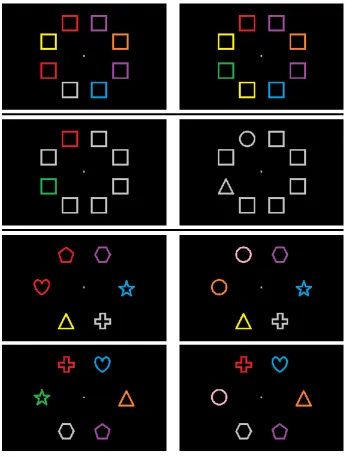
The present experiments were designed to investigate links between visual access and the N2pc component more directly, and to specifically test the single-feature access principle postulated by Boolean Maps theory. In Experiment 1, circular search displays contained either one or two colour-defined target objects among multiple distractor objects in different nontarget colours (see Figure 1, top panel). Participants searched for one of two possible coloured targets (two-colour search; see Irons, Folk, & Remington, 2012; Grubert & Eimer, 2016). There were single-target displays which included one target object that was equally likely to have either of these colours, and two-target displays with two target objects. In half of these displays, both target objects shared the same colour (e.g., both red; two-target/same displays). In the other half, they had two different colours (e.g., red and green; two-target/different displays). Both target objects always appeared on the same side of a search display, but never at adjacent positions. Participants performed a three-alternative choice task. They reported on each trial whether the search display contained a single target, two identical colour targets, or two different colour targets.
elicited by these displays should be larger than N2pcs triggered by single target displays, reflecting access to two versus just one target object. Such a result would be in line with previous N2pc studies that manipulated the number of same-colour target objects in the same display (e.g., Drew & Vogel, 2008; Mazza & Caramazza, 2011). The critical question concerns the N2pc components elicited by two-target/different displays. If access to both targets is impaired in these displays, N2pc components should be reduced in size relative to two-target/same displays. In fact, Boolean Maps theory makes the specific prediction that only one of the two targets should be accessible in two-target/different displays. If this was the case, N2pc components for these displays should be identical in size to the N2pc elicited by single-target displays, reflecting access to a single target object in both cases. An alternative possibility is that N2pc components elicited in response to visual search displays generally do not reflect visual access to targets, but are instead generated by earlier selection mechanisms that dissociate between target and distractor objects (e.g., by inhibiting distractors; e.g., Luck & Hillyard, 1994b). In this case, there should be no systematic N2pc amplitude differences between two-target/same and two-target/different displays.
Experiment 1
Method
Participants
Thirteen participants took part in Experiment 1. One participant was excluded from analysis due to chance-level accuracy. Of the final sample of 12 participants (M age = 34 years, SD = 7, 6 male; all right-handed), all reported normal or corrected-to-normal vision.
Stimuli and Procedure
degrees of visual angle) was present constantly throughout each experimental block. Each search display contained eight coloured squares (0.95 x 0.95°) presented equidistant from fixation at an eccentricity of 1.78°, measured from fixation to the centre of each object. These stimuli were arranged around an imaginary circle, with four items in the left and four in the right visual hemifield (see Figure 1, top panel). Squares could appear in the following six colours: red (CIE coordinates: .605, .322), orange (.543/.409), yellow (.405/.470), green (.296/.604), blue (.169/.152), magenta (.270/.134), or grey (.305/.325). All colours were matched for luminance (14 cd/m2).
--- Insert Figure 1 about here ---
Participants’ task was to report whether each search display contained a single target,
two identical targets, or two different targets, by pressing the ‘1’, ‘2’, or ‘3’ keys on the
numeric keypad with their right index, middle, or ring finger. The single-target response was
always ‘1’, while two-target/same and two-target/different responses were counterbalanced within-subjects halfway through the experiment. Following practice, participants completed six experimental blocks of 72 trials each. Single-target, target/same, and two-target/different displays were equiprobable, and the target(s) were equally likely to be presented on the left or right side.
EEG Data Recording and Analysis
EEG was DC-recorded at 27 scalp electrodes, mounted on an elastic cap at sites Fpz, F7, F8, F3, F4, Fz, FC5, FC6, T7, T8, C3, C4, Cz, CP5, CP6, P9, P10, P7, P8, P3, P4, Pz, PO7, PO8, PO9, PO10, and Oz. A 500-Hz sample rate was utilised, and a 40 Hz low-pass filter was applied during recording. An electrode attached to the left earlobe was used as an online reference, with the average of both earlobes used for offline re-referencing. No other filters were applied offline. Trials with eye blinks (exceeding ±60 µV at Fpz), horizontal eye movements (exceeding ±30 µV in the HEOG channels), and muscle movement artifacts (exceeding ±80 µV at all other channels) were rejected from EEG analyses, as were trials where an incorrect response was recorded. All other trials were segmented into epochs for each search display ranging from -100 to +500 ms relative to search display onset. EEG epochs were averaged relative to a 100 ms pre-stimulus baseline, separately for all three search display types, and for displays where target(s) appeared in the left or right visual field. N2pc components were quantified based on ERP mean amplitudes obtained at lateral posterior electrode sites PO7/PO8 between 200-300 ms post-stimulus onset.
Results
Insert Figure 2 about here ---
Behavioural Performance
Reaction times (RTs) on trials with correct responses were fastest for two-target/same displays (M = 754 ms), slowest for two-target/different displays (M = 813 ms), and intermediate for single-target displays (M = 792 ms). A one-way Analysis of Variance (ANOVA) showed a significant main effect of Display Type (F(2,22) = 6.74, p= .005, ηp2 = .38). A paired t-test confirmed that RTs to two-target displays were reliably faster when these displays contained two identical as compared to two different colour targets (t(11) = 6.12, p < .001). This difference is shown in Figure 2 (top panel, left). The RT differences between single-target and two-target/same displays and between single-target and two-target/different displays were not reliable (t(11) = 1.91 and 1.20, p = .083 and .25, respectively). Error rates also differed between the three search display types (F(2,22) = 7.91, p< .005, ηp2 = .42). As shown in Figure 2 (bottom panel, left), errors on two-target trials were more frequent when target colours differed than when they were identical (M = 19 % versus 9 %; t(11) = 3.65, p = .004). For single-target displays, errors were recorded on 11 % of all trials. This error rate was lower than for two-target/different displays (t(11) = 2.59, p = .03), but did not differ from two-target/same displays (t(11) = 1.14, p = .28). On trials with two-target/different displays, participants were more likely to incorrectly report the presence of a single colour target than the presence of two identical colour targets (55 % versus 40 % of all error trials; 5 % were no-response trials). For two-target/same displays, reports of single targets were less frequent than reports of two different targets (31 % versus 64 %).
--- Insert Figure 3 about here ---
N2pc components
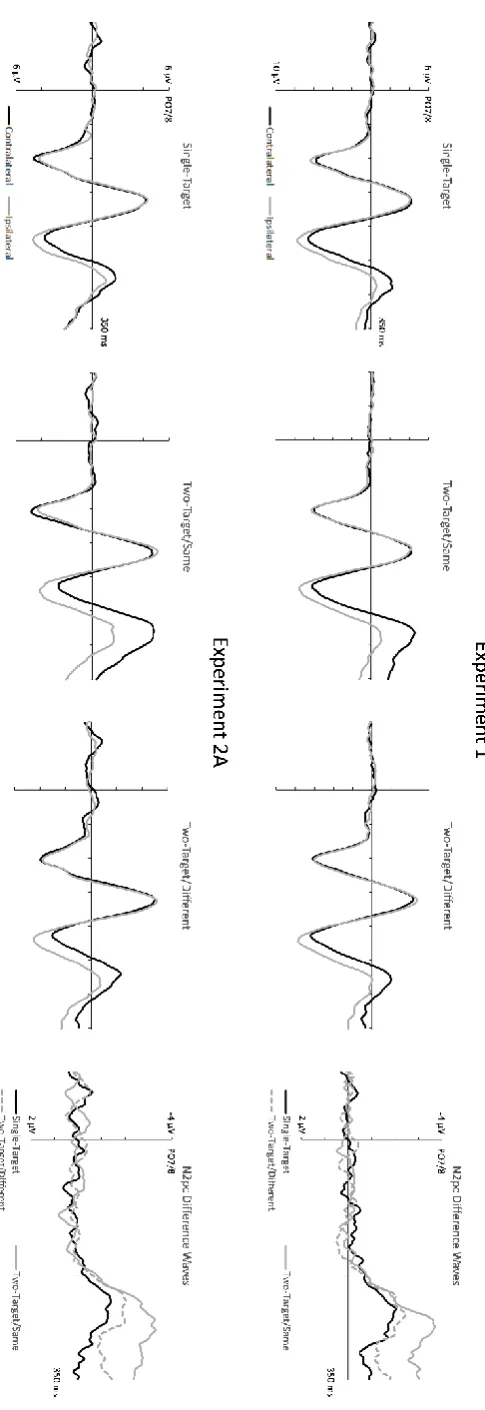
N2pc amplitudes elicited by two-target/different displays were considerably smaller than N2pcs to two-target/same displays, and similar in size to N2pcs triggered by single-target displays.
Mean amplitude data obtained 200-300 ms post-stimulus onset were entered into a 3x2 repeated-measures ANOVA with the factors Display Type (single-target, two-target/same, two-target/different) and Laterality (contralateral, ipsilateral). A significant main effect of Laterality (F(1,11) = 84.04, p< .001, ηp2 = .88) confirmed the reliable presence of N2pc components. There was also a significant Condition x Laterality interaction (F(2,22) = 14.93, p< .001, ηp2 = .58). Comparisons of contralateral versus ipsilateral ERPs showed that reliable N2pc components were elicited by all three search display types (t’s > 6.99, p’s < .001).
To compare these N2pcs, difference values were computed by subtracting ipsilateral from contralateral ERPs. N2pc components elicited by two-target/same displays (M diff = -2.51 µV, SD = .91) were significantly larger relative to single-target displays (M diff = -1.50 µV, SD = .64;
t(11) = 4.97, p < .001), and, crucially, also relative to two-target/different displays (M diff = -1.79 µV, SD = .89; t(11) = 4.67, p = .001). N2pc components triggered by two-target/different and single-target displays showed no reliable amplitude difference (t(11) = 1.39, p = .19).
Discussion of Experiment 1
Caramazza, 2011), which is likely to reflect parallel visual access to two targets versus just a single target object. The single-feature access principle also assumes that the behavioural costs for two-target/different displays are due to the fact that only a single target object can be accessed in these displays. In this case, the N2pc elicited should be identical to the N2pc triggered by single-target displays. Although there was a numerical trend for slightly enhanced N2pc amplitudes in response to two-target/different as compared to single-target displays, this difference was not significant, which suggests in both types of search displays, only a single target object was accessed.
the critical N2pc amplitude differences observed in Experiment 1 were not due to such grouping effects is clearly needed. One goal of Experiments 2 and 3 was to provide such evidence.
Experiment 2
In Experiment 1, target objects appeared among multiple distractors in different nontarget colours, and could therefore only be discriminated from distractors on the basis of their colour. The behavioural and N2pc results observed in this experiment showed that visual access to two target objects in the same search display was strongly impaired when these targets differed in their colour, and suggest that only a single target object could be accessed in these displays. These conclusions should not be based the results of a single experiment, and require confirmation in a replication experiment. This was done in Experiment 2A, which used exactly the same stimulus parameters and analysis procedures as Experiment 1.
If the performance and N2pc differences observed in Experiment 1 between the three types of search displays reflect differences in visual access to colour-defined target objects, a different pattern of effects should be observed in search tasks where access is not mediated by specific target features. To test this, Experiments 2B and 2C employed tasks where targets were salient feature singletons (e.g., the only coloured objects among homogeneous grey distractors). Such singletons can be detected by registering local discontinuities in search displays, without the need to discriminate specific target features (singleton detection mode; Bacon & Egeth, 1994). Boolean Map theory assumes that in such singleton search tasks, visual access does not operate in a feature-specific fashion, but on the basis of bottom-up salience values (Huang & Pashler, 2007). Because visual access is not controlled by specific feature labels, but operates in a purely location-based fashion in such tasks, observers should be able to simultaneously access two singleton target objects in the same display, regardless of whether these two objects are identical or differ in their features. If this is correct, there should be no behavioural or electrophysiological differences between two-target/same and two-target/different displays in singleton search tasks.
homogeneous distractors (see Figure 1). Targets were defined by one of two possible colours (Experiment 2B) or one of two possible shapes (Experiment 2C). In two-target/same displays, both targets were identical, while in two-target/different displays, they differed in their colour or shape. Participants again had to report the presence of a single target, two identical targets, or two different targets. If observers can access multiple target objects irrespective of their features during singleton search, there should no longer be any behavioural and electrophysiological access costs for two-target/different displays. Therefore, the performance and N2pc differences between these displays and two-target/same displays that were observed in Experiment 1 search should be eliminated in Experiments 2B and 2C. In contrast, and importantly, if the N2pc amplitude differences between these displays were due to the perceptual grouping of physically identical target objects, they should again be present in Experiments 2B and 2C.
Method
Participants
Thirteen participants took part in Experiment 2. Of these, one participant was excluded from analysis due to a high proportion of data contaminated by horizontal eye-movements in all three sub-experiments. Of the remaining 12 participants (M age = 28 years, SD = 8, 4 male; 1 left-handed), all reported normal or corrected-to-normal vision.
Stimuli and Procedure
their shape. For each participant, two target shapes were chosen from a set of three shapes (circle, triangle, or hexagon), and this was counterbalanced across participants. All distractor items were uniform grey squares. In all other respects, Experiment 2C was identical to Experiments 2A and 2B. The order in which Experiments 2A, 2B, and 2C were performed was randomised across participants.
EEG Data Recording and Analysis
These were identical to Experiment 1. For each sub-experiment, ERPs were computed separately for single-target, two-target/same and two-target/different displays with the target(s) in the left or right visual field. N2pc mean amplitudes were again computed within a 200-300 ms post-stimulus time window.
Results
Experiment 2A (Replication of Experiment 1)
Behavioural performance
As expected, results were very similar to Experiment 1 (see Figure 2). RTs on trials with correct responses were slower for two-target/different displays (M = 791 ms) than for two-target/same displays (M = 739 ms) and single-target displays (M = 725 ms), as reflected by resulting in a main effect of Display Type (F(2,22) = 11.76, p < .001, ηp2 = .52). Paired t-tests confirmed that this RT delay for target/different displays was reliable relative to two-target/same displays (t(11) = 6.24, p < .001), and also relative to single-target displays (t(11) = 3.88, p = .003). There was no significant RT difference between single-target and two-target/same displays (t < 1). Error rates also differed between display types (F(2,22) = 8.33, p
trials). The opposite tendency was observed for errors in response to two-target/same displays (25 % versus 69 %).
N2pc components
Figure 3 (bottom panels) shows ERPs elicited by the three different search display types at electrodes PO7/PO8 contralateral and ipsilateral to the side of the target object(s), and the corresponding contralateral-ipsilateral difference waveforms. Results were generally similar to Experiment 1 (Figure 3, top panel). Crucially, N2pc components were again much larger for two-target/same as compared to two-target/different displays. The N2pcs for single-target displays was slightly attenuated relative to N2pcs to two-target/different displays. An analysis of N2pcs mean amplitudes obtained 200-300 ms post-stimulus onset with the factors Display Type and Laterality revealed a significant main effect of Laterality (F(1,11) = 35.01, p< .001, ηp2 = .76) and a reliable Condition x Laterality interaction (F(2,22) = 13.55, p< .001, ηp2 = .55). All three types of search displays elicited reliable N2pc components (t’s > 4.52, p’s ≤ .001). N2pcs for two-target/same displays (M diff = -2.50 µV, SD = 1.66) were larger than N2pcs to single-target displays (M diff = -0.96 µV, SD = .73; t(11) = 4.19, p < .001), and also, critically, larger than N2pcs for two-target/different displays (M diff = -1.53 µV, SD = .78; t(11) = 4.67, p = .001). N2pc amplitudes to two-target/different displays were now reliably larger than N2pcs to single-target displays (t(11) = 3.15, p = .009).
Experiment 2B (Colour Singleton Search)
Behavioural performance
For RTs, an effect of Display Type was present (F(2,22) = 45.91, p < .001, ηp2 = .81). RTs were faster for single-target displays (M = 534 ms) relative to two-target/same displays (M = 645 ms; t(11) = 6.76, p < .001) and two-target/different displays (M = 656 ms; t(11) = 7.53, p
search tasks (Experiments 1 and 2A), the majority of errors on trials with two-target/different displays were reports of two identical targets (87 % of all error trials), while incorrect single-target responses were very infrequent (10 %). This pattern of errors was identical to that found for two-target/same displays (86 % versus 10 %).
--- Insert Figure 4 about here ---
N2pc components
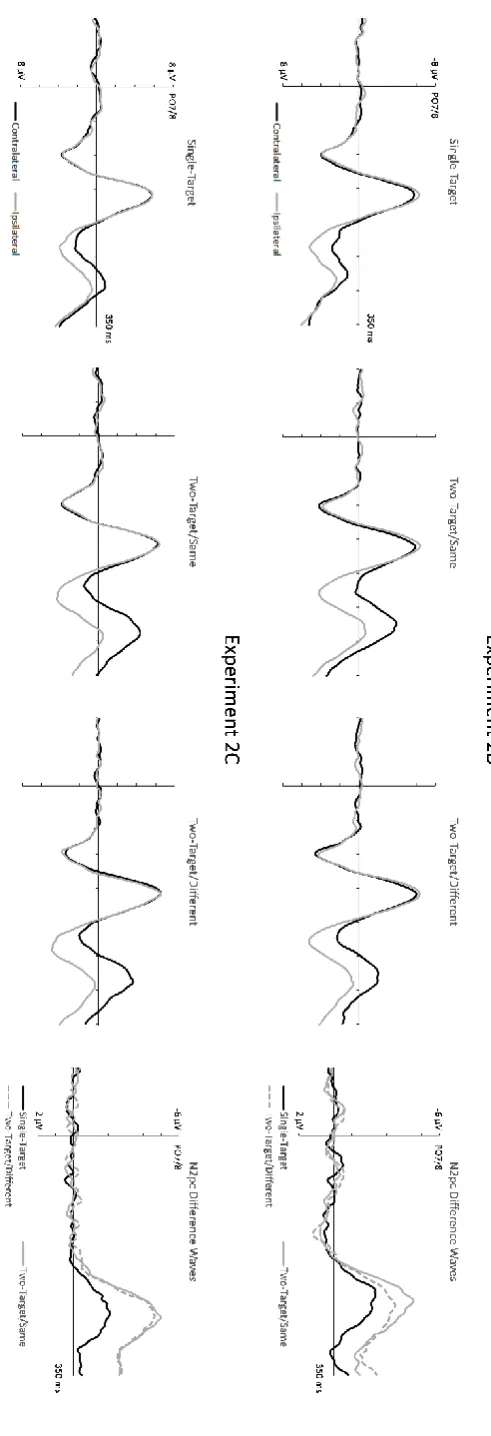
Figure 4 (top panels) shows contralateral and ipsilateral ERPs and the corresponding N2pc difference waveforms elicited in Experiment 2B for the three different search display types. N2pcs were smallest for single-target displays, and slightly larger for two-target/same as compared to two-target/different displays. For N2pc mean amplitudes, a main effect of Laterality (F(1,11) = 82.96, p< .001, ηp2 = .88) was accompanied by a Laterality x Display Type interaction (F(2,22) = 21.63, p < .001, ηp2 = .66). Reliable N2pcs were present for all three display types (t’s > 8.04, p’s < .001). N2pc amplitudes were larger for two-target/same displays (M diff = -3.41 µV, SD = 1.40) and two-target/different displays (M diff = -2.80 µV, SD = 1.21) relative to single-target displays (M diff = -1.62 µV, SD = .68; both t’s > 5.12, both p’s < .001).
Although the N2pc was numerically larger for two-target/same displays, the amplitude difference relative to two-target/different displays only approached statistical significance (t(11) = 1.93, p = .08).
Experiment 2C (Shape Singleton Search)
Behavioural performance
.001, ηp2 = .63) reflected the fact that participants made fewer errors for single-target displays (M = 2 %) relative to both two-target/same displays (M = 8 %; t(11) = 4.21, p = .001) and two-target/different displays (M = 11 %; t(11) = 4.73, p < .001). The error rate difference between both two-target search displays was also reliable (t(11) = 3.34, p = .007). For two-target/different displays, participants reported two identical targets on 85 % of all error trials, and a single target on only 11 % of these trials. A similar pattern of errors was found for two-target/same displays (79 % versus 16 %).
N2pc components
Figure 4 (bottom panels) shows contralateral and ipsilateral ERPs and the corresponding N2pc difference waveforms elicited in Experiment 2C for all search display types. N2pcs were much smaller for single-target relative to two-target displays, and appeared virtually identical for two-target/same and two-target/different displays. A main effect of Laterality (F(1,11) = 90.35, p < .001, ηp2 = .89) and a Laterality x Display Type interaction (F(2,22) = 27.88, p < .001, ηp2 = .72) were present for N2pc mean amplitudes. Reliable N2pcs were elicited by all three display types (t’s > 5.61, p’s < .001). N2pc amplitudes
were larger for two-target/same displays (M diff = -3.59 µV, SD = 1.34) and two-target/different displays (M diff = -3.41 µV, SD = 1.32) relative to single-target displays (M diff = -1.48 µV, SD = .91; both t’s > 5.61, both p’s < .001). Notably, there was no evidence for N2pc
amplitude differences between two-target/same and two-target/different displays (t < 1).
Discussion of Experiment 2
object can be accessed in both displays. Its implications will be further considered in the General Discussion.
A very different pattern of behavioural and N2pc results was observed in the colour and shape singleton search tasks of Experiments 2B and 2C. Here, RTs did not differ between two-target/same and two-target/different search displays (see Figure 2), indicating that the two target objects could be accessed equally well in both types of displays. There were also no differences in error rates between these displays in the colour singleton task (Experiment 2B) and only a small albeit reliable difference in the shape singleton task (Experiment 2C). These results strongly suggest that, in contrast to search for colour-defined targets (Experiments 1 and 2A), both target objects could be accessed simultaneously during singleton search, regardless of whether their features were identical or not. This was further confirmed by the pattern of target N2pc components measured in these tasks. During shape singleton search, virtually identical N2pc components were triggered in response to two-target/same and two-target/different displays. During colour singleton search, there was a numerical tendency for a larger N2pc for two-target/same displays, but this difference only approached significance.
According to Boolean Maps theory, the observation that both singleton target objects in Experiments 2B and 2C could be accessed simultaneously, regardless of whether their features were identical or not, implies that access was not based on feature labels, but operated in an entirely location-based fashion. However, this cannot be entirely correct. Because participants had to report whether the singleton targets in two-target displays were identical or different, some information about their colours or shapes had to be available. This suggests an important modification to the single-feature access principle: even though individual feature values may not have been explicitly represented in these experiments, the identity relationship between both targets (same versus different) must still have been accessible in parallel. In other words, observers are able to directly access the presence of a task-relevant feature difference in search displays without being able to simultaneously access the exact values of these feature. This apparent dissociation between visual access to individual feature labels and to the identity relationship between features needs to be investigated more systematically in future research.
not due to differences in visual access, but instead the result of a low-level visual grouping of two physically identical targets (as suggested by Mazza & Caramazza, 2012). No such N2pc amplitude differences were observed in the colour and shape singleton search tasks of Experiments 2B and 2C, in spite of the fact that such perceptual grouping effects should have been equally if not more pronounced in colour and shape singleton displays. This provides additional evidence that such N2pc amplitude modulations are indeed associated with differences in the efficiency of visual access processes. Further support for this conclusion will be provided by Experiment 3.
Experiment 3
In the colour-guided search tasks of Experiments 1 and 2A, two-target/same displays always contained a pair of identical target objects. It is possible that the performance benefits and N2pc enhancements observed for these displays relative to two-target/different displays were a result of this fact. Multiple feature-defined target objects in the same display may be simultaneously accessible only when they are physically identical, but not when they differ in some of their features. Boolean Map theory does not assume that physical identity is necessary for multiple-object access. According to this theory, multiple targets can be accessed in parallel as long as they share one feature in one dimension (e.g., colour), even when they differ in another dimension (e.g., shape).
share a feature, Experiment 3 should find behavioural and N2pc differences between target/match and target/mismatch displays that mirror those found between two-target/same and two-target/different displays in Experiments 1 and 2A.
The single-feature access principle of Boolean map theory applies to features from the same dimension, such as colour. It states that two targets defined by two different colours cannot be accessed simultaneously. This raises the question whether this is also the case when two targets are defined by features from different dimensions (e.g., a colour-defined and a shape-defined target object). For example, the Guided Search model (Wolfe, 2007) postulates an asymmetry between the control of visual search within and across dimensions. According to this model, search can be guided in parallel by multiple features from different dimensions, but only by a single feature within each dimension. Boolean Maps theory does not predict such an asymmetry for visual access to multiple target objects. According to Huang and Pashler (2007), Boolean maps can include feature labels for different dimensions, but only when these labels apply to the same object. When these features are distributed across different target objects, access to these objects requires the sequential creation of multiple Boolean maps, one for each feature, which can subsequently be combined via Boolean operations (intersection and union; see also Huang & Pashler, 2012). This implies that visual access to multiple target objects always has to be mediated by a single shared feature, and that features from different dimensions cannot be accessed simultaneously.
Method
Participants
Twelve participants took part in Experiment 3 (M age = 28 years, SD = 6, 4 male; 1 left-handed), all reporting normal or corrected-to-normal vision.
Stimuli and Procedure
Participants now performed a four-feature search task where targets were defined by one of two possible colours or two possible shapes, respectively. Pilot testing revealed that this task was very challenging, and produced much slower RTs and higher error rates than the tasks used in Experiments 1 and 2. For this reason, search display duration was extended from 100 ms to 150 ms, and the interval between two successive search displays from 1400 ms to 1850 ms. In addition, the number of search display objects was reduced from eight to six in Experiment 3. Each search display contained six coloured shapes arranged around an imaginary circle at an eccentricity of 2.10° (three objects in the left and three in the right visual field; see Figure 1, bottom panel). The distance between these objects was increased (by increasing stimulus eccentricity from 1.78° to 2.10°), in order to minimize visual crowding, which was less of an issue in Experiments 1 and 2 where search display objects only differed in a single dimension. Objects could appear in eight possible colours (red, orange, yellow, green, blue, magenta, grey, and, additionally for this experiment, pink; CIE coordinates: .315/.178) and eight possible shapes (square, circle, triangle, cross, heart, star, pentagon, and hexagon). For each participant, two colours and two shapes were chosen as target features, from a rotated choice of red/blue/green and circle/square/triangle.
Participants’ task was to search for target objects that matched one of the four
they belonged to different dimensions (i.e., one target colour and one target shape; e.g., red pentagon and green circle; different-dimension displays). Single-target, two-target/match and two-target/mismatch displays were equally likely and randomly distributed within each block.1 In all search displays, the colours and shapes of the distractor objects, and the other irrelevant attribute of the target object(s) were unique features. As in Experiments 1 and 2, both target objects in two-target displays were always presented in the same hemifield. Because search displays now only contained three objects on each side, the locations of these two targets were selected randomly, and they could therefore be presented at adjacent locations.
Response instructions were analogous to Experiments 1 and 2. Participants had to report on each trial whether a search display contained one target, two targets with a matching task-relevant feature, or two targets with mismatching task-relevant features. Because this task was difficult, it required considerable training. All participants completed a set of practice blocks prior to formal EEG testing, until they achieved a fixed performance threshold (above 75 % response accuracy). This practice phase lasted approximately 15-20 minutes, and was followed by 16 experimental blocks of 72 trials each.
EEG Recording and Analysis
These were similar to Experiments 1 and 2. ERPs were computed separately for all different types of search displays containing target object(s) in the left or right visual field. In the case of single-target displays, two-target/match displays, and two-target/mismatch displays where both targets were drawn from the same dimension, separate ERPs were computed for displays that contained colour-defined or shape-defined target objects. Separate ERPs were also computed for two-target/mismatch displays that contained one shape-defined and one colour-defined target (different-dimension displays). N2pc mean amplitudes were again computed within a 200-300 ms post-stimulus time window.
1 Due to a programming error, the total number of two-target displays with two identical versus two different
colour-defined targets was not identical for the first six participants tested. These participants were presented
with 168 identical-colour displays and 216 different-colour displays. The additional trials with different-colour
displays were removed from analysis. This error was corrected for the other six participants, who received each
Results
Behavioural performance
An initial ANOVA compared RTs for single-target displays, two-target/match displays (both collapsed across displays with colour-defined and shape-defined targets), and two-colour/mismatch displays (collapsed across displays with same-dimension and different-dimension targets). A significant effect of Display Type was observed (F(2,22) = 73.75, p <
.001, ηp2 = .87). RTs were much faster for two-target/match displays (M = 865 ms) relative to two-target/mismatch displays (M = 1093 ms; t(11) = 12.55, p < .001) and single-target displays (M = 1113 ms; t(11) = 8.89, p < .001), which did not differ in terms of RTs (t < 1). RTs in response to two-target/mismatch displays were slower when targets were defined in different dimensions as compared to the same dimension (M = 1013 vs. 1173 ms; t(11) = 11.22, p < .001). However, RTs for both types of displays were reliably slower than RTs to two-target/match displays (both t‘s > 10.08, both p’s < .001).
To assess any RT differences between displays with colour-defined and shape-defined targets, an additional analysis was conducted for single-target, target/match, and two-target/mismatch displays with the factors Display Type and Target Dimension (colour, shape). This analysis excluded search displays with two targets from different dimensions. A main effect of Display Type effect (F(2,22) = 60.83, p < .001, ηp2 = .85), was accompanied by an effect of Target Dimension (F(1,11) = 38.38, p< .001, ηp2 = .78), as RTs were generally faster for displays with colour-defined relative to shape-defined targets (M = 967 vs. 1027 ms). These two factors interacted (F(2,22) = 17.36, p < .001, ηp2 = .61). RT benefits for colour-defined targets were present for single-target displays (M = 1097 vs. 1129 ms; t(11) = 4.52, p
= .001) and for two-target/mismatch displays (M = 948 vs. 1077 ms; t(11) = 5.44, p < .001), but not for two-target/match displays (M = 857 vs. 874 ms; t(11) = 1.75, p = .11).
Parallel analyses were performed for error rate data. The initial ANOVA revealed an effect of Display Type (F(2,22) = 11.78, p < .001, ηp2 = .52). Error rates were lower for two-target/match displays (M = 5 %) as compared to two-target/mismatch displays (M = 19 %;
they came from the same dimension (M = 27 vs. 11 %; t(11) = 6.97, p < .001). However, error rates were higher for both types of displays relative to two-target/match displays (both t‘s >
4.45, both p’s ≤ .001). Across all two-target/mismatch displays, participants reported the presence of a single target on 77 % of all error trials, and two identical targets on only 23 % of these trials. For two-target/match displays, the opposite pattern of response errors was observed (33 % single-target responses versus 65 % different-target responses). The additional ANOVA including the factor Target Dimension obtained main effects of Display Type (F(2,22) = 6.37, p= .007, ηp2 = .37) and Target Dimension (F(1,11) = 12.77, p= .004, ηp2 = .54), as errors were generally less frequent for colour-defined targets (M = 9 vs. 12 %). There was a marginal interaction (F(2,22) = 3.33, p= .054, ηp2 = .23) between both factors. A colour benefit for response accuracy was present for two-target/mismatch displays (error rates: M
= 8 vs. 15 %; t(11) = 3.49, p = .005), but not for single-target displays (M = 16 vs. 14 %; t < 1) or two-target/match displays (M = 6 vs. 5 %; t(11) = 1.27, p = .23).
--- Insert Figure 5 about here ---
N2pc components
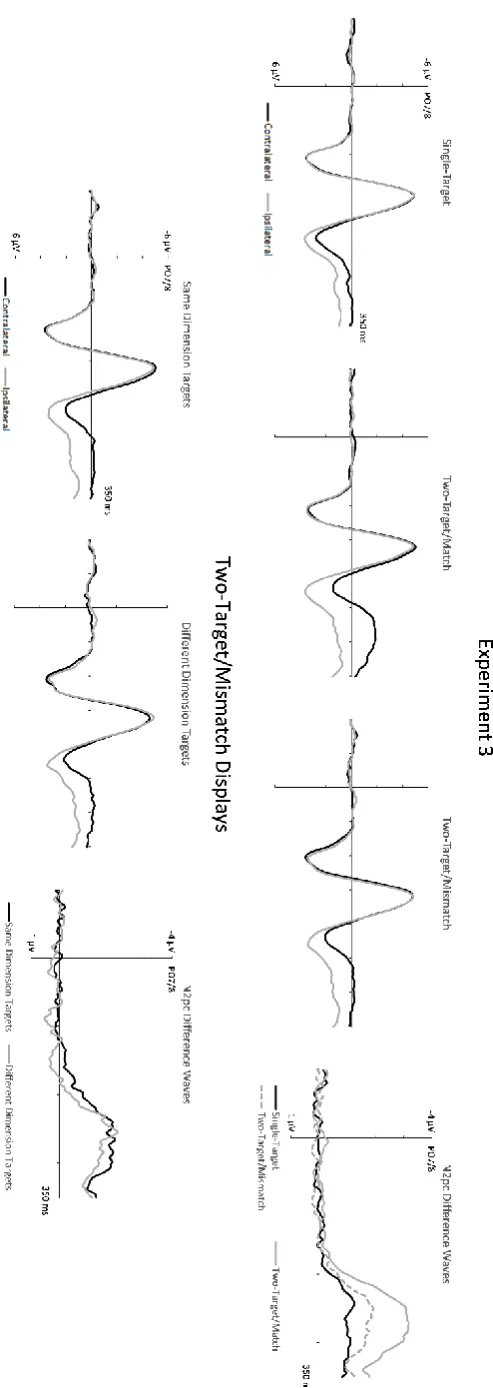
1.52 µV, SD = 1.15 vs. 1.03; t(11) = 13.96, p < .001). The N2pc for single-target displays (M diff = -.98 µV, SD = .47) was smaller than for two-target/match displays (t(11) = 6.98, p < .001), and was also attenuated relative to two-target/mismatch displays (t(11) = 2.73, p = .02).
Figure 5 (bottom panel) shows contralateral and ipsilateral ERPs as well as N2pc difference waveforms elicited in Experiment 3 for two-target/mismatch displays that included two target objects defined by two different features from the same dimension (two colours or two shapes) or from different dimensions (one colour, one shape). N2pc components were reliably present and similar in size for both types of displays (same-dimension displays: M diff = -1.62 µV, SD = .85; t(11) = 6.60, p < .001; different-dimension displays: M diff = -1.37 µV, SD = 1.35; t(11) = 3.54, p = .005). A direct comparison of N2pc amplitudes between these displays obtained no reliable difference (t(11) = 1.21, p = .25).
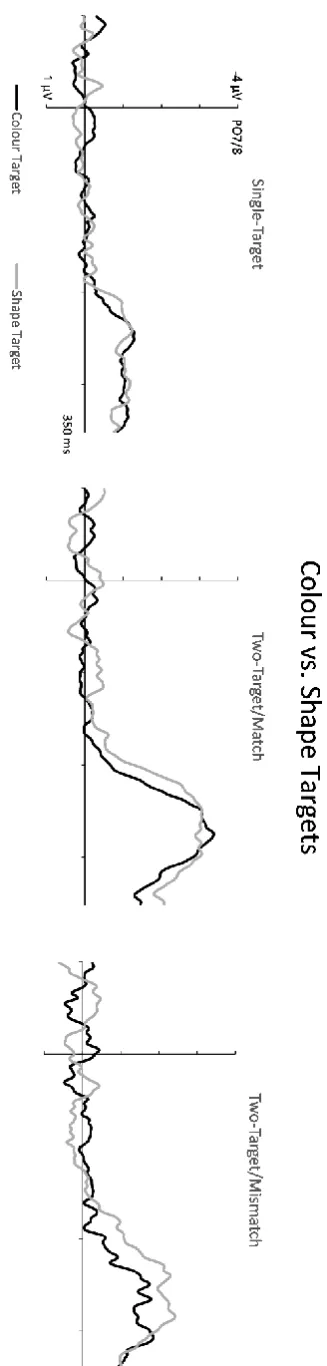
--- Insert Figure 6 about here ---
To assess any N2pc differences between search displays with colour-defined versus shape-defined target objects, N2pcs for one-target, target/match and two-target/mismatch displays were computed separately for colour and shape targets. Figure 6 shows the resulting contralateral-ipsilateral N2pc difference waves. Note that for two-target/mismatch displays (right panel), only displays containing two different target objects from the same dimension were included. An omnibus 3x2x2 ANOVA of N2pc mean amplitudes with the factors Display Type, Target Dimension, and Laterality obtained a significant three-way interaction (F(2,22) = 4.48, p = .02, ηp2 = .29). As can be seen in Figure 6, there were no N2pc amplitude differences between colour-defined and shape-defined targets in single-target and two-single-target/match displays, and this was confirmed by the absence of any Target Dimension x Laterality interactions for these displays (both F < 1). In contrast, this interaction was significant for two-target/mismatch displays (F(1,11) = 9.81, p = .01, ηp2 = .47), with larger N2pc amplitudes for displays containing two different shape-defined targets relative to displays with two different colour targets (M diff = -1.99 vs. -1.27 µV, SD = 1.14 vs. .71; see Figure 6, right panel).
Experiment 3 tested the single-feature access principle of Boolean Maps theory in a search task where targets were defined by one of four possible features from two different dimensions (colour and shape), and target objects in the same display were never physically identical. We compared behavioural performance and N2pc components for two-target search displays with target objects that either had the same or two different target-defining features. The critical question was whether the differences between these two-target/match and two-target/mismatch displays would be similar to those observed in Experiments 1 and 2A between two-target/same and two-target/different displays. This was indeed the case. RTs were more than 200 ms faster in response to displays with two feature-matching targets than for displays with mismatching targets, and error rates were much lower (5 % versus 19 %; see Figure 2). Importantly, N2pc components elicited by two-target/match displays were also larger than N2pcs for two-target/mismatch displays. These observations are in line with the single-feature access principle of Boolean Map theory, and show that it also applies to non-identical target objects. Similar differences between two-target/match and mismatch displays were observed regardless of whether these displays contained colour-defined or shape-defined targets, demonstrating that they are not specific to colour-guided attentional control processes, but generalize across feature dimensions. They mirrored the differences observed in Experiments 1 and 2A between displays with two identical versus two different colour targets, in spite of the fact that target objects were always physically different in Experiment 3.
in the same versus different dimensions were statistically equivalent, clear behavioural costs (slower RTs and more errors) were found for displays containing one colour-defined and one shape-defined target. The absence of N2pc differences between these displays suggests that these costs are generated at processing stages that follow visual access. For example, a decision that two targets are different may be reached faster when it can be based on comparing these targets within the same dimension than when different dimensions are involved.
The fact that the behavioural and N2pc effects observed in Experiment 3 were similar to those found in Experiments 1 and 2A also provides further evidence against the perceptual grouping hypothesis. If these effects were due to the perceptual grouping of identical target objects in the same display, they should have been absent or considerably smaller in Experiment 3, where these target objects always differed in a least one feature (colour or shape). Although the presence of the other shared feature could still have resulted in some perceptual grouping, any such tendency should have been smaller than in Experiments 1 and 2A for physically identical target objects. The results of Experiment 3 are thus not in line with a low-level perceptual grouping account. They instead suggest that simultaneous visual access to target objects is impaired when they are defined by different features as compared to a single shared feature, even in search displays that do not contain any physically identical objects.
General Discussion
search displays, and measured behavioural and electrophysiological correlates of visual access. These experiments found converging evidence from performance and ERPs that multiple-target access is indeed strongly impaired when target objects are defined by different features.
In Experiment 1, performance was better and N2pc amplitudes were larger for search displays where two target objects shared the same colour than for displays that contained two different colour-defined target objects. This demonstrates that visual access to different-colour targets was impaired relative to access to same-different-colour targets, and suggests that in the former case, only a single target object could be accessed at any given moment. These observations were confirmed in Experiment 2A. In contrast, no such differences between two-colour/same and two-colour/different displays were observed in Experiments 2B and 2C, where targets were colour or shape singletons, and could therefore be accessed in a feature-independent fashion (Bacon & Egeth, 1994). In line with the predictions of Boolean Map theory, these results suggest that two colour or shape singleton target objects can be accessed in parallel even when they are physically different. Experiment 3 demonstrated that the impairment of access to targets defined by different as compared to shared features remained present in a search task where target objects varied across two dimensions (colour and shape), and two targets in the same display were never physically identical.
did not share a feature were observed in Experiment 3, where all search display objects were physically different, and no perceptual grouping of identical target objects was possible. These observations rule out the possibility that these costs were primarily associated with low-level visual grouping, and thus strongly suggest that they reflect differences in visual access.
If this conclusion is correct, it also implies that the N2pc component is sensitive to visual access processes, and can be employed to investigate factors that modulate the efficiency of access to multiple targets in the same search display. Although it has previously been argued that the N2pc is primarily associated with earlier selection-related functions of attention (such as distractor suppression; e.g., Luck & Hillyard, 1994b), the current results firmly connect this component to attentional target processing stages that follow the initial discrimination between task-relevant and irrelevant objects in visual displays. At a more general level, the question whether the N2pc reflects either selection or access may be misplaced, since there is no a priori reason to assume that this component has to be exclusively associated with a single discrete stage of attentional processing. Previous research has shown that the N2pc is sensitive to different aspects of attentional control that emerge gradually in real time (see Eimer, 2014, for further discussion). For example, the early and late phase of the target N2pc in conjunction search tasks appear to reflect dissociable feature-based versus object-feature-based attentional guidance mechanisms (Berggren & Eimer, 2018). Thus, the current evidence for links between the N2pc and visual access does not imply that this component cannot also be sensitive to factors that modulate target-distractor selection processes.
single-feature access principle of Boolean Maps theory predicts that only a single target object can be immediately accessed in two-target/different displays, and the serial-access hypothesis postulates that access to each target in these displays operates in a sequential fashion.
The current results provide only partial support for these two specific claims. The pattern of errors observed for two-target/different displays is in line with the hypothesis that only one of the two target objects was immediately accessed in these displays. When access was feature-based (in Experiments 1, 2A, and 3), participants were more likely to incorrectly report the presence of a single target object than the presence of two matching objects. This indicates that they failed to register the presence of the other target in the same display, consistent with the single-object access hypothesis. In contrast, such single-target reports were very infrequent for displays with two feature-matching targets, and for all two-target displays during colour or shape singleton search, suggesting that both targets were visually accessible under these conditions. However, the pattern of N2pc results observed in the present study was not entirely in line with the single-feature access principle proposed by Boolean Map theory. In Experiments 2A and 3, small but reliable N2pc amplitude differences were found between single-target displays and two-target/different or two-target/mismatch displays, respectively, with smaller N2pcs for single-target displays. A similar non-significant tendency in the same direction was present in Experiment 1. If access was limited to a single target object in both displays, the corresponding N2pc components for these displays should have been identical in size. The fact that N2pc amplitudes tended to be larger for two-target/different displays suggests that even though visual access to both targets was strongly impaired relative to two-target/same displays, it may not have been completely restricted to a single target object on all trials.
(e.g., Irons et al., 2012; Grubert & Eimer, 2016). However, the guidance of search is generally less effective than in tasks where targets are defined by a single constant feature, as reflected by slower RTs and smaller target N2pc components. These multiple-feature costs suggest that observers fail to activate task sets for all possible target attributes on some trials, resulting in an impaired allocation of attention to targets defined by an insufficiently prepared feature. It is likely that such multiple-feature costs were also present in the two-colour search tasks of Experiments 1 and 2A, and especially in the four-feature search task of Experiment 3. Importantly, these costs will affect single-target search displays more strongly than displays with two different targets. When only one task set for one target colour is fully prepared during two-colour search (as in Experiments 1 and 2A), selecting and accessing a target that matches the other colour in single-target displays will be impaired, resulting in attenuated target N2pcs. In contrast, because two-target/different displays always contain both target colours, the target that happens to match the currently active task set can be selected and accessed on all trials, thereby reducing or eliminating any multiple-feature costs at the level of target N2pc components. The same applies to the four-feature search task of Experiment 3, where a failure to activate task sets for all possible target features on some trials will produce larger costs for N2pc amplitudes for single-target as compared to two-target/mismatch displays. In this case, the N2pc amplitude differences observed between these two types of displays would not reflect differences in the number of objects that can be accessed simultaneously, but instead limitations in the guidance of attentional selection (i.e., the discrimination between targets and distractors) during multiple-feature search that specifically affect single-target displays. If this was correct, these N2pc differences would not be inconsistent with the single-feature access principle of Boolean Maps theory.
find any evidence for an enhanced contralateral negativity in response to the latter displays that would reflect a delayed second N2pc component. The apparent absence of such effects does not necessarily imply that the serial-access claim of Boolean Maps theory is incorrect, as it may instead reflect methodological limitations of the present study. Both target objects in two-target displays always appeared in the same hemifield, and thus will both have elicited contralateral negativities in the same hemisphere. It is generally difficult to dissociate serial attentional allocation processes by temporally separating lateralised ERP components with the same polarity. For this reason, previous N2pc studies of serial selection (e.g., Woodman & Luck, 2003; Eimer & Grubert, 2014), employed different procedures where one target was presented laterally and the other on the vertical midline (above/below fixation), thus ensuring that only the lateral target would trigger an N2pc. Similar procedures will be required in future work in order to test the serial-access hypothesis of Boolean Maps theory more decisively.
Acknowledgements
References
Bacon, W.F., & Egeth, H.E. (1994). Overriding stimulus-driven attentional capture. Perception & Psychophysics, 55, 485-496.
Berggren, N., & Eimer, M. (2018). Object-based target templates guide attention during visual
search. Journal of Experimental Psychology: Human Perception and Performance, 44, 1368-1382.
Desimone, R., & Duncan, J. (1995). Neural mechanisms of selective visual attention. Annual Review of Neuroscience, 18, 193-222.
Drew, T., & Vogel, E.K. (2008). Neural measures of individual differences in selecting and tracking
multiple moving objects. Journal of Neuroscience, 28, 4183-4191.
Duncan, J. (1980). The locus of interference in the perception of simultaneous stimuli. Psychological Review, 87, 272-300.
Duncan, J. (2006). EPS Mid-Career Award 2004: Brain mechanisms of attention. The Quarterly Journal of Experimental Psychology, 59, 2-27.
Duncan, J., & Humphreys, G.W. (1989). Visual search and stimulus similarity. Psychological Review,
96, 433-458.
Eimer, M. (1996). The N2pc component as an indicator of attentional selectivity.
Electroencephalography and Clinical Neurophysiology, 99, 225-234.
Eimer, M. (2014). The neural basis of attentional control in visual search. Trends in Cognitive Sciences, 18, 526-535.
Eimer, M. (2015). EPS Mid-Career Awarded 2014: The control of attention in visual search:
Cognitive and neural mechanisms. The Quarterly Journal of Experimental Psychology,
68, 2437-2463.
Eimer, M., & Grubert, A. (2014). Spatial attention can be allocated rapidly and in parallel to new
visual objects. Current Biology, 24, 193-198.
Fuggetta, G., Pavone, E.F., Walsh, V., Kiss, M., & Eimer, M. (2006). Cortico-cortical interactions in
spatial attention: A combined ERP/TMS study. Journal of Neurophysiology, 95, 3277-3280. Grubert, A., & Eimer, M. (2016). All set, indeed! N2pc components reveal simultaneous
attentional control settings for multiple target colours. Journal of Experimental Psychology: Human Perception and Performance, 42, 1215-1230.
Hopf, J.M., Luck, S.J., Girelli, M., Hagner, T., Mangun, G.R., Scheich, H., & Heinze, H.-J. (2000). Neural
sources of focused attention in visual search. Cerebral Cortex, 10, 1233–1241.
Huang, L. (2010). What is the unit of visual attention? Object for selection, but Boolean map for
Huang, L., & Pashler, H. (2007). A Boolean map theory of visual attention. Psychological Review, 114, 599-631.
Huang, L., & Pashler, H. (2012). Distinguishing different strategies of across-dimension attentional
selection. Journal of Experimental Psychology: Human Perception and Performance, 38, 453-464.
Huang, L., Treisman, A., & Pashler, H. (2007). Characterizing the limits of human visual awareness.
Science, 317, 823-825.
Irons, J.L., Folk, C.L., & Remington, R.W. (2012). All set! Evidence of simultaneous
attentional control settings for multiple target colors. Journal of Experimental Psychology: Human Perception and Performance, 38, 758-775.
Luck, S.J. (2012). Electrophysiological correlates of the focusing of attention within complex visual
scenes: N2pc and related ERP components. In S.J. Luck & E.S. Kappenman (Ed.), The Oxford handbook of event-related potential components (pp. 329-360). New York: Oxford University Press.
Luck, S.J., & Ford, M.A. (1998). On the role of selective attention in visual perception. Proceedings of the National Academy of Sciences USA, 95, 825-830.
Luck, S.J., & Hillyard, S.A. (1994a). Electrophysiological correlates of feature analysis during visual
search. Psychophysiology, 31, 291-308.
Luck, S.J., & Hillyard, S.A. (1994b). Spatial filtering during visual search: Evidence from
human electrophysiology. Journal of Experimental Psychology: Human Perception and Performance, 20, 1000-1014.
Mazza, V., & Caramazza, A. (2011). Temporal brain dynamics of multiple object processing: The
flexibility of individuation. PLoS One, 6, e17453.
Mazza, V., & Caramazza, A. (2012). Perceptual grouping and visual enumeration. PLoS One, 7, e50862.
Mazza, V., Pagano, S., & Caramazza, A. (2013). Multiple object individuation and exact enumeration.
Journal of Cognitive Neuroscience, 25, 697-705.
Pagano, S., & Mazza, V. (2012). Individuation of multiple targets during visual enumeration: New
insights from electrophysiology. Neuropsychologia, 50, 754-761.
Posner, M.I., & Petersen, S.E. (1990). The attention system of the human brain. Annual Review of Neuroscience, 13, 25-42.
Treisman, A.M., & Gelade, G. (1980). A feature-integration theory of attention. Cognitive Psychology,
12, 97-136.
Gray (Ed.), Integrated Models of Cognitive Systems (pp. 99-119). New York: Oxford. Woodman, G.F., & Luck, S.J. (1999). Rapid shifts of attention during visual search. Nature, 400,
867-869.
Woodman, G.F., & Luck, S.J. (2003). Serial deployment of attention during visual search. Journal of Experimental Psychology: Human Perception and Performance, 29, 121-138.
Wyble, B., Potter, M.C., Bowman, H., & Nieuwenstein, M. (2011). Attentional episodes in visual
perception. Journal of Experimental Psychology: General, 140, 488-505.
Zivony, A., Allon, A.S., Luria, R., & Lamy, D. (2018). Dissociating between the N2pc and attentional
shifting: An attentional blink study. Neuropsychologia, 121, 153-163.
Zivony, A., & Lamy, D. (2016). Attentional capture and engagement during the attentional blink: A
Figure captions
Figure 1: Examples of search displays shown across experiments (not to scale). Top panels: In
Experiments 1 and 2A, search displays included eight squares. One or two of these were targets
defined by their colour. The examples show a two-target/same search display with two red targets,
and a two-target/different display with a red and a green target. Middle panels: In Experiments 2B
and 2C, targets were colour or shape singletons among uniform distractors (grey squares). The
examples show two-target/different search displays. Bottom panels: In Experiment 3, search displays
contained six coloured shapes, with targets defined by two possible colours and two possible shapes
(e.g., red, green, circle, square). The examples on the upper row show two-target/match search
displays, containing two red targets or two circle targets. The examples on the lower row show
two-target/mismatch search displays. Here, two targets could contain mismatching target features from
the same feature-dimension (e.g., one red and one green target) or mismatching target features from
different dimensions (e.g., one red and one circle target).
Figure 2: Reaction times (top panels) and error rates (bottom panels) observed in Experiment 1,
Experiments 2A, 2B, and 2C, and Experiment 3, for two-target displays with identical/feature-matching
targets versus two-target displays with different/feature-mismatching targets.
Figure 3: (Top panels) Grand average ERPs obtained in Experiment 1 in the 350 ms interval following
search display onset at posterior electrode sites PO7/PO8 contralateral and ipsilateral to the side of
the target object(s) in the search displays. ERPs are shown separately for single-target displays,
two-target/same displays, and two-target/different displays. The corresponding difference waveforms
computed by subtracting ipsilateral from contralateral ERPs are shown on the right. (Bottom panels):
Contralateral and ipsilateral ERPs and corresponding difference waves measured for these three types
of search displays in Experiment 2A.
Figure 4: (Top panels) Grand average ERPs obtained in Experiment 2B (colour singleton search) at
electrodes PO7/PO8 contralateral and ipsilateral to the side of the target object(s) in single-target,
two-target/same, and two-target/different displays, shown together with the corresponding
contralateral-ipsilateral difference waveforms. (Bottom panels): Contralateral and ipsilateral ERPs and
N2pc difference waves measured for these three types of search displays in Experiment 2C (shape