
2017 2nd International Conference on Wireless Communication and Network Engineering (WCNE 2017) ISBN: 978-1-60595-531-5
Development of a Serious Game to Assist in Teaching History
Jennifer Sarah SALOMÃO, Clayton Eduardo dos SANTOS,
Ana Paula Muller GIANCOLI and Flavio Cezar AMATE
*Federal Institute of Education, Science and Technology of São Paulo, Bragança Paulista-SP, Brazil *Corresponding author
Keywords: Serious game, Learning, ICT, Education.
Abstract. Computerized games have proved to be a great tool to help students learn independently of their application, either in foreign language teaching or to arouse interest in learning from other disciplines or even to help them learn specific functions in certain professions, due to its popularity and motivational capacity. Nowadays, with Information and Communication Technologies (ICT) available, it is possible to create new teaching methodologies that use Game-Based Learning (GBL) to facilitate learning. This work aims to develop a Serious Game to aid in the acquisition of knowledge about a historical event occurred in the sixteenth century: The Black Death. The game provides teachers and students with a new kind of teaching that can be used in the classroom, motivating and facilitating the acquisition of students' knowledge. The game was developed using the RPG Maker VX Ace tool, that allows create attractive, versatile and accessible RPG games. Other advantage isn't internet connection is required to use the game. To create scripts, RPG Maker uses the Ruby programming language, an open source language that is easy to understand and use, and is focused on productivity. After completing, the game proved to be a good tool to help the teacher, addressing the Black Death theme and the Mongol attack on the city of Caffa. The game gave an insight on the theme, introducing the subject and as waiting, presented the theme form more dynamic, in order to arouse the students' interest.
Introduction
ICTs positively impacted the quality and quantity of teaching, learning and research in higher education institutions, both traditional and distance, according to [1, 2]. It has been proven that ICTs also increase the level of interest and commitment of students, accelerating, enriching and deepening their knowledge [2]. Communication can also be facilitated, taking into account the new means of communication that technology presents us, such as: emails, chat rooms, video conferences, forums and among others.
Serious Games can also be considered as part of the ICTs, they appear as a way to assist both students and teachers in learning. They can be used in a variety of activities, both for specific content development and skills that have helped the development of the student [3]. Unlike ordinary games that are fun-only, Serious Games are often used to conduct business training, and the results have proven to be advantageous. Taking this into account, [4] argue that introducing a Serious Game into the classroom can make the learning experience more fun and less tedious for the student, but without losing the seriousness and importance of class.
Educational games can be used in activities that collaborate with the enrichment of the general formation of the student, expanding their language, communication, problem solving strategies among others, stimulates the interest and concentration, creativity, and several other benefits [3].
Student Performance in the Classroom
In Brazil the unsatisfactory school performance is evident and it is related to students' learning difficulty, social, emotional issues among others. These learning difficulties have been studied since the 1960s and are seen as a serious problem requiring attention. These problems can be generated by several factors, such as cognitive, emotional and motivational problems [5].
Teachers have been concerned about the motivation of students because many are absent from classes, making development in the minimum studies. Already students who feel motivated present better performance compared to others [6]. This same study revealed that students may have an intrinsic motivational stance in some activities and in others an extrinsic motivational stance. Intrinsic motivation occurs when the student is motivated by curiosity, challenges or interest in the subject of the lesson, while the extrinsic occurs when motivation comes through notes and teacher approval, say [6].
Younger children were motivated by curiosity, while the older ones only care about meeting the expectations of the teacher, which led the authors of this study to confirm that the intrinsic motivation falls, as the student progresses in the school trajectory and the reason is the way the school uses extrinsic incentives (based on grades and teacher approval) in class, [6].
In research conducted by [7, 8], students stated that their experiences of school failure occurred because of their lack of motivation. Technologies effectively help students, making them feel motivated to socialize with resources and improve school performance [5]. By using them, creativity, value judgment and self-esteem are stimulated. In addition, using technologies with students who have difficulty learning is indispensable, since it helps to identify learning failures and alleviate them [5].
Taking into account the motivation of the students, it can be said that a tool such as a Serious Game, which has already explained, increases the student's motivation and interest, can rescue the intrinsic motivation of the students, thus possibly reducing school failure.
Information and Communication Technologies in Learning
ICTs are part of our lives nowadays. The whole world is connected through them. Emails, chats and more can be cited as part of this technology. Since their popularization, they have positively impacted the quality of teaching, learning, and research, among others. According to [2], "ICTs can elevate teaching and learning through its dynamic, interactivity and captivating content and can provide opportunities for individual instruction".
These technologies can be used to prepare students for the future, prepare them for the job market, providing tools for them to practice for a given function they will exercise according to [2, 9].
ICTs can also make school more efficient and more productive by providing different types of tools and facilitating teachers' professional activities, this encourages students to learn actively and independently in ways they feel better or in collaboration with other students [10].
The technology used in social interactions also provides help to the student, making him learn more about this context, modifying the school-student relationship [5].
There are still teachers who are resistant to adhere to the use of the technologies available in the classroom. Since the use will have a positive impact on student learning, it is important that the teacher is willing to adhere to the changes [5].
According to the data previously collected, it is possible to classify this type of tool as a Serious Game, since it is also considered an ICT and can bring several benefits to students and teachers, assisting in teaching, complementing and reinforcing what has already been seen in classroom, facilitating learning.
BlackDeath
The Mongols helped to carry out the transmission of the plague, as they dumped corpses infected with the disease in the city of Caffa, this event ended up contributing to the transmission by the population, since survivors, in their attempts to escape, transmitted the plague to other parts of the basin of the Mediterranean [12].
The first pandemic occurred in Europe, North Africa and in Central-South Asia. The second pandemic occurred in Europe and became known as the Black Death due to black spots that appeared in the body of the infected. Its transmission form was pneumonic and decimated around a third of the European population as pointed out by [11]. The latest pandemic has sprung up in China due to the maritime advance and spread rapidly across the inhabited continents.
After their emergence, many experts tried to discover their origins and forms of treatment, before discovering that transmission was performed through infected rats on ships, they tried to clean the cities, to aromatize, to perform prayers and processions, many believed that the plague came to man as a divine punishment [11].
In 1340, the disease again reached Europe, brought by vessels of Genoveses merchants. After several investigations were carried out, was discovered that the plague to have originated in Mongolia and its transmission was carried out by flea bites from rats infected with Yersinia Pestis bacteria and by contact with an infected person. Mice invaded ships because of poor hygiene.
Method
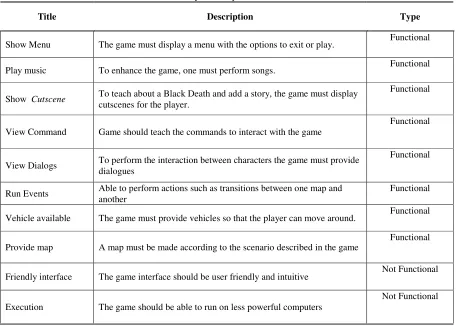
[image:3.612.79.535.392.718.2]To begin the development of the game was carried out the survey of functional requirements that must be met for the game to function properly. Table 1 presents the requirements raised during the analysis phase. It is possible to observe that most of the requirements are essential, since, the game would not work if they were not implemented.
Table 1. System Requirements Table.
Title Description Type
Show Menu The game must display a menu with the options to exit or play. Functional
Play music To enhance the game, one must perform songs. Functional
Show Cutscene To teach about a Black Death and add a story, the game must display cutscenes for the player.
Functional
View Command Game should teach the commands to interact with the game
Functional
View Dialogs To perform the interaction between characters the game must provide dialogues
Functional
Run Events Able to perform actions such as transitions between one map and another
Functional
Vehicle available The game must provide vehicles so that the player can move around. Functional
Provide map A map must be made according to the scenario described in the game
Functional
Friendly interface The game interface should be user friendly and intuitive Not Functional
Execution The game should be able to run on less powerful computers
Not Functional
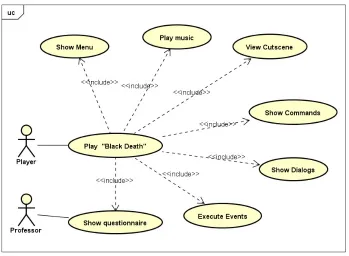
Figure 1. Graphical representation of the use case of the game "Black Death".
Next, the class diagram developed for the elaboration of the game will be presented. The figure 2 represents the class diagram of the game "Black Death".
[image:4.612.124.489.392.689.2]Black-box test. One of the tests performed on the system was the black box test, in which ten candidates tested the features present in the game. Table 2 presents the test results.
Table 2.Results of the black box test conducted in the game "Black Death” (adapted from [13]).
Test Operations Status
1 View main menu 10/10
2 Start game 10/10
3 Turn-off game (close game) 10/10
4 View cutscenes 10/10
5 View Commands 10/10
6 View the option “Proceed” 10/10
7 View the option “No” 9/10
8 Change to next scene 10/10
9 View Dialogues 10/10
10 Move Character 10/10
11 Display text when trying to return (scenario 2) 10/10
12 Enter and exit the ship 10/10
13 Move ship 10/10
14 Display text by going to the wrong side (Scenario 2) 10/10
15 View dialogs while interacting with NPC 10/10
16 View dialog when running Trigger in scenario 10/10
17 Return to main menu 10/10
Conclusion
Observing the information analyzed, it is understood that the use of ICTs in the classroom is still an unknown practice. Even when the technology is present in several schools, it is rare to find a technology created to aid learning. Using a Serious Game to aid teaching brings a number of benefits, such as facilitating the learning process and engaging students in learning a particular subject.
It is worth mentioning that teachers are still the basis in the teaching-learning context, so when using the Serious Game, it is necessary to follow the teacher, because the tool will only aid in teaching. The game Black Death was created for this purpose, during the game, the game demonstrates several events about the Black Death and the Mongols, applying a questionnaire at the end, so that the teacher can evaluate the student's knowledge.
The black box and usability tests were performed by ten candidates. In the black box test performed, the game presented a good performance and stability, no execution or locking errors were observed. The usability test carried out proved that the game is user-friendly and arouses interest in the game, making the experience fun for the player and aiding in their learning.
The use of Ruby language in the game made it easier to develop, it fits perfectly with RPG Maker, making development easier because its syntax is easy to understand and the ability to create custom scripts according to the need of the game.
Therefore, the game is a great tool to teachers to complement the class.
Acknowledgement
References
[1] Almeida, Maria Elizabeth Bianconcini de. Distance learning on the internet: approaches and contributions from digital learning environments. Educação e Pesquisa 29.2 (2003): 327-340.
[2] Yusuf, Mudasiru Olalere. "Information and Communication Technology and Education: Analysing the Nigerian National Policy for Information Technology." International Education Journal 6.3 (2005): 316-321.
[3] de Morais, Alana Marques, Liliane dos Santos Machado, and Ana Maria Gondim Valença. "Serious games na odontologia: Aplicações, características e possibilidades." XII Congresso Brasileiro de Informática em Saúde, Porto de Galinhas–PE. 2013.
[4] El-Ghouli, Lotfi, and Faddoul Khoukhi. "Contributions of serious games on adaptive learning systems." Intelligent Systems: Theories and Applications (SITA), 2016 11th International Conference on. IEEE, 2016.
[5] de Souza, Isabel Maria Amorim, and Luciana Virgília Amorim de Souza. "O uso da tecnologia como facilitadora da aprendizagem do aluno na escola." Revista Fórum Identidades (2013).
[6] Martinelli, Selma de Cássia, and Carla Helena Manzini Genari. "Relations between school performance and motivational orientations." Estudos de Psicologia (Natal) 14.1 (2009): 13-21.
[7] Maluf, Maria Regina, and Cristina Bardelli. "As causas do fracasso escolar na perspectiva de professoras e alunos de uma escola de primeiro grau." Psicologia: Teoria e Pesquisa 7.03 (2013): 263-271.
[8] Neves de Jesus, Saul, and Willy Lens. "An integrated model for the study of teacher motivation." Applied Psychology 54.1 (2005): 119-134.
[9] Yusuf, M. O., and S. A. Onasanya. "Information and communication technology (ICT) and teaching in tertiary institutions." Teaching in Tertiary Intitutions (2004): 67-76.
[10] Kirschner, Paul, and Iwan GJH Wopereis. "Mindtools for teacher communities: A European perspective." Technology, Pedagogy and Education 12.1 (2003): 105-124.
[11] da Silva ALVES, Gabriel Vieira, and Fabiana Perpétua Ferreira Fernandes. "Impacto Da Peste Negra Na Europa."
[12] Wheelis, Mark. "Biological warfare at the 1346 siege of Caffa." Emerging infectious diseases 8.9
(2002): 971.
[13] Assis, M. G., M. A. Assis, and F. C. Amate. "Software for mapping of the risks of Pressure Ulcer, fall and phlebitis." J Health Inform [Internet] 4 (2012): 130-7.
![Table 2. Results of the black box test conducted in the game "Black Death” (adapted from [13])](https://thumb-us.123doks.com/thumbv2/123dok_us/297122.1030871/5.612.84.527.111.406/table-results-black-test-conducted-black-death-adapted.webp)
