2017 2nd International Conference on Computer, Mechatronics and Electronic Engineering (CMEE 2017) ISBN: 978-1-60595-532-2
Simulation Studies of CMAC-PID Combined Control for
Electro-hydraulic Position Servo System
Chang-lin MA
*and Lin HAO
Xi’an Research Inst. of Hi-tech Hongqing Town Xi’an, Shanxi Province, China
*Corresponding author
Keywords: Electro-hydraulic position servo system, CMAC control, Combined control, Simulation.
Abstract. An electro-hydraulic servo system is taken as control object, the control strategy combining CMAC network with the PID controller is discussed. The inverse dynamic control is realized using CMAC neutral network as feed-forward controller, the PID controller is acted as feedback controller to subdue the turbulence and guarantee its stabilization. Output signals from the CMAC network and from a conventional PID controller are integrated to constitute an overall output signal, which then acts on the controlled object. Thus, good regulating performance by itself is guaranteed. The AMESim model of the electro-hydraulic servo control system is established, and the collaborative simulation of hydraulic system model and control algorithm is implemented. Simulation results show that this control strategy is effective and practical.
Introduction
Electro hydraulic position servo system, due to its high control accuracy, response speed, large output power, signal processing, flexible, easy to realize all kinds of parameters of feedback, etc., now has been widely used in various fields of technology. However, due to the hydraulic servo system exists such as dead zone and friction non-linearity is more complex, the object parameters will change with changes in environmental conditions, and many electro-hydraulic servo system are the external load disturbance, these perturbations are usually uncertain and unknown, so the traditional control algorithm is difficult to meet the control performance requirements.
CMAC is a neural network model proposed by Albus in 1975, which has the characteristics of nonlinear and self-learning ability. In recent years, CMAC has been widely used in real time control, pattern recognition, non-linear time series analysis and so on. In this paper, the CMAC neural network and PID composite control strategy are discussed, and it is applied to the real-time control of the electro-hydraulic position servo system, and the effectiveness of the algorithm is verified by simulation.
Working Principle of CMAC Network
The realization of CMAC network:
Firstly, the input space S is divided into many sub spaces, and each adjacent sub space is overlapped with each other.
Secondly, the input vectors of S fall into the corresponding sub space under the function of the field function, and each sub space is activated by the two maps to activate the N storage unit.
Finally, the weights of these elements are stored to generate an output of CMAC.
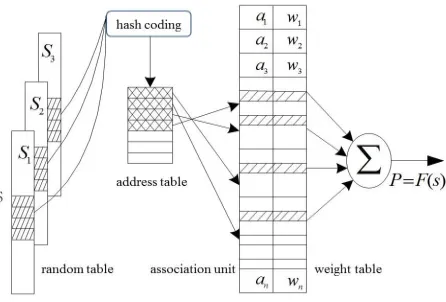
CMAC neural network architecture is shown in figure 1 In the graph, S is the input vector, A is the associative unit vector, F (S) is the output function, a1~an are the storage selection vector , and
n
w
w1~ are the weights in the actual memory. From the graph, it can be seen that the CMAC is
Figure 1. CMAC neural network structure.
The mapping is divided into two processes:
First mapping S(x) is the input state space X of arbitrary point x as the address mapping variables to the concept memory A, X to a mapping is by rolling the combination, and its principle is the vector space is similar to the input and in the output space to more similar, X in a has associative characteristics, Lenovo cell number n, n is also known as the size of the generalization and by Lenovo to unit and its value is 1, the rest to 0. The address of the A space is a virtual address. If the input vector dimension less, virtual address can and physical address correspondence; if input vector dimension is large, the storage space of concepts a have may be very huge, to enable the network to achieve the physical, the pseudo random mapping method, namely Hash-coding method, a mapping to a smaller actual storage space Ap and corresponding physical unit number is Ng. This is usually a kind of mapping, that is, every vector X in xi corresponds to a few of the identified cells
in the Ap.
Second mapping P is used to calculate the output value
i N
i i T
a w w a a P y
g
∑
=
= = =
1
)
( (1)
In the formula, j is the address of the Ap corresponding to the i.
CMAC learning is based on gradient descent method, which can be described as
) ˆ ( s s
g
j y y
N
w = −
∆ β (2)
In the formula, s is the sample mark, △wj is the weight correction, βis the learning rate, 0<β<1.
Compound Control Strategy Based on CMAC
Composite control is based on the feedback control, the control signal of the differential system as a system of additional input. This kind of hybrid control with feedback and feed-forward can improve the tracking precision and dynamic performance of the system. Considering CMAC neural network has strong nonlinear approximation ability and strong self-learning ability, taking into account the CMAC learning fast, CMAC neural network is chosen as a forward link, in order to improve the compensation effect of the composite control.
Controller Structure
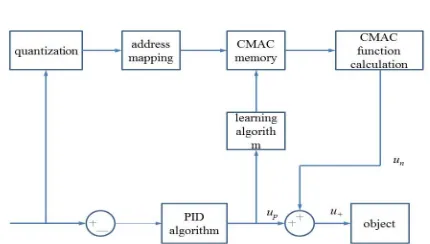
CMAC and PID compound control structure as shown in Figure 2, the system through the CMAC and PID compound control to realize feed-forward, feedback control, so as to enable the controlled object dynamic inversion control, CMAC controller using the input layer, hidden layer and output layer of the three layer neural network, through training to optimize the weights, the feedback control is realized by using the conventional controller, guarantee the system stability and disturbance rejection.
Controller Learning Algorithm
CMAC uses a tutor's learning algorithm, the end of each control cycle, calculate the corresponding CMAC output un(k), and with the total control input un(k) comparison, correction
weight, into the learning process. The purpose of the study is to make the total control input and the difference between the outputs of the CMAC. After CMAC learning, the learning of the CMAC only depends on the error of the measured value and the value of the change. The control algorithm of the system is
i c
i i n k wa
u
∑
= = 1 ) ( (3) ) ( ) ( )(k u k u k
u = n + p
[image:3.612.198.413.333.455.2](4)
Figure 2. CMAC and PID composite control structure diagram.
In the formula, ai is a binary choice vector, c is the norm parameter of CMAC network, un(k)
generates the corresponding output, up(k) is the output of the PID controller. CMAC adjustment index is shown as
c a k u k u k E i n ⋅ − = 2 )) ( ) ( ( 2 1 )
( (5)
Using gradient descent algorithm, the weight adjustment formula of CMAC is obtained:
i p i n a c k u a c k u k u k
w( )=η ( )− ( ) =η ( )
∆ (6)
)) 1 ( ) ( ( ) ( ) 1 ( )
(k =w k− +∆w k + w k −w k−
w α (7)
In the formula, η is the network learning rate, η∈(0,1), and α is the inertia weight, α∈(0,1).
Simulation Method and Examples
AMESim Modeling of Electro Hydraulic Position Servo Control System
AMESim is a French imagine company to develop advanced engineering system simulation modeling environment, which is fluid, liquid, gas, machinery, control, electromagnetic engineering system provides a better simulation environment.
In the process of modeling, the sketch mode, sub-model mode, parameter mode and run mode are required. According to the actual hydraulic circuit, in sketch mode selection of various hydraulic components, can also use the HCD Library of model components needed to build, then according to the inter element connections connect the components into complete hydraulic loop; select the specific models of all components and pipe in the sub-model mod; detailed parameter in the parameter mode setting element; in run mode to set up the simulation time and step length. Then the simulation can be run.
Figure 3 shows a simplified AMESim model for the typical electro-hydraulic servo system, which consists of a servo valve, a hydraulic cylinder, etc.
Figure 3. AMESim model of electro hydraulic position servo system.
Realization of Collaborative Simulation Method
The hydraulic system simulation model is built based on AMESim environment, using Interface inter-face to construct control model Simulink is an icon, set number of input, output port, the definition of the icon name, interface type, and then the model with the corresponding interface icon part is connected to, after the completion of the selection of each element type, setting the parameters of each element, system the model has been built to run the above control module generates the corresponding link file, and then through the Function module in SIMULINK S-Function is added to the Simulink model, modify the file name and set parameters of the system calls the link file, then the model control algorithm in Simulink connected to the AMESim in Controller, because S-Function can interact with the solver in AMESim, can make the real-time data exchange with the AMESim model in the simulation process, so as to realize the organic combination of AMESim and Simulink.
Simulation Results
[image:4.612.221.390.225.377.2]Figure 4. Simulink model based on CMAC + PID composite control system.
Simulation results as shown in Figure 5 for comparison, the step response of conventional PID control is given, we can see the CMAC-PID compared to PID control makes smaller overshoot and high control precision.
Figure 5. Comparison chart of simulation results.
Conclusion
In view of the characteristics of nonlinear and uncertainty of electro-hydraulic servo control system, the application of CMAC-PID adaptive control strategy is proposed. A typical electro-hydraulic servo control AMESim model of the system, through the hydraulic system model and control algorithm model of collaborative simulation. The results show that electro hydraulic position servo control in the CMAC compound controller with dynamic performance is better than conventional PID control.
Reference
[1] Liu Jinkun. Advanced PID control and MATLAB simulation [M]. Electronics Industry Press, 2003.
[2] Hou Shi-ying, Shi Wen-fei, Wan Jiang. Modeling and Evaluating of Diesel Generators Based on CMAC-PID [J]. Journal of System Simulation, Vol. 19 No. 13, July, 2007.
[3] Zhu, Jiaqun Zou, Ling Sun, Yuqiang. Application Research of Compound Control based on CMAC and PID [J]. Microcomputer Information. 2006(13):59~61.
[4] Ming-Feng Yeh, Min-Shyang Leu. ART-type CMAC network classifier [J]. Neuro computing. 2010 (5).
[image:5.612.209.410.235.349.2]