2017 2nd International Conference on Advances in Management Engineering and Information Technology (AMEIT 2017) ISBN: 978-1-60595-457-8
Network Sorting Algorithm for Multi-frequency Hopping
Signals with Adaptive SNR
Xin-yong YU
*, Ying GUO, Yang XUE, Kun-feng ZHANG,
Lei LI and Hong-guang LI
Institute of Information and Navigation, Air Force Engineering University, Xi’an, China
*
Corresponding author
Keywords: Frequency-Hopping (FH), under-determined, adaptive SNR, TF signal source, network sorting.
Abstract. Aiming at the multi-FH signal sorting under undetermined condition, this paper put
forward a SNR-adaptive sorting algorithm. Firstly, sorting model is established under undetermined condition; then the SNR adaptive pivot threshold setting method is used to find the TF single source. The mixed matrix is estimated according to the TF matrix of single source; lastly, signal sorting is realized through improved subspace projection combined with relative power deviation of source. Simulation result shows the effectiveness of this method under low SNR condition.
Introduction
Frequency-hopping communication has been widely used in military communication because of its characteristics of good security, strong anti-interference ability, low probability of interception and strong networking capability[1-2]. How to realize the correct network sorting for multiple frequency hopping signals without prior knowledge is the core problem of frequency hopping signal reconnaissance and countermeasure.
For the multiple frequency hopping signals network sorting, the traditional algorithm mainly consider the characteristic parameters of FH signals, such as the hop time, amplitude, direction of arrival and so on, but the accuracy is low and the complexity is high. the blind source separation method is proposed in [3-4] to realize the signal sorting of broadband frequency hopping signal, but this method is only applicable to the orthogonal frequency hopping signal. Yang proposed a maximum SNR blind source separation method in[5]. For asynchronous non-orthogonal FH signals, the separation accuracy is high and fast, but for synchronous orthogonal FH signals, the accuracy is greatly reduced. Then Sha in [6] proposed an improved subspace projection method to realize the network separation under undetermined conditions, but the SNR adaptive capacity is weak.
Based on the above issues, this paper put forward a SNR-adaptive sorting algorithm using the time-frequency (TF) sparsity of FH signal. Firstly, the hybrid frequency hopping signal is transformed by Gabor transform, and the model of network sorting is constructed. Secondly, the mixing matrix is estimated accurately by the TF ratio matrix of TF single source point, and then an improved subspace projection method is used for network sorting, and the adaptive SNR TF pivot threshold method is used to find the TF single source point. Finally, the algorithm in [6] is used as the reference algorithm and the simulation results using the two algorithms are compared as well.
Multi-FH Signal Sorting Model
TF domain is chosen as the sparse domain because of the good sparsity of FH signal domain. Gabor transform is chosen as the TF transform of the system. Since Gabor transform is a linear TF distribution, the system model can be formulated as
( , )t f = ( , )t f + ( , )t f
X AS V (1)
signal ( )s t , and additive noise signal ( )v t respectively. Formula (1) represents the model of multi-FH signal sorting under undetermined condition in the TF domain.
Estimation of the Mixing Matrix
Adaptive SNR Pivot Threshold Setting
Supposed that( ,tk fk)is an arbitrary TF point in TF domain, if
2
2
( , ) 0
k k t f >
X
is satisfied, then ( , )
k k t f
is defined as the TF pivot point. Noise interference is inevitable in the actual frequency hopping signal detection, the selection of the TF points is given by
2
2 ( , )
k k t f >
ε
X
(2) Whereεis a threshold of TF pivot point. The main idea of the proposed algorithm is to find the
minimum and maximum frequency module value W1and Wkof all TF points and the initial
thresholdε1firstly:
1
1 (W W+ k) 2
ε =
(3)
Then divide the TF points into two partsTF1,TF2withε1as the TF pivot point threshold. Calculate
the number of TF points and average frequency module values of the two regions Wtf1andWtf2. A
new threshold is calculated according to the average frequency module value of the two regions.
1 2
( ) / 2
K Wtf Wtf
ε = +
(4) Finally, the threshold constantly is updated using iterative idea according to the above method.
The final iteration is determined until the (K+1)-th result equals the K-th result (i.e. εK+1=εK) .
Mixing Matrix Estimation Based on the TF Ratio Matrix
Suppose that any FH signal has a multiple TF single source point. Let the set of TF single source
point of source signal ( )s tk is 1( , ) k
k k i k i L
i= t f
=
Λ
∪
, whereLkdenotes the number of TF single sourcepoints of source signal. For any ( ,tk i fk i)∈
Λ
k, X( , )t f is expressed as( , )t f =ak k( , )t f + ( , )t f
X S V (5)
Despite the influence of noise, the mixed matrixAcan be estimated by (6) if we obtain the TF single-source point set.
1
1 1
1 ( , ) 1 ( , )
, ,
( , ) ( , )
k k
k i ki M ki ki k
k m ki ki k m ki ki T
L L
i i
X t f X t f
a
L X t f L X t f
∧
= =
=
∑
∑
(6)Considering the noise, the columns of the ratio matrix in (6) are different from each other, but have significant clustering characteristics.
, , , ,
1 2
= ( , )
/
( ), ( , )k
k i n k i n
L
k i k k i
i
E t f L t f
=
∈
Λ
∑
X a(7) Suppose that the number of sources in each TF point isR, and the mixing matrix column vector of the corresponding FH source signal at the TF point( ,t f' ')is
R
A , so the FH signal network sorting
model at the TF point can be expressed as:
' ' ' ' ' ' ( ,t f )= R R( ,t f )+ ( ,t f )
X A S V (8)
LetHpresents the orthogonal project matrix onto noise subspace ofARwhen the number of
source signals at TF point ' '
( ,t f ) is less than the number of receiving elements.His expressed as
-1
R R
H H
R R
H = I - A (A A ) A
(9) SinceR=M', Equation (9) can be expressed in the form of relative power as:
1 1 1
' ' ' '
( , ) M ( , )
M M
j n j n
n n n n
t f =a E eθ + +a E eθ + t f
X V
(10) The TF active sources at TF point ' '
( ,t f )are estimated by
' ' 1 ' ' ( ,t f ) ( ,t f ) ∧
−
=
S A X (11)
Simulation and Analysis
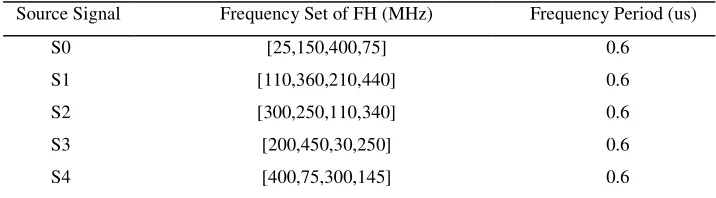
[image:3.612.126.484.414.513.2]Suppose that the number of received array elementsM=2, the spacing of the elements is 2.5m. The signal parameters of five sources are summarized in Table 1.
Table 1. Parameters of FH source.
Source Signal Frequency Set of FH (MHz) Frequency Period (us) S0
S1 S2 S3
[25,150,400,75] [110,360,210,440] [300,250,110,340] [200,450,30,250]
0.6 0.6 0.6 0.6
S4 [400,75,300,145] 0.6
TF Distribution of Observation Signal
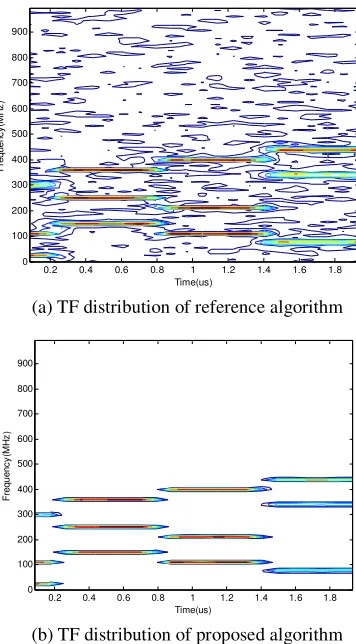
Figure 1 is the TF distribution of proposed algorithm and reference algorithm in the situations that source signals are
1
0, , 2
S S S respectively whileSNR=5dB. It can be seen from Figure 1 that under
(a) TF distribution of reference algorithm
[image:4.612.212.390.74.396.2](b) TF distribution of proposed algorithm
Figure 1. Comparison between T-F image of observed signal.
Multi-FH Signal Network Sorting
Figure 2 is the TF distribution of network sorting results of the source signals
1
0, , 2,S3
S S S at
0
SNR= dBin proposed algorithm and reference algorithm. It can be seen from Figure 3 that compared with the reference algorithm the TF distribution of the FH source signal of proposed algorithm is not affected by noise and cross-interference term, and the energy of signal spectrum is more concentrated. The proposed algorithm can obtain four FH network from the mixed signals of the received array elements effectively.
(a) Network sorting of reference algorithm
F
re
q
u
e
n
c
y
(M
H
z
)
Time(us)
0.2 0.4 0.6 0.8 1 1.2 1.4 1.6 1.8 0
100 200 300 400 500 600 700 800 900
F
re
q
u
e
n
c
y
(M
H
z
)
Time(us)
0.2 0.4 0.6 0.8 1 1.2 1.4 1.6 1.8 0
[image:4.612.218.387.529.666.2](b) Network sorting of proposed algorithm Figure 2. FH sorting result comparison.
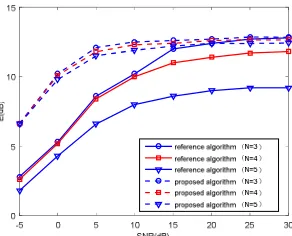
In order to measure the performance of multi-FH signal network sorting, the signal-to-interference ratio (SIR) is taken as the criterion. The larger the value of S is, the closer the estimated signal is to the true source signal which means better sorting effect.
It can be seen from the Figure 3 that our algorithm reaches its limit whenSIR=10dBwhile the reference algorithm reaches its limit whenSIR=15dB.The sorting performance of the reference algorithm processing source signal N=3 is better than N=4, but when the number of frequency hopping source signals reaches 5, the sorting performance is greatly reduced regardless of the SNR; The sorting performance of the proposed algorithm is almost the same when N = 3, 4, 5, the SIR does not decrease with the increase of FH signal.
Figure 3. Comparison of SIR.
Conclusion
Multi-FH signal network sorting under undetermined condition is of great significance. We have introduced undetermined blind separation algorithm based on sparse representation to sort the FH signals. The adaptive-SNR threshold setting method improves estimation performance under low SNR conditions. Simulations demonstrated that the new algorithm can separate the FH signals efficiently in low SNR conditions.
Acknowledgment
[image:5.612.232.378.367.485.2]References
[1] W.H. Fu, Y.Q. Hei, X.H. Li, USBB and Blind parameters estimation algorithms for synchronous orthogonal FH signals, J. Journal of System Engineering and Electronics. 25 (2014) 911-920.
[2] X.Q. Liu, D.S. Nicholas, A. Swami, Joint hop timing and frequency estimation for collision resolution in FH networks, J. IEEE Transactions on Wireless Communications. 4 (2005) 3063-3074.
[3] K.T. Wong, Blind beamforming/geolocation for wideband-FFHs with unknown hop-sequences, J. IEEE Transactions on Aerospace and Electronic Systems. 37 (2001) 65-76.
[4] P. Comon, C. Jutten, Handbook of blind source separation: independent component analysis and application. (Academic Press, New York, 2010).
[5] B.P. Ang, Y.G. Chen, L. Yang, A blind separating method for asynchronous nonorthogonal frequency hopping network, J. High Power Laser and Particle Beams. 27 (2015) 103251-1-103251-6.
[6] Z.C. Sha, Z.T. Huang, Y.Y. Zhou, Frequency-hopping signals sorting based on underdetermined blind source separation, J. IET Communications. 7 (2013) 1456-1464.
[7] K.C. Fu, Y.F. Chen, Blind iterative maximum likelihood-based frequency and transition for frequency hopping systems, J. IET Communications. 7 (2013) 883-892.
[8] Y.S. Gan, X.H. Chen, X.H. Chen, Improved AP algorithm: M-AP clustering algorithm, J. Computer Science. 42 (2015) 232-235.