R E S E A R C H A R T I C L E
Open Access
Methodological and ethical challenges in
studying patients
’
perceptions of coercion:
a systematic mixed studies review
Päivi Soininen
1,2*, Hanna Putkonen
2,3, Grigori Joffe
4, Jyrki Korkeila
5,6and Maritta Välimäki
1,7Abstract
Background:Despite improvements in psychiatric inpatient care, patient restrictions in psychiatric hospitals are still in use. Studying perceptions among patients who have been secluded or physically restrained during their hospital stay is challenging. We sought to review the methodological and ethical challenges in qualitative and quantitative studies aiming to describe patients’perceptions of coercive measures, especially seclusion and physical restraints during their hospital stay.
Methods:Systematic mixed studies review was the study method. Studies reporting patients’perceptions of coercive measures, especially seclusion and physical restraints during hospital stay were included. Methodological issues such as study design, data collection and recruitment process, participants, sampling, patient refusal or non-participation, and ethical issues such as informed consent process, and approval were synthesized systematically. Electronic searches of CINALH, MEDLINE, PsychINFO and The Cochrane Library (1976-2012) were carried out.
Results:Out of 846 initial citations, 32 studies were included, 14 qualitative and 18 quantitative studies. A variety of methodological approaches were used, although descriptive and explorative designs were used in most cases. Data were mainly collected in qualitative studies by interviews (n = 13) or in quantitative studies by self-report questionnaires (n = 12). The recruitment process was explained in 59% (n = 19) of the studies. In most cases convenience sampling was used, yet five studies used randomization. Patient’s refusal or non-participation was reported in 37% (n = 11) of studies. Of all studies, 56% (n = 18) had reported undergone an ethical review process in an official board or committee. Respondents were informed and consent was requested in 69% studies (n = 22).
Conclusions:The use of different study designs made comparison methodologically challenging. The timing of data collection (considering bias and confounding factors) and the reasons for non-participation of eligible participants are likewise methodological challenges, e.g. recommended flow charts could aid the information. Other challenges identified were the recruitment of large and representative samples. Ethical challenges included requesting participants’informed consent and respecting ethical procedures.
Keywords:Methodology, Ethics, Coercion, Inpatient, Perception
Background
Major efforts have been made to reduce the use of coer-cion in psychiatric care at national and international level [1]. The evidence as to which reduction programme is most successful has been questioned mainly due to a lack of experimental study designs [2-4]. The use of seclusion
and restraint (S/R) has been questioned due to a lack of evidence of its safety, usefulness and effectiveness [5,6]. Despite improvements in psychiatric inpatient care, pa-tient restrictions in psychiatric hospitals are still in use. There is also a clear trend towards service-user involve-ment in treatinvolve-ment decisions, also when the decision con-cerns coercive measures. Earlier studies have shown that patients tend to view seclusion and restraint as punish-ment and consider the use of these disempowering mea-sures unnecessary [7-11]. On the other hand, the use of * Correspondence:[email protected]
1Department of Nursing Science, University of Turku, Turku, Finland 2
Hospital District of Helsinki and Uusimaa, Hyvinkää Hospital Area, Kellokoski Hospital, Tuusula, Finland
Full list of author information is available at the end of the article
© 2014 Soininen et al.; licensee BioMed Central Ltd. This is an Open Access article distributed under the terms of the Creative Commons Attribution License (http://creativecommons.org/licenses/by/2.0), which permits unrestricted use, distribution, and reproduction in any medium, provided the original work is properly credited.
seclusion or restraint may also be perceived to increase feelings of safety and attention paid to inpatients [12,11]. In psychiatric hospital care, patients may face coercion, which may be due to their own disturbed behaviour or condition (agitation, aggression, psychosis) [13]. Forced medication, seclusion and restraint (mechanical or phys-ical) among others are used to treat these situations, and to help patients to avoid hurting themselves or others [2].
Investigating patients’perceptions of being secluded or restrained [10,14,11], outcome studies [15], or evaluating the effectiveness of S/R includes a number of methodo-logical and ethical challenges [16]. For example, scholars have considered how to avoid additional distress while studying patients who have experienced coercion. Ques-tions include who, when, by what method and how the data should be collected from patients to avoid distressing them [17]. There are also problems with the participant recruitment process as numerous patients refuse to par-ticipate in studies [18,19]. Patient recruitment strategies may also be less valid, causing problems in response rates [20]. The main question in recruiting participants with re-stricted liberty and self-determination is how voluntary participants feel when giving consent to participate in re-search [21]. The question raised is how a valid informed consent process can be guaranteed [22]. The patient’s abil-ity to absorb information and give consent may be im-paired due to her/his condition [23]. Timing in requesting patients’informed consent is crucial. For example, it is al-most impossible to ask patients’consent before the coer-cive intervention, which is not predictable [16].
A variety of ethical principles [24-27] and guidelines such as the Declaration of Helsinki 2008 [26], the Singapore Statement on Research Integrity 2010 [27] exist to facilitate high quality research when studying vulner-able patient groups. The Declaration of Helsinki, for ex-ample, is the common guideline for research ethics accepted throughout the world and highlights the import-ance of the proposal process for the research in ethics committees or review boards. Every country has its own legislation, which affects the protocol of broader ethical permission and informed consent procedures [28]. It is unclear how studies focusing on patients’ points of view have taken into account methodological and ethical lenges. Murphy et al. [29] examined methodological chal-lenges in constructing effective treatment for chronic psychiatric patients to make sequential decisions and found that traditional randomized controlled trials (RCT) are not the best option to study adaptive treatment strat-egies [29]. In a recent review Gupta & Kharawala [21] crit-ically investigated the Informed Consent Procedure (ICD) in psychiatric clinical studies and raised the question of the validity of the consent and the autonomy of the indi-vidual subjects [21]. A wide variation in inclusion and ex-clusion criteria impairs comparability between studies and
representativeness. These workers likewise found notable gaps in reporting methodological issues [30].
The purpose of this mixed studies review was to evalu-ate methodological and ethical challenges in studies inves-tigating coercive methods from the patients’perspective. Mixed studies reviews integrate qualitative, quantitative, and mixed methods studies [31]. There is a knowledge gap in what researchers should take into account meth-odologically and research ethically when investigating co-ercion from patients’perspective to improve the quality of the studies and to improve the evidence of the care and treatment. To support researchers to conduct studies with vulnerable populations with ethically sensitive topics [23,24,29], we sought to review the methodological and ethical challenges in studies aiming to describe patients’ perceptions of coercive measures, especially seclusion and physical restraints during their hospital stay. We addressed two main questions:
1. What methodological challenges are identified in qualitative and quantitative studies focusing on patients’perceptions of coercion?
2. What ethical challenges are identified in qualitative and quantitative studies focusing on patients’ perceptions of coercion?
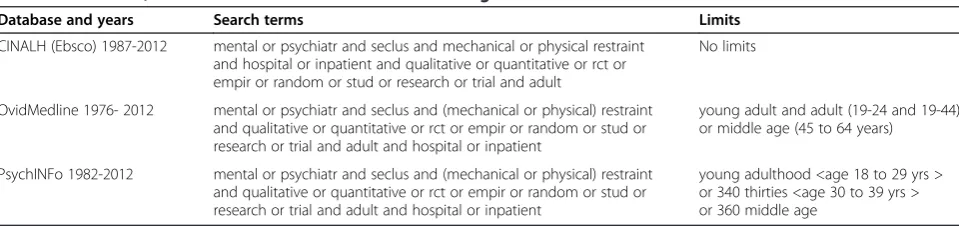
Methods Search strategy
Published research reports were identified using computer-ized searches of databases: CINAHL (the Cumulative Index of Nursing and Allied Health Literature (1987-2012), Ovid Medline (Medical Literature Analysis and Retrieval System Online, National Library of Medicine, 1976- 2012), and Psy-chINFO (American Psychological Association, 1982-2012) in April 2012 (Table 1). The search terms in the Cochrane review by Sailas & Fenton [5] on the subject of S/R were used. The search was limited to peer-reviewed reports in English-language journals.
Inclusion criteria
Studies were included if they focused on psychiatric inpa-tients aged 18-65 years and had faced coercion, forced medication, seclusion or restraint (mechanical/physical) in psychiatric care. We included studies using different study methods, qualitative, quantitative and mixed methods.
Studies focusing on children, adolescents, or geriatric patients, mental retardation, dementia, eating disorders or seclusion/restraint in somatic disorders or chemical restraint alone were excluded. Further, review articles were excluded. Papers that did not specifically address patients’ perceptions related to coercion were likewise excluded.
Soininenet al. BMC Psychiatry2014,14:162 Page 2 of 12
Identification of studies
The first author (PS) assessed all the titles and abstracts retrieved for relevance for inclusion in the review. At that stage only those articles were selected that met the inclu-sion criteria. For the publications selected full texts were obtained and screened to decide on inclusion or exclusion. Any discrepancies were discussed and resolved together with another author (MV).
Data extraction
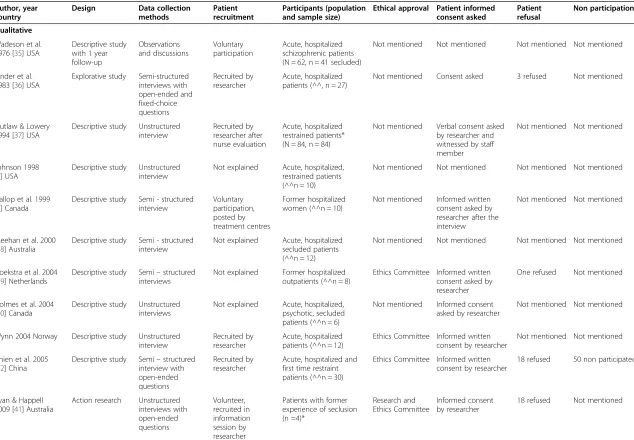
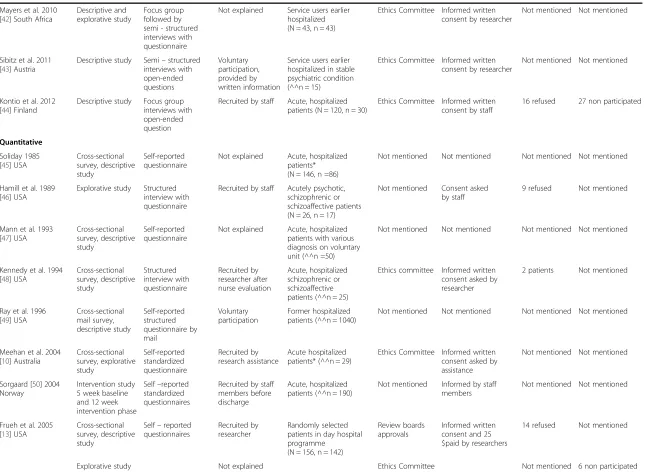
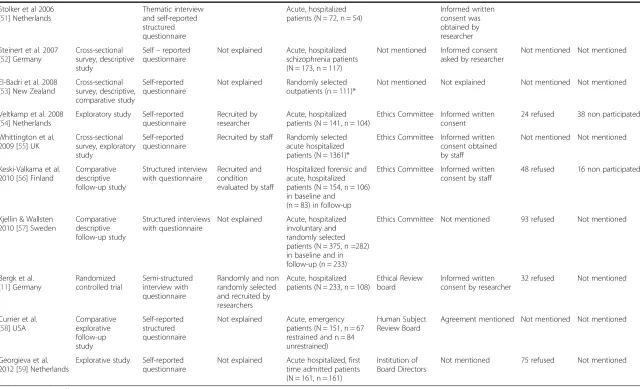
PS independently extracted data from the studies in-cluded. These, together with information on authors, country and year of publication were listed chronologic-ally from the oldest to the most recent in Table 2. First the qualitative studies were listed and second the quantitative studies. The articles were read carefully and the following data were gathered separately: methods used, study design, data collection methods, recruitment process, partici-pants, sampling, refusal (patients asked to participate, but refused) and non-participation (eligible, but were not of-fered the opportunity to participate) as well as the time elapsing from the coercive episode to data collection, and data on ethical procedures such as informed consent and ethical proposal process were extracted to reduce the in-formation so that core inin-formation was retained and then the data were synthesized in specific categories [32]. Methodological issues were identified by screening the texts and comparing them to the methodological litera-ture. The method section describes the research design, the sample, measures and data collection, and study pro-cedures [32,33,25]. Research design was either mentioned in studies or interpreted according to the literature. Issues concerning research ethics were based on the principles contained in the Declaration of Helsinki (2008) and fo-cused on the formed consent and proposal process. The research ethical process was identified in the text based on its description. In this study we did not use any critical ap-praisal tools to ascertain the quality of selected studies but only looked at certain criteria emerging from the litera-ture. No tools were specifically designed to assess the methodological quality in mixed study reviews [31].
Data analysis
A synthesis was produced based on the data extracted and by using convergent design; qualitative and quantitative synthesis was made of all study types [31]. The rationale to use both qualitative and quantitative data is to gain a wider picture of methodological and ethical issues in the research field of studies concerning patients’perceptions. The synthesis was made by analysing and synthesizing the key methodological and ethical elements in each study with the aim of transforming individual findings into new conceptualization and interpretations [32,34].
The studies were interpreted by inspecting the meth-odological demands for studying psychiatric inpatients who had experienced coercive methods. The resulting synthesis was based on all studies included in the analysis. The studies were both qualitative and quantitative; de-scriptions of the studies were merged in template format and synthesized in Table 2. The information was then ana-lysed both in quantitative and qualitative format as fol-lows: information on recruitment and data collection processes (who, when and how – classified to voluntary participation, researcher recruitment, staff recruitment or not mentioned), research procedures from an ethical point of view (how patients’ informed consent was requested and if ethical approval was mentioned in qualitative and in quantitative studies), the representativeness of the par-ticipants (refusal and non-participation) and possible con-founding factors related to study protocols. Qualitative and quantitative studies were analysed separately and then merged in the discussion. Study designs were either men-tioned by researchers or interpreted in light of the re-search questions and methods used in the studies.
Results Search results
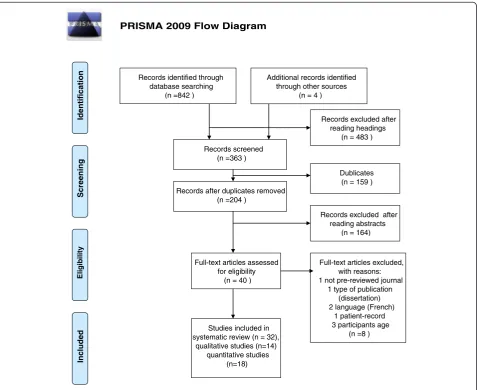
[image:3.595.58.538.620.733.2]These initial searches resulted in 846 hits: OvidMedline (n = 278), CINALH (n = 157), PsychInfo (n = 407), and four additional records although other sources were found manually. The titles of the studies were reviewed for rele-vance and 483 were excluded on the basis of inclusion cri-teria. This left us with 363 items for screening. After removing 156 duplicates, 204 abstracts were carefully
Table 1 Databases, search terms and limits for search strategies
Database and years Search terms Limits
CINALH (Ebsco) 1987-2012 mental or psychiatr and seclus and mechanical or physical restraint and hospital or inpatient and qualitative or quantitative or rct or empir or random or stud or research or trial and adult
No limits
OvidMedline 1976- 2012 mental or psychiatr and seclus and (mechanical or physical) restraint and qualitative or quantitative or rct or empir or random or stud or research or trial and adult and hospital or inpatient
young adult and adult (19-24 and 19-44) or middle age (45 to 64 years)
PsychINFo 1982-2012 mental or psychiatr and seclus and (mechanical or physical) restraint and qualitative or quantitative or rct or empir or random or stud or research or trial and adult and hospital or inpatient
young adulthood <age 18 to 29 yrs > or 340 thirties <age 30 to 39 yrs > or 360 middle age
Soininenet al. BMC Psychiatry2014,14:162 Page 3 of 12
Table 2 Methodological and ethical concerns of the studies
Author, year country
Design Data collection methods
Patient recruitment
Participants (population and sample size)
Ethical approval Patient informed consent asked
Patient refusal
Non participation₫
Qualitative
Wadeson et al. 1976 [35] USA
Descriptive study with 1 year follow-up
Observations and discussions
Voluntary participation
Acute, hospitalized schizophrenic patients (N = 62, n = 41 secluded)
Not mentioned Not mentioned Not mentioned Not mentioned
Binder et al. 1983 [36] USA
Explorative study Semi-structured interviews with open-ended and fixed-choice questions
Recruited by researcher
Acute, hospitalized patients (^^, n = 27)
Not mentioned Consent asked 3 refused Not mentioned
Outlaw & Lowery 1994 [37] USA
Descriptive study Unstructured interview
Recruited by researcher after nurse evaluation
Acute, hospitalized restrained patients* (N = 84, n = 84)
Not mentioned Verbal consent asked by researcher and witnessed by staff member
Not mentioned Not mentioned
Johnson 1998 [7] USA
Descriptive study Unstructured interview
Not explained Acute, hospitalized, restrained patients (^^n = 10)
Not mentioned Not mentioned Not mentioned Not mentioned
Gallop et al. 1999 [8] Canada
Descriptive study Semi - structured interview
Voluntary participation, posted by treatment centres
Former hospitalized women (^^n = 10)
Not mentioned Informed written consent asked by researcher after the interview
Not mentioned Not mentioned
Meehan et al. 2000 [38] Australia
Descriptive study Semi - structured interview
Not explained Acute, hospitalized secluded patients (^^n = 12)
Not mentioned Not mentioned Not mentioned Not mentioned
Hoekstra et al. 2004 [39] Netherlands
Descriptive study Semi–structured interviews
Not explained Former hospitalized outpatients (^^n = 8)
Ethics Committee Informed written consent asked by researcher
One refused Not mentioned
Holmes et al. 2004 [40] Canada
Descriptive study Unstructured interviews
Not explained Acute, hospitalized, psychotic, secluded patients (^^n = 6)
Not mentioned Informed consent asked by researcher
Not mentioned Not mentioned
Wynn 2004 Norway Descriptive study Unstructured interview
Recruited by researcher
Acute, hospitalized patients (^^n = 12)
Ethics Committee Informed written consent by researcher
Not mentioned Not mentioned
Chien et al. 2005 [12] China
Descriptive study Semi–structured interview with open-ended questions
Recruited by researcher
Acute, hospitalized and first time restraint patients (^^n = 30)
Ethics Committee Informed written consent by researcher
18 refused 50 non participated
Ryan & Happell 2009 [41] Australia
Action research Unstructured interviews with open-ended questions
Volunteer, recruited in information session by researcher
Patients with former experience of seclusion (n =4)*
Research and Ethics Committee
Informed consent by researcher
18 refused Not mentioned
Soininen
et
al.
BMC
Psychiatry
2014,
14
:162
Page
4
o
f
1
2
http://ww
w.biomedce
ntral.com/1
471-244X/14
Table 2 Methodological and ethical concerns of the studies(Continued)
Mayers et al. 2010 [42] South Africa
Descriptive and explorative study
Focus group followed by semi - structured interviews with questionnaire
Not explained Service users earlier hospitalized (N = 43, n = 43)
Ethics Committee Informed written consent by researcher
Not mentioned Not mentioned
Sibitz et al. 2011 [43] Austria
Descriptive study Semi–structured interviews with open-ended questions Voluntary participation, provided by written information
Service users earlier hospitalized in stable psychiatric condition (^^n = 15)
Ethics Committee Informed written consent by researcher
Not mentioned Not mentioned
Kontio et al. 2012 [44] Finland
Descriptive study Focus group interviews with open-ended question
Recruited by staff Acute, hospitalized patients (N = 120, n = 30)
Ethics Committee Informed written consent by staff
16 refused 27 non participated
Quantitative
Soliday 1985 [45] USA
Cross-sectional survey, descriptive study
Self-reported questionnaire
Not explained Acute, hospitalized patients* (N = 146, n =86)
Not mentioned Not mentioned Not mentioned Not mentioned
Hamill et al. 1989 [46] USA
Explorative study Structured interview with questionnaire
Recruited by staff Acutely psychotic, schizophrenic or schizoaffective patients (N = 26, n = 17)
Not mentioned Consent asked by staff
9 refused Not mentioned
Mann et al. 1993 [47] USA
Cross-sectional survey, descriptive study
Self-reported questionnaire
Not explained Acute, hospitalized patients with various diagnosis on voluntary unit (^^n =50)
Not mentioned Not mentioned Not mentioned Not mentioned
Kennedy et al. 1994 [48] USA
Cross-sectional survey, descriptive study Structured interview with questionnaire Recruited by researcher after nurse evaluation Acute, hospitalized schizophrenic or schizoaffective patients (^^n = 25)
Ethics committee Informed written consent asked by researcher
2 patients Not mentioned
Ray et al. 1996 [49] USA
Cross-sectional mail survey, descriptive study Self-reported structured questionnaire by mail Voluntary participation Former hospitalized patients (^^n = 1040)
Not mentioned Not mentioned Not mentioned Not mentioned
Meehan et al. 2004 [10] Australia
Cross-sectional survey, explorative study Self-reported standardized questionnaire Recruited by research assistance Acute hospitalized patients* (^^n = 29)
Ethics Committee Informed written consent asked by assistance
Not mentioned Not mentioned
Sorgaard [50] 2004 Norway
Intervention study 5 week baseline and 12 week intervention phase
Self–reported standardized questionnaires
Recruited by staff members before discharge
Acute, hospitalized patients (^^n = 190)
Not mentioned Informed by staff members
Not mentioned Not mentioned
Frueh et al. 2005 [13] USA
Cross-sectional survey, descriptive study
Self–reported questionnaires
Recruited by researcher
Randomly selected patients in day hospital programme
(N = 156, n = 142)
Review boards approvals
Informed written consent and 25 $paid by researchers
14 refused Not mentioned
Explorative study Not explained Ethics Committee Not mentioned 6 non participated
Table 2 Methodological and ethical concerns of the studies(Continued)
Stolker et al 2006 [51] Netherlands
Thematic interview and self-reported structured questionnaire
Acute, hospitalized patients (N = 72, n = 54)
Informed written consent was obtained by researcher
Steinert et al. 2007 [52] Germany
Cross-sectional survey, descriptive study
Self–reported questionnaire
Not explained Acute, hospitalized schizophrenia patients (N = 173, n = 117)
Not mentioned Informed consent asked by researcher
Not mentioned Not mentioned
El-Badri et al. 2008 [53] New Zealand
Cross-sectional survey, descriptive, comparative study
Self-reported questionnaire
Not explained Randomly selected outpatients (n = 111)*
Not mentioned Not explained Not mentioned Not mentioned
Veltkamp et al. 2008 [54] Netherlands
Exploratory study Self-reported questionnaire
Recruited by researcher
Acute, hospitalized patients (N = 141, n = 104)
Ethics Committee Informed written consent
24 refused 38 non participated
Whittington et al. 2009 [55] UK
Cross-sectional survey, exploratory study
Self-reported questionnaire
Recruited by staff Randomly selected acute hospitalized patients (N = 1361)*
Ethics Committee Informed written consent obtained by staff
Not mentioned Not mentioned
Keski-Valkama et al. 2010 [56] Finland
Comparative descriptive follow-up study
Structured interview with questionnaire
Recruited and condition evaluated by staff
Hospitalized forensic and acute, hospitalized patients (N = 154, n = 106) in baseline and
(n = 83) in follow-up
Ethics Committee Informed written consent by staff
48 refused 16 non participated
Kjellin & Wallsten 2010 [57] Sweden
Comparative descriptive follow-up study
Structured interviews with questionnaire
Not explained Acute, hospitalized involuntary and randomly selected patients (N = 375, n =282) in baseline and in follow-up (n = 233)
Ethics Committee Not mentioned 93 refused Not mentioned
Bergk et al. [11] Germany
Randomized controlled trial
Semi-structured interview with questionnaire
Randomly and non randomly selected and recruited by researchers
Acute, hospitalized patients (N = 233, n = 108)
Ethical Review board
Informed written consent by researcher
32 refused Not mentioned
Currier et al. [58] USA
Comparative explorative follow-up study
Self-reported structured questionnaire
Not explained Acute, emergency patients (N = 151, n = 67 restrained and n = 84 unrestrained)
Human Subject Review Board
Agreement mentioned Not mentioned Not mentioned
Georgieva et al. 2012 [59] Netherlands
Explorative study Self-reported questionnaire
Not explained Acute hospitalized, first time admitted patients (N = 161, n = 161)
Institution of Board Directors
Not mentioned 75 refused Not mentioned
*Both patients and staff were participants. ^^Number of total eligible participants was missing.
₫Mentioned non participation due to e.g. quick discharge, exclusion criteria, patients’condition.
Soininen
et
al.
BMC
Psychiatry
2014,
14
:162
Page
6
o
f
1
2
http://ww
w.biomedce
ntral.com/1
471-244X/14
reviewed. Based on the inspection, 40 articles published between 1976 and 2012 and focusing on patients’ experi-ences of coercion were selected. The manuscripts of 40 ar-ticles were retrieved and eight were excluded (publication type/forum: dissertation, report published in a non-peer-reviewed journal, and two French-language articles; study design: patient record research and age; children and ado-lescent included). Thus we eventually included 32 studies, which met all our criteria. A flow chart of data selection is presented in Figure 1.
Description of the studies
All together 32 articles published in the period 1976–2012 were retrieved, 14 qualitative and 18 quantitative studies (see Table 2). Most of these (n = 22) were published after 2000, nine qualitative studies and 13 quantitative studies. These studies had been conducted in thirteen countries. The majority had been published in the USA (n =11, four qualitative and seven quantitative), and the others were
published in the Netherlands (n =4, one qualitative and three quantitative), Australia (n =3, two qualitative and one quantitative), Canada (n = 2 qualitative), Finland (n =2, one qualitative and one quantitative), Germany (n =2 quantitative), Norway (n = 2, one qualitative and one quantitative), and Austria (qualitative), China tive), New Zealand (quantitative), South Africa (qualita-tive, mixed study), Sweden (quantita(qualita-tive, mixed study) and the United Kingdom (quantitative) one article each. See Table 2.
Methodological issues of the studies Study designs
Out of the 32 studies, 14 were qualitative [7,8,14,12,35-44] and 18 were quantitative [13,10,15,45-59]. Two of the studies were mixed methods studies [42,51]. A mixed methods study [42] was classified as a qualitative study, because the article reported mainly qualitative data and
PRISMA 2009 Flow Diagram
Records identified through database searching
(n =842 )
Scre
e
ning
Included
Eli
g
ib
il
ity
Identificat
ion
Records after duplicates removed (n =204 )
Records screened (n =363 )
Records excluded after reading headings
(n = 483 )
Full-text articles assessed for eligibility
(n = 40 )
Full-text articles excluded, with reasons: 1 not pre-reviewed journal
1 type of publication (dissertation) 2 language (French)
1 patient-record 3 participants age
(n =8 ) Additional records identified
through other sources (n = 4 )
Studies included in systematic review (n = 32),
qualitative studies (n=14) quantitative studies
(n=18)
Dublicates (n = 159 )
Records excluded after reading abstracts
[image:7.595.61.539.330.720.2](n = 164)
Figure 1Data selection.
Soininenet al. BMC Psychiatry2014,14:162 Page 7 of 12
one mixed methods study classified as a quantitative study reporting mainly quantitative results [51].
In qualitative studies designs were mainly descriptive (n = 11), explorative (n = 1), both descriptive and ex-plorative (n = 1) or action research (n = 1). Six of the qualitative studies mentioned theoretical bases; three of them were based on grounded theory [40,14,43], two on hermeneutic theory [7,41] and one on ethnographic the-ory [8]. A participatthe-ory approach was used in one study, meaning that consumer researchers were used as data collectors [42].
In quantitative studies cross-sectional survey and de-scriptive design (n = 7), explorative studies (n = 4), com-parative follow-up (n = 3), cross-sectional survey with explorative design (n = 2), and intervention, RCT study one each.
Data collection methods
The data collection methods used in 14 qualitative stud-ies were observation (n = 1), semi-structured interviews with questionnaire (n = 3) semi-structured questionnaire with open-ended questions (n = 3), unstructured inter-views (n = 5), focus group interinter-views (n = 2).
The data collection methods in 18 quantitative studies were semi-structured (n =1) and structured interviews with questionnaire (n = 4), and self-report questionnaires (n = 13). Validated questionnaires were used to investi-gate the patients’perceptions of or attitudes towards co-ercion or perceived trauma in an inpatient setting [46,10,50,13,45,55,57,15], others used questionnaires de-veloped specifically for their studies [47-49,54,56,58]. See Table 2.
Recruitment process
The recruitment process was explained in nine of the qualitative studies [35-37,8,14,12,41,43,44], and in ten of the quantitative studies [46,10,48-50,13,54-56,15]. In qualitative study recruitment was accomplished by staff (n = 1) and by researcher (n =4) or voluntary participa-tion (n = 4) inviting participants by mail, informaparticipa-tion sessions or aided by the outpatient staff. Information was missing or imprecise in five of the qualitative studies [7,38-40,42].
In quantitative studies recruitment was accomplished by staff (n = 4) and by researcher (n = 5). Information was missing or imprecise in eight of the quantitative studies [45,47,51-53,57-59]. Voluntary participation was mentioned in one study. See Table 2.
Participants and sampling
Participants were mostly acute, hospitalized patients (n = 24, nine in qualitative and 15 in quantitative stud-ies). Outpatients (former inpatients) were participants in eight studies (five in qualitative and three in quantitative
studies). Staff members were participants in five studies and their experiences or attitudes were compared to those of patients [45,37,53,41,55]. Sample sizes in qualitative studies (n = 14) varied from four patients to 84 (mean 24 participants), and in quantitative studies (n = 18) from 17 to 1 361 (mean 230 participants). See Table 2.
The studies mainly used convenience sampling, mean-ing that participants who met the inclusion criteria were selected from a certain group in a certain context. Five quantitative studies included randomly selected partici-pants. El-Badri et al. [53] selected participants on certain days of the week. Frueh et al. [13] used computer-generated simple random sampling of eligible participants approached by staff. Whittington et al. [55] selected potential partici-pants randomly; staff assessed participartici-pants and then a re-search assistant approached them to request informed consent but the randomization or inclusion criteria were not explained. Kjellin & Wallsten [57] recruited using both consecutive sampling and randomization, only the exclu-sion criteria were mentioned. There was one RCT [15]. The method used in the stratified randomization was envelope-method were the envelopes were serial numbered on each ward.
Patients’refusal and non-participation
The number of patients refusing to participate was men-tioned (n = 13). Out of these in five qualitative studies pa-tients’ refusal was mentioned (min 1 - max 18 refusals) and in nine studies it was not mentioned. The number of non-participants (eligible, but not offered an opportunity to participate) was explained in two qualitative studies. An explanation for non-participation and numbers of individ-uals at every stage of the study process was supplied in one qualitative study [44].
Out of all quantitative studies, patients’ refusal was mentioned in eight studies (min 2 max 93 refusals). The number of non-participants (eligible, but not offered an opportunity to participate) was explained in three quanti-tative studies. An explanation for non-participation and numbers of individuals at every stage of the study process was supplied in five quantitative studies [13,56,57,15,59], and in one study a flow diagram was presented [56]. The main reasons for non-participation were patient’s condi-tion, criteria, short stay in hospital (quick discharge) or not offered participation a chance to participate (for ex-ample, staff forgot to ask).
Time elapsing between coercion and data collection The time elapsing between the coercion episode and data collection was mentioned (n = 14) and this varied from during the restraint episode [37] to one month after the experience, mean approximately seven days, in eight qualitative studies [36,37,8,38,40,14,12,44]. The time elapsing between the seclusion experience and data
Soininenet al. BMC Psychiatry2014,14:162 Page 8 of 12
collection was not specified in three qualitative studies [35,7,39]. Reasons for the time elapsing were mentioned in one study [39]. In addition, Gallop et al. [8] collected data approximately five years after the restraint experience.
The time elapsing between the coercion episode and data collection was mentioned in six quantitative studies [46-48,10,51,15]. Reasons for the time elapsing were mentioned in two studies [10,15]. The time elapsing be-tween the seclusion experience and data collection was not specified in one was quantitative study [49].
Most authors mentioned that data collection had been intended quite soon after the episode, but the patient’s condition or other factors influenced the timing of data collection. Studies (n = 13), interested in patients’attitudes to coercion, preferences regarding treatment methods or traumatic experiences caused by coercion, and partici-pants who had previously been hospitalized or outpa-tients, and therefore did not report the time elapsing, in three qualitative studies [41-43] and in ten quantitative studies [45,50,13,52-55,57-59].
Research ethics
Out of all the studies included in this review, 18 (56%) reported having undergone an ethical review process in an official board or committee. Out of these, approval was reported to have been requested in seven qualitative studies. Respondents were informed and consent was re-quested in 11 qualitative studies. In seven qualitative studies patients gave informed, written consent. In nine qualitative studies consent was requested by a researcher and in one by staff members. In two qualitative studies staff assessment was mentioned before a researcher approached potential participants to request informed consent [37,14]. In four qualitative studies patients had contacted researchers voluntarily [35,8,41,43].
Out of all studies, 11 quantitative studies reported ask-ing approval from an ethics committee. Respondents were informed and consent was requested in 12 quanti-tative studies. In eight quantiquanti-tative studies patients gave informed, written consent. In ten quantitative studies consent was requested by a researcher and in four stud-ies by staff members. In two quantitative studstud-ies staff assessment was mentioned before a researcher approached potential participants to request informed consent [48,54]. Five quantitative studies mentioned being part of more ex-tensive research projects and some information reported elsewhere was referred to [50,13,51,53,55].
Discussion
Methodological challenges in the studies
This systematic review explored the variation in study designs used in researching patients’perceptions of co-ercive measures, which made comparison difficult. The study designs were mainly descriptive or explorative,
examining a phenomenon or differentiating it from other phenomena [32,30]. Qualitative studies aimed to explore or describe how patients felt about perceived coercion by interviewing patients, using open-ended questions, ques-tionnaires or focus group interviews. Quantitative studies aimed to explore patients’perceptions of coercion in lar-ger samples by using cross-sectional survey design or comparing results longitudinally. One further experimen-tal design [15] was identified. The study designs described the situation and proposed that a more profound under-standing of psychiatric inpatients’preferences and experi-ences was needed. Yet there persists a lack of knowledge of the effectiveness of coercive measures. This may explain the conclusion that more experimental research is needed. Patients’recruitment process is crucial when estimating the trustworthiness of findings: the aim is to recruit a rep-resentative sample of the population and to meet the re-quired sample size [20,17]. Trustworthiness is related to the process of establishing the validity (credibility) and re-liability (dependability) of the findings. Trustworthiness also concerns by what criteria of the results can be judged and how applicable the findings are in other setting [33]. In almost half of the studies the description of the recruit-ment process was inadequate, which raises the question of trustworthiness of the studies. The information on who invited coerced patients to participate is important as to whether patients participated voluntarily and if their au-tonomy was respected [18,19]. Most research on human participants involves working with staff. Clinicians who are supportive of research are the best guarantors for suc-cess and should be identified at the beginning of the pro-cedure [20]. If the staffs of the study wards or units are responsible for recruitment and data collection, there is a danger that many eligible participants may decline to par-ticipate due to unknown reasons. Kontio et al. [44] re-ported that a total of 26% of potential participants declined to participate and assumed that the staff had de-liberately omitted to invite these patients. The studies most successful in their recruitment were those in which the study protocol was carried out in a manner that did not delegate the staff’s responsibility for recruitment, par-ticipants’information, asking consent and data collection. Recommendations such as the STROBE (Strengthening the Reporting of Observational Studies in Epidemiology) statement suggest reporting numbers of participants at every stage, giving reasons for non-participation and using flow diagrams. Only one study was identified using a flow chart to show the number of non-participating but eligible participants.
The question of representative sample size in different studies is unclear and is dependent on study design [33]. In the qualitative studies numbers of participants were small, which includes a limitation of transferability (generalizability) of the results and this was mentioned
Soininenet al. BMC Psychiatry2014,14:162 Page 9 of 12
as a limitation in many articles. In the quantitative stud-ies sample sizes were quite large, although no justifica-tion for the research sample sizes was given. None of the quantitative studies tested the sample size through power analysis [32]. The wide variation in populations may affect the generalizability of the results and different groups may require different approaches in building trust and aligning the research goals [20].
Confounding factors
Confounding factors and bias affect the results so these should be discussed when interpreting results [60]. Few researchers had paid attention to confounding factors: The influence of the time elapsing between coercion and interview; adaptation to coercive methods; expected re-sponses; researchers’attitudes when explaining results and making conclusions [9,39] or the relationship between the researcher (interviewer) and participants [38,15]. Involun-tarily treated respondents may feel less voluntary and try to please if the investigator was, for example, a staff mem-ber involved in treatment. This may be situation especially in qualitative studies. The relationship between respon-dents and researchers was not always clear. Fortunately most studies reported the relationship and used re-searchers external to the treatment facilities thus eliminat-ing the effect of the relationship to the results [20,27]. Responding anonymously and independently as well returning responses in sealed envelopes may be easier for patients and gives more reliable answers.
Several other factors may have influenced patients’ accounts because of the time elapsing after the episode (S/R): forgetting, psychotic symptoms, patients may even have been afraid to report how they felt. Hoekstra et al. [39] purposely investigated patients whose seclusion room experience had taken place some time ago to learn about patients’coping processes after the episode. The place where interviews were conducted might also affect how patients responded, if they felt controlled, forced etc. [7,39].
None of the studies included international compari-sons of patients’ experiences of coercive methods, al-though there are indeed studies on how much and what kind of coercive methods are used internationally [61]. Many researchers reported that generalizability was also hampered by cultural specificity. Cultural specificity was reportedly a religious [12] or organizational culture [10,51,59]. One might consider the influence on the in-terpretation of researchers’ ideological and theoretical perspectives or personal interests or practical knowledge when their overall conclusions are drawn [60].
Challenges in research ethics
It has already been discovered that ethical considerations are of insufficient quality in studies [62]. This study also
soted that the recommendations of the Declaration of Helsinki (2008) were not adhered to in all reports. In half (56%) of the studies included it was reported that research permission was requested from the appropriate ethics committee. There was also a lack of information on how participants were informed, how consent was obtained, if the consent obtained was in written form and if the participant was really aware of the meaning of the study. Hence it remains unclear how voluntary and informed participants were about their rights. This may lead to unreliable responses. However, the standard of research ethics improved in the more recently published studies.
A crucial question in informed consent is, when psy-chiatric patients in need of seclusion or restraint due to their condition, mainly their psychotic state, are capable of giving consent and are truly competent to understand the participation and by whom the evaluation of their competence has been made [22]. Patients’ competence cannot be underestimated due to their condition, but in-formation should be given in a form that takes into ac-count the patients’ situation, vulnerability and the voluntary nature of the participation.
Conclusion
We can conclude on the basis of this review that research-ing coerced patients’or service users’perceptions of coer-cive interventions is challenging. Many studies in this area were descriptive and explorative, while more experiment-al studies could guarantee the effectiveness of coercive methods could be described as well. More attention should also be paid to ethical questions, proposal procedure and requesting informed consent. Therefore, researchers clearly need training in how to manage ethically sensitive research topics with vulnerable patient populations.
Strengths and limitations
The strength of this review was that the methodological and ethical challenges of studies on patients’perceptions of coercion were identified. A wide variation in study de-sign was found, making comparison of results difficult. In research on vulnerable patients, ethical concerns are core factors. The second finding of weakness in research ethics should be paid more attention although ethical as-pects were better addressed in later studies.
On the contrary, limitations of this review a many. First, the search terms used were based on a Cochrane review published in 2000, and other search terms could have been used. Second, the search term coercion yielded many publications, and heterogeneous findings. Third, concentrating on patients’ perceptions of seclu-sion and restraint may have narrowed the findings, and thereby helped synthesis. Fourth, the studies reviewed used both qualitative and quantitative approaches, so the
Soininenet al. BMC Psychiatry2014,14:162 Page 10 of 12
study procedures differed, making methodological syn-thesis challenging. Despite these limitations this system-atic review provides new insights for psychiatric research to take into account.
Implications
In light of the findings of this review, we recommend that more attention should be paid to the following issues. First, to improve ethics of the studies, guidelines as the Declaration of Helsinki should be followed. Second, more attention should be paid to how the research frame is de-scribed to ensure better quality and comparability. Third, to increase understanding of how representative the re-search results are, it is important to know why some eli-gible participants were not included. Non-participants may change the results leading to bias, either or qualita-tive or quantitaqualita-tive studies. Refusing to participate may lead to assumptions of poor quality of information of the study protocol, fear of consequences and distress due to participating. Using research assistants outside the study organisation in the patient recruitment process and data collection may be useful. Fourth, the studies reviewed in-cluded many aspects for improvement as reported by pa-tients. These may have implications in clinical practice as follows: 1) more interaction between staff and patients; 2) need for debriefing, knowledge about the reasons for S/R; 3) staff education and training in how to proactively ad-dress situations so that seclusion and restraint could be avoided, and 4) patients’option to retain their own cloth-ing in seclusion, 5) the opportunity to read, and 6) im-provement in the comfort of the S/R environment. And fifth, a quality of the study reports should be increased. In this task, guidelines should be followed from research planning to reporting, for example, CONSORT (The Con-solidated Standards of Reporting Trials) Statement [63] or STROBE (Strengthening the Reporting of Observational Studies in Epidemiology) [64]. This would ensure that im-portant details in designing, implementing and reporting research study are taken into account in the study.
Competing interests
The authors declare that they have no competing interests.
Authors’contributions
PS designed the study and involved the data collection, analyses and drafting the manuscript. HP, GJ, JK , and MV were involved in the design of the study, drafting the manuscript and critically reviewed the manuscript. MV checked the data and analyses. All authors have read and approved the manuscript.
Acknowledgement
This review was supported by the University of Turku, the Hospital District of Helsinki and Uusimaa and Hyvinkää Hospital Area.
Author details 1
Department of Nursing Science, University of Turku, Turku, Finland.2Hospital District of Helsinki and Uusimaa, Hyvinkää Hospital Area, Kellokoski Hospital, Tuusula, Finland.3Vanha Vaasa Hospital, Vaasa, Finland.4Department of Psychiatry, Hospital District of Helsinki and Uusimaa, Helsinki University
Central Hospital, Helsinki, Finland.5Faculty of Medicine, University of Turku,
Turku, Finland.6Hospital District of Satakunta, Pori, Finland.7Turku University Hospital, Turku, Finland.
Received: 25 February 2013 Accepted: 16 May 2014 Published: 4 June 2014
References
1. Bowers L, Ross J, Nijman H, Muir-Cochrane E, Noorthoorn E, Stewart D: The scope for replacing seclusion with time out in acute inpatient psychiatry in England.J Adv Nurs2011,68(4):826–835.
2. Sailas E, Wahlbeck K:Restraint and seclusion in psychiatric inpatients wards.Curr Opin Psychiatry2005,18:555–559.
3. Gaskin CJ, Elsom SJ, Happell B:Interventions for reducing the use of seclusion in psychiatric facilities.Br J Psychiatry2007,191:298–303. 4. Stewart D, Van der Merwe M, Bowers L, Simpson A:A review of
interventions to reduce mechanical restraint and seclusion among adult psychiatric inpatients.Issues Ment Health Nurs2010,31(6):413–424. 5. Sailas E, Fenton M:Seclusion and restraint for people with serious mental
illnesses.Cochrane Database Syst Rev2000, (2): Art. no.: CD001163. doi:10.1002/14651858.CD001163. Retrieved February 23th 2014.
6. Nellstrop L, Chandler-Oatts J, Bingley W, Bleetman T, Corr F, Cronin-Davis J, Fraher D-M, Hardy P, Jones S, Gourney K, Johnston S, Pereira S, Pratt P, Tucker R, Tsuchiya A:A systematic review of the safety and effectiveness of restraint and seclusion as intervention for the short-term
management of violence in adult psychiatric inpatient settings and emergency departments.Worldviews Evid Based Nurs2006,3(1):8–18. 7. Johnson ME:Being restraint: a study of power and powerless.Issues Ment
Health Nurs1998,19:191–206.
8. Gallop R, McCay E, Guha M, Khan P:The experience of hospitalized and restraint of women who have a history of childhood sexual abuse.
Health Care Women Int1999,20:401–416.
9. Sequeira H, Halstead S:Control and restraint in the UK: service user perspectives.British J Forensic Pract2002,4(1):9–18.
10. Meehan T, Bergen H, Fjeldsoe K:Staff and patient perceptions of seclusion: has anything changed?J Adv Nurs2004,47(1):33–38. 11. Soininen P, Välimäki M, Noda T, Puukka P, Korkeila J, Joffe G, Putkonen H:
Secluded and restrained patients’perceptions of their treatment.
Int J Ment Health Nurs2013,22(1):47–55.
12. Chien W-T, Chan CWH, Lam L-W, Kam CW:Psychiatric inpatients’ perceptions of positive and negative aspects of physical restraint.
Patient Educ Couns2005,59:80–86.
13. Frueh BC, Knapp RG, Cusack KJ, Grubaugh AL, Sauvageot JA, Cousins VC, Yim E, Robins CS, Monnier J, Hiers TG:Patients’report of traumatic or harmful experiences within the psychiatric setting.Psychiatr Serv2005, 56(9):1123–1133.
14. Wynn R:Psychiatric inpatients’experience with restraint.J Forensic Psychiatry Psychol2005,15(1):124–144.
15. Bergk J, Einsiedler B, Flammer E, Steinert T:A randomized controlled comparison of seclusion and mechanical restraint in inpatient setting.
Psychiatr Serv2011,62(11):1310–1317.
16. Bergk J, Einseidler B, Steinert T:Feasibility of randomized controlled trials on seclusion and mechanical restraint.Clin Trials2008,5:356–363. 17. Macias FM, Ramsay E, Rowan AJ:Recruitment and retention in clinical
trials of the elderly.Int Rev Neurobiol2007,81:265–272.
18. Furinsky I, Cheung AH, Dewa CS, Zipursky RB:Strategies to enhance patient recruitment and retention in research involving patients with a first episode of mental illness.Contemp Clin Trials2008,29(6):862–866. 19. Patel MX, Doku V, Tennakoon L:Challenges in recruitment of research
participants.Adv Psychiatr Treat2003,9:229–238.
20. Dyas JV, Apekey T, Tilling M, Siriwardena AN:Strategies for improving patient recruitment to focus groups in primary care: a case study reflective paper using an analytic framework.BMC Med Res Methodol
2009, doi:10.1186/1471-2288-9-65. Retrieved October 18th2013.
21. Gupta U, Kharawala S:Informed consent in clinical psychiatry research: a conceptual review of issues, challenges, and recommendations.
Perspect Clin Res2012,3(1):8–15.
22. Carpenter WT Jr, Gold JM, Lahti AC, Queern CA, Conley RR, Bartko JJ, Kovnick J, Appelbaum PS:Decisional capacity for informed consent in schizophrenia research.Arch Gen Psychiatry2000,57:533–538.
Soininenet al. BMC Psychiatry2014,14:162 Page 11 of 12
23. Beauchamp TL, Childress J:Principles of Biomedical Ethics.5th edition. NY USA: Oxford University Press; 2001:152–158.
24. Jonsen AR, Siegler M, Winslade WJ:Clinical Ethics–A Practical Approach to Ethical Decisions in Clinical Medicine.6th edition. USA: The McGraw Hill Companies; 2006.
25. Dane FC:Evaluating Research.USA: Methodology for People Who Need to Read Research. Sage Publications; 2011.
26. WMA Declaration of Helsinki - ethical principles for medical research involving human subjects.http://www.wma.net/en/30publications/ 10policies/b3/index.html. Retrieved April 15th2014.
27. Singapore Statement on Research Integrity 2010, 2ndWorld Conference of
Research Integrity. http://www.singaporestatement.org. Retrieved April 15th2014.
28. Israel M, Hay I:Research Ethics for Social Scientists.London: Sage Publications; 2011:23–59.
29. Murphy SA, Oslin DW, Rush AJ, Zhu J:Methodological challenges in constructing effective treatment sequences for chronic psychiatric disorders.Neuropsychopharmacology2007,32:257–262.
30. Moher D, Liberati A, Tetzlaff J, Altman DG:The PRISMA group preferred reporting items for systematic reviews and meta-analyses: the PRISMA statement.PLoS Med2009,6(6):e1000097. doi:10.1371/journal.pmed1000097. Retrieved April 15th2014.
31. Pluye P, Hong QN:Companing the power of stories and the power of numbers: mixed methods research and mixed studies reviews.Annu Rev Public Health2014,35(2):1–17.
32. Polit DF, Beck CT:Essentials of Nursing Research, Methods, Appraisal, and Utilization.6th edition. Philadelphia USA: Lippincott Williams & Wilkins; 2006:175–258.
33. Burns N, Grove SK:Understanding Nursing Research.4th edition. USA: Saunders Elsevier. Missouri; 2007.
34. Cronin P, Ryan F, Coughlan M:Undertaking a literature review: a step-by-step approach.Br J Nurs2008,17(1):38–43.
35. Wadeson H, Carpenter WT:Impact of the seclusion room experience.
J Nerv Ment Dis1976,163(5):318–328.
36. Binder RL, McCoy SM:A study of patients’attitudes toward placement in seclusion.Hosp Community Psychiatry1983,34(11):1052–1054.
37. Outlaw FH, Lowery BJ:An attributional study of seclusion and restraint of psychiatric patients.Arch Psychiatr Nurs1994,8(2):69–77.
38. Meehan T, Vermeer C, Windsor C:Patients’perceptions of seclusion: a qualitative investigation.J Adv Nurs2000,31(2):370–377.
39. Hoekstra T, Lendemeijer HHGM, Jansen MGMJ:Seclusion: the inside story.
J Psychiatr Ment Health Nurs2004,11:276–283.
40. Holmes D, Kennedy SL, Perron A:The mentally ill and social exclusion: a critical examination of the use of seclusion from the patient’s perceptive.
Issues Ment Health Nurs2004,25:559–578.
41. Ryan R, Happell B:Learning from experience: using action research to discover consumer needs in post-seclusion debriefing.Int J Ment Health Nurs2009,18:100–107.
42. Mayers P, Keet N, Winkler G, Flisher AJ:Mental health service users’ perceptions and experiences of sedation, seclusion and restraint.
Int J Psychiatry2010,56:60–73.
43. Sibitz I, Scheutz A, Lakeman R, Schrank B, Schaffer M, Amering M:Impact of coercive measures on life stories: qualitative study.Br J Psychiatry2011, 199:239–244.
44. Kontio R, Joffe G, Putkonen H, Kuosmanen L, Hane K, Välimäki M:Seclusion and restraint in psychiatry: patients’experiences and practical suggestions on how to improve practices and use alternatives.
Perspect Psychiatr Care2012,48:16–24.
45. Soliday SM:A comparison of patient and staff attitudes toward seclusion.
J Nerv Ment Dis1985,173(5):282–286.
46. Hamill K, McEvoy J, Koral H, Schneider N:Hospitalized schizophrenic patients’views about seclusion.J Clin Psychiatry1989,50:174–177. 47. Mann LS, Wise TN, Shay L:A prospective study of psychiatry patients’
attitudes toward the seclusion room experience.Gen Hosp Psychiatry
1993,15:182–188.
48. Kennedy BR, Williams CA, Pesut DJ:Hallucinatory experiences of psychiatric patients in seclusion.Arch Psychiatr Nurs1994,8(3):169–176. 49. Ray NK, Myers KJ:Patient perspectives on restraint and seclusion
experiences: a survey of former patients of New York State psychiatric facilities.Psychiatr Rehabil J1996,20(1):1–13.
50. Sorgaard KW:Patients’perception of coercion in acute psychiatric wards. an intervention study.Nord J Psychiatry2004,58:299–304.
51. Stolker JJ, Nijman HLI, Zwanikken P-H:Are patients’views on seclusion associated with lack of privacy in the ward?Arch Psychiatr Nurs2006, 20(6):282–287.
52. Steinert T, Bergbauer G, Schmid P, Gebhardt R:Seclusion and restraint in patients with Schizophrenia. clinical and biographical correlates.
J Nerv Ment Dis2007,195(6):492–496.
53. El-Badri S, Mellsop G:Patient and staff perspectives on the use of seclusion.Australas Psychiatry2008,16(4):248–252.
54. Veltkamp E, Nijman H, Stolker JJ, Frigge K, Driers P, Bowers L:Patients’ preferences for seclucion or forced medication in acute psychiatric emergency in the Netherlands.Psychiatr Serv2008,59(2):209–211. 55. Whittington R, Bowers L, Nolan P, Simpson A, Neil L:Approval ratings of
inpatient coercive interventions in a national sample of mental heath service users and staff in England.Psychiatr Serv2009,60(6):792–798. 56. Keski-Valkama A, Koivisto A-M, Eronen M, Kaltiala-Heino R:Forensic and
general psychiatric patients’view of seclusion: a comparison study.
J Forensic Psychiatry Psychol2010,21(3):446–461.
57. Kjellin L, Wallsten T:Accumulated coercion and short-term outcome of inpatient psychiatric care.BMC Psychiatry2010,10(53):1–7.
58. Currier G, Walsh P, Lawrence D:Physical restraint in the emergency department and attendance as subsequent outpatient psychiatric treatment.J Psychiatr Pract2011,17(6):387–393.
59. Georgieva I, Mulder CL, Wierdsma A:Patients’preference and experience of forced medication and seclusion.Psychiatr Quartely2012,83:1–13. 60. Strout TD:Perspectives on the experience of being physically restrained:
an integrative review of the qualitative literature.Int J Ment Health Nurs
2010,19:416–427.
61. Bowers L, van der Werf B, Vokkolainen A, Muir-Cochrane E, Allan T, Alexander J:International variation in containment measures for disturbed psychiatric inpatients: A comparative questionnaire survey.
Int J Nurs Stud2007,44:357–364.
62. Vergnes J-N, Marchal-Sixou C, Nabet C, Maret D, Hamel O:Ethics in systematic reviews.J Med Ethics2010, doi:10.1136/jme.2010.039941. Retrieved October 18th2013.
63. Campbell MK, Piaggio G, Elbourne DR, Altman DG:Consort 2010 statement: extension to cluster randomised trials.BMJ2012, doi:10.1136/bmj.e5661. Retrieved August 23th 2013.
64. von Elm E, Altman DG, Egger M, Pocock SJ, Gotzsche PC, Vanderbroucke JP: STROBE initiative. the Strengthening the Reporting of Observational studies of Epidemiology (STROBE) statement: guidelines for reporting observational studies.J Epidemiol2008,61(4):344–349.
doi:10.1186/1471-244X-14-162
Cite this article as:Soininenet al.:Methodological and ethical
challenges in studying patients’perceptions of coercion: a systematic mixed studies review.BMC Psychiatry201414:162.
Submit your next manuscript to BioMed Central and take full advantage of:
• Convenient online submission
• Thorough peer review
• No space constraints or color figure charges
• Immediate publication on acceptance
• Inclusion in PubMed, CAS, Scopus and Google Scholar
• Research which is freely available for redistribution
Submit your manuscript at www.biomedcentral.com/submit
Soininenet al. BMC Psychiatry2014,14:162 Page 12 of 12