S T U D Y P R O T O C O L
Open Access
Mindfulness for children with ADHD and
Mindful Parenting (MindChamp): Protocol
of a randomised controlled trial comparing
a family Mindfulness-Based Intervention as
an add-on to usual with
care-as-usual only
Nienke M. Siebelink
1,2*, Susan M. Bögels
3, Lisanne M. Boerboom
2, Noor de Waal
2, Jan K. Buitelaar
1,2,
Anne E. Speckens
4and Corina U. Greven
1,2,5Abstract
Background:Self-control in childhood has been linked to long-term and cascading effects on health, academic, criminality, wealth and parenting outcomes. Hence it is important to target self-control deficits early in life. Self-control deficits are a hallmark of Attention Deficit/Hyperactivity Disorder (ADHD). Even after receiving care-as-usual (CAU) for ADHD, impaired self-control often remains. Pharmacotherapy can be hampered by side-effects, low adherence and short-term effectiveness. Other limitations of CAU are decreased effectiveness when parents have ADHD and little effect on parental well-being. Mindfulness-Based Interventions (MBIs) are an emerging non-pharmacological approach with potential to improve self-control and well-being in both children and parents. However, there is a lack of sufficiently powered randomised controlled trials (RCTs) to establish their effects in families with ADHD. This study protocol describes an RCT to investigate the effectiveness of a family MBI as an add-on to CAU in treatment of youth with ADHD, and is described in accordance with Standard Protocol Items: Recommendations for Interventional Trials (SPIRIT).
(Continued on next page)
* Correspondence:[email protected]
1Department of Cognitive Neuroscience, Donders Institute for Brain, Cognition and Behaviour, Radboud University Medical Centre, Nijmegen, The Netherlands
2Karakter Child and Adolescent Psychiatry, University Center, Reinier Postlaan 12, Nijmegen 6525, GC, The Netherlands
Full list of author information is available at the end of the article
(Continued from previous page)
Methods/design:An RCT will be conducted inN= 100 children (aged 8–16 years) with ADHD and their parents. The experimental condition will consist of a family MBI (MYmind): 8-week group-based MBI for youth combined with parallel group-based Mindful Parenting for their parents, as an add-on to CAU. The control condition will consist of CAU-only. Assessments will take place at baseline, end of treatment (3 months later), 2 and 6 months’follow-up. Primary outcome measure will be an ecologically valid assessment of child self-control with the parent-rated Behaviour Rating Inventory of Executive Function (BRIEF). Secondary child outcome measures will be teacher-rated BRIEF, computerised self-control tasks and questionnaires on psychological symptoms (e.g. ADHD, symptoms of autism), well-being and mindfulness. For parental outcomes, secondary measures will be self-rated BRIEF, computerised self-control tasks and questionnaires on psychological symptoms, well-being and mindful parenting.
Discussion:The proposed RCT will take account of methodological limitations of previous studies on MBIs in child ADHD populations. The current study will provide valuable information on family MBI as a potential effective intervention in targeting self-control deficits for youth with ADHD and their parents.
Trial registration: ClinicalTrials.gov NCT03220308. Retrospectively registered 18 July 2017. Keywords: Self-control, Executive function, Attention, Adolescent, Parents, Mindfulness, ADHD,
Background
Self-control can be seen as an umbrella construct that bridges concepts from different disciplines (e.g., execu-tive function, impulse control, attention-regulation, emotion-regulation, planning, delay of gratification, and cognitive flexibility) [1, 2]. Poor self-control is an im-portant feature of psychiatric disorders arising in child-hood and adolescence, including Attention Deficit/ Hyperactivity Disorder (ADHD), oppositional defiant disorder (ODD), conduct disorder (CD), mood and anxiety disorders, substance use disorder, and gambling [3–5]. Early self-control predicts not only mental and physical health, but also current and later academic per-formance, wealth, criminality and parenting [1,6–8]. For example, children with poor self-control at preschool age have been shown to be more likely to have substance dependence, financial troubles and a criminal record at age 32 [1]. Therefore, targeting self-control in interven-tions for youth with deficits in self-control appears of ut-most importance.
Self-control can be trained, although it is unclear which interventions are most effective in improving self-control in youth [9]. Mindfulness-Based Interven-tions (MBIs) use exercises that train self-control capaci-ties [10] and are increasingly gaining ground as an approach to increase self-control in youth [11, 12]. Mindfulness is often defined as the trainable capacity to pay attention to experiences in the present moment, on purpose and without judgement [13, 14]. It has been suggested that MBIs enhance self-regulation through three interacting processes: enhanced attention control, improved emotional regulation, and altered self-awareness (diminished self-referential processing and enhanced body awareness) [15]. This is supported by an activation likeli-hood estimation meta-analysis of 21 structural neuroimag-ing studies in ~ 300 adult (mindfulness) meditation
practitioners, showing that neural correlates of these cog-nitive processes are altered in meditators compared to non-meditators with a global medium effect size [16]. In addition, 78 functional neuroimaging studies were reviewed in an activation likelihood estimation meta-analysis with 527 healthy non-clinical adult medita-tion practimedita-tioners who actually meditated during scanning. The results indicate dissociable brain (de)activation pat-terns during different styles of meditation, which are con-gruent with the psychological and behavioural aims of each practice [17]. If neural mechanisms underlying self-control can be altered structurally and functionally by meditation practices, this likely results in effects on behav-ioural and cognitive measures of self-control as well.
and methodological quality of the studies varied [20]. A meta-analysis of MBIs with youth found significantly higher effect sizes for clinical samples than for non-clinical samples [21]. In addition, an RCT found that specifically children with poor executive functioning show improvement in this area based on teacher and parent reports [22]. Hence, effectiveness of MBIs in in-creasing self-control may be greater in a more homoge-neous clinical population with self-control difficulties.
As a consequence, MBIs are increasingly applied as an approach in the treatment of ADHD in which deficits in self-control are a central component [23]. ADHD is a com-mon neurodevelopmental disorder characterised by impair-ing symptoms of inattention and hyperactivity-impulsivity, affecting 5–7.5% of all children worldwide [24]. The annual health care costs and societal‘costs of illness’of ADHD in youth are high and comparable in magnitude to other ser-ious medical problems (e.g. stroke, asthma in children) and mental health problems (e.G. major depressive disorder) [25]. Furthermore, ADHD has a significant impact on the quality of life of the affected children comparable to other mental health conditions (e.g. anxiety disorders, autism spectrum disorders (ASD), mood disorders) and severe physical disorders (e.g. cerebral palsy, cancer) [26, 27]. Moreover, quality of life of parents is also negatively affected by ADHD of their child, for example in terms of their psychological well-being, personal ful-filment, family and couple relationships and daily life activities [28].
Current care-as-usual (CAU) for children with ADHD consists of psychoeducation, pharmacotherapy and/or (cognitive-) behavioural treatments [29, 30]. Psychoedu-cation enhances parents’ knowledge about ADHD and may enhance engagement in psychopharmacological treatment [31]. Pharmacotherapy can be effective in re-ducing core symptoms of ADHD and to a lesser extent improving other outcomes like quality of life, function-ing [32], response inhibition, sustained attention and working memory [33]. However, pharmacotherapy can be hampered by side effects and low adherence [34–38]. Meta-analyses of (cognitive) behavioural interventions in the treatment of youth with ADHD show that these can improve parenting behaviour, increase parents’sense of self-worth and reduce child conduct problems. Specific modules may improve child social skills and academic functioning [31]. Nevertheless, this review also shows that behavioural treatment does not reduce observer rated ADHD symptoms of the child and no support was found for its effects on parental mental well-being [31,
39]. Moreover, cognitive training of attention and execu-tive functioning in children with ADHD does not yield significant improvements in these areas [40]. Another limitation of both pharmacotherapy and behavioural in-terventions for ADHD is that treatment is less effective
when parents have ADHD themselves [31, 41]. As ADHD runs in families and is highly heritable, this is often the case [42,43]. In conclusion, CAU for ADHD is not sufficient for many families and a substantial sub-group of children with ADHD has remaining symptoms and impairment [44, 45]. MBIs for children and their parents are promising in targeting self-control, behav-ioural symptoms and parental outcomes [46–49].
A few clinical trials looked at effects of MBIs on self-control as assessed with neurocognitive tests and/or with questionnaires in youth with ADHD. In a first RCT, comparing a family MBI with a waitlist control group in children with ADHD aged five to seven years (N= 100) and their parents, significantly greater improvement in the family MBI group compared to control group was found for child executive attention (conflict monitor-ing)(d = .41) [52]. This result is in line with a quasi-experimental trial on neurocognitive task per-formance following an MBI in adolescents (N = 8) and adults (N = 24) with ADHD, which also found significant improvements for measures of executive attention. In addition, significant effects were found for set-shifting [53]. A pilot pre-post-intervention study with a family MBI in children aged eight to twelve years (n = 11) found significant improvement with large effect sizes on objective attention tests, but not on parent ratings of self-control on the Behaviour Rating Inventory of Executive Function (BRIEF) [54]. In contrast, in a quasi-experimental trial with ten ad-olescents (aged 11–15 years) following a family MBI, self-control assessed with the BRIEF improved signifi-cantly at 8-weeks follow-up, but only according to father reports and not mother reports [55]. For youth with ADHD, no RCT has been published on effects of MBIs on ecologically valid questionnaire ratings of self-control (e.g. BRIEF). In adults with ADHD, a ran-domised waitlist controlled MBI trial (N = 20) resulted in significant group differences at the end of treatment favouring the MBI group on self-reported self-control (assessed in the laboratory and with eco-logical momentary assessment) and clinician rated self-control with large effect sizes. In contrast, no sig-nificant improvement was observed with the objective self-control tasks [56]. In another waitlist RCT on an MBI in adults with ADHD (N = 103), self-control as assessed with the BRIEF improved with a large effect size (d = .93) as well [57]. Furthermore, in a rando-mised CAU controlled MBI trial in 120 adults with ADHD, improvement on the BRIEF over time after MBI + CAU compared with CAU only was found, resulting in an effect size of d = .49 at 6-month follow-up [58]. In summary, implementing MBIs in the treatment of youth with ADHD to improve self-control is promising. Although there are prelimin-ary positive results, the existing evidence in youth is insufficient due to a lack of studies with good meth-odological quality. RCTs with sufficient power are needed.
The current protocol describes an RCT comparing an 8-week family MBI for youth with ADHD and their par-ents (MYmind) in addition to CAU with continuation of CAU only. Participating children will have an ADHD
diagnosis and comorbidities will be allowed (including ASD). The primary, secondary and tertiary aims corres-pond to the primary, secondary and tertiary measures that will be used in this study. The primary aim is to in-vestigate the effectiveness of a family MBI in improving self-control of youth with ADHD, as assessed with ecologically valid parent-ratings (BRIEF-P, primary out-come). Different definitions are used in literature on self-control, some take a broad approach, other narrow, and opinions vary on what self-control comprises. We take a broad view on self-control in that it entails self-regulation of behaviour, emotion, cognition and at-tention. Given the moderate convergent validity of neu-rocognitive tests of self-control, we prefer ecologically-valid questionnaire ratings of self-control over neurocognitive tests [2]. The predictive validity of behavioural questionnaire ratings of self-control on clinically and societally relevant objective outcomes even decades later (e.g. months unemployed, single parenthood, criminal conviction) has been docu-mented [1, 59]. The secondary aim is to examine the ef-fects of family MBI on child self-control as assessed with teacher-ratings (BRIEF-T) and objective computerised tasks and on psychological symptoms (e.g. ADHD symp-toms, symptoms of ASD, brooding), well-being and mind-fulness of the children (secondary outcome measures for children). In addition, we aim to examine effects of family MBI on parental self-control as assessed with ecologically valid self-ratings (BRIEF-A) and objective computerised tasks and on psychological symptoms, well-being and mindful parenting of the parents (secondary outcome measures for parents). Our tertiary aim is to look at the ef-fects of family MBI on some exploratory measures such as mind-wandering. Finally, child saliva samples will be col-lected for (epi)genetic research and qualitative data will be collected to explore effects that are not captured with quantitative assessments and to explore facilitators and barriers of family MBI for youth with ADHD and their parents.
Methods/design
Study design
This is a parallel group RCT in which all participants with ADHD receive CAU. Randomisation will assign children with ADHD and their parents to either a family MBI (plus continuation of CAU) or to the control condi-tion (continuacondi-tion of CAU) with a 1:1 ratio.
Participants
three different Karakter locations in the central eastern part of the Netherlands, namely Nijmegen, Arnhem and Ede (see also the clinical trial registration). In addition, families will be recruited by media advertisements.
Eligibility criteria
We will include families who meet the following cri-teria: a) child is 8–16 years old and in the third grade of primary school or higher; b) child has a primary diagnosis of ADHD according to the Diagnostic and Statistical Manual of Mental Disorders (DSM-IV or DSM-5) system [60, 61] and confirmed by a structured interview (see Assessments section); c) child receives CAU for ADHD and has remaining ADHD symptoms (average score > 1.0 on the investigator-rated DSM-5 items from the Conners’ADHD rating scale [62]); d) ADHD medication dose of child is stable, at least two weeks prior to baseline, or an informed decision is made on not taking ADHD medication; e) at least one parent is willing to participate. Exclusion criteria are a) psychosis, bipolar illness, active suicidality, untreated posttraumatic stress disorder or substance use disorder of the child that impedes functioning; b) psychosis, bi-polar disorder, active suicidality, untreated posttraumatic stress disorder or substance use disorder of the parent that impedes functioning; c) child and/or participating parents have an estimated Intelligence Quotient (IQ) < 80; d) child and/or participating parents do not have adequate mastery of Dutch language; e) child and/or participating parents have participated in an > = 8-week mindfulness programme in the past year or ever in a Mindful Parenting training; f) child or parents participate in another intervention study.
Intervention
Family MBI (MYmind)
We will use the MYmind course [63], a standardised, highly-structured protocol developed to target the specific difficulties that children with ADHD and their parents may confront when meditating. As self-control problems in regulating attention, impulses and motor activity are core issues of children with ADHD, the course is designed around these difficul-ties. The aim of MYmind is to teach children to meditate and to practice non-reactivity, that is, aware-ness of their impulses but not following them auto-matically. The course for the parents focuses on their role as a parent, through teaching them mindful par-enting (e.g., to help guide their child with the medita-tions, practice non-reactive parenting and mindful communication with the child), but also directly addresses parents’ own self-control and behaviour.
MYmind consists of eight weekly 90-min group ses-sions for children (groups of approximately 5–8), and parallel group sessions for their parents of equal length
and duration. The child and parent sessions take place in separate rooms, with the exception of sessions 1, 5 and 8, where part of the session is together in the same room. In the sessions (playful) mindfulness exercises are done and education is given around the following themes, one per session: 1) Beginners’mind, 2) Home in our body, 3) The breath, 4) Distractors!, 5) Stress, 6) High way, walking way, 7) Acceptance & autonomy, and 8) The future. Both children and parents receive daily homework during the eight weeks of training (15 min for child and 30–45 min for parent, 6 days/week). The-ory and exercises are described in a workbook that both children and parents receive together with audio-files to guide the mindfulness exercises. As children with ADHD may have motivational problems, a reward sys-tem is incorporated in the course for the children to enhance motivation to practice in the sessions and at home. The 8-week course is followed by eight weeks of home self-practice, and a single joint child-parent 90-min booster session. In the booster session, partici-pants share experiences of the mindfulness practice in the last eight weeks where they did not have the support of the group training, rehearse certain practices in order to remind the families of the possible joys and benefits of mindfulness practice, and are encouraged to think about how to implement mindfulness in their lives and to renew their intentions. Participants who attend four or more sessions will be considered as‘completers’.
The first trial on an MBI for children combined with Mindful Parenting was conducted by Bögels et al. (2008) [64], which resulted in the MYmind training. Since then, several non-randomised pilot studies have been con-ducted with the MYmind training in child and adoles-cent samples with ADHD [54,55,65–67] and with ASD [68, 69]. Findings are promising and show that the MYmind training is feasible and acceptable [70].
Mindfulness teachers
materials and experience in giving training); > = seven days in-service training per two years; giving > = two MBSR/MBCT courses per two years. In addition, for the current study, mindfulness teachers will be trained thoroughly in the administration of the MYmind protocol by following a 5½-day advanced teacher training in MYmind given by its developer (SB). Following an advanced teacher training in MYmind also gives teachers access to the course ma-terials (i.e. workbooks and audio files) for the partici-pants. During the trial, the mindfulness teachers will be supervised by SB who has extensive expertise and experience working with the intervention delivered in this proposal. In the child-group there will be a mindfulness co-teacher, who will have experience with children with ADHD, in addition to the mindfulness teacher. All sessions during the 8-week training will be videotaped for treatment integrity purposes. Mind-fulness teacher competency will be assessed on the Teaching Assessment Criteria (MBI:TAC; [74, 75]) by experienced mindfulness teachers using a random se-lection of the videotapes on the Teaching Assessment Criteria (MBI:TAC [74, 75]).
CAU
According to the Dutch Multidisciplinary guidelines for the diagnosis and treatment of ADHD [76], CAU for chil-dren aged 8–16 years consists of psycho-education and the prescription of medication approved for ADHD and/ or evidence-based parent and/or teacher-administered be-haviour therapy, preferably both medication and behav-iour therapy. First-line option for medication is a psychostimulant, second-line options are atomoxetine or alpha-2 presynaptic agonists. Participants in the CAU-group will be informed that it is not allowed to par-ticipate in a mindfulness programme until the 2-month follow-up assessments of the study.
Expectancy, satisfaction, compliance and healthcare consumption
For family MBI and CAU condition, credibility and ex-pectancy of clinical outcome will be evaluated with the parent-rated 6-item Credibility/Expectancy Question-naire (CEQ, translation to Dutch by the authors for this study) [77]. The CEQ shows a good internal consistency and test-retest reliability [77]. Satisfaction with family MBI/CAU will be assessed in parents and children at end of treatment, 2- and 6-month follow-up. Parental and child compliance with the mindfulness practices, and child adherence with any ADHD medication, will be assessed in the parents at the same three time points. Type and dose of possible ADHD-medication and other medication will be assessed at all time points for parent and child. At baseline parents will report which
treatments for ADHD the child received prior to study participation. In addition, child healthcare consumption between assessments will be assessed with a 30-item adapted version of the parent-rated Trimbos and iMTA questionnaire on Costs associated with Psychiatric ill-ness (TiC-P) [78] at end of treatment and both follow-up time points. Parental healthcare consumption during the whole study period will be assessed with the 46-item self-rated TiC-P at 6-month follow-up. The TiC-P is a valid questionnaire with a sufficient to high test-retest validity (ICC > .6) [79].
Assessments Descriptives
Clinical ADHD diagnosis will be confirmed using a structured psychiatric interview (Schedule for Affective Disorders and Schizophrenia for School-Age Children-Present and Lifetime Version; K-SADS-PL) [80], adapted to DSM-5 and administered to a parent by a trained researcher. The focus of the interview will be on the behaviour of the child off medication in the past half year. Further, parents will be screened for the presence of adult psychiatric disorders, using the 10-item Kessler Psychological Distress Scale (K10) [81]. For those with elevated scores (25 or higher) a diagnos-tic interview (Mini-International Neuropsychiatric Inter-view; MINI) [82] will be administered to establish axis-I disorders by a trained researcher. In case no valid IQ test results of participants are available, full-scale IQ will be estimated by two subtests of the Wechsler Intelligence Scale for Children-Third Edition (WISC-III) [83] or Wechsler Adult Intelligence Scale-Third Edition (WAIS-III) [84]: Vocabulary and Block Design. These subtests together are known to correlate between .88–.91 with the Full-scale IQ [85, 86]. Standardised questionnaires completed by parents as part of routine intake procedures at Karakter will give us a wide range of additional background information on variables such as age, gender, medical/medication history, ethnicity, family-structure and socioeconomic status. Some add-itional participant characteristics will be collected at baseline as there might be changes in family-structure or socioeconomic status between intake at Karakter and study participation. The Pubertal/Physical Development Scale (PDS) [87] will be used to assess the pubertal de-velopmental stage of the child at baseline and 6-month follow-up.
Primary outcome measure
and research settings for ADHD. The questionnaire con-sists of 75 items with a 3-point rating scale ranging from 1 (never) to 3 (often) with higher scores indicating more problems in executive functioning. The BRIEF gives rise to a global executive composite score as well as two broad indexes (Behavioural Regulation and Metacogni-tion) and eight subscales (Inhibit, Shift, Emotional Con-trol, Initiate, Working Memory, Plan/Organise, Organisation of Materials, and Monitor). The internal consistency of the Dutch version is sufficient when ad-ministered to adolescents with ADHD (Cronbach’sα co-efficients ranging from .69 to .95) [55]. Test-retest reliability is high with intra-class correlations of ≥.73. The BRIEF demonstrates good convergent validity [88].
Secondary outcome measures for children
Teacher-rated child self-control Child self-control will also be assessed using teacher-ratings on the BRIEF-T [88]. Teachers have the advantage to be able to evaluate the child’s behaviour in the context of their peers’ behav-iour and of the normative range, and are blinded to exactly which intervention is provided to the child at home and/or in the clinic [89]. The BRIEF-T consists of 75 items with the same 3-point rating scale and struc-ture as the parent form. The Dutch version shows a good internal consistency, with Cronbach’sαcoefficients ranging from .88 to .98, and a high test-retest reliability (ICC = .77 for the global executive composite score) [88].
Computerised tasks of child self-control Logan’s Stop Signal task will be used to measure motor inhibition [90, 91]. In this task, participants are presented with go-trials which consist of the presentation of a stimulus (i.e. either the letter O or the letter X) and are instructed to press the corresponding response button as quickly and accurately as possible. In 25% of the tri-als, at random, the go-trial is followed by an auditory stop-signal (i.e. a tone). In those trials, participants are required to withhold their response. The delay between the go and the stop signal is varied using a dynamic tracking algorithm, such that an average person has a 50% chance of correctly withholding their response at a stop-trial. The two main dependent behavioural mea-sures will be the percentage of errors and the Stop Signal Reaction Time (SSRT), which is calculated by subtracting the Mean Delay from the Mean Correct Re-action Time [90]. Secondary behavioural outcome mea-sures will be reaction time variability and speed accuracy trade off [92]. The Stop Signal task shows an adequate test-retest reliability when administered to children with ADHD (ICC = .72 for the SSRT) [91].
Temporal discounting refers to the decrease of sub-jective reward value as a function of increasing delay
[93]. In the Temporal Discounting task that will be used in this study [94, 95] participants are asked to choose between a smaller immediate reward (i.e. one, two, three of four eurocents) and a larger delayed reward (i.e. five eurocents) during forty trials. Choices are visually repre-sented by two airplanes on a computer screen. Delays are represented by the “height” at which the planes are flying, and vary between five and sixty seconds. Partici-pants choose the preferred plane which results in earn-ing the chosen amount, immediately or after the appropriate delay. A maximum of two euros can be earned. The computer task will be followed by a debrief-ing on the child’s choices and emotions regarding every delay interval using the Self-Assessment Manikin. This measure is shown to be a reliable, non-verbal method for assessing a person’s emotional reaction in response to a certain event or stimulus [96]. Outcome measure will be the subjective reward value, defined as the mag-nitude of the smaller immediate reward that leads to indifference of the participant towards the larger delayed reward [93]. At this point, the participant shows no clear preference for one of the rewards, either the delayed or the immediate one. The real Temporal Discounting task (with actual money and delays) has a clear advantage compared to hypothetical tasks in terms of ecological validity [97] and is proven useful in assessing individual differences in children versus adolescents [94] and indi-viduals with less and more hyperactivity/impulsivity symptoms [98].
the total times the participant repeats their choice), Ra-tio Lose-Shift (the number of times the participant shifts response following a punished trial, divided by the total times the participant shifts choices) and perseverative er-rors (two or more consecutive error responses during the reversal phase) [99]. The Probabilistic Reversal Learn-ing task is a well-defined and ecological instrument which is widely used measuring cognitive flexibility in children [101] and adolescents [102]. Neurocognitive test instruc-tions to children can be found in Additional file1.
Child psychological symptoms Externalising and inter-nalising problem behaviours of the child will be assessed through parent- and teacher-ratings on the Conners’ Parent/Teacher Rating Scales-Revised: Long (CPRS-R:L [62]/CTRS-R:L [103]). We will use the subscales DSM-IV Inattentive Symptoms, DSM-IV Hyperactivity-Impulsive Symptoms, Oppositional, Anxious-Shy, Social problems and the Emotional Lability Index, resulting in question-naires containing 44 (CPRS) and 37 items (CTRS). Items are scored on a 4-point rating scale ranging from 0 (not true at all) to 3 (very much true) with higher scores reflect-ing more symptoms. Both forms of the American version have a good internal consistency for all named subscales (Cronbach’s α coefficient ranging from .80 to .94) except the Emotional Lability Index, which is sufficient (Cronbach’sαcoefficient ranging from .72 to .80) [103].
Symptoms of ASD will be assessed with the Social Re-sponsiveness Scale (SRS) [104, 105] rated by parent and teacher. The 65 items can be organised into five subscales (i.e. Social Awareness, Social Cognition, Social Communi-cation, Social Motivation, and Restricted Interests and Re-petitive Behaviour) and two DSM-5 subscales (i.e. Social Communication and Interaction, and Restricted Interests and Repetitive Behaviour). Items are rated on a 4-point rating scale ranging from 1 (not true) to 4 (almost always true) with higher scores reflecting less social responsive-ness. The Dutch version has a good internal consistency for both the parent- and teacher-form with Cronbach’sα coefficients of .92 and higher [106].
Brooding will be assessed using the self-report sub-scale of the Ruminative Response Scale (RRS; items reformulated by the authors for children from age 8) [107, 108]. Items are scored on a 4-point rating scale ranging from 1 (almost never) to 4 (almost always) with higher scores reflecting more brooding in re-sponse to sadness. The internal consistency of the American Brooding subscale is good (α= .80) when administered to adolescents [109].
Child well-being We will use parents report on their child’s quality of life using the 11-item KIDSCREEN-10 [110]. Items are scored on a 5-point rating scale ranging
from 1 (never) to 5 (always) with higher scores reflecting a higher health related quality of life. The internal consistency based on ten items is adequate (α= .78) [111].
Child mindfulness Mindfulness skills will be assessed using self-report on the Child and Adolescent Mindful-ness Measure (CAMM) [112,113]. The CAMM consists of ten items that are scored on a 5-point rating scale ranging from 0 (never true) to 4 (always true) with lower scores reflecting better mindfulness skills. Internal consistency for the Dutch version was reasonable when administered to children (α= .71) and good for adoles-cents (α= .80) [112].
Secondary outcome measures for parents
Self-rated parental self-control Adult versions of the self-control measures for children will be administered to parents. The BRIEF-A [114] is a 75-item self-report questionnaire comparable to the child version in rating scale and structure, but with slightly different subscales (i.e. Inhibit, Shift, Emotional Control, Self-Monitor, Initi-ate, Working Memory, Plan/Organise, Task Monitor and Organisation of Materials). The Dutch version shows a good internal consistency for the global executive com-posite score and both indexes (Cronbach’sα coefficient ranging from .92 to .96) and sufficient internal consistency for all subscales [114].
Computerised tasks of parental self-control The par-ents’version of the Stop Signal task and the Probabilistic Reversal Learning task will be identical to those de-scribed for children. The Stop Signal task shows an ad-equate test-retest reliability when administered to adults without a DSM-IV diagnosis in the past year (r= .65 for the SSRT) [115]. The Probabilistic Reversal Learning task shows adequate results when administered to adults with schizophrenia (ICC ranging from .49 to .68) [116].
where they switch between taking the delayed reward to taking the immediate one. The hypothetically Tem-poral Discounting task is widely used in various stud-ies [97] and shows good internal consistency (α= .89) when administered to adults with and without self-reported ADHD [117]. Neurocognitive test instruc-tions to parents can be found in Additional file1.
Parental psychological symptoms Symptoms of ADHD will be assessed using self-report on the Dutch version of the ADHD DSM-IV rating scale [118], which consists of 26 items concerning behaviour in the last two weeks (23 items) and childhood (three items). The latter three items are useful for estimating ADHD diag-nosis, as onset of ADHD symptoms needs to be before the age of twelve according to the DSM-5. Items are scored on a 4-point rating scale ranging from 0 (never or seldom) to 3 (very often) with higher scores indicat-ing more ADHD traits. The internal consistency is high for the Inattentiveness dimension (α= .83) and adequate for both the Hyperactivity (α= .75) and Im-pulsivity dimension (α= .72) [118].
Symptoms of ASD will be assessed using the self-rated 10-item Short Autism-Spectrum Quotient (AQ-10) [119,
120]. Each item is rated on a 4-point rating scale (1 = def-initely agree, 2 = slightly agree, 3 = slightly disagree, 4 =definitely disagree) with higher scores indicating more symptoms of ASD. The internal consistency is good for the English 10-item version (α> .85) [120].
Symptoms of depression, anxiety and stress will be assessed using the self-rated 21-item Depression Anx-iety Stress Scale (DASS-21) [121, 122] rated on a 4-point rating scale ranging from 0 (did not apply to me at all) to 3 (applied to me very much of most of the time). Higher scores reflect more symptoms of de-pression, anxiety and/or stress. All subscales of the Dutch version show a good internal consistency with Cronbach’s α coefficient ranging from .85 to .94 for students and a clinical sample of adults with an anx-iety disorder and/or depression [122].
Brooding will be assessed using the Brooding subscale of the self-rated RRS [107, 108] containing five items that are rated on a 4-point rating scale ranging from 1 (almost never) to 4 (almost always). Higher scores indi-cate more brooding in response to sadness. The internal consistency of the Dutch Brooding subscale is sufficient (α= .78) when administered to adults [108].
Parental well-being Quality of life will be assessed using the self-rated 5-item World Health Organization-Five Well-Being Index (WHO-5) [123]. Each item is scored on a 6-point rating scale ranging from 5 (all the time) to 0 (not at all). Higher scores
reflect higher psychological well-being. The WHO-5 shows an adequate validity as an outcome measure in clinical controlled trials, sensitive for assessing change [124].
Emotional, psychological and social well-being will be assessed using self-report on the 14-item Mental Health Continuum-Short Form (MHC-SF) [125]. Each item is scored on a 6-point rating scale ranging from 0 (never) to 5 (every day) with higher scores indicating more posi-tive mental health. The Dutch version shows high in-ternal consistency for the total MHC-SF score (α= .89) and the two subscales Emotional and Psychological Well-Being (both α= .83), and adequate for the third subscale Social Well-Being (α= .74) [125].
Mindful parenting We will use self-ratings on the 31-item Interpersonal Mindfulness in Parenting scale (IM-P) [126,127] assessing 1) Listening with Full Atten-tion; 2) Compassion for the Child; 3) Non-judgmental Acceptance of Parental Functioning; 4) Emotional Non-reactivity in Parenting; 5) Emotional Awareness of the Child and 6) Emotional Awareness of Self. Items are scored on a 5-point rating scale (1 =never true, 2 =rarely true, 3 =sometimes true, 4 = often true, 5 = always true) with higher scores reflecting more mindful parenting. The Dutch version of the IM-P shows a good internal consistency based on 29 items (α= .89) [126].
Tertiary measures for children
Self-rated We will use the 8-item subscale Body Aware-ness of the Body Experience Questionnaire for Children (BEQC) as a tertiary measure, which shows an adequate internal consistency for the Dutch version (α= .71) [128]. Sensory-processing sensitivity will be assessed using the 12-item Highly Sensitive Child Scale (HSCS). The HSCS shows an adequate internal consistency (α = .79) [129]. For children aged eleven and older we will use the 24-item Inventory of Callous-Unemotional Traits (ICU) assessing uncaring, callousness and unemo-tional traits. The Dutch version shows a good internal consistency (α= .89) [130]. Self-compassion will be assessed by using one item per subscale of the Self-Compassion Scale [131] with the highest factor loading [132]. This resulted in six exploratory items which were reformulated by the authors for children. Mind-wandering will be assessed using an exploratory questionnaire (items developed by JB for this study, 2015) containing three items (e.g. “When you are busy with schoolwork, a task or a chore, do you notice that you are daydreaming?”).
(SWAN) [133] will be used to assess ADHD traits (in-attentiveness and hyperactivity-impulsivity). The Dutch version of the SWAN shows a good internal consistency (α> .87) when administered to parents (α= .88) [134] and will be included as it provides good resolution across the full range of continuous ADHD traits, thereby potentially providing additional information to the Con-ners’Rating Scales [135]. Neuroticism, as a covariate for the HSCS, will be assessed by administering the 5-item Big Five questionnaire [136]. Sleeping habits will be assessed using the 5-item Sleep Questionnaire used in standard clinical care assessing problems with sleeping in, sleeping through and total amount of sleep compared to children of the same age.
Teacher-rated The above described 18-item SWAN [133] will be administered to teachers, also showing a high internal consistency for the Dutch version (α= .91) [134].
Tasks Reading speed and accuracy will be assessed with the Dutch One Minute Reading Test; a test of word de-coding, in which children are instructed to read as many words from a list as possible within one minute. The test shows a good test-retest reliability with high correlations ranging from .80 to .92 [137].
Tertiary measures for parents
Self-rated The 12-item Highly Sensitive Person Scale (HSPS) will be administered to parents assessing sensory-processing sensitivity, showing a good internal consistency (α= .89) when administered to adults [136]. Neuroticism, as a covariate for the HSPS, will be assessed by administering the 5-item Big Five question-naire [136]. For the six subscales of the Self-Compassion Scale, the item that correlates the most with the total scale will be selected to create a 6-item questionnaire to explore self-compassion [132].
Qualitative research
Qualitative interviews with families and mindfulness teachers will be conducted after the family MBI, with the aim to capture the richness and heterogeneity of ex-periences of families with ADHD potentially not tapped by the quantitative assessments, and to facilitate adapta-tions to the MYmind protocol based on participant and mindfulness teacher experience. Purposive sampling will be used to include a subset of families with different backgrounds, age groups, gender and drop-outs will also be interviewed. Data will be generated until saturation is reached. The interviews are semi-structured using a topic guide focusing on two main topics: 1) facilitators and barriers to participating in family MBI training; and 2) effects of family MBI on parent, child and
parent-child interactions. Interviews will be conducted separately with parent, child and mindfulness teachers. All interviews will be audio recorded, transcribed verba-tim and analysed in the Atlas.ti software using Grounded Theory [138]. Analysis will be performed by a team of researchers to ensure no data get lost. Essential aspects of qualitative research concerning relevant participant selection, appropriate data collection methods, compre-hensive data collection process and data analysis will be followed [139].
Biological assessments
Studying (epi)genetic factors alongside environmental factors in relation to family MBI can help understand the biological basis of family MBI. Five saliva samples will be drawn from children for DNA and RNA isolation and assessment of biomarkers: one OG-500 DNA at baseline for genotyping of DNA; one Oragene OG-575 DNA at baseline and one at end of treatment for methy-lomic profiling of CpG DNA sequences; and one Ora-gene RE-100 RNA at baseline and one at end of treatment for profiling of transcriptomics (mRNA), microRNA expression and epigenomic profiling. The collection of saliva during end of treatment will be scheduled during the same time of the day as the collec-tion at baseline within participants to account for hor-monal fluctuations. Children will be asked to refrain from food and drinks (except water) and cigarettes thirty minutes before collection. Samples will be processed under barcode in a validated and well-controlled pipeline designed to process samples for clinical use. The mater-ial of biological nature will be stored at −20 or−80 °C (as appropriate; RE-100 RNA vials to be stored at−80 ° C to minimise any RNA degradation). Data will be stored in an automated, validated laboratory information system (Labvantage:www.labvantage.com/).
Procedure and treatment allocation
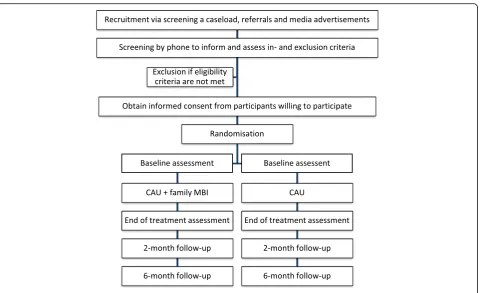
participation. Participants not referred by Karakter will also give consent to request medical data from the insti-tute/clinician who diagnosed ADHD. The participants will be randomised after completion of the informed consent forms. In case families withdraw consent before the baseline assessments, randomisation will be undone and participants can be replaced, in order not to let non-participants imbalance the treatment groups for the primary analyses. School teachers and general practi-tioners of included participants will be informed about the study via telephone, email and/or postal letter. The school teachers will be requested not to ask the family about treatment allocation to keep them‘blinded’. Like-wise, the participants will be requested not to speak about treatment allocation to the school teachers.
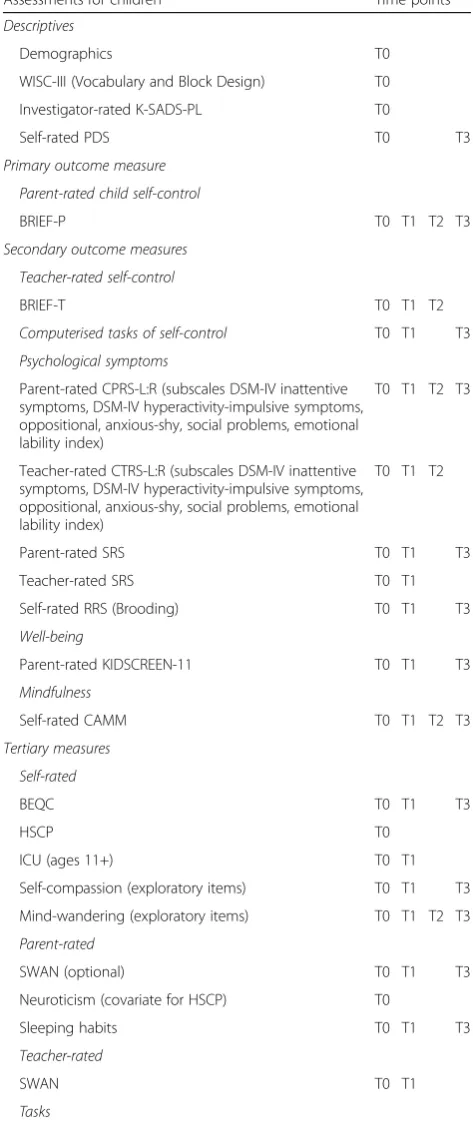
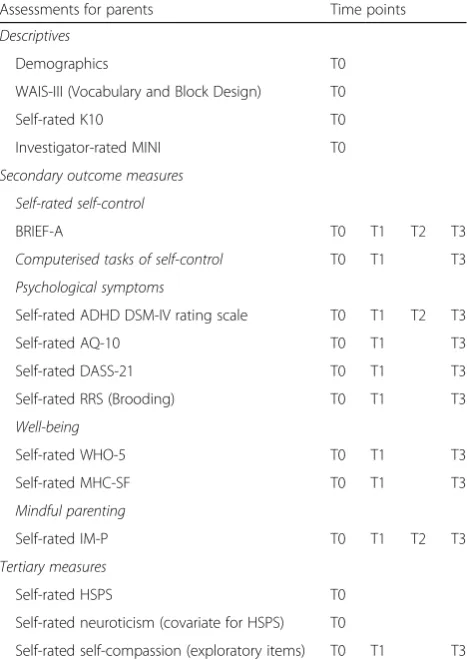
[image:11.595.305.539.99.140.2] [image:11.595.55.292.106.679.2]Assessments will take place at baseline (T0), end of treatment (T1), two (T2) and six (T3) months after end of treatment. For the family MBI condition, T0 will be scheduled in the two weeks prior to the start of the inter-vention and T1 in the two weeks after the 8th session of the MYmind training. The booster session will be followed by the first follow-up assessments (T2) which will be two months after T1 and the second follow-up as-sessments (T3) will be scheduled half a year after T1. In-tervals between assessments will be kept similar for the family MBI and CAU condition. For baseline, end of treatment and 6-month follow-up assessments, partici-pants will be invited to a location of Karakter. Assess-ments will be conducted by a researcher or research assistant. Participants will be asked to interrupt ADHD medication intake 48 h prior to these assessments. For the 2-month follow-up assessments, both parent and child will receive an invitation to complete questionnaires online (not at Karakter). School teachers will be asked to complete all questionnaires online at baseline, end of treatment and 2-month follow-up. See Table 1for which assessments for children will be taken at which time points and Table2 for assessments for parents and time points. Further, see Fig.1 for a flowchart on recruitment and the study procedure.
Table 1Assessments for children and time points
Assessments for children Time points
Descriptives
Demographics T0
WISC-III (Vocabulary and Block Design) T0
Investigator-rated K-SADS-PL T0
Self-rated PDS T0 T3
Primary outcome measure
Parent-rated child self-control
BRIEF-P T0 T1 T2 T3
Secondary outcome measures
Teacher-rated self-control
BRIEF-T T0 T1 T2
Computerised tasks of self-control T0 T1 T3
Psychological symptoms
Parent-rated CPRS-L:R (subscales DSM-IV inattentive symptoms, DSM-IV hyperactivity-impulsive symptoms, oppositional, anxious-shy, social problems, emotional lability index)
T0 T1 T2 T3
Teacher-rated CTRS-L:R (subscales DSM-IV inattentive symptoms, DSM-IV hyperactivity-impulsive symptoms, oppositional, anxious-shy, social problems, emotional lability index)
T0 T1 T2
Parent-rated SRS T0 T1 T3
Teacher-rated SRS T0 T1
Self-rated RRS (Brooding) T0 T1 T3
Well-being
Parent-rated KIDSCREEN-11 T0 T1 T3
Mindfulness
Self-rated CAMM T0 T1 T2 T3
Tertiary measures
Self-rated
BEQC T0 T1 T3
HSCP T0
ICU (ages 11+) T0 T1
Self-compassion (exploratory items) T0 T1 T3
Mind-wandering (exploratory items) T0 T1 T2 T3
Parent-rated
SWAN (optional) T0 T1 T3
Neuroticism (covariate for HSCP) T0
Sleeping habits T0 T1 T3
Teacher-rated
SWAN T0 T1
Tasks
Table 1Assessments for children and time points(Continued)
Assessments for children Time points
One Minute Reading Test T0 T1 T3
Saliva collection T0 T1
T0 baseline, T1 end of treatment, T2 2-month follow-up, and T3 6-month follow-up, WISC-III Wechsler Child Intelligence Scale-Third Edition, K-SADS-P Schedule for Affective Disorders and Schizophrenia for School-Age Children-Present and Lifetime Version, PDS Pubertal Development Scale, BRIEF-P Behaviour Rating Inventory of Executive Function-Parent form, BRIEF-T Behaviour Rating Inventory of Executive Function-Teacher form, CPRS-L:R Conners’Parent Rating Scales-Revised: Long, CTRS-L:R Conners’Teacher Rating Scales-Revised: Long, SRS=Social Responsiveness Scale, RRS = Ruminative Response Scale, CAMM = Child and Adolescent Mindfulness Measure, BEQC=Body Experience Questionnaire for Children, HSCP=Highly Sensitive Child Scale, ICU=Inventory of
Sample size Power calculation
Power analyses are based on the primary hypothesis that family MBI, relative to control, will lead to improvement in self-control (as measured by the BRIEF) at end of treatment. The BRIEF has shown modest to large effect sizes in MBI studies for clinical samples, including bipo-lar disorder [140][Cohen’s d effect sizes from 0.08–1.33 on self-report BRIEF] and adult ADHD [57][Cohen’s d effect size from 0.43 to 0.93 on self-report BRIEF]; [56][Cohen’s d effect size from 0.67 to 1.72 on self-report BRIEF]. Further, in previous work using the MYmind programme (unpublished data on a larger non-randomised waitlist-controlled pilot in youth with ADHD N = 195 families using parent-report BRIEF; see also [55][Cohen’s d effect size from 0.0 to 1.8 on parent-report BRIEF; 0.2 to 0.5 on teacher-rated BRIEF]),
a moderate effect on the BRIEF was found. Therefore power calculations were based on a moderate effect size of 0.4. Power analyses were run using the software G*power 3.1 and based on the procedure by G. F. Borm, J. Fransen and W. A. Lemmens [141]. Using this method, the N per group is obtained from the N per group for t-test multiplied by the design factor (D). The design factor D = 1–r2, where r2 is the correlation be-tween baseline and end of treatment on the BRIEF. We determined r using the data of a normative sample over a comparable time frame (six weeks): .86 [142]. As the period between baseline and end of treatment is slightly longer in this trial (around eleven weeks) the power ana-lyses was conducted using a more conservative estimate ofr= .76, hence D = 1–.762= .42.
Based on a power of 80%, a two-tailed test withα= .05 and an estimated effect size of 0.4, we need 100*.42 = 42 children in each group. Past studies conducted using the MYmind programme (see section Intervention) using non-randomised designs in youth with ADHD and ASD found attrition rates from 5 to 15%. Therefore, we will recruit a slightly larger sample (2xN = 50, totalN= 100), allowing room for attrition of around 15%.
Randomisation
Randomisation by means of minimisation [143] will be performed after completion of the informed consent forms. The treatment group that most strongly mini-mises the imbalance between the two conditions is chosen to allocate the patient. To balance possibly prognostic factors across treatment groups, the follow-ing procedure will be performed: first, a stratification for age group is performed (elementary school or secondary school). Then, block randomisation is per-formed (with varying predefined block sizes), combined with minimisation. The three minimisation factors are: 1) medication for ADHD at baseline (medication versus no medication); 2) gender (male versus female); and 3) age (younger (child: age 8–10 or adolescent: age 12–14) versus older (child: age 10–12 or adolescent: age 14– 16)). Minimisation factors are of equal importance, and block randomisation always wins over minimisation. Concealment of allocation is guaranteed as the se-quence behind the randomisation will be unknown by the executing researcher.
Data collection, management analysis
[image:12.595.57.291.101.433.2]As soon as the participant is enrolled, across all assess-ments he or she will only be identifiable via a unique pseudocode identifier to anonymise all data. A separ-ate protected data-base will link the unique pseudo-code to the participants’ names. Anonymous and non-anonymous (e.g. informed consent forms) data Table 2Assessments for parents and time points
Assessments for parents Time points
Descriptives
Demographics T0
WAIS-III (Vocabulary and Block Design) T0
Self-rated K10 T0
Investigator-rated MINI T0
Secondary outcome measures
Self-rated self-control
BRIEF-A T0 T1 T2 T3
Computerised tasks of self-control T0 T1 T3
Psychological symptoms
Self-rated ADHD DSM-IV rating scale T0 T1 T2 T3
Self-rated AQ-10 T0 T1 T3
Self-rated DASS-21 T0 T1 T3
Self-rated RRS (Brooding) T0 T1 T3
Well-being
Self-rated WHO-5 T0 T1 T3
Self-rated MHC-SF T0 T1 T3
Mindful parenting
Self-rated IM-P T0 T1 T2 T3
Tertiary measures
Self-rated HSPS T0
Self-rated neuroticism (covariate for HSPS) T0
Self-rated self-compassion (exploratory items) T0 T1 T3
Note. T0 baseline, T1 end of treatment, T2 2-month follow-up, and
will be stored in separate password protected folders. Video-data of the sessions will be transported with an encrypted external hard disk and stored on a network attached storage only accessible for the appointed re-searchers. Questionnaire data will be collected and stored with the online electronic data capture soft-ware CASTOR EDC [144], which tracks and logs any manual changes made to raw data and is fully Good Clinical Practice (GCP) compliant. Quantitative data that is first collected on paper (e.g. IQ test, diagnostic interview) will be manually entered in CASTOR EDC and the entry will be double checked by another re-searcher. To prevent missing data, the force step completion function will be used so informants can only continue with the questionnaire when all items are completed. When questionnaires are not com-pleted within the expected period, participants/school teachers will be sent online reminders. If no response follows they will be contacted per telephone to dis-cuss the absence of response and to motivate them to complete the questionnaires, if necessary with conces-sions (e.g. fewer questionnaires). In case participation is discontinued, reasons will be noted and participants will be asked to complete a drop-out questionnaire with the main outcome measures (BRIEF-P, BRIEF-A, CPRS and parental ADHD self-report). Clinically in-formative results derived from child- and parent-rated
questionnaire data will be reported by the researchers and sent to the involved participant after study par-ticipation ends.
Statistical analyses
Data will be analysed and reported according to CON-SORT guidelines. Baseline demographic and clinical characteristics of the family MBI- and CAU-groups will be compared to examine whether these have been dis-tributed evenly across the two groups by the randomisa-tion. The primary analyses will be aimed at comparing results on the outcome measures at end of treatment be-tween the family MBI and CAU condition, controlling for baseline levels and possible other baseline differ-ences between intervention and CAU groups. To test our primary hypothesis that assignment to family MBI (relative to CAU) will improve child self-control, we will use ANCOVA with group condition (family MBI versus CAU) as the primary independent vari-able, and child self-control (continuous BRIEF-P score) at end of treatment as the primary dependent variable and child self-control at baseline as covariate. Cohen’s d effect sizes will be calculated. Analyses will be conducted both according to intention-to-treat principle, and per-protocol on completers (family MBI condition: child and parent attended > = 4 family MBI sessions). Intention-to-treat analyses will be conducted
[image:13.595.60.542.85.378.2]using available case analysis (not considering individ-uals with missing data) as well as imputation, as described in [145]. In case both parents participate in the assessments, data of the parent with the most complete dataset will be used for the ANCOVA, and if both are complete, the sex of the parent (or age, for same-sex parents) will determine which dataset will be used so that the fathers:mothers ratio is most similar across both study arms.
Secondary analyses, aimed at examining the consolida-tion of treatment effects at follow-ups, will use multi-level modelling with time point as repeated measurement, following the approach described in [58]. Moreover, we will conduct a set of complementary ana-lyses to derive prediction models for response to inter-vention from baseline characteristics, and explore interactions between child and parental outcomes.
Monitoring
A data protection officer independent from the re-searcher will be assigned and monitors 1) the protec-tion of the rights and well-being of the participants; 2) whether the reported research data is accurate and completely verifiable in source documents; and 3) whether the implementation of the research is con-sistent with the approved protocol/amendment(s) at that time, with GCP and the applicable legal require-ments [146]. After including the first five participants, all data will be monitored. That is, the accuracy and completeness of all data (on item/trial level) per par-ticipant will be checked. After including parpar-ticipant five to ten, the completeness and accuracy of the data on summary/scale level will be checked for all partici-pants. Thereafter, data on summary/scale level will be checked randomly for one in five participants. Out-comes of this data monitoring will be summarised in an overview and reported to all research personnel.
Based on previous studies on MBI for children and Mindful Parenting, deterioration as a result of family MBI is not expected. Therefore, no interim analysis will be conducted. Adverse events (AEs) are defined as any undesirable experience occurring to a participant dur-ing the study, whether or not considered related to the family MBI. All AEs reported spontaneously by the par-ticipant or observed by the researcher or mindfulness teachers will be recorded. All serious adverse events (SAEs, resulting in death, life threatening, requiring hospitalisation or other important medical events) will be communicated to the principal and coordinating re-searchers, who will report the SAEs to the accredited ethics committee that approved the protocol, within fif-teen days after the sponsor has first knowledge of the SAE. SAEs that result in death or are life threatening should be reported expedited. The expedited reporting
will occur not later than seven days after the respon-sible researcher has first knowledge of the SAE.
Discussion
Self-control is a malleable determinant of success in health, wealth, parenting, and avoiding crime [147]. Hence, improving self-control in children with self-control deficits has an important impact on their life and society. An example of a clinical population in which targeting self-control in treatment is pressing is youth with ADHD. ADHD is associated with adverse outcomes including impediment on academic achieve-ment, mental and substance use disorders, criminality, and employment [148]. Current CAU for youth with ADHD is often not sufficient in improving self-control. Furthermore, CAU is generally not focused on mental health and well-being of the parents, although this has impact on the (treatment of the) child as well. ADHD medication can have undesired side effects, is refused by some families, compliance may be low, and improve-ments do not last after medication discontinuation [35]. These shortcomings might be addressed by offering a family-based MBI in addition to CAU. Self-regulation is present at the basis of MBIs and work by cognitive neu-roscientists demonstrates that brain structures and func-tions that are involved in self-control are altered with (mindfulness) meditation. There is strong evidence of positive overall effects of MBIs in children as well as adults [21, 149, 150]. However, studies investigating the effects of MBIs on self-control in youth with ADHD and/or their parents are scarce and there is a need for methodologically stronger trials.
outcomes (e.g. neuropsychological functions, clinical symp-toms, positive health) will be assessed in both the child and the parent. This not only allows studying the effect of fam-ily MBI on child and parental outcomes but also how they relate to each other. This will increase our understanding of the influence of parental symptoms, functioning and well-being on the child and vice versa, and the possible role that MBI on a family level may play in targeting child and/ or parental needs. In addition, follow-up assessments until six months after the end of treatment make it possible to investigate both the short- and long-term effectiveness of the intervention. In a similar trial of an MBI in adults with ADHD, significant effects on self-control assessed with the BRIEF were only found at follow-up [58], as it might take more time and practice before MBI results in improvement of real-life self-control skills. Effects of self-control are sug-gested to follow a continuum, therefore interventions that achieve even small improvements in self-control for indi-viduals, could shift outcomes across the population as a whole in a positive direction to impact health, wealth and crime rates [1]. Finally, ADHD is one of several psychopa-thologies (e.g. ODD, CD, addictions, mood- and anxiety disorders) that involve self-control deficits. Hence, results of the proposed RCT are in a cross-disorder perspective informative for a broad clinical population.
Additional file
Additional file 1:Neurocognitive tests instructions. Neurocognitive test
instructions (translated from Dutch). (DOCX 18 kb)
Abbreviations
ADHD:Attention Deficit/Hyperactivity Disorder; AE: Adverse Event; AQ-10: Short Autism Spectrum Quotient; ASD: Autism Spectrum Disorder; BEQC: Body Experience Questionnaire for Children; BRIEF: Behaviour Rating Inventory of Executive Function; CAMM: Child and Adolescent Mindfulness Measure; CAU: Care-As-Usual; CD: Conduct Disorder; CEQ: Credibility/ Expectancy Questionnaire; CMO: Central committee on research involving human subjects; CPRS-R:L: Conners’Parent Rating Scales-Revised: Long; CTRS-R:L: Conners’Teacher Rating Scales-Revised: Long; DASS-21: Depression Anxiety Stress Scale; DSM-5: Diagnostic and Statistical Manual of Mental Disorders, Fifth Edition; DSM-IV: Diagnostic and Statistical Manual of Mental Disorders, Fourth Edition; GCP: Good Clinical Practice; HSCS: Highly Sensitive Child Scale; HSPS: Highly Sensitive Person Scale; ICU: Inventory of Callous-Unemotional traits; IM-P: Interpersonal Mindfulness in Parenting scale; IQ: Intelligence Quotient; K10: Kessler Psychological Distress Scale; K-SADS-PL: Schedule for Affective Disorders and Schizophrenia for School-Age Children-Present and Lifetime Version; MBCT: Mindfulness-Based Cognitive Therapy; MBI: Mindfulness-Based Intervention; MBSR: Mindfulness-Based Stress Reduction; MHC-SF: Mental Health Continuum-Short Form; MINI: Mini-International Neuropsychiatric Interview; ODD: Oppositional Defiant Disorder; PDS: Pubertal/Physical Development Scale; RCT: Randomised Controlled Trial; RRS: Ruminative Response Scale; SAE: Serious Adverse Event; SPIRIT: Standard Protocol Items: Recommendations for Interventional Trials; SRS: Social Responsiveness Scale; SSRT: Stop Signal Reaction Time; SWAN: Strengths and Weakness of ADHD Symptoms and Normal Behaviour; TAC: Teaching Assessment Criteria; TiC-P: Trimbos and iMTA questionnaire on Costs associated Psychiatric illness; VMBN: Association of mindfulness-based teachers in the Netherlands and Flanders; WAIS-III: Wechsler Adult
Intelligence Scale-Third Edition; WHO-5: World Health Organization-Five Well-being Index; WISC-III: Wechsler Intelligence Scale for Children-Third Edition
Acknowledgements
We are grateful to Karakter Child and Adolescent Psychiatry as participating centre and for additional financial support. Further, we would like to thank Hans Groenewoud for his contribution to the randomisation procedure.
Sponsor
Stichting Karakter, Reinier Postlaan 12, 6525 GC Nijmegen, The Netherlands. The sponsor and funding bodies have no role in the design of this study and will not have any role during its execution, analyses, interpretation of the data, or decision to submit results.
Dissemination policy
Communication and dissemination activities will be focused on professionals in child and adolescent psychiatry and youth mental health, on
paediatricians, and organisations engaged in guidelines on the management of ADHD and other psychiatric disorders in children, on professionals involved in prevention research and working in the educational system, and media and the general public. The findings of our study will be published in peer-reviewed scientific journals. Further results from this study will be pre-sented at national and international conferences.
Funding
MindChamp is funded by a Horizon 2020 Marie Sklodowska-Curie Innovative Training Networks grant (C.G., J.B., grant number 643051 MiND); with additional support from the Netherlands Foundation of Mental Health (C.G., J.B., grant number 2016 7057) for the part of the study that focuses on the parents with 09/09/2016 as start date.
Availability of data and materials
Study data will be available for other researchers eighteen months after finishing the study. We will give limited access to the data, that is, data can be obtained provided that the applicant will submit a research plan and the researchers of the current study will be involved in the research on the shared data. Data will be anonymised and accompanied by the present study protocol and data list description. Other researchers can contact Karakter (sponsor of the study) to obtain data.
Authors’contributions
AS, CG, JB, NS and SB contributed to the design of the study. CG is principal investigator and project coordinator of the study and JB, AS and SB are co-principal investigators. NS drafted the paper, which was modified and supplemented by all other authors. NS, NW, CG and LB are involved in recruiting participants and data collection. NS, NW and CG take care of the logistics of the study. SB contributes to the training and supervision of the mindfulness teachers. All authors read and approved the final manuscript.
Ethics approval and consent to participate
This study has been ethically approved by CMO Arnhem-Nijmegen and is registered under number 2015–1938. Written informed consent will be obtained from all participating families included in the study.
Consent for publication
Not applicable.
Competing interests
JB has been in the past 3 years a consultant to/member of advisory board of/and/or speaker for Janssen Cilag BV, Eli Lilly, Shire, Medice, and Servier. He is not an employee of any of these companies, and not a stock shareholder of any of these companies. He has no other financial or material support, including expert testimony, patents and royalties. SB is shareholder of UvA minds and UvA minds You, in which MYmind is offered to families and teacher training in MYmind to professionals. AS is the founder and clinical director of the Radboudumc Center for Mindfulness. The other authors declared that they have no competing interests.
Publisher’s Note
Author details
1Department of Cognitive Neuroscience, Donders Institute for Brain, Cognition and Behaviour, Radboud University Medical Centre, Nijmegen, The Netherlands.2Karakter Child and Adolescent Psychiatry, University Center, Reinier Postlaan 12, Nijmegen 6525, GC, The Netherlands.3Research Institute of Child Development and Education, University of Amsterdam, Amsterdam, the Netherlands.4Department of Psychiatry, Radboudumc Centre for Mindfulness, Radboud University Medical Centre, Nijmegen, The Netherlands. 5King’s College London, Social, Genetic and Developmental Psychiatry, Institute of Psychiatry, Psychology and Neuroscience, London, UK.
Received: 12 June 2018 Accepted: 9 July 2018
References
1. Moffitt TE, Arseneault L, Belsky D, Dickson N, Hancox RJ, Harrington H, et al. A gradient of childhood self-control predicts health, wealth, and public safety. Proc Natl Acad Sci U S A. 2011;108(7):2693–8.
2. Duckworth AL, Kern ML. A meta-analysis of the convergent validity of self-control measures. J Res Pers. 2011;45(3):259–68.
3. Strayhorn JM Jr. Self-control: theory and research. J Am Acad Child Adolesc Psychiatry. 2002;41(1):7–16.
4. Tang YY, Posner MI, Rothbart MK. Meditation improves self-regulation over the life span. Ann N Y Acad Sci. 2014;1307:104–11.
5. Caspi A, Houts RM, Belsky DW, Goldman-Mellor SJ, Harrington H, Israel S, et al. The p factor: one general psychopathology factor in the structure of psychiatric disorders? Clin Psycholo Sci. 2014;2(2):119–37.
6. Biederman J, Monuteaux MC, Doyle AE, Seidman LJ, Wilens TE, Ferrero F, et al. Impact of executive function deficits and attention-deficit/hyperactivity disorder (ADHD) on academic outcomes in children. J Consult Clin Psychol. 2004;72(5):757–66.
7. Thorell LB. Do delay aversion and executive function deficits make distinct contributions to the functional impact of ADHD symptoms? A study of early academic skill deficits. J Child Psychol Psychiatry. 2007;48(11):1061–70. 8. Valiente C, Eisenberg N, Spinrad TL, Haugen R, Thompson MS, Kupfer A.
Effortful control and impulsivity as concurrent and longitudinal predictors of academic achievement. J Early Adolesc. 2013;33(7):946–72.
9. Pandey A, Hale D, Goddings AL, Blakemore SJ, Viner R. Systematic review of effectiveness of universal self-regulation-based interventions and their effects on distal health and social outcomes in children and adolescents: review protocol. Syst Rev. 2017;6(1):175.
10. Masicampo EJ, Baumeister RR. Relating mindfulness and self-regulatory processes. Psychol Inq. 2007;18(4):255–8.
11. Jansen P, Schulze A, Nottberg C. Influence of mindfulness-based interventions on executive functions in childhood: a systematic review. Z Entwicklungspsychol Padagog Psychol. 2016;48(4):206–16.
12. Diamond A. Activities and programs that improve Children's executive functions. Curr Dir Psychol Sci. 2012;21(5):335–41.
13. Kabat-Zinn J. Full catastrophe living : how to cope with stress, pain and illness using mindfulness meditation. London: Piatkus; 1990.
14. Kabat-Zinn J. Mindfulness-based interventions in context: past, present, and future. Clin Psychol-Sci Pr. 2003;10(2):144–56.
15. Tang YY, Holzel BK, Posner MI. The neuroscience of mindfulness meditation. Nat Rev Neurosci. 2015;16(4):213–25.
16. Fox KC, Nijeboer S, Dixon ML, Floman JL, Ellamil M, Rumak SP, et al. Is meditation associated with altered brain structure? A systematic review and meta-analysis of morphometric neuroimaging in meditation practitioners. Neurosci Biobehav Rev. 2014;43:48–73.
17. Fox KC, Dixon ML, Nijeboer S, Girn M, Floman JL, Lifshitz M, et al. Functional neuroanatomy of meditation: a review and meta-analysis of 78 functional neuroimaging investigations. Neurosci Biobehav Rev. 2016;65:208–28.
18. Tang YY, Yang L, Leve LD, Harold GT. Improving executive function and its neurobiological mechanisms through a mindfulness-based intervention: advances within the field of developmental neuroscience. Child Dev Perspect. 2012;6(4):361–6.
19. Lao SA, Kissane D, Meadows G. Cognitive effects of MBSR/MBCT: a systematic review of neuropsychological outcomes. Conscious Cogn. 2016;45:109–23. 20. Mak C, Whittingham K, Cunnington R, Boyd RN. Efficacy of mindfulness-based interventions for attention and executive function in children and adolescents-a systematic review. Mindfulness (N Y). 2018;9(1):59–78.
21. Zoogman S, Goldberg SB, Hoyt WT, Miller L. Id, Goldberg SBOhoo. Mindfulness interventions with youth: A meta-analysis. Mindfulness (N Y). 2015;6(2):290–302. 22. Flook L, Smalley SL, Kitil MJ, Galla BM, Kaiser-Greenland S, Locke J, et al.
Effects of mindful awareness practices on executive functions in elementary school children. J Appl Sch Psychol. 2010;26(1):70–95.
23. Barkley RA. ADHD and the nature of self-control. New York. London: Guilford Press; 1997.
24. Polanczyk G, de Lima MS, Horta BL, Biederman J, Rohde LA. The worldwide prevalence of ADHD: a systematic review and metaregression analysis. AmJPsychiatry. 2007;164(6):942–8.
25. Pelham WE, Foster EM, Robb JA. The economic impact of attention-deficit/ hyperactivity disorder in children and adolescents. J Pediatr Psychol. 2007; 32(6):711–27.
26. Danckaerts M, Sonuga-Barke EJ, Banaschewski T, Buitelaar J, Dopfner M, Hollis C, et al. The quality of life of children with attention deficit/hyperactivity disorder: a systematic review. Eur Child Adolesc Psychiatry. 2010;19(2):83–105. 27. Peasgood T, Bhardwaj A, Biggs K, Brazier JE, Coghill D, Cooper CL, et al. The
impact of ADHD on the health and well-being of ADHD children and their siblings. Eur Child Adolesc Psychiatry. 2016;25(11):1217–31.
28. Cappe E, Bolduc M, Rouge MC, Saiag MC, Delorme R. Quality of life, psychological characteristics, and adjustment in parents of children with attention-deficit/hyperactivity disorder. Qual Life Res. 2016;26(5):1283–94. 29. NICE. Atttention deficit hyperactivity disorder. The NICE guideline on
diagnosis and management of ADHD in children, young people and adults. National Clinical Practice Guideline Number 72. London: The British Psychological Society, Leicester & The Royal College of Psychiatrists; 2009. 30. NICE. Attention defificit hyperactivity disorder: diagnosis and management.
London: The British Psychological Society, Leicester & The Royal College of Psychiatrists; 2018.
31. Daley D, van der Oord S, Ferrin M, Cortese S, Danckaerts M, Doepfner M, et al. Practitioner review: current best practice in the use of parent training and other behavioural interventions in the treatment of children and adolescents with attention deficit hyperactivity disorder. J Child Psychol Psychiatry. 2017;https://doi.org/10.1111/jcpp.12825.
32. Coghill DR, Banaschewski T, Soutullo C, Cottingham MG, Zuddas A. Systematic review of quality of life and functional outcomes in randomized placebo-controlled studies of medications for attention-deficit/hyperactivity disorder. Eur Child Adolesc Psychiatry. 2017;26(11):1283–307.
33. Tamminga HG, Reneman L, Huizenga HM, Geurts HM. Effects of
methylphenidate on executive functioning in attention-deficit/hyperactivity disorder across the lifespan: a meta-regression analysis. Psychol Med. 2016; 46(9):1791–807.
34. Biederman J, Faraone SV. Attention-deficit hyperactivity disorder. Lancet. 2005;366(9481):237–48.
35. van der Oord S, Prins PJ, Oosterlaan J, Emmelkamp PM. Efficacy of methylphenidate, psychosocial treatments and their combination in school-aged children with ADHD: a meta-analysis. Clin Psychol Rev. 2008; 28(5):783–800.
36. Hennissen L, Bakker MJ, Banaschewski T, Carucci S, Coghill D, Danckaerts M, et al. Cardiovascular effects of stimulant and non-stimulant medication for children and adolescents with ADHD: a systematic review and meta-analysis of trials of methylphenidate. Amphetamines and Atomoxetine CNS Drugs. 2017;31(3):199–215.
37. Stuckelman ZD, Mulqueen JM, Ferracioli-Oda E, Cohen SC, Coughlin CG, Leckman JF, et al. Risk of irritability with psychostimulant treatment in children with ADHD: a meta-analysis. J Clin Psychiatry. 2017;78(6):e648–55. 38. Kidwell KM, van Dyk TR, Lundahl A, Nelson TD. Stimulant medications and sleep for youth with ADHD: a meta-analysis. Pediatrics. 2015;136(6):1144–53. 39. Daley D, van der Oord S, Ferrin M, Danckaerts M, Doepfner M, Cortese
S, et al. Behavioral interventions in attention-deficit/hyperactivity disorder: a meta-analysis of randomized controlled trials across multiple outcome domains. J Am Acad Child Adolesc Psychiatry. 2014; 53(8):835–47. 847.e831–835
40. Rapport MD, Orban SA, Kofler MJ, Friedman LM. Do programs designed to train working memory, other executive functions, and attention benefit children with ADHD? A meta-analytic review of cognitive, academic, and behavioral outcomes. Clin Psychol Rev. 2013;33(8):1237–52.