Combining Harmony search algorithm and Ant
Colony Optimization algorithm to increase the
lifetime of Wireless Sensor Networks
Zahra Kamaei1, Hamidreza Bakhshi2, Behrooz Masoumi3Received (2015-06-13) Accepted (2015-08-04)
Abstract — Wireless Sensor Networks are
the new generation of networks that typically are formed great numbers of nodes and the communications of these nodes are done as Wireless. The main goal of these networks is collecting data from neighboring environment of network sensors. Since the sensor nodes are battery operated and there is no possibility of charging or replacing the batteries, the lifetime of the networks is dependent on the energy of sensors. The objective of this research, is to combine the Harmony Search Algorithm and Ant Colony Optimization Algorithm, as successful Meta heuristic algorithm to routing at wireless sensor to increase lifetime at this type of networks. To this purpose, algorithm called HS-ACO is suggested. In this algorithm, two criterion of reduction consumption of energy and appropriate distribution of consumption energy between nodes of sensor leads to increase lifetime of network is considered. Results of simulations, show the capability of the proposed algorithm in finding the Proper path and establishment appropriate balance in the energy consumed by the nodes. Propose algorithm is better than Harmony Search algorithm and Ant Colony Optimization algorithm and Genetic Ant algorithm.
Index Terms—Wireless Sensor Network, Routing, Meta heuristic algorithms, Harmony Search Algorithm, Ant Colony Optimization Algorithm.
Keywords - Data Grid, Dynamic Data
Replication, Fault Injection, Reliability, Availability
I. INTRODUCTION
A
wireless sensor network is a collection of a large number of sensor nodes with small dimensions and by limited capabilities of communications and computing is used to collect and transmit data from the environment to the base station. Despite advances in this type of networks, sensor nodes still to meet their energy requirement depends on the batteries with low power. Therefore, one of the most important issues in wireless sensor networks, isenergy efficiency management [1]. Also, since the efficiency of wireless sensor networks is
strongly depends on the lifetime of network, in this kind of network protocols should consider the increasing of the lifetime of the network. By
definition, the time lapse since the beginning of the network, it takes energy to finish in the first node, called the network lifetime [2]. The
purpose of this study, is the combination of
Harmony Search Algorithm (HS) [3] and Ant Colony Optimization Algorithm (ACO) [4], as
successful Meta heuristic algorithms, for routing in wireless sensor networks, in order to increase the lifetime of these networks.
Harmony Search Algorithm is a Meta heuristic algorithm that was proposed in 2001
[3]. It is inspired based on the form of music
orchestra on the methods and operation to achieve coordination between the components. In wireless sensor networks, the harmony search algorithm has been used for problems such as
clustering [5], coverage [6], localization [7] and routing [8].
Ant Colony Optimization algorithm was
proposed in 1992 [4]. It is one of the most apparent
examples of collective intelligence that has been
1- M.SC. Student in Computer Engineering: Software, Science and Research Branch, Azad University of Qazvin, Iran. ([email protected])
2- Associate Professor and faculty member of Electrical Engineering, Department of Electrical engineering and Computer, Qazvin, Iran. ([email protected])
inspired by the collective behavior of ants. The Algorithm is used to solve Traveling Salesman
problem [9], scheduling [10] and routing [11].
In the proposed algorithm, to reduce energy consumption of the path, it was tried to consider the shortest path between the source node to the destination node with the highest average energy of nodes participating in the route. Thus, if the energy consumed in the route is less and the average residual energy nodes participating in the route is more, the probability of to choose the route increases. It is clear that the routing according to two criteria, is a Multi-objective optimization problem and NP-hard problem that it can be solved by means of an approximation algorithms. The need to establish an appropriate balance between energy consumption and increase the average remaining energy in routing
nodes participating is considered effectively in the fitness function of harmony search algorithm.
In the next, the introduction of several research similar about energy aware routing at network using wireless Sensor networks by Meta heuristic
algorithms is considered. At [12], the research
for designing Multi-objective routing at wireless sensor network has done by Genetics Algorithm. This routing, two Criterion of energy and time delay are considered constraints for routing.
Method recommended at [12], suggests sudden routing. At [13], One Energy-aware routing at wireless Sensor Networks are offered with the
use of Particle Swarm Optimization. At This Research, using one Multi-phase Particle Swarm Optimization, Restrictions such as connection and all broadcast constraints are considered.
In [14], other way to increase lifetime with
using Nervous networks are presented. This Research with using the clustering sensor nodes,
tries to increase lifetime of the network. In [15], [16] Multi-objective routing at multimedia
wireless sensor networks with the goal of
increasing final lifetime of the network using Genetics Algorithm is proposed. In [17], it is tried
to present routing method based on clustering at wireless sensor networks using combined genetic algorithm and ant community to balance the consumption of energy at the network.
The rest of the paper is organized as follows: Section II describes the perfect harmony search algorithm and Ant Colony Optimization algorithm and introduces the features of this algorithm. The proposed method has been described in detail in Section III and Section IV simulation results are
presented. Section V is devoted to summary and conclusion.
II. INTRODUCTION OF HARMONY SEARCH ALGORITHM AND ANT COLONY
OPTIMIZATION ALGORITHM
1. Harmony Search Algorithm (HS)
The algorithm first proposed by Geem, et.al. [3]. Consider a group of musicians in one orchestra.
The appropriate combination of composed notes
implementation by each musician, at finally
converts to beautiful music. Each composition from notes played by musicians, is called harmony. Each harmony after the production, should be checked from the Aesthetics view to be sure that the obtained harmony is the same music or not. Consecutive exercises are conducted until the considered harmony to be created. It is clear that the musicians at any time repeat practice,
effort to produce better harmony from view of
aesthetics, than previous one. At here it is tried that each of the description listed at about orchestra
performance music, fitted with components
of Harmony Search Algorithm. Each of the musicians at orchestra music, is one variable in the Harmony Search Algorithm. Each musician
in the specific time intervals could perform the notes, each variable is selected from specific
intervals. Harmony made at orchestra, is indeed one answer vector. As each harmony at orchestra music after production, should be checked from aesthetics view, each solution at Harmony Search
Algorithm also should be evaluated with fitness
function. Musicians at each repeat of the exercise,
effort to improve the quality of the New Harmony,
it means that new harmonies, must be better than previous harmonies from the aesthetics views. Every musician in the orchestra music, has three options for playing notes that are:
1) Play the famous notes exactly from his or her memory.
2) play somewhat similar to the notes (with little change in the notes).
3) Play a random note.
In the first case, as in a musical orchestra each
harmony is the same. Therefore, when a variable
selects the first case, in fact, one of the variables
in the memory column harmony is selected. The probability of selection for variable rate depending on the Harmony Memory Considering Rate (HMCR). In the second case, in a musical orchestra, notes that a player can play in the previous exercises to implement some changes. This is called Pitch Adjustment Rate (PAR). Similarly, the harmony search algorithm, a variable can change slightly the value of the parameter HMCR Selected. About the third case, as a musician in an orchestra music can play random notes, the harmony search algorithm can randomly choose the values of a variable. In the next, for the third case, randomized term is used.
2. Ant Colony Optimization Algorithm (ACO) The algorithm was presented by Marco
Dorrigo [9]. The collective Intelligence is rather
new approach in the optimization problems that inspired from social behavior of insects and animals, such as ants that were inspired to many methods and techniques.
In the real world, the ants move randomly
at first. Ants have different routes to find food in advance and as soon as they find food, they
create a trace of pheromone returning to the colony. There pheromone secreted by the ants can increase the probability of selecting a path. After some pheromones on the sun began to evaporate, thus absorbing force fall. Pheromone evaporation is an advantage because of convergence to a local optimum solution is prevented.
Ants move can be considered a fully connected graph. Ants move from the vertices to other vertices to create a solution. Assuming m is the total number of ants and n is the number of vertices k ant move from vertices i to j using a probabilistic approach according to equation (1)
is performed [11]:
𝑃𝑃𝑃𝑃𝑖𝑖𝑖𝑖𝑖𝑖𝑖𝑖𝑘𝑘𝑘𝑘(𝑡𝑡𝑡𝑡) = ⎩ ⎨ ⎧
𝜏𝜏𝜏𝜏𝑖𝑖𝑖𝑖𝑖𝑖𝑖𝑖𝛼𝛼𝛼𝛼(𝑡𝑡𝑡𝑡) 𝜂𝜂𝜂𝜂 𝑖𝑖𝑖𝑖𝑖𝑖𝑖𝑖
𝛽𝛽𝛽𝛽(𝑡𝑡𝑡𝑡) 𝑖𝑖𝑖𝑖 ∈ 𝑎𝑎𝑎𝑎𝑎𝑎𝑎𝑎𝑎𝑎𝑎𝑎𝑎𝑎𝑎𝑎𝑎𝑎𝑎𝑎𝑎𝑎𝑎𝑎𝑎𝑎𝑎𝑎𝑘𝑘𝑘𝑘 ∑ 𝜏𝜏𝜏𝜏𝑖𝑖𝑖𝑖𝑖𝑖𝑖𝑖𝛼𝛼𝛼𝛼(𝑡𝑡𝑡𝑡) 𝜂𝜂𝜂𝜂𝑖𝑖𝑖𝑖𝑖𝑖𝑖𝑖𝛽𝛽𝛽𝛽(𝑡𝑡𝑡𝑡)
0 𝑎𝑎𝑎𝑎𝑡𝑡𝑡𝑡ℎ𝑎𝑎𝑎𝑎𝑒𝑒𝑒𝑒𝑎𝑎𝑎𝑎𝑖𝑖𝑖𝑖𝑒𝑒𝑒𝑒𝑎𝑎𝑎𝑎
(1)
𝑃𝑃𝑃𝑃𝑖𝑖𝑖𝑖𝑖𝑖𝑖𝑖𝑘𝑘𝑘𝑘(𝑡𝑡𝑡𝑡) is probability of Ant k movement from
i to j vertices at t moment. Allowed is a collection of vertices that ant k has access to them. t
represents the amount of pheromone stored on edge (j and i) and α and β parameters that define
the importance of pheromones and heuristic
information. η is the inverse of the edge length
that is calculated by the equation (2) as:
𝜂𝜂𝜂𝜂𝑖𝑖𝑖𝑖𝑖𝑖𝑖𝑖= 1
𝑑𝑑𝑑𝑑𝑖𝑖𝑖𝑖𝑖𝑖𝑖𝑖 (2)
Pheromone is sticking on edge that connects the vertices i and j together is for all ants that have created solution, according to equation (3) is updated:
𝜏𝜏𝜏𝜏𝑖𝑖𝑖𝑖𝑖𝑖𝑖𝑖(𝑡𝑡𝑡𝑡+𝑛𝑛𝑛𝑛)← 𝜌𝜌𝜌𝜌.𝜏𝜏𝜏𝜏𝑖𝑖𝑖𝑖𝑖𝑖𝑖𝑖(𝑡𝑡𝑡𝑡) +∆𝜏𝜏𝜏𝜏𝑖𝑖𝑖𝑖𝑖𝑖𝑖𝑖 (3)
Where r is the rate of evaporation,
∆𝜏𝜏𝜏𝜏𝑖𝑖𝑖𝑖𝑖𝑖𝑖𝑖=� ∆𝜏𝜏𝜏𝜏𝑖𝑖𝑖𝑖𝑖𝑖𝑖𝑖𝑘𝑘𝑘𝑘
𝑚𝑚𝑚𝑚
𝑘𝑘𝑘𝑘=1
the pheromone cast by ant k when
moving from vertices i to j at time t to t+n. According to the relationship (4) is calculated as:
∆𝑖𝑖𝑖𝑖𝑖𝑖𝑖𝑖𝑘𝑘𝑘𝑘=�
𝑄𝑄𝑄𝑄
𝑑𝑑𝑑𝑑𝑖𝑖𝑖𝑖𝑖𝑖𝑖𝑖 𝑖𝑖𝑖𝑖𝑖𝑖𝑖𝑖𝑎𝑎𝑎𝑎𝑎𝑎𝑎𝑎𝑎𝑎𝑎𝑎𝑘𝑘𝑘𝑘𝑔𝑔𝑔𝑔𝑔𝑔𝑔𝑔𝑔𝑔𝑔𝑔𝑔𝑔𝑔𝑔𝑎𝑎𝑎𝑎ℎ𝑟𝑟𝑟𝑟𝑟𝑟𝑟𝑟𝑔𝑔𝑔𝑔ℎ𝑖𝑖𝑖𝑖,𝑖𝑖𝑖𝑖
0 𝑔𝑔𝑔𝑔𝑎𝑎𝑎𝑎ℎ𝑔𝑔𝑔𝑔𝑟𝑟𝑟𝑟𝑒𝑒𝑒𝑒𝑖𝑖𝑖𝑖𝑔𝑔𝑔𝑔𝑔𝑔𝑔𝑔 (4)
Where Q is a constant and dij is distance between two nodes i and j.
III. THE PROPOSED ALGORITHM
1. DEFAULTS
Consider a wireless sensor network with stationary nodes. Each node can have data transfer to nodes in its radio range. The most important challenge is the limited power nodes. Each node should transmit its data via an appropriate route (considering the distance, energy consumption, and also the path that will help to increase the lifetime of the network), to the sink. All calculations are done in the sink. Size of the packets is considered identical.
Harmony memory is implemented as a matrix where each row is actually a solution to the problem. Therefore, each row of the matrix
as a path between the source (first element) and
of the graph. The number of rows in the harmony memory matrix is HMS. Harmony memory matrix has n+1 Columns and n is the maximum length of a path. This can be a maximum path length to the number of nodes in the graph. The last column of the matrix is for the storage of the
fitness function for each surface. According to
the harmony search algorithm, we need all the harmony memory rows are randomly generated. It is important to note that after the production of each rows, the two case of being path of the rows and there is no circle in the path, should be set.
For this purpose, the first element is considered
the source node. Now randomly select one of the neighboring nodes (nodes which are in radio
range), (first basic requirement). By considering
the condition, the solution can be solved. Now the selected node is omitted from the set of selected nodes to form the rest of the path, (second essential requirement). The condition prevents building circle around the track. This will continue to be elected to the destination node. If during the course of production, due to both
the first and second fundamental requirement,
we reached an impasse and the conditions are not applicable, delete the path, and instead the new path is produced. By the strategy outlined above, at the end, we have HMS Number of
paths of different lengths without circle. After the production of rows, using the fitness function, the fitness value of each row element specified in the
corresponding row, is stored. Fitness function in this algorithm. In a relationship (5) is suggested:
fitness function = 1/Energy consumed along the path
(5)
The harmony search algorithm has a certain number of repetitions using the randomization of the parameters, HMCR and PAR, a new solution is generated. It is important to note that this new solution is a temporary solution to calculate
the fitness function, if harmony is better than
the worst in memory, will be replaced that row. Second entries in temporary solution using a three-parameter randomization, HMCR and PAR is generated. Next, a description of each parameter is given.
Parameter HMCR: we assume that we want to produce the third element of temporary solution using the HMCR parameter. To do so, one of the entries in the third column, we randomly selected memory harmony so that two basic criteria to be
met. Note that the element of choice is also an option. In this case, it is possible to reach a state of deadlock, in which case we will act similar to the description given in the random parameter. If the value of this parameter is very small and close to zero is selected, the convergence is slow and if it’s too big and close to one, the result is not a good solution, this parameter is usually between
0.5, 0.9 is considered[7], [8]. HMCR guarantees
the appropriate variables that have been achieved over previous iterations, are always maintained.
Parameter PAR: Before explaining parameter PAR, it is necessary to point out here the way of diagnosis of weights of the edges of a graph. Edge weight between node A and node B in equation (6) is calculated.
Weight between two nodes A and B = The remaining energy of B / Distance between two nodes A and B
(6)
The method of weighted residual energy of the next node, for a better distribution of energy is ultimately intended to increase the lifetime of the network. Also consider the distance between two nodes, thereby reducing the energy consumption. So in fact the weight is more than one path, the path is more worth it. According to the weighting
method and the significance of the residual energy
of the next node, it is clear that the graph is a directed graph. The weight of the edge between two nodes in a sweep, it may not be identical. One element of the parameter PAR method is similar HMCR except that the node to replace the node that also satisfy two basic requirements, have a higher weight to the previous element. The PAR parameter to improve the results, will be used. Through parameter PAR, distribution of energy consumption is taken into consideration, which ultimately leads to an increase in the lifetime of the network. Note that if the element produced by the parameter HMCR, there is no choice for PAR, produced from the same node we use the HMCR and go to the next element. The local PAR is used
to refine the results. The value of this parameter
if it is too small and close to zero is selected, the convergence is slow. They cause a little subspace of the solution space, and if the search is too large will cause the algorithm to randomly search function, this parameter is considered between
0.2 and 0.6. [7], [8].
to generate a path, in order to fill the initial
harmony memory that was previously described. This means that when we need to produce a random element, it must comply with the basic requirements, a randomly selected element. Note that the line element of an interim solution, it cannot be selected component. The time may come when deadlock is reached, we do not have any choice as to establish two basic conditions, in this case we’ll be back step back, to produce the previous element again and continue the rest of the production of the path. Randomization is used to increase the diversity of solutions. Although PAR algorithms to local search, and entrapment in local optimum is guided, the use of randomized algorithms into a nationwide search
to find the global optimal solution is used.
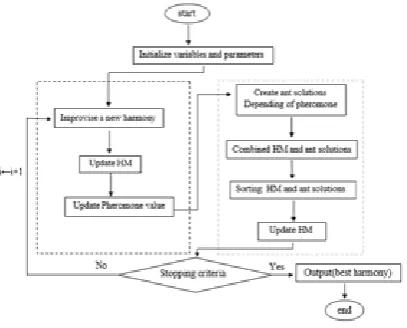
2. THE PROPOSED ALGORITHM (HS-ACO) The main idea is combining Ant Colony Optimization algorithm and harmony search algorithm. How to implement this algorithm is shown in Figure 1.
Fig. 1. Algorithm performance graph HS-ACO
First parameters and variables are initialized at a random sample space is created that contains the matrix of HMS Random path. Then the
fitness function according to equation (5) is calculated for each row. Next, the effect of
pheromones for all paths is updated. By using memory consideration, pitch adjustment, and randomization, create a new harmony and check whether an update occurs (HM and pheromone value). After that, ant solutions with the size of HMS are generated by using the ACO algorithm, based on the pheromone trail determined by the HS algorithm. The combined ant solution and HM are stored in a temporary memory that has
twice the size of HMS, and they are sorted in
ascending order by the total distance, defined as
the objective function. The top 50% with higher value in the temporary memory are determined as the new HM. These procedures are repeated until
the stopping criteria are satisfied.
IV. SIMULATION AND ANALYSIS OUTPUTS
We consider Wireless sensor network as a graph. The uniform distribution of nodes, the space is divided into several segments and nodes are distributed randomly in the area. Distance information between nodes is stored in a matrix. This matrix can be used to awareness of the connection matrix used to establish a connection between any two nodes. This is necessary for the element that is greater than the maximum radio range of sensors, such as number (-1) can be placed. So if there is the number (-1) between two nodes, the two nodes are not connected and cannot directly submit the data. As mentioned above, the maximum radio range of sensors is considered the same as a matrix to store Energy levels of the nodes is considered that the routing information is updated in the matrix. Energy
consumption in this study according to [5] It is intended that the relationship (7) is:
𝐸𝐸𝐸𝐸𝑇𝑇𝑇𝑇=𝐸𝐸𝐸𝐸𝑒𝑒𝑒𝑒𝑒𝑒𝑒𝑒𝑒𝑒𝑒𝑒𝑒𝑒𝑒𝑒 ∗ 𝑒𝑒𝑒𝑒+𝐸𝐸𝐸𝐸𝑓𝑓𝑓𝑓𝑓𝑓𝑓𝑓∗ 𝑒𝑒𝑒𝑒 ∗ 𝑑𝑑𝑑𝑑2, 𝑑𝑑𝑑𝑑<𝑑𝑑𝑑𝑑0
𝐸𝐸𝐸𝐸𝑇𝑇𝑇𝑇=𝐸𝐸𝐸𝐸𝑒𝑒𝑒𝑒𝑒𝑒𝑒𝑒𝑒𝑒𝑒𝑒𝑒𝑒𝑒𝑒 ∗ 𝑒𝑒𝑒𝑒+𝐸𝐸𝐸𝐸𝑓𝑓𝑓𝑓𝑓𝑓𝑓𝑓∗ 𝑒𝑒𝑒𝑒 ∗ 𝑑𝑑𝑑𝑑4, 𝑑𝑑𝑑𝑑>𝑑𝑑𝑑𝑑0
𝐸𝐸𝐸𝐸𝑅𝑅𝑅𝑅=𝐸𝐸𝐸𝐸𝑒𝑒𝑒𝑒𝑒𝑒𝑒𝑒𝑒𝑒𝑒𝑒𝑒𝑒𝑒𝑒∗ 𝑒𝑒𝑒𝑒
𝑑𝑑𝑑𝑑0= �𝐸𝐸𝐸𝐸𝑓𝑓𝑓𝑓𝑓𝑓𝑓𝑓�𝐸𝐸𝐸𝐸𝑚𝑚𝑚𝑚𝑚𝑚𝑚𝑚
(7)
ET Energy consumption for nodes sender information. Eelec is the energy required to transmit one bit of information that does not depend on distance. Efs and Emp is energy required to transmit a bit of free space on the model and model multi-path fading. l is the length of the message. d sender node to destination node distance recipient information. ER Energy consumption to the node is receiving data. Each sensor node has both the sending and receiving information. The recipient information to receive a message bits by Eelec. energy consumption.
The transmission has two parts. The first part
amplify the desired information over distance. In all simulations the values in Table 1 were used:
Table 1. The initial values of the parameters
Parameter Amount
Count Node 70 Node
Perimeter Area 200 Meter At 200 meters Coordinates well 190 m to 190 m. Primary energy nodes Random with uniform distribution in the interval [ 0.4-0.5]
HMCR Random with uniform distribution inthe interval [0.5-0.9]
PAR Random with uniform distribution in the interval [0.2-0.6]
The number of
repetitions 1762 Away
HMS 100
Α 0.8
Β 1
Ρ 0.8
Efs 10 pJ / bit / M 2
L 4000 bit
Eelec 50 nJ / bit
Emp 0.0013pJ / bit / m 4
To compare the ability of algorithms the three categories of network lifetime, energy consumption and the average standard deviation of residual energy of sensor nodes, after the
death of the first node in each case is considered.
Whatever the distribution of energy consumption among sensor nodes should be performed, the standard deviation of the residual energy of the nodes of the sensor is less. As can be seen in the latter case, the average increase in energy consumption, the standard deviation is reduced, so in this case, a proper balance between the two measures of energy consumption and distribution of energy, lifetime of the network has been increased. In the second case, the average power consumption is more, but considering the power of participating nodes in routing, the fact of such nodes for routing need more energy. This would increase the network lifetime as well.
To assess the ability of the proposed algorithm, a simulation using harmony search algorithm, Ant Colony Optimization algorithm and Genetic
Ant Colony algorithm [17] is performed and
the results were compared with each other. Four algorithms are implemented in the same circumstances. Table 2, results and Figure 2 shows the distribution of performance and energy
consumption of the routing for 4 algorithm at 70
nodes.
Table 2. Comparison of algorithms
Algorithm Lifetime Network
After 1762
the average energy consumption
routing (J)
Standard deviation of the residual energy of sensor nodes around
1762 after routing
HS-ACO 1977 0.131 0.076 ACO [11] 1762 0.98 0.099
HS [8] 1894 0.105 0.083 Genetic Ant
Colony[17] 1886 0.110 0.087
Figure 2 illustrates the fact that the distribution of energy consumption algorithm HS-ACO, relative to harmony search algorithms, ACO algorithm and Genetic Ant Colony algorithm is better than them. HS-ACO algorithm with spend
more energy, effort energy distribution, which
ultimately leads to increased lifetime. However, the HS-ACO algorithm to devote more energy,
trying to delay the death of the first node Life
expectancy is increasing, but it makes life a network, assuming replacement of dead nodes, the death of the other nodes occur more rapidly.
Fig. 2. How Energy distribution after the routing
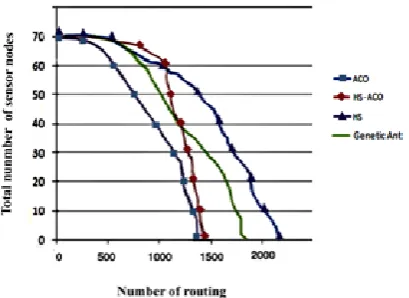
Figure 3 shows life trend of the network. In the HS-ACO algorithm, due to more energy consumption to increase the lifetime of the network, the lifetime of the whole network has reduced and the numbers of the live nodes has reduced in each moment. Therefore, in applications such as monitoring of the weather
that delayed the death of the first sensor node is
critical, Ant Colony Optimization and Genetic Ant Colony algorithms works better. Instead of monitoring or tracking applications that
postponing the first death of the last death,
algorithms HS-ACO, is the right choice and work better. Ant Colony Optimization algorithm,
the right answer, Need more generation. So in the same environmental conditions and taking into account the number of times of the generation, installation of the Harmony search algorithms and algorithms HS-ACO, fewer quality solutions
(the lower the fitness function) is produced. The
solution produced by the HS-ACO algorithm with the same generation, in terms of energy consumption and energy distribution is preferred that led to this result.
Fig. 3. The life trend of the entire network
V. CONCLUSION
Result Simulations show that the HS-ACO algorithm is able to create a good balance between energy consumption and increase energy intermediate nodes participating in the
routing find better path between the source node
and the destination node. The result Simulations show that the HS-ACO algorithm with respect to the HS algorithm, ACO algorithm and Genetic Ant Colony algorithm on equal terms, increase the network lifetime. HS-ACO algorithm uses more energy sensor nodes to routing and creates appropriate distribution of energy consumption by the sensors that increases the lifetime of the network. To increase the average residual energy of sensor nodes participating in the routing which leads to a better distribution of the energy consumption and increase its lifetime and consume more energy. This makes the overall network energy is reduced and the life after
death, the first network node, the death rate of the
sensor nodes become faster. The number of nodes in each moment of life is reduced and the lifetime of the network decreases. This feature makes the HS-ACO algorithm important for applications in which the death of the last node is not a good performance.
REFERENCES
[1] Akyildiz, IF; Su, W.; Sankarasubramaniam, Y.; Cayirci, E.; “A Survey on Sensor Networks”; IEEE Commun. Mag; 40 (8), 2002, 102-114.
[2] Anisi, M .; Bdullah, A .; Azak, R .; Asri Ngadi, M .; “ An Overview of Data Routing Approaches for Wireless Sensor Networks “; Sensors; 12, 2012, 3965- 3403 .
[3] Geem, ZW; Kim, JH; Loganathan, GV.; “A New Heuristic Optimization Algorithm: Harmony Search”; SIMULATION: Transactions of the Society for Modeling and Simulation International; 76 (2), 2001, 60-68.
[4] Dorigo, M.; “Learning and Natural Algorithms”; PHD Thesis; Department of Electronics; Politecnico di Milano; Italy, 1992.
[5] Hoang, DC; Yadav, P.; Kumar, R.; Panda, SK.; “ A Robust Harmony Search Algorithm Based Clustering Protocol for Wireless Sensor Networks “; IEEE International Conference on Communications Workshops (ICC); 2010, 1-5.
[6] EbrahimNezhad, S .; Kamali, HJ; Moghaddam, ME.; “Solving K-Coverage Problem in Wireless Sensor Networks Using Improved Harmony Search”; International Conference on Broadband; Wireless Computing, Communication and Applications (BWCCA); 2010, 49-55.
[7] Manjarres, D .; Ser, JD; Lopez, SG; Vecchio, M .; Torres, IL; Valcarce, RL; “On the Application of a Hybrid Harmony Search Algorithm to Node Localization in Anchor-based Wireless Sensor Networks”; International Conference on Intelligent System Design and Application (ISDA); 2011, 1014-1019.
[8] RezaeiNejad, M.; Mousavi, SA.; RahimiNasab, M.; “Energy-Aware Routing Using Harmony Search Algorithm”; Journal of Soft Computing; 1, 2012, 2-15.
[9] Dorigo, M.; “Ant Colony System: A Cooperative Learning Approach to the Traveling Salesman Problem”; IEEE Transactions on Evolutionary Computation; 1, 1997, 53-66,
[10] Zhang, J.; Hu, X.; Tan, X.; Zhong, JH; Huang, Q.; “Implementation of an Ant Colony Optimization Technique for Job ShopScheduling Problem “; Transactions of the Institute of Measurement and Control; 28, 2006, 93-108.
[11] Guo, h.; “Investigation on Ant-Colony Based Routing Algorithm for Wireless Sensor Networks”; Conference on Dependable Computing; 2010, 227-229.
[12] Pourkabirian, A.; Haghighat, AT.; “Energy-aware, Delay-Constrained Routing in Wireless Sensor Networks through Genetic Algorithm”; 15th International Conference on Software; Telecommunications and Computer Networks; 2007, 1-5.
[13] Yuan, P .; Ji, C .; Zhang, Y .; Wang, Y .; “Optimal Multicast Routing in Wireless Ad Hoc Sensor Networks”; International Conference on Networking; Sensing & Control; 1, 2004, 367-371.
[15] Niansheng, C.; Zhi, L.; Zongwu, K.; Xiaoshan, G.; “A QoS Multicast Routing Algorithm Based on Genetic Algorithm of Game Selection”; Ninth International Symposium on Distributed Computing and Applications to Business, Engineering and Science; 2010, 308-311.
[16] Dong, W; Ke, Z; Chen, N; Sun, Q.; “QoS Routing Algorithm for Wireless Multimedia Sensor Networks”; 4th International Symposium on Advances in Computation and Intelligence; 2009, 512-524.
[17] Xirong, B; Shi, Z; Dingyu, X.; “Research and Simulation on Genetic Ant Colony Routing in Wireless Sensor Network”;4th International Conference on Wireless Communications; Networking and Mobile Computing; 2008, 1-5.