How to cite this paper: Zainuddin, N.B., Abdollah, M.F.B., Yusof, R.B. and Sahib, S.B. (2014) A Study on Abnormal Behaviour in Mobile Application. Open Access Library Journal, 1: e1229. http://dx.doi.org/10.4236/oalib.1101229
A Study on Abnormal Behaviour in Mobile
Application
Naqliyah Bt Zainuddin
*, Mohd Faizal Bin Abdollah, Robiah Bt Yusof, Shahrin Bin Sahib
Faculty of Information and Communication Technology, University Technical Malaysia Malacca, Karung Berkunci No. 1752 Pejabat Pos Durian Tunggal, Melaka, Malaysia
Email: *[email protected]
Received 31 October 2014; revised 2 December 2014; accepted 26 December 2014
Copyright © 2014 by authors and OALib.
This work is licensed under the Creative Commons Attribution International License (CC BY). http://creativecommons.org/licenses/by/4.0/
Abstract
Abnormal application behavior in mobile can produce a number of undesirable effects. An incor-rect or insufficient implementation of application lifecycle, memory related issues and malicious application might cause an unexpected behavior of the application such as bad usability, not res-ponding, crashed and even data loss. Current analysis and detection of abnormal applications be-havior are still not comprehensive enough where bebe-havior under user visible failure category such as crash, “stopped unexpectedly” and “not responding” received less attention by researchers. Furthermore, framework of analysis technique has not been developed by researcher to investi-gate the abnormal behavior in mobile application. Thus, in this paper we will study, analyze and classify the possible issues in causing abnormal application behavior and the existing techniques in identifying abnormal application behavior.
Keywords
Abnormal Behavior, Application, Android, Analysis Techniques
Subject Areas: Applications of Communication Systems, Mobile and Portable Communications Systems
1. Introduction
In today’s world, mobile applications are becoming increasingly important in all aspects of our lives. No longer are phones reserved just for making calls, they now do more than the PC’s of a few years ago. The open source Android operating system is a great example of the future of mobile applications. The rapid growth of smart-phones has lead to a renaissance in mobile application services. Android and iOS, currently the most popular smartphone platforms, each offer their own public marketplace.
*
OALibJ | DOI:10.4236/oalib.1101229 2 December 2014 | Volume 1 | e1229 Detection of malwares, resources issues and others factors causing unexpected or abnormal behavior in mo-bile application has been the main focus by researchers in momo-bile security. As stated by [1], the major focus on Android security research is analyzing application for malicious behaviour.
[2] in his research also highlighted about “AppBrain”, a website which provide a mechanism called “low quality application detection”. It acts as a filter by automatically perform detection of applications which are un-likely to be useful or “low quality applications”. This resulted Google to remove these applications from the market roughly once a quarter, in which case the total number of available Android applications goes down. The removed applications are almost always classified by as “low quality applications”.
Even though there is no specific definition on “low quality application”, inevitably, low quality applications can produce a number of undesirable effects and caused abnormal application behavior in mobile.
Thus, this research will study, analyze and classify the possible issues in causing abnormal application beha-vior and the existing techniques in identifying abnormal application behabeha-vior.
2. Abnormal Behavior in Mobile Application
The word “abnormal” means deviating from what is normal or usual, typically in a way that is undesirable, un-expected or worrying. [3] highlighted that, anomaly detection refers to the problem of finding patterns in data that do not conform to expected behavior. [4] added that anomaly detection techniques commonly used the fol-lowing theories such as probability and statistics, artificial neural networks, genetic algorithms, fuzzy recogni-tion and artificial immune method.
According to [5], crash event is identified as “abnormal behavior” because it is an unpredictable event that occurs when the system is in an arbitrary state and can produce a number of undesirable effects. A crash is fined as a fatal condition that occurs when a piece of software stops performing the activities it has been de-signed for.
Furthermore, [6] highlighted that an unexpected behavior or crashes in software systems can be similarly avoided by monitoring the behavior of constituent methods and modules, if we know which methods or modules are likely to cause a software crash beforehand. Another definition by [7] categorized crash as a “user visible failure”, when a system alert displaying the message “Force Close” (in Android 2.2) or “Application has stopped unexpectedly” (in Android 4.0). These failure messages manifest in the log files as a log entry stating “FATAL EXCEPTION: main” and are essentially effects of uncaught exceptions thrown by the Android runtime.
Malicious software will also resulted in unexpected behavior by attempting to leak personal information, get-ting root privilege and abuse functions of the mobile [8]. [9] had stressed that even if applications have acquired explicit user consents, users may be unaware that the applications may execute malicious behaviors. Besides,
[10] also highlighted other standard malicious attacks for PCs, like worms and Trojans are also becoming appli-cable to the mobile platforms. Malicious software such as Geimini and Droid Dream will result in unexpected behavior by attempting to leak personal information, getting root privilege and abuse functions of the smart-phone as reported by [8]. [11] also had reported that the behavior of malicious applications could vary from an-noying messages to very unrecoverable damages.
Definitely, a compromised smartphone can inflict severe damages and caused unexpected behavior in Andro-id application. Memory leaks are highlighted by [12] as one of the major issues seen on the performance side of the mobile application which causing a sluggish behavior. [13] and [14] also emphasized that the memory leak phenomenon will affect the memory usage, affects the application to switch efficiency and cause the increase of memory usage and diminish overall system performance.
Despite the capability of Android to handle memory allocation using garbage collection automatically, [15] in his research identified that many applications currently suffer from memory leak vulnerabilities and causing ap-plications to crash due to out of memory error while running.
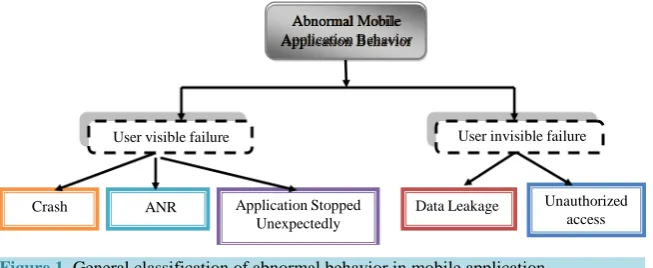
Based on literature review, this study has managed to classify the abnormal behavior in mobile application as depicted inFigure 1.
OALibJ | DOI:10.4236/oalib.1101229 3 December 2014 | Volume 1 | e1229 Figure 1. General classification of abnormal behavior in mobile application.
Above researchers highlighted the possible reasons on unexpected or abnormal behavior in an android appli-cation. Despite the outbreak of research activity in this area, [16] has highlighted that there is no framework yet that focuses on analysis and profiling the behavior of an Android application. Definitely, abnormal behavior in mobile application can produce a number of undesirable effects which might cause an unexpected behavior such as bad usability, not responding, crashed and even data loss. Majority of works done are focusing on detecting of malicious behavior due to malicious software whereas less work done so far in identifying abnormal application behavior which causing application to crash, “stopped unexpectedly” and “not responding”. In the next section, this study will explore related work done on the behavior related detection technique and analysis on mobile ap-plication.
3. Related Works in Detecting Abnormal Behavior in Mobile Applications
“CrowDroid” is a framework introduced by [17]. The framework is using dynamic analysis on system call (Strace) which enable the distinguishing between applications that having the same name and version but behave differently. The focus of the framework is to detect anomalously application in form of Trojan horses. Crow-Droid used Strace to output the behavior patterns such as system calls of installed applications on users’ devices. This information is sent to a remote server where the system calls are clustered using a K-means algorithm into benign and malicious categories. CrowDroid concluded that open (), read (), access (), chmod () and chown () are the most used system calls by malware. Moreover, [18] introduced “Andromaly” another behavioral mal-ware detection framework for android devices. Andromaly is a lightweight malmal-ware detection system using Machine Learning classification techniques to classify collected observations (system performance, user activity, memory, CPU consumption, battery exhaustion etc.) as either normal or abnormal.
Another work is by [19] proposed “AASandbox” (Android Application Sandbox). AASandbox is using static and dynamic approach to automatically detect suspicious application. For static approach, AASandbox scans the software for malicious patterns without installing it. While for dynamic approach, the analysis on the application is conducted in fully isolated environment which intervenes and logs low-level interactions. [20] had introduced a comprehensive software inspection framework. The framework allows identification of software reliability flaws and to trigger malware without require source-code. The framework is using dynamic approach by col-lecting run-time behavior analysis and also the I/O system calls generated by the applications.
[21] had introduced “ModelZ” for monitoring, detection, and analysis of energy-greedy anomalies in mobile handsets. Using light weight approach, ModelZ will monitor, detect and analyze new or unknown threats and energy-greedy anomalies on small mobile devices, with high accuracy and efficiency. [22] introduced “Droid-Box” a dynamic analysis tool to classify Android applications by monitoring API calls of interest invoked by an application. The analysis includes generating two graphs (behavior graphs and treemap graphs) for sample in order to provide the basis in identifying benign or malicious categories.
[23] also had used system call, logs and timestamp information in his research to detect the “misbehaving” applications, alert the users, and log the evidence of malicious activities with. From the discussion on analysis technique in detecting malicious application, Strace is identified as a common tool in Android research and it has been used in works on malware detection by most of the researchers. Strace used the view of Linux-kernel such as network traffic, system calls, and file system logs to detect anomalies in the Android system. Further-more, [17] also emphasized that monitoring systems calls (Strace) is one of the most accurate techniques to
de-User visible failure User invisible failure
ANR Application Stopped
Unexpectedly
Crash Data Leakage Unauthorized
access Abnormal Mobile
OALibJ | DOI:10.4236/oalib.1101229 4 December 2014 | Volume 1 | e1229 termine the behavior of an Android application since they provide detailed low level information. In the next section, we will discuss on other analysis technique used by researchers in analyzing other type of abnormal be-havior due to resources leaks and application life-cycle.
The detection of resources problems in mobile application has been studied by [24], [25] and [14]. [24] intro-duced an approach using static analysis tools called Relda, which can automatically analyze an application’s re-source operations and locate rere-source leaks. The method is based on a modified Function Call Graph, which handles the features of event-driven mobile programming by analyzing the callbacks defined in Android frame-work.
[25] proposed a novel and comprehensive approach for systematic testing for resource leaks in Android ap-plication. The approach is based on a GUI model, but is focused specifically on coverage criteria aimed at re-source leak defects. These criteria are based on neutral cycles: sequences of GUI events that should have a “neutral” effect and should not lead to increases in resource usage.
The work on memory leakage detection is by [14] using a PCB hooking technique. The technique is using dynamic analysis by gathering memory execution information (i.e.; process ID, priority, shared library list, spe-cific process-resource list) in run-time to detect memory leakage. In the experiment, Memory Analysis Tool (MAT) was used as a comparison with their invented tool.
The only work on monitoring software crashes is by [6] who presented a framework which monitors and re-produces software crashes. This approach involves learning patterns from features of methods that previously crashed to classify new methods as crash-prone or crash-resistant. Investigations had shown that 30% of crashed methods in ECLIPSE and 44% from ASPECTJ threw exceptions. The remaining 70% of crashed methods are not throwable and it is less common to see developers throw runtime exceptions in their programs.
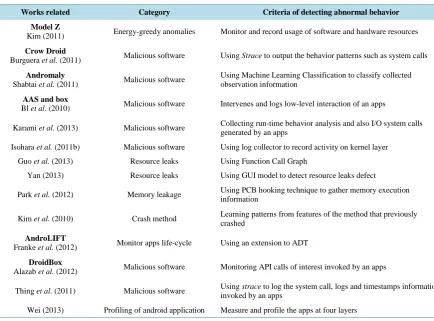
Futhermore, [26] presented a tool called “AndroLIFT” which helps the developer to monitor the life cycle, assists in implementing it and testing life cycle-related properties. AndroLIFT is written as an extension to the ADT, the common way of developing Android applications with the Eclipse IDE. The life cycle view of this tool allows the developer to observe and analyze the life cycle of the Android application. Besides, it allow de-veloper to easily learn about the behavior of the application life cycle to certain triggers, like an incoming call, and with which callback methods one can react appropriately. The summary of analysis techniques used in the detecting malicious and abnormality in mobile application is depicted inTable 1.
All in all, the aforementioned frameworks and systems as stated inTable 1 proved valuable in protecting mo-bile devices in general. Most of the works are focusing on malware detection in momo-bile application using both dynamic and static analysis techniques. Detection technique on malicious software received a lot of attention by researchers. However, there is a gap in identifying the abnormal behavior which may lead to behavior of crash, “stopped unexpectedly” and “not responding”.
From the discussion on analysis technique in detecting malicious application, Strace is identified as a com-mon tool in Android research and it has been used in works on malware detection by most of the researchers.
Strace used the view of Linux-kernel such as network traffic, system calls, and file system logs to detect anoma-lies in the Android system. Furthermore, [17] also emphasized that monitoring systems calls (Strace) is one of the most accurate techniques to determine the behavior of an Android application since they provide detailed low level information.
Moreover, [26] has highlighted that logcat is identified as the main logging mechanism in mobile application. Logcat allows us to capture the system debug output and log messages from the application. Wei [16] used a combination of the logcat and getevent tools of ADB to gather the data of the user layer for multi-layer profiling of Android application.
A specific tool for memory analysis is Memory Analyzer Tool (MAT). The MAT tooling is a set of plug-ins which visualizes the references to objects based on Java heap dumps and provides tools to identify potential memory leaks in Android applications. The MAT detects leakage by analyzing heap memory of one application. MAT analyzes heap memory situation when extracting log, and shows information which turns into a cause of memory leakage defect [14].
4. Proposed Framework and Summary
OALibJ | DOI:10.4236/oalib.1101229 5 December 2014 | Volume 1 | e1229 Table 1. Analysis techniques in detecting abnormal behavior in mobile application.
Works related Category Criteria of detecting abnormal behavior
Model Z
Kim (2011) Energy-greedy anomalies Monitor and record usage of software and hardware resources
Crow Droid
Burguera et al. (2011) Malicious software Using Strace to output the behavior patterns such as system calls
Andromaly
Shabtai et al. (2011) Malicious software
Using Machine Learning Classification to classify collected observation information
AAS and box
Bl et al. (2010) Malicious software Intervenes and logs low-level interaction of an apps
Karami et al. (2013) Malicious software Collecting run-time behavior analysis and also I/O system calls generated by an apps
Isohara et al. (2011b) Malicious software Using log collector to record activity on kernel layer
Guo et al. (2013) Resource leaks Using Function Call Graph
Yan (2013) Resource leaks Using GUI model to detect resource leaks defect
Park et al. (2012) Memory leakage Using PCB hooking technique to gather memory execution information
Kim et al. (2010) Crash method Learning patterns from features of the method that previously
crashed
AndroLIFT
Franke et al. (2012) Monitor apps life-cycle Using an extension to ADT
DroidBox
Alazab et al. (2012) Malicious software Monitoring API calls of interest invoked by an apps
Thing et al. (2011) Malicious software Using strace to log the system call, logs and timestamps information invoked by an apps
Wei (2013) Profiling of android application Measure and profile the apps at four layers
to Android applications to identify causes of abnormal behavior. The proposed framework of analysis tech-niques will utilize a combination of Linux trace (Strace) and Android debug facilities techtech-niques (logcat and MAT) to profile the abnormal behavior in mobile application for user visible failure category which are crash, “stopped unexpectedly” and “not responding”.
The analysis techniques are used in identifying abnormal behavior patterns: 1) To understand the application level activity sequences for abnormal activity via logcat; 2) To identify the objects and classes consuming mem-ory in the java heap; 3) To identify system calls or signals made to the OS using Strace. We will discuss in de-tailed on our framework of analysis techniques in following paper.
By having this framework, it should allow the application developer to conduct investigation and improve-ment on abnormal behavior application, and hence able to determine the possible caused of “abnormal” applica-tion activity in the Android’s applicaapplica-tion.
References
[1] Sasnauskas, R. and Regehr, J. (2014) Intent Fuzzer : Crafting Intents of Death. 12th Int. Work. Dyn. Anal. + Work. Softw. Syst. Perform. Testing, Debugging, Anal., California, 22 July 2014, 1-5.
[2] Costa-Montenegro, E., Barragáns-Martínez, A.B. and Rey-López, M. (2012) Which App? A Recommender System of Applications in Markets: Implementation of the Service for Monitoring Users’ Interaction. Expert Systems with Appli-cations, 39, 9367-9375. http://dx.doi.org/10.1016/j.eswa.2012.02.131
[3] Chandola, V. (2009) Anomaly Detection : A Survey. ACM Computing Surveys, 41, 1-72.
http://dx.doi.org/10.1145/1541880.1541882
[4] Zhao, M., Ge, F., Zhang, T. and Yuan, Z. (2011) AntiMalDroid : An Efficient SVM-Based Malware. Communications in Computer and Information Science, 243, 158-166.
OALibJ | DOI:10.4236/oalib.1101229 6 December 2014 | Volume 1 | e1229 [6] Kim, S., Bettenburg, N. and Zimmermann, T. (2013) Predicting Method Crashes. Proceedings of 6th India Software Engi-
neering Conference, New Delhi, 21-23 February 2013, 1-5.
[7] Maji, A.K., Arshad, F.A., Bagchi, S. and Rellermeyer, J.S. (2012) An Empirical Study of the Robustness of In-ter-Component Communication in Android. 2012 42nd Annual IEEE/IFIP International Conference on Dependable Systems and Networks (DSN), Boston, 25-28 June 2012, 1-12.
[8] Isohara, T., Takemori, K. and Kubota, A. (2011) Kernel-Based Behavior Analysis for Android Malware Detection. 2011 7th International Conference on Computational Intelligence and Security (CIS), Hainan, 3-4 December 2011, 1011- 1015. http://dx.doi.org/10.1109/CIS.2011.226
[9] Luo, H., He, G., Lin, X. and (Sherman) Shen, X. (2012) Towards Hierarchical Security Framework for Smartphones. 2012 1st IEEE International Conference on Communications in China (ICCC), Beijing, 15-17 August 2012, 214-219. [10] Delac, G., Silic, M. and Krolo, J. (2011) Emerging Security Threats for Mobile Platforms. MIPRO 2011 Proceedings
of the 34th International Convention, Opatija, 23-27 May 2011, 1468-1473.
[11] Pocatilu, P. (2011) Android Applications Security. Information Economics, 15, 163-172. [12] Joshi, M. (2012) Analysis and Debugging of OEM’s.
[13] Peng, L., Peir, J.K., Prakash, T.K., Staelin, C., Chen, Y.K. and Koppelman, D. (2008) Memory Hierarchy Performance Measurement of Commercial Dual-Core Desktop Processors. Journal of Systems Architecture, 54, 816-828.
http://dx.doi.org/10.1016/j.sysarc.2008.02.004
[14] Park, J. and Choi, B. (2012) Automated Memory Leakage Detection in Android Based Systems. International Journal of Control Automation and Systems, 5, 35-42.
[15] Shahriar, H., North, S. and Mawangi, E. (2014) Testing of Memory Leak in Android Applications. IEEE 15th Interna-tional Symposium on High Assurance Systems Engineering, Miami Beach, 9-11 January 2014, 176-183.
[16] Wei, X. (2013) ProfileDroid : Multi-Layer Profiling of Android Applications Categories and Subject Descriptors. Pro-ceedings of the 18th Annual International Mobile Computing and Networking, Istanbul, 22-26 August 2012, 1-12.
[17] Burguera, I. and Zurutuza, U. (2011) Crowdroid : Behavior-Based Malware Detection System for Android. Proceed-ings of the 18th ACM Computer and Communications Security, Illnois, 17 October 2011, 15-25.
[18] Shabtai, A., Kanonov, U., Elovici, Y., Glezer, C. and Weiss, Y. (2011) “Andromaly”: A Behavioral Malware Detection Framework for Android Devices. Journal of Intelligent Information Systems, 38, 161-190.
http://dx.doi.org/10.1007/s10844-010-0148-x
[19] Bl, T., Batyuk, L., Schmidt, A., Camtepe, S.A., Albayrak, S. and Universit, T. (2010) An Android Application Sand-box System for Suspicious Software Detection. 5th International Conference on Malicious and Unwanted Software, France, 19-20 October 2010, 55-62.
[20] Karami, M., Elsabagh, M., Najafiborazjani, P. and Stavrou, A. (2013) Behavioral Analysis of Android Applications Using Automated Instrumentation. IEEE 7th International Conference on Software Security and Reliability Compa-nion, Washington DC, 18-20 June 2013, 182-187.
[21] Kim, H. (2011) MODELZ: Monitoring, Detection, and Analysis of Energy-Greedy Anomalies in Mobile Handsets. IEEE Transactions on Mobile Computing, 10, 968-981. http://dx.doi.org/10.1109/TMC.2010.245
[22] Alazab, M., Monsamy, V., Batten, L., Lantz, P. and Tian, R. (2012) Analysis of Malicious and Benign Android Appli-cations. 32nd International Conference on Distributed Computing Systems Workshops, Macau, 18-21 June 2013, 608- 616.
[23] Thing, V.L.L., Subramaniam, P.P., Tsai, F.S. and Chua, T. (2011) Mobile Phone Anomalous Behaviour Detection for Real-Time Information Theft Tracking. CYBERLAWS 2nd International Conference on Technical and Legal Aspects of the e-Society, Guadeloupe, 23-28 February 2011, 7-11.
[24] Guo, C., Zhang, J., Yan, J., Zhang, Z. and Zhang, Y. (2013) Characterizing and Detecting Resource Leaks in Android Ap- plications. 28th IEEE/ACM International Conference on Automated Software Engineering, Silicon Valley, 11-15 No- vember 2013, 389-398.
[25] Yan, D. (2013) Systematic Testing for Resource Leaks in Android Applications. IEEE 24th International Symposium on Software Reliability Engineering, Pasadena, 4-7 November 2013, 411-420.
[26] Franke, D. and Roy, T. (2012) AndroLIFT : A Tool for Android Application Life Cycles. VALID 2012 4th Internation-al Conference on Advances in System Testing and VInternation-alidation Lifecycle, Lisbon, 8 November 2012, 28-33.
[27] Isohara, T., Takemori, K. and Kubota, A. (2011) Kernel-Based Behavior Analysis for Android Malware Detection. 7th International Conference on Computational Intelligence Security, Hainan, 3-4 December 2011, 1011-1015.