© 2018, IRJET | Impact Factor value: 6.171 | ISO 9001:2008 Certified Journal | Page 2207
A case study of Seismic Evaluation of Steel Buildings
with rapid evaluation method
Alex Kurniawandy
1, Shoji Nakazawa
21Department of Civil Engineering, Universitas Riau, Pekanbaru, 28293 Indonesia
2Professor, Departement of Architecture and Civil Engineering, Toyohashi University of Technology
1-1 Tempaku-cho, Toyohashi, 441-8580 Japan
---***---Abstract -
This paper discusses the seismic evaluation ofsteel buildings with the rapid evaluation method. The recent earthquakes have exposed the vulnerability of the existing buildings in Indonesia. The need for evaluating the seismic adequacy of the existing structures has come into focus. To carry out a seismic evaluation, a simplified procedure for evaluation is highly in need. A rapid evaluation method has been conducted in this research refers to ASCE 41-13 Seismic Evaluation and Retrofit of Existing Building. There are three parts of the procedure has been done. A set of basic checklist considers to the geometry of the structure and a set structural checklist with focussing lateral force resisting element. Nonstructural checklist focus on finishing appliance, electrical, mechanical and plumbing system at the end of the part.
A case study building with steel moment frame structure conforms to common building type S1 in ASCE 41-13 benchmark. Structure model is steel special moment frame which consists of 6th stories. The structure is located in Padang city of Indonesia, which has a high level of seismicity and site class stiff soil. Seismic design category base on spectral design response is D category. The model was analyzed for gravity, and seismic load using Indonesian code refers to SNI 1727:2013 and SNI 1726:2012. The design generated according to specification for structural steel buildings in Indonesia refers to SNI 1729:2015.
Weak story and soft story able to detect rapidly in the basic checklist. Furthermore, it has deficiencies in the column flexural stress due to the strong column and weak beam not compliant in the structural checklist. Infill walls placed in moment frame designed not to resist seismic load subjected to damage due to no isolation. Detailing beam column joint and panel zone stiffness also needs to pay attention to the steel structure. The result of this rapid evaluation recommends that this building requires further evaluation.
Key Words: Seismic, Rapid Evaluation, Steel Structure,
Deficiencies, Retrofit.
1. INTRODUCTION
Earthquakes are a disaster that can happen anytime and anywhere. Indonesia is a country that often experienced an earthquake. The cause of the territory of Indonesia located in three tectonic plates such as Eurasian, Pacific, and Indo-Australian. These boundaries will continue to move and collide each other which is the cause of the earthquake.
Furthermore, Indonesia lies in the Pacific ring of fire. A lot of active volcanos become the earthquake potential increased [1].
There are series of earthquake events that have occurred in Indonesia. The USGS information center, before 2004, the most recent megathrust earthquakes along the Sumatran-Andaman plate boundary were in 1797 (M 8.7-8.9), 1833 (M 8.9-9.1) and 1861 (M8.5). Since 2004, much of the Sunda megathrust between the northern Andaman Islands and Enggano Island, a distance of more than 2,000 km, has ruptured in a series of large subduction zone earthquakes - most rupturing the plate boundary south of Banda Aceh. The great M 9.1 earthquake of December 26, 2004, which produced a devastating tsunami, ruptured much of the boundary between Myanmar and Simeulue Island offshore Banda Aceh. Immediately to the south of the great 2004 earthquake, the M 8.6 Nias Island earthquake of March 28, 2005 ruptured a 400-km section between Simeulue and the Batu Islands. Farther south in the Mentawai islands, two earthquakes on September 12, 2007 of M 8.5 and M 7.9 occurred in the southern portion of the estimated 1797 and 1833 ruptures zone, which extends from approximately Enggano Island to the northern portion of Siberut Island. Smaller earthquakes have also been locally important: an M 7.6 rupture within the subducting plate caused considerable damage in Padang in 2009, and an M 7.8 rupture on October 25, 2010 occurred in the shallow portion of the megathrust to the west of the Mentawai Islands, and caused a substantial tsunami on the west coast of those islands. In addition to the current seismic hazards along this portion of the Sunda arc, this region is also recognized as having one of the highest volcanic hazards in the world. One of the most dramatic eruptions in human history was the Krakatau eruption on August 26-27, 1883, a volcano just to the southeast of the island of Sumatra, which resulted in over 35, 000 casualties [2].
© 2018, IRJET | Impact Factor value: 6.171 | ISO 9001:2008 Certified Journal | Page 2208 detail than rapid screening. It is recommended to conduct
rapid visual screening before carried out the rapid evaluation method. This research explains an evaluation using the rapid evaluation method particularly for steel structural building.
2. STRUCTURAL EVALUATION
Structural evaluation of building due to the seismic load is carried out referring to the guidance of FEMA 310, 1998, then standardized on ASCE 31-03. Currently ASCE 31-03 “Seismic Evaluation of existing building” and ASCE 41-06 “Seismic rehabilitation of existing building” merging become ASCE 41-13. Like FEMA 310, ASCE 41-13 has a procedure for evaluating divided into three tiers. Tier 1 Screening phase as rapid evaluation, Tier 2 Deficiency based evaluation, utilizes more involved checks of the building to provide a deeper understanding of the building’s design and Tier 3 Systematic evaluation procedure, provides a full building review including linear and non-linear performance-based analysis and design options. If the result of Tier 1 has some deficiencies, Tier 2 and Tier 3 evaluation provide more detailed and complex information. The screening purpose is to screen out if the building complies with criteria according to description parameters mentioned in this guidance. There are three parts of the rapid evaluation which covers building configuration, structural and nonstructural components. The aim of this research is simulating rapid evaluation of structure only [3, 4].
There are many types of building are classified as benchmark building as per AISC 41-13. Benchmark is related to material and system element as resisting seismic force such as wood structure, steel structure, reinforcement concrete, precast system and hybrid system. In this research, building type is classified in accordance with S1 benchmark building. It consists of a frame assembly of steel beams and steel columns. Floor and roof framing consists of cast-in-place concrete slabs or metal deck with concrete fill supported on steel beams, open web joists, or steel trusses. Seismic forces are resisted by steel moment frames that develop their stiffness through rigid or semi-rigid beam-column connections. Where all connections are moment-resisting connections, the entire frame participates in seismic force resistance. Where only selected connections are moment-resisting connections, resistance is provided along discrete frame lines. Columns are oriented so that each principal direction of the building has columns resisting forces in strong axis bending. Diaphragms consist of concrete or metal deck with concrete fill and are stiff relative to the frames. Where the exterior of the structure is concealed, walls consist of metal panel curtain walls, glazing, brick masonry, or precast concrete panels. Where the interior of the structure finished, frames are concealed by ceilings, partition walls, and architectural column furring. The foundation system may consist of a variety of elements [4].
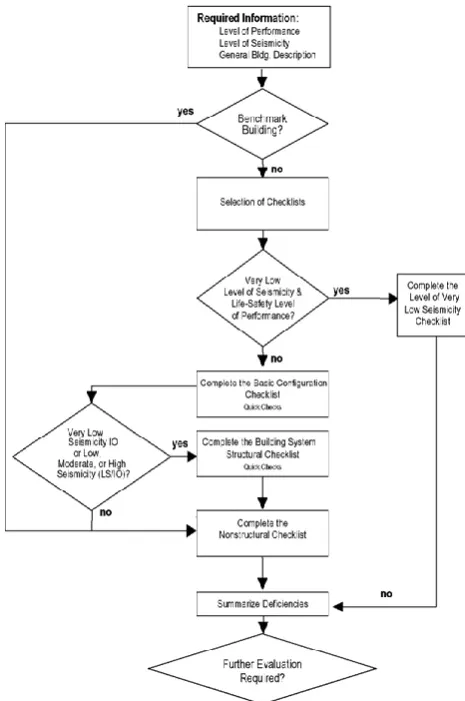
In Tier-1, there are two kinds of checklists which consist of structural and nonstructural. The structural checklist is basic,
supplement and Foundation. On the other hand, Nonstructural consist of basic and supplement. The flowchart for Tier-1 can be seen in Fig. 1.
Fig -1: Flowchart of rapid evaluation procedure In Tier-1, there are two kinds of checklist which consist of structural and nonstructural. The structural checklist is basic, supplement and Foundation. On the other hand, Nonstructural consist of basic and supplement. Table 2 and Table 5 show checklist evaluation procedure.
3. CASE STUDY
A Case study conforms to common building type S1 steel moment frame in ASCE 41-13 benchmark. Structure model is steel special moment frame which consists of 6th stories. It has three bays in x-direction with length 5 m per each and three bays in y-direction with length 6 m per each. Plan and perspective view can be seen in Figure 2.
[image:2.595.316.549.124.475.2]© 2018, IRJET | Impact Factor value: 6.171 | ISO 9001:2008 Certified Journal | Page 2209
Fig-2: The 6th stories structure model
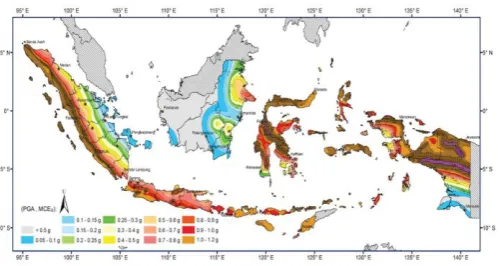
The structure is located in Padang city of Indonesia which has a high level of seismicity and site class stiff soil. Seismic design categories base on design spectral response is D category [6]. Figure 3 shows a map of the risk-adjusted maximum considered earthquake in Indonesia.
Fig -3: SS Risk-Adjusted Maximum Considered Earthquake ground motion parameter in Indonesia [6].
The design generated according to specification for structural steel buildings in Indonesia refers to SNI 1729:2015 [7,8,9][6]. The target of structural performance is collapse prevention (CP) and nonstructural is similar to structural performance level. Summarize of design section can be seen in Table 1.
Table -1: Summarize of section property
No Description WF Section (Mpa) Fy (Mpa) Fu Material
Standard
1 Column 1st -3rd
Stories 400.400.13.21 345 450 A 992
2 Column 4th -6th
Stories 300.300.10.15 345 450 A 992
3 Beam 400.200.8.13 345 450 A 992
4. RAPID EVALUATION METHOD
Rapid evaluation method refers to the checklist in tier 1 in ASCE 41-13 guideline. Requirement checklist for high seismicity level and immediate occupancy performance level consist of 3 part evaluation. Part 1 is basic checklist
procedure concerning the configuration of building and foundation. In this part also evaluated the location of building concerning geologic site hazard system as shown in Table 2. The basic checklist applies to all building type and all performance target level. Part 2 is structural checklist procedure which distinguishes for all building type. Immediate occupancy performance has more detail checklist compared to life safety as shown in Table 5. The other is non structural checklist. Nonstructural objective is architectural, mechanical and electrical components that are permanently installed in a building system.
[image:3.595.51.272.85.212.2]Each of the evaluation statements in this checklist shall be marked Compliant (C), Noncompliant (NC), Unknown (U), or Not Applicable (N/A). Compliant statements identify issues that are acceptable according to the description criteria, whereas noncompliant and unknown statements identify issues that require further investigation. Not applicable is used to indicate when description does not apply to a particular case or because the description is not available.
Table -2: Basic configuration checklist
No Description checklist Result Remark
A. Building System
General
1 Load Path C There is no discontinuity of
element to resist seismic force
2 Adjacent Buildings C There is no building at
distance 2 meters
3 Mezzanines C No mezzanine floor
Building Configuration
4 Weak Story NC In story 3 and 4, the sum
strength is 60% (Less than 80%)
5 Soft Story NC In story 3 and 4, the sum
stiffness is 30% (Less than 80%)
6 Vertical Irregularities C No shear wall and brace frame
7 Geometry C No Setback
8 Mass C No Heavy floor
9 Torsion C No Torsion
B. Geologic Site Hazards
10 Liquefaction C No potential liquefaction due
to soft soil
11 Slope Failure C No slope close to building
12 Surface Fault Rupture C No potential for large fissures and differential movement
C. Foundation Configuration
13 Overturning C Deep foundation, the ratio
less than 0.6 Sa
14 Ties Between Foundation Elements C Adequates tie beams
[image:3.595.39.290.312.445.2] [image:3.595.297.564.336.730.2]© 2018, IRJET | Impact Factor value: 6.171 | ISO 9001:2008 Certified Journal | Page 2210 story. The first is dimension of the steel section in story 4
(WF 300.300.10.15) smaller than story 3 (WF 400.400.13.21) and the second is the differences shear strength 58% (Table 3). If the shear strength less than 80%, it has potential to be weak story failure.
Table -3: Weak story evaluation
Story no Column
section
Relative Shear strength
Ratio adjacent
story
Remarks
Story - 6 WF 300.300.10.15 2700 -
100%
Story - 5 WF 300.300.10.15 2700 100%
100%
Story - 4 WF 300.300.10.15 2700 100%
58% < 80 %
Story - 3 WF 400.400.13.21 4654 172%
100%
Story - 2 WF 400.400.13.21 4654 100%
100%
Story - 1 WF 400.400.13.21 4654 100%
-
The stiffness of the seismic resisting system in any story is not less than 70% of stiffness in an adjacent story above or less than 80% of the average seismic force-resisting system stiffness of the three stories above [10, 11]. However story three and four have the differences stiffness is 30% (Table 4).
Table -4: Soft story evaluation
Story No Column section Relative Stiffness
Ratio adjacent
story
Remarks
Story - 6 WF 300.300.10.15 39,800 -
100%
Story - 5 WF 300.300.10.15 39,800 100%
100%
Story - 4 WF 300.300.10.15 39,800 100%
30% < 70 %
Story - 3 WF 400.400.13.21 130,800 329%
100%
Story - 2 WF 400.400.13.21 130,800 100%
120%
Story - 1 WF 400.400.13.21 109,000 83%
Further evaluation for structural checklist describes in Table 5. There were some deficiencies found in structural evaluation. Lack of column flexural stress due to the strong column and weak beam not compliant. Similar problem to the previous finding, it was because of section geometry
smaller at store 4 to 6. The selected dimension of steel section must be considered to the limitation of compactness section. Infill walls placed in moment frame designed not to resist seismic load subjected to damage due to no isolation. Detailing beam column joint and panel zone also needs to be focused on the steel structure.
Table -5: Structural checklist for steel moment with immediate occupancy performance (ASCE 41-13)
No Description checklist Check Remark
A. Seismic-Force-Resisting System
1 Drift check C Story drift ratio < 0.025
2 Column axial stress check C Columns < 0.1 Fy
(gravity only), Alternatively, columns, equation
(4-12) < 0.3 Fy (overturning alone)
3 Flexural stress check NC No strong column-weak beam in
story 3
4 Redundancy C Redundant frame (3 bays)
5 Interfering walls NC No isolation for wall
(Wall subjected to damage)
6 Transfer to steel fra C Floor have adequate connection
with frame structure (welded and shear studs)
7 Steel columns C the foundation and anchorage
system is able to develop the least of the tensile capacity of
the column
8 Moment-resisting connection NC Considering as no compliant for further analysis
9 Panel zones NC Considering as no compliant for
further analysis (there is no treatment for PZ)
10 Column splices C No column splice
11 Strong column - weak beam NC Not satisfy > 50% SCWB check for each story
12 Compact members NC Non compact element
13 Beam penetrations C No web opening in beam frame
14 Girder flange continuity plates C Continuity plates installed
15 Out-of-plane bracing NC No out of plane bracing
16 Bottom flange bracing C Bottom flange bracing installed
B. Diaphragms
17 Plan irregularities C Regularities
18 Diaphragm reinforcement C No diapraghm opening
19 Openings at frames C No diaphragm opening
C. Foundation system
20 Deep foundations C Adequate piles and pier
21 Sloping sites NA No sloping site
© 2018, IRJET | Impact Factor value: 6.171 | ISO 9001:2008 Certified Journal | Page 2211
5. CONCLUSIONS
A rapid evaluation method has been conducted to 6 stories building steel moment frame. The evaluation refers to ASCE 41-13 Seismic Evaluation and Retrofit of Existing Building. There are three parts of the procedure has been done, basic checklist concerning structure geometry and configuration, a structural checklist with focusing lateral force resisting element and nonstructural checklist.
Weak story and soft story able to detect rapidly in the basic checklist. Furthermore, For the structural checklist, deficiencies in column flexural stress due to “strong column and weak beam” not compliant. Infill walls placed in moment frame designed not to resist the seismic load subjected to damage due to no isolation. Detailing beam column joint and panel zone stiffness also needs to consider the steel structure. The result of this rapid evaluation recommends that this building requires further evaluation.
ACKNOWLEDGEMENT
The first author would like to acknowledge financial support from the Indonesian Endowment Fund for Education (LPDP), Ministry of Finance; and the Directorate General of Higher Education (DIKTI), Ministry of Research, Technology and Higher Education, Republic of Indonesia.
REFERENCES
[1] Kurniawandy, A., et al., “Structural building screening
and evaluation”, AIP Conference Proceeding 1892, Ignite Conference, Penang, 2017.
[2] USGS National Earthquake Information Center, Regional
Information, [accessed 2018 January 25]. https://earthquake.usgs.gov/earthquakes/eventpage/u s2000cmwz#region-info.
[3] FEMA 310, “Handbook for the Seismic Evaluation of
Buildings”, Federal Emergency Management Agency, Washington DC, United States of America, 1998.
[4] ASCE/SEI 41-13, “Seismic Evaluation and Retrofit of
Existing Building”, American Society of Civil Engineers, Virginia, United States of America, 2014.
[5] Indonesian Code, SNI 1727:2013, "Beban minimum
untuk perancangan bangunan gedung dan struktur lain", Badan Standarisasi Nasional, Jakarta, 2013.
[6] Indonesian Code, SNI 1726:2012, “Tata Cara
Perencanaan Ketahanan Gempa Untuk Struktur Bangunan Gedung dan Non Gedung", Badan Standarisasi Nasional, Jakarta, 2012.
[7] Indonesian Code, SNI 1729:2015, "Spesifikasi untuk
bangunan gedung baja struktural", Badan Standarisasi Nasional, Jakarta, 2015.
[8] Wiliam T. Segui, “Steel Design”, Fifth Edition, Cengage
Learning, United States of America, 2013.
[9] Bruneau, M., Uang, C., Sabelli, R., “Ductile Design of Steel
Structures”, Second Editions, McGraw Hill, United States of America, 2011.
[10] ANSI/AISC 341-10, “Seismic Provisions for Structural
Steel Buildings”, American Institute of Steel Construction, United States of America, 2010.
[11] ANSI/AISC 360-10, ”Specification for Structural Steel