© 2017, IRJET | Impact Factor value: 5.181 | ISO 9001:2008 Certified Journal
| Page 2248
Development of Android Based Mobile App for PrestaShop eCommerce
Shopping Cart (ALC)
Swapnil S. Jagtap
1, Dinesh B. Hanchate
2Department of Computer Engineering VPKBIET, Baramati, Pune, India.
---***---Abstract -
There are many online shopping cart websites and their android applications available on the internet. These online shopping websites and their android app run on the single server and share the database, i.e.- the android application is integrated with the web server to share the resources and the database. There are different types of web servers available for the different purposes in the market, according to your need you need to choose the server and customize its services. The android app that is going to be developed have its website built in PrestaShop eCommerce Shopping Cart software using PHP PL and is used with the MySQL DB to store the data. The objective of this project is to develop the online shopping android app and integrate the App with the PrestaShop eCommerce Shopping Cart software running on XAMPP Server and connect it to the MySQL database and design the GUI of the App for different devices like phones and tablets, so that the customers can easily use the App for online shopping on their android devices. The theme of the app should be attractive and easy to modify by the user so that the customers get attracted to use this app for online shopping. However, we are going to improve performance and scalability of web applications, we will do the analysis. We will decide the guidelines for guiding the design of web application. We will try to put and implement and maintain application level caching which supports to the developers.Keywords
- Android Studio, Android SDK, XAMPP server, MySQL, PHP, PrestaShop eCommerce Shopping Cart.I.
INTRODUCTION
The Electronic Commerce or eCommerce is a term for a business or business exchange, that includes the change of data over the internet. Online business permits clients to electronically trade products and ventures with no boundary of time or distance. The Mobile Commerce or mCommerce is the purchasing and selling of goods and services through wireless handheld gadgets, for example, mobiles and tablets. It is known as next generation eCommerce. Online shopping is a type of eCommerce which permits clients to directly purchase goods or services from a merchant over the internet using a web browser.
Online shopping has two types of process,
1. Business-to-Consumer (B2C)
2. Business-to-Business (B2B)
The online shopping system has the shopping cart which permits the customers to create a list of items to be purchased. At the time of checkout, the total is calculated for the items list in the shopping cart, including shipping and handling charges and the associated taxes as applicable. This project is of type one process i.e.- Business-to-Consumer because the products are sold directly to the customers.
Traditional shopping is a tedious and time-consuming job. Although the growing trend of online shopping has reduced some load, there is still some difference in actually going to shops and hand-picking products to get the feel of their quality and features that cannot be experienced online. Customers also feel worried to carry out online purchases due to fear of less secure transaction process that may lead to
hacking of user's sensitive data, insecurity of credit/debit cards, unreliability or breach of privacy. The project aims at removing flaws of both kinds of shopping and bridge the gap between physical and a virtual world.
“Android platform was built from the ground up with the explicit goal to be the first free platform, open and complete platform created specifically for mobile devices.”
Android platform is an open framework and is allowed to use by anybody. A mobile handset manufacturer can utilize android in the event that they take after the assertion expressed in the Software Development Kit (SDK). There is no limitations or prerequisite for the handset manufacturer to impart their expansions to any other person as they are in another open source programming in the event that they leave the Linux kernel as it seems to be. The Linux kernel is under an alternate and more confined permit than Android.
II.
Application Level Cache
Applying caching at the application layer is an engaging choice since it can enhance the execution of both the application servers and the database. Application level caches are a prevalent solution for enhancing the versatility of complex web applications: they are broadly used by some outstanding sites. They are engaging on the grounds that they can be executed with a straightforward, adaptable plan, and their adaptability enables them to address many bottlenecks.
© 2017, IRJET | Impact Factor value: 5.181 | ISO 9001:2008 Certified Journal
| Page 2249
manner. Expanding database limit is regularly a troublesomeand costly suggestion, requiring careful partitioning of distributed databases. Application server bottlenecks can be easy to address – basically including more nodes is normally an alternative – however no less costly, as these nodes are not free.
To implement the application level cache in our project, we first designed the website using the PrestaShop eCommerce shopping cart software, then we added the application level cache module on the website. Then we developed the Android app for the website and integrated it with the PrestaShop software. When the integration of the app was successful with the website we developed the application level cache module for the android app and implemented it in the system.
The intention of using the application level cache in the system was to improve the performance of the system by reducing the response time to fetch the data from the server on user's request. When the user makes the request to fetch the data, this request is first processed by the application cache manager, if the data is present in the cache it is returned to the requesting process and if the data is not present in the cache then the application makes the request to the application server to send the data. The result of using application level cache is that the computation time of the server is reduced and the communication latency between the application and the server is reduced, thus the performance of the app is improved.
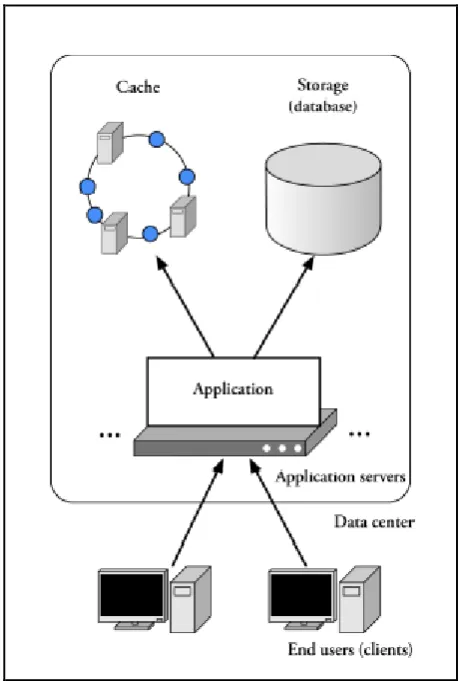
[image:2.595.314.545.97.438.2]The cache does not lie before the application servers or between the application server and database. It enables the application to store self-assertive items. These items are ordinarily created from the consequences of at least one database queries alongside some calculation in the application layer.
Figure 1: Architecture for an Application Level Cache
This adaptability permits an application level cache to supplant existing caches: it can go about as database query cache, or it can go about as a web cache and store whole pages. Application level caching is all the more capable on the grounds that it can cache intermediate calculations, which can be much more valuable. For instance, many sites have greatly customized content, providing entire page web cache generally useless; application level stores can isolate a normal content from customized content and cache the regular content independently so it can be shared between clients.
Application-level caches can address server load; they can deflect expensive post-processing of DB records, for example, changing them to an inner replica or producing partial HTML output.
Existing application level caches generally display a hash table interface to the application, enabling it to GET and PUT objects distinguished by a key. This interface offers two advantages:
The interface is adaptable, in that it enables the
© 2017, IRJET | Impact Factor value: 5.181 | ISO 9001:2008 Certified Journal
| Page 2250
objects. It can be utilized to hold database query results,created web pages, or anything in the middle.
The interface fits a basic, versatile execution. An example is memory cache, which stores objects on a group of nodes. The cache is put away totally in memory and does not try to do any processing other than restoring the object recognized by the requested key.
III .REVIEW OF LITERATURE
A Qualitative Study of Application-level Caching [1]
The web applications that we use every day on our smartphones or on computers requires the internet connection to communicate with the web services hosted on the web servers, this process contains some communication latency and it also cost for internet-based services. To reduce this latency, the developers can use the cache in their applications. This paper deals with the study of how developers can deal with the handling of caching logic in their web applications, to improve performance and scalability of their web applications.
W3C Working Group Tackles New Models for Internet Payment [2]
The online shopping is becoming more and more popular now a day due to large amount of offers and discounts been offered on the items available for purchase online. The additional discount is also applied on the purchase of items by making the online payment through net-banking, debit/credit card or digital wallet. So, to give the payment providers and merchants lower costs of payment management, improve consumer choice and transparency, and create new opportunities to introduce value-added services, the Web Payments Working Group (WPWG) is formed. It works with the study of development in the security of online transactions and net-banking. This is the step further for the cashless payment methods been promoted by all the merchants of online shopping.
Mobile Web Service Provisioning and Performance Evaluation of Mobile Host [3]
Giving web administrations from smartphones is the current trend, this happened because of smartphones are utilized practically every region, where today's client utilizes versatile smartphones for mobile banking, messaging, emailing, looking area and searching information. smartphones are progressed as far as processing power, memory and with an embedded camera, different sensors and same time parallel headway in the remote system and web advancements. Because of these progressions empowers the versatile smartphones to fill in as a web provider rather
than web benefit consumer. Hosting web services on the portable host is not new but rather in most recent one decade scientists chipping away at versatile web benefit provisioning. This paper deals with the exploration work in the cellular domain to the present era mobile platform advances and guidelines, for example, Android OS and REST. This paper manages mobile host adaptability and exploratory outcome examination for what number of simultaneous client’s access to the mobile host.
A Privacy-aware Shopping Scenario [5]
Giving private information is a very questionable and generally faced off topic. The data about people as well as about organizations, data should to be kept private. With a specific end goal to fulfill the necessities of both people and organizations, relating security insurance mechanisms must be executed. For instance, frameworks which help clients during their shopping procedure in a physical retail location require client related data, for example, the shopping list, sensitivity or financial bank data and also information from the retailer, similar to the item range and costs. This paper presents an idea for decoupling both data sources from people and organizations implemented in a shopping situation, which among others permits Mobile Payment without the transmission of private information. The executed model has been exhibited at a huge reasonable for potential clients keeping in mind the end goal to get important feedback.
Performance Analysis of Web Services for Android based Devices [6]
© 2017, IRJET | Impact Factor value: 5.181 | ISO 9001:2008 Certified Journal
| Page 2251
Smart Shopping: An Android Based ShoppingApplication [7]
This paper introduces a unique method of combining ease in online shopping and the sense of security, money wise as well as for customer satisfaction while doing shopping offline. This is implemented using an Android application. In Offline mode, the customer needs to physically pick up his purchase, carry cash, credit/debit cards along with them and wait in the long queue to make payments. The application mentioned in this paper would read the barcode of the product and add it to the shopping cart in the application. It provides the mechanism to change the quantity of product's purchased and update the shopping list. Along with this, the customer would be informed about the on-going offers in the store. Payment can be done according to customer convenience.
IV. SYSTEM OVERVIEW
Problem Statement
The main objective of this system is to develop an android app which has the application level cache implemented in it and integrate the app with the website built using the PrestaShop eCommerce Shopping Cart software and connect it to the MySQL database of the website. The website runs on the XAMPP server. PrestaShop creates the website in PHP programming language and have many modules which can be included in the website as per users need and have very complex framework for the website. To integrate the android app with this website we have to reduce the number of modules used in the website and try to make the framework simple to understand, so that we can make the connection between the website and android app. We are using the XAMPP server to host the website on the local machine and to access the web services of it in the android app.
About PrestaShop
Most of the open source shopping cart software are available only for the web platform, they are not available for the mobile platform. PrestaShop is one of the software available from dozens of such software. PrestaShop is a free, open source eCommerce software. It is composed in the PHP PL with support for the MySQL DB administration framework.
PrestaShop is currently utilized by 250,000 shops worldwide and is accessible with the support of 60 different regional languages. PrestaShop has more than 3000 modules to help you to customize your online store, increase traffic, improve conversion rate and build customer loyalty.
So, the user has to add the modules to his web store according to his requirements and then the user can
customize that module as per his needs to be implemented in the web store.
Pros & Cons of Prestashop
1. Pros
It can be easily installed & customized
It offers an intuitive & user-friendly dashboard
It is available in 65 languages, supporting English & Hindi
It takes few minutes to install the software
It creates the database tables automatically
2. Cons
It lacks graphic customization as there is not much you
can do with it
It has limitations with its templates, themes & modules
It has compatibility issues with some systems
It creates many tables in the DB which makes it
complicated to understand the structure of the data
It does not have official support team
Objectives of the system
1. To develop the Shopping Cart Android App.
2. Integrate the Android App with the PrestaShop
eCommerce Shopping Cart software.
3. Create the connections between the App and the web
services of the shopping cart on the XAMPP server.
4. Connect to MySQL database management system.
5. Implement the application level cache in the android app.
6. Design the GUI of the App for different devices (i.e.- Phone, Phablet, Tablet).
[image:4.595.307.560.562.726.2]7. Design the attractive theme for the App.
© 2017, IRJET | Impact Factor value: 5.181 | ISO 9001:2008 Certified Journal
| Page 2252
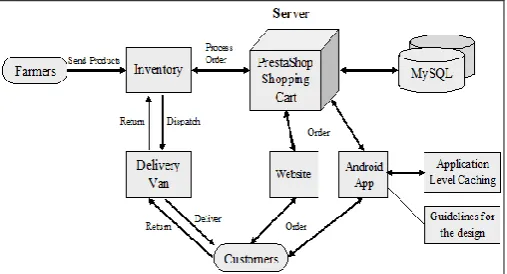
The farmers send their farm products to the inventory. Theinventory is the place where cleaning, sorting, grading and packing of the raw products from the farm is done. Then the available stock is updated in the database. When the customers place their orders in the PrestaShop shopping cart through the website or through the android app, this order is sent to the inventory. According to the orders, the workers in the inventory pack the products in the parcel and put the shipping address on the parcel. These parcels are then loaded in the delivery van to dispatch for delivery to the customers. When the parcel is delivered to the customer, the status of the order in PrestaShop shopping cart is changed to delivered or if the parcel is not delivered to the customer, it is returned back to the inventory.
[image:5.595.307.571.397.554.2]The PrestaShop shopping cart system uses the MySQL database management system to handle the database. In the proposed system we will use the application level cache to improve the performance of the android app, so that app does not create the latency in the communication with the PrestaShop software running on the XAMPP server due to the slow internet connection. The cache stores the required important data in the cache memory of the user mobile, so the operation of the app becomes faster and users does not encounter any problem of slow data loading.
Figure 3: Block diagram of PrestaShop Shopping Cart System
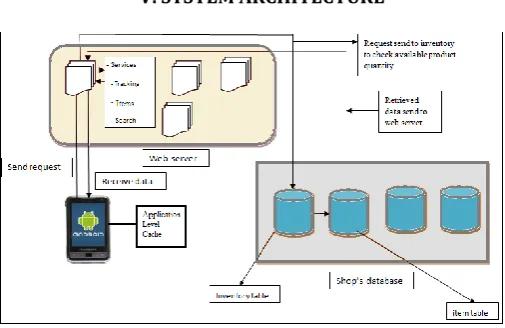
When the user will open this app in his android smartphone, the list of items will be displayed on his screen. When the user will select the item or search for some item, the request will be sent to the PrestaShop software, then that item will be searched in the shop’s database. Shops database has different tables like inventory table, items table, etc. Inventory table contains the item stock details, items table contains the item details and description. All this information of the item will be retrieved from the database and sent back to the requesting user device. After reading the item information user can add the item to the cart if he wishes to buy it, the user can also view and update the shopping cart and place the order.
Caching Policies - there are different cache replacement policies as follows: First In First Out (FIFO), Last In First Out (LIFO), Least Recently Used (LRU), Most Recently Used (MRU) and Random Replacement (RR). These policies are used to flush out the old data from the cache, so that new data can be brought in to the cache, thus the data in the cache is always remains updated and consistent. Cache is used for fast data retrieval because the data access speed of cache is faster than main memory. But the memory size of cache is very less (few megabytes) as compared to main memory.
The average time for cache reference is calculated as follows:
Where,
T = average cache reference time m = cache miss ratio
h = cache hit ratio m = 1 – h
Tm = time required to access main memory when there is
cache miss
Th = time required to reference cache memory when there
is cache hit
[image:5.595.37.291.404.541.2]E = other latencies
Figure 4: Network test snapshot
VI . SYSTEM ANALYSIS
The three factors can be considered while evaluating the quality of eCommerce website and web app as follows:
1. Usability - it refers to qualities that empower electronic trade to be helpful in a variety of circumstances, through its own improvement procedure, as well as the utilization and support, and depends on the unwavering quality of the site and comprises of the accompanying two angles;
© 2017, IRJET | Impact Factor value: 5.181 | ISO 9001:2008 Certified Journal
| Page 2253
3. Representative reliability - it refers to the agentpotential outcomes of electronic trade that influence the comprehension and treatment of the store through its life cycle.
[image:6.595.35.291.283.436.2]Utilizing these variables, the investigation of the site and web application can be completed. It is then conceivable to figure out which of these elements that have been contrasted is suitable with utilize. The examination of the devices depends on the above variables and on their legitimate working to give the clients most extreme help and the utilization of the instruments. The online store can be tried for the client perspective and the managerial perspective, including enlistment, web page route and submitting a request for the items in the shopping cart.
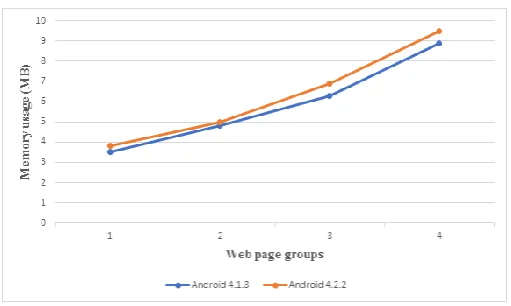
[image:6.595.35.291.457.615.2]Figure 5: Memory usage line graph
Figure 6: Response time line graph
To assess the general execution of the web application amid execution of its usefulness, the accompanying three measurements can be considered, where bring down qualities show better execution.
1. Response time: the time in seconds(s) that the web application takes from the earliest starting point of its execution to the finish of stacking the whole site page content.
2. CPU time: the time in seconds(s) that the way toward survey the site page possessed the CPU resource. Since the CPU may perform different tasks while stacking a website page, this metric separates the time taken just by the application being assessed.
3. Memory usage: the volume in megabytes(MB) that the way toward showing the page utilized as a part of the RAM of the execution condition.
The graphs below show the performance analysis of the web app for different android versions and different android emulator settings for memory usage and CPU time.
By implementing the application level cache in the project, we are trying to improve the performance of the android app in terms of response time to communicate the app with the web server to retrieve data from the server to the device over the internet.
CONCLUSION
In this paper “Development of Android based Mobile App for PrestaShop eCommerce Shopping Cart,” an Android App is introduced for online shopping. This Android App will be integrated with the PrestaShop eCommerce Shopping Cart software. As the PrestaShop software is the open source shopping cart software available only for web platform, this survey is made trying to integrate the Android App with the software to make it available for the mobile platform by exposing the web services of the software using the XAMPP Server and making the connection of the App with the MySQL database management system. As per the study of the previous work, it is the challenging task to integrate the android app with the PrestaShop software without violating the standard rules of the software and the internet protocols for web services, so that the whole system does not create any vulnerabilities in the security of the PrestaShop software.
ACKNOWLEDGMENT
This paper would not have been written without the valuable advice and encouragement of Dr. D. B. Hanchate, guide of ME Dissertation work. Authors special thanks go to Prof. S. A. Shinde and Prof. S. S. Nandgaonkar, Head of Computer Department and Honorable Principal Dr. M. G. Devamane, for their support and for giving me an opportunity to work on this project and survey of the development of android based mobile app for PrestaShop eCommerce shopping cart.
References
© 2017, IRJET | Impact Factor value: 5.181 | ISO 9001:2008 Certified Journal
| Page 2254
[2]
https://open-stand.org/w3c-working-group-tackles-new-models-for-internet-payment/
[3] K. Wagh, Dr. R. Thool, “Mobile Web Service Provisioning
and Performance Evaluation of Mobile Host,” International Journal on Web Service Computing, Vol. 5, No. 2, June 2014.
[4] Y. Jaegeol, “Design of a Mobile Shopping App for Regional Products,” Advanced Science and Technology Letters, ISSN:2287-1233, Vol. 66, 2014.
[5] G. Kahl, D. Paradowski, “A Privacy - Aware Shopping Scenario,” ACM 978-1-4503-1966-9/13/03, March 2013. [6] A. S. Johal, B. Singh, “Performance Analysis of Web Services for Android based Devices,” International Journal of Computer Applications, ISSN:0975-8887, Vol. 92, No. 11, April 2014.
[7] A. Borkar, M. Ansingkar, M. Khobragade, “Smart
Shopping: An Android Based Shopping Application,” International Journal of Advanced Research in Computer Engineering & Technology, Vol. 4, No. 3, March 2015.
[8] M. Singhal, A. Shukla, “Implementation of Location based
Services in Android using GPS and Web Services,” International Journal of Computer Science, Vol. 9, No. 2, January 2012.
[9] G. Nagra, R. Gopal, “Study of Factors Affecting on Online Shopping Behavior of Consumer,” International Journal of Scientific and Research Publications, Vol. 3, No. 6, June 2013.
[10] E. Constantinides, “Influencing the online
consumer's behaviour: The web experiences,” Internet Research, Vol. 14, No. 2, 2004.
[11] C. Giloth, J. Tanant, “Reconstitution of the Labyrinthe
of Versailles as a Mobile App,” International Conference on Information Visualisation, 2014.
[12] D. Kim, J. Jung, “CyberOffice: A Smart Mobile
Application for Instant Meetings,” International Journal of Software Engineering and Its Applications, ISSN:1738-9984, Vol. 8, No.1, 2014.
[13] C. Katawetawaraks, C. L. Wang, “Online Shopper
Behaviour: Influences of Online Shopping Decision,” Asian Journal of Business Research, Vol. 1, No. 2, 2011.
[14] P. F. Alfred, “Improvised Smart Shopping Based on
Android Application,” International Journal of Engineering Trends and Technology, ISSN:2231-5381, Vol. 35, No. 7, May 2016.
[15] P. V. Lokhande, P. M. Abhale, “Smart Shopping: