Blended Learning for effective remote Learning
Anita M. Belapurkar
H.G.M. Azam College of Education, Pune
This paper explores about effective application of Blended Learning for Remote Learning. This paper discusses how Blended Learning approach will help the teachers and institutions to select most appropriate environment for remote learners. The author highlights implications of important concepts in remote learning and blended learning. It discusses about concept and pedagogies of remote learning , different aspects and benefits of blended learning, It helps teachers to develop understandings and strategies to facilitate learning in a blended environment.
Introduction:
Distance education, like all other technical–social developments, is historically
constituted in the thinking and behavioral patterns of those who developed, tested, and
implemented what were once novel systems. Given the requirement for distance education to
be technologically mediated in order to span the geographic and often temporal distance
between learners, teachers, and institutions, it is common to think of development or
generations of distance education in terms of the technology used to span these distances.
Thus distance education theorists (Garrison, 1985; Nipper, 1989), in a somewhat
technologically deterministic bent, have described and defined distance education based on
the predominate technologies employed for delivery.
Identifying blended learning (or e-learning) with distance-learning is a mistake that has
significant implications for program design and delivery. The design of distance-learning
requires that all learning outcomes are anticipated and this may require expertise beyond the
scope of most academics. Distance learning therefore involves substantial development time
flexibility is impaired. In practice all teaching and learning includes some element of distance
learning. It is the art of programme design teams to decide what proportion this should be
and what activities are best conducted by distance (Procter, 2002).
Smith (2001) defines blended learning thus:A method of educating at a distance that uses
technology (high-tech, such as television and the Internet or low-tech, such as voice mail or
conference calls) combined with traditional (or, stand-up) education or training.
Pedagogies for remote learning:
There are different pedagogies of remote learning, which can be effectively used to address
the full spectrum of learning needs and aspirations of 21st century learners. Important of
them are; the cognitive- behaviourist pedagogy, social constructivist pedagogy and
connectivist pedagogy.
Cognitivist behaviourist models defined the first generation of individualized distance
education. They maximized access and student freedom, and were capable of scaling to very
large numbers at significantly lower costs than traditional education, as demonstrated by the
successful mega-universities (Daniel, 1996).
Constructivist distance education pedagogies moved distance learning beyond the narrow
type of knowledge transmission that could be encapsulated easily in media through to the use
of synchronous and asynchronous, human communications-based learning. Thus, Garrison
and others argue that the rich student-student and student-teacher interaction could be viewed
as a “post-industrialist era” of distance education.(Terry)
The third generation of distance-education pedagogy emerged recently and is known as
connectivism. It is noteworthy that connectivist models explicitly rely on the ubiquity of
networked connections between people, digital artifacts, and content, which would have been
inconceivable as forms of distance learning were the World Wide Web not available to
mediate the process. Thus, as we have seen in the case of the earlier generations of distance
learning, technology has played a major role in determining the potential pedagogies that may
be employed.
It is clear that whether the learner is at the centre or part of a learning community or learning
understanding of how people can learn more effectively: Cognitivist, behaviourist,
constructivist, and connectivist theories each play an important role.
Advances in network and communication technologies have shifted the way we deliver
instruction to learners in remote locations. Newer ways to blend traditional instruction with
technology mediated instructional methods have emerged in an effort to meet the diverse
needs of learner satisfaction and improve their learning levels. Several research studies
claimed the positive effect of blended learning for teaching and learning (Bielawski, L. and
D. Metcalf, 2005)
Blended Learning:
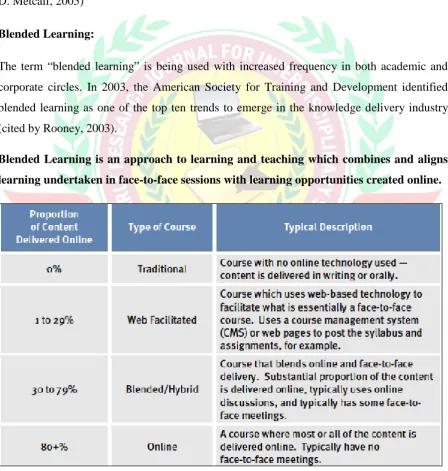
The term “blended learning” is being used with increased frequency in both academic and
corporate circles. In 2003, the American Society for Training and Development identified
blended learning as one of the top ten trends to emerge in the knowledge delivery industry
(cited by Rooney, 2003).
Blended Learning is an approach to learning and teaching which combines and aligns
[image:3.595.74.523.235.707.2]learning undertaken in face-to-face sessions with learning opportunities created online.
Blended learning is more than just combining an online component to the traditional
classroom…it is a systematic process of selecting the most appropriate media for a specific
learning intervention based upon learning objectives. Learning Environment Component: A
learning environment can either be synchronous or asynchronous. Each learning environment
has its distinct set of advantages and disadvantages, and the goal of blended learning is to
leverage those specific attributes of each environment to ensure the most optimum use of
resources to attain the instructional goal and learning objectives.
Instructional Component: Used to select the most appropriate instructional strategies that
support the learning objectives (Instructional strategies are the products of learning objectives
and serve to ensure the learning objectives and facilitate the transfer of learning.
When developing blended learning, maintaining instructional quality is paramount.
Consequently, learning objectives need not be compromised when developing a blended
learning solution.
Need for Blended learning: Osguthorpe and Graham (2003) identified six reasons why one
might chose to design or use a blended learning system: (1) pedagogical richness, (2) access
to knowledge, (3) social interaction, (4) personal agency, (5) cost effectiveness, and (6) ease
of revision.
Graham et al. (Graham, Allen, & Ure, 2003, in press) found that overwhelmingly people
chose BL for three reasons: (1) improved pedagogy, (2) increased access/flexibility, and (3)
increased cost effectiveness.
Courses that integrate online with traditional face-to- face class activities in a planned
pedagogically valuable manner; and…where a portion (institutionally defined) of face-to-face
time is replaced by online activity.
[image:4.595.68.528.221.597.2]Blended Learning
Figure 1: Blended Traditional
Classroom
Online
Consequently, from an educational perspective, blended learning is primarily focused on
integrating two separate paradigms…the traditional classroom [synchronous] environment
and the asynchronous online environment.
The major thrust of blended instruction is to overcome the shortcomings of online instruction
and utilize various instructional sequencing and delivery strategies to enhance learner
satisfaction while also achieving increased learning outcomes. Among the many definitions
available, three representative definitions of blended instruction include: (a) a learning
method with more than one delivery mode is being used to optimize learning outcomes and
reduced cost associated with program delivery ([Singh, H. and C. Reed), (b) any mix of
instructor-led training methods with technology-based learning (Bielawski, L. and D.
Metcalf,2005) and (c) the mix of traditional and interactive-rich forms of classroom training
with any of the innovative technologies such as multimedia, CD-ROM, video streaming,
virtual classroom, email/conference calls, and online animation/video streaming technology.
Distance education often suffers from making large amounts of information available for
students to absorb independently (Waddoups & Howell, 2002). Some have seen blended
learning approaches increase the level of active learning strategies, peer-to-peer learning
strategies, and learner centered strategies used (Collis, 2003; Hartman, Dziuban, & Moskal,
1999; Morgan, 2002; Smelser, 2002).
Benefits of blended learning for remote learning:
Increased Access/Flexibility. Access to learning is one of the key factors influencing the
growth of distributed learning environments (Bonk, Olson, Wisher, & Orvis, 2002).
Increased Cost Effectiveness. Cost effectiveness is a third major goal for BL systems in
both higher education and corporate institutions. Blended learning systems provide an
opportunity for reaching a large, globally dispersed audience in a short period of time with
consistent, semi-personal content delivery.
Improved Pedagogy. As indicated above, one of the most commonly cited reasons for
blending is more effective pedagogical practices. Blended learning may be applied at all
levels of teaching learning;
Course level
Program level
Institutional level
Across all four levels, the nature of the blends is either determined by the learner or the
designer/instructor. (Jennifer Patterson 2011).
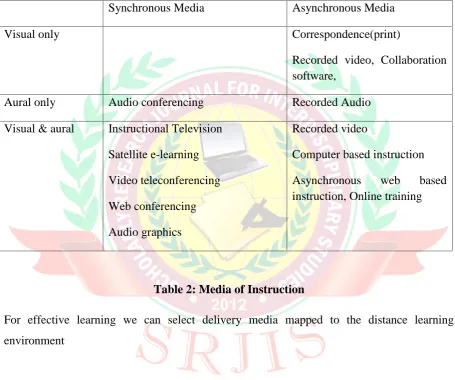
Synchronous Media Asynchronous Media
Visual only Correspondence(print)
Recorded video, Collaboration software,
Aural only Audio conferencing Recorded Audio
Visual & aural Instructional Television
Satellite e-learning
Video teleconferencing
Web conferencing
Audio graphics
Recorded video
Computer based instruction
[image:6.595.68.524.198.578.2]Asynchronous web based instruction, Online training
Table 2: Media of Instruction
For effective learning we can select delivery media mapped to the distance learning
environment
Distance Learning Classroom
• group centric (classroom environment)
• primarily synchronous
• dialectic & collaborative
• constrained by time & place
• Satellite e-learning
• Video Conferencing
• Audio Conferencing
• Audio Graphics
Virtual Classroom
• individual centric
• synchronous & asynchronous capability
• mostly didactic but can support interaction
• constrained by time not place
Supporting Media
• Web conferencing tools
Virtual Learner
• Individual centric (portable to any location)
• primarily asynchronous
• primarily didactic with little/no interaction
• not constrained by time & place
Supporting Media
• Mobile devices
• Web conferencing tools
Designing Blended learning:
Some of the major issues while designing Blended learning are as follows;
1) the role of live interaction (2) the role of learner choice and self-regulation, (3) models for
support and training, (4) finding balance between innovation and production, (5) cultural
adaptation, and (6) dealing with the digital divide.
There is a tendency to regard the future of distance learning as belonging solely to online or
web classes. However, some researchers have found that courses offered in ITV were
sometimes preferred by students even when the same course was offered online. Also, the
visual and interactive nature of instructional television benefited students and that student
satisfaction with ITV has been generally confirmed.
Conclusion:
A survey of the research literature has provided a number of dimensions to blended learning
that are found to be common within most tertiary educational institutions (Oliver and
Trigwell, 2005; Sharpe et al., 2006). Smith, Lewis, and Massey (2000) observe that the issues
in education raised by the development of new educational technologies are extraordinarily
important and extraordinarily divisive. New technologies necessarily evoke debate and policy
decisions around educational methodology, implementation, evaluation and costs.
Utilizing blended learning and lecture capture presents a unique opportunity for institutions
deliberating where and how to invest their limited resources to support strategic academic
priorities. Given its documented contributions to student learning and satisfaction, the use of
blended learning and lecture capture across an entire university is becoming commonplace.
Thus in all we can conclude thatBlended Learning will definitely be a key to, Drive distance
learning programs, Support comprehensive plans to improve graduation rates, Offer remote
learning during emergencies and campus closures, and Recruit and retain more students.
References:
Bielawski, L. and D. Metcalf. Blended Elearning: Integrating Knowledge, Performance
Garrison R., Implications of Online Learning for the Conceptual Development and Practice
of Distance Education, 2011.
Holden J., Instructional Media Selection: Implications for Blended Learning , School of
Education,American InterContinental University.
Osguthorpe, T. R. and R. C. Graham. Blended learning environments. Quarterly Review
of Distance Education 4(3): 227–233, 2003.
Procter c, Blended learning in practice, [email protected]
Picciano, A. G. Blended learning: Implications for growth and access. Journal of
Asynchronous Learning Networks 10(3): 85–91, 2006.
Smythe M, Blended learning: A transformative processs, Nelson Marlborough Institute of
Technology, [email protected]
The Student View of Blended Learning ,
www.ecsu.edu/.../distanceeducation/docs/studentviewBlendedLearning.
Thorne, K. Blended Learning: How to Integrate Online & Traditional Learning. London:
Korgan Page Ltd, 2003.