20
DESIGN OF GROUP HIERARCHY SYSTEM FOR
MULTICAST COMMUNICATION
1R. VARALAKSHMI, 2Dr. V. RHYMEND UTHARIARAJ
1Ramanujan Computing Centre, Anna University, Chennai, India 2Ramanujan Computing Centre, Anna University, Chennai, India
E-mail: 1[email protected], 2[email protected]
ABSTRACT
Secure and reliable group communication is an active area of research. Its popularity is fuelled by the grow-ing importance of group-oriented and collaborative applications. The central research challenge is secure and efficient group key management. The present paper is based on the Design of Group hierarchy system for multicast communication using the most popular absolute encoder output type code named Gray Code. The focus is of two folds. The first fold deals with the reduction of computation complexity which is achieved in our protocol by performing fewer multiplication operations during the key updating process. To optimize the number of multiplication operations, the Fast Fourier Transform (FFT), divide and conquer approach for multiplication of polynomial representation of integers, is used in this proposed work. The second fold aims at reducing the amount of information stored in the Group Center and group members while performing the update operation in the key content. Comparative analysis to illustrate the perfor-mance of various key distribution protocols is shown in this paper and it has been observed that this pro-posed algorithm reduces the computation and storage complexity significantly.
Keywords: Multicast Group Key Management, Group Hierarchy System, Fast Fourier Transform,
Poly-nomial Integer Multiplications, Computation Complexity, Storage Complexity.
1. INTRODUCTION
Many applications like pay-per–view, distribu-tion of digital media etc., require secure multicast services in order to restrict group membership and enforce accountability of group members. A major issue associated with the deployment of secure multicast delivery services is the scalability of the key distribution scheme. This is particularly true with regard to the handling of group membership changes, such as membership departures and/or expulsions, which necessitate the distribution of a new session key to all the remaining group mem-bers.
As the frequency of group membership change increases, it becomes necessary to reduce the cost of key distribution operations. One solution is to let all authorized members use a shared key to encrypt the multicast data. To provide backward and for-ward confidentiality (D.M. Wallner and Agee, 1999), this shared key has to be updated on every membership change and redistributed to all author-ized members securely which is referred to as re-keying. The efficiency of rekeying is an important issue in secure multicast as this is the most
fre-quently performed activity with dynamic change in the membership.
21 more time and needs more resources per hosts than using multicasting to re-key the group.
In this paper we study the problem of key man-agement for multimedia multicast services. We begin in Section2 by introducing the concepts of key management in multicast communication and present a gray code[1] based group key manage-ment scheme that will be used later in the paper in Section 3. In Section 4, we introduce a HCF based key distribution protocol for multicast key man-agement to minimize the computation overhead, storage complexity and the number of rekeying operations. Section 5 analyses the performance of the proposed scheme, followed by the conclusion in Section 6.
2. KEY MANAGEMENT IN MULTICAST
COMMUNICATION
During the design of a multicast application, there are several issues that should be kept in con-sideration when choosing a key distribution scheme.
The problem of designing efficient key updating schemes [1-10] has seen recent attention in the lit-erature. One approach for achieving scalability is to apply hierarchical subgroups and map the KEKs to a logical hierarchy. The hierarchy-based approach to group rekeying was originally presented by Wallner et al. [3], and in-dependently by Wong et al. [18]. Due to the hierarchy structure, the commu-nication overhead is O(log n), while the storage for the center is O(n) and for the receiver is O(log n). We note that the O notation is presented to indicate that the constant factors are implementa-tion dependent.
In most of the existing Key Management schemes, different types of group users obtain a new distributed multicast Group key which is used for encrypting and decrypting multimedia data for every session update. Among the various works on key distribution, Maximum Distance Separable (MDS) [12] method instead of using encryption algorithms focuses on error control coding tech-niques for distributing re-keying information. In MDS, the key is obtained based on the use of Eras-ure decoding functions [13] to compute session keys by the GC/group members. Moreover, the Group center generates n message symbols by send-ing the code words into an Erasure decodsend-ing func-tion. Out of the n message symbols, the first mes-sage symbol is considered as a session key and the group members are not provided with this particular key alone by the GC. Group members are given the (n − 1) message symbols and they compute a code
word for each of them. Each of the group members uses this code word and the remaining (n − 1) mes-sage symbols to compute the session key. The main limitation of this scheme is that it increases both computation and storage complexity. The computa-tional complexity is obtained by formulating lr + (n − 1)m where lr is the size of r bit random number used in the scheme and m is the number of message symbols to be sent from the group center to group members. If lr = m = l, computation complexity is nl. The storage complexity is given by (log2 L + t) bits for each member. L is number of levels of the Key tree. Hence Group Center has to store n (log2 L + t) bits.
Secure communication using the extended Eu-clidean algorithm [14] was proposed for centralized secure multicast environments. The main advantage of this algorithm is that only one message is gener-ated per rekeying operation and only one key is stored in each user’s memory. In this algorithm, two values (δ, L) are computed in the intermediate steps of GC. The main limitation of the Euclidean algo-rithm is that the two computed values must be rela-tively prime. If this is not the case, then the algo-rithm fails in which the user cannot recover the secret information sent by GC. Also, the time taken for defining a new multiplicative group is high, whenever a new member joins or depart the mul-ticast operation. This approach is only suitable for a star based key management scheme.
22 by David and Alan. In this method, the keys are computed up the tree, from the departs to the root. This approach reduces re-keying broadcasts to only about log n keys. The major limitation of this ap-proach is that it consumes more space. However, the time complexity is more important than space complexity. The storage complexity of GC is 2nK and group member is LK , where K is the key size in bits. In our work, we focused on reduction of computation of both time complexity as well as storage complexity.
Wade Trappe and Jie Song proposed a Paramet-ric One Way Function (POWF) [20] based binary tree Key Management. Each node in the tree is assigned a Key Encrypting Key (KEK) and each user is assigned to a leaf and given the IKs of the nodes from the leaf to the root node in addition to the session key. These keys must be updated and distributed using top down or bottom up approach. The storage complexity is given by (logτn)+2 keys for a group center. The amount of storage needed bythe individual user is given as (τL+1−1) / τ−1 keys. Computation time is represented in terms of amount of multiplication required. The amount of multiplication needed to update the KEKs using the bottom up approach is τ logτ n−1. Multiplication needed to update the KEKs using the top down approach is (τ−1) logτ n(logτ n+1) / 2 . This com-plexity can be reduced substantially if the numbers of multiplications are reduced. In P. Vijayakumar et al.,[21] proposed Centralized key distribution protocol using greatest common divisor method using a cluster based Key Management Scheme that reduces computation time by reducing the number of multiplications required in the existing approach-es. They use the Karatsuba fast multiplication algo-rithm to optimize the multiplication operations used in the key distribution protocol in the GC.
Therefore, in this paper we propose a new Group hierarchy based Key Management Scheme using Gray Code [1] that reduces computation time as well as storage by reducing the number of multipli-cations required in the existing approaches, and also refreshes the session key for secure communication. We also use the fast fourier transform polynomial integer multiplication algorithm which yields better results than the previous scheme to optimize the multiplication operations used in the key distribu-tion protocol in the GC. The proposed method also reduces the amount of information that needs to be stored for updating the keys when there is a change in the group membership. Our proposed algorithm is suitable for single or batch join/depart operation which is achieved by refreshing the session key.
3. DESIGN OF GROUP HIERARCHY
BASED MULTICAST COMMUNICATION
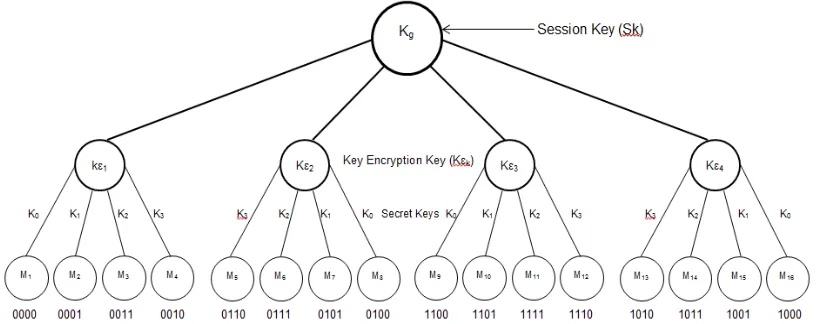
Scalability can be achieved in this proposed key distribution approach by applying this scheme in a Group hierarchy based key management scheme to update the GK and SGK. Fig. 1 shows a Group hierarchy in which the root is the Group key (kg), leaf nodes are individual keys, and the intermediate level is Sub Group Key (SGK-kε). The hierarchy
shown in Fig. 1 consists of only three levels. The lowest level (0th level) is the group key. The next higher level (1st level) contains the shared secret keys, kεi, where εi = 1, 2, . . . , n. The last level (2nd
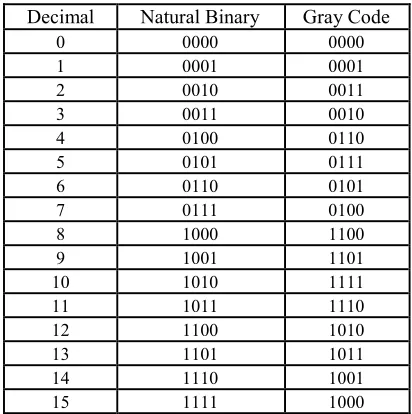
[image:3.612.103.514.546.708.2]level) is the user’s level, where M number of users are grouped into k Groups, Hk. To issue new keys upon a user event, the main task is to identify the keys that need to be changed. So, In our scheme each member of the group is associated with a unique user ID (UID) which is a Gray code of string length n. Gray Code is a form of binary that uses a different method of incrementing from one number to the next.
23
[image:4.612.91.297.172.379.2]Figure 2. Time Intervals
Table 1. Decimal, Natural Binary And Gray Code Repre-sentation
Decimal Natural Binary Gray Code
0 0000 0000
1 0001 0001
2 0010 0011
3 0011 0010
4 0100 0110
5 0101 0111
6 0110 0101
7 0111 0100
8 1000 1100
9 1001 1101
10 1010 1111
11 1011 1110
12 1100 1010
13 1101 1011
14 1110 1001
15 1111 1000
Table 1 depicts the Decimal, Natural Binary and Gray Code Representation. With Gray Code, only one bit changes state from one position to another. The length of the UID depends upon the size of the multicast group. Each Groups is attached to the upper level (1st level) node and in turn with the group key node. When the number of joining users exceeds the Groups size, a new node is created from the root to form the second Groups . The number of Groups s formed is based on the Groups size M which is fixed by GC and the number of joining users. If the Group hierarchy based key manage-ment consists of N number of users M1, M2, . . . , MN and each Groups size is of size M then there will be ⌈N/M⌉ Groups s. In this Group hierarchy based key management scheme, updating is neces-sary for each rekeying operation used for member depart and member join operations.
Due to the dynamic nature of the group, and the possible expiration of keying material, it is neces-sary to update both the SK and KEKs using rekey-ing messages. The Four operations involved are Key Refreshing, GC Initialization, key updating when a new user joins the service, and key updating when a user departs the service. In the discussions that follow, we use an integer-valued time index to denote the time intervals during which fundamental operations occur, and assume that there is a
system-level mechanism that flags or synchronizes the users to the same time frame. We shall always use the time index to denote the interval for which the new key information will become valid. Time inter-val will correspond to the time interinter-val during which the new key information is being transmitted. Further, time interval corresponds to the interval of time during which a new member contacts the ser-vice provider wishing to join, or a current member announces to the service provider his desire to de-part the service. We have depicted these cases in Fig. 2. Observe that it is not necessary that the time intervals have the same duration.
3.1 Key Refreshing
Refreshing the session key is important in secure communication. As a session key is used, more information is released to an adversary, which in-creases the chance that a SK will be compromised. Therefore, periodic renewal of the session key is required in order to maintain a desired level of con-tent protection. By renewing keying material in a secure manner, the effects of a session key com-promise may be localized to a short period of data.
The crypto-period associated with a session key is governed by many application-specific considera-tions. First, the value of the data should be exam-ined and the allowable amount of unprotected (compromised) data should be addressed.
Since the amount of data encrypted using KEKs is usually much smaller than the amount of data encrypted by a session key, it is not nec-essary to refresh KEKs. Therefore, KEKs from the previous time interval (t-1) carry over to the next time interval. In order to update the session key kg(t-1) to a new session key kg(t), the group center
generates kg(t) and encrypts it using the KEK kε(t).
This produces a rekeying message αg(t)= E(kε(t),
kg(t)), where we use E(k,m) to denote the en-cryption of m using the key K. The message αg(t)is sent to the users.
3.2 GC Initialization
24 when the ‘a’ value increases, the value of δ also increases.
3.3 Member Join
In multimedia services, such as pay-per-view and video conferences, the group membership will be dynamic. Members may want to join and depart the service. It is important to be able to add new mem-bers to any group in a manner that does not allow new members to have access to previous data. In a pay-per-view system, this amounts to ensuring that members can only watch what they pay for, while in a corporate video conference there might be sen-sitive material that is not appropriate for new mem-bers to know.
3.3.1 Key Updating process steps at Group Cen-ter Side
1 Initially, GC selects a random element g from
2 GC now computes the shared secret key kε =
kga mod p.
3 The GC calculates L=
4 The GC computes a HCF value of (δ, L) by using the extended Euclidian algorithm de-scribed in [ 27] from which it finds x, y, b such that x× δ + y × L= b.
5 The GC multicasts kg, x, p, q and d to the
group members.
3.3.2 Key Updating process steps at User Side 1 Computes x1 using the relation x mod ki = x1. 2 Computes δ using x1−1 mod k
i = δ.
3 Performs the following operation to find the shared secret key.
kgb×δ/ kgq mod p = kg(b×δ)−q mod p = kε .
The kε obtained in this way must be equal to the
kε computed in Step 2 of GC.
Upon receiving all the above information (kg, u,
p, q, b) from the GC, an authorized user ui of the
current group executes the following steps to obtain the new group key kg .
Suppose that, during time t-2 interval, a new user contacts the service desiring to become a group member. If there were n-1 users at time t-2 then there will be n users at time t.
During time interval t-1, the rekeying infor-mation must be distributed to the n-1 current mem-bers. Observe that we must renew both the SK and
KEK in order to prevent the new user for accessing previous rekeying messages and to prevent access to prior content.
3.4 Member Departure
The protocol shown in figure 3, depicts the com-putation of encryption keys for member departure using gray code.
Fig.3.: Protocol For Computation Of Encryption Keys For Member Departure Using Gray Code.
Let B1 = Most Significant Bit; B4 = Least Sig-nificant Bit S = Set contains remaining group members
C = 0 (Count for no. of sub group with no members leaving
Step 1: /* No member leaving from that sub group */
Do 1 to no. of subgroups
If no. of same occurrence at B1B2 = No. of members in that sub group
S = S – Group members from the sub group C = C + 1
End if End Do
Step 2: /* No member leaving in a particular position in remaining subgroup */
Do 1 to no. of subgroups – C
If no. of occurrence of B3B4 = no. of subgroup – C
S = S – Group members from the sub group End if
End Do
Step 3: /* Users at same position in different sub group */
Do 1 to no. of subgroups – C If no. of occurrence of B3B4 != 1
S = S – Group members from the sub group End if
End Do
Step 4: /* Users at different position in different sub group */
Do 1 to no. of subgroups – C If no. of occurrence of B1B2 = 1
S = S – Group members from the sub group End if
25 Let us consider the case when user un departs the group at timeframe t-1. Since user un knows kg(t-1) and kε(t-1) these keys must be renewed. First kε is renewed. Next, the session key kg(t) is updated. The GC forms a new SKkg(t) and encrypts using the new KEKkε(t) to form αg(t)= E(kε(t), kg(t)). This message is then sent to the users.
For example, if a member M7 with user ID (0101) in Groups 2 from the Fig. 1 departs the group, then the keys on the path from his leaf node to the hierarchy’s root node must be changed.
Hence, only the keys kε and kg will become
in-valid. Therefore, these two keys must be updated. In order to update these two keys, two approaches are used in the member’s departure operation. In the first approach, updating of the sub group key, kε2for the Groups 2 is performed as given in Algo-rithm 1. When a member M7user ID (0101) departs from the service, GC computes the protocol given in Fig.3, step 3 Users at same position in different sub group L(k5,8) for the existing users using their own secret keys which are kept in GC. When com-puting L(k5,8) for the members M5 user ID (0110), M6 user ID (0111), and M8user ID (0100) the GC uses k3, k2, and k0 which are the secret keys for the remaining members of all Groups s . Since the se-cret key k1 is known to the member M7with user ID (0101) who had left from the service. GC is not using the secret key k1 when it computes the func-tion L(k5,8) for the members M5 user ID (0110), M6 user ID (0111), and M8 user ID (0100).
However, the computation time of L(k5,8) can be
reduced by dividing the kε by k1as shown in Step 1
of Algorithm 1 rather than multiplying all users secret key once again. Next, the GC computes δ, HCF value of (δ, L(k5,8)) and generates a multicast
message as indicated in Step 4 of Algorithm 1 and sends the message to all the existing members of the Groups in order to update the new SGK kε`.
Algorithm 1.
1 L(k5,8) = L(k5,8) / k1
2 GC computers the new kg, q and computers δ and kε` values.
3 Now GC computes HCF value of (δ, L(k5,8))
and finds out x, y, b values.
4 Finally GC multicasts kg, x, p, q, and b to the existing group members. Group members M5 user ID (0110), M6 user ID (0111), and M8 us-er ID (0100) executes the following steps to obtain the new sub group key kε2.
5 Compute x mod ki = x1.
6 Compute x1−1 mod k i = µ.
7 Perform the following operation to find the shared secret key.
8 kgb×δ/ kgq mod p = kg(b×δ)−q mod p = kε2 .
After updating the above SGK successfully, GC has to use the second approach in order to update the group key kg using a different procedure as explained below. The new group key kg is used to encrypt the multimedia data. For updating the GK, GC generates a new group key from , with a condition that the new group key kg1<kεi. If this
condition is not satisfied then append a value 1 in front [1] of kεi in order to make kεi a greater value
than kg1. Every time a new Groups is created its corresponding SGK is multiplied with all other SGKs and the result is stored in a temporary varia-ble X. Therefore whenever a new Groups is creat-ed, only the new kεi of the newly created Groups is
multiplied with the value X which is stored in GC. Hence only one multiplication is needed for updat-ing the GK. Similarly when an existupdat-ing Groups is completely deleted X is divided by the correspond-ing ε i value and hence only one division is neces-sary for updating the GK. In order to understand the key updation when a single member departs a group, consider an example using Fig. 1 where only one member M7with user ID (0101) is allowed to depart the Groups (Groups 2). In this case, ε2 must be updated and let the updated ε2 be represented as ε21. In order to update ε2, the GC must divide X by ε2 first and then the result must be multiplied with the newly computed ε21 and the final result is stored in the variable X. This X is added with the newly generated group key kg1 to obtain kε and the
rekeying message is formed by using the equation kε = kg1 + X. In this way, member depart
opera-tions are handled effectively by reducing the num-ber of multiplications/divisions.
The resultant value kε is broadcast to the
remain-ing members of the group. The members of the group can recover the updated group key with the help of εi using the relation,
kε mod (kεi) = kg1 .
26 tc + 1, where tc is used to denote the total number of L (ki,j) and kεi used for every Groups that are
stored in GC and 1 represents group key storage area.
4. SECURITY ANALYSIS
To ensure multicast or broadcast security, group key management should satisfy four security prop-erties
1. Non-group confidentiality, 2. Collusion freedom,
3. Future confidentiality (forward secrecy), and 4. Past confidentiality (back secrecy).
This Group hierarchy (proposed scheme) satisfies the above said properties.
5. PERFORMANCE EVALUATION
Assumption Let L= be a multiplication function which is used for member join operation, where ki = secret is the key of a user. Now, ‘σi’ is the size of the ki, where i = 1, 2, 3, . . . , n (n = size
of the group).
Algorithm. Consider a scenario, where σ1 = 2 and σ2 = 2. A set of ‘σi’ are multiplied to form L as shown in Step 3 in Section 3.3 using the traditional multiplication operation present in most of the ex-isting key distribution approaches [4, 13]. In order to multiply σ1 and σ2 using traditional multiplica-tion operamultiplica-tion, the algorithm takes 4 multiplicamultiplica-tion operations. In general, when two ‘σ ’ digit numbers are to be multiplied, it takes (σ2) multiplication operations in order to obtain the solution.
For optimizing the number of multiplication op-erations used for computing there exist faster multi-plication algorithms, based on the fast Fourier trans-form, a divide and conquer approach [11,24–26] is used in our proposed key distribution algorithm. The idea is : multiplying two numbers represented as digit strings is virtually the same as computing the convolution of those two digit strings. Instead of computing a convolution, one can instead first compute the discrete Fourier transforms, multiply them entry by entry, and then compute the inverse Fourier transform of the result. Based on this idea, the number of multiplication operations to be per-formed in total to obtain the solution for the ‘σ ’ digit number will be O σ (n log (n)).
Therefore it is faster than the traditional multipli-cation, which requires σ2 single-digit products and the complexity is O σ log24 . The fast Fourier trans-form multiplication approach works well when the
value of σ > 4000 digits. However, if the number of digits of σ < 16, this algorithm shall not show a significant difference. In order to optimize the use of the fast Fourier transform multiplication ap-proach, the group size in our proposed key distribu-tion algorithm can have 16-digits, 32-digits, 64-digits, 128-64-digits, etc. In the proposed algorithm given in Section 3.4, we have analyzed and tested the algorithm for a group size p as 16-digit, 32-digit and 64-digit prime numbers. The key values used in our algorithm are 16 and 32 digit numbers.
Theorem 1. The number of multiplications in the computation of L is in the order of O(ω log (ω)) when fast fourier transform divide and conquer multiplication is employed for the key computation process where the key size is a n digit number. Proof :Two integers A and B, of length n represent-ed as a polynomial in base x. It is important to stress at this stage that the length n has to be a pow-er of two (n is even). In the implementation thpow-ere will be some processing to ensure that n is always even.
A(x) = A0+ A1x + A2x2 + ... + An-1 xn-1
B(x) = B0+ B1x + B2x2 + ... + Bn-1 xn-1
Split A, and B in the following manner:
A0= a0+ a2 + ... + an-2 and A1 = a1 + a3 + ... + an-1
B0= b0 + b2 + ... + bn-2 and B1 = b1 + b3+ ... + bn-1
Both halves are equal to ω/2 as the length n is a power of two. However, one half possesses the even positions and the other the odd positions. Given a sequence A = (a0, a2, … , aω-2), compute its Fouri-er transform according to the formulae
Choosing for ωk the complex roots of unity (Note: i is equal to -1)
This formulae is used to compute the complex roots of unity needed to evaluate thenumber at 2n distinct points.
27 From above we get the sequence F2n(B) = (d0, d1, …, d2n-1),
The two sequences are multiplied together and produce the third sequence E
E = (e0, e1, …, e2n-1), where ek = ak * bk On sequence E, we use the inverse Fourier Trans-form. This produces the sequence G
Finally, dividing each of the resulting integers by 2n will give us the coefficients that construct the product of the multiplication.
Time Complexity of FFT = T(ω) T(ω) = 2T(ω/2) +O(ω) = O(ωlog ω).
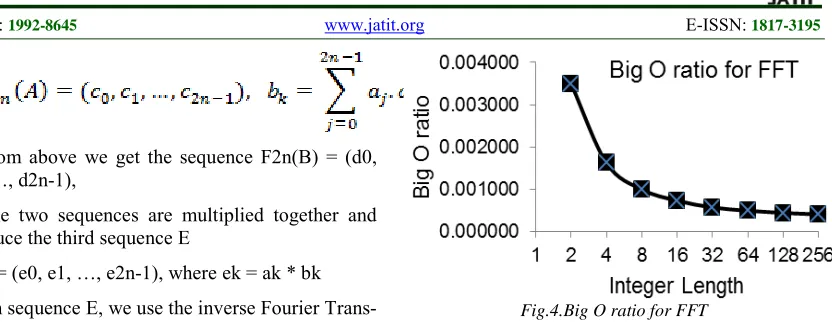
In order to determine whether the Fourier al-gorithm performs close to its theoretical expecta-tion or not, the Fourier algorithm is run 10,000 times on multiplicands of length of up to the eighth power of two (256) and the results are shown in Table3. Then, the average time for each power of two is divided by n log n (where n is the length of the multiplicands). If this ratio (time / n log n) gets smaller and smaller when increas-ing the length of the multiplicands then the Fourier implantation is said to be behaving close to our theoretical efficiency.
Table 1.Performance of FFT
Integer
Length Time (ms) FFT n log n Operation (time / n log n) Big O ratio or
2 0.007 2 0.003500
4 0.013 8 0.001625
8 0.024 24 0.001000
16 0.047 64 0.000734
32 0.092 160 0.000575
64 0.191 384 0.000497
128 0.398 896 0.000444
[image:8.612.111.527.69.230.2]256 0.841 2048 0.000410
Fig.4.Big O ratio for FFT
These results in Figure 4 show that the ‘Big O ratio’ starts of at 0.00350 and gradually de-creases to 0.000410 at integers of length 256. It is predicted to keep decreasing for greater pow-ers of two than 256. It will eventually reach a constant c0. Therefore, the implementation of this FFT algorithm for our scenario in order to reduce the number of multiplications is considered successful as it is so close to our theoretical expectation. Most of the applications like PAY-TV, Video-on-demand, sporting events are fully based on the idea of reducing the computation time where our proposed protocol will be more suitable.
6. CONCLUSION
A comparison between the proposed scheme and the previous schemes were undertaken while providing secure multimedia multicast through effective key management techniques. For this purpose a new Group hierarchy-based key distribu-tion protocol (key value = ‘n’ bit numbers) has been proposed in this paper. The proposed algorithm has two dimensional focuses—minimal computation complexity and minimal storage complexity. The comparison shows that the proposed scheme using the reflected code called Gray code [1] achieves lower storage requirements at both the group con-troller and the group members.
28 depart operations. The conceptual idea has been discussed in this paper. Implementation is being carried out.
REFERENCES
[1] R. Varalakshmi, Dr.V.RhymendUthariaraj, “A New Secure Multicast Group Key Management Using Gray Code”, Paper No: 978-1-4577-0590-8/11, IEEE-International Conference on Recent Trends in Information Technology, ICRTIT 2011,MIT, Anna University, Chennai. June 3-5, 2011.
[2] I. Chang, R.Engel, D.Kandlur, D.Pendarakis and D.Daha. “Key management for secure internet multicast using Boolean function minimization technique”. ACM SIGCOMM’99, March 1999. [3] Debby M. Wallner, Eric J. Harder, Ryan C.
Agee, “Key Management for Multicast: Issues and Architectures”, Informational RFC, draft-Wallnerkey-arch-ootxt, July 1997.
[4] Mingyan Li, R. Poovendran, A. David McGrew, Minimizing center key storage in hybrid one-way function based group key management with communication constraints, Information Processing Letters (2004) 191–198. Elsevier. [5] R. Poovendran, J.S. Baras, An
information-theoretic approach for design and analysis of rooted-tree-based multicast key management schemes, IEEE Transactions on Information Theory 47 (2001) 2824–2834.
[6] Sandeep S. Kulkarni, BezawadaBruhadeshwar, Key-update distribution in secure group com-munication, Computer Communications 33 (6) (2010) 689–705. Elsevier.
[7] BezawadaBruhadeshwar, Kishore Kothapalli, MaddiSreeDeepya, Reducing the cost of session key establishment, ARES (2009) 369–373. [8] BezawadaBruhadeshwar, Kishore Kothapalli, M.
Poornima, M. Divya, Routing protocol security using symmetric key based techniques, ARES (2009) 193–200.
[9] Shiuh-Jeng Wang, Yuh-Ren Tsai, Chien-Chih Shen, Pin-You Chen, Hierarchical key deriva-tion scheme for group-oriented communicaderiva-tion systems, International Journal of Information Technology, Communications and Convergence 1 (1) (2010) 66–76.
[10] Mohsen Imani, Mahdi Taheri, M. Naderi, Security enhanced routing protocol for ad hoc networks, Journal of Convergence 1 (1) (2010) 43–48.
[11] J. M. Pollard. The Fast Fourier Transform in a Finite Field. Mathematics of Computation, 25(114):365-374, April 1971.
[12] Mario Blaum, JehoshuaBruck, Alexander Vardy, MDS Array codes with independent par-ity symbols, IEEE Transactions on Information Theory 42 (2) (1996) 529–542.
[13] LihaoXu, Cheng Huang, Computation-efficient multicast key distribution, IEEE Transactions on Parallel and Distributed Systems 19 (5) (2008) 1–10.
[14] J.A.M. Naranjo, J.A. Lopez-Ramos2, L.G. Casado, Applications of the extended Euclidean algorithm to privacy and secure communica-tions, in: Proceedings of the 10th International Conference on Computational and Mathemati-cal Methods in Science and Engineering, CMMSE, 2010.
[15] Wade Trappe, Jie Song, RadhaPoovendran, K.J. Ray Liu, Key distribution for secure mul-timedia multicasts via data embedding, in: IEEE International Conference on Acoustics, Speech, and Signal Processing, vol. 3, 2001, pp. 1449– 1452.
[16] J.S. Lee, J.H. Son, Y.H. Park, S.W. Seo, Opti-mal level-homogeneous tree structure for logi-cal key hierarchy, in: Proc. of IEEE Conference on Communication System Software and Mid-dleware Workshop, COMSWARE, 2008. [17] Dong-Hyun Je, Jun-Sik Lee, Yongsuk Park,
Seung-Woo Seo, Computation-and-storage-efficient key tree management protocol for se-cure multicast communications, Computer Communications 33 (6) (2010) 136–148. Elsevier.
[18] C. Wong, M. Gouda, S. Lam, Secure group communications using key graphs, IEEE/ACM Transactions on Networking 8 (2002) 16–30. [19] A. David McGrew, Alan T. Sherman, Key
establishment in large dynamic groups using one-way function trees, IEEE Transactions on Software Engineering 29 (5) (2003) 444–458. [20] Wade Trappe, Jie Song, RadhaPoovendran,
K.J. Ray Liu, Key management and distribution for secure multimedia multicast, IEEE Transac-tions on Multimedia 5 (4) (2003) 544–557. [21] P. Vijayakumar et al,Centralized key
29 [22] Ng W. Hock Desmond, M. Howarth, Z. Sun, H.
Cruickshank, Dynamic balanced key tree man-agement for secure multicast communications, IEEE Transactions on Computers 56 (5) (2007) 590–605.
[23] Wade Trappe, Lawrence C. Washington, Intro-duction to Cryptography with Coding Theory, second ed., Pearson Education, 2007, pp. 66– 70.
[24] M. Scott. An Implementation of the Fast-Fourier Multiplication Algorithm. Technical Rep ort CA-0790,Dublin City University, 1990. [25] Tom St Denis, BigNum Math Implementing
Cryptographic Multiple Precision Arithmetic, SYNGRESS Publishing, 2003.