SRJIS/BIMONTHLY/ SONIA GUJRAL & DR. MAMTA GUPTA (5459-5467)
MAY-JUNE 2017, VOL- 4/31 www.srjis.com Page 5459 A STUDY ON THE REFORM AT THE SCHOOL STAGE IMPROVING THE
PERFORMANCE OF STUDENTS IN SCHOLASTIC AND CO-SCHOLASTIC
AREAS
Sonia Gujral1 & Mamta Gupta2, Ph.D. 1
Research Scholar, Mats University, Raipur
2
Head of Department(Education), Pt. Hari Shankar Shukla College, Raipur
CBSE is bringing reforms at the school stage so that students performance may be improved in scholastic and co – scholastic areas. Therefore, this study has been under taken to find out what reforms at the school stage is improving the performance of students in scholastic and co-scholastic areas. A random sample of 50 teachers and 100 students of CBSE schools were selected from Raipur. Self made questionnaire were used to collect the relevant data. The results revealed that conducting different types of tests develop good study habit in students. Assessment of listening and speaking skills will equip the students with good communication skills. Further the results revealed that inclusion of value based question and open book examination will help the students in enhancing higher order thinking skills. Teachers favored that co-scholastic assessment are also important for imparting value education and it should be done systematically and methodologically.
INTRODUCTION
Assessments at school level emphasize more on academic performance based on written
tests. These tests demarcate the students as intelligent or slow learners. Scholastic aspects
were duly taken into by our assessment system whereas we need to look at the holistic
assessment of a child which includes assessment of both: scholastic and co scholastic areas.
In the modern schooling increasing emphasis is laid on the personal and social development
of the child as well as his academic achievements, which has called for the corresponding
development of a variety of techniques for appraising all phases of child growth and
development of his achievements, of behavior and of teaching-learning processes. Scholarly Research Journal's is licensed Based on a work at www.srjis.com
SRJIS/BIMONTHLY/ SONIA GUJRAL & DR. MAMTA GUPTA (5459-5467)
MAY-JUNE 2017, VOL- 4/31 www.srjis.com Page 5460 Scholastic and Co-Scholastic Assessment
Scholastic Assessment
Scholastic Assessment is a process in which knowledge, skills, understanding, attitudes and
applications are recorded in measurable terms. To improve the teaching learning process,
assessment should be both formative and summative. Scholastic Assessment includes
Periodic Assessment/ Formative Assessment and Summative Assessment/ Term Exam.
Formative Assessment/ Periodic test
Formative Assessment/ Periodic test is a tool used by the teacher to continuously monitor
students’ progress in a nonthreatening, supportive environment which involves a regular
descriptive feedback, a chance for the student to reflect upon the performance, take advice
and improve. It is carried out during a course of instruction for providing continuous feed
back to both teachers and the learners.
Summative Assessment/ Term End Examination
Summative assessment/ Term End Examinations are carried at the end of the course of
learning. It measures or ‘sums up’ how much a student has learned from the course. It is
usually a graded test, i.e., it is marked according to a scale or a set of grades. The methods
used for Summative assessment / Term End Examinations are the most traditional methods
such as Objective type, Short Answers and Long Answers.
Co-Scholastic Assessment
The Co- Scholastic abilities are concerned with the learner’s attitude, interest, values,
feelings, habits, social interaction. These co-scholastic areas assessed indirectly by merely
observing the behavior of the learner and his experiences and also through biographies, self
reports, checklists etc. The co-scholastic Assessment is the desirable behavior related to
learner’s life skills, attitudes, interests, values, co-curricular activities and physical health; it
consists of parts - 2(A) Life skills, 2(B) work education, 2(C)Visual and performing Arts,
2(D) Attitudes and Values and 3. Co-curricular Activates which comprises of 3(A)Activities
and 3(B) Health and 3(C) Physical Education.
Life Skills Education
Life Skills are defined as abilities for adaptive and positive behavior that enable individuals
to deal effectively with the demands and challenges of everyday life – World Health
Organization (1997). Moreover, based on this definition a working definition was formed by
South East Asian Region (SEAR) as “abilities for adaptive and positive behavior that enable
them to deal with the demands and challenges within the family, community and cultural
SRJIS/BIMONTHLY/ SONIA GUJRAL & DR. MAMTA GUPTA (5459-5467)
MAY-JUNE 2017, VOL- 4/31 www.srjis.com Page 5461 the student evaluation system in CBSE schools. There are a large number of life skills
emanating from various sources, for practical purposes and for feasibility, the life skills
chosen are Self-awareness, Problem Solving, Decision making, Critical thinking, Creative
thinking, Interpersonal relationship, Effective communication, Empathy, Coping and
dealing with stress.
Attitude and Value System
Education for values aims at promoting broader capabilities, attitudes and skills that matter,
not just in schools but also life beyond schools, making the world a better place for them and
for their family, friends, colleagues and others. Education for values highlights the
understanding that values are to be inculcated in students not just for their own interest but
also for the common
Good, reflecting the balance between individual’s interest and larger interest. The focus,
therefore, can not only be improving academic knowledge, practical and technical skills
mostly tied to market needs and employability but also holistic education focusing on the
emotional and relational skills conducive to health and wholeness of the society and the
nation. The aim of holistic development of students can thus be located in education for
values.
Literature review
National Policy of Education, (1986) recommended that minimum level of learning laid
down at each stage of primary education, and that steps be undertaken to ensure that all
students achieve these minimum levels of learning.
National Curriculum Framework (1988) considered necessary to develop a scheme of
evaluation in order to improve the evaluation system. A school based evaluation scheme was
conceived at implementing the idea of continuous and comprehensive evaluation in school
situation by the unit of Department of Educational Evaluation and Measurement.
Junge et al. (2003) examined the development of life skills within a sample of kindergarten
through sixth grade students enrolled in 4-H after school programs. Results of retrospective
pre/post-surveys indicate that children rolled in the program showed life skill gain over time,
and that gain on specific life skills differ as a function of age, gender, and ethnicity.
Jones (2010) showed that students need technical and academic skills as well as the ability to
think and work collaboratively with others. Career education must begin in middle school or
earlier to allow students time to develop the aptitudes, skills and attitudes necessary to create
SRJIS/BIMONTHLY/ SONIA GUJRAL & DR. MAMTA GUPTA (5459-5467)
MAY-JUNE 2017, VOL- 4/31 www.srjis.com Page 5462 Rao et al. (2011) analyzed the importance of Life Skills Education (LSE) in terms of
behavior modification of juvenile delinquents. Interactive and participatory methods were
adopted for the training. Results showed that life skills program helped them to strengthen
their personalities. Behavioral changes took place among the boys who were trained and
criminal propensity came down and morality increased.
Tahir Mehmood et. al. (2012)the study was designed to find out the impact of co-curricular
activities on personality development of Secondary School Students. On the basis of data
analysis, it was found that co-curricular activities have significant impact on selected
personality traits.
Zahida Habib (2012)the modern education system recognizes that child comes to school for
all-round and better development. It aims at the development of the total personality of the
child and for that school provides opportunities for experience. Results indicated that
Community Model Schools were better in student performance due to well organized
co-curricular activities and physical facilities than Govt. Girls Primary Schools. By and large it
came out that the performance of community model schools is better than Govt. Girls
Primary Schools which is due to the well organized co-curricular activities in Community
Model Schools.
Objectives
The objectives of this research are as follows:
1. To find out reform at school stage of CBSE students improving their performance in
scholastic areas.
2. To find out reform at school stage of CBSE students improving their performance in
co-scholastic areas.
Sample
A sample for the study was 50 teachers and 100 students of CBSE schools selected by
random sampling method.
Research methodology
A survey research methodology was selected.
Tool
A self made questionnaire was used by the researcher. It was made on viewpoints presented
regarding reform at the school stage is to help the learners to improve their performance in
SRJIS/BIMONTHLY/ SONIA GUJRAL & DR. MAMTA GUPTA (5459-5467)
MAY-JUNE 2017, VOL- 4/31 www.srjis.com Page 5463 Procedure of the study
The researcher visited CBSE schools to know the awareness of teachers and students about
the assessment of scholastic and co-scholastic aspects of the learner. A questionnaire was
distributed and analyzed as per the responses given by the CBSE school teachers and
students.
[image:5.595.69.539.241.657.2]Data representation
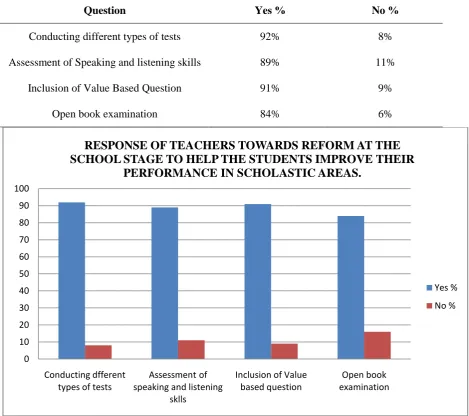
Table 1: Response of Teachers On The Reform At The School Stage Improving The
Performance Of Students In Scholastic Areas
GRAPH 1
0 10 20 30 40 50 60 70 80 90 100
Conducting dfferent types of tests
Assessment of speaking and listening
sklls
Inclusion of Value based question
Open book examination
RESPONSE OF TEACHERS TOWARDS REFORM AT THE SCHOOL STAGE TO HELP THE STUDENTS IMPROVE THEIR
PERFORMANCE IN SCHOLASTIC AREAS.
Yes %
No %
Question Yes % No %
Conducting different types of tests 92% 8%
Assessment of Speaking and listening skills 89% 11%
Inclusion of Value Based Question 91% 9%
SRJIS/BIMONTHLY/ SONIA GUJRAL & DR. MAMTA GUPTA (5459-5467)
[image:6.595.92.518.113.257.2]MAY-JUNE 2017, VOL- 4/31 www.srjis.com Page 5464 Table No.2:Response Of Teachers On The Reform At The School Stage Improving The
Performance Of Students In Co-Scholastic Areas.
Question Yes % No %
Assessment to be done systematically 95% 5%
Develops positive attitude 82% 18%
Helps in imparting value education 92% 8%
Learning & practicing life skills help students to improve their personal &
social qualities
87% 13%
[image:6.595.72.511.606.732.2]GRAPH 2
Table No. 3: Response Of Students On The Reform At The School Stage Improving The
Performance Of Students In Scholatic Areas
Question Yes % No %
Conducting different types of tests 73% 27%
Assessment of Speaking and listening skills
76% 24%
Inclusion of Value Based Question 79% 21%
Open book examination 84% 16%
0 10 20 30 40 50 60 70 80 90 100
Assessment to done systematically
Develop positive attitude
Helps in imparting Value education
Helps improve their personal & social
qualities
RESPONSE OF TEACHERS TOWARDS REFORM AT SCHOOL STAGE TO HELP THE STUDENTS TO IMPROVE THEIR
PERFORMANCE IN CO-SCHOLASTIC AREAS.
Yes %
SRJIS/BIMONTHLY/ SONIA GUJRAL & DR. MAMTA GUPTA (5459-5467)
[image:7.595.68.544.154.779.2]MAY-JUNE 2017, VOL- 4/31 www.srjis.com Page 5465 GRAPH 3
Table No.4: Respemse Of Students On The Reform At The School Stage Improving The
Performance Of Students In Co-Scholastic Areas.
Question Yes % No %
Assessment to be done systematically 73% 27%
Develops positive attitude 83% 17%
Helps in imparting value education 77% 23%
Learning & practicing life skills help you to improve your personal & social qualities
89% 11%
0 10 20 30 40 50 60 70 80 90 100
Assessment to done systematically
Develop positive attitude
Helps in imparting Value education
Helps improve their personal & social
qualities
RESPONSE OF STUDENTS TOWARDS REFORM AT SCHOOL STAGE TO HELP THE STUDENTS TO IMPROVE THEIR
PERFORMANCE IN CO SCHOLASTIC AREAS.
Yes % No % 0 10 20 30 40 50 60 70 80 90 Conducting dfferent types of tests
Assessment of speaking and listening
sklls
Inclusion of Value based question
Open book examination
RESPONSE OF STUDENTS TOWARDS REFORM AT SCHOOL STAGE TO HELP THE STUDENTS IMPROVE THEIR
PERFORMANCE IN SCHOLASTIC AREAS.
Yes %
SRJIS/BIMONTHLY/ SONIA GUJRAL & DR. MAMTA GUPTA (5459-5467)
MAY-JUNE 2017, VOL- 4/31 www.srjis.com Page 5466 GRAPH 4
Findings
As per Table No 1, the results revealed that 92% of the teachers agreed that conducting
different types of tests develop good study habit in students. 89% of teachers admitted
that assessment of speaking and listening helps the students top understand the language
better. 91% of teachers favored the value based questions as a part of summative
assessment. Majority of the teachers (84%) admitted that open text book examination
helps the students to enhance their thinking skills. (Graph 1)
According to Table No 2, the results revealed that 92% of the teachers admitted that the
assessment of co-scholastic areas need to be done systematically and methodologically.
80% of the teachers admitted that co-scholastic activities develop positive attitude and
confidence. 87% of the teachers agreed that learning & practicising life skills help the
students to improve their personal & social qualities. (Graph 2)
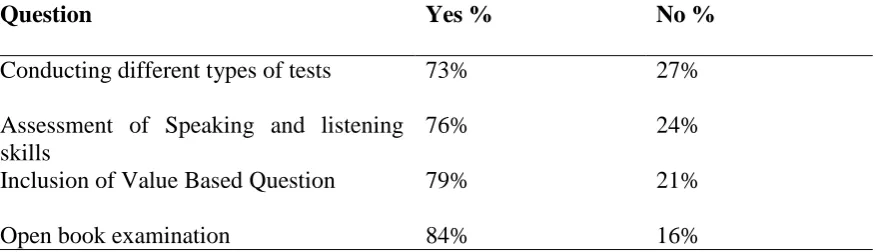
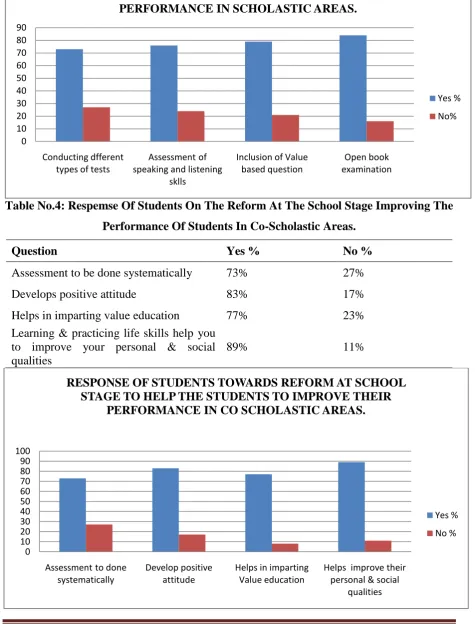
As shown in Table No. 3,seventy-three (73%) of students accepted that multiple types of
tests develop good study habits, but 17% of the students felt it burdensome to have so
many tests. 76% of the students agreed with assessment of speaking and listening helps
the students top understand the language better. 79% of the students favored the value
based questions as a part of summative assessment. Majority of the students (84%)
admitted that open text book examination helps the students to enhance their thinking
skills. (Graph 3)
As per Table No. 4, majority of the students (77%) felt that co - scholastic activities are
also important for imparting value education.73% of the students agreed that assessment
in co-scholastic areas need to be done systematically and methodologically. Most of the
students agreed that co-scholastic activities develop positive attitude and confidence. 89%
of the students favored that learning & practicing life skills helps them to improve their
personal & social qualities. (Graph 4)
Conclusion
With the growing demand and concern for improving the quality of achievement of the
learner, various commissions have stressed on the assessment of co- scholastic areas along
with scholastic aspects which include life skills, attitudes and value system. Life skills are
very important to develop healthy habits, attitudes decision making, problem solving, critical
SRJIS/BIMONTHLY/ SONIA GUJRAL & DR. MAMTA GUPTA (5459-5467)
MAY-JUNE 2017, VOL- 4/31 www.srjis.com Page 5467 lives in a healthy productive manner. Since it is a new area of evaluation system and new
curriculum, we face several challenges, and look for remedies for better implementation.
References
Government of India. (1986). National Policy on Education. New Delhi: MHRD Department of Education.
Agrawal. (2000). Towards quality schools through continuous and comprehensive evaluation. Journal of Indian Education, 1-11.
Habib, Z. (2012). Role of co-curricular activities for the performance of students at primary level in schools. . Interdisciplinary journal of contemporary research in business, Vol.3, No.9.
Jones, V. (2010). Virginia's academic and career plan emphasizes middle school. In V. Jones. Association for Career and Technical Education 85(7).
Junge, S., Manglallan, S., & Raskauskas, J. (2003). Building life skills through after school participation in experiential and cooperative learning. Child study journal,33.
NCERT. (1988). National Curriculum for Elementary and Secondary Education. New delhi: Publication Deaprtment NCERT.
NCERT. (2010). Continuous Comprehensive Evaluation Manual for teacher’s class VI to VIII. New Delhi: NCERT.
Rao, T. (2011). India's Youth Education Scenario-Need for Inclusion of Life Skills.