R E S E A R C H
Open Access
Description of complex interventions:
analysis of changes in reporting in
randomised trials since 2002
Bridget Candy
1*, Victoria Vickerstaff
1, Louise Jones
1and Michael King
2Abstract
Background:Inadequate description of non-pharmacological complex interventions in trial publications means
that they cannot be replicated or assessed for generalisability. There are published guidelines on how to describe an intervention, such as those from the CONSORT Group. However, there have been few evaluations of whether intervention reporting is improving.
Methods:We aimed to assess whether descriptions of multicomponent, non-pharmacological interventions
evaluated in randomised trials are improving. To do so, we chose trials of educational and psychotherapeutic interventions to promote adherence to therapy, and compared those published between 2002 and 2007 (Time-1) with those between 2010 and 2015 (Time-2). These time periods were chosen to concord with the publication in 2008 of the CONSORT extension statement of reporting guidelines for non-pharmacological treatment which included items on intervention description. We assessed 19 items, based on the CONSORT Statement and the more recent Template for Intervention Description and Replication Checklist (TIDieR). Two reviewers independently extracted data. We created a quality score of the eight items we considered key information for replication and assessment of generalisability (setting, provider, recipient, comparator, intervention intensity, how it was conducted, existence of a manual or protocol, and detail of whether there was an assessment of fidelity). Score per item was‘1’if reported adequately and‘0’if not.
Results:Of the eligible trials, 42 were published in Time-1 and 134 published in Time-2. The trials included were published in 112 peer-reviewed journals, 52 of these journals currently require authors to follow the CONSORT Statements, while only one recommended adherence to the TIDieR.
Most items of CONSORT and TIDieR were reported by more than half of the trials at both time points. Few trials reported fidelity. A large proportion of the trials did not report the existence of a manual or protocol, or what the comparator group received. We found no statistically significant improvement in the eight-item quality score (Time-1: mean 5.71 (standard deviation (SD) 1.09), Time-2: 5.87 (SD 1.28),p= 0.49).
Conclusions:We found no overall evidence that reporting the specifics of multicomponent, non-pharmacological interventions is improving. Details to replicate interventions remain lacking, impairing best implementation or meaningful further research. Editorial endorsement of reporting checklists needs to be more extensive.
Keywords: Trials, Reporting standards, Complex intervention content, CONSORT, TIDieR
* Correspondence:[email protected]
1Marie Curie Palliative Care Research Department, Division of Psychiatry,
University College London, 6th Floor, Maple House, 149 Tottenham Court Road, London W1T 7NF, UK
Full list of author information is available at the end of the article
Background
The development of effective healthcare interventions relies on appropriate design and evaluation. There are guidelines to assist in intervention development, includ-ing from the Medical Research Council (MRC) on com-plex interventions [1]. The MRC guidance recommends a careful process of development of underlying theory, modelling of process and outcomes, followed by assess-ment of feasibility and eventual dissemination. To enable dissemination, adequate description of any intervention is required so that it can be replicated and tested in other populations and settings, or generalised and ap-plied across contexts [2, 3]. Limitations in descriptions of interventions reported in publications in which these interventions have been tested in randomised trials may waste resources and potentially harm patients [4].
Reporting of complex, non-pharmacological interven-tions may be challenging. Such interveninterven-tions may be multi-faceted; there may be several components and it may be unclear which of these components provide the ‘active ingredient(s)’[1]. Moreover, both the effectiveness and the replicability of a non-pharmacological interven-tion may be reliant not only on how it is provided, but by whom [5]. Fidelity to protocol in the conduct of the intervention may be challenging, in part as an interven-tion may need to be tailored to the recipients [6]. How-ever, testing of complex interventions in randomised controlled trials is needed with clear descriptions of the content of the intervention and its procedures [7].
Recognition of the need to provide clear and complete reporting is not new. The Consolidated Standards of Reporting Trials (CONSORT) guidance first published in 1996 aims to improve trial reporting [8]. Consort reporting statements are held in high regard. Peer-reviewed journals and editorial publishing groups en-dorse them, for instance by providing direct links to CONSORT websites and requiring their use in submit-ted manuscripts of clinical trials. The 2008 extension to CONSORT Statements for non-pharmacological treat-ment [9] takes into special consideration the issues in reporting of these treatments, including intervention complexity and delivery (Table1). A more recent devel-opment that aims to enhance intervention reporting fur-ther is the Template for Intervention Description and Replication (TIDieR) Checklist [10]. This checklist in-cludes 12 domains. The endorsement of TIDieR has yet to be taken up as extensively by journals as the CON-SORT. Both TIDieR and CONSORT are listed for use in the international publishing and writing initiative to En-hancing the QUAlity and Transparency Of health Re-search (EQUATOR) network [11].
There are, to our knowledge, limited comparative eval-uations on whether reporting of interventions is improv-ing, none have compared two recent 5-year periods
separated by publication of a new reporting guideline. In this paper, we explored whether the quality of the de-scriptions of non-pharmacological interventions has im-proved by comparing trials published in the 5 years prior to the 2008 publication of the CONSORT exten-sion statement for non-pharmacological treatments with those published between 2010 and 2015.
Methods
We used, as an example, published papers reporting tri-als of interventions to promote adherence to therapy. We selected these type of interventions as we were aware of multiple trial evaluations, and because the in-terventions are varied, complex and multicomponent.
Data source
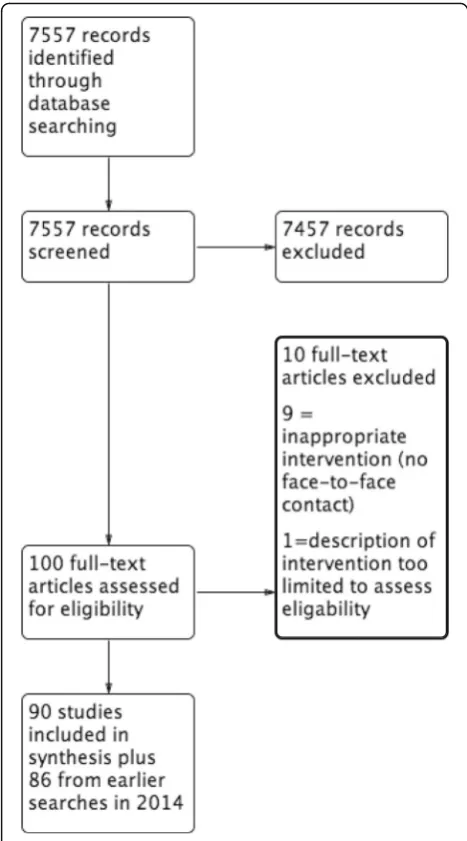
We used trials included in the latest version of a Cochrane review on interventions for enhancing medica-tion therapy adherence [12], but updated their search from 2013 to 2015. To do this we re-ran their search terms (see Appendix) in the same six citation databases they used (namely: CINAHL (via EBSCO), MEDLINE, EMBASE and PsycINFO (all via Ovid), Sociological Ab-stracts (via ProQuest) and Cochrane CENTRAL). We applied their inclusion criteria to identify relevant trials of these interventions. See review flow chart, Fig.1.
Our inclusion criteria
We included peer-reviewed journal publications of the main findings from randomised controlled trials of psy-chotherapeutic and/or educational interventions to pro-mote adherence to therapy. These trials were selected because the interventions are varied in their compo-nents and how they are provided. These complex varia-tions highlight the need for precise reporting of the intervention.
We included only those papers which evaluated a multicomponent intervention and for which there was some detailed description (more than one sentence) concerning the intervention content. This restriction allowed a more useful application of intervention-Table 1The Consolidated Standards of Reporting Trials (CONSORT) extension statement for non-pharmacological treatments: items specific to intervention description and its implementation
When applicable, eligibility criteria for centres and those performing the interventions
Precise details of both the experimental treatment and comparator
Description of the different components of the interventions and, when applicable, descriptions of the procedure for tailoring the interventions to individual participants
Details of how the interventions were standardized
reporting guidelines. We also only included those inter-ventions that involved face-to-face contact as opposed to those, for example, where the intervention was pro-vided online or via telephone contact. This restriction aimed to ensure greater similarity in aspects of the intervention for which it was reasonable to expect a clear and comparable description to have been included in the report of the trial (e.g. who delivered the intervention).
Trials were only included if they were published within two 5-year time periods; 2002 to 2007 (Time-1) and 2010 to 2015 (Time-2). We chose a gap of several years between the time periods to allow time for any impact of the 2008 extension to CONSORT Statements for non-pharmacological treatment on trial reporting of in-terventions [9].
Outcomes of interest
Our primary outcome of interest was the quality of the description of the intervention in terms of its:
Potential for replicability in clinical practice or in subsequent trials (e.g. content, intensity and how delivered)
Assessment for generalisability (e.g. setting, recipient and provider)
Secondary outcomes included:
Items that provide a greater understanding of the development of the intervention, such as theory to underpin the intervention or whether patients’views had informed development
Items that may provide additional description of the trial such as supplementary materials or descriptive aids such as a table or figure, and even the trial’s title
Items that may be more important to describe for some trials such as where the intervention is shaped or fitted to the requirements of each individual
Items on other ways that may measure
improvement in reporting such as the word length devoted to intervention description
Whether there are differences in reporting between trials published in journals that currently require trials to following CONSORT Statements or other reporting guidelines, and those that do not
Whether there are differences between trials published in journals with higher compared to lower impact factors
Data handling and analysis
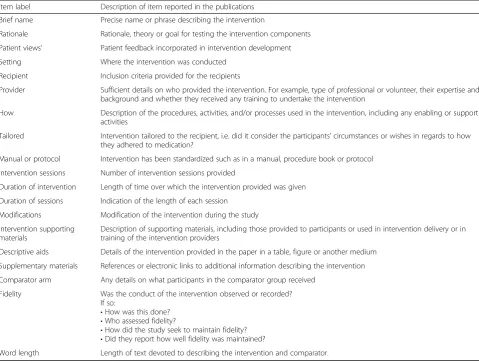
We extracted data guided by 19 categories/items relating to the development of the intervention, the description of the intervention and the description of any compara-tor (control or another intervention). These items are detailed in Table 2. They are based on the CONSORT extension statement [9] and the TIDieR Checklist [10], although most items are derived from the more exten-sive TIDieR Checklist. We extracted data on two add-itional items: the length of text devoted to the description of the intervention and the comparator; and whether the patients’ views were considered in the de-velopment of the intervention. We also noted how many of our included trials were published in journals that now recommend the use of the CONSORT and TIDieR Statements and the current impact factor of the journal.
[image:3.595.56.290.87.508.2]differences discussed between us. Should consensus not have been reached, we would have referred to discussion with the other authors (LJ, MK).
Not all the data that we extracted were relevant to our main outcome of interest (the provision of sufficient in-formation for replication and assessment of generalis-ability of outcomes). To enable us to answer our primary aim we created a total quality score of the eight items that we considered provided information needed for replication and generalisability. The items concerned description of the:
Setting
Intervention provider
Recipient
Comparator arm
and documentation of:
The number of sessions the intervention involved
How the intervention was provided
A manual or protocol
Whether fidelity of conduct of the intervention was assessed
We totalled the score for these items per time point. Data were summarised using descriptive statistics. T tests were used to compare quality scores between the time periods and between those which were published in a journal that requires the use of a CONSORT State-ment or other reporting guidelines and those which do not. Correlations were undertaken between the journal impact factor and overall quality score. Statistical ana-lysis was performed using Stata software version 13.
Results
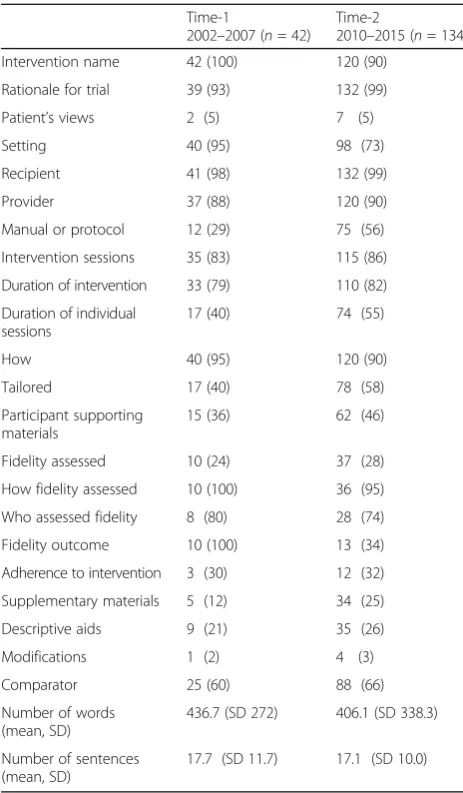
Forty-two trials published in Time-1 and 134 published in Time-2 were eligible for inclusion (See Fig.1). Table3
[image:4.595.58.538.99.462.2]presents how the items were reported. For many items reporting in both time periods was similar. In Time-1, eight items were adequately reported and in Time-2 six items were adequately reported in 90% or more of trials; for both time periods these included provision of a ra-tionale for the intervention, inclusion criteria for the Table 2Description of items extracted
Item label Description of item reported in the publications
Brief name Precise name or phrase describing the intervention
Rationale Rationale, theory or goal for testing the intervention components
Patient views’ Patient feedback incorporated in intervention development
Setting Where the intervention was conducted
Recipient Inclusion criteria provided for the recipients
Provider Sufficient details on who provided the intervention. For example, type of professional or volunteer, their expertise and background and whether they received any training to undertake the intervention
How Description of the procedures, activities, and/or processes used in the intervention, including any enabling or support activities
Tailored Intervention tailored to the recipient, i.e. did it consider the participants’circumstances or wishes in regards to how they adhered to medication?
Manual or protocol Intervention has been standardized such as in a manual, procedure book or protocol
Intervention sessions Number of intervention sessions provided
Duration of intervention Length of time over which the intervention provided was given
Duration of sessions Indication of the length of each session
Modifications Modification of the intervention during the study
Intervention supporting materials
Description of supporting materials, including those provided to participants or used in intervention delivery or in training of the intervention providers
Descriptive aids Details of the intervention provided in the paper in a table, figure or another medium
Supplementary materials References or electronic links to additional information describing the intervention
Comparator arm Any details on what participants in the comparator group received
Fidelity Was the conduct of the intervention observed or recorded? If so:
•How was this done?
•Who assessed fidelity?
•How did the study seek to maintain fidelity?
•Did they report how well fidelity was maintained?
recipient of the intervention and detail on how the inter-vention was provided. Some items were consistently under-reported in a large proportion of studies, in par-ticular, fidelity was reported as being assessed in 24% of the trials at Time-1 and in 28% at Time-2. There was no description of the comparator in 40% of studies at Time-1 and in 34% at Time-2. Very few trials, 5% at both times, reported that patients’views were considered in the development of the intervention. Some items were reported more often in Time-2: these were rationale, the existence of a protocol or manual, the existence of sup-plementary materials and whether or not the interven-tion had been tailored. Setting was more often reported in Time-1.
Using our overall quality score, we found no statisti-cally significant improvement in reporting of the eight
items we considered key information for replication and as-sessment of generalisability of these interventions (Time-1: mean 5.71 (standard deviation (SD) 1.09), Time-2: 5.87 (SD 1.28),p= 0.49.
Trials were published in 112 different peer-reviewed journals; of these journals 52 currently (November 2017) require authors to follow the CONSORT Statements, one specified the use of the TIDieR guidance. There was no statistically significant difference in reporting quality between trials published in journals that cur-rently recommend CONSORT or other reporting guide-lines (such as TIDieR) and those that do not. The average quality score for those which do not have reporting requirements was 5.75 (5.49, 6.01) and for those which do have reporting requirements was 5.99 (5.73, 6.24) (mean difference = −0.240, 95% confidence interval(CI)−0.61, 0.13,p= 0.20). There was no statisti-cally significant association between the reporting qual-ity of the trials and the current impact factor of the journals in which they were published (coefficent = 0.02, (95% CI−0.01, 0.05)),p= 0.15.
Discussion
Summary of key findings
We assessed whether descriptions of complex interven-tions in randomised trials are improving. To do so, we chose trials which evaluated multicomponent educa-tional and psychotherapeutic interventions to promote adherence to therapy. We found no overall evidence that reporting of intervention content is improving. Descrip-tions in trial papers remained poor, in particular, whether a protocol or manual describing the interven-tion existed and any details on what the comparator intervention or control involved. One reason that report-ing guidelines on intervention description have had little impact may be because a notable proportion of peer-reviewed journals do not currently require trial authors to use reporting guidelines. The TIDieR guidance super-sedes the CONSORT extension statement in regards to reporting the intervention. It includes a clearer under-standing of what detail may be included when reporting a trial of an intervention; however, only one of the jour-nals where papers in our sample were published cur-rently recommends its use.
Outcomes assessed
[image:5.595.56.288.108.505.2]We sought to evaluate whether the reporting of inter-ventions had improved as this is key to better assess-ments of the generalisabilty of the intervention and to replicate it. However, we recognize the challenges in our evaluation. Some items that we assessed concerned as-pects of development and design, while others con-cerned the quality of how the trial was conducted. Some items overlapped, for instance one considered access to Table 3Number of items reported (n(%))agrouped by 5-year
time periods
Time-1
2002–2007 (n= 42)
Time-2
2010–2015 (n= 134)
Intervention name 42 (100) 120 (90)
Rationale for trial 39 (93) 132 (99)
Patient’s views 2 (5) 7 (5)
Setting 40 (95) 98 (73)
Recipient 41 (98) 132 (99)
Provider 37 (88) 120 (90)
Manual or protocol 12 (29) 75 (56)
Intervention sessions 35 (83) 115 (86)
Duration of intervention 33 (79) 110 (82)
Duration of individual sessions
17 (40) 74 (55)
How 40 (95) 120 (90)
Tailored 17 (40) 78 (58)
Participant supporting materials
15 (36) 62 (46)
Fidelity assessed 10 (24) 37 (28)
How fidelity assessed 10 (100) 36 (95)
Who assessed fidelity 8 (80) 28 (74)
Fidelity outcome 10 (100) 13 (34)
Adherence to intervention 3 (30) 12 (32)
Supplementary materials 5 (12) 34 (25)
Descriptive aids 9 (21) 35 (26)
Modifications 1 (2) 4 (3)
Comparator 25 (60) 88 (66)
Number of words (mean, SD)
436.7 (SD 272) 406.1 (SD 338.3)
Number of sentences (mean, SD)
17.7 (SD 11.7) 17.1 (SD 10.0)
a
Including fidelity sub-items. See Table2for further details on items.SD
a manual and another access to supplementary material; both types of documents may hold similar details. Other items may have been more relevant for some trials than others. Our team held several discussions on what items to include in an overall quality score (on an adequate de-scription for replication and assessment of generalisabil-ity). We are aware that our final selection may fit some of the included trials better than others.
We are also aware that more detail on the interventions may have been found in supplementary materials, such as a published protocol. Our focus, however, was on what could be gleaned from the main trial papers. Importantly, some of the items missing in substantial proportions of studies would not have taken many additional words to describe. Therefore, word limitations would not necessar-ily be a reason for their exclusion. More journals are pro-vided in e-format only and thereby word restrictions are becoming less of an issue. Even reading a protocol will not necessarily provide information on whether all compo-nents planned were implemented as described. Since a substantial proportion of studies at both time points did not report the existence of other information, we believe that our evaluation is meaningful.
Uptake of guidelines and journal publication
We did not restrict our focus to journals that recom-mend the CONSORT Statements or use other guidelines on reporting the intervention. However, since the CON-SORT guidance is a well-cited tool, we assumed that these guidelines would have been taken up by authors and peer reviewers of their manuscripts. Our choice of not restricting by journal may be viewed as a limitation. Our lack of restriction however, highlights the limited endorsement of reporting guidelines amongst journals. We compared CONSORT and other guideline endorsers with non-endorsers. While we found no statistical sig-nificant difference in reporting quality between them, our analysis was based on whether the journalcurrently endorses reporting guidelines and not whether it did so in the year of publication of each trial. Therefore, our analysis may have under-estimated the impact of report-ing guidelines as some trials will have been published some years prior to this requirement.
We found no association between the quality of reporting of the intervention in trials and the current impact factor of the journals in which they were pub-lished. We are aware that current impact factors may not reflect that at the time each paper was published. However, while such factors change, the relative rank-ings often do not.
The TIDieR guidance provides more detail on what to consider when describing an intervention and we found most items of the guidance easy to apply to our data as they
were clearly expressed. However, some items remained open to differences in interpretation.
Why have we found no improvement?
Trials continue to under-report intervention descrip-tions. The reasons for this are multiple. There remains a lack of awareness of the need for adequate reporting as many journals still do not endorse the use of reporting guidelines. However, even when they do it is likely that these policies are not always closely adhered to. Authors may also have little steer from journals on what to in-clude in regards to intervention description, even from those that endorse the CONSORT guidelines. The items on intervention description in the CONSORT extension statement for non-pharmacological treatments are lim-ited. Important details, such as the length and intensity of the intervention, are not specified (see Table1). While the more recent TIDieR guideline provides more direc-tion it was only endorsed in one journal in this cohort. Another reason for under-reporting is that some au-thors, novice or experienced, may feel overwhelmed by the growing number of reporting tools and may not know which to select [13]. Furthermore, authors may be challenged because of the complexity of the intervention and their own lack of clarity on the key details (or active ingredients) that are essential to report. They may, for example, fear over-simplifying in providing a summary of the intervention’s content and delivery. Should this arise there is in general the opportunity to publish or make available the intervention on request in the format of a protocol, manual or separate paper describing the intervention in detail. However, this does not seem to be happening. In the more recent cohort in our study only just over half (56%) of the authors documented a link to further intervention details.
Protocols are still not being published. Reasons may include authors’ lack of awareness of the opportunity to publish a protocol. Some may not appreciate the value of devoting additional time to this endeavour. Not all journals may accept protocols. Some authors may not want to publish a protocol in case the intervention devi-ates in testing from what was originally set out in the protocol. While changes to intervention content are ac-ceptable and should be documented, some authors may be unaware of this. Others may be aware but have lim-ited time to devote to justifying this in trial publications.
Poor reporting is a wider issue
have been found [14–16]. For example, one study eval-uated reporting over three decades of 20,920 rando-mised controlled trials and found improvement in reporting of six methodological items, in particular in randomization sequence and allocation concealment [14]. However, these studies did not assess the report-ing of intervention features. Others that have assessed the quality of intervention description have not found improvement [17,18]. For example, a Cochrane review (in its last version published in 2012) exploring the im-pact of CONSORT Statements on trial reporting found no difference in reporting of intervention between trials published in journals that endorse CONSORT and those that do not [17]. Yu et al. explored in two cohorts (trials published in 2003 and 2013) the reporting of items in CONSORT including the CONSORT extension for Trials Assessing Non-Pharmacological Treatments [18]. While they found overall improvements in reporting in 2013 compared to 2003 they did not do so in items relating to the intervention. Another study reported similar findings when comparing intervention reporting of cardiac re-habilitation over several decades (1975 to 2014) [19]. In sum, these studies show that while there has been im-provement in reporting of methodological items in CON-SORT this has not extended to intervention descriptions.
It should be remembered that under-reporting is not an issue solely for the intervention [20]. Under-reporting can be found in all documents for clinical trials of both pharmacological and non-pharmacological interventions, from commercial companies and funders’ reports, to systematic reviews and guidelines [21]. However, to our knowledge, our study is the first to explore whether intervention reporting has improved between two 5-year time points separated by the publication of a new report-ing guideline.
Contextualising intervention development
Complex interventions, by the nature of their complex and multicomponent content, are difficult to describe. They are also difficult to develop, and poor description may reflect inadequate attention to the theoretical and modelling phases of their development. Consultation with stakeholders early in the development process is recommended [1] yet very few studies reported that they incorporated patient feedback into their intervention de-sign. This is surprising since the interventions that we focussed on addressed how best to help patients better adhere to their therapy.
Implications and perspectives
This study found no overall improvement in the report-ing of complex, multicomponent, non-pharmacological treatment interventions. There may be strong evidence that an intervention works but a clinician may be
unclear how to use it with their patients as the content of the intervention remains unclear. Researchers may also be unclear how to further develop a promising intervention as they are unsure they have all the details of what it involved.
Awareness raising of the need for reporting adequately interventions should be undertaken early, through edu-cation and training starting at university and continuing through professional education and continuous profes-sional development. Moreover, academic institutions could have reporting polices or recommendations for staff undertaking research. Checking that a manuscript adheres to reporting guidelines should not be the last thing an author undertakes prior to submission. Docu-mentation of key aspects of the intervention should be an integral part of the trial development and its analysis. In the case of developing complex interventions, greater attention should be paid early by research teams and re-search funders to the MRC and other intervention de-velopment guidelines. The inclusion of a statistician or other methodologist in a trial team has been demon-strated to improve quality of trial reporting [22].
Publishing groups and journal editors need to endorse reporting guidelines and provide links to initiatives like the EQUATOR guidance that help researchers to formu-late research design that is robust and easy to report. Fur-ther evaluations need to explore why journals do not recommend CONSORT or other recommendation report-ing guidelines, includreport-ing the more extensive TIDieR State-ments. In those that do recommend guidelines it would be useful to explore how well they ensure that authors ad-here to them. In a recent survey, it was found that only one of 59 leading pathology journals required authors to submit a guideline-reporting checklist [23]. Journals that implement a policy mandating the submission of a com-pleted reporting guideline checklist for studies have been found to increase compliance and improve the quality of reporting [24].
Conclusions
This study compared the quality of reporting of com-plex, multicomponent, non-pharmacological treatment interventions from 2003 to 2008 with 2010 to 2015. It explored reporting in trial papers of interventions to promote adherence to therapy. The study found no over-all improvement in reporting.
Appendix Search filters used
MEDLINE
1. ((exp patient compliance/ OR (patient adj
adherence).tw.) AND ((clinical trial OR random:).mp. OR tu.xs.)) NOT ((qualitative OR retrospective OR mice OR rat OR rats).tw. OR editorial.pt. OR letter.pt. OR comment.pt.) NOT (animals NOT humans).sh. 2. ((random: OR control:).mp. AND (exp patient
compliance/ OR patient dropouts/ OR psychotherapy/ OR treatment refusal/ OR patient education/ OR regimen:.tw.) AND (intervention: OR outcome:).tw. AND (medicat:.tw. OR drug therapy/)) NOT ((qualitative OR retrospective OR mice OR rat OR rats).tw. OR editorial.pt. OR letter.pt. OR comment.pt.) NOT (animals NOT humans).sh.
CINAHL
1. MH patient compliance+ OR TI“patient compliance”OR AB“patient compliance”OR TI “patient adherence”OR AB“patient adherence”OR TI“medication compliance”OR AB“medication compliance”OR TI“medication adherence”OR AB “medication adherence”NOT PT editorial or PT letter or TI qualitative or AB qualitative or TI retrospective or AB retrospective or TI mice or AB mice or TI rat or AB rat or TI rats or AB rats (limited by Clinical Queries therapy sensitive search filter and date–2007 to 2012).
2. MH patient compliance OR MH medication compliance OR MH patient dropouts OR MH treatment refusal OR MH patient education OR TI psychotherapy OR AB psychotherapy AND TX ((random* OR control*)) AND TX ((medicat* OR drug therapy)) NOT PT editorial or PT l.
EMBASE
(random: or control:).mp. AND (patient compliance or pa-tient dropouts or illness behavior or psychotherapy or treat-ment refusal or patient education or regimen:).mp. AND (intervention: or outcome: or treatment outcome).mp. AND (medicat: or drug therapy).mp. AND (clinical trial or controlled study or randomized controlled trial).mp.
PsycINFO
(((control: or random:).tw. or exp. treatment/) and (ad-herence or compliance or noncompliance or dropouts or patient education).mp. and (drug therapy or drug or medicat: or treatment or regimen).mp. and (intervention or outcomes or treatment outcomes).mp.) not (qualita-tive or retrospec(qualita-tive or mice or rat or rats).tw.
Sociological Abstracts
((patient or treatment or dropouts) AND (clinical trials or control) AND (drugs or medicine or medication)) (Searched using all fields; all(medication) retrieves su(me-dication adherence).
Abbreviations
CI:Confidence interval; MRC: Medical Research Council; SD: Standard deviation; TIDieR: Template for Intervention Description and Replication Checklist
Acknowledgements
We thank Marie Curie Care for funding the posts of two of the authors (BC, VV).
Funding
Marie Curie Care funded Bridget Candy and Victoria Vickerstaff through a Research Department Programme Grant award 168112.
Availability of data and materials
Not applicable
Authors’contributions
BC conceived of the idea. BC, LJ, MK and VV participated in the design of the project. BC and VV conducted the research. VV proposed and undertook the statistical analysis plan. BC drafted the manuscript. LJ, MK and VV provided critical input on the manuscript. All authors read and approved the final manuscript.
Ethics approval and consent to participate
Not applicable
Consent for publication
We consent to publish this research paper.
Competing interests
The authors declare that they have no competing interests.
Publisher’s Note
Springer Nature remains neutral with regard to jurisdictional claims in published maps and institutional affiliations.
Author details
1Marie Curie Palliative Care Research Department, Division of Psychiatry,
University College London, 6th Floor, Maple House, 149 Tottenham Court Road, London W1T 7NF, UK.2Division of Psychiatry, University College London, 6th Floor, Maple House, 149 Tottenham Court Road, London W1T 7NF, UK.
Received: 26 May 2017 Accepted: 15 January 2018
References
1. Craig P, Dieppe P, Macintyre S, Mitchie S, Nazareth I, Petticrew M. Developing and evaluating complex interventions: new guidance: MRC, 2008. https://www.mrc.ac.uk/documents/pdf/complex-interventions-guidance/. Accessed 25 May 2017.
2. Glasziou P. What is missing from descriptions of treatment in trials and reviews? BMJ. 2008;336:1472.
3. Conn VS, Cooper PS, Ruppar TM, Russell CL. Searching for the intervention in intervention research reports. J Nurs Scholarsh. 2008;40:52–9.
4. Chalmers I, Glasziou P. Avoidable waste in the production and reporting of research evidence. Lancet. 2009;372:86–9.
5. Beighton C, Victor C, Normansell R, Cook D, Kerry S, Iiiffe S, Ussher M, Whincup P, Fox-Rushby J, Woodcock A, Harris T. It’s not just about walking...it’s the practice nurse that makes it work’: a qualitative exploration of the views of practice nurses delivering complex physical activity interventions in primary care. BMC Public Health. 2015;15:1236. 6. Datta J, Petticrew M. Challenges to evaluating complex interventions: a
content analysis of published papers. BMC Public Health. 2013;13:568. 7. de Bruin M, Viechtbauer W, Hospers HJ, Schaalma HP, Kok G. Standard care
quality determines treatment outcomes in control groups of HAART-adherence intervention studies: implications for the interpretation and comparison of intervention effects. Health Psychol. 2009;28:668–74. 8. Begg C, Cho M, Eastwood S, Horton R, Moher D, Olkin I, Pitkin R, Rennie D,
9. Boutron I, Moher SD, Altman DG, Schulz KF, Ravaud P. Methods and processes of the CONSORT Group: example of an extension for trials assessing nonpharmacological treatments. Ann Intern Med. 2008;148:60–6. 10. Hoffman TC, Glasziou PP, Boutron I, Milne R, Perera R, Moher D, Altman DG,
Barbour V, Macdonald H, Johnson M, Lamb SE, Dixon-Woods M, McCulloch P, Wyatt JC, Chan A-W, Michie S. Better reporting of interventions: template for intervention description and replication (TIDieR) checklist and guide. BMJ. 2014;348:g1687.
11. EQUATOR Network. Enhancing the QUAlity and Transparency Of health Research.http://www.equator-network.org/. Assessed 25 May 2017. 12. Nieuwlaat R, Wilczynski N, Navarro T, Hobson N, Jeffery R, Keepanasseril A,
Agoritsas T, Mistry N, Iorio A, Jack S, Sivaramalingam B, Iserman E, Mustafa RA, Jedraszewski D, Cotoi C, Haynes RB. Interventions for enhancing medication adherence. Cochrane Database Syst Rev. 2014;11:CD000011. 13. Buccheri RK, Sharifi C. Critical Appraisal tools and reporting guidelines for
evidence-based practice. WorldViews Evid Based Nurs. 2017;https://doi.org/ 10.1111/wvn.12258
14. Dechartres A, Trinquart L, Atal I, Moher D, Dickersin K, Boutron I, Perrodeau E, Altman DG, Ravaud P. Evolution of poor reporting and inadequate methods over time in 20 920 randomised controlled trials included in Cochrane reviews: research on research study. BMJ. 2017;357:2490. 15. Moher D, Glasziou P, Chalmers I, Nasser M, Bossuyt PMM, Korevaar DA,
Graham ID. Increasing value and reducing waste in biomedical research: who’s listening? Lancet. 2016;387:1573-86.
16. Plint AC, Moher D, Morrison A, Schulz K, Altman DG, Hill C, Gaboury I. Does the CONSORT checklist improve the quality of reports of randomised controlled trials? A systematic review. Med J Aust. 2006;185:263–7. 17. Turner L, Shamseer L, Altman DG, Weeks L, Peters J, Kober T, Dias S, Schulz
KF, Plint AC, Moher D. Consolidated standards of reporting trials (CONSORT) and the completeness of reporting of randomised controlled trials (RCTs) published in medical journals. Cochrane Database Syst Rev. 2012;11: MR000030.https://doi.org/10.1002/14651858.MR000030.pub2
18. Yu J, Li X, Li Y, Sun X. Quality of reporting in surgical randomized clinical trials. British J Surg. 2017;104:296–303.
19. Abell B, Glasziou P, Hoffmann T. Reporting and replicating trials of exercise-based cardiac rehabilitation. Circulation. 2015;8:187–94.
20. Hudson BF, Oostendorp LJM, Candy B, Vickerstaff V, Jones L, Lakhanpaul M, Bluebond-Langner M, Stone P. The under reporting of recruitment strategies in research with children with life-threatening illnesses: a systematic review. Palliat Med. 2017;31:419–36.
21. Hoffmann TC, Walker MF, Langhorne P, Eames S, Thomas E, Glasziou P. What’s in a name? The challenge of describing interventions in systematic reviews: analysis of a random sample of reviews of non-pharmacological stroke interventions. BMJ Open. 2015;5:e009051.
22. Kloukos D, Papageorgiou SN, Doulis I, Petridis H, Pandis N. Reporting quality of randomised controlled trials published in prosthodontic and
implantology journals. J Oral Rehabil. 2015;42:914–25.
23. Caron JE, March JK, Cohen MB, Schmidt RLA. survey of the prevalence and impact of reporting guideline endorsement in pathology journals. Am J Clin Pathol. 2017;148:314–22.
24. Agha RA, Fowler AJ, Limb C, Whitehurst K, Coe R, Sagoo H, Jafree DJ, Chandrakumar C, Gundogan B. Impact of the mandatory implementation of reporting guidelines on reporting quality in a surgical journal: a before and after study. Int J Surg. 2016;30:169–72.
• We accept pre-submission inquiries
• Our selector tool helps you to find the most relevant journal • We provide round the clock customer support
• Convenient online submission • Thorough peer review
• Inclusion in PubMed and all major indexing services • Maximum visibility for your research
Submit your manuscript at www.biomedcentral.com/submit