UNIVERSITI TUN HUSSEIN ONN MALAYSIA
STATUS CONFIRMATION FOR MASTER’S PROJECT REPORT
AN EFFICIENTBACKOFF ALGORITHM FOR IEEE 802.15.4 WITH MAC TECHNIQUESIN SLOTTED CSMA/CA NETWORKS
ACADEMIC SESSION: 2015/2016
I, SHAYMA NAIF HASSAN, agree to allow this Master’s Project Report to be kept at the Library under the following terms:
1.This Master’s Project Report is the property of the UniversitiTun Hussein Onn Malaysia. 2. The library has the right to make copies for educational purposes only.
3. The library is allowed to make copies of this report for educational exchange betweenhigher educational institutions.
4. **Please Mark (√)
(Contains information and high security or of great importance to Malaysia as STIPULATED under the OFFICIAL SECRET ACT 1972) CONFIDENTIAL
(Contains restricted information as determined by the Organisation / institutions where research was conducted)
Approved by,
(WRITER’S SIGNATURE) (SUPERVISOR’S SIGNATURE)
Permanent address: DR. JIWA BIN ABDULLAH KL-SERDANG-SERI KAMPANG-43300
JUTAMINES CONDOMINUM BLOCK A-9-1
.
Date: Date:
Note:
FREE ACCESS CONFIDENTIAL
RESTRICTED
** If this Master’s Project Report is classified as CONFIDENTIAL or
RESTRICTED, please attach the letter from the relevant authority/organization stating reasons and duration for such classifications.
This thesis has been examined on date 29 DECEMBER 2015 and is sufficient in fulfilling the scope and quality for the purpose of awarding the
Degree of Master.Chairperson: DR. MARIYAM JAMILAH BT HOMAM Faculty Electrical and Electronic EngineeringUniversiti Tun Hussein Onn Malaysia
Examiners:
DR. LUKMAN HANIF BIN M. AUDAH Faculty of Electrical and Electronic Engineering Universiti Tun Hussein Onn Malaysia
TLE
AN EFFICIENT BACKOFF ALGORITHM FOR IEEE 802.15.4 WITH MAC TECHNIQUES IN SLOTTED CSMA/CA NETWORKS
SHAYMA NAIF HASSAN
A thesis submitted in partial
Fulfillment of the requirement for the award of the Degree of Master of Electrical Engineering
Faculty of Electrical and Electronic Engineering Universiti Tun Hussein Onn Malaysia
ii
DECLARATION
“I hereby declare that I have read this thesis and in my opinion, this work is sufficient in terms of scope and quality to be given honours in MASTEROF ELECTRICAL
AND ELECTRONIC ENGINEERING”
Student :………
SHAYMA NAIF HASSAN
Date :………
Supervisor : ……….
DR. JIWA BIN ABDULLAH
DEDICATION
I would like to dedicate my project to soul of my father (NAIF HASSAN) the lovely and kindest person, Rest his soul in Peace insha Allah and wish I achieved what he wanted me to do to satisfied from me.
A special dedication to:
My lovely mother (AMAL MUSTAFA)
“My beloved siblings”
WALEED, KHALED, MOHAMMED, AHMED, ATHRAA, SHAFAA, SANAA ALAA.
Without their full support, understand and love, the completion of this work would not have been possible.
To my lovely nephew (SAJAD NABEEL, ALI NABEEL, AHMED NABEEL) All love and thank to my sweat family ………..
And
All my beloved friends,
Who encouraged and inspired me throughout my journey of education.
iv
ACKNOWLEDGEMENT
Alhamdulillah. Thanks to Allah (SWT), Whom with His willing and generous giving me the opportunity to complete my Project. Project was prepared for Faculty of Electrical and Electronics Engineering (FKEE) at University Tun Hussein Onn Malaysia (UTHM) as graduate program for degree of master in Electrical and Electronic engineering (Communication Engineering).
Firstly, Immeasurable appreciation and deepest gratitude to my supervisor PROF. MADYA DR. JIWA BIN ABDULLAH, for giving me his time, effort, help, support, advices, guidance, valuable comment, and his suggestion is making my project finish and success.
Deepest thanks and appreciation to my lovely mother, my family for their encouragement, full of support, help me to study abroad and prayer for ALLAH to success in my study.
Thanks to all of my friends, those have been contributed by supporting my work, sharing important information about study and assisted each other’s to complete projects. May ALLAH bless all.
Last but not least, my thanks to Faculty of Electrical and Electronics Engineering
(FKEE) at University Tun Hussein Onn Malaysia (UTHM), for great commitment and cooperation during my Final Year Project and for all my lecturer who put their faith in me
ABSTRACT
vi
ABSTRAK
CONTENTS
TITLE ... i
DECLARATION... ii
DEDICATION... iii
ACKNOWLEDGEMENT ... iv
ABSTRACT ... v
ABSTRAK ... Error! Bookmark not defined. LIST OF TABLES ... xi
LIST OF FIGURE ... xii
LIST OF ABBREVIATIONS ... xiii
LIST OF APPENDEX ... xiv
CHAPTER 1 ... 1
INTRODUCTION... 1
1.1Background ... 1
1.2 Problem statement and motivation ... 3
1.2Objectives... 4
1.3 Summary ... 4
CHAPTER 2 ... 5
viii
2.1ntroduction ... 5
2.2 Wireless sensor networks ... 6
2.2.1 Wsns applications ... 6
2.2.2 Wsns challenges ... 8
2.3 Medium access control (MAC) Protocol for Wsns ... 8
2.3.1 Medium access control functions... 9
2.3.2 Medium access control requirements... 10
2.3.3 Energy-efficient techniques for MAC protocols... 11
2.4 IEEE 802.15.4 medium access control standard ... 11
2.4.1 An overview of IEEE 802.15.4 standard ... 11
2.4.1.1In this exploration. ... 12
2.4.1.2Network topology ... 13
2.4.2 Limitations of IEEE 802.15.4 MAC ... 20
2.4.1.3Power efficiency limitation ... 21
2.4.1.4Throughput limitation ... 21
2.5 Related work on different algorithms to enhance the IEEE 802.15.4 MAC ... 22
2.6 Summary ... 32
CHAPTER 3 ... 33
METHODOLOGY ... 33
3.1 Introduction ... 33
3.2 System goals and definition ... 35
3.2.1 Network definition ... 36
3.2.2 MAC layer implementation ... 38
3.3 Channel access procedure ... 39
3.3.1 Carrier sense multiple access with collision avoidance (CSMA/CA) algorithm ... 39
3.3.2 Problem analysis and proposed solutions of CSMA/CA algorithm ... 42
3.4.1 Description of EBA-15.4 MAC algorithm... 44
3.4.2 Working principle of the EBA-15.4 MAC algorithm ... 46
3.5 Research scope ... 51
3.5.1 Scheduled-based MAC protocols ... 51
3.5.2 Contention-based MAC protocols ... 51
3.6 Study module ... 53
3.7 System model assumptions ... 54
3.8 Performance parameters ... 55
3.8.1 Network throughput ... 55
3.8.2 End-to-End Delay ... 56
3.8.3 Delivery ratio ... 56
3.8.4 Energy consumption ... 57
3.9 Network simulator (NS-2) ... 57
3.10 Summary ... 58
CHAPTER 4 ... 59
RESULTS AND ANALYSIS ... 59
4.1 Proposed system ... 59
4.2 Algorithm (CSMA/CA) ... 60
4.3 Algorithm performance ... 61
4.4 Tools ... 63
4.5.1 Scenario one: Implementation mathematical equations for parameters in NS2 programm ... 65
4.5.1.2Energy consumption ... 67
4.5.1.3Link quality indicator drops ... 68
4.5.2 Scenario two: different number of traffic generation loads ... 69
4.5.3Scenario three: different number of active nodes ... 71
4.6 Discussion... 73
x
CONCLUSION AND FUTURE WORK ... 74
5.1 Conclusion ... 74
5.2 Future work ... 75
REFERENCES ... 76
LIST OF TABLES
2.1: Comparison and Summary of Different………..………36
Mechanisms to Enhance the Performance
of IEEE 802.15.4 WSNs
xii
LIST OF FIGURE
FIGURE 1.1:STUDY MODULE ... ERROR!BOOKMARK NOT DEFINED.
FIGURE 2.1:IEEE802.15.4/ZIGBEE PROTOCOL STACK ... 12
FIGURE 2.2:AN EXAMPLE OF A WSN ... 13
FIGURE 2.3:SENSOR NODE INNER STRUCTURE ... 14
FIGURE 2.4:STAR TOPOLOGY MODEL ... 16
FIGURE 2.5: PEER-TO-PEER TOPOLOGY MODEL ... 23
FIGURE 2.6:OPERATION MODES OF IEEE802.15.4STANDARD ... 18
FIGURE 2.7:IEEE802.15.4SUPERFRAME STRUCTURE ... 20
FIGURE 3.1:PROCESS FLOW DIAGRAM ... 37
FIGURE 3.2:CSMA-CA ALGORITHM SLOTTED ... 48
FIGURE 3.3:EBA-15.4MACPROPOSED ALGORITHM ... 50
FIGURE 3.4:STUDY MODULE..………..………59
FIGURE 4.1:TOPOLOGY FOR NODES ... 67
FIGURE 4.2: MATLAB TOOL... 69
Figure 4.3: Packet data ratio………..…….….….…69
FIGURE 4.4:ENERGY CONSUMPTION ... 67
FIGURE 4.5:LQI DROPS ... 71
FIGURE 4.6:LQI DROPS VERUS TRAFFIC LOAD ... 73
LIST OF ABBREVIATIONS WSNs MEMS BS MAC CW CSMA/CA NTB TB LR-WPANs CAP CFP NS-2 FFD RFD BI BO CCA GTS PPCLSS 𝐸𝐸𝑡𝑡
𝑅𝑅𝑒𝑒(𝑖𝑖)
𝑃𝑃𝑟𝑟(𝑖𝑖)
𝐸𝐸𝑟𝑟
𝐸𝐸𝑢𝑢(𝑖𝑖)
LE
Nr
Ns
Wireless Sensor Networks
Micro-Electro-Mechanical System
Base Station
Medium Access Control
Contention window
Carrier Sense Multiple Access with Collision Avoidance
Next Temporary Backoff
Temporary Backoff
Low Rate Wireless Personal Area Networks
Contention access period
Contention free period
Network Simulator
Full Function Device
Reduced FunctionDevice
Beacon Interval
Beacon Order
Clear Channel Assesment
Guaranteedtime spaces
Probabilistic Prediction Coefficient Based Link Stability Scheme
Total energy of mobile node ‘i’
Residual energy
Number of packets relayed by node ‘i’
Maximum energy
Energy utilized by nodes
Link Estimate
No. of Retransmit Packet
xiv
LIST OF APPENDEX
APPENDEX TITLE PAGE
CHAPTER 1
INTRODUCTION
1.1 Background
The IEEE 802.15.4 standard was proposed and had been commercially adopted for protocols in the physical and data link layers. That supports low data rate, low cost, low complexity and low power consumption applications [1]. The MAC layer of IEEE 802.15.4 standard works in two possible modes, the beacon and beaconless modes and supports both star and peer to peer network topologies [2]. In beacon enabled mode the central coordinator is responsible for sending beacons in order to synchronize the nodes [2].
2
busy this value shall increase to the maximum value of 5. This backoff delay time along with channel sensing and finally packet transmission have all occurred in the backoff period, which is limited by the bounds of each slot contained in the 16 superframe slots [3].
Nevertheless, following CSMA/CA backoff strategy cannot totally avoid collisions.This is imputable to the fact that the backoff period is randomly picked out from the modest range of [0-2BE-1] and therefore, there is a big possibility that more than two nodes pick up or touch the same backlog periods and as the web becomes larger in scale or nodes emit intensive and frequent traffic loads, this example is more likely to happen [3].Apparently, this position arrives at those nodes which become silent for the same backup periods detect that the availability of the free channel simultaneously.As a solution, they start emitting data at the same time having an unavoidable collision.This leads to retransmissions and consequently will increase power consumption which is a critical constraint in WSN. This will also affect network throughput which is a result of packet losses, and hence affect network performance [3].
1.2 Problem statement and motivation
Medium Access Control (MAC) plays an significant part in the performance of WSNs especially in the case of contention based protocols such as IEEE 802.15.4 standard [6]. It is established standard technology designed to achieve low complexity, low price and low rate wireless networks such as Wireless Sensor Networks (WSNs). In addition, IEEE 802.15.4 standard defines the specifications of the PHY and MAC sublayer for low-rate wireless personal area networks (LR-WPANs). It is capable to operate via two different channel access methods: beacon-enabled mode and non-beacon beacon-enabled mode. The beacon is defined as a special synchronization frame generated periodically by the coordinator node [7, 8].
In this research, focuson beacon-enabled based IEEE 802.15.4 MAC due to its simplicity for WSNs application compared to the non-beacon enabled mode [9-11]. To come up to the demands of the WSNs, IEEE 802.15.4 standard utilizes the slotted carrier sense multiple access with collision avoidance (CSMA/CA) mechanism.[12, 13]. The drawbacks of currentCSMA/CA algorithm are asfollows: 1. CSMA/CA updates contention window size without considering the number of
competing nodes in the communication medium.
2. CSMA/CA uses very limited number of Backoff Exponent (BE) that increased probability of two nodes selecting the same number of backoff periods. This will give rise to more collisions among the contending nodes and affect the overall system’s performance.
3. In CSMA/CA, the node performs carrier sensing only when the backoff process is completed. Hence, causing longer average time delay.
4
1.2 Objectives
The objectives of the project are:
1. To investigate an efficient and adaptive backoff technique.
2. To increase throughput and delivery ratio by offering an efficient backup algorithm that defines the appropriate size of contention window (CW).
3. To develop simulation framework to minimize the access collision, average delay and energy use of the proposed technique by using a novel Temporary Backoff (TB) and Next Temporary Backoff (NTB).
4. To evaluate the performance of the proposed model, algorithm in term of metrics which are (throughput, end to end delay, energy consumption, packet data ratio).
1.3Summary
CHAPTER 2
LITERATURE REVIEW
2.1ntroduction
Recently the development of Wireless Sensor Networks (WSNs) has largely been driven by numerous military, industrial, and scientific applications [9].Sincesensor nodes deployed in real environments have greatdifficulty in recharging their batteries, the reduction ofthe power consumption becomes one of the main challenges and concerns [13,14].
IEEE 802.15.4 standard defines the characteristicsof the physical and MAC layers for low-rate, low-power andlow-complexity WPANs, which is compatible with Zigbeeand Bluetooth communication networks [13]. The advantages ofa WPAN are ease of installation, reliable data transfer, short-rangeoperation, extremely low cost and a reasonable batterylife, while maintaining a simple and flexible protocol stack. Thephysical layersupports functionalities for channel selection, link qualityestimation, energy detection measurement and clear channelassessment (CCA) [14]. The MAC layer defines two operationalmodes, namely, non-beacon-enabled mode and beacon-non-beacon-enabled mode [17].
The original IEEE 802.15.4 standard was proposed in 2003.To accurately predict the performance of SCSMA algorithmsfor IEEE 802.15.4 networks, several analytical models werepresented. [17].
6
2.2 Wireless sensor networks
Remote sensor systems comprise of countless sensor hubs that are sent in the detecting field covering a vast geological zone. These sensors are little in size with restricted assets and are low-control gadget that has capacity sense natural physical phenomenasuch as temperature, weight, stickiness and procedure data for information sending to one or more particular focuses, called sinks or base stations [17]. In view of above representation. There are essential parts of WSNs as below:
Sensor node: represents few to a huge number of hubs that cooperate for observing a particular district to gather information from distinctive environments [18].
Sensor field: an expansive region or physical environment that must be checked. A sensor field incorporates parks, doctor's facility, battlefields, and homes [18].
Sink hub (Base Station): responsible for transmitting information and related data to all sensor hubs in the system [19].
Remote User (Observer): a hub that gives summons to the sensor system by means of the sink hub to dole out errands and exchange information to alternate sensors and get information detected through the sink [19].
Event (Command): the followed question and checked phenomena for occurrence, temperature, weight, humidity, and creatures' development [20].
2.2.1 Wsnsapplications
detecting of one or couple of parameters of major item like a building or open space, WSNs additionally permit to control the procedures in article [20].
WSNs advances began to effectively create in mid 1990s, and before all else of 2000s the microelectronics improvement made it conceivable to item rather modest basic base for sensor hubs. A considerable measure of branches and business fragments (generation, building, diverse sorts of transport, life bolster, security, fighting) are occupied with WSNs organization, and their number is for all time expanding [21].
Checking applications comprise of force observing, wellbeing observing, grape observing, and sea water observing. Following applications comprise of following creatures, movement, articles, and people. Subsequently, presented diverse zones for these applications and how they relate and apply in genuine situation [20, 22].
(i) Military applications: are viewed as essential zone of enthusiasm relating to ideas of remote sensor systems. Its having turned into fantastic instrument for example, interruption location frameworks, war zone reconnaissance [23]. (ii) Industrial application: The execution of mechanical application is standout
amongst most critical key elements. Sensors can exchange information inside of particular and known time. For example, manufacturing, packaging, and wood machining that need frameworks with superior to accomplish low expenses [23].
(iii)Healthcare observing applications: WSNs innovations can enhance human services, patient checking and change lifestyles with their applications. Baby observing and alarming listening to hindered [23].
(iv)Building applications: WSNs give colossal answers for vitality sparing by facilitating accessibility of information and establishment of sensors. In such applications, remote correspondence advancements assume bigger part to give opportunities and approaches to expand quantity of sensors, controllers, and actuators by lessening expenses and establishment work [23, 24].
8
Cost: it is evident and critical to lessening upkeep cost when utilizing remote sensors on account of extensive structure.
Accuracy: expression "precision" is not particular with all sensor gadgets, for instance, inner or outer frameworks.
Interference:Standard estimation strategy can be utilized to give normal impedance design that could help clients characterize their remote framework.
2.2.2 Wsnschallenges
Numerous specialists concentrated on modest bunch of imperative variables that are thought to be a major test in configuration of sensor systems and sensor hub stages. These variables incorporate force utilization, adaptation to non-critical failure and scalability [25].
(i)Faulttolerance: This disappointment ought not to influence general sensor hub's attributes and imperatives. This called adaptation to non-critical failure, characterizing capacity to accomplish stable usefulness of sensor systems with no interference because of sensor hub failures [25].
(ii)Power utilization: This plan specifically impacts system lifetime as sensor hubs are controlled by battery. As sensor hubs ought to have a lifetime to extent that would be possible to empower them to fulfil application necessities [27, 29]. (iii) Scalability: This variable must have capacity to be adjusted to few elements
changing, for example, change in topology and system estimate that can be utilized as part of sensor hubs' organizations. [30, 31].
2.3 Medium access control (MAC) Protocol for Wsns
challenges, classifications and a percentage of MAC convention benchmarks, for example, IEEE 802.15.4 [32].
2.3.1 Medium access control functions
Essential capacity of MAC convention's configuration is to guarantee vitality effectiveness identifying with remote medium, throughput, inactivity and additionally conveyance proportion contingent upon particular outline and its applications [31]. Numerous MAC convention capacities have been acquainted due with system's and upper layer's necessities. When all is said in done, MAC conventions give accompanying key capacities [32]:
(i) Medium access control: Provide correspondence between connections at any given time and help the hub choose how and when to get to the channel.
(ii) Framing: Define usefulness of casing organization, for example, outline length between listening and rest state furthermore to give information execution between specialized gadgets.
(iii) Addressing: In this capacity, information connection layer characterizes locations of both sender and beneficiary by adding header to casing.
(iv) Reliability: Used to guarantee fruitful information conveyance between gadgets. There are numerous strategies to guarantee fruitful information transmission; the most well-known one is through affirmation (ACK) and re-transmission of harmed or lost edges.
(v) Flow control: Data connection layer uses this component if the information rate retained in beneficiary is not as much as that of information rate created by sender. Utilizing this method abstains from overpowering the beneficiary. (vi) Error control: Consisting of mistake location and adjustment administrations,
10
2.3.2 Medium access control requirements
Medium access control conventions for remote sensor systems must give best execution attributes that mirroring its conduct, for example, throughput, dormancy, and conveyance proportion to get lower vitality utilization as examined in past area [25]. By and large, first objective of planning a run of mill MAC convention is to make framework of sensor system when countless hubs are conveyed, MAC convention must start and set up a correspondence connection between these sensor hubs. Second objective is, to share correspondence medium decently and proficiently. Numerous specialists are at present drawn in to create plans that satisfy few properties and traits that ought to have been considered amid configuration of decent proficient MAC protocol [25, 33, 34]. These characteristics delineated are: (i) Energy efficiency: primary force wellspring of sensor hubs is battery.
Numerous scientists have engaged and concentrated on numerous instruments on most proficient method to minimize vitality to beat its effect on framework execution [32].
(ii) Throughput: In correspondence conventions, I can gauge system's proficiency by hub's throughput. A decent remote MAC convention must give high throughput and low dormancy to get steady framework execution of vitality effectiveness. For example, crash shirking, idleness, and channel use [35]. (iii) Latency: The vital element of idleness is subject to specific applications, for
example, checking or observation. In such applications, for quite a while, hubs will be checked until something is recognized [33].
(iv) Fairness: Reasonableness is characterized as capacity of clients, hubs, or applications to share or access channel just as. In WSN, all hubs work for a solitary regular errand. [32].
2.3.3 Energy-efficient techniques for MAC protocols
The vitality effectiveness procedure is standout amongst the most essential issues in WSNs. sensor hubs are battery fuelled and substitution and in addition energizing of batteries is troublesome. A few originators of sensor hubs have attempted to diminish this expense by supplanting the sensor hub instead of energizing them. Keeping in mind end goal to plan productive MAC convention, I must keep accompanying four noteworthy wellsprings of vitality waste in remote sensor networks [31, 35]:
(i) Packet collision: Collision happens when there is more than one parcel attempting to transmit to specific hub in meantime. At point when this happens, every impacted bundle must be disposed of and re-transmitted once more. This prompts expanded vitality utilization.
(ii) Idle tuning in: It happens in numerous sensor applications when hubs listen to an unmoving channel to get fitting trafficthat is not yet sent.
(iii) Control parcel overhead: Packet overhead is utilized to make information transmission between hubs. Sending and accepting these bundles will devour vitality yet we can lessen parcel overhead when utilizing cross-layer outline in light of fact that this will build up communication between distinctive layers. (iv) Message overhearing:That happens when hubs get an excess of parcels
transmitted over the common medium not bound to a particular hub.
2.4 IEEE 802.15.4 medium access control standard
This area presents a diagram of 802.15.4 MAC convention standard that is being concentrated on in this examination. I checked on in this segment, 802.15.4's qualities and capacities, system topology, convention structural planning and latest related deals with diverse backoff components [37].
12
This segment presents outline of 802.15.4 MAC convention standard that is being contemplated in this exploration. I explored in this segment, 802.15.4's qualities and capacities, system topology, convention building design and latest related deals with diverse backoff components [36].
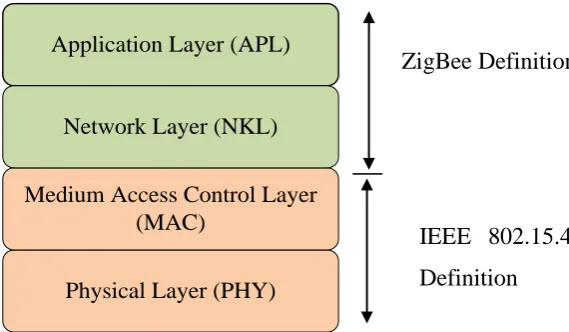
[image:28.595.262.547.389.555.2]IEEE 802.15.4 standard characterizes particulars of both PHY layer and MAC sub-layer for low rate wireless personal area networks (LR-WPANs) [36]. Standard is intended to accomplish ease, low power and low information rate transmissions [37]. The benefit of LR-WPAN is minimal effort, dependability of information exchange, simple installation, and suitable battery life. While 802.15.4 is intended for PHY and MAC layers, ZigBee convention is set up for higher layers. NWK and APL layers. The ZigBee Alliance convention lives up to expectations in conjunction with IEEE 802.15.4 gathering to frame basic convention stack for WSNs [19]. (Figure 3) represents the IEEE 802.15.4/ZigBee convention construction model
Figure 2.1: IEEE 802.15.4/ ZigBeeprotocol stack
2.4.1.1 In this exploration, attention is on IEEE 802.15.4 MAC convention.IEEE 802.15.4 MAC layer characterizes two sorts of hubs: Full Function Device (FFDs) and Reduced Function Device (RFDs). FFD is complete useful gadget of IEEE 802.15.4 that backings all MAC layer capacities and primitives while RFD is prepared to bolster subset of them [38]. Additionally, FFD can go about as system facilitator or as system end-gadget. At point when FFDs is going about as facilitator, it can send reference point extraordinary synchronization outline that is
IEEE 802.15.4 Definition ZigBee Definition Application Layer (APL)
Physical Layer (PHY) Medium Access Control Layer
(MAC)
then utilized for correspondence between system administrations. Then again, RFDs must be end-gadget and interface with solitary FFD. The accompanying area gives more insights about parts of the two unique sorts of gadgets, FFDs and RFDs relying upon kind of topology [37].
[image:29.595.114.513.235.500.2]2.4.1.2 Network topology
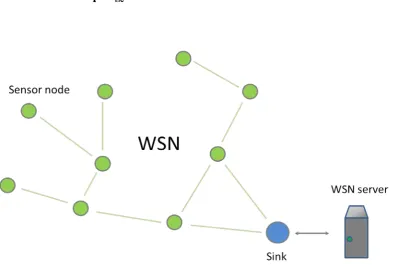
Figure 2.2: An example of a WSN
14
[image:30.595.108.496.189.453.2]source and is associated with server which is handling information got from WSN. Such association is executed straightforwardly, if server and WSN are put on same article. In event that it is important to give remote access to WSN, system sink likewise works as entryway, and it is conceivable to cooperate with WSN through worldwide system, for example, the Internet [38].
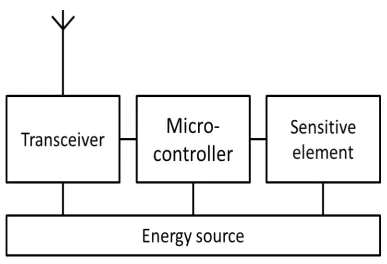
Figure 2.3: Sensor node inner structure
Inside sensor hub microcontroller (all more absolutely, its firmware) represents information gathering and association with other sensor hubs. Microcontroller firmware has arrangement of calculations to control handset and detecting component [35]. These calculations make it conceivable to give sensor hub working. In meantime, notwithstanding information gathering and transmitting their own estimations, sensor hubs takes a section in information transmission from other remote sensor hubs. Likewise, microcontroller firmware is checking the sensor hub's battery and on account of its running down it changes every one of its parts' operation mode to extend sensor hub uptime however much as could reasonably be expected [37].
Another vital normal for WSN is self-association of intra-system integration. System self-association makes it workable for arbitrarily spatially appropriated sensor hubs and sinks to frame a WSN naturally [39]. Besides, when system is being used and there are association issues with some sensor hubs, it doesn't make entire framework come up short. All things considered WSN essentially changes its method of operation with specific end goal to not utilize lost hubs for information transmission [37]. This element of WSNs perceptibly streamlines their establishment and upkeep, furthermore permits to make WSNs with huge number of hubs on grounds that there is no compelling reason to change system's mode physically when including new hubs [35]. WSN's self-association highlight all in all makes WSN more dependable in light of fact that system reproduction should be possible continuously mode and it permits WSN to rapidly respond to earth changes or sensor hubs disappointments. Moreover, self-association calculations can give improvement of vitality utilization to information transmission [38].
16
IEEE 802.15.4 supports two main types of network topology. They can form star (single-hop) and peer-to-peer (multi-hop) topologies and they are defined as follows [31]:
[image:32.595.395.543.299.441.2](i) Star In this system topology: PAN facilitator can correspond with hubs to build up and keep up transmission. In star topology, FFD can take part of PAN facilitator while alternate hubs can be RFDs or FFDs with their interchanges to the organizer. In this exploration, star system topology is considered.(Figure 2.4) demonstrates system model of star system [19].
Figure 2.4: Star Topology Model [39]
(ii) Peer-to-peer topology (multi-hop):
In shared topology (as showed in Figure 2.5) hubs can converse with facilitator and course their information inside of transmission range. Additionally, FFD can correspond with different FFDs through middle FFD to shape multi-bounce system [19]. A few distributed systems can cooperate to shape additional system topologycross section/group tree topologies.
PAN
PAN
Reduced Function Device (RFD)
Full Function Device (FFD)
PAN Coordinator
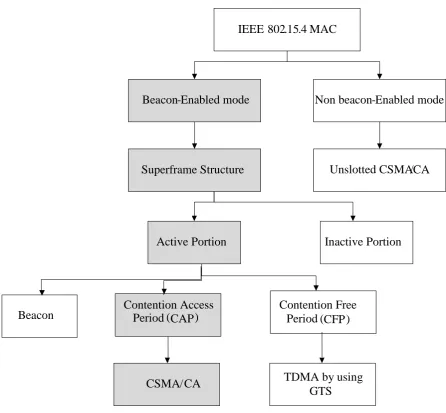
The operation of IEEE 802.15.4 system can deal with two typical channel access techniques: guide empowered mode and non-reference point empowered mode [40]. (i) Beacon enabled mode:
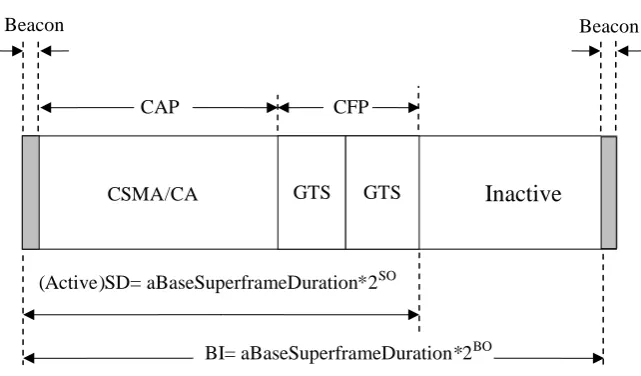
In this method of operation, organizer utilizes superframe to manage entire session of bundle transmission as portrayed. The superframe is bound by exceptional synchronization edges sent intermittently from organizer hubs called reference points [18].A superframe starts and closures with reference point outline. The period between two back to back signals is known as Beacon Interval (BI) and it is size characterized inside of Beacon Order (BO) parameter as takes after [17].
PC
PC
Reduced Function Device ( RFD ) Full Function Device (FFD)
[image:33.595.391.542.94.273.2]PAN Coordinator Communication Flow
18
Figure 2.6: Operation Modes of IEEE 802.15.4 Standard
BI = aBaseSuperframeDuration *2BO symbols (2.1) For 0 ≤ BO ≤ 14
Moreover, each superframe comprises of dynamic and dormant period. The dynamic piece of superframe is partitioned into 16 equivalent estimated timeslots and took after by dormant period. Amid dynamic period, sensor hubs speak with organizer and enter low-power state in inert period to spare vitality. The dynamic period is alluded
IEEE 802 . 15 . 4 MAC
Beacon - Enabled mode Non beacon - Enabled mode
Superframe Structure Unslotted CSMA / CA
Active Portion Inactive Portion
Contention Access Period ( CAP )
Contention Free ( CFP )
to asSuperframe Duration (SD) and characterized through Superframe Order (SO) parameter [17] as takes after:
SD = aBaseSuperframeDuration * 2SO symbols (2.2) For 0 ≤ SO ≤ BO ≤ 14
As indicated by Equation (2.1) and (2.2) aBaseSuperframeDuration alluded to as base length of time of superframe, is settled to 960 images (IEEE 802.15.4 Standard 2006) and characterized as quantity of images framing superframewhensuperframe request is equivalent to 0 [36]while every image speaks to season of transmitting four bits [41]. The estimation of two characteristics, macBeaconOrder (BO) and macSuperframeOrder(SO) decides how regularly facilitator transmits its signal. 0-15 is scope of BO thus. In my situation, I utilized equivalent estimation of SO and BO (SD =BI) to keep the superframe dynamic at all times [35].
What's more, dynamic period (SD) is likewise separated into three sections: reference point, controversy access period (CAP) and Contention Free Period (CFP). The three sections contain 16 time spaces same long and estimate and characterized in as [19]:
aBaseSuperframeDuration = aBaseSlotDuration*aNumSuperframeSlots(2.3) = 60 * 16 = 960 images
aBaseSlotDuration is quantity of images framing superframe opening when superframe request is equivalent to 0, while aNumSuperframeSlots is quantity of spaces contained in any superframe (IEEE 802.15.4 Standard 2006). Any gadget wishing to get to channel and communicate during CAP utilizes an opened CSMA/CA component.
20
Figure 2.7 : IEEE 802.15.4 Superframe Structure
(ii) Non-beacon enabled mode:
There is no superframe in non-signal empowered mode. Gadgets are constantly dynamic and an unspotted CSMA/CA calculation is utilized for channel access and bundle transmission [42]. In this examination, we concentrated on reference point empowered method of IEEE 802.15.4 MAC standard and proposed proficient and versatile system to comprehend wasteful backoff strategy and to improve CSMA/CA calculation [41].
2.4.2 Limitations of IEEE 802.15.4 MAC
This area presents the most imperative restrictions of IEEE 802.15.4 MAC standard on account of channel access methods and information transmission plans by utilizing customary transporter sense various gets to with crash shirking CSMA/CA calculation. The accompanying sub-areas present constraints of 802.15.4 as far as force utilization and throughput which is measure the productivity of the system[44].
CSMA/CA GTS GTS Inactive
CAP CFP
Beacon Beacon
(Active)SD= aBaseSuperframeDuration*2SO
2.4.1.3 Power efficiency limitation
One principle issue that causes wastage in vitality effectiveness of IEEE 802.15.4 is clarified in accompanying. The dynamic time of 802.15.4 can be isolated into contention access period (CAP) and contention free period (CFP). In CAP, opened CSMA/CA component is utilized. Amid channel access technique, hub might hold up irregular number of backoff periods chose somewhere around 0 and (
BE
2 - 1), BE is backoff example characterizing holding up time hub should hold up before attempting to get to channel [36], BE begins with estimation of 3 spoke to by macMinBEand has its most extreme estimation of macMaxBEthat is spoken to by 5. Because of less quantities of BE, likelihood of hubs picking indistinguishable number of backoff types will build bringing on considerable measure of utilization in vitality and corruption in framework execution. Numerous arrangements have been proposed in our related work to beat previously stated issue, one of which being our proposed calculation as we will examine top to bottom inchapter three. I can comprehend from the issue over that CSMA/CA calculation utilizing wasteful arbitrary backoff periods cause increment in force utilization [38].
2.4.1.4 Throughput limitation
22
to postpone again and perform the CCA. The issue emerges when hub recognizes occupied channel and performs another backoff process on grounds that sensor hubs may overlook data about CCA'sfailed identification and further cause’s repetitive senses [41]. The wasteful backoff procedure will bring about considerable measure of debasements in framework execution, for example, bringing down usage and additionally minimizing system throughput. There are more impediments and limitations that influence the execution of IEEE 802.15.4 MAC standard, following segment presents late related works and proposed suitable answers for upgrade CSMA/CA [44].
2.5 Relatedwork on different algorithms to enhance the IEEE 802.15.4 MAC
The controversy time of IEEE 802.15.4 standard assumes critical part in execution of wireless sensor system. In CAP of 802.15.4, opened CSMA/CA calculation is utilized. The issue emerges when wasteful arbitrary access technique is used to permit battling hubs to defer and access remote medium. In this manner, few backoff instruments have been proposed and concentrated on to determine these issues [31]. This area presents late related deals with diverse backoff plans.
force utilization of mobile sensor hubs will increment, as well. In this manner, creator proposed MBS as resolve to wrong size of CW. MBS records the CW esteem for fruitful information transmission in past superframe to starting estimation of CW of current superframe. At theendof procedure, facilitator doles out starting CW esteem for current super frame and give this quality to portable hub by means of signal casing. MSB with EWMA methodology can be complimented for picking of exact beginning CW values. The points of interest of ascertaining EWMA can be discovered [39].
Besides, investigative model has been produced to assess execution of the proposed calculation against IEEE 802.15.4 standard. Likewise, re-enactment results demonstrated that MSB + EWMA beat 802.15.4 standard when movement is high and show great execution as far as throughput, normal deferral and declines power utilization for versatile sensor hubs [39].
In [43], creators adjusted IEEE 802.15.4 MAC by presenting another State Transition Scheme (STS). As said before, MAC convention is intended to take care of transmission issue when specific hub has more information to send contrasted with others and this is will influence the system's proficiency. Therefore, creator proposed an answer of static estimation of macMinBE that is to change backoff Exponent (BE) territory in IEEE 802.15.4 MAC and apply State Transition Scheme. IEEE 802.15.4 standard sets BE esteem to an irregular number between two parameter.
24
The essential strides of STS can be found in [43]. By actualizing this plan, system limit will increment all more proficiently. Suggestions for future works incorporate more alterations are executed on attributes of IEEE 802.15.4 medium access control layer including vitality utilization and different applications.
The key steps of STS can be found in [43]. By completing this arrangement, as far as possible will augment more capably. Recommendations for future works fuse more changes are executed on qualities of IEEE 802.15.4 medium access control layer including imperativeness usage and distinctive applications.
The Adaptive Backoff Exponent (ABE) Algorithm was proposed in [44] to update and manage inefficient backoff sort (BE) of IEEE 802.15.4 MAC. BE chooses backoff time or amount of backoff periods contraption ought to hold up before starting transmission [36]. As analysed in previous zones, centre points utilize CSMA/CA count to get to channel and send their data to destination centre. Thusly, centre points need to backoff for self-assertive delay worth picked in ABE has been actualized and analysed against 802.15.4 MAC. From the got results, ABE had accomplished great framework execution as far as force utilization, throughput, conveyance ratio, and normal deferral.
In [45], Delayed Backoff Algorithm (DBA) was proposed to take care of discord issue in IEEE 802.15.4. DBA is presented for livelihood in the controversy access period (CAP) of IEEE 802.15.4. In CAP, CSMA/CA calculation that utilized arbitrary backoff postponement brought on pointless wastage in vitality and expanded rates of impact. Along these lines, DBA is proposed to address issue of irregular backoff. In DBA, every fighting hub has its own backoff time allocated by the organizer as per transmission condition.
![Figure 2.4: Star Topology Model [39]](https://thumb-us.123doks.com/thumbv2/123dok_us/8763381.895115/32.595.395.543.299.441/figure-star-topology-model.webp)
![Figure 2.5: Peer-to-Peer Topology Model [39]](https://thumb-us.123doks.com/thumbv2/123dok_us/8763381.895115/33.595.391.542.94.273/figure-peer-to-peer-topology-model.webp)