NODE LOCATION ANALYSIS USING RSSI FOR
AUTOMATIC POSITION REPORTING SYSTEM
1S.V.Tresa Sangeetha, 2 Dr.S.Ravi, 3Dr.Uma RajaRam, 4Dr.S.Radha Rammohan,
1,2,3
Dr.MGR Educational and Research Institute University, Chennai, INDIA
4
Assistant Professor - IT Department, Ministry of Higher Education, Sultanate of Oman
Email: [email protected], [email protected],[email protected],
4
ABSTRACT
This paper analyses various connectivity issues encountered when a mobile node identifies an access point with greater signal strength and find a proper node location in the network. Dynamic networks require adaptive policies for optimal performance and guaranteed QoS to support realtime environment. The network connectivity issues of different wireless protocols and standards are discussed with respect to bit rate and the number of users accessing the network. The study is demonstrated with an experimental set up of multiple wireless nodes performing push and pop functions in a common server through the network. The experimental work is extended to specific application like Automatic Position Reporting System (APRS) of remote data logging and a protocol implementation work of packet flow and data structure is presented.
Keyword: Wireless Network, Access Point (AP), Self Learning Network, Fairness Policy
1. INTRODUCTION
The wireless network is a set up with wireless nodes that can move randomly and communicate even without a network infrastructure. A typical ethernet network uses twisted-pair and fiber optic cable to interconnect networks. Another media competing for use in higher data-rate is wireless, based on the IEEE 802.11 wireless standard. The concept of wireless network in the workplace opens many opportunities to provide more flexibility and can potentially access the network from virtually any location within the workplace.
To provide wireless connectivity, the network administrator must be sure the network services are reliable and secure. To provide reliable network services means, the administrator should have a
good understanding of wireless network
configurations and techniques. Additionally,
security vulnerabilities of the routing protocols make it unprotected against attacks by malicious nodes. For e.g. a sinkhole attack can occur and attract all the traffic in the network to itself. The sinkhole does not forward the data to the target and instead uses the data for other malicious purposes. The performance of the network service can be improved by including an AP. The access point is a
transmit/receive unit (transceiver) that
interconnects data from the wireless LAN to the wired network and provides 802.11 MAC layer
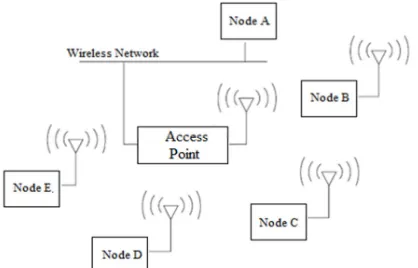
[image:1.595.308.517.492.626.2]functions and supports bridge protocols. It typically uses an RJ-45 jack for connecting to the wired network. If AP is being used, users establish a wireless communications link through it to communicate with other users in the wireless network as shown in Figure 1.
Fig. 1 Connectivity between access points to the wireless network service
The rapid increase of node devices is building Wi-Fi as preferred method of network access, predominantlywithin campus or buildings. The location analysis method with MSE is enables to realize unprecedented benefits from location-based services includes;
of time spend and the frequency oftheir visits within the site.
(ii) Advanced analytics: Provides knowledge of movement patterns by the visitors while available in the campus.
The wireless network service cannot visit outside of the radio range of a station’s wireless link with one access point. The solution to this issue is to add multiple access points to the network and access points so as to extend the range of mobility of a wireless client in the wireless network. It establishes an authorized connection with the AP that has the strongest signal level. It moves towards the signal strength of the signal from AP to increase longevity. The wireless medium can also be infrared, although, this is rare. The wireless services provided by the wireless network adapter includes,
(i) Delivery of data,
(ii) Authentication and
(iii) Privacy
The mode of operations in wireless network is given in Table 1.
Table 1 Mode of operation in wireless network
Infrastructure Mode Ad-Hoc Mode
Wireless host is connected to the larger network via a base station (access point).
Wireless hosts have no infrastructure with which to connect.
If not operating in infrastructure mode, a network operates in ad-hoc mode.
The hosts themselves provide services (such as
routing, address
assignment, DNS-like name translation etc.)
2. PREVIOUS WORK
L. Tassiulas et al., presented characterized the maximum attainable throughput region and provided a scheduling strategy that attains the throughput region in wireless network. X. Wu, et al., [2006] proposed queue length stability of maximal greedy schedules in wireless networks. L. Tassiulas [1998] proposed linear complexity algorithms for maximum throughput in radio networks and input queued switches. D. Shah et al., proposed to provide linear complexity randomized scheduling schemes that attain the maximum achievable throughput region. A. Eryilmaz and R. Srikant [2005] proposed fair resource allocation in wireless networks using queue-length based scheduling and congestion control. X. Lin et al., [2005] presented a distributed maximal matching
scheduling strategy to attain at least half of the region for the node-exclusive spectrum sharing model. X. Wu and R. Srikant [2006] proposed bounds on the capacity region of multi-hop wireless networks under distributed greedy scheduling. L. Bui, et al., [2006] presented the node exclusive spectrum sharing model, maximal scheduling can be used for maximizing the network utility and congestion control. X. Lin and N. Shroff [2005] proposed algorithms that utilization of the
stability region for node-exclusive-spectrum
sharing (NESS) interference model. X. Wu and R. Srikant [2005] proposed a distributed scheduling algorithm for multi-hop wireless networks with node exclusive spectrum sharing. S. Vasudevan, et al., [2005] presented the problem of AP selection that identify potential bandwidth that the client is likely to receive after affiliating with a particular AP. G. Judd et al., [2002] presented the approach to access point selection is based on received signal strength measurements from the access points within range. A. Balachandran, [2002] presented the affiliation algorithm is end-host initiated and does not necessitate changes at the AP. Y. Bejerano, et al., [2004] proposed fairness and load balancing in wireless LANs using association control. Yi Li, et al., [2008] presented a novel approach to optimize the performance of IEEE 802.11-based multi-hop wireless networks. A. Kashyap, et al., [2007] proposed a measurement-based approach to modeling link capacity in 802.11-based wireless networks. L. Jiang and J. Walrand [2009] proposed convergence and stability of a distributed CSMA algorithm for maximal network throughput.
3. IDENTIFYING ACCESS POINT BY A WIRELESS STATION
A transceiver used to interconnect a wireless network is an AP, which uses the association to build a table of users (clients) on the wireless network. The MAC addresses for each networking device connected to the wireless network forward data packets between the access point and the wireless network. A wireless bridge is a choice for connecting wireless network together even if the networks are miles apart. APs transmit beacon frames. An AP’s beacon frames will be transmitted over one of the channels. The beacon frames permit nearby wireless stations to discover and identify the AP.
with the new AP, the new AP creates a frame with the wireless station’s MAC address and broadcasts the frame. The frame is received by the switch. This forces the switch to update its forwarding table, so that frames destined to the wireless station are sent via the new AP. Any ordinary Bluetooth node can be a master node whereas access points in 802.11 networks are special devices (normal wireless devices like laptops cannot be used as access points).
4. OPTIMIZING WIRELESS NETWORK PERFORMANCE
Wireless networks are becoming increasingly ubiquitous in the form of WLANs, city-wide meshes, and sensor networks. But extracting predictable performance from these networks today is notoriously hard. A single new flow can lead to a disproportionate decline in network performance. Attempts to increase network performance, for instance by adding relay nodes to shorten link distances, can end up reducing performance. This is in sharp contrast to wireline network management, where network operators have many effective techniques to predict and improve performance.To develop optimization techniques for wireless networks that enables a prediction of the resulting performance at the level of individual flows. The basic capabilities are for real networks are,
(i) Network operators should be able to
predict if the network can support the current or a planned traffic demand.
(ii) Able to perform “what if” analysis to
predict the impact of configuration changes such as addition of new flows or routing changes.
(iii)Able to predict safe sending rates of
various flows based on policy and path capacity.
Without appropriate rate-limiting, network
throughput can decline sharply when flows send more than what the path can support. It can link single flow traversing two links. End-to-end congestion control, e.g., using TCP, while helpful, is not sufficient to prevent this pathological behavior.
5. FAIRNESS POLICY IN DESIGNING WIRELESS NETWORK
The control of data networks to achieve high throughput and fair allocation of the resources among competing users (or flows) is clearly one of
the most important problems in data
communications. There has been considerable interest and progress in the development of algorithms that address the issues of efficiency and fairness for both wireline and wireless networks. For wireline networks, these policies can be implemented in a distributed fashion by using buffer occupancy information of only the neighboring nodes. In contrast, in wireless multi-hop networks, there is no known scheme for low complexity implementation of throughput-optimal policies. For the fairness requirement such that each node receives an equal amount of data during each downstream sub-frame, let n1, n2, n3 and n4
respectively represent the number of slots that A, B, C and D get. The data transmitted to A in 1 slot = 10t Mbits (assuming the duration of each slot to
be t). Hence, total amount of data transmitted to A
(in n1 slots) = 10t n1. Similarly, total amounts of
data transmitted to B, C, and D equal to 5t n2, 2.5t
n3, and t n4 respectively. To fulfill the fairness
requirement, the condition is;
10t n1 = 5t n2 = 2.5t n3 = t n4. Hence,
n2 = 2 n1
n3 = 4 n1
n4 = 10 n1
If, the total number of slots is N, hence, n1+ n2+ n3+ n4 = N
i.e. n1+ 2 n1 + 4 n1 + 10 n1 = N
i.e. n1 = N/17
Hence,
n2 = 2N/17
n3 = 4N/17
n4 = 10N/17
The average transmission rate is given by:
(10t n1+5t n2+ 2.5t n3+t n4)/tN =
(10N/17 + 5 * 2N/17 + 2.5 * 4N/17 + 1 * 10N/17)/N
= 40/17 = 2.35 Mbps
If node A receives twice as much data as nodes B, C, and D during the sub-frame, then,
10tn1 = 2 * 5tn2 = 2 * 2.5tn3 = 2 * tn4
i.e. n2 = n1
n3 = 2n1
n4 = 5n1
Again,
n1 + n2 + n3 + n4 = N
i.e. n 1+ n1 + 2n1 + 5n1 = N
i.e. n1 = N/9
Now, average transmission rate increases to; (10t n1+5t n2+ 2.5t n3+t n4)/tN
Similarly, considering nodes B, C, or D receive twice as much data as any other nodes, different values for the average transmission rate can be calculated. Accordingly, optimal value can be selected.
5.1 Proportional Fair Scheduling
The proportional fair scheduling supports high resource utilization while maintaining good fairness among network flows. A user is likely to be scheduled when its instantaneous channel quality is high relative to its own average channel
condition over time. If ܯ݅ is the modulation and
coding scheme (MCS) index assigned to a user, depending upon the corresponding channel quality indicator (CQI). Using the transport block size
(TBS) mapping, ܵܯ݆, where ܤ is the TBS as
defined in 3GPP standard TS36.213 and ܤ is the
number of resource blocks used. The number of resource blocks is decided according to the bandwidth of transmission channel. Let, ݆ܶ (ݐ), is
the past average throughput of the user ݆, therefore,
the rate achievable by the user ݆ is given by,
Rj (k,t) = S(Mj,B)/τ
where, ߬ is the transmission time interval.
Scheduling of the users is done according to the following relation.
ik (t) = argmax Rj (k,t)/Tj (t), j=1,…, N
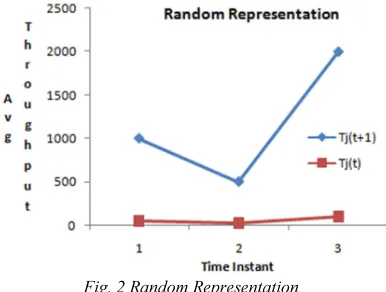
[image:4.595.138.504.79.411.2]The average throughput is graphically (randomly) given in Figure 2.
Fig. 2 Random Representation
where, ߣ is a constant which is very close to unity.
݆ܶ (ݐ) is the actual throughput achieved by user ‘݆’
in the sub-frame ݐ.
6. IMPLEMENTATION WORK
[image:4.595.93.286.487.633.2]In this work, the implementation work shows the Wi-Fi enable connection using AP and RSSI techniques to find the location of different values is shown in Figure3.
Fig. 3Flowchart for Location based analysis using AP and RSSI techniques
Fig. 4Flowchart to find distance location using triangulation method
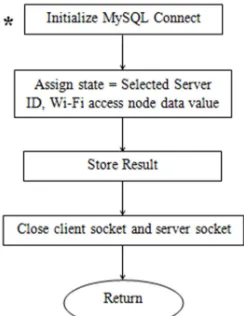
The flowchart has client and server socket, which receive messages from Wi-Fi node is shown in Figure 5. The MYSQL connection assigns sate and store results are shown in Figure 6.
[image:5.595.84.318.106.490.2]Fig. 5 Messages received from WiFi nodes
Fig. 6 Initialization process for client and server socket
7. RESULTS AND DISCCUSION
[image:5.595.346.468.393.551.2]1Wi-Fi Node, 2 Data Tx: (Button Press = 1, Button Press = 0), 3 Wi-Fi Modem
Fig. 7 Image of Wi-Fi node with modem
AApp in mobile to access Wi-Fi node data through (server) MySQL database
Fig. 8 Mobile to access Wi-Fi node
Step 1: Bind server with Wi-Fi Modem,
Step 2: Scan port of Wi-Fi Node and create socket,
Step 3: Wi-Fi Node Tx: data 1/0 (Press / No Press),
Step 4:Server program collects Node status and updates MySQL database,
Step 5: App in mobile gets status of Wi-Fi node data from server.
1 Data sent from Wi-Fi node
[image:6.595.119.255.288.486.2]Note: [Sending Data, MySQL Database Update and Mobile Access are independent processes]
Fig. 9 Data transmitted from Wi-Fi node
B Changed data in Wi-Fi node displayed in mobile thro’ MySQL database update
Fig. 10 Changed data in Wi-Fi node displayed in mobile
[image:6.595.331.483.358.599.2]Fig.11 WiFi NODE data received by server
7. CONCLUSION
In this research work, mobile node identifies the access point to improve signal strength and offers improved performance to suit realtime network system. RSSI technique is used to find the location of different values using triangulation method. This work also achieve increased throughput and does fair allocation of the resources for supporting automatic position reporting system (APRS).
REFERENCES:
[1] L. Tassiulas and A. Ephremidis, “Stability
properties of constrained queueing systems and scheduling policies for maximum throughput in multihop radio networks”, IEEE Transactions on Automatic Control, Vol. 37, No. 12, pp. 1936–1948, Dec 1992.
[2] X. Wu, R. Srikant and James R. Perkins,
“Queue length stability of maximal greedy
schedules in wireless networks”, in
Proceedings of Information Theory and Applications Inaugural Workshop, University of California, San Diego, February 2006.
[3] L. Tassiulas, “Linear complexity algorithms
for maximum throughput in radio networks and input queued switches”, in Proceedings of IEEE Infocom, pp. 533–539, 1998.
[4] D. Shah, P. Giaccone and B. Prabhakar, “An
efficient randomized algorithm for input-queued switch scheduling”, IEEE Micro, Vol. 22, No. 1, 2002.
[5] A. Eryilmaz and R. Srikant, “Fair resource
allocation in wireless networks using queue-length based scheduling and congestion control”, in Proceedings of IEEE Infocom, March 2005.
[6] X. Lin and N. Shroff, “The impact of
imperfect scheduling on cross-layer rate control in multihop wireless networks”, in Proceedings of INFOCOM, Miami, FL, Mar 2005.
[7] X. Wu and R. Srikant, “Bounds on the
capacity region of multi-hop wireless
networks under distributed greedy
scheduling”, in Proceedings of IEEE
Infocom, 2006.
[8] L. Bui, A. Eryilmaz, R. Srikant and X. Wu,
“Joint asynchronous congestion control and distributed scheduling for multihop wireless networks”, in Proceedings of INFOCOM, Barcelona, April 2006.
[9] X. Lin and N. Shroff, “The impact of
imperfect scheduling on crosslayer rate control in multihop wireless networks”, in Proceedings of IEEE Infocom, Miami, FL, March 2005.
[10] X. Wu and R. Srikant, “Regulated maximal
matching: A distributed scheduling algorithm for multi-hop wireless networks with node
exclusive spectrum sharing”, IEEE
Conference on Decision and Control, 2005.
[11] S. Vasudevan, K. Papagiannaki, C. Diot, J.
Kuroseand D. Towsley, “Facilitating Access Point Selection in IEEE 802.11 Wireless Networks”, USENIX Association, Internet Measurement Conference 2005.
[12] G. Judd and P. Steenkiste, “Fixing 801.11
access point selection”, in Proceedings of ACM Mobicom, Pittsburgh, Aug. 2002.
[13] A. Balachandran, P. Bahl and G. Voelker,
“Hot-spot congestion relief and service guarantees in public-area wireless networks”,
SIGCOMM Computer Communication
Review, Vol. 32, No. 1, 2002.
[14] Y. Bejerano, S. Han and L. Li, “Fairness and
load balancing in wireless LANs using association control”, in Proceedings of ACM Mobicom, Philadelphia, Oct 2004.
[15] Yi Li, Lili Qiu, Yin Zhang, Ratul Mahajan,
Eric Rozner, “Predictable Performance
SIGCOMM, Seattle, Washington, USA, August 17–22, 2008.
[16] A. Kashyap, S. Das and S. Ganguly, “A
measurement-based approach to modeling link capacity in 802.11-based wireless
networks”, in Proceeding of ACM
MOBICOM, Sept. 2007.
[17] L. Jiang and J. Walrand, “Convergence and
Stability of a Distributed CSMA Algorithm
for Maximal Network Throughput”,