Compound Document Architecture
Digital Technical] ournal
in mosaic small aba
-.>er of the :tuare slab, �enriched. 1are table, ns, to pro-�p_er_i!!c_U_!ll_:-__ _ oof. 3. A 1e walls ot tion; ocea-n paint.
·chitecture I rulers of
---,----
---I I
I I
architecture
:
1. The art and science of<t
esigningI I
and building structures, or large groups of sttr. I I
I I
m keeping wi
�
aesthetics and functionalG
OneDigital Equipment Corporation
----...._:;...
Voh•.me 2 Number I
Cover Design
This issue features products specified in Digital's compound document architecture, the CDA architecture. The design on our cover takes a page from classical architecture to evoke the concepts of structured architecture and creation of compound documents. Like the blueprint shown in the background, the CDA architecture provides a structure for applications to seamlessly integrate text and graphics into pages such as those displayed in the foreground.
Tbe cover was designed by David Com berg and David Shepherd of the Corporate Design Group.
Barbara Lindmark, Associate Ediwr Richard W. Beane, Managing Edi!Or
Circulation
Catherine M. Phillips, Administrawr Suzanne). Babineau, Secretary Production
Helen L. Patterson, Production Editor Nancy jones, Typographer
Patrick E. Conte, Designer Peter Woodbury, Illustrator Advisory Board Samuel H. Fuller, Chairman
Roberr M. Glorioso john W . McCredie Mahendra R. Patel F. Grant Saviers W illiam D. Strecker Victor A. Vyssmsky
The Digital Teclmicaljournal is published quartc:orly by Digital Equipment Corporation, 146MainStreet MLO l-3ill68, Maynard, Massachusetts 01754-2571 Subscriptions to the journal arc 540.00
for four issues and must be prepaid in U.S. funds. University and college professors and Ph.D. students in the electrical engineering and com puter science fields receive complimentary subscriptions upon request. Orders, inquiries, and address changes should be scm to The: Digital Tecbnicaljournalat the published-by address. Inquiries can also be sent electronically on NEA RNET to [email protected]. Single copies and back issues are available for S 16.00 each from Digital Press of Digital Equipment Corporation, 12 Crosby Drive, Bedford, MA 01730-1493. Digual employees may send subscription orders on the ENET to RDVAX::)OURNAL orby interoffice maii!O mailstop MLO 1-3/868. Orders should include badge number, cost center, site location code, and group name. U.S. engineers in Engineering and Manufacturing receive complimentary subscriptions; engineers in these organizations in countries outside the U.S. should contact the journal office to receive their complimentary subscriptions. All employees must advise of changes of address.
Comments Go the content of any paper are welcomed and may be sent to the edi!Or at the published-by or network address.
Copyrightt• 1990 Digital Equipment Corporation. Copying without fee is permi11ed prov ided that such copies are made for use in educational institutions by faculty members and are not distributed for commercial advantage. Abstracting with credit of Digital Equipment Corporation's
authorship is permi11ed. All rights reservc:d.
The information in this journal is subject to change without nmice and should not be construed as a commitment by Digital Equipment Corpo ration. Digital Equipment Corporation assumes no responsibility for any errors that may appear in this journal.
ISSN 0898-90 I X
Documentation Number EY-C 196E-DP
The following are rradcmarks of Digital Equipment Corporation: BASEVIEW, CDA, DDIF, DDIS, DEC, DECdecision, DECwindows, DECwrite, the Digital logo, DTJF, EDT, LiveLink, ReGIS, ULTRIX, VAX, VAXcadoc, VAXcadview, VAX DATATRIEVE, VAX DBMS, VAX DECalc, VAX DECalc-PLU S, VAX Notes, VAX RMS, VAXstation, VAX TEAMDATA, VAX VTX, VAX Xway, VMS, VT240, WPS-PLUS, XI I
C is a registered trademark of Microsoft Corporation.
IBM is a registered trademark and DB2 and OS/2 arc trademarks of International Business Machines Corporation.
HPGL is a trademark ofHewleu-Packard Company.
IOMS/R is a trademark ofCullinet Software, Inc. lnterleafis a trademark oflntcrleaf, Inc.
Lotus 1-2-3 is a trademark and DIF is a registered trademark of lotus Development Corporation.
Macintosh is a registered trademark of Apple Computer, Inc. PostScript is a registered trademark of Adobe Systems, 1 nc. TEK4014 and Tektronix are registered trademarks of Tektronix, Inc. VisiCalc is a trademark of Lotus Development GmbH.
I
Contents
6 Foreword Jeffrey H . Rudy
8 CDA Overview
Robert L. Travis Jr.
16 The Digital Document Interchange Format
William R. Lauru ne a nd Robert L. Trav is Jr.
28 The Digital Table Interchange Format
Carol A . Young and Neal F. jacobson
38 Development of the CDA Toolkit
Richard T. Gumbel a nd Martin L . )ack
49 Interapplication Access and Integration
Baldwin K. Cheung and Neal F. Jacobson
CompoWld Docwnent Architecture
60 The Design and Development of the DECdecision Product
Alan Su ng, Neal F. jacobson, and Carol A . You ng
73 The Relationship between the DECwrite Editor and the
Digital Document Interchange Format Seth S. Cohe n a nd Wm . Eugene Morgan
83 CDA in Science and Engineering
I
Editor's Introduction
Jane C. Blake Editor
Compound document architecture is the theme of this issue of the Digital Technical journal. Digital's architectu re for compound docu ments, CDA , addresses a need a U of u s have i f we work with text files, tabular data, graphics, or images. We want the flexibility to easily exchange that data, revise it, or combine it into one document, regardless of the appli cations, operating systems, and hardware involved.
In the paper that opens the issue, Bob Travis recalls Digital Engineering's recognition of this need for an overall data interchange environment . Bob's paper is a n overview of the CDA architecture which resulted from this recognition. He intro duces the syntax and standards that formed the basis for development and shows the relationships of these to the CDA components and to the goals for the architecture.
Central to the architecture is the revisable form of a compound document and its data cross-linkages. In the paper following the overview, Bill Laurune and Bob Travis discuss the DDIF document inter change format w hich specifies the revisable form for tex t , graphics, and images. The authors describe the DDIF design, its relationship to stan dards, and practical aspects of data interchange.
A second format, DTIF, is the subject of Carol Young's and Neal Jacobson's paper. They open their discussion with a description of the types of problems designers had to address to allow for the inter change of revisable tabular data between applica tions. They then describe how the DTIF format meets the goals they set, among which were archi tecture neutrality, application independence, and extensibility.
For processing DDIF, DTIF, and non-CDA formats, the CDA architecture includes a set of services, specifically, the CDA Toolkit and the converter architecture. Dick Gumbel and Marty Jack relate
2
how the toolkit was designed to provide application programs access to CDA documents through a pro cedural interface. They also describe the converter architecture which imports and exports documents to and from non-CDA formats .
Two more services are included in the CDA archi tecture for efficient interapplication integration. In their paper, Baldwin Cheung and Neal Jacobson give details of the AIL application interface library and DECdecision Builder. With A IL, developers can build tightly integrated levels of applications . DECdecision Builder allows applications to be inte grated at the user level.
AI Sung, Neal Jacobson, and Carol Young then describe the DECdecision product. Designed for end-user decision support, the DECdecision appli cation's five components provide a high level of data integration through database access, spread sheet, charting, flow control, and management functions. DECdecision serves as a model for the development of applications that use the features of the DECwindows and CDA architectures.
The DECwrite editor, developed in conjunction with the DECwindows and CDA architectures , is the topic of our next paper. Seth Cohen and Gene Morgan focus on the relationship between this DEC windows-based compound document editor and the DDIF interchange format. By resolving issues rela tive to this relationship, designers were able to draw on the benefits of the interchange format without sacrificing formatting speed and ease of editing.
The closing paper for this issue, by Neal Appel and Ron Olson, features an application that extends the CDA architecture to meet scientific and engineering requirements. Neal and Ron describe the development of the DECview3D application which supports interactive two- and three-dimen sional viewing and annotation of scientific and engineering data.
Biographies
Neal B. Appel As a p rincipal software engineer in the CAD/CAM Technology Cente r, Neal Appel is the a rchitect for the DECview3D product and consultant for the design of other CAD/CAM products . Before joining Digital in 1987, Neal wo rked at Computervision, where he was a member of the Technical Staff Council. In this role, he p rovided technical d i rection and consul ti ng fo r Computerv ision's graphics development. He received a B.Sc. (Honors, 1977) in mathematics from Northeastern University, an M .Sc. (1979) in applied mathe matics, and an M .Sc. (1980) in computer science from Michigan State University. He is a member of ACM and the SJGGRAPH Special Interest G roup .
Baldwin K. Cheung Baldwin Cheung is a p rincipal software engineer in the Co re Applications Grou p. He is a developer of the DECwrite editor, the a rchitect for the AIL application interface library, and responsible for developing the L i velink functions. With co-developer Neal jacobso n , he has applied for a p a tent for the Application Interface lib ra ry . Since joining Digital i n 1982, Baldwin has participated in the YT240, PRO/GIDIS, PRO/NAPLPS, PROIYENIX,
and VS31 graphics development projects. He holds a B.S. (1977, highest honors) in mechanical engineering from Northeastern University. Baldwin has taken graduate studies at the Massachusetts Institute of Technology.
Seth S. Cohen A consultant software engineer in the Workgroup Publishing G roup , Seth Cohen designed the DECwrite compound document editor and led its development effo rt . He also coordinated the use of DECw rite technology across different Digital platforms and projects. Since joining Digital in 1973, Seth has designed the hard-copy support of UIS workstations, the PRO document a rchitecture, and a package to validate RMS files. He has led the development projects for h is designs, as well as the development teams for the PRO graphics a rts, MIS- 10/RMS-20, DBMS- 10/DBMS-20 p rojects. Seth has an M . S . (1973) in computer science from the Massachusetts Institu te of Technology.
Richard T. Gumbel Richa rd Gumbel joined Digital in 1979. He is cu rrently a principal software engineer in the Core A pplications Group. Dick is one of the developers of the CDA Toolkit and CDA converter architecture. Together with his co-develo pe r, Martin)ack, he has applied for a patent for the CDA converter a rchitecture . He is currently designing more featu res fo r the toolkit. Prior to his wo rk on CDA projects, Dick was part of the DECforms and RT -11 development e fforts , and the leader for the VAX FMS p roject. He has a B . S . (1974 ) in p h ysics and an M .S. (1979) in computer science from West Vi rginia Unive rsity. Dick is a member of ACM and the SIGSOFT Special Interest G roup.
I
4
Martin L.Jack One of the developers of the CDA Toolkit and CDA converter architecture, MartinJack is now designing new approaches to simplify software product installation and management. He has applied for a patent for the CDA converter architecture with his co-developer, Richard Gumbel, and for a patent for the DOTS multiple object transport system. Marty is a consultant software engineer in the VMS Base Systems Platform Engineering Group. He worked on the VAX COBOL compiler project and was a member of the VAX architecture review committee. He joined Digital in 1973. Marty has an S.B. (1971) in chem istry from the Massachusetts Institute of Technology.
Neal F. Jacobson As the project leader for the DEC decision Builder project, Neal Jacobson led the design and development of this component . In his position as consulting software engineer in the Core Applications Group, he is currently the architect for the Application Control Services project . Neal joined Digital in 1980. He received a B. S. (1978) in computer science and mathematics from SUNY at Albany. Neal has also worked on VAX DBMS and Jed the VAX TEAMDATA project. He has patent applications pending for the Builder Application Integration Services, the DTIF table interchange format, and the Application Interface Library.
William R. Laurune At the time of his work on the DDIF document interchange format, William Laurune was a principal software engineer in the Core Applications Group . He is currently a member of the Digital team that is developing factory automation software for Boeing Commercial Airline's new sheet metal center. Bill joined Digital in 1980. He has a degree in English writing, with a minor in computer science, from the University of Pittsburgh . A combination of graduate classes in computer graphics and a writing background led to a natural interest in Digital's first laser printer support projects and advanced document process ing technologies .
Wm. Eugene Morgan Eugene Morgan is the co-developer of the DECwrite version 1.0 product and developed the DDIF document interchange format's read and write code for that version. As a principal engineer in the Workgroup Publishing Group, he is now leading the DECwrite version 1. 1 and version 2 . 0 projects. Since joining Digital in 1978, Gene has worked on many projects, including support of DECnet-20 and IBM 2780/3780 communications for DECSYSTE M- 10 and DECsystem-20, and the Printserver 40 Communications Software, for which he has a patent application pending. Gene studied mathematics and computer science at Old Dominion University, and is a member of ACM and SIGGRAPH.
Alan Sung A lan Sung is a principal software engineer in the Core Applications Group. In this position he is responsible for the development of decision support products. He was the senior technical contributor to the DECdecision Calc project and continues to act as a consultant to the project. He was also the principal designer and project leader for the VAX X way project. Prior to that project, Alan worked on the VAX DECalc project in the Technical Systems Group. He joined Digital in 1982 . He has a B . S . (1982) in computer science from Cornell University and is a member of ACM .
Robert L. Travis Jr. Since joining Digital i n 1978, Robert Travis has been a member of the development teams for many of Digital's major document processing products, including WPS-8. He represented Digital on the ANSI and ISO standards committees for the development of mail/messaging, SGML, and ODA standards. Most recently, as a senior consultant for Software Engineering in the Core Applications Group, Bob developed the CDA architecture and started the CDA program. Before joining Digital, he managed his own software consulting firm. He holds a B . A . {1963) and an M.A. (1965) in mathematics from Wesleyan University .
Carol A. Young Carol Young is the architect of the DTIF table interchange format and leader of the DECdecision Calc version 1.0 project. She and her co-developers have applied for patents for the DTIF format and for asynchro nous DECalc-PLUS. Carol is c urrently a principal software engineer in the Decision Support Group . Prior to this, as a senior software engineer, she was the project leader for the development of DECalc versions 3.0a , 2 . 2 , and 2 .1. She was a technical contributor to DECalc-PLUS version 1 .0. Carol joined Digital in 1982 after receiving a B . A . in computer science and French language and litera ture from the University of Michigan.
I
I
Foreword
Jeffrey H. Rudy
Gruup Manager
Core Applications Group
In the 1 �POs, word processing systems were the most advanced method of document processing. With this technology, users could create and revise documents. However, there were limitations. Only one user could access data at a time. Graphics were not supported, and the fin ished product had the appcaranu: of " computer-generated" material .
In the 1980s, higher performance electronic publishing systems began replacing word process ing systems. sers could now create and revise text
and graphics, and could produce professional, high quality printed documents. Electronic publishing systems also met a growing demand for more infor mation-sharing capability. Multiple users could now share the data. However, there were still limitations. Information could only be shared among users of the same operating systems and the same applica tions. Electronic publishing systems did not address the need to integrate and interchange data.
As we approach the 1990s, the need is growing to interchange data across different operating system platforms, different applications, and different stan dards. A principal barrier to this type of information sharing is the fact that companies will continue to use different systems. Therefore, vendors must develop document processing systems that both meet these companies needs and accommodate existing and future multi vendor environments.
In the early 1980s, Digital recognized that future document processing systems would need to sup port data interchange and integration through a compound document architecture. To this end , the diverse document processing development projects then underway were brought together into one body to reach technical agreement on a common
6
architecture and standards for data interchange. From this effort, an overall design structure for data interchange among all developing applications and a meta-syntax for that design were defined .
In 1987, Digital announced its CDA design. T he first version of the CDA toolkit that incorporates this design was distributed in 1988. The design comprises three parts: the CDA architecture, CDA compliant products, and the CDA program. The interchange formats in the CDA architecture are, in part, an outgrowth of the work done in the: 1980s by U.S. and international standards bodies.
The CDA architecture is a comprehensive and open interchange standard which enablcs users to easily interchange numerous types of revisable information among applications and with cach other. We refer to this revisable information as "compound documents" that can encompass n o t o n l y text, but graphics, images, and numerical data, as well as the table-oriented data usually asso ciated with spreadsheets or database queries. The
CDA architecture has been fu rther e n hanced w i th a n Appl ications Control service that dynamicall y links the files i n a CDA document t o give users access to "live" data in the network.
Moreover, the CDA architecture is opcrating system-independent and removes the barrier to information shar i ng that has limited p revious document processing systems. In fact, Digital has made the technical specifications for the CDA archi tecture public to further support the open inter change of information.
At the present time, the CDA architecture contains four formats that support data interchange. A fifth is planned for the near future. The DDIS document interchange syntax, which is the meta-syntax, is the base encoding system for the interchange formats,
DDIF and DTIF. DDIF is the CDA document inter change format for revisable text, graphics, and images. DTIF is the CDA table interchange format for revisable data tables and spreadsheets. The DOTS
object transport syntax supports the electronic transfer of multiple data elements, in multiple interchange formats .
The CDA architecture goes beyond other data interchange formats by providing an integrated conversion architecture that supports software development for translating existing formats to and from CDA documents. In addition, the CDA
one format to a CDA format and then translated tO another format. As additional converters become available, the conversion architecture will simplify data interchange and support of multiple standards and application formats for the application devel oper because separate converters and applications will not be necessary.
CDA-compliant products give users the power to implement the CDA architecture and actively exchange and share data.
In the past year, Digital has announced several major CDA-compliant products. The DECwrite editOr is a "what-you-see-is-what-you-get" (WYSIWYG) compound document editor that combines wor
�
processing, desktOp publishing, drawing, and��
SI ness graphics into one product. The DECdeciSIOn product is a workstation-based, advanced decision support solution for data-dependent professionals. Three VAXimage products permit users tO include images, i.e., nonelectronic, existing objects such as photographs, in documents and exchange them as if they were text or graphics.The scope of CDA-compliant products has been extended to meet the unique document processing needs of specific industries. In the scientific area, the DECview3 D product provides graphics transla tions, two-dimensional and three-dimensional graph ics manipulation, and annotation of engineering and scientific data.
Digital is as firmly committed tO supporting third party development of CDA-compliant products as i t is to developing these products itself. Many CDA applications have been and will continue to be pro duced by organizations external to Digital. Third parties were actively involved in the design of the CDA architecture to ensure that the design included what they needed to develop CDA-compliant prod ucts in the future. The result of that involvement was very successful. We now have over 50 key soft ware companies developing CDA applications.
The CDA program is a broad set of activities that support the implementation of the CDA architec ture. These activities include:
• Providing tools, training, and support for CDA
compJiant products by independent software vendors
• Making CDA toolkits available for multiple plat
forms and extensions to the CDA architecture
• Making the CDA Manual publicly available
• Ensuring that all future Digital products support
the CDA architecture
Together, the CDA architecture, the CDA-compliant products, and the CDA program answer the data interchange limitation of past document process ing systems.
For the future, the CDA design is open and exten sible. Already, Digital and third parties are develop ing more applications to extend the revisability capabilities for the data and add more interchange methods.
Although many vendors have recognized the need for a compound document architecture, Digital is the first to develop and release one. Our success is based on many factors. One is our ability to build system architectures. Our network, VAX system, and DECwindows architectures are successful examples of that point. Digital is also a recognized supporter of open standards, as proven by its founding mem bership role in the Open Software Foundation. Many of the CDA applications, such as the DDIF and DTIF interchange formats, are based in part on existing ISO standards. Finally, Digital has proba bly the broadest and most in-depth expertise and experience in building distributed network systems. From all of this, we were able to build a single system architecture that provides an integrated, seamless computing environment across multi ven dor operating platforms.
In this issue of the Digital Technical jou rnal, you will learn in more detail about how the many pieces of the CDA design were developed. As you read these papers and come to see the CDA design as an inte grated whole, you will understand how the CDA design makes a truly distributed network possible.
7
CDA Overview
The CDA family of architectures, services, and applications is designed to support the creation, interchange, and processing of compound documents in a heterogeneous
network environment. This family emerged as the result of a furulamental goal: to develop a coherent set of starulards and capabilities for data interchange across the Digital computing environment. Qf the four stages identified by the CDA document processing model, the central focus is the revisable compound document and its logical structures and data cross-linkages. Key design decisions for each of the major
CDA components were made with reference to Digital, industty, and international starulards. The major CDA component development efforts are described in more detail in this issue's succeeding papers.
Background of the CDA Program
As our society has made the transition from an industrial economy to one based on information, the role of documents in business has changed. Documents are no longer merely for record keeping - slips of paper that record the tr:msfer or status of real goods. Today, documents arc often the real goods.Documents are a fundamental part of the overall business information flow. Information flows from sensors, such as laboratory instruments, financial data acquisition, and processing programs, and is incorporated into summaries, reports, and presen tations. The recipients of the information use it to make decisions that, in turn, will affect the infor mation avai.lable to other decision makers.
In light of the growth of information sharing, document preparation and presentation tech nology is no longer the exclusive province of document processing professionals. Workstations, color graphics terminals and personal computers, laser printers, computer digital-font technology, and document preparation software make high quality document production accessible to all .
A s the amount of data available on-line increases, so does the need to create links among the various application programs that support the data. Multi ple workstation and central processing graphics and data processing applications need to he :tble to interchange information in a revisable format tO produce business and technical documents.
As early as 1983 , Digital's Systems Architecture
and Review Authority (SARA) recognized the need
for an overall data interchange architecture for Digital products and sponsored a task force to
8
design it. (SARA was a Digital Central Engineering cross-group technical committee that has since been superseded by other structures.)
At that time, a number of separate text and graphics projects existed. These projects were related to workstation developments and other platforms, and each had its own emerging architec ture and standards. In addition, several database and spreadsheet-oriented data table processing efforts were underway, all of which clearly needed effective data interchange; without it, all the prod ucts wou ld be "standalone" and unable to work cooperatively . The SARA effort brought together the representatives of these diverse efforts to reach technical agreement on common interchange.
The first thing the SARA task force did was tO agree on an overall design structure for data interch;mge among all of the developing applica tions. This design called for a single, common meta-syntax for the data and a n umber of domains; each domain would have i ts own data syntax based on the common model. Some of the domains envisioned were compound docu ments, database tables, scientific arrays, labora tory data, and CAD/CAM product information. The efforts of the ARA task force culminated in agreement on a common meta-syntax, DDIS, on which each of the separate data domains would be based.
In addition to the definition of the DDIS meta syntax, small work groups were formed with members from existing development efforts to address the domain-specific problems. The CDA interchange formats are, in part , an outgrowth of that work.
Compound Document Archltecture
Certain additional adjustments were made to DDIF to enhance support for SGML. Bit-for-bit compatibility with ODA was not a goal for the DDIF format, since converters would be needed anyway to deal with the required extensions. However, all important compatibility functions were consid ered . Because of its positioning in the CDA model, the DDIF format only deals with the elements of ODA's Processible Document Architecture.
The text content of the DDIF format is derived directly from ISO character coding standards. The added graphics primitives were designed to be compatible with the ANSI/ISO Graphical Kernel System (GKS) standards because of their wide use. The document imaging model is designed to be compatible with PostScript. Image content types incl ude the standard CCITT bitonal (FAX) encod ings, as well as significant extensions to handle mul tispectral images .
Several non-Digital research groups helped to align the DDIF structures and semantics to key existing or evolving standards. (The Austrian Research Center at Seibersdorf and the AGD/FhG group at Darmstadt were among the groups that helped . )
For table data, there are a number of d e facto industry standards or pseudo-standards. All are different, and all are proprietary to one or more products. The DTIF format defines a single stan dard encoding for all the functions that appear in all the important industry standards. DTIF may not assign a standard treatment for a function or feature which is unique to a single industry product and not apparently suitable for inter change with others. However, the DTIF format includes a general escape mechanism for private encodings in such cases .
No existing standards are applicable to the problem the DOTS syntax set out to address. The CCITT X.400 mail and messaging standard, how ever, is closest to the kind of multiple object transport function DOTS provides. Therefore, our decision was to design the DOTS system encoding to be as compatible as possible with the x.400 stan dard's treatment of multiple body parts in message interchange.
Unrelated to standards issues, but nonetheless a significant decision, was how to couple CDA prod ucts with the technical and scheduling constraints of Digital's base systems and with DECwindows software.
Since the CDA architecture is meant to be an enhancement to the overall system infrastructure,
14
it affects a number of base system components. There is a logical coupling with DECwindows software, as well, because much of the benefit from the CDA architecture is only realized in a multi application graphics context. As design projects, these components had different technical require ments and schedules. The impact of these factors was felt particularly in the development of the CDA Toolkit, because its consistency as a bundled product across multiple operating system environ ments had tO be maintained .
Multiple product development schedules also complicated the debugging environment, because multiple layers of dependent products were being developed and tested at the same time. Fortu nately, the Digital Easynet provided some very effective communications tools to support these multiple development groups. These included the VAX Notes product and multiple interconnected mail systems. We also benefited from an enthusias tic group of early users, who frequently accepted code updates on-line. As a result, the test-fix-retest cycle was accomplished very rapidly, even though many levels of products had to be tested.
Summary
The CDA family of architectures, services, and applications form an integrated support environ ment for compound documents. This support is designed and implemented to operate consistently on multiple hardware and software platforms . Tools for software development, as well as end user access, are included within the CDA architec ture. Significant efforts have been undertaken to ensure that the CDA benefits are not restricted to Digital-produced products.
There is still much work to do, however, as the applications and requirements for compound doc uments continue to expand into new media types - voice, music, and video - and into more dynamic relationships, such as hypertext. These areas , and others, are now active areas of CDA architecture research and development.
Acknowledgments
Many people in addition to those recognized else where in this issue of the Digital Technical journal have contributed significantly to the development of CDA , and it is only possible ro name a few of them here. Tom Hastings and Vijay Trehan drove the SARA data interchange architecture and vision, and developed the first drafts of the DDIS specification
services were also designed in detail and devel oped. Fortunately, much of the early architecture model development and many of the key decisions had already been approved . Thus, the devel opment teams were able to work with a re;u;onably stable base. Even so, a great deal of productive feedback from the development process into the architecture process still occurred.
Architecture and Development
Trade-offs
Designers looked at a number of alternative tech nical paths during the CDA development - choices that would have led to quite different results. Perhaps the most significant of these was the selec tion of the revisable and final interchange formats.
The basic question in each case was whether we should develop a new Digital standard or adapt either an existing internal or an international industry standard.
As discussed in the earlier section Background of the CDA Program, DDIS was chosen as the basis for the CDA architecture interchange syntaxes, based on ISO ASN.l. Other alternatives had been considered. These included a variant of TLV binary encoding used in the VAX workstation (VWS) facil ity, as well as some plain text encodings. None of these alternatives had the combined advantages of the chosen DDIS encoding.
• It was a good match with ISO and Consultative
Committee on Telephony and Telegraphy (CCITT) standards.
• It could use the same encoding support as in
other network and data protocols.
• It was compact and easy to decode.
• It was extensible.
• It could easily handle arbitrary embedded data syntaxes, including binary.
The DDIS syntax provides some Digital standard priv:.Ite identifiers for convenient exchange of pop ular data types, such as floating point and standard character string types. It also ddines domain iden tWers that are used to uniquely identify data streams, which are defined as DDIS syntaxes. Some of the more complex features of ASN.l are not included in DDIS - macros, for instance because they are not yet needed in the specific data syntaxes. This may change in the future, as the DDIS specification use continues to broaden.
Digital Tecbntcal]ournal Vnl. 2 No. I, Winter 1990
The DDI F format had to be highly compatible with the existing ISO Standard Generalized Markup Language (SGML), ISO 8879, and the emerging ISO Office Document Architecture and Interchange Format (ODA/ODIF) standard , ISO 861 3. Digital's customers today require the implementation of computing standards that extend beyond the boundaries of any single vendor. Even standards that are merely national in scope are no longer ade quate, since electronic communications today span the globe to support international commerce. Even within the bounds of a single multinational corporation, the equipment of many different vendors and countries of origin may be repre sented. For these reasons, Digital is committed to the international standards process.
One option was simply to choose either SGML or ODA/ODIF and define the DDIF data format as its extension or specialization. The apparent advantages of this option faded on careful analysis.
• SGML and ODA are not compatible. Th�refore,
choosing one makes compatibility with the other somewhat problematic.
• SGML is delimiter based . Moreover, no tech
niques were available for mixing SGML elements with ASN .l elements.
• SGML's standard technique for incorporation of
nontext data is by external reference only.
• The DDIF format required semantics that the SGML standards did not contain.
• ODA was very incomplete in several areas critical
to CDA . The required extensions would make the result nonconforming, since CDA could not consider the extensions optional. One example of this is the need to handle linkages between multiple documents and applications.
• ODA does not integrate text and nontext (e .g. , graphics and image) data types very welL It sim ply combines the existing, nonintegrated stan dards by layering structuring primitives on top .
We decided to follow the ODA document model
very closely, including the treatment of generic and specific structure, but to adopt a different treat ment for combining structure with content. By following the ODA model closely, we are able to track ODA evolution compatibility, even though our philosophy maintains that the relationship between structure and content should be more highly integrated.
CompoWld Document Architecture
DATABASE AND/OR SPREADSHEET
COMPOUND DOCUMENT EDI TOR
! t
! t
DTIF
CHA R T E R / DDIF DOFF PRINTING/
DATA R E PORT VIEWING
G E NERATOR G E NERATOR FORMATTER SYSTEM
REVISABLE
COMPOU N D FORMATTED
TABLE DATA DOC U M ENT DOCUMENT
I NTERCHANGE INTERCHANGE I NTERCHANGE
FORMAT FORMAT FORMAT
COMPOSITE DATA OBJECT MANAGEMENT, MAIL I NTERCHANGE
DOTS
PACK U N PACK
D
D
D
D
DATA OBJECT TRANSPORT SYNTAX
D
D
D
D
Figure 2 CDA Component A rchitectures
or implied to the creating application(s) can be changed, updated, or recalculated more easily than in final form documents. Applications that involve processing and data interchange are more easily developed and operate more efficiently by dealing with revisable rather than final form document data.
The revisable form for spreadsheet and data tables is specified by the DTIF table interchange for mat. The revisable form for structured text, graph ics, and image is specified by the DDIF document interchange format. Both DTI F and DDIF provide for the inclusion of related or underlying data in other formats. The CDA Toolkit implements a data interchange hub using these two interchange for mats. The toolkit also provides general processing access to in-memory representations of the data.
The final form of a document represents the abstract document component relationships as resolved display attributes. These attributes include text fonts, character positions, positioned and sized graphics frames, and final page layout. Final form is produced from revisable form by a format ting process. A final form document is specifically formatted for a particular class of display. The final form for compound documents in the CDA
archi-12
tecture is the DOFF format described earlier; the current version of this is based on PostScript.
Figure 2 indicates how the CDA architectures relate to each other, and which types of applica tions and services are most concerned with each architecture.
1he Interchange
Formatsand Services
Within the model, two things could be clearly seen. These were the required interchange formats and their supporting services, and the key appli cations that must rely on those services and inter change formats. Task groups were formed to define the interchange formats and their supporting services.
Each task group first abstracted a design model, based on the application requirements. The priori ties for elements w ithin the model were based on the actual needs of the specific applications. Each format or interface had a responsible architect to arbitrate and make final decisions regarding the resulting structures.
As the CDA services such as the CDA Toolkit were being defined and built, the applications and bun dled system components that needed tO use the
The key Digital-produced appl ications that form the hub of end-user access to the CDA architecture facilities are the DECwrite application, a powerful compound document editor, and the DECdecision application, an integrated table data-handling and analysis package. Both are capabiL of tight integra tion with other applications, and with each other, by means of Live Link connections.
DECwrite and DECdecision can be used coopera tively to build decision support applications and include the results in reports and other kinds of compound documents. The DECchart application is included with both DECwrite and DECdecision, and its features for dynamic plotting of data tables are available through LiveLink connections. The other components of DECdecision - Builder, Calc, and Access - are all linked together and dynamically share data by using the LiveLink facilities.
The CDA architecture and program comprehen sively support and encourage non-Digital develop ment groups to support the CDA architecture in their products. The focus of the CDA Toolkit is to provide easy access from application code to CDA interchange formats and converters. Training is available for software developers in the use of the toolkit and other CDA components.
Development of a Compound
Document Architecture
The first concrete step in the development of the CDA architecture was to establish a model. This model would accurately describe the desired result and identify the various architectures and other necessary components.
STAGE 1 STAGE 2
The CDA Architecture Model
The CDA architecture model identifies a four-stage applications pipeline which culminates in the dis play or printing of a document. (See Figure 1 .) The first stage encompasses applications that are the source of information (tables or graphs) for inclu sion in documents. The second stage is a revisable compound document, where content is added and manipulated. This stage is dominated by logical structure and data cross-linkages . In the third stage, a final compound document results from applying formatting rules and layout characteris tics to a revisable compound document. The fourth stage is the transformation of a final document into device-specific language for display or printing.
The processing steps and data formats of the first stage are diverse and very domain specific, since they are determined by the needs of many different processing environments. The first stage is impor tant to the CDA model because it is the foundation for the LiveLink function's access to other applica tions and data. Application-specific data viewing modules (e. g . , DECview3 D software) provide the link between the stage one and stage two functions . Data interchange can take place in all four stages, but the CDA architecture primarily focuses on the second one. Revisable compound documents, their processing and interchange, are at t he heart of the CDA architecture.
The revisable form of a document contains abstract relationships between components of the document. Because these relationships are abstract (logical) rather than concrete (representational), any aspect of the document that the user has stated
STAGE 3 STAGE 4
DECwindows PROCESSIBLE
DATA LIBRAR I ES
CR EATE
REVISABLE FORMAT COMPOU N D
DOCUM ENTS PUBLISH
FINAL FORMAT COM POU N D DOC U M ENTS
(APPLICATIONS. TABLES, TEXT, GRAPHICS, IMAGES, . . . )
MANY DATA FORMATS (APPLICATION-SPECIFIC)
SU PPORTED VIA LiveLink CON N ECTIONS FROM D D I FfDTIF; INTERCHANGED WITHIN SPECI FIC APPLICATION DOMA I N S
(LOGICAL STRUCTURES, DATA LINKAGES)
DO IF DTIF
SU PPORTED BY TOOLKIT AND BY CONVERTERS; INTERCHANGED BY KEY CDA APPLICATIONS
(LAYOUT STRUCTURES, PAGES, L I N ES)
DOFF/PostScript
PRODUCED BY KEY APPLICATIONS A N D BY TOOLKIT; SU PPORTED BY DEVICE DRIVERS
Figure 1 Compound Document Processing Model
Digital Technical journal Vol. 2 No. I, Winter 1990
300- DPI LASER
HOLOGRAMS?
MANY PROTOCOLS (DEVICE-SPECI FIC)
PRODUCED BY DEVICE D R IVERS; SU PPORTED BY DEVICES
Compound Docwnent Architecture
There are currently three interchange formats and two related encoding standards that are managed as part of CDA.
• As noted above, the DDIS data interchange syn tax is the base encoding standard for inter change formats. These formats include the DOTS data object transport syntax, the DDIF document interchange format, and the DTIF table interchange format.
• DOTS is a general encoding for multiple data elements, in multiple interchange formats, and the network of cross-relationships that might exist among them. It is used by the mail program to interchange multifile documents, maintain ing the links among them .
• DDIF is the CDA interchange format for revisable
compound documents. It is supported by the CDA Toolkit, read and created by multiple prod
ucts, and edited by the D ECwrite editor.
• DTIF is the CDA interchange format for revisable
data tables and spreadsheets. It is supported by the CDA Toolkit and edited by DECdecision components.
• DOFF is the name given to the CDA interchange format for final form compound documents, but DOFF itself is not yet defined . We have hopes that the ISO SPDL (Standard Page Description Language) effort will be able to meet the CDA requirements in this area, when its specification is avai lable. In the meantime, CDA applications use Structured PostScript as the canonical final form for compound documents. It is created by document formatting applications and by con verters within the CDA Toolkit and consumed by output handlers. It can become a part of other revisable or final compound documents by means of links.
The DDIF and DTIF formats share many important characteristics, as can be seen from the associated descriptions elsewhere in this issue. Perhaps chief among these are a common approach to external file linkage to support application integration and to aid cross-system transport, and common features to support future extensions of the standards as well as ad hoc extensions to meet user- and application specific needs.
Services and Application Program Interfaces
Services and their associated application program interfaces (A Pis) are used by application developers10
to include CDA functions within applications. Stan dard A Pis for the CDA bundled services are provided on all system types, which enhances the portability of applications by removing any potential system dependency.
The revisable interchange formats (DDJF and DTIF) both have associated in-memory formats that can be manipu lated by using the CDA Toolkit. The toolkit also serves as the hub for the CDA con verter architecture, which provides some convert ers that are bundled with the base operating systems and others that are optionally available with applications or in the CDA converter library . The CDA Toolkit also has a core DDJF layout capa bility, which forms the basis for the CDA viewers that are bundled with the operating systems.
The LiveLink services support cross-application integration within the CDA mode l . Currently, these services are bundled with the DECwrite editor and DEC decision tool applications.
On the VMS operating system, the record man agement services (RMS) have been enhanced to sup port automatic filtering of the CDA architecture data types into plain text streams . This enhance ment allows existing non-CDA applications to have appropriate read access to CDA data types. CDA data streams that exist as RMS files are all specially marked as to data type by the new RMS semantics tag feature. This rag drives the selection of an appropriate filter when needed.
The corresponding facilities on the ULTRIX oper ating system are available as standard filters and utilities . Since semantics tagging is not possible on the ULTRIX operating system, the ULTRIX file utility has been enhanced to recognize the CDA architec ture file types.
Mail and print utilities on the operating systems automatically deal with the CDA architecture file formats . The DECwindows mail interface can invoke the appropriate CDA architecture viewer on receipt of a mail message containing CDA architec ture data types.
Applications
Digital has produced a few key applications as part of the CDA program . These applications provide a showcase for the CDA facilities and a focus for application integration, and also deliver some key end-user services. The bulk of the applications supporting CDA, however, will certainly come from Digital's customers and from other software producers.
DDIS Overview
The DDIS meta-syntax is based on the International Standards Organization (ISO) standards for the Abstract Syntax Notation; ISO standards 8824 and
8825 are collectively called ASN . 1 . ISO 8824
describes a notation for describing a data syntax, and ISO 8825 describes the method of physically encoding a given element of the notation. ISO 8825
prescribes a method of defining private data elements. We used this method in DDIS to define a floating point data type, which was missing from ASN . I . Also missing from ASN . 1 was a means of representing the ISO 8859 character sets, such as Latin l , now in standard use in Digital products.
The DDIS syntax is Digital's standard data def inition and encoding method for the central CDA data formats. From the outset, we wanted a com mon data access method for CDA data formats so we could build a common data acct;SS layer, use a common notation, and build a common set of development tools such as analyzer utilities.
The DDIS standard notation can be compiled to create a parse table, symbol table, and symbolic definitions in the form of include files. These tools make software development faster and simpler.
The DDIS encoding has a number of desirable characteristics for encoding CDA data.
• DDIS is a tag-length-value (TLV) encodililg. This
method allows unused data elements to be omit ted, thus producing a more compact encoding.
Such elements are described in the notation as being "optional." Alternatively, the notation may specify a "default" value, which the DDIS
data access layer used by the receiver supplies to the receiving process.
• The DOtS access layer converts the DDIS encod ing to and from the native format of the CPU on which the process is running. The layer accom plishes this conversion by locating a given tag in a parse table that contains the data type of each tag. Thus, for example, DDIS-encoded mail delivered on a node is converted by low-level access routines to the system's native format at the time the mail is read.
• The DDIS encoding has no special delimiting bit
sequences; it makes use of a full eight bits per byte. Thus the encoding can represent scanned images, arrays of floating point numbers, and integers more efficiently than an ASCII encod ing, which would reserve certain bit sequences.
Dfgttal Tecbntcal]ournal Vol. 2 No. I, Winter 1990
CDA Program Goals
Consequent to the efforts of the SARA task force to define the overall data interchange environment, Digital created the CDA program. The program would pull together the development and architec ture resources needed for the full support of a robust compound document environment.
It soon became clear this effort would require a system-wide infrastructure upgrade. We realized that an architecture was needed to cover the data and function integration requirements of com pound documents. As a result of that need, all
relevant parts of the software system environment potentially would need enhancement to handle compound documents. In particular, those stan dard system utilities on which users depend for normal everyday tasks had to be enhanced . Such utilities as mail and print ing would need to deal with complex data types as gracefully as they did simple ASC I I text.
The technical goals adopted for the CDA archi tecture were to
• Provide seamless handling of text, tables,
graph-ics, and image document content
• Be extensible to new media/data types
• Incorporate support for linked applications
• Deal with data and documents at the end-user
(application) level
• Provide layered services for document handling
• Incorporate support for key industry and inter
national standards
• Support heterogeneous systems
Elements of Digital's Compound
Document Architecture
The CDA architecture is a composite architecture, comprising multiple interchange formats, services, and applications. All of the key components of the CDA architecture are described in detail in other papers in this issue of the Digital Technical journal . These components are also described briefly here, with particular emphasis on their relationships to each other and to the CDA architecture as a whole.
Interchange Formats and Related Standards Interchange formats and encoding standards enable CDA applications and services to interoperate in a distributed heterogeneous environment.
and carried it a long unti l the CDA program was able to take it over. Mahendra Patel saw the necessity of a corporate CDA architecture and provided the senior technical guidance to give it the appropriate urgency. Andy Wilson and Alan Hasham were key members of the original technical team that worked with me to define the key elements of the CDA architecture, and helped to educate other
engineering groups about CDA requirements.
Butler Lampson provided critical help in the early days of CDA to set DDIF development on the right course. Bob Ayers helped to clarify our thinking about the proper relationship of CDA with the ODA/ODIF standard under development. Leszek Kotsch provided us with his own valuable tech nical insights as wel l as the contacts with external research and standards people we needed for early external technical review. Finally, there are the literally dozens of immensely bright and com mitted engineers who reviewed all the early drafts of specifications, found problems and suggested solutions, built baselevels of their products to use
Digital Tecbnicaljournal Vol. 2 No. I, Winter 1990
CD4 Overview
early CDA support implementations, and su ffered all the pain of having to redo things that already worked, in order to track the evolving specifica tions and make interchange a reality; thank you1
General References
International Standard ISO 7942 for Information Processing Systems, Graphical Kernel System, Interna tional Standards Organization ( 1985).
International Standard ISO 8879-1986(£) Informa tion Processing, Text and Office Systems, Standard Generalized Markup Language (SGML) .
International Standard ISO 8613 Information Pro cessing, Text and Office Systerm� Office Document Architecture (ODA) and Interchange Format (1989) .
CCITT X.400 standards for mail and messaging ( 1988).
CDA ReferenceManual, vols. 1 and 2 (Maynard: Digital Equipment Corporation, Order Nos. AA-PABUA-TE
and AA-PABVA-TE, 1989).
William R. Laurune
I
Robert L. Travis Jr.The Digital Document
Interchange Format
The DDIF document interchange format is one of the central data formats of the CDA
architecture. The design of the format was driven by the user demand for increased data portability and system support for more sophisticated document processing capabilities. The DDIF format supports highly integrated text, graphics, images, and application data. A major goal was to design the DDIF format for acceptance as a standard document format. The design includes easy and speedy data access, minimal storage size, high-quality data representation, revisability, and format extensibility. The extensibili�y of the format makes it easy for users to accommodate individual and future needs.
This paper presents an overview of the CDA architec ture data format, the DDIF document intercnange format. Since the DDIF format is described in great detail in the CDA manual, this pap�r provid�� the
. Digital Technical journal audien<;�
w
ith insight into the concepts and motivations b�;:hind the devel opment and implementation of the; DPIF form;!t.1 It also presents an overview of th� design of the DDIFformat in a less formal manner than either the DDIF
standard or the CDA manual.
Motivation for DDIF Development
Looking back to the mid-1980s, we can readily see that the computer hardware being produced by Digital was changing in a number of ways. The simul taneous increase in processor speed and decrease in the size and cost of memory made a computer of a given capacity less expensive and more widely available, especially in the form of personal work stations. Equally significant for document processing, cheaper memory and microprocessors made it econo mical to build display devices in which each bit of memory was mappccl to :1 pixel on a video display or to a dot on :t print�d page.
A display device that is driven from such a mapping of bits to pixels has a tremendous advantage over a device that can only display a limited set of characters on a fixed grid . A pixel-addressable device, like a mod ern laser printer, can display complex graphics, text of any size and style, and , of course, scanned images. The utility of bitmapped displays to convey information is a quantum leap from character-cell devices like the video terminals and impact printers of the early 1980s .
16
Still , the potential power of a bitmapped display was not immediately available to computer users, who cannot reasonably assemble bitmapped pixel displays bit by bit. What was clearly needed was a host of applications that allowed users to transform their ideas into pixel images that could be displayed on the new devices .
As bitmapped devices began to grow in popu larity, several groups within Digital began to plan the next generation of office software to take advantage of these new workstations and display devices. To the authors and their management, it was clear that the new hardware and software would gradually replace the previous generation. It was equally clear that the forthcoming software would create a host of new problems if no stan dardization of data representations was in place.
In particular, data portability, one great advantage of the existing software, was threatened by the explo sion in the number of office applications. At the time, hardware and software alike generally accepted ASC I I . A user could create a document in ASCII, distribute it by means of electronic mail, and print it without special conversion or processing. ASC I I text files could also be used as data files for software applications, including operating system utilities.
The software applications in existence for more advanced devices already suffered noticeably from an inability to interchange data and from a lack of operating system support. Users could not change editors, mail their documents, or submit them to conventional print queues. The foreseeable boom in graphics, image processing, and advanced text
applications threatened to compound the data portability problem by introducing a host of new data formats.
The solution to many of the data portability and system support problems was to find or develop a standard data format for high-quality text, graph ics, and scanned images. The Digital standard for document interchange ultimately became known as the DDIF document interchange format. This paper presents some of our goals for the DDIF for mat, describes the basic design of the DDIF format, and highlights some of the design decisions we made along the way. Other papers in this journal describe some of the facilities provided by the CDA architecture that allow much of the ease of use and data portability formerly provided only by simple ASCII text files.
Goals
From the outset, our goal for the DDIF format was that it eventually serve as the common currency of document processing, just as the ASCII text file does on Digital systems today. Moreover, the DDIF format would have expanded capabilities that included graphics, sophisticated text, and relation ships to external data.
As a common coin of the realm, the DDIF format would offer users tremendous power and flexibil ity. The 1 980s computer user could create, edit, mail, print, view, search, and compile text files. We wanted the 1 990s user to be able to create complex documents for which the same set of basic services was available.
For the DDIF format to be acceptable as a stan dard document format, a number of challenging goals had to be met.
Speedy access - Reading a DDIF file could not require so much memory or CPU time that users would not accept the DDIF format as a natural storage format for their data. Stated otherwise, after allowing for expected near-term increase in processor speed, we wanted processing of DDIF documents to take about the same amount of time (or less) as processing a simple text format on the early 1980s generation of computer hardware.
Minimal size - Relative to the kind of data being stored, the storage overhead of using the DDIF format could not rule out its use by many of the products used on D igital platforms.
Ease-of-access - Unless application developers could call a set of toolkit routines to read and write the DDIF files, it was not likely that the format would become popular. The design of such
soft-Digital Tecbnicaljournal Vol. 2 No. I, Winter 1990
Tbe Digital Document Interchange Format
ware layers required a clear division of function between application and toolkit.
Highly representative - To serve adequately as a document storage format, the DDIF format had to be able to represent the data each application woul.d need.
To some extent, the vast number of features that users of high-end document processing systems expect pushes the DDIF format away from its goals for easy and speedy access and more toward com plexity. Many of these features are based on the traditions of the publishing industry and do not necessarily fall into the boundaries of any formal scheme or theory of document processing. The way to keep the DDIF format representation small was to seek the smallest basic units of document representation that could be combined to build the more complex units. Later in this paper, we explore how the various elements of the DDIF for mat are combined like atoms to create the complex molecules of documents.
Another set of goals for the DDIF format is related to the success of products that rely on the format for representing documents. For products based on DDIF to be competitive with similar products in the market, the format had to
• Be highly revisable. The native format for docu
ments must support document editor features that make revising a document as easy as possi ble. A revisable document contains many inter element relationships that allow revision. For example, a printer protocol might describe text as being fixed on specific pages, but a revisable document format describes the rules for the flow of text.
• Provide a modern imaging model to display
complex pictures. The conceptual basis for describing a picture is an imaging model, which describes the operations that can be performed on a video display or laser printer page under formation. Applications use the basic operations provided in the imaging model to build complex pictures. Imaging models vary in the number of operations required to build complex pictures. Imaging models can also be deficient. For exam ple, some older imaging models failed to allow for the compact description of curves.
As a revisable document format, the DDIF format is necessarily influenced by the prevailing capa bility of printers and video displays. It would hardly be a service to users to allow them to cre ate documents they cannot accurately view or
print. On the other hand, a document swrage format that does not provide the user with access to the most useful features of modern laser printers can hardly hope to form the basis for competitive products in today's market, much less in tomorrow's market.
• Provide an application integration capability.
For a document interchange format, application integration support encompasses the ability to represent references to external data sources, and applications to invoke to process such external data. For example, a chart in a docu ment might be produced by a charting appli cation that converts user-supplied parameters and a designated spreadsheet into a chart that is ultimately represented in the document inter change format's native graphics primitives.
• Provide extensibility for future needs. Two forms of extensibility are needed in a format used for both data interchange and storage of user data. The first form is the ability to extend a format in a standard way to represent new semantics for interchange. The second form of extensibility is the ability to allow individual applications to represent private semantics that must be retained from one session of the applica tion to the next .
DDIFDesign
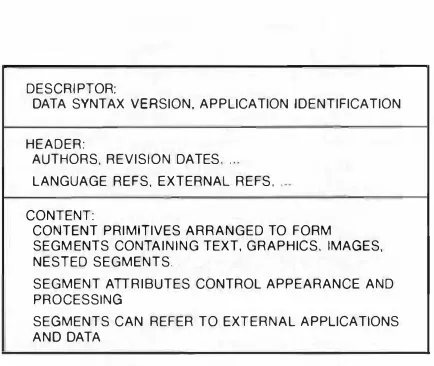
Each DDIF encoded document consists of three variable-length elements: the document descrip tor, the document header, and the document con tent. (See Figure l .)
DESCRI PTOR:
DATA SYNTAX VERSION. APPLICATION IDENTIFICATION
HEADER:
AUTHORS. REVISION DATES . .
LANGUAGE REFS. EXTERNAL REFS . .
CONTENT:
CONTENT PRI MITIVES ARRANGED TO FORM
SEGM ENTS CONTAINING TEXT. GRAPHICS. IMAGES.
NESTED SEGMENTS.
SEGMENT ATTRI BUTES CONTROL APPEARANCE AND
PROCESSING
[image:20.588.79.296.517.700.2]SEGMENTS CAN REFER TO EXTERNAL APPLICATIONS AND DATA
Figure 1 Top-level Structure of a DDIF Document
18
The descriptor contains information about the revision level of the data syntax and the name of the application that created the document. The docu ment header contains global document-specific information such as time and date of creation and a list of authors. The document content generally contains the largest quantity of data, and describes the part of the document that is displayed, printed, and edited.
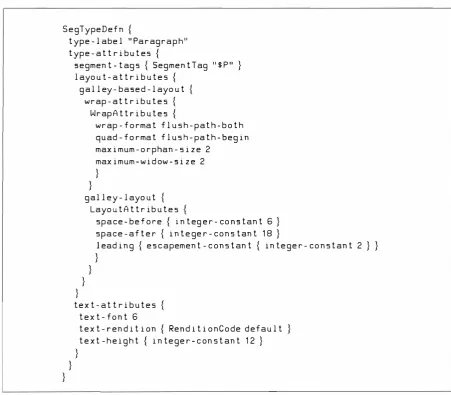
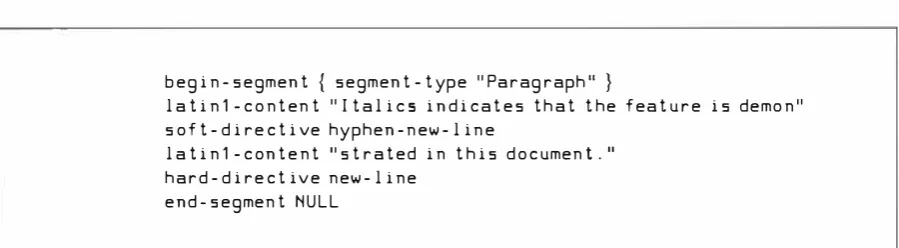
As shown in Figure 2, the content of a document is organized in the DDIF format as a hierarchy of bounded document content portions, called seg ments 2 Each DDIF segment may be text, graphics, image, and/or nested segments. Additionally, a seg ment's content may be computed by a standard or application-defined function.
Each segment represents document content that is distinguished from its surrounding content by a difference in its presentation or processing. As a result, each segment has a unique set of attributes that apply to the presentation and processing of the content. Attributes not declared for a given seg ment are generally inherited from the segmem that encompasses that segment. The values of attributes bound to a segmem override the value of the same attribute bound to an outer-level segment.
The DDIF standard prescribes initial values for each presemation attribute. These are supplied by each receiving application or by the CDA Toolkit on behalf of the application. The fact that each seg ment declares only the difference between its attributes and its parent segment's attributes keeps document size minimal.
The nesting of segments and the declaration of seg ment attributes can be compared to the use of begin-end program segments in a structured pro gramming language. In a structured language, variables can be declared for each segment. When a programming language allows nested declara tion of variables of a given name, then variables of i nnermost scope take precedence when that name is referenced.
The scoped method of structuring document content was chosen for the DDIF format in prefer ence to the alternative " modal" form, where an attribute remains in effect u ntil explicitly changed. For revisable documents, the scoped approach allows a segment to be skipped entirely without rendering the attribute state ambiguous. Conversely, a segment can be inserted into the document without resetting the previous state.
An application can maintain the current state of the segment attributes by pushing all the changed