DEVELOPMENT BATTERY OPERATION MANAGEMENT
TO MAINTAINING CONTINUITY OPERATION OF
MICROGRIDS IN ISLANDING CONDITION
HARTONO BUDI SANTOSO 1, RUDY SETIABUDY 2, BUDIYANTO3
1 Department of Electrical Engineering, Universitas Indonesia, Depok, Indonesia. 2 Department of Electrical Engineering, Universitas Indonesia, Depok, Indonesia. 3 Department of Electrical Engineering, Universitas Muhamadiyah, Jakarta, Indonesia.
Email: [email protected], [email protected], [email protected]
ABSTRACT
This research developed power sharing methods between inverters in the PV microgrid. The regulator of microgrid operation mode while using the back-up battery in every distributed generation during islanding condition needs to be done in order to maintain continuity of power supply from every generator to meet the power load. Arrangement of microgrid operation mode is done by adjusting power-sharing supply distribution between generators which sourced from the battery and utilizing energy source from solar radiation optimally when the sun exist.
The study was conducted by comparing three microgrid operation mode simulations ; stand alone, equal output power, and equal battery level. The simulation results show that the distribution of power sharing method between generators, based on equal battery level, is better than equal output power, where on equal battery level, the Power Distribution Index (PDI) = 100% while, in equal output power, PDI = 94.6%. Meanwhile forthe Battery Charging Index (BCI) both methods give the same result of 100%.
Keywords: Microgrid, Power Distribution Index, Battery Charging Index, Islanding Condition And Continuity Operation
1. INTRODUCTION
The increase in the penetration of distributed generation (DG) and the presence of multiple distributed generators in electrical proximity to one another have brought about the concept of the microgrid [1,2]. The concept of the microgrid was first proposed by the Consortium for Electric Reliability Technology Solutions (CERTS) in America; it is a new type of distributed generation network structure with a wide range of development prospects [3].
Microgrids comprise low-voltage distribution systems with distributed energy sources, storage devices, and controllable loads that are operated either islanded or connected to the main power grid in a controlled, coordinated way. In grid connected mode, the micro sources act as constant power sources, which are controlled to inject the demanded power into the network[4]. During islanding, each distributed generation unit is able to balance power and share loads within the microgrid system [5].
G
G PCC
DG
DG
DG
DG DG
DG DG
[image:1.595.307.509.474.617.2]DG DG DS
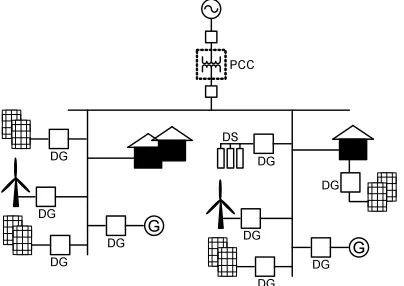
Figure 1. Diagram Of Microgrid System
of energy resources [6-7]. The topological change
in the power system landscape is opening up possibilities to form micro-grids: localized groups of DGs, storages and loads that act as autonomous power systems with a single point of common coupling to the main electricity network. DG produces electricity near the load site. This approach is not likely to be used to replace central station plants, but it could respond to particular needs with in competitive markets [8]. Battery energy storage units provide an added degree of freedom to a microgrid that allows time-shifting between the generation and use of energy. Microgrid energy storage elements are very similar to any other inverter-based source with the exception of bi-directional power flow capabilities. Having the ability to generate and accept power means that the demand and the supply can be disparate by as far as the power capabilities of the energy storage unit allow [9]. To minimize the micro-grid operation cost or equivalently maximize the profit, and the decision variables are the charging and discharging power of the battery storage system for each time interval of the day, the micro-grid management schedules the battery for the day-ahead by taking into account the hourly electricity tariffs and the load and generation forecasts. [10].
The problems that arise microgrid islanding condition (off grid) is how to control the power sharing that generated by DG to meet power balance between the generated power and the load demand. There are several power sharing methods in microgrid; centralized control, master-slave, ALS, 3C and droop method [11]. However, all of existing power sharing methods are still excluding the availability of energy reserves, which is used to achieve better continuity of operations of microgrid.
In the microgrid that uses solar energy sources, there is one condition during islanding conditions and the generator doesn’t get the solar energy supply, at night, therefore it will only using battery as its energy source. This situation raises another issue, that is how to manage battery operation of each DG, thus, can still maintain the continuity of power supply to the load, without disconnecting the load due to insufficient energy supply from the battery. Battery operation can be managed by considering variation of the load that needs to be supplied by each DG, and, other parameters such as the variation in the power inverter capacity or energy storage capacity or battery capacity and
[image:2.595.307.508.154.352.2]solar panel related to the amount of power that can be generated from solar energy.
Figure 2. Operation Pattern Of-PV Microgrid When Islanding Conditions
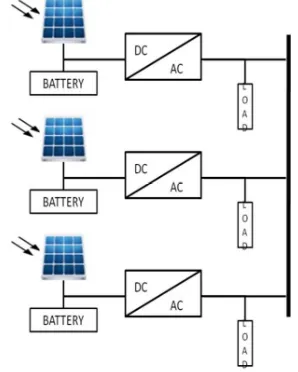
With operation pattern of PV-microgrid during islanding condition as shown in Figure 2 and microgrid configuration in islanding conditions, as in Figure 3, then, it is necessary to have a operation control mechanism which enables to achieve a continuous power supply during simulation and maximum battery level condition at the end of the simulation.
Figure 3. Microgrid Configuration While Islanding Condition
[image:2.595.332.481.485.671.2]different load profile. This is caused by
inappropriate operation control which can be resulted in one DG still has enough power but it can not supply other DG load that have been running out ofbattery back-up power, due to the limited capacity of DG inverter or DG inverter with a large enough power capacity should be able to supply the other DG load, but it can not because there is no power from battery or the battery is already at minimum level.
To resolve the above problems, it is necessary to develop energy management system (EMS) in the PV microgrid that will perform the operation management of the battery, during islanding condition and no energy source from solar radiation. This research will develope the power sharing method of each DG on the PV-microgrid To get a better microgrid operation continuity.
2. SIMULATION METHOD
To see the characteristics of the system developed, the power sharing methods development is carried out through simulation of three parallel inverters operation in islanding condition. The simulations carried out in three operation modes, namely, stand-alone and parallel operation. Parallel operation performed two power sharing methods, namely, average/equal output power and equal battery level.
At the equal output power mode, the output power of each inverter is the average of the total load power that must be supplied. So that each DG will supply the equal amount of power. While at equal battery level mode, at an early stage of operation, the inverter is intended to achieve the same level of the battery. So that the DG with a larger battery capacity will supply greater power than other DG with a smaller battery capacity, to achieve the same level of the battery. When the battery reached the same level then the three inverters will operate with the same output power inverters, to maintain the battery level remains the same.
From these three methods, an operation test is performed using simulated data of solar radiation and load forecasts. Based on this data, operation planning of three inverters is performed. The final results of simulation is expected to get the three inverters operate continuously without disconnecting the load, because the inverter incapability to supply the load due to inverter limited power capacity. In addition, at the end of the simulation is also expected that the battery level
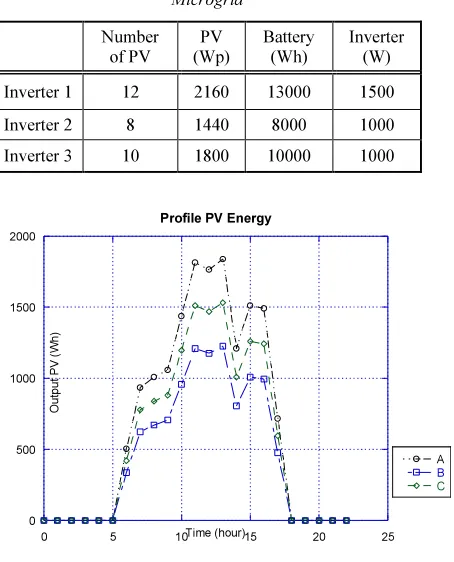
[image:3.595.303.530.182.463.2]will approaching its maximum level. Data simulation starts at 18.00 pm up to 24 hours ahead. The simulation device specifications are as follows:
Table 1. Specification Of Simulation Components Of PV-Microgrid Number of PV PV (Wp) Battery (Wh) Inverter (W)
Inverter 1 12 2160 13000 1500
Inverter 2 8 1440 8000 1000
Inverter 3 10 1800 10000 1000
0 500 1000 1500 2000
0 5 10 15 20 25
Profile PV Energy
A B C O u tp u t PV (W h ) Time (hour)
Figure 4. Simulation Data Of Output Power PV Generstor Base On Radiation Forecast Data
Based on radiation forecast data, the output power calculation of solar panel is performed of each DG by the following equation:
. .η
Where : , output power of solar panels (W); ,
width of solar panels (m2); , power of solar radiation (W/m2) and η , efficiency of solar panels. By input the width of every panel multiplied by the number of panels, then, the amount of energy obtained by each DG as shown in Figure 4.
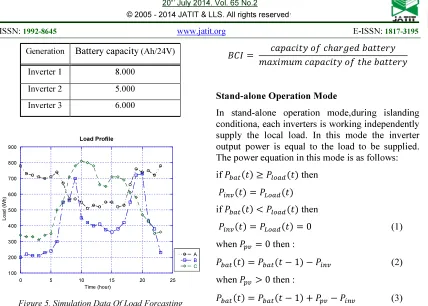
Battery capacity is listed in table 1, is not effective battery capacity that will be used in the simulation. In fact, by taking into account, the Depth of Discharge (DOD) factors by 15% of maximum battery capacity or 100% State of Charge (SOC), battery efficiency factor, inverter efficiency factor, and 24V nominal voltage of battery, then the battery effective capacity value of each DG is shown in table 2:
Generation Battery capacity (Ah/24V)
Inverter 1 8.000
Inverter 2 5.000
Inverter 3 6.000
100 200 300 400 500 600 700 800 900
0 5 10 15 20 25
Load Profile
A B
C
Lo
ad
(W
h
)
[image:4.595.89.517.84.390.2]Time (hour)
Figure 5. Simulation Data Of Load Forcasting
For performance testing purpose of the developed microgrid operation method, simulation data of load forcasting is used as shown in Figure 5. The simulation data illustrates the three characteristics of load, namely, load A/DG 1, have a tendency for activity, is shown on the amount of power consumption used at night is greater than during the day. Load B/DG 2, illustrates household load where high loads occur at the turn of the day and night until hours 20:00 to 21:00. While load C/DG 3, which illustrates of office load, during the day is the peak load usage.
Based on these data, simulation of microgrid operation is performed in three operation modes, namely:
• Stand alone
• Equal Output Power Inverter • Equal Battery Level
Performance parameters of each mode of operation is stated in power distribution index (PDI) and battery charging index (BCI). Power distribution index states ratio between load power that must be supplied compare to supplied load power,
Battery charging Index states ratio between capacity of charged battery compare to maximum capacity of the battery,
Stand-alone Operation Mode
In stand-alone operation mode,during islanding conditiona, each inverters is working independently supply the local load. In this mode the inverter output power is equal to the load to be supplied. The power equation in this mode is as follows:
if ! " ! then
! !
if ! # ! then
! ! 0 (1)
when 0 then :
! % 1! % (2)
when ' 0 then :
! % 1! ( % (3)
Equal Inverter Output Power Operation Mode
In this operating mode, the inverter output power on each DG is an average of total power of three inverters, so each inverter has the same amount of power. The power equation of this operation mode is as follows :
, !
∑
, ! (4)
when 0 then :
, ! , % 1! % ∗ , ! (5)
when ' 0 then :
, ! , % 1! ( , ! ( ! %
, ! (6)
Ls parameter is a parameter of the load termination, =1 if , % 1! ' , ! and
=0 when , % 1! # , !. while
! is a parameter of battery excess power, if
Figure 6. Flowchar Of Equal Inverter Output Power Operation Mode
Equal Battery Level Operation Mode
In this operation mode, during the operation, the system will try and maintain battery level of three inverters at the same level, so that, at any time, each inverter will still be able to supply power. Power equation of in this mode are as follows :
∆ ! , ! % ! (7)
, ! ∆ ! (8)
∑
, ! ∑ ∆ ! (9)
For battery equation, the same equation as in Equal Inverter Output Power Operation Mode is applied, equatio, (5) and (6). In equation (7) ∆ ! states
the battery level difference between the highest level of the battery with the lowest level batteries in
microgrid. While the parameters states the
inverter power amount ration that must be supplied against the difference of battery level. To illustrate the calculation of the amount of output power of each DG is shown in Figure 7,
A B C D E F
∆Ε1
∆Ε2
∆Ε3
[image:5.595.89.299.110.519.2]∆Ε4
Figure 7. Calculation Illustration Of Power Sharing Mode In Equal Battery Level
The amount of power needed to supply the load PL
is :
, ∗ ∆ ( ∆
∆
1
- .% , ∗ ∆
/
For the case on Figure 7. the amount of the load power and the power that will be supplied by each DGs are :
∆1 ( 2 ∗ ∆2! ( 3 ∗ ∆3! ( 5 ∗ ∆4!
( ∆
∆1 ( 2 ∗ ∆2! ( 3 ∗ ∆3! ( ⋯
2 ∗ ∆2! ( 3 ∗ ∆3! ( 5 ∗ ∆4! ( ⋯
3 ∗ ∆3! ( 5 ∗ ∆4! ( ∆( ⋯
The equation above does not apply massively as written in the above equation, but depend on the inverter and battery capacity that available at that time. Supposedly, if ΔE1 is large enough, thus exceeding the capacity of the inverter A, then the output power of inverter A is equal to maximum capacity of inverter A.
In this operation mode, when ' 0 The three
inverters continue to supply the load with the same amount of power. Meanwhile, different power input from PV radiation caused the condition of the battery level tend to lead towards a different level. Therefore, simulation of different inverter operation START
READ ALL GENERATION
DATA
CALCULATE THE TOTAL OF LOAD POWER (TLP), CAPACITY OF POWER
AVAILABLE (CPA)
TLP> CPA
DETERMINATION OF LOAD POWER, WITH
LOAD DISCONNECTION I=1:24
(HOUR OF ONE DAY)
CALCULATION OF LOAD
POWER ACCORDING TO
AVERAGE OF LOAD POWER
I=1:N (NUMBER OF GENERATION)
method is performed, when ' 0 where in this
condition each inverter will supply power according to the local load power, which must be supplied. So the power equation when ' 0 becomes :
, ! , % 1! ( , ! ( ! %
, ! (10)
[image:6.595.306.503.241.553.2]Flowchar of equal battery level operation mode as show in figure 7.
Figure 7. Flowchar Of Equal Battery Level Operation Mode
3. SIMULATION RESULT AND DISCUSSION
Stand alone Operation Mode
In this operating mode, it is shown that inverter 1 at 4 and 5 am was unable to supply power to the load, this happened because of the battery level has reached the minimum limit before the sun rises at 6 am. Meanwhile, for inverter 2 and inverter 3, the battery capacity was enough to supply the load until the sun is rising, so it is not necessary to disconnect the load.
Figure 8. Graph Of Inverter Output Power
Figure 9. Battery Power Level
Since each inverter works independently, it can not do power sharing between inverter, thus inverter 1 that has power shortage to supply the load, can not be supplied from other inverters that have excess power to supply the load. When viewed from the battery level of each inverter, the maximum battery level is reached at the end of the simulation. Simulation results shown thatn the inverter output power and battery level as shown in figure 8 and figure 9.
START
READ ALL GENERATION
DATA
SORT THE DATA BASED ON CAPACITY
OF BATTERY
CALCULATE THE TOTAL OF LOAD POWER (TLP), CAPACITY OF POWER AVAILABLE (CPA)
TLP> CPA
DETERMINATION OF LOAD POWER, WITH
LOAD DISCONNECTION
RADIATION < 0
CALCULATION OF LOAD POWER ACCORDING TO EQUAL BATTERY
LEVEL I=1:24
(HOUR OF ONE DAY)
I=1:N (NUMBER OF GENERATION)
CALCULATION OF LOAD
POWER ACCORDING TO
AVERAGE OF LOAD POWER
I=1:N (NUMBER OF GENERATION)
[image:6.595.90.293.254.651.2]
Figure 10. Supplied Power To The Load
In accordance with equation (1) the power supplied to the load is equal to the output power of the inverter as shown in Figure 10. The performance magnitude of this operation mode is the power distribution index, PDI = 96.33% and battery charging index , BCI = 97.84% which means not all loads that should be supplied power from the microgrid can be reached. Meanwhile at the end of the simulation, the battery level condition is not in maximum capacity, it only reached 97.84% of the maximum capacity.
Equal Output Power Inverter Operation Mode
Based on the simulation results, it shown that when all battery power of all inverter is enough to supply the load, then the three inverters will supply the load at the same amount. Meanwhile, if there is an inverter that cannot supply the power because running out of battery power back-up, then the two remaining inverters, if possible, will supply the total power that must be supplied by three inverters. If cannot be complied, then the load will be disconnected. As shown in the output power inverter graph, figure 11, at 4:00 and 5:00, where the battery capacity of inverter 2 has reached the minimum level so that the load on the inverter 2 is supplied from inverter 1 and inverter 3.
[image:7.595.93.291.107.270.2]What should be noted with this approach is when the difference of battery capacity between one generation to another generation is large enough there will be a condition where the battery capacity of one generation has run out while the other generation still have enough back-up power but it can not supply the power to another generation that have run out of battery power because it is constrained by the capacity of the inverter. So load termination must be done on the generation, as shown in the simulation results, that load termination on inverter 2 and 3 was performed at 6:00.
Figure 11. Inverter Output Power
Figure 12. Supplied Power To Load In Equal Output Power Inverter
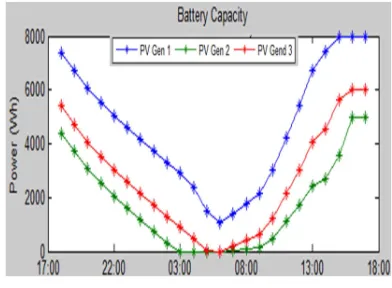
[image:7.595.308.504.573.717.2]With power-sharing mechanism it evenly between the three of PV generation, the amount of power supplied by each inverter is not the same as that power supplied to the load of each generation, as shown in Figure 11 and 12. While the condition of battery level during the simulation shown in Figure 13, which shown that the battery capacity of inverter 2 already reached its minimum capacity at 3 o'clock in the morning, while the battery capacity of inverter 3 reached its minimum capacity at 5.
Battery capacity on inverter 1 was never reached its
minimum capacity due to the battery capacity inverter 1 is quite large. As shown in this mode, that although inverter 2 is no longer supplying power but the power can still be supplied by the two remaining inverters, therefore the power on that inverter is still working because of power supply from the two remaining inverters. This is shown on inverter 2, that although the inverter output power already = 0 W at 3 o'clock to 5 o'clock, but the load on the inverter can still be supplied with power from the two remaining inverters. While the load on the inverter 3 was terminated at 5 am and no longer be able to received power from the inverter 1, because the remaining power, is not sufficient to supply the load on inverter 3. Consideration on load termination on inverter 3 because remaining power on the inverter 1 is only enough to supply power to the inverter 1 and inverter 2.
The simulation results shown that the performance of applied operation methods gives PDI = 97.92%, which means that not all load is successfully supplied with power, there are some part of load, which should perform load termination. While BCI = 100%means that on this operation mode at the end of each simulation successfully recharged the battery to reach its maximum capacity of the battery charged.
Equal Battery Level Operation Mode
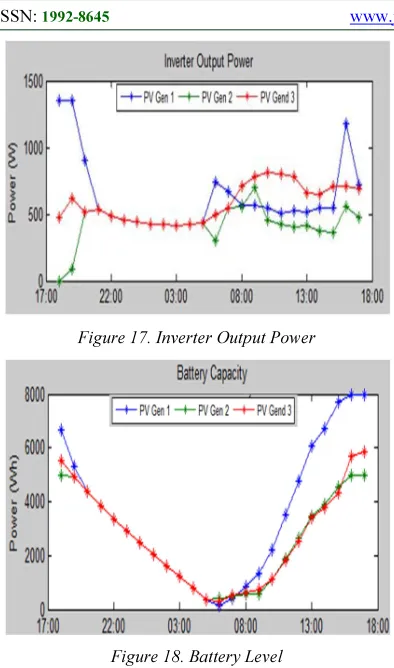
[image:8.595.307.502.256.395.2]In this operating mode, as shown in the graph of battery level, in which, at some time after the simulation begins all three inverters have the same battery level. When the same battery level is reached, each inverter also supply the same power. In this operation mode, allthree inverters are able to supply the entire load that should be supplied as shown in load forecast.
Figure 14. Inverter Ouput Power In Equal Battery Level
[image:8.595.306.503.256.575.2]However, on the inverter itself, the amount of output power is not the same with the load that should be supplied, because the magnitude of the output power of the inverter, following the condition of the battery level in order to be maintained at the same level. This is due to the mechanism of power sharing between inverters. All three inverters also successfully achieve the maximum level of the battery capacity at the end of the simulation.,. The simulation results can be seen in Figure 14, 15 and 16.
Figure 15. Supplied Power To Load In Equal Battery Level
Figure 16. Battery Level In Equal Battery Level
[image:8.595.92.289.577.713.2]
Figure 17. Inverter Output Power
Figure 18. Battery Level
Based on simulation results, it can be seen that the application of power sharing method based on the equal battery level gives better performance in which, all the load still can be served by all three inverters, without performing load termination and the maximum battery level is reached at the end of the simulation.
Both approaches are used in the application of equal battery level method, produce the same performance parameters, in which PDI = 100% and BCI = 100.00%, which means equal battery level method provides continuous power distribution to the load better, in which the entire load is successfully supplied and the battery charging capacity reached its maximum capacity at the end of the simulation.
4. CONCLUSION
The control of power-sharing during islanding condition and operation of generation, using energy source from the battery, which performed using equal battery level method gives better results than stand alone operation or based on method of equal output power generation/inverter. This is caused, by maintaining the battery level of each generation at
the same level, each generation has the ability to supply power to the network. While in equal output power method, if there is large differences on the battery capacity, there will be a condition where the generation is running out of battery level, while other generation can not supply the load on that generation, due to the limited capacity of the inverter. In stand-alone mode, the power-sharing does not occur because each inverter work, supplying load power owned by each generation.
Based on the performance parameters of each method, it can be concluded that the operation method of the microgrid based on equal battery level is still better than the stand alone method and equal output power method. In which, with equal battery level method obtained PDI = 100%, meanwhile in, equal output power PDI = 97, 92% and standalone modes obtained PDI = 96.33%. BCI value for equal battery level method obtained BCI = 100.00%, as same as that obtained using equal ouput power method and in standalone operation mode BCI = 98.02%.
REFERENCES
[1] R. Lasseter, A. Akhil, C. Marnay, J. Stephens, J. Dagle, R. Guttromson, A. Meliopoulos, R. Yinger, J. Eto, White paper on Integration of Consortium Energy Resources. The CERTS MicroGrid Concept, CERTS, Rep. LBNL-50829, 2002.
[2] MICROGRIDS: Large Scale Integration of Micro-Generation to Low Voltage Grids, EU Contact ENK5-CT-2002-00610, Technical Annex, 2002.
[3] W. Deng, W. Pei, Z. Qi, “Impact and improvement of distributed generation on voltage quality in micro-grid", 3rd International Conference on Electric Utility Deregulation and Restructuring and Power Technologies, pp. 1737-1741, 2008.
[4] A. A. Salam, A. Mohamed and M. A. Hannan,
"TECHNICAL CHALLENGES ON
MICROGRIDS", ARPN Journal of Engineering and Applied Sciences, VOL. 3, NO. 6, DECEMBER 2008, pp. 64-69
[5] J. A. Pecas Lopes, C.L Moreira, F.O.Resende. 2005. Microgrids blackstart and islanding operation in Proc.15th PSCC, Liege, Belgium, [6] R.H. Lasseter, “Microgrids", IEEE Power Engineering Society Winter Meeting, Vol. 1, pp. 305-308, 2002.
delivery infrastructure", IEEE Power
Engineering Society General Meeting, pp. 18-22, 2006.
[8] Para Kalpana, And Dr. A.Lakshmi Devi, "Placement And Sizing Of Distributed Generators In Distributed Network Based On Lric And Load Growth Control", Journal of Theoretical and Applied Information Technology, 10th January 2013. Vol. 47 No.1 [9] Robert Lasseter, Micah Erickson, "Integration
of Battery-Based Energy Storage Element in the CERTS Microgrid", CERTS, University of Wisconsin-Madison, October 27, 2009 [10] Pukar Mahat, Jorge Escribano Jiménez, Eloy
Rodriguez Moldes, Sandra Iren Haug,Ireneusz Grzegorz Szczesny, Karl Eide Pollestad, Luminita Cristiana Totu, “A Micro-Grid Battery Storage Management” Proceedings of the IEEE PES General Meeting 2013, IEEE Press, 2013
[11] Josep M. Guerrero, Lijun Hang, dan Javier Uceda, “Control of Distributed Uninterruptible Power Supply Systems”, IEEE
TRANSACTIONS ON INDUSTRIAL