INTRODUCTION
Nearly all angiosperm flowers possess a perianth, a series of sterile organs that surround the reproductive organs – the stamens and carpels. In many flowering plant lineages, the perianth is differentiated into distinct outer organs called sepals, and inner organs called petals; this is termed a bipartite perianth. Petals are therefore defined as occupying the spatial position outside of the stamens but internal to the sepals, and are often large, showy and pigmented, and contain specialized reflective papillate epidermal cells (Endress and Matthews, 2006). The evolution of flowers with elaborated petals is likely to have increased fitness through facilitating pollinator interactions (Clegg and Durbin, 2003).
Our current understanding of the molecular mechanisms controlling petal-identity specification rests largely on functional analyses carried out in several core eudicot species, including Arabidopsis thaliana and Antirrhinum majus (Weigel and Meyerowitz, 1994). In Arabidopsis, for example, the APETALA3 (AP3) and PISTILLATA (PI) MADS-box genes are required to specify petal and stamen identity, and mutations in these genes result in homeotic transformations of petals into sepals and stamens into carpeloid structures (Bowman et al., 1991; Goto and Meyerowitz, 1994; Jack et al., 1992). The AP3 and PI gene products heterodimerize, and are likely to act in vivo as part of larger MADS-box protein complexes, in order to specify petal as well as stamen identity (Bowman et al., 1991; Goto and Meyerowitz, 1994; Honma and Goto, 2001; Jack et al., 1992; Pelaz et al., 2001; Riechmann et al., 1996).
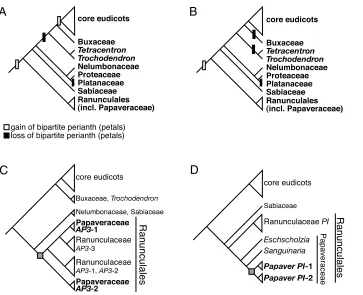
Although a considerable amount is known about the molecular mechanisms specifying petal identity in Arabidopsisand other core eudicot species, there is little functional evidence that homologs of these genes play similar roles in petal-identity specification outside of the core eudicots. It is generally accepted that a bipartite perianth with distinct petals evolved independently multiple times within the flowering plants (Drinnan et al., 1994; Takhtajan, 1991). However, exactly when such events occurred is still unresolved. Phylogenetic analyses have been used to suggest that transitions between a unipartite and bipartite perianth have occurred multiple times within the eudicots (Albert et al., 1998; Soltis et al., 2005; Zanis et al., 2003). These analyses, though, are equivocal in determining the direction of such evolutionary transitions. One possibility is that a bipartite perianth represents independent evolutionary events in core eudicots as compared with the Ranunculales (Fig. 1A). Alternatively, a bipartite perianth might have been ancestral, and was lost in only a few, derived, non-core eudicot lineages (Fig. 1B). Determining whether core eudicots and Ranunculales species possess similar or divergent developmental genetic mechanisms to condition petal identity would be valuable in assessing the merits of these two hypotheses.
A variety of studies have already been carried out to assess the roles of AP3homologs in core eudicot species. A duplication in the AP3gene lineage at the base of the core eudicots gave rise to the euAP3and TM6lineages, which are characterized by having distinct C-terminal sequence motifs (Kramer et al., 1998). The sequence motifs in the TM6lineage genes are more similar to those of the paleoAP3genes, which are found in non-core eudicot angiosperms (Kramer et al., 1998). Genetic analyses of euAP3genes in core eudicot species, such as of the Arabidopsis AP3gene, support the idea that these genes have a common function in petal-identity specification, as well as in stamen specification (de Martino et al., 2006; Jack et al., 1992; Schwarz-Sommer et al., 1992; Vandenbussche et al., 2004). By contrast, core eudicot TM6genes appear to have a more restricted role in conditioning stamen identity (de Martino et al., 2006; Rijpkema et al., 2006).
Functional analyses of genetic pathways controlling petal
specification in poppy
Sinéad Drea1, Lena C. Hileman1,*, Gemma de Martino1and Vivian F. Irish1,2,†
MADS-box genes are crucial regulators of floral development, yet how their functions have evolved to control different aspects of floral patterning is unclear. To understand the extent to which MADS-box gene functions are conserved or have diversified in different angiosperm lineages, we have exploited the capability for functional analyses in a new model system, Papaver
somniferum(opium poppy). P. somniferum is a member of the order Ranunculales, and so represents a clade that is evolutionarily distant from those containing traditional model systems such as Arabidopsis,Petunia, maize or rice. We have identified and characterized the roles of several candidate MADS-box genes in petal specification in poppy. In Arabidopsis, the APETALA3 (AP3) MADS-box gene is required for both petal and stamen identity specification. By contrast, we show that the AP3lineage has undergone gene duplication and subfunctionalization in poppy, with one gene copy required for petal development and the other responsible for stamen development. These differences in gene function are due to differences both in expression patterns and co-factor interactions. Furthermore, the genetic hierarchy controlling petal development in poppy has diverged as compared with that of Arabidopsis. As these are the first functional analyses of AP3genes in this evolutionarily divergent clade, our results provide new information on the similarities and differences in petal developmental programs across angiosperms. Based on these observations, we discuss a model for how the petal developmental program has evolved.
KEY WORDS: Petal identity, Homeotic genes, MADS-box genes, Poppy, Papaver somniferum Development 134, 4157-4166 (2007) doi:10.1242/dev.013136
1Department of Molecular, Cellular and Developmental Biology, Yale University, New Haven, CT 06520, USA. 2Department of Ecology and Evolutionary Biology, Yale University, New Haven, CT 06520, USA.
*Present address: Department of Ecology and Evolutionary Biology, University of Kansas, Lawrence, KS 66045, USA
†Author for correspondence (e-mail: [email protected])
Accepted 7 September 2007
D
E
V
E
LO
P
M
E
N
The roles of paleoAP3genes in non-core eudicot angiosperms are somewhat unclear. A variety of expression analyses have been carried out that, in general, support the idea that paleoAP3genes have a conserved role in stamen identity specification, but their role in petal specification remains ambiguous. For instance, in many basal angiosperms, paleoAP3genes show strong and ubiquitous expression in stamens, but often inconsistent, weak or patchy expression in petal primordia (Kim et al., 2005; Kramer and Irish, 1999; Zahn et al., 2005). In non-grass monocots, expression of paleoAP3genes can be observed in developing petaloid organs in some taxa [e.g. inLilium longiflorum(Tzeng and Yang, 2001)], but not in others [e.g. Aparagus officinalis (Park et al., 2003)]. Functional analyses in several monocot grasses have demonstrated that the paleoAP3 genes in these species are required for the development of stamens and lodicules (Ambrose et al., 2000; Nagasawa et al., 2003; Xiao et al., 2003). As these grass species lack petals, such studies cannot directly assess the roles of paleoAP3 genes in petal development. Furthermore, a chimeric AP3gene containing a non-core eudicot paleoAP3motif has been shown to be sufficient to rescue stamen, but not petal, identity in Arabidopsis (Lamb and Irish, 2003). By contrast, other studies have shown that ectopic overexpression of a monocot paleoAP3gene can rescue both petal and stamen development, suggesting that levels of paleoAP3 gene expression might be important in determining developmental function (Whipple et al., 2004). Based on these observations, it has been suggested that the paleoAP3genes lack the capacity to fully specify petal identity, although they may play subsidiary roles in petal cell-type differentiation (Kramer and Irish, 1999; Kramer and Irish, 2000).
In order to explicitly and critically test the role of paleoAP3and PIhomologs in the specification of petals in a non-core eudicot lineage, we have carried out functional analyses of paleoAP3and
PI-like genes in the non-core eudicot Papaver somniferum(opium poppy). The Ranunculales, which includes Papaverspecies (the poppies), are well-supported as the sister group to all other eudicots (Angiosperm Phylogeny Group, 2003; Kim et al., 2004) (Fig. 1) and so are well-placed for comparative studies. P. somniferum is one of the oldest cultivated medicinal plants, and its continuing pharmaceutical importance as the source of a variety of morphinan alkaloids has made it one of the best-studied Papaver species (Chitty et al., 2006; Kapoor, 1995; Millgate et al., 2004; Zulak et al., 2007). Furthermore, functional genetic analyses can be rapidly carried out in P. somniferumusing virus-induced gene silencing (Hileman et al., 2005). Our results provide the first functional evidence that petal identity can be conditioned by the action of a paleoAP3gene, and suggest that petal-identity specification in non-core eudicots relies on an independently derived, but similar, developmental program as that present in core eudicots. In addition, we show that there has been extensive functional diversification in the role of paleoAP3gene products in specifying petal and stamen identity in poppies.
MATERIALS AND METHODS Isolation of Paps genes
RT-PCR reactions using the following degenerate primers were used to isolate poppy sequences from floral poly(A) RNA: PapsAP3DF [5⬘ -AA(G/A)AAGCT(A/C)AAGA(A/G)CT(A/T/G)AC(A/T)(A/G)TTCT-3⬘] and PapsAP3DR [5⬘ATC(T/G)T(G/C)TCC(T/C/A)(T/G/A)(T/G/C)CCT -(C/T)TGC(T/C)AT(C/T)TC-3⬘] for the PapsAP3genes; PapsPIDF [5⬘ -AAGAGG(A/C)(A/G)AA(A/C)TGG(G/A)(T/A)T(G/C/T)(T/C/A)G/C)AA (G/A)A-3⬘] and PapsPIDR [5⬘AG(A/G)(C/T/A)G(C/T)TT (A/G)TT -(G/A/T/C)TC(C/T)(A/G)C(C/T)TC(T/C/A)A-3⬘] for the PapsPIgenes. Full-length sequences were obtained using RACE (rapid amplification of cDNA ends) according to the manufacturer’s instructions (GIBCO-BRL, Carlsbad, CA).
core eudicots
Buxaceae Tetracentron Trochodendron
Platanaceae Proteaceae Nelumbonaceae
Sabiaceae Ranunculales (incl. Papaveraceae)
gain of bipartite perianth (petals) loss of bipartite perianth (petals)
Ranunculaceae PI
Papaver PI-1
Ranunculales
core eudicots
Ranunculaceae AP3-3
Ranunculaceae AP3-1, AP3-2
Papaveraceae AP3-1
Papaveraceae AP3-2
Ranunculales
core eudicots
Buxaceae Tetracentron Trochodendron
Platanaceae Proteaceae Nelumbonaceae
Sabiaceae Ranunculales (incl. Papaveraceae)
inferred gene duplication
Buxaceae, Trochodendron
Nelumbonaceae, Sabiaceae
core eudicots
Sabiaceae
Papaver PI-2
Sanguinaria Eschscholzia
Papaveraceae
A
B
[image:2.612.52.415.55.350.2]C
D
Fig. 1. Inferred evolutionary history of petals and MADS-box genes in the eudicots.(A,B) Alternative scenarios for the evolution of petals. (A) The evolution of a bipartite perianth occurred independently in the lineage leading to the Ranunculales as compared with the core eudicots. (B) The evolution of a bipartite perianth occurred prior to the radiation of the eudicots, with losses of this character in multiple lineages. (C,D) Summary of phylogenetic analyses. For comprehensive phylogenetic analyses, see Figs S1, S2 in the supplementary material. (C) The duplication of paleoAP3-like genes resulting in
PapsAP3-1 and PapsAP3-2 occurred within the Ranunculales, pre-dating the divergence of the Ranunculaceae and Papaveraceae. (D) The duplication of PI -like genes occurred relatively recently in the Papaveraceae, leading to PapsPI-1
and PapsPI-2in P. somniferum. Clades in bold represent those containing Paps
genes described in this study.
D
E
V
E
LO
P
M
E
N
Phylogenetic analyses
Nucleotide sequences of AP3 and PI homologs were aligned using CLUSTALX and refined by hand using MacClade (Maddison and Maddison, 2000). Aligned sequences were used to generate maximum likelihood trees under the GRT + gamma model of molecular evolution, as implemented in GARLI (www.bio.utexas.edu/faculty/antisense/ garli/ Garli.html) (D. J. Zwickl, PhD thesis, University of Texas at Austin, 2006).
RT-PCR
Total RNA was extracted using Trizol (Invitrogen, Cleveland, OH) and approximately 300 ng was used in 10 l cDNA synthesis reactions using Superscript III Reverse Transcriptase (Invitrogen). For cDNA synthesis, the poly(T) primer used was 5⬘-GACTCGAGTCGACATCGA(T)17. Primers for testing expression of PapsAP3-1,PapsAP3-2,PapsPI-1 andPapsPI-2were: PAP3-11, 5⬘-AAGAAATAAAGCCATGGAGG-3⬘and PAP3-12, 5⬘CTA -AATACCGATTTTGGAGTC-3⬘; PAP3-21, 5⬘AAGCTAAGGAACCAC -ACTGA-3⬘and PAP3-22, 5⬘-CACGCATGGTTCATAGATAT-3⬘; PPI-11, 5⬘-TTGCCAAACTACAACAAGTG-3⬘ and PPI-12, 5⬘TAGCAGCTA -TGATCATGATC-3⬘; PPI-21, 5⬘-ACTCAAGAAAAATGGAAGAC-3⬘and PPI-22, 5⬘-GCTTTTTATAAGTTCTTTGC-3⬘. Actin primers were: ACT1, 5⬘-ATGGATCCTCCAATCCAGAC-3⬘ and ACT2, 5⬘TATTGTGTTG -GACTCTGGTG-3⬘.
In situ hybridization
Hybridizations were carried out as previously described (Drea et al., 2005; Kramer and Irish, 1999) with minor modifications. Gene specific regions derived from the C-terminal domain and 3⬘UTR of PapsAP3-1, PapsAP3-2,PapsPI-1, and PapsPI-2sequences were used to generate digoxygenin-labeled RNA probes.
Virus-induced gene silencing
Gene-specific regions of PapsAP3-1,PapsAP3-2,PapsPI-1and PapsPI-2, as well as concatenated PapsAP3-1/PapsAP3-2and PapsPI-1/PapsPI-2 sequences were introduced into the TRV2 vector (Liu et al., 2002), transformed into Agrobacteriumstrain GV3101 and used to infiltrate poppy seedlings at the 3- to 5-leaf stage as previously described (Hileman et al., 2005). Individual resulting plants were assayed for the presence of the viral vector using RT-PCR as well as for any visible phenotype.
Scanning electron microscopy
Plant material was fixed overnight in 3.7% formaldehyde, 5% acetic acid, 50% ethanol (FAA) and then transferred to 70% ethanol. Samples were dehydrated in an ethanol series before critical-point drying. Samples were coated in gold and analyzed on a Zeiss ISI-SS40 scanning electron microscope equipped with digital image capture.
Yeast two-hybrid assays
PapsPI-1, PapsPI-2, PapsAP3-1 and PapsAP3-2 IKC domains were fused with the GAL4 DNA-binding domain in the pGBT9 vector and with the GAL4 activation domain in the pGAD424 vector (Clontech, Mountain View, CA). Two independent transformations for each vector combination were performed and five colonies per transformation were used for  -galactosidase liquid assays, using the protocol available at http://www.fhcrc.org/science/labs/gottschling/yeast/Bgal.html.
RESULTS
Identification of P. somniferum AP3-like and PI -like genes
We identified P. somniferumpaleoAP3-like and PI-like genes using a degenerate RT-PCR approach. In referring to P. somniferumgenes, we have used the abbreviation Paps, as attached to gene symbols, so as to distinguish them from genes of other species. Sequencing and Southern hybridization analyses showed that there are two paleoAP3 -like (PapsAP3-1and PapsAP3-2) and two PI-like (PapsPI-1and PapsPI-2) genes in the P. somniferumgenome (data not shown). Phylogenetic analyses of paleoAP3-like and PI-like genes from a variety of basal eudicot species are consistent with the hypothesis that in both cases the duplications occurred within the Ranunculales (Fig.
1C,D and see Figs S1, S2 in the supplementary material). The duplication resulting in paralogous paleoAP3-like genes appears to have occurred early in the radiation of the Ranunculales (Fig. 1C and see Fig. S1 and Table S2 in the supplementary material), whereas the duplication giving rise to poppy PI-like genes appears to have occurred more recently within Papaveraceae (Fig. 1D and see Fig. S2 and Table S2 in the supplementary material).
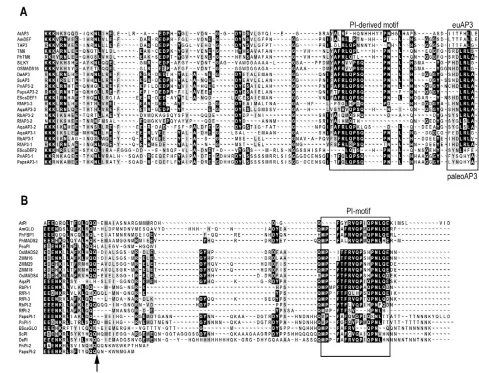
Both PapsAP3-1and PapsAP3-2encode characteristic paleoAP3 PI-derived motifs (Kramer et al., 1998), but the PapsAP3-1predicted product lacks the consensus paleoAP3motif (Kramer et al., 1998) (Fig. 2A). This pronounced difference at the C-terminus is due to insertions/deletions between the PapsAP3 genes that engender frameshifts beginning at the start of exon 6. As such, PapsAP3-1 lacks pleisiomorphic sequence motifs, but has gained a novel C-terminus, whereas PapsAP3-2retains the ancestral character state of a paleoAP3 C-terminal motif.
The PapsPI-1gene encodes a product containing the PI-motif as well as a sequence extension at the C-terminus (Fig. 2B). The PapsPI-2 predicted product lacks the consensus PI-motif (Kramer et al., 1998) at the C-terminus. This appears to be due to a single nucleotide insertion in the 3⬘ coding region followed by a 2-nucleotide deletion 22 bp downstream, generating a stop codon and a truncated protein (Fig. 2B). Although this domain has been shown to be essential for protein function in the Arabidopsis PI protein (Lamb and Irish, 2003), the Pisum sativum PIgene also lacks this conserved domain but has been shown to be capable of rescuing the Arabidopsis pi mutant phenotype (Berbel et al., 2005).
Diversification in expression of P. somniferum genes
P. somniferumflowers contain two sepals, four petals, numerous hypogynous stamens, and generally 8 to 12 carpels, which produce the capsular fruit (Kapoor, 1995). The early development of floral organ primordia in P. somniferum can be characterized by a variety of morphological landmark stages (Fig. 3). These include stage P3 of development when the petal, stamen and carpel primordia are first clearly visible, and are enclosed by the surrounding sepal primordia. By stage P5, the anther and filament of the stamens are discernable and the capsule has become invaginated; ovules are distinguishable by stage P5. Between stages P7 and P8 the petals undergo accelerated growth and extend to fill the space bounded by the two sepals. This rapid growth of the petals continues to force the sepals apart when the bud opens just after anthesis. At later stages, P. somniferum buds (stage P8 and later) become pendant prior to anthesis, before extending upright as the flower opens owing to asymmetric growth of the pedicel. At maturity, each floral organ type is characterized by distinctive epidermal cell morphologies (Fig. 4A). Sepal cells are somewhat irregular, with numerous stomata present on the abaxial surface, and adaxial sepal epidermal cells being more domed. Petal cells are distinctively long and narrow, with prominent ridges on the adaxial surface that differ from the characteristic conical and papillar cells found in petals of many species. Stamen filaments possess elongated epidermal cells, whereas the epidermal cells of the anther are more irregularly shaped. The gynoecium results from a fusion of multiple carpels and possesses distinctive ridges; the epidermal cells between the ridges are relatively flat and are interspersed with stomata.
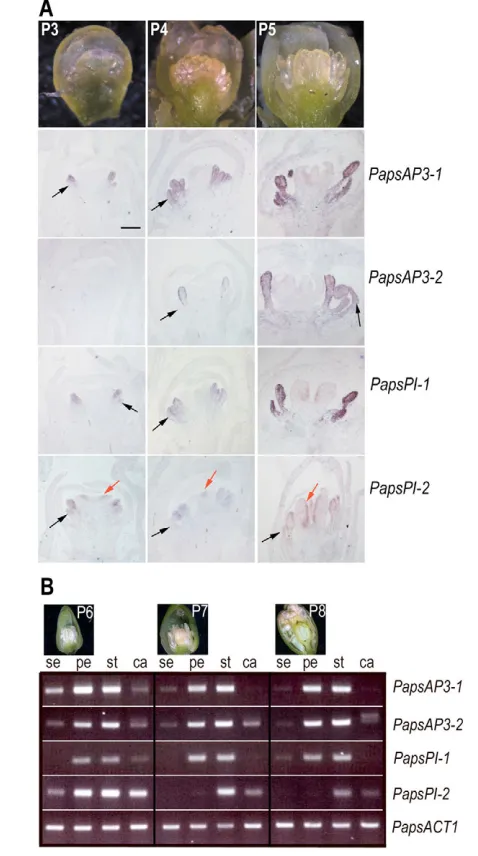
RT-PCR and in situ hybridization analyses showed that each of the P. somniferum genes had a distinct pattern of expression during floral development. PapsAP3-1expression was initially detected in petal and stamen primordia at stage P3, when these primordia are first
D
E
V
E
LO
P
M
E
N
apparent (Fig. 3A). Expression of PapsAP3-1 throughout the developing stamens and petals persisted through later stages of flower development (Fig. 3A,B). Weak expression of PapsAP3-1could be detected in sepal and carpel primordia at later stages of development (Fig. 3B). By contrast, PapsAP3-2expression was initially detected at stage P4 in stamen primordia, but was excluded from petal primordia (Fig. 3A). This pattern persisted until the P5 stage of flower development when PapsAP3-2expression was also detected in petal primordia (Fig. 3A). PapsAP3-2expression appeared to be more ubiquitous at later stages of development, in that low levels of expression could be detected in sepal and carpel primordia through stage P8 (Fig. 3B). The sequence and expression analyses indicate that PapsAP3-2 is more representative of paleoAP3-like genes of other Ranunculales species (Kramer et al., 2003; Kramer and Irish, 2000; Shan et al., 2006), suggesting that lack of early and ubiquitous petal-specific expression is ancestral in this clade.
PapsPI-1 was expressed throughout the petal and stamen primordia from stage P3 onwards throughout floral development, an expression pattern that appeared similar to that ofPapsAP3-1(Fig. 3A). PapsPI-2expression was detected early in P3 buds in petals, stamens and carpels (Fig. 3A), and remained largely restricted to the stamen and carpel whorls and at lower levels throughout later stages of floral development (Fig. 3A,B).
Loss-of-function phenotypes demonstrate a distinct function in floral organ identity for each
P. somniferum gene
To assess the functional roles of the AP3-like and PI-like genes in P. somniferum, we used tobacco rattle virus (TRV)-mediated, virus-induced gene silencing (VIGS) (Hileman et al., 2005). Gene-specific regions of PapsAP3-1, PapsAP3-2, PapsPI-1and PapsPI-2, as well as concatenated PapsAP3-1/PapsAP3-2 and PapsPI-1/PapsPI-2 sequences, were introduced into the TRV2 vector (Liu et al., 2002) for silencing. We screened approximately 500 infiltrated seedlings for each of the six constructs, with 0.5-8% of resulting plants containing the transformation vector and showing a phenotype (see Table S1 in the supplementary material). Transcript levels of silenced genes were considerably reduced (Fig. 6), although not completely eliminated, consistent with our previous observations that TRV-VIGS is an effective tool to downregulate gene expression in P. somniferum(Hileman et al., 2005). Silencing of an individual gene did not affect the expression of the other AP3-like or PI-like genes (Fig. 6), indicating that silencing was gene-specific.
[image:4.612.58.537.56.429.2]The range of phenotypes in silenced plants was distinct for each construct. Reduction in PapsAP3-1expression resulted in homeotic transformations of petals to more sepaloid organs (Fig. 4B), whereas stamens were unaffected. This transformation was evident at the
Fig. 2. Sequence alignment of P. somniferumAP3- and PI-like sequences.Alignment of C-terminal domains of predicted AP3 (A) and PI (B) proteins from core eudicots, monocots and basal eudicots. Conserved domains are boxed. Identical residues are highlighted in black and similar residues in gray. The arrow in B indicates the position of the insertion in PapsPI-2 that mediates a frameshift.
D
E
V
E
LO
P
M
E
N
cellular level, with both adaxial and abaxial second-whorl cells showing sepaloid characteristics (Fig. 4B). Conversely, silencing of PapsAP3-2expression resulted in stamens that showed variable
transformations to carpeloid structures containing ovules, whereas the petals remained completely unaffected (Fig. 4C). The VIGS phenotypes indicate that PapsAP3-1and PapsAP3-2control distinct developmental pathways. When both PapsAP3-1and PapsAP3-2 were silenced simultaneously, both petals and stamens showed homeotic transformations (Fig. 4D, Fig. 5). The range of petal phenotypes in these plants was similar to that of the PapsAP3-1 -silenced lines, but the transformation of stamens to carpels was generally much more severe than in the PapsAP3-2-silenced lines alone. These results suggest that PapsAP3-1 and PapsAP3-2, although having discrete functions, are also redundant in regulating stamen development. Furthermore, one target of their transcriptional action is PapsPI-1, as its expression was downregulated in the carpeloid stamens of plants silenced for both PapsAP3-1 and PapsAP3-2(Fig. 6).
VIGS of PapsPI-1 resulted in flowers with homeotic transformations of stamens to carpeloid organs and petals possessing sepaloid characteristics (Fig. 4E). By contrast, silencing of PapsPI-2produced no visible phenotype (data not shown). However, the transformation of stamens to carpeloid organs observed in the PapsPI-1-silenced lines was less severe than when both PapsPI genes were silenced (Fig. 4F), suggesting that PapsPI-2might play a redundant role in stamen development. Coordinate silencing of PapsPI-1and PapsPI-2also resulted in downregulation of PapsAP3-1expression in carpeloid stamens, whereas PapsAP3-2expression was less severely affected (Fig. 6).
Conservation and diversification in P. somniferum protein-protein interactions
Various lines of evidence have suggested that homodimerization of the paleoAP3-like gene products was ancestral (Winter et al., 2002), and that in core eudicots the ability of AP3 gene products to homodimerize has been lost (Riechmann et al., 1996; Schwarz-Sommer et al., 1992). To determine the dimerization capabilities of the P. somniferum gene products, we carried out yeast two-hybrid assays on pairwise combinations of P. somniferumproteins (Table 1). PapsPI-2 did not dimerize with any of the tested proteins, although this does not obviate the possibility that it interacts with other MADS-box gene products to effect its function. This is supported by the observation that silencing of PapsPI-2enhances the silenced phenotype of PapsPI-1 (Fig. 4F), pointing to the possibility that both PapsPIgene products participate in common protein complexes. PapsAP3-2 was able to homodimerize, supporting the idea that it has retained the ancestral character state. Furthermore, PapsAP3-1 and PapsAP3-2 were able to heterodimerize with PapsPI-1. This heterodimerization could serve to delimit PapsPI-1expression to the petal and stamen whorls as a consequence of autoregulatory feedback control, as has been shown for Arabidopsisand Antirrhinum(Honma and Goto, 2000; Trobner et al., 1992). Our results are consistent with this model, because PapsAP3-1and PapsAP3-2are required to maintain expression of PapsPI-1 but not PapsPI-2 (Fig. 6). This also implies that evolutionary changes in AP3lineage gene expression can drive alterations in the domains of PIgene expression, without having to invoke secondary changes in PIregulation.
DISCUSSION
[image:5.612.51.290.110.538.2]Petal and stamen specification in P. somniferum We have examined the functions of AP3-like and PI-like genes in P. somniferum in order to define their roles in specifying different floral organ identities. Our data clearly show that paleoAP3 and PI homologs play key roles in the specification of petals in a non-core
Fig. 3. Expression analyses of PapsAP3 and PapsPIgenes.
(A) mRNA in situ hybridization analyses for PapsAP3-1,PapsAP3-2,
PapsPI-1and PapsPI-2during P3 to P5 stages of poppy flower development. Light micrographs of representative stages are shown. Black arrow, petal primordia; red arrow, carpel primordia. PapsAP3-1is expressed in petal and stamen primordia commencing at stage P3, and is maintained in these organs through later stages. This is in contrast to
PapsAP3-2expression, which is initially restricted to the stamen primordia; later, PapsAP3-2expression expands to include developing petals at stage P5. PapsPI-1expression commences in petal and stamen primordia at stage P3, and is maintained in this pattern through later stages. PapsPI-2expression is weak but detectable in petal, stamen and carpel primordia at stage P3; by stage P5, expression is predominantly in stamens and on the adaxial side of the carpels. Scale bar: 200 m, for all panels. (B) RT-PCR analyses of PapsAP3and PapsPIexpression during stages P6 to P8 of poppy flower development (as shown above). At each stage, sepals (se), petals (pe), stamens (st) and carpels (ca) were removed separately for analysis. The P. somniferum actin gene
(PapsACT1) was used as an amplification control.
D
E
V
E
LO
P
M
E
N
eudicot species. We have shown that the AP3and PIlineage genes have undergone extensive functional diversification as a result of both recent and more ancient gene duplication events. Whereas PapsPI-1 is required to specify both petal and stamen identity, PapsAP3-1functions primarily in the specification of petals, and PapsAP3-2functions primarily in the specification of stamens. The differences in PapsAP3-1and PapsAP3-2functions can be ascribed
in part to differences in their expression (Fig. 3). Differences in PapsAP3-1and PapsAP3-2functions also are presumably owing to differences in protein–co-factor interactions (Table 1), which are likely to reflect the C-terminal motif differences between the two PapsAP3gene products, as variations in these C-terminal motifs have been implicated in functional diversification in other systems (de Martino et al., 2006). Together, these data support the idea that PapsAP3-1and PapsAP3-2play qualitatively different roles in floral development.
[image:6.612.53.503.57.339.2]Our analyses in P. somniferumalso illuminate aspects of the regulatory hierarchy controlling petal and stamen development in this species. PapsAP3-1, which is required for petal specification, is redundantly regulated by both PapsPIgenes in stamens, but not in petals; similarly, the PapsAP3genes are redundantly required for PapsPI-1expression in stamens, but not petals (Fig. 5). These observations suggest that the mechanisms controlling PapsAP3and PapsPIgene expression in petals versus stamens are distinct, and reflect whorl-specific differences in regulation. This could in turn reflect differences in autoregulatory feedback control; we have shown that the PapsAP3-2gene product can homodimerize, whereas PapsAP3-1 and PapsAP3-2 were able to heterodimerize with PapsPI-1. One possibility is that PapsAP3-2, which is expressed and functions predominantly in stamens, can act via larger multimeric MADS-box protein complexes to regulate the expression of
[image:6.612.52.266.575.695.2]Fig. 5. Functional analysis of PapsAP3genes.Wild-type (right) and vigsAP3-D (left) mature flower buds. A dramatic homeotic conversion of petals and stamens is seen in the vigsAP3-D bud.
Fig. 4. Functional analyses of PapsAP3and PapsPI genes using virus-induced gene silencing.(A) Wild-type poppy flower. Scanning electron micrographs (SEMs) of abaxial (a) and adaxial (b) sepals; abaxial (c) and adaxial (d) petals; anther (e) and filament (f) of stamens; carpel wall (g) and ovules (h). (B) vigsAP3-1 (silenced for PapsAP3-1) flower showing homeotic transformation of petals into sepaloid organs. SEM of abaxial (a) and adaxial (b) sepaloid petals. (C) vigsAP3-2 flower showing variable transformations of stamens to carpeloid structures. Range of carpeloidy in stamens (a). SEM of carpeloid stamen with stigmatic ray overlying anther tissue (b) and showing the presence of ectopic ovules (c). (D) vigsAP3-D (vigsAP3-1/AP3-2) flower showing a strong homeotic transformation of petals and stamens. SEM of abaxial (a) and adaxial (b) sepaloid petals; abaxial surface (c) and ectopic ovules of carpeloid stamens (d). (E) vigsPI-1 flower displaying homeotic transformations in petals and stamens. SEM of abaxial (a) and adaxial (b) sepaloid petals; emerging ovule at junction of anther and filament of carpeloid stamen (c) and examples of stigmatic tissue overlying the anther of carpeloid stamens (d). (F) vigsPI-D (vigsPI-1/PI-2) flower showing strong homeotic transformations of petals and stamens. SEM of abaxial (a) and adaxial (b) sepaloid petals; abaxial surface (c) and ovules of carpeloid stamens (d). Scale bars: 30 m in Aa-f, Ba,b, Da,b, Ea,b, Fa,b; 10 m in Ag, Dc, Fc; 100 m in Ah, Cc, Dd, Ec,d, Fd; 300 m in Cb.
D
E
V
E
LO
P
M
E
N
PapsAP3-1and PapsPI-1in those organs. By contrast, none of the PapsAP3or PapsPIgenes appears to play a role in auto- or cross-regulatory interactions in maintaining gene expression in the petals, pointing to an alternative regulatory strategy. In Arabidopsis, the AP1MADS-box gene plays just such a role in regulating AP3and PI expression in the second whorl (Hill et al., 1998; Ng and Yanofsky, 2001); however, orthologs of Arabidopsis AP1do not exist in Ranunculales (Litt and Irish, 2003), suggesting that other gene functions, potentially AP1 paralogs, play the equivalent regulatory role in P. somniferum.
Subfunctionalization and adaptive change of
PapsAP3genes
Gene duplications can provide the raw material for the evolution of new morphologies, either through neofunctionalization (the evolution of a novel function in one gene copy) or through subfunctionalization (the partitioning of ancestral function), with the possibility of further adaptive changes to one or both paralogs (Force et al., 2005; Force et al., 1999; Ohno, 1970). Why duplicated genes persist in genomes at higher frequencies than expected, possibly allowing for subsequent changes in protein function, remains an important question of genome evolution. The immediate retention of duplicate genes appears to depend, in part, on the biological roles of the encoded proteins. Genes encoding products that function as key regulatory components, such as transcription factors, as well as those that participate in large multiprotein complexes [e.g. MADS-domain proteins (Honma and
Goto, 2001)], appear to be preferentially maintained owing to the requirement for a stoichiometric balance with other components in the pathway (Birchler and Veitia, 2007; Evangelisti and Wagner, 2004). The selective retention of duplicate AP3 gene lineages, both at the base of the core eudicots (Kramer et al., 1998) and in Ranunculales (this work), might reflect the requirement for their functions in a developmentally and biochemically complex regulatory system.
We have provided two scenarios for the evolution of a bipartite perianth containing petals (Fig. 1A,B). Under both of these evolutionary scenarios, the ancestor of eudicots is considered to have possessed a bipartite perianth with distinct petals, and this condition was inherited in the Ranunculales. We therefore argue that the combinatorial function of PapsAP3-1and PapsAP3-2to specify a bipartite perianth with distinct petals was inherited from a eudicot ancestor with a single paleoAP3homolog capable of specifying both petals and stamens. This is also consistent with our phylogenetic analyses, which indicate that the ancestral eudicot possessed a single paleoAP3 gene (see Fig. S1 in the supplementary material). Subsequent to the duplication in the paleoAP3 lineage in Ranunculales, the two resulting paralogs became subfunctionalized such that in poppy, PapsAP3-1 retained the ancestral subfunction of specifying petal identity, and PapsAP3-2retained the ancestral subfunction of specifying stamen identity. Interestingly, whereas PapsAP3-2 does not seem to retain any residual role in petal specification, PapsAP3-1 does retain some ability to direct the development of stamens, as evidenced by the stronger transformation of stamens to carpeloid organs in the coordinate silencing of PapsAP3-1and PapsAP3-2, as compared with silencing ofPapsAP3-1alone (Fig. 4).
[image:7.612.49.298.65.220.2]The subfunctionalization of PapsAP3-1and PapsAP3-2is also evident in their patterns of gene expression and co-factor interactions. Although they have overlapping patterns of expression in both petals and stamens, PapsAP3-2is expressed predominantly in stamens, and only comes to be expressed in petals at later stages of development. It is also clear that adaptive changes in protein-protein interactions have occurred during the evolution of PapsAP3-1 and PapsAP3-2. The proteins encoded by PapsAP3-1 and PapsAP3-2can heterodimerize with PapsPI-1, but PapsAP3-2can also homodimerize. The ability to heterodimerize as well as homodimerize has been observed for paleoAP3gene products from lily, a monocot (Tzeng et al., 2004). Thus, it seems likely that the ancestral eudicot paleoAP3gene possessed both capabilities, which have subsequently been parsed in the PapsAP3-1and PapsAP3-2 genes. This diversification in function presumably reflects the differences in C-terminal motifs found in PapsAP3-1as compared with PapsAP3-2, as these motifs have been found to play crucial roles in protein-protein interactions and function (Lamb and Irish, 2003; Tzeng et al., 2004). Therefore, subfunctionalization of PapsAP3-1 and PapsAP3-2 is likely to have occurred through evolutionary shifts in expression, in interaction with other protein partners, and through changes in their binding affinity for
Fig. 6. Expression analyses of VIGS lines.Petals (pe), sepaloid petals (sp), stamens (st), carpeloid stamens (cs) and pooled stamens and carpels (s/c) were dissected out and used for RT-PCR analyses.
Expression of PapsACT1,PapsAP3-1,PapsAP3-2,PapsPI-1and PapsPI-2
in each of the six VIGS backgrounds and in wild-type flowers is shown. RT-PCR was also used to demonstrate the presence of the TRV2 vector insert in each transformation. PapsACT1served as an amplification control.
Table 1. Summary of yeast two-hybrid assays with PapsAP3 and PapsPI PapsAP3-1BD PapsAP3-2BD PapsPI-1BD PapsPI-2BD BD
PapsAP3-1AD – – ++ – –
PapsAP3-2AD – + ++ – –
PapsPI-1AD ++ ++ – – –
PapsPI-2AD – – – – –
AD – – – – –
AD, Gal4 activation domain; BD, Gal4 binding domain.
++, Strong interaction; +, weak interaction; –, no interaction.
D
E
V
E
LO
P
M
E
N
[image:7.612.51.562.653.719.2]downstream cis-regulatory sequences of target genes in the respective petal and stamen developmental pathways. The differences in PapsAP3-1and PapsAP3-2functions are likely to reflect an early diversification event in the Ranunculales. A similar AP3subfunctionalization event has been postulated to have occurred in Aquilegia, another member of the Ranunculales, based on disparate expression patterns of the three Aquilegia AP3-like genes (Kramer et al., 2007). However, this hypothesis has yet to be functionally tested.
In contrast to the roles of PapsAP3 genes during flower development, our genetic analyses of PapsPIgenes indicates that these duplicates have not parsed their functions in a whorl-specific manner. PapsPI-1appears to have retained the majority of function, based on its robust expression levels, protein interaction capabilities, and the strong homeotic phenotype observed for PapsPI-1-silenced plants. PapsPI-2could potentially be on the way to becoming a pseudogene; our VIGS studies indicate that it possesses only a redundant role in specifying petal and stamen identity, it is expressed at low levels, and has accumulated mutations that result in the loss of conserved C-terminal motifs. Duplication of PIgenes appears to have occurred multiple times across the Ranunculales. Some lineages such as Clematis and Papaveraceae possess two PI copies, whereas other Ranunculales such as Aquilegiahave only one PI gene (see Fig. S2 in the supplementary material). Silencing of the single PI homolog present in Aquilegiaresults in a phenotype similar to that we have described for silencing of PapsPI-1. However, the homeotic transformations observed for silencing of Aquilegia PIare difficult to ascribe to silencing of this locus alone, as these plants show coordinate downregulation of AP3homologs as well (Kramer et al., 2007). As such, it remains to be tested whether the function we have ascribed to PapsPI-1represents a common role for PI-like genes across the Ranunculales.
The evolution of petal-identity pathways
Our data provide the first functional evidence that paleoAP3 genes play critical homeotic roles in petal specification. Based on these results, in conjunction with a number of other observations, we propose a model to explain the evolution of the petal-identity pathway. The role of AP3-like and PI-like genes appears to be conserved in regulating stamen development across angiosperms, and presumably reflects the ancestral role of such genes in specifying male reproductive identity, a function that is likely to have been conserved in gymnosperms where such genes are expressed in male cones (Mouradov et al., 1999; Sundstrom et al., 1999). During the early diversification of the angiosperms, we propose that, concomitant with the evolution of the angiosperm bisexual axis, the pattern of expression of paleoAP3 genes broadened. This is consistent with the broad and variable patterns of paleoAP3gene expression seen in a variety of basal angiosperm species (Kim et al., 2005). However, because no functional data exist for any basal angiosperm species, it is unclear to what extent this diversification in expression is responsible for directing petaloid identity.
We suggest that the ancestral role for AP3-like and PI-like genes in the angiosperms might have been in specifying regional identity, as opposed to organ identity. True petals are defined as occupying the second whorl (or inner perianth) and having a narrow base, distinctive pigmentation and conical reflective epidermal cells (Endress, 2006; Martin et al., 2002; Weberling, 1989). A number of species possess second-whorl structures that do not display the morphological characteristics of petals (e.g. tepals and lodicules) and, conversely, there are species that possess organs that display a petaloid morphology outside of the second whorl (e.g. heterotopic
petaloidy). Therefore, the development of true petals depends on two separable processes: second-whorl regional specification and appropriate morphological differentiation.
AP3- and PI-like gene functions have been examined in monocot grasses, which lack petals. In addition to specifying stamen identity, these genes are also required for the specification of a grass-specific organ, the lodicule (Ambrose et al., 2000; Nagasawa et al., 2003; Whipple et al., 2007). Lodicules appear to correspond to second-whorl structures in that they occupy a region of the flower outside of the stamens but internal to the other non-reproductive organs of the grass flower, but otherwise are not homologous with petals in that they do not display the morphological characteristics of a petal, although they do have a distinctive morphology (Clifford, 1988; Dahlgren et al., 1985; Whipple et al., 2007). These data from grasses demonstrate that AP3/PI-like genes can condition the specification of non-petaloid second-whorl structures. Furthermore, analyses of AP3/PI gene expression in the monocot Asparagus officinalis, which possesses a perianth composed of two whorls of undifferentiated tepals, has shown that AP3and PIorthologs are expressed in inner-whorl, but not outer-whorl, organs (Park et al., 2004; Park et al., 2003), suggesting a role in regional specification. Similarly, silencing of a PIortholog in Aquilegiasuggests that it is required for the specification of inner, but not outer whorls of petaloid organs (Kramer et al., 2007). The genetic requirement for AP3/PIgene functions in specifying core eudicot petals (de Martino et al., 2006; Jack et al., 1992; Schwarz-Sommer et al., 1992; Vandenbussche et al., 2004), non-core eudicot petals (this work), and lodicules (Ambrose et al., 2000; Nagasawa et al., 2003; Whipple et al., 2007), suggests a common role for these genes in specifying a spatially limited regional domain within the flower. As such, this might facilitate multiple instances of re-recruitment of AP3-like genes to direct a petal developmental program in the second whorl as petals are evolutionarily lost and regained across angiosperms.
Consistent with this idea, our data support a model whereby different and independent gene duplication events have allowed for the recruitment of AP3-dependent gene functions for specifying petal identity. In the core eudicots, the euAP3/TM6gene duplication event has allowed for the subfunctionalization (through shifts in both expression and dimerization capabilities) of the resulting gene copies. In basal eudicots, a distinct gene duplication event has resulted in the PapsAP3-1 and PapsAP3-2genes that have also parsed their functions. Regardless of whether petals arose independently in the core eudicots as compared with the Ranunculales, or whether petals in the core eudicots and Ranunculales are homologous (Fig. 1), we have shown that distinct gene duplication events have allowed for the differential recruitment of gene functions to specifying petal identity in these different angiosperm lineages.
We thank Jalean Petricka, Emily Hood, Jenny Yamtisch, Kristina Gremski and Takudzwa Shumba for technical assistance; Iain Dawson and members of the Irish laboratory for discussion and comments throughout the course of this work; and Gunter Wagner and John Carlson for their comments on the manuscript. This work was supported by grants #0110731 and IOB-0516789 from the National Science Foundation to V.F.I. and by a Yale University Brown fellowship to S.D.
Supplementary material
Supplementary material for this article is available at http://dev.biologists.org/cgi/content/full/134/23/4157/DC1
References
Albert, V. A., Gustafsson, M. H. G. and DiLaurenzio, L.(1998). Ontogenetic
systematics, molecular developmental genetics, and the angiosperm petal. In
D
E
V
E
LO
P
M
E
N
Molecular Systematics of Plants II(ed. D. E. Soltis, P. S. Soltis and J. J. Doyle), pp. 349-374. Boston: Kluwer Academic Publishers.
Ambrose, B. A., Lerner, D. R., Ciceri, P., Padilla, C. M., Yanofsky, M. F. and Schmidt, R. J.(2000). Molecular and genetic analyses of the Silky1 gene reveal conservation in floral organ specification between eudicots and monocots. Mol. Cell5, 569-579.
Angiosperm Phylogeny Group(2003). An update of the Angiosperm Phylogeny Group classification for the orders and families of flowering plants: APG II. Bot. J. Linn. Soc.141, 399-436.
Berbel, A., Navarro, C., Ferrandiz, C., Canas, L. A., Beltran, J. P. and Madueno, F.(2005). Functional conservation of PISTILLATA activity in a pea homolog lacking the PI motif. Plant Physiol.139, 174-185.
Birchler, J. A. and Veitia, R. A.(2007). The gene balance hypothesis: from classical genetics to modern genomics. Plant Cell19, 395-402. Bowman, J. L., Smyth, D. R. and Meyerowitz, E. M.(1991). Genetic
interactions among floral homeotic genes of Arabidopsis. Development112, 1-20.
Chitty, J. A., Allen, R. S. and Larkin, P. J.(2006). Opium Poppy (Papaver somniferum). Methods Mol. Biol. 344, 383-391.
Clegg, M. T. and Durbin, M. L.(2003). Tracing floral adaptations from ecology to molecules.Nat. Rev. Genet.4, 206-215.
Clifford, H. T.(1988). Spikelet and floral morphology. In Grass Systematics and Evolution(ed. T. R. Soderstrom, K. W. Hilu, C. S. Campbell and M. E. Barkworth), pp. 21-30. Washington, DC: Smithsonian Institution Press. Dahlgren, R. M. T., Clfford, H. T. and Yeo, P. F.(1985). The Families of the
Monocotyledons. New York: Springer Verlag.
de Martino, G., Pan, I., Emmanuel, E., Levy, A. and Irish, V. F.(2006). Functional analyses of two tomato APETALA3 genes demonstrate diversification in their roles in regulating floral development. Plant Cell18, 1833-1845. Drea, S., Corsar, J., Crawford, B., Shaw, P., Dolan, L. and Doonan, J. H.
(2005). A streamlined method for systematic, high resolution in situ analysis of mRNA distribution in plants. Plant Methods1, 8.
Drinnan, A. N., Crane, P. R. and Hoot, S. B.(1994). Patterns of floral evolution in the early diversification of non-magnoliid dicotyledons (eudicots). In Early Evolution of Flowers(ed. P. K. Endress and E. M. Friis). New York: Springer-Verlag.
Endress, P. K.(2006). Angiosperm floral evolution: morphological developmental framework. Adv. Bot. Res. 44, 1-61.
Endress, P. K. and Matthews, M.(2006). Elaborate petals and staminodes in eudicots: diversity, function and evolution. Org. Divers. Evol.6, 257-293. Evangelisti, A. M. and Wagner, A.(2004). Molecular evolution in the yeast
transcriptional regulation network. J. Exp. Zool. B Mol. Dev. Evol.302, 392-411.
Force, A., Lynch, M., Pickett, F. B., Amores, A., Yan, Y. L. and Postlethwait, J. (1999). Preservation of duplicate genes by complementary, degenerative mutations. Genetics151, 1531-1545.
Force, A., Cresko, W. A., Pickett, F. B., Proulx, S. R., Amemiya, C. and Lynch, M.(2005). The origin of subfunctions and modular gene regulation. Genetics
170, 433-446.
Goto, K. and Meyerowitz, E. M.(1994). Function and regulation of the Arabidopsis floral homeotic gene PISTILLATA. Genes Dev.8, 1548-1560. Hileman, L. C., Drea, S., Martino, G., Litt, A. and Irish, V. F.(2005).
Virus-induced gene silencing is an effective tool for assaying gene function in the basal eudicot species Papaver somniferum (opium poppy). Plant J.44, 334-341.
Hill, T. A., Day, C. D., Zondlo, S. C., Thackeray, A. G. and Irish, V. F.(1998). Discrete spatial and temporal cis-acting elements regulate transcription of the Arabidopsis floral homeotic gene APETALA3. Development125, 1711-1721. Honma, T. and Goto, K.(2000). The Arabidopsis floral homeotic gene PISTILLATA
is regulated by discrete cis-elements responsive to induction and maintenance signals. Development127, 2021-2030.
Honma, T. and Goto, K.(2001). Complexes of MADS-box proteins are sufficient to convert leaves into floral organs. Nature409, 469-471.
Jack, T., Brockman, L. L. and Meyerowitz, E. M.(1992). The homeotic gene APETALA3 of Arabidopsis thaliana encodes a MADS box and is expressed in petals and stamens. Cell68, 683-697.
Kapoor, L. D.(1995). Opium Poppy: Botany, Chemistry, and Pharmacology. Binghamton, NY: Haworth Press.
Kim, S., Soltis, D. E., Soltis, P. S., Zanis, M. J. and Suh, Y.(2004). Phylogenetic relationships among early-diverging eudicots based on four genes: were the eudicots ancestrally woody? Mol. Phylogenet. Evol.31, 16-30.
Kim, S., Koh, J., Yoo, M. J., Kong, H., Hu, Y., Ma, H., Soltis, P. S. and Soltis, D. E.(2005). Expression of floral MADS-box genes in basal angiosperms: implications for the evolution of floral regulators. Plant J.43, 724-744. Kramer, E. M. and Irish, V. F.(1999). Evolution of genetic mechanisms controlling
petal development. Nature399, 144-148.
Kramer, E. M. and Irish, V. F.(2000). Evolution of petal and stamen developmental programs: evidence from comparative studies of the lower eudicots and basal angiosperms. Int. J. Plant Sci. 161, S29-S40.
Kramer, E. M., Dorit, R. L. and Irish, V. F.(1998). Molecular evolution of petal
and stamen development: gene duplication and divergence within the APETALA3 and PISTILLATA MADS-box gene lineages. Genetics149, 765-783. Kramer, E. M., DiStilio, V. S. and Schluter, P. M.(2003). Complex patterns of
gene duplication in the APETALA3 and PISTILLATA lineages of the Ranunculaceae. Int. J. Plant Sci. 164, 1-11.
Kramer, E. M., Holappa, L., Gould, B., Jaramillo, M. A., Setnikov, D. and Santiago, P. M.(2007). Elaboration of B gene function to include the identity of novel floral organs in the lower eudicot aquilegia. Plant Cell19, 750-766. Lamb, R. S. and Irish, V. F.(2003). Functional divergence within the
APETALA3/PISTILLATA floral homeotic gene lineages. Proc. Natl. Acad. Sci. USA
100, 6558-6563.
Litt, A. and Irish, V. F.(2003). Duplication and diversification in the APETALA1/FRUITFULL floral homeotic gene lineage: implications for the evolution of floral development. Genetics165, 821-833.
Liu, Y., Schiff, M. and Dinesh-Kumar, S. P.(2002). Virus-induced gene silencing in tomato. Plant J.31, 777-86.
Maddison, W. P. and Maddison, D. R.(2000). MacClade, Analysis of Phylogeny and Character Evolution. Sunderland, MA: Sinauer.
Martin, C., Bhatt, K., Baumann, K., Jin, H., Zachgo, S., Roberts, K., Schwarz-Sommer, Z., Glover, B. and Perez-Rodrigues, M.(2002). The mechanics of cell fate determination in petals. Philos. Trans. R. Soc. Lond. B Biol. Sci.357, 809-813.
Millgate, A. G., Pogson, B. J., Wilson, I. W., Kutchan, T. M., Zenk, M. H., Gerlach, W. L., Fist, A. J. and Larkin, P. J.(2004). Analgesia: morphine-pathway block in top1 poppies. Nature431, 413-414.
Mouradov, A., Hamdorf, B., Teasdale, R. D., Kim, J., Winter, K.-U. and Theissen, G.(1999). A DEF/GLO like MADS box gene from a gymnosperm: Pinus radiata contains an ortholog of angiosperm B class floral homeotic genes.
Dev. Genet.25, 245-252.
Nagasawa, N., Miyoshi, M., Sano, Y., Satoh, H., Hirano, H., Sakai, H. and Nagato, Y.(2003). SUPERWOMAN1 and DROOPING LEAF genes control floral organ identity in rice. Development130, 705-718.
Ng, M. and Yanofsky, M. F.(2001). Activation of the Arabidopsis B class homeotic genes by APETALA1. Plant Cell13, 739-753.
Ohno, S.(1970). Evolution by Gene Duplication. New York: Springer. Park, J. H., Ishikawa, Y., Yoshida, R., Kanno, A. and Kameya, T.(2003).
Expression of AODEF, a B-functional MADS-box gene, in stamens and inner tepals of the dioecious species Asparagus officinalis L. Plant Mol. Biol. 51, 867-875.
Park, J. H., Ishikawa, Y., Ochiai, T., Kanno, A. and Kameya, T.(2004). Two GLOBOSA-like genes are expressed in second and third whorls of
homochlamydeous flowers in Asparagus officinalis L. Plant Cell Physiol.45, 325-332.
Pelaz, S., Tapia-Lopez, R., Alvarez-Buylla, E. R. and Yanofsky, M. F.(2001). Conversion of leaves into petals in Arabidopsis. Curr. Biol. 11, 182-184. Riechmann, J. L., Krizek, B. A. and Meyerowitz, E. M.(1996). Dimerization
specificity of Arabidopsis MADS domain homeotic proteins APETALA1, APETALA3, PISTILLATA, and AGAMOUS. Proc. Natl. Acad. Sci. USA 93, 4793-4798.
Rijpkema, A. S., Royaert, S., Zethof, J., van der Weerden, G., Gerats, T. and Vandenbussche, M.(2006). Analysis of the Petunia TM6 MADS box gene reveals functional divergence within the DEF/AP3 lineage. Plant Cell18, 1819-1832.
Schwarz-Sommer, Z., Hue, I., Huijser, P., Flor, P. J., Hansen, R., Tetens, F., Lonnig, W.-E., Saedler, H. and Sommer, H.(1992). Characterization of the
Antirrhinumfloral homeotic MADS-box gene deficiens: evidence for DNA binding and autoregulation of its persistent expression throughout flower development. EMBO J. 11, 251-263.
Shan, H., Su, K., Lu, W., Kong, H., Chen, Z. and Meng, Z.(2006). Conservation and divergence of candidate class B genes in Akebia trifoliata (Lardizabalaceae).
Dev. Genes Evol.216, 785-795.
Soltis, D. E., Soltis, P. S., Endress, P. K. and Chase, M. W.(2005). Phylogeny and Evolution of Angiosperms. Sunderland, MA: Sinauer.
Sundstrom, J., Carlsbecker, A., Svenson, M., Svensson, M. E. and Engstrom, P.(1999). MADS box genes active in developing pollen cones of Norway Spruce are homologous to the B class floral homeotic genes in angiosperms. Dev. Genet.25, 253-266.
Takhtajan, A.(1991). Evolutionary Trends in Flowering Plants. New York: Columbia University Press.
Trobner, W., Ramirez, L., Motte, P., Hue, I., Huijser, P., Lonnig, W. E., Saedler, H., Sommer, H. and Schwarz-Sommer, Z.(1992). Globosa – a homeotic gene which interacts with Deficiens in the control of Antirrhinum floral
organogenesis. EMBO J.11, 4693-4704.
Tzeng, T. Y. and Yang, C. H.(2001). A MADS box gene from lily (Lilium Longiflorum) is sufficient to generate dominant negative mutation by interacting with PISTILLATA (PI) in Arabidopsis thaliana. Plant Cell Physiol.42, 1156-1168. Tzeng, T. Y., Liu, H. C. and Yang, C. H.(2004). The C-terminal sequence of
LMADS1 is essential for the formation of homodimers for B function proteins. J. Biol. Chem.279, 10747-10755.
Vandenbussche, M., Zethof, J., Royaert, S., Weterings, K. and Gerats, T.
D
E
(2004). The duplicated B-class heterodimer model: whorl-specific effects and complex genetic interactions in Petunia hybrida flower development. Plant Cell
16, 741-754.
Weberling, F.(1989). Morphology of Flowers and Inflorescences. Cambridge: Cambridge University Press.
Weigel, D. and Meyerowitz, E. M.(1994). The ABCs of floral homeotic genes.
Cell78, 203-209.
Whipple, C. J., Ciceri, P., Padilla, C. M., Ambrose, B. A., Bandong, S. L. and Schmidt, R. J.(2004). Conservation of B-class floral homeotic gene function between maize and Arabidopsis. Development131, 6083-6091.
Whipple, C. J., Zanis, M. J., Kellogg, E. A. and Schmidt, R. J.(2007). Conservation of B class gene expression in the second whorl of a basal grass and outgroups links the origin of lodicules and petals. Proc. Natl. Acad. Sci. USA
104, 1081-1086.
Winter, K. U., Weiser, C., Kaufmann, K., Bohne, A., Kirchner, C., Kanno, A., Saedler, H. and Theissen, G.(2002). Evolution of class B floral homeotic
proteins: obligate heterodimerization originated from homodimerization. Mol. Biol. Evol.19, 587-596.
Xiao, H., Wang, Y., Liu, D., Wang, W., Li, X., Zhao, X., Xu, J., Zhai, W. and Zhu, L.(2003). Functional analysis of the rice AP3 homologue OsMADS16 by RNA interference. Plant Mol. Biol. 52, 957-966.
Zahn, L. M., Leebens-Mack, J., DePamphilis, C. W., Ma, H. and Theissen, G. (2005). To B or Not to B a flower: the role of DEFICIENS and GLOBOSA orthologs in the evolution of the angiosperms. J. Hered.96, 225-240.
Zanis, M. J., Soltis, P. S., Qiu, Y. L., Zimmer, E. and Soltis, D. E.(2003). Phyolgenetic analyses and perianth evolution in basal angiosperms. Ann. Mo. Bot. Gard.90, 129-150.
Zulak, K. G., Cornish, A., Daskalchuk, T. E., Deyholos, M. K., Goodenowe, D. B., Gordon, P. M., Klassen, D., Pelcher, L. E., Sensen, C. W. and Facchini, P. J.(2007). Gene transcript and metabolite profiling of elicitor-induced opium poppy cell cultures reveals the coordinate regulation of primary and secondary metabolism. Planta225, 1085-1106.