S T U D Y P R O T O C O L
Open Access
Acupoint herbal plaster for patients with
primary dysmenorrhea: study protocol for a
randomized controlled trial
Siyi Yu
1†, Yueqiang Wen
2†, Wanting Xia
3†, Mingxiao Yang
1, Zhengtao Lv
4, Xiaoji Li
1, Wenyao Li
1, Sha Yang
1,
Youping Hu
1, Fanrong Liang
1*and Jie Yang
1*Abstract
Background:Primary dysmenorrhea (PD), is one of main gynecological complaints in women of child-bearing age. Common medications for PD do not always achieve satisfactory outcome of pain relief. Hence, both health professionals and patients are seeking help from complementary and alternative medicine. The acupoint herbal plaster (AHP), which appears to be a safe and effective way to alleviate menstrual pain, as well as to improve other PD-related symptoms. Despite similar clinical studies for this condition in the past, no high-quality methodology-based clinical trial has been reported to date. The current study aims to assess the efficacy of the AHP compared with the acupoint placebo plaster (APP) and being placed on a waiting-list control group in patients with primary dysmenorrhea.
Methods/design:This study is a randomized, single-center, placebo-controlled clinical trial. A total of 180 women with PD will be included and randomly allocated to the AHP, APP and waiting-list (WL) groups in a 1:1:1 ratio. Patients in the AHP group will be provided with herbal plasters (Shaofuzhuyudecoction) on various acupoints:
Shenque(CV8),Guanyuan(CV4),Qihai(CV5),Ciliao(BL32) andZigong(EX-CA1). Women in the APP group will receive placebo plasters on the same acupoints, and no intervention will be given to the WL group until
completion of the study. The primary outcome will be pain intensity reduction measured by a Visual Analog Scale (VAS), with other outcome measurements including the Cox Menstrual Symptom Scale (CMSS), the 12-Item Short Form Health Survey (SF-12) and the Participant Global Impression of Change (PGIC). All assessments will be performed at baseline, each menstrual cycle during the treatment course and the follow-up course. Any adverse events will be recorded throughout the study.
Discussion:This is the first study to compare the changes in menstrual pain after three different interventions: the active intervention (AHP), the placebo intervention (APP), and a period of no intervention (WL). This three-arm randomized controlled trial (RCT) aims to investigate the relative contributions of the specific (AHP vs. APP) and non-specific (APP vs. WL) effects to the overall clinical effects of the active AHP on women with PDM. The scientific and rigorous methodology design of this trial should gather good evidence to assess the curative effects and safety of the AHP on PD. Moreover, the results of this study may provide evidence-based references for the treatment of menstrual pain in future.
Trial registration:Chinese Clinical Trial Registry, ID: ChiCTR-TRC-16008701. Registered on 22 July 2016.
Keywords:Acupoint herbal plaster, Primary dysmenorrhea, Randomized controlled trial, Placebo control
© The Author(s). 2019Open AccessThis article is distributed under the terms of the Creative Commons Attribution 4.0 International License (http://creativecommons.org/licenses/by/4.0/), which permits unrestricted use, distribution, and reproduction in any medium, provided you give appropriate credit to the original author(s) and the source, provide a link to the Creative Commons license, and indicate if changes were made. The Creative Commons Public Domain Dedication waiver (http://creativecommons.org/publicdomain/zero/1.0/) applies to the data made available in this article, unless otherwise stated.
* Correspondence:[email protected];[email protected] †Siyi Yu, Yueqiang Wen and Wanting Xia contributed equally to this work. 1The Department of Acupuncture and Tuina, Chengdu University of
Background
Primary dysmenorrhea (PD) is prevalent among adoles-cent girls and women of reproductive age [1]. The inci-dence of PD ranges from 45% to 72% of all menstruating women; moreover, among adolescent girls it can be as high as 93% [2, 3]. Its symptoms vary but typically in-clude dull, throbbing and cramping pain in the lower ab-domen during menstruation [4, 5]. Patients may also experience vomiting, nausea, diarrhea, fatigue, fever, headache, sleeplessness and backache [6, 7]. This wide-spread condition not only decreases social participation and the quality of life of women, but also causes signifi-cant financial losses due to inability to work and extra medical costs [8,9].
Approximately 67% of patients with PD choose ano-dyne drugs to temporarily relieve pain [10]. Nonsteroidal anti-inflammatory drugs (NSAIDs) are well advocated as the first-line medication for PD [11]. However, the pharmacological treatment has been reported to be asso-ciated with adverse effects including indigestion, head-ache, drowsiness; and in 20%–25 of patients, failure to relieve the pain was reported [12]. Consequently, efforts have been made to identify effective, low-risk interven-tions [13,14].
Acupuncture and moxibustion therapy has been used as a non-pharmacological analgesic method in China for hundreds of years. Some clinical studies have demon-strated that acupuncture and moxibustion can be as ef-fective as, or even superior to, pharmacological drugs in relieving menstrual pain [15–17]. In addition, a number of systematic reviews and meta-analyses have also shown that acupuncture leads to overt reduction in the pain of dysmenorrhea [18, 19]. As a typical external treatment in acupuncture, the acupoint herbal plaster (AHP) is a non-invasive, minimal-dose, transcutaneously absorbed, pharmacological treatment modality. Technically, its performance is based on the classical acupuncture and herbal medicinal theories. The treatment starts with pla-cing processed Chinese herbal paste on a medical sticky plaster and then applying the plaster on certain acu-points. It is used for different treatment purposes in a much gentler format but can still achieve almost the same results of needling acupuncture. The AHP has been long known for its classical use of relieving respira-tory conditions including pediatric recurrent pneumonia [20], stable chronic obstructive pulmonary disease [21], asthma [22] and rhinitis [23], as well as other conditions such as acute pancreatitis [24] and male infertility [25]. Nowadays, this traditional therapy has been innovated and developed to treat a much wider range of conditions including PD. Accordingly, modern clinical observational studies [26–28] have also indicated that the AHP has the potential to safely and effectively alleviate menstrual pain and improve PD-related symptoms.
According to the basic Traditional Chinese Medicine (TCM) theory, the major actions of the AHP are pro-moting blood circulation and moving energy (Qi) within the human body. The underlying mechanism of the fa-vorable effect of the AHP possibly originates from the dual effects of acupoint stimulation and drug actions. Based on different herbal formulas, the AHP has been reported to exert different therapeutic effects, including regulating cellular immune function, reducing pulmon-ary surfactant proteins, and reducing the severity of in-flammation [29–32]. Modern pharmaceutical studies have demonstrated that paeoniflorin, petroleum ether-soluble fraction, eleven gingerols and others are the key chemical compound constituents within the herbs in the AHP [33–36]. The herbs that will be used in the plaster come from an ancient formula named “ShaoFu-ZhuYu
Tang” (SFZYT).. This has been recognized as a safe and effective remedy to treat PD since the Qing Dynasty [37,
38]. An earlier pharmacological study showed that SFZYT inhibits the constriction of the uterine muscles and causes a favorable anti-inflammatory action [39]. Moreover, another study that employed PD-modeled rats indicated that the estradiol, oxytocin, progesterone, endothelin, β-endorphin and PGF2α were restored to normal levels after intake of SFZYT [33]. These bioactive components within SFZYT can be absorbed transcuta-neously from the herbal plaster. Hence, they can play a crucial role in regulating the whole body.
Unfortunately, there is a lack of high-quality clinical trials until now that have assessed the efficacy and safety of the AHP for PD. Therefore, we designed this clinical trial to fill this gap. To our knowledge, this study is the first RCT to date with a placebo design to test the effi-cacy and safety of the AHP on PD.
Methods/design
Study design
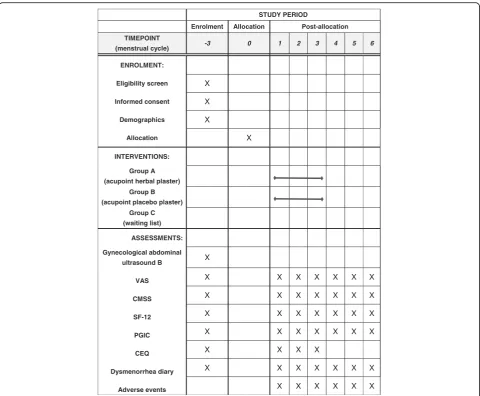
total of 180 subjects meeting the including criteria will be allocated randomly to three research groups that in-clude one experimental group of the AHP and two con-trol groups of the acupoint placebo plaster (APP) group and the waiting-list WL group. After randomization, subjects in the AHP and APP groups will receive treat-ments for another three menstrual cycles. Follow-up as-sessments through telephone calls or social media smartphone application will be processed for the last period of three menstrual cycles until the completion of study. Altogether it takes 9 months of three stages with three period cycles in each session. (See Fig. 1 for the study flowchart, and Fig.2for the assessment schedule).
Participants
Recruitment strategies
Study participants will be recruited mainly from the out-patient and inout-patient sections of the Gynecology Depart-ment. Additionally, through flyers and social media advertisements, participants will be recruited from local communities and university campuses. All patients have the right to participate or drop out at any time, and will be required to sign the informed written consent before any study procedures commences.
Inclusion criteria
Participants who, in line with the following criteria, will qualify for the study are: (1) nulliparous women (18– 30 years old), (2) women who meet the diagnostic cri-teria of PD under the Primary Dysmenorrhea Consensus Guideline [11], (3) women who meet the TCM diagnosis of “qi and blood stagnation” or “cold and dampness re-tention,” (4) women who have normal menstrual cycles (occurring every 28 ± 7 days), (5) a VAS score of the menstrual pain ≥40 mm during the baseline menstrual period, (6) women who agree to complete a DD during the study period, (7) women who agree to sign a in-formed consent form and volunteer for the research.
Exclusion criteria
Participants from the study who meet one or more fol-lowing criteria will be excluded: (1) women with second-ary dysmenorrhea caused by endometriosis, polycystic ovarian syndrome, pelvic inflammation and other gyne-cologic diseases, (2) women with any of the serious contraindications of cardiovascular, liver and kidney diseases, (3) women who are unable to express their sub-jective symptoms due to intellectual or mental condi-tions, (4) women with a malignant tumor, (5) women
[image:3.595.61.538.384.723.2]with poor compliance (i.e., cannot understand the pur-pose of this study or complete a DD during the baseline as-sessment), (6) pregnancy or breastfeeding, (7) women receiving another therapy or having received any other medical inventions for PD within the last 3 months.
Randomization and allocation concealment
After the screening visit, qualified subjects will be ran-domly assigned to either the AHP group, the APP group, or the waiting-list group in a ratio of 1: 1: 1. Random numbers will be generated by a third person (BJ Gou) who is not practicing throughout the study, using the random number generator in the SPSS statistical soft-ware package (Version 22.0, SAS Institute Inc.). As the letters are drawn (A or B or C), they will be placed into opaque envelopes labeled with sequential numbers. The envelopes will be sealed and remain in numerical order
in a safe place until the completion of surgery. The same researcher (BJ Guo) (not involved in the study) will pre-pare the envelopes. However, it was not possible to con-ceal the allocation among the waiting-list group.
Blinding
The herbal paste will be packed and labeled by the 3rd Affiliated Hospital of Chengdu University of TCM to en-sure that the practitioner and the patients involved in the study will remain fully blinded as to the identity of the treatment administered. Therefore, the participants, clinical practitioners, the outcome evaluators, the data manager and statistician will not know the treatment al-locations, which will not be revealed until the end of study. In addition, the practitioner will be instructed not to communicate with participants about the possibility
[image:4.595.58.539.86.482.2]of their allocation. However, blinding of the waiting-list group is not possible for this trial.
Interventions
Acupoint plaster treatment will be performed by certified acupuncturists with at least 5 years’ clinical experience (Fig.3a and b). All treatment details will be standardized between practitioners by guiding videos and relevant training before the first treatment session. The acupoint selection regimen was based on academic literature data mining [42] and expert opinions. Five acupoints will be used: Shenque (CV8), Guanyuan (CV4), Qihai (CV5),
Ciliao(BL32) andZigong(EX-CA1).
In this study, there are two types of paste to be applied on the sticky plasters: herbal paste (HP) for the AHP group, and buckwheat paste (BP) for the APP group (Fig.3c and d). The HP remedy in this study comes from an ancient Chinese herbal formula namedShaofu Zhuyu Tang (SFZYT) which was recorded in a TCM medical classic, Yi Lin Gai Cuo (Correction of Errors in Medical Classics), which was written or recorded by Qingren
Wang in 1830. Clinical studies have shown the positive effect of SFZYT on PD [43, 44]. A systematic review re-cently found the therapeutic effects of SFZYT on PD to be superior to drugs [45]. In addition, previous clinical observations [46–48] have demonstrated that the SFZYT was safe for acupoint plaster. Therefore, we adapted this formula and standardized its performance.
In the AHP group, the standard operating procedures (SOP) are listed as follows:
1. Prepare the herbal materials: SFZYT includes
Angelicae sinensis Radix(danggui), Rhizoma (chuanxiong),Paeoniae Radix rubra(chishao),
Cinnamomi cortex(rougui),Foeniculi fructus
(xiaohuixiang),Zingiberis rhizoma (ganjiang), Myrrha (moyao),Trogopterus dung(wulingzhi),
Typhae Pollen (puhuang) andCorydalis rhizoma
(yanhusuo). The ingredients of this formula are mixed in a weight ratio of 3: 1: 2: 1: 0.5: 2: 1: 3: 1: 1 and then the raw materials ground into fine powder (under 75μm diameter) using a special Chinese
[image:5.595.60.537.350.691.2]medicinal crop powder mixer (manufactured by Royalstar Co., Ltd., Hefei, China)
2. Add the liquid base: place the mixed herbal powder into a container, add honey and stir well to make a thick herbal paste
3. Add the sticky plaster: put 10 g of the herbal paste onto a medical sticky plaster. Then apply the plaster over the acupoints. The sticky plasters are sized 5 × 5 cm2with a 0.8-cm radius in the middle of which is placed the host herbal paste. The rest of the sticky plaster carries no herbal paste, which makes it adhere to the skin over the acupoints 4. Treatment procedures: locate the acupoints,
disinfect the skin, and attach the plaster on the skin over the acupoints. The plasters will be left on the skin for 4–8 h depending on each patient’s individual response because it must be removed immediately should any allergic reaction occur, which may be described by patients as a burning sensation, severe itchiness, blisters, pruritus or rash on the local skin. A total of nine sessions will be performed during the three menstrual cycles, the treatment starts 1 week prior to the menstruation, with one 6–8-h treatment three times per week, according to the subject’s estimated dates
For the APP group, the placebo paste is made of buck-wheat flour without any herbal medicines; however is still mixed with honey to maintain a similar appearance to the AHP (Fig.2c and d) so that the plasters used in these two experimental groups are undistinguishable to patients and practitioners. Moreover, the only variable between the AHP group and the APP group is the ingredients of paste. In order to reduce the bias caused by performance, all the rest of the clinical procedures remain the same.
No intervention will be performed in the WL group. The participants are required to continue their current living habits, including exercise and diet, while filling out related questionnaires throughout the full observa-tional period of six menstrual cycles. To meet the re-quirements of the Rule of Ethics, all participant in the WL group will be offered free AHP treatment of their choice at the completion of the study.
With regard to quality control of the herbal plaster, we will take the following measures: (1) first, the herbal plas-ter will be prepared beforehand by the central pharmacy of the 3rd Affiliated Hospital of Chengdu University of TCM that meets the requirements of the regulatory guid-ance issued by the China Food and Drug Administration, (2) in addition, pre-job SOP training and examination will be provided by the principal investigator (Prof. J Yang) to the practitioner for ensuring the quality of treatment pro-cedures (i.e., locate the acupoints, disinfect the skin, at-tach the plaster on the skin over acupoints), (3)
furthermore, the data and results will be monitored by the Evidence-based Medicine Center of Chengdu University of Traditional Chinese Medicine.
Outcome measurements
Primary outcome
The primary outcome will be pain intensity reduction measured by the Visual Analog Scale (VAS). The sever-ity of menstrual pain will be estimated using the VAS graded from 0 mm to 100 mm, indicating an absence of pain to the most serious pain imaginable [49].
Secondary outcomes
The secondary outcomes include the Cox Menstrual Symp-tom Scale (CMSS) [50], the 12-Item Short Form Health Survey (SF-12) [51], the Participant Global Impression of Change (PGIC) [52] and the DD.
Time points of outcome measurements
The VAS, CMSS, SF-12 and DD will be recorded at baseline and at every menstrual cycle throughout the treatment and the follow-up periods. The PGIC will be measured at the first, second, third, fourth, fifth and sixth menstrual cycles after inclusion.
We will estimate the expectation of participants to deter-mine whether their expectations affected the outcomes by using the Credibility Expectancy Questionnaire (CEQ) [53,
54] at the baseline and the first to the third menstrual cycle before receiving treatment. In the proposed study, the ques-tionnaire will be used to control for placebo effects, which are expected to be relatively high for light-therapy studies [54]. Blinding will be assessed by asking participants what group they thought they were in (AHP group or APP group, or“don’t know”) at the end of trial, and why they be-lieved that they were in that group.
Safety evaluation
Sample size calculation
A few scientific trials have investigated the biomechan-ical effects of acupoint plaster on PD; however, the re-search methodologies are not appropriate to reference the determination of sample size to this study. The art-icle being used for our study, was from an acupuncture clinical report with the use of VAS scores [16]. Liu’s study reported that patients who received classical acu-point achieved a mean reduction of 36.1 in VAS after acupuncture; while patients who received non-acupoint treatment showed a worse score of 29.9. Therefore, the decrease in VAS score of the three groups was predicted to be 38, 29 and 26, respectively. Using a bilateral test with an alpha value of 5% and a power of 80%, standard deviation for each group was 20 mm. According to the calculation with PASS software (Version 11.0, NCSS, LLC. Kaysville, UT, USA) in a 1:1:1 ratio, the effect size is 0.2550 of 51 participants in each group. The sample size is also calculated using the following formula [58]:
n ¼ 2 σz1−α=ð Þ2τ þz1−β
μA−μB
2
:
Allowing for a 15% dropout, the sample size was in-creased to 60 per group, making a total of 180.
Statistical analysis plan
Data integrity
All participants are assessed at run-in period and at the first, second, third, fourth, fifth and sixth menstrual cy-cles after recruitment. A well-trained assessor, who is blinded to the treatment assignment, will collect clinical data using CRF files at each visit. Another two pre-trained data managers will verify and cross-check the CRFs, for the sake of ensuring reliability and accuracy of the data. If there are any queries in the CRFs, the results will be sent to the third investigator for resolution. Data managers will also be responsible for administration, co-ordination and monitoring (including Excel spread sheet-set up, data entry, coding and query management). Any incomplete data will be coded as unknown, missing or not applicable, and all data will be anonymously ex-tracted to keep the identities of patients confidential. Re-sults of the analysis must not be released with individual identification of the subject until the Excel spread sheet is closed.
Methods of statistical analyses
Data analyses will be processed with SPSS 22.0 (SPSS Inc., Chicago, IL, USA) and supervised by a skilled statis-tician blinded to group allocation.
The Full Analysis Set (FAS) is for all participants who have been randomized in terms of the intention-to-treat (ITT), and the per-protocol analysis set (PPS) and is for
the individuals who complete the trial and do not have significant protocol violations. On the basis of rule of the last-observation-carried-forward, missing values will be imputed. In order to evaluate therapeutic effect and safety, the FAS and PPS will be used simultaneously.
Categorical data, such as gender and medical history, will be tabulated with frequencies or percentages; and continuous data, such as age and disease course, will be reported as mean ± standard deviation (SD), or median. For the baseline variables, sociodemographic data and other basic indicators will be carried out using analysis of variance (ANOVA) andχ2. To compare variables be-fore and after treatment in the same group, a paired t
test will be used. Repeated measures analysis of variance (ANOVA) will be used to compare the intergroup differ-ences among the three groups. Tests of ITT between the AHP and APP arms and between the APP and WL arms with respect to the change will based on time-intervention interactions in the mixed-effect models. A
P value of less than 0.05 (two-sided) indicates a statisti-cally significant difference, with 95% confidence intervals.
Discussion
placebo effects may happen secondary to their strong beliefs of being in the AHP group.
To our knowledge, the present study will be the first clinical trial that compares the AHP with the APP, and being placed in a waiting-list control group in treating PD. The scientific and rigorous methodo-logic design of this trial hopefully will provide consol-idated evidence on the efficacy and safety of the AHP for treating PD, and hopefully provide reference to clinical practice Additional file 2.
Trial status
Participant recruitment is currently ongoing.
Additional files
Additional file 1:Standard Protocol Items: Recommendations for Interventional Trials (SPIRIT) 2013 Checklist: recommended items to address in a clinical trial protocol and related documents. (DOC 123 kb)
Additional file 2:Standards for Reporting Interventions in Clinical Trials of Acupuncture (STRICTA). (DOCX 17 kb)
Abbreviations
AEs:Adverse events; AHP: Acupoint herbal plaster; ANOVA: Analysis of variance; AP: Acupoint plaster; APP: Acupoint placebo plaster; BP: Buckwheat plaster; CMSS: Cox Menstrual Symptom Scale; CONSORT: Consolidated Standards of Reporting Trials; CRF: Case Report Form; DD: Dysmenorrhea Diary; FAS: Full analysis set; HP: Herbal plaster; IRB: Institutional Review Board; ITT: Intention-to-treat; NSAIDs: Nonsteroidal anti-inflammatory drugs; PD: Primary dysmenorrhea; PGIC: Participant Global Impression of Change; PPS: Per-protocol analysis set; RCT: Randomized controlled trial; SD: Standard deviation; SF-12: 12-Item Short Form Health Survey; SFZYT:Shaofu-Zhuyu Tang; SOP: Standard operating procedures; TCM: Traditional Chinese Medicine; VAS: Visual Analog Scale; WL: Waiting list
Acknowledgements
The authors thank all of the collaborators and participants of the study.
Funding
This trial is supported by the program of People Benefit Project of the Technology Bureau of Chengdu (Grant No. 2015-HM01–00195-SF), the pro-gram of Fok Ying-Tong Education Foundation for Young Teachers in the Higher Education Institution of China (Grant No. 20155132210002) and the programs of the National Natural Science Foundation of China (Grant Nos. 81303060 and 81574089).
Availability of data and materials
All data and material supporting our findings can be obtained from the main author.
Authors’contributions
JY and FL contributed to the design of the study protocol. SY, YW and WX are directors of the recruitment sites, provided clinical expertise and drafted the study protocol. MY, ZL, XL, WL and YH critically revised the manuscript and will conduct the study. All authors have read and approved the final manuscript.
Ethics approval and consent to participate
This study protocol has been approved by the Institutional Review Board of the Teaching Hospital of Chengdu University of TCM (Approval No. 2016KL– 003). Any modifications to the research protocol will be notified to this Human Research Ethics Committee. Informed consent will be obtained from each subject prior to enrollment. The study conforms to the principles of the Declaration of Helsinki and Good Clinical Practice guidelines.
Consent for publication
No personal data will be published, and the informed consent form will include permission to publish group data. Results will be disseminated in peer-reviewed publications and published in international journals.
Competing interests
The authors declare that they have no competing interests.
Publisher’s Note
Springer Nature remains neutral with regard to jurisdictional claims in published maps and institutional affiliations.
Author details
1The Department of Acupuncture and Tuina, Chengdu University of
Traditional Chinese Medicine, Chengdu, Sichuan, China.2The Department of
Basic Medical Sciences, Chengdu University of Traditional Chinese Medicine, Chengdu, Sichuan, China.3The Department of Clinical Medical, Chengdu
University of Traditional Chinese Medicine, Chengdu, Sichuan, China.
4Department of Orthopedics, Tongji Hospital, Tongji Medical College,
Huazhong University of Science and Technology, Wuhan, China.
Received: 19 April 2017 Accepted: 10 May 2018
References
1. Kennedy S. Primary dysmenorrhoea. Lancet. 1979;56:1116. 2. Yang J, Chen J, Lao L, Yang M, Chen J, Bo L. Effectiveness study of
moxibustion on pain relief in primary dysmenorrhea: study protocol of a randomized controlled trial. Evid Based Complement Alternat Med. 2014; 2014:1–6.
3. Ju H, Jones M, Mishra G. The prevalence and risk factors of dysmenorrhea. Epidemiol Rev. 2014;36:104–13.
4. Grandi G, Ferrari S, Xholli A, Cannoletta M, Palma F, Romani C, Volpe A, Cagnacci A. Prevalence of menstrual pain in young women: what is dysmenorrhea? J Pain Res. 2012;2012:169–74.
5. Zahradnik HP, Groth BK. Nonsteroidal anti-inflammatory drugs and hormonal contraceptives for pain relief from dysmenorrhea: a review. Contraception. 2010;81:185–96.
6. Harel Z. Dysmenorrhea in adolescents. Menarche Transit Girl Woman. 2008; 1135:185–95.
7. Iacovides S, Avidon I, Baker FC. What we know about primary dysmenorrhea today: a critical review. Hum Reprod Update. 2015;21:17. 8. Faramarzi M, Salmalian H. Association of psychologic and nonpsychologic
factors with primary dysmenorrhea. Iran Red Crescent Med J L. 2014; https://www.doi.org/10.5812/ircmj.16307.
9. Ruoff G, Lema M. Strategies in pain management: new and potential indications for COX-2 specific inhibitors. J Pain Symptom Manag. 2003;25:21–31.
10. Jun E-M, Chang S, Kang D-H, Kim S. Effects of acupressure on dysmenorrhea and skin temperature changes in college students: a non-randomized controlled trial. Int J Nurs Stud. 2007;44:973–81.
11. Lefebvre G, Pinsonneault O, Antao V, Black A, Burnett M, Feldman K, Lea R, Robert M. Primary dysmenorrhea consensus guideline. J Obstet Gynaecol Can. 2005;27:1117.
12. Park J-S, Park S, Cheon C-H, Go H-Y, Sun S-H, Shin Y-C, Jang B-H, Ko S-G. Effects of Gyejibongnyeong-hwan on dysmenorrhea caused by blood stagnation: study protocol for a randomized controlled trial. Trials. 2012;13:6. 13. Proctor M, Hing W, Johnson TC, Murphy PA, Brown J. Spinal manipulation
for dysmenorrhoea. Cochrane Database Syst Rev. 2006;https://www.doi. org/10.1002/14651858.CD002119.
14. Gou CQ, Gao J, Wu CX, Bai DX, Mou HY, Hou XL, Zhao X. Moxibustion for primary dysmenorrhea at different interventional times: a systematic review and meta-analysis. Evid Based Complement Alternat Med. 2016;https:// www.doi.org/10.1155/2016/6706901.
15. Sriprasert I, Suerungruang S, Athilarp P, Matanasarawoot A, Teekachunhatean S. Efficacy of acupuncture versus combined oral contraceptive pill in treatment of moderate-to-severe dysmenorrhea: a randomized controlled trial. Evid Based Complement Alternat Med. 2015; https://www.doi.org/10.1155/2015/735690.
17. Yang M, Chen X, Bo L, Lao L, Chen J, Yu S, Yu Z, Tang H, Yi L, Wu X. Moxibustion for pain relief in patients with primary dysmenorrhea: a randomized controlled trial. PLoS One. 2017;12:17.
18. Smith CA, Zhu X, He L, Song J. Acupuncture for primary dysmenorrhoea. Cochrane Database Syst Rev. 2011;40:132.
19. Cho SH, Hwang EW. Acupuncture for primary dysmenorrhoea: a systematic review. BJOG Int J Obstet Gynaecol. 2010;117:509–21.
20. Wang L, Pang L, Bai X, Zhao L, Liu F, Lv X. Clinical efficacy on pediatric recurrent pneumonia treated with point application in summer for the prevention in winter. Chin Acupunct Moxibust. 2016;36:261.
21. Li JS, Li SY, Yu XQ, Xie Y, Wang MH, Li ZG, Zhang NZ, Shao SJ, Zhang YJ, Zhu L. Bu-Fei Yi-Shen granule combined with acupoint sticking therapy in patients with stable chronic obstructive pulmonary disease: a randomized, double-blind, double-dummy, active-controlled, 4-center study. J Ethnopharmacol. 2012;141:584–91.
22. Lai X, Li Y, Fan Z, Zhang J, Liu B. An analysis of therapeutic effect of drug acupoint application in 209 cases of allergic asthma. J Tradit Chin Med. 2001;21:122–6.
23. Peng J, Wu X, Hu J, Fang Y, Zi M, Liu B. Influencing factors on efficacy of summer acupoint application treatment for allergic rhinitis: a retrospective study. J Tradit Chin Med. 2012;32:377–81.
24. Ge H, Chen B. Clinical observation of acute pancreatitis treated with acupoint application combined with medicine. Chin Acupunct Moxibust. 2012;32:602–4.
25. Peng S, Zheng Y, Zheng K, Lin K, Wu J, Zheng W, Li Y. Effect of a comprehensive therapy plus Gushenyutai plaster administered at Guanyuan (CV 4) on male infertility associated with semen non-liquefaction. J Tradit Chin Med. 2014;34:666–72.
26. Wang S, Lu D, Li Y. Observation on therapeutic effect of acupoint application on dysmenorrhea of excess syndrome and effect on prostaglandins. Chin Acupunct Moxibust. 2009;29:265–8. 27. Feng X, Li X, Huang Y. Observation on 60 cases of primary
dysmenorrheal treated with acupoint-application. Liaoning J Tradit Chin Med. 2013;6:1225–6.
28. Yang Y. Observation on primary dysmenorrhea treated with acupoint-application. Hubei J Tradit Chin Med. 2017;1:32–3.
29. Liu LY, Qiao M, Gao F, Wang HS, Sun JH. Effect of acupiont sticking therapy withKechuantingpaste on expression of T-bet and GATA-3 mRNA in lung for chronic asthma airway inflammation rats. J Nanjing Univ Tradit Chin Med. 2014;6:550–3.
30. Chen J, Chen JQ, Huang Y, Zhang JL, Tang CZ. Study of traditional Chinese medicine acupoint sticking ultrafine effect on the TGF-β1 and IL-17 content in allergic rhinitis rats. Chin J Basic Med Trad Chin Med. 2014;9:1218–21. 31. Ding Y, Wang Y. The effects of acupoint sticking therapy in summer for
winter disease on inflammation mediator in patients with chronic bronchitis. Int J Laboratory Med. 2014;17:2289–90.
32. Yao H, Tong J, Zhang P, Wang Z. Effect of acupoint application on inflammatory cells level in patients with bronchial asthma. J Guangzhou Univ Tradit Chin Med. 2007;4:289–92.
33. Huang X, Su S, Duan J, Sha X, Zhu KY, Guo J, Yu L, Liu P, Shang E, Qian D. Effects and mechanisms of Shaofu-Zhuyu decoction and its major bioactive component for Cold–Stagnation and Blood–Stasis primary dysmenorrhea rats. J Ethnopharmacol. 2016;186:234–43.
34. Wang L, Huang S, Chen B, Zang XY, Su D, Liang J, Xu F, Liu GX, Shang MY, Cai SQ. Characterization of the anticoagulative constituents ofAngelicae Sinensis Radixand their metabolites in rats by HPLC-DAD-ESI-IT-TOF-MSn. Planta Med. 2016;82:362–70.
35. Xin Y, Liu S. Quantitative assessment of the influence ofRhizoma Zingiberis on the Level of aconitine in rat gut sacs and qualitative analysis of the major influencing components ofRhizoma Zingiberison aconitine using UPLC/MS. PLoS One. 2015;10:16.
36. Tian Y, Li J, Li Y, Dong Y, Yao F, Mao J, Li L, Wang L, Luo S, Wang M. Effects ofBufei Yishengranules combined with acupoint sticking therapy on pulmonary surfactant proteins in chronic obstructive pulmonary disease rats. Biomed Res Int. 2016;2016:1–8.
37. Fan M. Clinical observation ofShaofu Zhuyudecotiong for treating primary dysmenorrhea of cold coagulation and blood stasis. Beijing J Tradit Chin Med. 2011;30:455–6.
38. Cheng Q, Zhu Y. Clinical study on primary dysmenorrheal of blood—stasis of cold-coagulation syndrome treated with modifiedShaofu Zhuyu decoction. J Chin Med. 2011;26:1249–50.
39. Ye X, Wang H, Le J. Effects ofShaofuzhuyu Tangon uterine convulsion and anti-inflammatory action in rodent. Chin J Hosp Pharm. 2002;22:329–31. 40. Schulz KF, Altman DG, Moher D. CONSORT 2010 statement: updated
guidelines for reporting parallel group randomized trials. BMC Med. 2010;8:18.
41. Chan AW, Tetzlaff JM, Altman DG, Laupacis A, Gøtzsche PC, KrležajerićK, Hróbjartsson A, Mann H, Dickersin K, Berlin JA. SPIRIT 2013 Statement: Defining Standard Protocol Items for Clinical Trials. Ann Intern Med. 2013; 158:200–7.
42. Yu S, Yang J, Yang M, Gao Y, Chen J, Ren Y, Zhang L, Chen L, Liang F, Hu Y. Application of acupoints and meridians for the treatment of primary dysmenorrhea: a data mining-based literature study. Evid Based
Complement Alternat Med. 2015;https://www.doi.org/10.1155/2015/752194. 43. Zhang X, Zhang S, Xu C.Jiawei Shaofu Zhuyudecoction combined with
moxibustion therapy in treating primary dysmenorrhea—55 cases. Chin J Exp Tradit Med Formulae. 2014;20:192–5.
44. Wang N, Li P. Analysis of therapeutic effects of modifiedShaofu Zhuyu decoction for dysmenorrhea caused by coagulation and blood stasis. J Clin Med Pract. 2013;5:036.
45. Lee H, Choi T-Y, Myung C-S, Lee JA, Lee MS. Herbal medicine(Shaofu Zhuyu Decoction) for treating primary dysmenorrhea: a systematic review of randomized clinical trials. Maturitas. 2016;86:64–73.
46. Lin D. The acupoint application ofShaofu Zhuyu Tangon navel. J Extern Ther TCM. 2000;9:36–7.
47. Li J, Zhang M, Wang X. The clinical observation on the treatment of chronic pelvic inflammatory disease by oral and external application ofShaofu Zhuyu Tang. J Qinghai Med. 2014;44:53–4.
48. Fu J, Xia Y. The clinical observation on oral and external application ofShao Xue Tong Yudecoctionon for treating chronic pelvic inflammatory disease. Mod J Integrat Trad Chin Western Med. 2012;21:1513–4.
49. Price DD, Mcgrath PA, Rafii A, Buckingham B. The validation of visual analogue scales as ratio scale measures for chronic and experimental pain. Pain. 1983;17:45–56.
50. Cox DJ, Meyer RG. Behavioral treatment parameters with primary dysmenorrhea. J Behav Med. 1978;1:297–310.
51. Bourion-Bédès S, Schwan R, Laprevote V, Bédès A, Bonnet JL, Baumann C. Differential item functioning (DIF) of SF-12 and Q-LES-Q-SF items among French substance users. Health Qual Life Outcomes. 2015;13:1–8. 52. Pagé I, Abboud J, O Shaughnessy J, Laurencelle L, Descarreaux M. Chronic
low back pain clinical outcomes present higher associations with the STarT Back Screening Tool than with physiologic measures: a 12-month cohort study. BMC Musculoskelet Disord. 2015;16:1–10.
53. Smeets RJ, Beelen S, Goossens ME, Schouten EG, Knottnerus JA, Vlaeyen JW. Treatment expectancy and credibility are associated with the outcome of both physical and cognitive-behavioral treatment in chronic low back pain. Clin J Pain. 2008;24(4):305–15.
54. Devilly GJ, Borkovec TD. Psychometric properties of the credibility/ expectancy questionnaire. J Behav Ther Exp Psychiatry. 2000;31(2):73–86. 55. US Department of Health and Human Services. Common terminology
criteria for adverse events (CTCAE) version 4.0[J]. National Cancer Institute. 2009;(09-5410).
56. Wu X, Jin P, Li G, Wei Z, Liu G, Liu B. Efficacy evaluation of summer acupoint application treatment on asthma patients: a two-year follow-up clinical study. J Tradit Chin Med. 2015;35:21–7.
57. Wu XQ, Peng J, Li GQ, Su HP, Liu GX, Liu BY. Association between skin reactions and efficacy of summer acupoint application treatment on chronic pulmonary disease: A prospective study. Chin J Integr Med. 2016;22: 284–92.
58. Chow SC, Shao J, Wang H. Sample size calculations in clinical research. Boca Raton: Chapman & Hall/CRC Biostatistics; 2003.