Scholarly Research Journal for Interdisciplinary Studies, Online ISSN 2278-8808, SJIF 2016 = 6.17, www.srjis.com UGC Approved Sr. No.45269, SEPT-OCT 2017, VOL- 4/36 https://doi.org/10.21922/srjis.v4i36.10194
Copyright © 2017, Scholarly Research Journal for Interdisciplinary Studies
GAMMA RAY INTERACTION STUDIES ON SOME SHAPE MEMORY ALLOYS
IN THE ENERGY RANGE 122 KEV TO 1330 KEV
Gopinath P. Dapke1, Vishal V. Awasarmol2, Siddheshwar D. Raut3, Pravina P. Pawar4
1-4
Department of Physics, Dr. Babasaheb Ambedkar Marathwada University, Aurangabad:
431004, India. E-mail:- [email protected] and [email protected]
In this paper, we have been calculated and measured the attenuation cross section parameters of some shape memory alloys in the energy range 122 keV to 1330 keV. From the present study, it is observed that there is good agreement between experimental and theoretical values and the variation of obtained values of all parameters strongly depends on the photon energy; it decreases or increases due to chemical composition and density of the sample material. All samples have been studied extensively using WinXCOM program and transmission curve shows that the variation of all sample materials initially decreases with increasing photon energy. The present study can be useful in radiation therapy, medical, aerospace, robotics, engineering and many technological applications.
Keywords: Mass attenuation coefficients, total atomic cross section, total electronic cross section
1. Introduction:
The data on absorption and penetration of X-rays/ gamma rays photon interaction
with matter is great significant in many fields such as medical, biological and industrial area.
The study of absorption and scattering of gamma rays in the compound materials has become
an interesting and exciting field of research (Manohara et al., 2007). There is a plethora in
this particular field and a large number of photon attenuation measurements and calculations
have been made for diverse materials and the attenuation coefficient has been studied as a
function of various parameters. The mass attenuation coefficient, total atomic cross section
and total electronic cross section are basic parameter for penetration and diffusion of x-ray or
gamma ray in extended media. The accurate values of the mass attenuation coefficient for
X-ray and gamma X-ray in different materials are very significant in various fields such as
medical, agriculture, industrial, biological, nuclear radiation physics and radiation dosimetry
(Han and Demir ; 2009). The mass attenuation coefficient is key parameter in the primary physics and many applied fields. Mass attenuation coefficient (m) is a measure of the
probability of interaction that occurs between incident photons and samples mass per unit
area. Mass attenuation coefficient is needed to understand the diffusion and transmission of
Gopinath P. Dapke, Vishal V. Awasarmol, Siddheshwar D. Raut, Pravina P. Pawar
(Pg. 8018-8026) 8019
Copyright © 2017, Scholarly Research Journal for Interdisciplinary Studies
X-ray and - ray in the material (Manohara and Hanagodimath; 2007). Number of the authors
were represented the table in the form of tabulation for all elements and developed new
computer program such as WinXCOM program (Hubbell; 1982, Hubbell and Seltzer; 1995,
Berger and Hubbell; 1987, Gerward et al.; 2001). Some of the research papers are available
on experimental and theoretical study of mass attenuation coefficient (μm) values in a variety
of elements and compounds/mixtures. Mass attenuation coefficient data can be used for the
determination of several parameters such as effective atomic numbers (Zeff), effective
electron density (Neff), molar extinction coefficient (), mass energy absorption coefficient
(µen/ρ), etc. of compound materials (Kore et al.; 2016, Pawar and Bichile; 2013, Ladhaf and
Pawar; 2015, Gaikwad et al.; 2016, Awasarmol et al.; 2017a, Awasarmol et al.; 2017b,
Awasarmol; 2017c, Awasarmol et al.; 2017d).
Shape Memory Alloy’s (SMA’s) are the most significant branch from the smart /
intelligence materials (Satish et al.; 2013). During the last decade smart materials and
structures have received increasing attention because due to their huge technological and
scientific consequence. SMA’s are basically functional materials which exhibit peculiar
thermo mechanical properties such as shape memory effect and the super elasticity. These
properties are significant as a reversible thermo elastic martensitic transformation occurring
at the solid state. SMA alloys are most commonly used in commercial fields such as
biomedical (i.e. stents, surgical tools); sensor/actuator (valves); coupling (i.e. electric
fastener, pipe fastener); sport, antennas, gadgets, manufactures etc (Kumar and Lagoudas ;
2008).
In literature, we observed that the no experimental data is available on the study of
some shape memory alloys. The aim of the present study, we have been measured the mass
attenuation coefficient of some shape memory alloys and related parameters in the energy
region 122 keV to 1330 keV by using the transmission method and compared with Win
XCOM data.
2. Theoretical Analysis:
2.1 Calculation of mass attenuation coefficient (µm)
The mass attenuation coefficients for the compound materials and energies are
determined by the transmission experiment. This process described by the following
equation:
)
exp(-0 t
I
Gopinath P. Dapke, Vishal V. Awasarmol, Siddheshwar D. Raut, Pravina P. Pawar
(Pg. 8018-8026) 8020
Copyright © 2017, Scholarly Research Journal for Interdisciplinary Studies
where I0 and I are the unattenuated and attenuated photon intensities respectively, µm
(cm2gm-1) is mass attenuation coefficient of the material and t (g/cm2) is the sample
thickness.
The photon mass attenuation coefficient for compound or mixture of element is given by
mixture rule:
i m i m iW ( )
(2)
where Wi and (m)i are the weight fraction and mass attenuation coefficient of the ith
constituent element, respectively. For a chemical compounds, the fraction by weight (Wi) is
represented by following expression:
j j j
i i i
A n
A n
W (3)
where Ai is the atomic weight of the ith element, ni is the number of formula units, ∑jnj is the
total number of atoms present in the molecular formula and Aj is the molecular weight of the
jth constituent elements.
2.2 Calculation of total atomic cross section (t,a)
The total atomic cross section can be derived by following equation:
iWi Ai m A
N a
t /
1 ,
(4)
where NA is the Avogadro’s number, µm is the mass attenuation coefficient.
2.3 Calculation of total electronic cross section (t,el)
The total electronic cross section is determined by,
i m
i Zi
i A i f
A N el
t ( )
1
,
(5)
where fi is the number fraction of atoms of element i and Zi is the atomic number of the ith
element in the mixture or compound.
3. Experimental details
In this study, we have been carried out some attenuation cross section parameter by
the transmission method of the narrow beam good geometry setup. The schematic diagram as
shown in Fig. 1. In this experiment we have been used six radioactive sources such as 57Co,
133
Ba, 137Cs, 54Mn60, Co, and 22Na. All these radioactive sources are provided by Bhabha
Atomic Research Center, Mumbai, for the experimental work. These radioactive sources
Gopinath P. Dapke, Vishal V. Awasarmol, Siddheshwar D. Raut, Pravina P. Pawar
(Pg. 8018-8026) 8021
Copyright © 2017, Scholarly Research Journal for Interdisciplinary Studies
The radioactive sources were collimated and detected by (2″×2″) NaI (Tl) scintillation
detector with resolution 8.2% at 662 keV and the signals at the detector were amplified and
analyzed by the 8K multichannel analyzer. For preparation of the sample in the form of pallet
and the sample was weighed in a sensitive digital balance and having a good accuracy of
measurements about 0.001 mg and the plastic container was used as sample holder, and
attenuation of a photon by unfilled container were found to be negligible (Pawar and Bichile;
2013). The weighing samples five time to get more accuracy. The mean of this set value was
considered to be the mass of the sample. The transmitted intensity of photo peak was
measured to minimize both contributions of small angle and multiple scattering within the
full width at half maxima. For more accuracy, a thickness of the sample was selected as per
Creagh (1987) criteria 2 < ln (I0 /I) < 4. More information about the experimental
arrangement has been reported in our previous work by (Awasarmol et al.; 2017a,
Awasarmol et al.; 2017b, Awasarmol; 2017c, Awasarmol et al.; 2017d).
4. Results and discussion
In this study, the theoretical and experimental values of mass attenuation
coefficient (μm), total atomic cross section (t,a) and total electronic cross section (t,el) were
measured at 122 keV to 1330 keV photon energies for some shape memory alloys i.e. cast
Iron, Nitinol, Babit Metal, Stelite, Amalgam carried out by NaI (Tl) scintillation detector
with a well collimated narrow beam good geometry setup. Theoretically and experimentally measured values of the mass attenuation coefficients (m) for five samples tabulated in Table
1 and variation with energy (E) is displayed in Fig. 2. From Fig. 2 it is clearly seen that the
variation of m values decreases with increasing photon energy. The experimental values of
µm agree with theoretical values calculated using the WinXCOM program based on the
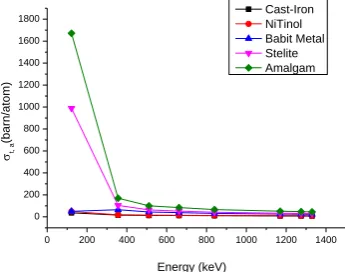
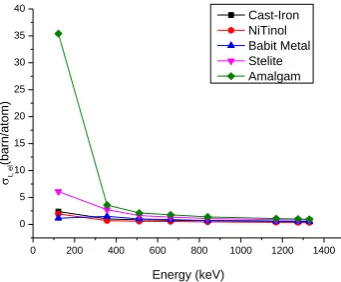
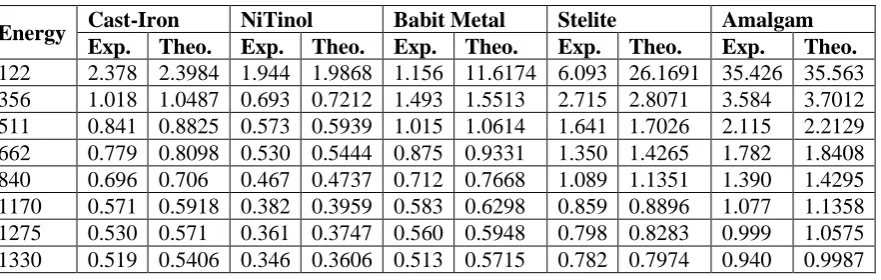
mixture rule. Measured total atomic cross section (t, a) and total electronic cross section (t,
el) for the studied shape memory alloys are listed in Tables 2 and 3 respectively. The typical
plots of t, a and t, el versus photon energy (E) are displayed in Figs. 3 and 4 respectively.
From Figs. 3 and 4 the behavior of t, a and t, el with photon energy (E) is almost similar to
that of µm. The variation of the all attenuation parameters were systematically studied in the
given photon energy region.
5. Conclusion
In this research m were investigated to get sufficient information about mass
Gopinath P. Dapke, Vishal V. Awasarmol, Siddheshwar D. Raut, Pravina P. Pawar
(Pg. 8018-8026) 8022
Copyright © 2017, Scholarly Research Journal for Interdisciplinary Studies
section (t, el) for shape memory alloys materials and it has been observed that the present data on m values and other parameters are very useful in biomedical, medical and biological,
sensor/actuator, and other applications. In this paper, we reported that the experimental data
on (m), (t, a), and (t, el) of shape memory alloys materials at different photon energy range.
Mass attenuation coefficient and other parameters of all samples have been calculated at 122
keV to 1330 keV photon energies. This study concludes that any compound material depends
on its chemical composition, density, and concentration of the elements that it contains
Acknowledgments:
The author (VVA) would like to thank University Grant Commission, New Delhi for
providing RGNF
References:
Manohara S.R., Hanagodimath S.M.; 2007, Studies on effective atomic numbers and electron densities of essential amino acids in the energy range 1keV-100GeV, Nuclear Instruments and Methods in Physics Research B, Vol. 258, 321-328.
Han I., Demir L.; 2009, Studies on mass attenuation coefficient, effective atomic and electron number of Ti and Ni alloy, Radiation Measurements, Vol. 44, 289-294.
Manohara S.R., Hanagodimath S.M.; 2007, Studies on effective atomic numbers and electron densities of essential amino acids in the energy range 1keV-100GeV, Nuclear Instruments and Methods in Physics Research B, Vol. 258, 321-328.
Hubbell J.H.; 1982, Photon mass attenuation and energy absorption, International Journal of Applied Radiation and Isotopes, Vol, 1269-1290.
Hubbell J.H., Seltzer S.M.; 1995, Tables of X-ray mass attenuation coefficients and mass energy absorption coefficients 1 keV to 20 MeV for elements Z=1 to 92 and 48 additional substances of dosimetric interest, National Institute of Standards and Physics Laboratory, NISTIR 5632. Berger M.J., Hubbell J.H.; 1987, (XCOM) Photon cross section on a personal computer. NBSIR,
87-3597.
Gerward L., Guilbert N., Jensen K.B., Levring H.; 2001, X-ray absorption in matter, Reengineering XCOM. Radiation Physics and Chemistry, Vol. 60, 23-24.
Kore P.S., Pawar P.P., Selvam T.P.; 2016, Evaluation of radiological data of some saturated fatty acids using gamma ray spectrometry, Radiation Physics and Chemistry, Vol. 119, 74-79. Pawar P.P., Bichile G.K.; 2013, Studies on mass attenuation coefficient, effective atomic number and
electron density of some amino acids in the energy range 0.122-1.330 MeV, Radiation Physics and Chemistry, Vol. 92, 22-27.
Ladhaf B.M., Pawar P.P.; 2015, Studies on mass energy absorption coefficient and effective atomic energy absorption cross-section for carbohydrates, Radiation Physics and Chemistry, Vol. 109, 89-94.
Gopinath P. Dapke, Vishal V. Awasarmol, Siddheshwar D. Raut, Pravina P. Pawar
(Pg. 8018-8026) 8023
Copyright © 2017, Scholarly Research Journal for Interdisciplinary Studies
Awasarmol V.V., Gaikwad D.K., Raut S.D. Pawar P.P.; 2017, Photon interaction study of organic nonlinear optical materials in the energy range 122-1330 keV. Radiation Physics and Chemistry, Vol. 130, 343-350.
Awasarmol V.V. Gaikwad D.K., Raut S.D. Pawar P.P.; 2017, Gamma ray interaction studies of organic nonlinear optical materials in the energy range 122 keV to 1330 keV. Results in Physics, Vol. 7, 272-279.
Awasarmol V.V.; 2017, Gamma ray attenuation parameters of inorganic nonlinear optical materials in the energy range 122 keV to 1330 keV. Indian Journal of Pure and Applied Physics, Vol. 55, 65-72.
Awasarmol V.V., Pawar P.P. Solunke M.B.; 2017, Effective atomic numbers and effective electron densities of inorganic nonlinear optical materials in the energy range 356 keV to 1330 keV. International journal of technical research and science, 2, 26-29.
Satish S., Malik U.S., Raju T. N.,” corrosion Behavior of Cu -Zn Ni Shape Memory Alloys” Journal of Minerals and Material characteristics and Engineering, 2013 , 1 , 49-54.
Kumar P.K., Lagoudas D.C. (ed), Introduction to shape memory Alloys Springer Science + business media LLC; 2008 DOI: - 10.1007 / 978 -0-387-47685-8-1.
Gopinath P. Dapke, Vishal V. Awasarmol, Siddheshwar D. Raut, Pravina P. Pawar
(Pg. 8018-8026) 8024
[image:7.595.190.450.109.353.2]Copyright © 2017, Scholarly Research Journal for Interdisciplinary Studies Fig. 1 Schematic set up of NaI (Tl) scintillation detector.
0 200 400 600 800 1000 1200 1400
0.0 0.2 0.4 0.6 0.8 1.0 1.2 1.4 1.6 1.8 2.0
(cm
-1)
[image:7.595.208.373.410.546.2]Energy (keV) Cast-Iron NiTinol Babit Metal Stelite Amalgam
Fig. 2 Mass attenuation coefficients of shape memory alloys.
0 200 400 600 800 1000 1200 1400
0 200 400 600 800 1000 1200 1400 1600 1800
t, a
(b
ar
n/a
tom
)
Energy (keV)
Cast-Iron NiTinol Babit Metal Stelite Amalgam
[image:7.595.203.376.591.727.2]Gopinath P. Dapke, Vishal V. Awasarmol, Siddheshwar D. Raut, Pravina P. Pawar
(Pg. 8018-8026) 8025
Copyright © 2017, Scholarly Research Journal for Interdisciplinary Studies
0 200 400 600 800 1000 1200 1400
0 5 10 15 20 25 30 35 40
t, el
[image:8.595.207.378.104.245.2](b ar n/a tom ) Energy (keV) Cast-Iron NiTinol Babit Metal Stelite Amalgam
Fig. 4 Total electronic cross section of shape memory alloys.
Table 1. Mass attenuation coefficients of shape memory alloys.
Energy Cast-Iron NiTinol Babit Metal Stelite Amalgam Exp. Theo. Exp. Theo. Exp. Theo. Exp. Theo. Exp. Theo.
122 0.229 0.231 0.275 0.281 0.0991 0.996 1.685 1.706 1.809 1.816
356 0.098 0.101 0.098 0.102 0.128 0.133 0.177 0.183 0.183 0.189
511 0.081 0.085 0.081 0.084 0.087 0.091 0.107 0.111 0.108 0.113
662 0.075 0.078 0.075 0.077 0.075 0.08 0.088 0.093 0.091 0.094
840 0.067 0.068 0.066 0.067 0.061 0.066 0.071 0.074 0.071 0.073
1170 0.055 0.057 0.054 0.056 0.05 0.054 0.056 0.058 0.055 0.058
1275 0.051 0.055 0.051 0.053 0.048 0.051 0.052 0.054 0.051 0.054
[image:8.595.66.530.451.688.2]1330 0.05 0.054 0.049 0.051 0.044 0.049 0.051 0.052 0.048 0.051
Table 2. Total atomic cross section of shape memory alloys.
Energ y
Cast-Iron NiTinol Babit Metal Stelite Amalgam Exp. Theo. Exp. Theo. Exp. Theo. Exp. Theo. Exp. Theo.
122
36.45
1 36.769
48.61 1 49.671 6 50.08 6 503.38 4 988.65
0 1000.97
1672.12 5 1678.59 5 356 15.59 9 16.076 5 17.32 3 18.030 2 64.69 2 67.218 9 103.85 2 107.372
6 169.154 174.699
511 12.89 3 13.529 7 14.31 8 14.848 4 43.97 0 45.991
9 62.781 65.1276 99.828 104.45
662 11.93 8 12.415 5 13.25 8 13.611 1 37.90 5 40.432
5 51.633 54.5664 84.115 86.8876
840 10.66 5 10.823 8 11.66 7 11.843 4 30.83 0 33.356
7 41.658 43.4184 65.628 67.4765
1170 8.755 9.0729 9.545 3.8989
25.27 0
27.291
9 32.857 34.0306 50.839 53.6115
1275 8.118 8.7545 9.015 9.3686
24.25 9
25.775
7 30.510 31.6837 47.141 49.9142
1330 7.959 8.2876 8.662
9.0151 4
22.23 8
24.764
Gopinath P. Dapke, Vishal V. Awasarmol, Siddheshwar D. Raut, Pravina P. Pawar
(Pg. 8018-8026) 8026
[image:9.595.82.523.108.248.2]Copyright © 2017, Scholarly Research Journal for Interdisciplinary Studies
Table 3. Total electronic cross section of shape memory alloys.
Energy Cast-Iron NiTinol Babit Metal Stelite Amalgam Exp. Theo. Exp. Theo. Exp. Theo. Exp. Theo. Exp. Theo.
122 2.378 2.3984 1.944 1.9868 1.156 11.6174 6.093 26.1691 35.426 35.563
356 1.018 1.0487 0.693 0.7212 1.493 1.5513 2.715 2.8071 3.584 3.7012
511 0.841 0.8825 0.573 0.5939 1.015 1.0614 1.641 1.7026 2.115 2.2129
662 0.779 0.8098 0.530 0.5444 0.875 0.9331 1.350 1.4265 1.782 1.8408
840 0.696 0.706 0.467 0.4737 0.712 0.7668 1.089 1.1351 1.390 1.4295
1170 0.571 0.5918 0.382 0.3959 0.583 0.6298 0.859 0.8896 1.077 1.1358
1275 0.530 0.571 0.361 0.3747 0.560 0.5948 0.798 0.8283 0.999 1.0575