© 2015, IRJET ISO 9001:2008 Certified Journal
Page 1967
Performance of Diesel Engine with different biodiesel blends of
Castor oil –A Review
1
Vivek S Khachane ,
2Prof.Amit G Bhuibhar
1
Final year P G student , Department of Mechanical Engineering , Rajarshi Shahu College Of Engineering
,Buldhana ,Maharashtra ,India.
2
Assistant Professor, Department of Mechanical Engineering Rajarshi Shahu College Of Engineering ,Buldhana ,
Maharashtra ,India.
---***---Abstract:-
As in this decade more emphasis is laid down on seeking the best possible alternative fuels to compensate the demands of energy as well as to replace the fossil fuel, biodiesel been the frequently discussed topic among the researches made till date . In this hour of need when the world is suffering from the problems related to fossil fuel reserves depletion, attempts are being made to adapt the alternative source of fuel which is more reliable and meeting the goals of the era ,leading to sustain growth rate ,reduction in pollution ,meeting stringent pollution norms and regulation laid down by the pollution control boards worldwide .This paper deals with the comprehensive review of castor biodiesel blends with the diesel using Diesel engine and the performance of the diesel engine in terms of performance characteristics in terms of Brake Power, Brake Thermal Efficiency, Break specific fuel consumption etc. combustion characteristics & Exhaust gas emission characteristics in terms of CO,HC ,NOX, Smoke Opacity ,Particulate matter emission etc at different loading conditions and speeds and the results of the castor blends are compared with that of the diesel. In addition to this cold flow behavior of castor oil ,cold flow additives and its effect on the performance of the engine at low temperature ,need of modification in engines for the use of biodiesel and major manipulation in terms of injection timing and injection pressure variation to arrive and predict the optimum performance of the diesel engine for different biodiesel blends is briefly overviewed .Also this study is an attempt to throw the lights on the distinguishing features of castor biodiesel and comparison with the biodiesel from other renewable feedstock sources.Keywords:
-Castor, BSFC, Cold weather performance,Injection timing , C.P, P.P
1 Introduction:-
In recent years there is tremendous growth in the fields of industrialization, urbanization as well as proportionate growth in the automotive sector. Automotives are the part and parcel of human life, in last few decades the growth in the automotive sector has achieved the height and this
© 2015, IRJET ISO 9001:2008 Certified Journal
Page 1968
it simple for the transport without risk. It has lower Suphur content and is eco-friendly. The Castor biodiesel blends at different blending points on the volume basis with diesel gives satisfactory performance using the diesel engine without any modifications. However the problems related to higher NOX emission still associates which can
be resolved using modern techniques such as Exhaust Gas Recirculation, Catalytic Converters, Retarded injection timing, Staged Injection, Exhaust Catalyst and reduction of premixed burned fraction by reducing ignition delay etc. Another problem frequently occurs in case of biodiesel that it has higher BSFC which can be further reduced to some extent by modifying the engine setting in terms of injection timing and injection pressure variations. Injection pressure modifications also becomes helpful to prevail the fuel injection, nozzle clogging, injector fouling and atomization problems especially at low temperatures. However the use of cold flow additives in the biodiesel can serve the purpose to resolve most of the problems encountered due to cold flow operability of biodiesel. The cold flow additives influence the Cloud Point and Pour Point and provides the great advantage over the low temperature range .These also helpful with regards to offer higher level of stability and makes the fuel blends of castor more ideal combustible in extreme seasonal weather which imparts the castor blend with the high fluidity. .
1.1 Biodiesel:-
Biodiesel are the Fatty acid Methyl Esters obtained through the process of conversion from the Triglycerides and Alcohol when heated in presence of the suitable catalyst like NaOH or KOH for the certain specified time .The process of conversion of Triglycerides into the Fatty Acid Methyl esters is called as the Esterification wherein the glycerol and Esters are obtained as the byproducts when allowed the mixture after reaction to settle down for separation. Through the process of Esterification, Castor oil can be converted into the biodiesel.
[image:2.595.309.559.132.402.2]1.2 Castor oil properties:-
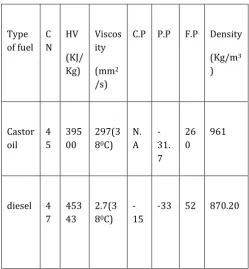
Table l : Comparison between the properties of castor oil and diesel-
Table 1 . shows that the Cetane Number for the Castor oil is close to that of the diesel. But diesel have a higher heat value than the Castor oil, whereas the flash point of castor oil is higher and the pour point is also close to that of the diesel. Flash point is the distinguishingly higher which makes the castor oil safe to handle and for storage. Previous literature review properties of Castor oil can be preferably enhanced in this context the alkaline catalysed transesterification is a promising area of research for the production of biodiesel in large scale .However the effect of different parameters such as time, temperature, reactant ratio, and catalyst concentration on biodiesel yield were analysed .The best combination of parameters from previous literature shown that 9:1 molar ratio of Methanol to oil ,0.8%NaOH catalyst, 600C Reaction
Temperature and 2 Hours of Reaction time for the biodiesel with quite good properties are expected.
Type
of fuel C N
HV
(KJ/ Kg)
Viscos ity
(mm2
/s)
C.P P.P F.P Density
(Kg/m3
)
Castor oil
4 5
395 00
297(3 80C)
N. A
-31. 7
26 0
961
diesel 4 7
453 43
2.7(3 80C)
-15
© 2015, IRJET ISO 9001:2008 Certified Journal
Page 1969
Table ll: Properties of castor biodiesel compared to dieselafter treatment
propertie s
Units Die sel
Cas tor oil
Cas tor oil este r
On treatm ent
With turpen tine oil
Stand ard value
BIS:1 5607
Density(1 5ºC)
kg/ m3
875 940 915 870
860-900
Flash point ºC
ºC 45 215 191 120 MIN
Kinematic Viscosity(
40 ºC) Mm2
/s
2.4 0
250 26 .8
2.5-6.0
Cetane No --- 46 40 48 45 MIN
Net calorific Value
(MJ/ Kg)
43. 5
38 38.
5
40.5 40
From the literature Table .[ii] shows after undergoing treatment with the turpentine oil the Castor biodiesel with enhanced properties meeting the Standard values which are much closer to the values given by diesel which makes the biodiesel property rich and can be conveniently used in the diesel engine without much requirement in engine setting modification s.
2 Performance of Castor biodiesel blends
in Diesel engine:-
Castor biodiesel blends prepared on the volume basis with the diesel and these different blends prepared are subjected to combustion in the diesel engine at different loading conditions, speed, injection pressure, injection timings and other similar parameters and compared the performance of these blends are compared with the Diesel fuel. The number of experiments conducted on the Diesel engine previously from different literatures showed following results in terms of Performance characteristics, Combustion Characteristics, Exhaust gas Emission Characteristics, Cold Weather performance etc are discussed step by step.
2.1
Performance Characteristics:-
1.Literature [1] has showed researcher conducted an investigation using different blends of castor biodiesel as 25%,75% , pure diesel at 100% Exhaust Gas Recirculation(EGR) in order to find out the performance of diesel engine in terms of Brake Power, Brake Specific Fuel Consumption, Brake Mean Effective Pressure and Brake Thermal Efficiency and results are obtained showed the controlled emission and method proved very reliable in terms of fuel economy.
Total fuel Consumption when tested against the Brake Power showed the Diesel has lower BSFC as compared to both blends B25 &B75, while B25 has lower BSFC than B75 blend
Brake Specific fuel Consumption when tested against Brake Mean Effective Pressure at 100% showed BSFC is higher forB75 blend as compared to B25&Diesel
Brake Thermal Efficiency checked against the Brake Power showed that BTE for B25 was higher than diesel and B75
2.Another literature[2] in which performance test carried out with different Castor biodiesel blends B20, B40, B60,B80,B100 i.e neat biodiesel at different loading conditions 25%,50%,75%&100% loading at constant speed of 1500 rpm and for the specified time (20min) results obtained in terms of various performance parameters are –
BSFC was checked against BMEP showed decrease in the BSFC with the increase in the BMEP at full loading conditions and it is noteworthy that BSFC increases with increase in biodiesel percentage in Diesel. Increase in load increases Exhaust Gas Temperature which reveals effective combustion i.e reduction in loss of exhaust energy. Blending percentage increases the exhaust gas temperature for all blend s under study but it can be seen that for B80 blend has less exhaust gas temperature at all loads. B60 blend showed less smoke opacity as compared to all other blends and B60 gave optimum performance.
3.literature[3] conducted using Castor biodiesel blend ,Canola oil &High Speed Diesel at different speeds and compared for the performance parameters Brake Power, Exhaust Gas Temperature and Torque rendered B.P of Diesel is higher than that of biodiesel blends B10CASTOR&
B10CANOLA.but B10CASTOR has higher B.P than B10CANOLA as
castor has higher calorific value than canola.
HSD delivered the higher Torque during testing probably due to high calorific value of HSD than B10CASTOR&
B10CANOLA.at starting the more Torque is required as the
© 2015, IRJET ISO 9001:2008 Certified Journal
Page 1970
decrease can be seen after passage of time in the Torque values.
Engine exhaust temperature was found less for HSD as compared to blends.B10CASTOR has exhaust temperature
higher than B10CANOLA.this may be due to higher C.V &
higher flash point of B10CASTOR also the biodiesel having
higher oxygen content tends to burn at higher temperatures .It is also found that for maintaining torque and power output engine speed need to be higher and consequently it leads to increase in the amount of fuel injected to E
4. Literature [4] shows when Diesel engine performance evaluated at different loading conditions ranging from no load to full load using blend of castor biodiesel such as B25,B50,B75,B100& pure diesel alone ,Brake Thermal Efficiency at different Brake powers shown that BTE for B25 blend exhibited the highest value at79.94% of total load as compared to diesel. The maximum BTE for B25 was 23.21% obtained at 4Kw against 24.3% for pure diesel.
Brake Specific Fuel Consumption was lower than all other blends of the castor oil at different brake power and most significant values was obtained for B25 blend and has slightly lower value of BSFC. At maximum BTE load for B25, BSFC is found to be 0.342 Kg/Kw.hr as compared to 0.281 Kg/Kw.hr for Diesel.
5.The literature [5] showed that the blends of Castor oil, Ethanol &Diesel taken together as D85C15E15 & D90C10E20 had almost same Brake Thermal Efficiency to that of pure Diesel and increases with Brake Power up to 6.3Kw.
6.A Low Heat Rejection Diesel engine [6] in which the combustion performance was evaluated for castor biodiesel blends B25,B50,B75,B100 at different loads 1,2,3,4,5.2 at rated engine speed of 1500 rpm. Showed that the B25 blend of castor biodiesel can be substituted for the diesel in diesel engine without modifications still we can get the better performance and combustion characteristics with some modifications.
Brake Thermal Efficiency of B25 blend was higher than normal diesel engine as compared to LHR engine at varied load condition because of increased combustion rate in LHR engine which ensures complete burning of fuel due to low heat rejection. In spite of this B25 has lower BTE than diesel due to large difference in Viscosity, Specific Gravity &Volatility.
Mechanical efficiency was found to be increased up to B25 blend with increase in load whereas Brake Specific Fuel Consumption decreases with the increase in loads for different biodiesel blends in LHR engine. As SFC depends on the numerous factors like Volumetric Efficiency, Fuel
injection, fuel density, viscosity and lower heating value etc. due to lower heating value of the biodiesel blends, more biodiesel is required to produce the same power as compared to diesel and hence the BSFC increases with the blending percentage.
Mean Effective power of biodiesel blend is low due to low volatility and lower calorific value as compared to diesel and as the load increases the MEP increases.
When Cylinder Pressure was evaluated at different Crank Angle to study the heat release, as burning rate during the premixed burning phase influences the cylinder pressure as it initiates the better combustion and heat release ,Biodiesel blends brings the Peak pressure more closely to TDC due to higher burning rate in the early stage of combustion is higher in case of biodiesel. Castor biodiesel shows lower heat release rate during premixed burning phase as compared to diesel.
7.The literature [7]using Castor biodiesel blends B20, B40,B60 in diesel engine evaluated for its performance at various loading condition and at the rated engine speed showed that the Brake power developed by the engine at all the loads for all the tested blend was more or less same. Brake Power for the Castor biodiesel blends observed to be slightly higher as compared to the diesel. At 70% loading, BP for the Castor biodiesel 1.75% higher than that of diesel .For other blends the BP for the Castor is also observed to be at higher side.
BSFC at 20% loading for all the blends of Castor was found to be lower and it increases with the loadings.B40shows the lower BSFC than that of the diesel whereas at 70% loading Diesel has lower SFC than any other blend.
BTE of pure Castor biodiesel is more than that of the diesel, Castor bio fuel has more fuel consumption than diesel due to lower heating value .BP is same at all load.BTE for the blendsB20 to B60 is quite better as compared to Castor fuel only.BTE at above 60% loading is observed as quite high , this may be due to lower exhaust temperature as compare with diesel.
Volumetric efficiency of pure biodiesel s greater than that of the diesel, this may be due to low exhaust gas temperature. Exhaust gas temperature increases with increase in the load on the engine however Castor biodiesel blends have lower EGT at higher loads than the diesel.
8. The test carried on the Thermal Barrier Coated diesel
engine LHR engine[8] with Castor blends
© 2015, IRJET ISO 9001:2008 Certified Journal
Page 1971
atomization , however the BTE can be improved by increasing the percentage of biodiesel in the blends as biodiesel has the higher oxygen content which causes better combustion inside cylinder.EGT is found to be higher for all the biodiesel than pure diesel. IMEP increases with the increase in the castor in the blend. Diesel has higher mechanical efficiency than castor blends still C20 has the nearly same efficiency as pure diesel. Using C20 blend air fuel mixture decreases with increase in load .biodiesel blends has lower BMEP for the biodiesel blends than diesel engine, however the BTE of C20 blend using LHR engine is higher than that of pure diesel in normal engine because of better combustion and lower heat rejection. BSFC is higher for the Castor blends than the diesel due to the reduced heating value of biodiesel, in spite of this the biodiesel blends with LHR engine can give higher combustion rates t early stage of combustion and peak pressure is reached at almost near the TDC owing to better combustion.
9.Literature[9] showed when different castor blends B5, B10, B15,B20 &B100 tested, Castor biodiesel blend B5 shows the lower energy consumption as compared with B100 and behaves in the same manner as diesel, this may be due to improved heat content, improved reactivity and rapid gasification. Castor blend B5 offers comparatively higher BTE than other blends at all loads except full load.
10.A literature[10] shows the test conducted on the diesel engine using Castor oil biodiesel blends with Ethanol and diesel namely D75B20E5,D80B10E10,D85B10E5 and compared with the Diesel at varied loading condition from no load to full load with 20% increment in load at each stage , the performance characteristics reveals break power increases as break specific fuel consumption becomes minimum at full loading condition and all the three blends gave minimum values of BSFC at full load. BSFC increases for D80B10E10 as compared to diesel due to lower calorific value of biodiesel. For D75B20E5, D85B10E5 & neat B100 BSFC is higher than Diesel at all load due combined effect of low heating value and viscosity. Brake Thermal Efficiency increases for all the blends up to maximum loading condition, whereas BTE decreases for all samples at overload conditions may be due to tendency of knock at overload condition.
2.2 Emission Characteristics:-
Previous literature on the emission caused due to biodiesel and its blends are compared with that of diesel and the results in terms of percentage reduction or increase in exhaust emission gases are tabulated in the manner showed that except NOx emission all the other gas
emission reduced in case of biodiesel and its blends.
Table.lll Emission comparison between diesel and
biodiesel blends& pure biodiesel
Sr.
No
Type of emission
B100
B20
1 Hydrocarbons(HC)
-67%
-20%
2 CO
-48%
-12%
3 Particulate
matter(PM)
-47%
-2%
4 NOX +10 +2
5 SO2 -100 -20
6 PAH -80 -13
1. Previous literature [3] shows when the trial conducted on the diesel engine with castor biodiesel blend with the blending percentage B10 in the High Speed Diesel engine and compared with pure diesel for Exhaust gas emission, it was found that CO2 Emission for B10 was comparatively
more than HSD. This may be due to higher carbon atom and higher oxygen content of biodiesel. However CO emission for B10 was slightly lower than diesel.NOX
emission for blend B10 is higher than HSD also the emission of Sulphur is more for diesel .for B10 blend higher exhaust gas temperature is recorded ,fuel Oxygen content is less for the B10 while it is higher for the HSD. Particulate matter in exhaust is high for HSD than that of B10.
2. Literature [4] on the castor biodiesel blends B25, B50, B75, B100 evaluated in terms of emission characteristics shown following results for different gases.
© 2015, IRJET ISO 9001:2008 Certified Journal
Page 1972
Unburned hydrocarbons Emission:-
The result obtained by plotting the percentage of Unburned Hydrocarbon against different loading conditions gave the biodiesel blends caused considerably less HC emission than diesel fuel. This may be due to presence of sufficient amount of oxygen in a biodiesel .Biodiesel blend B25 was noted down for its lower HC emission among all biodiesel blends.
Smoke emission:-
Diesel has higher smoke emission compared with all other blends of castor oil, B75 blend of the castor oil smoke opacity is well comparable to the diesel at all loads. Smoke of neat castor oil has the lowest values compared with all other blends and diesel. This may be due to the presence of the higher Oxygen content of biodiesel.
NOX Emission:-
Biodiesel blend B25 gave slightly lower NOX emission than
that of diesel. At all the loads NOX emission for the diesel
was found out to be higher than all other blends of Castor oil. Generally NOX emission is higher for biodiesel
compared to diesel but in the result obtained from given blends .It is shown that at 81.95of rated load neat biodiesel exhibited lower NOX emission rate as compared
with all the other blends at all loads.
3. Performance and emission test carried out on the diesel engine [2] with different castor oil biodiesel blends with diesel and compared for the blends B20, B40, B60, B80 at different loading conditions , the results indicates the blend B60 gives lowest BSFC with highest exhaust gas temperature and lowest smoke opacity also biodiesel reduces CO,HC &smoke emission but increased NOX
emission . B60 blend was found to cause less smoke opacity as compared to other blends.
4. A literature shows that biodiesel causes the higher CO2
emission due to presence of Oxygen for the same volume of fuel consumed.
5.Literature[11] shows that the test conducted on the Diesel engine using different castor blends B25, B50, B75, B100 at rated load ,the neat castor oil emissions CO, UHC, smoke are 56.41%, 21.27%,31.32% higher and NOX are
44% lower compared to the diesel.CO emission for castor B25blend is found to be 2.12% with respect to the value 1.95% for the diesel.UHC emission for B25 blend gave the 74ppm as compared 79ppm by diesel and has lower emission compared with all other blends.NOX emission for
the castor biodiesel blends at different loading conditions reflected that the blend B25 has slightly lower NOX
emission than the diesel and giving 55ppm as compared to 58ppm for the diesel. Thus blend B25 attributes to lowest possible NOX emission as compared to all other
blend at different loading condition.
6. When biodiesel blends compared to evaluate in terms of Exhaust gas temperature [9] it was found that blend B5 gives lower exhaust gas temperature than pure biodiesel B100 may be due to lower viscosity, improved volatility, improved spray and shorter burn duration.
7. A Literature[12] showed that the biodiesel & its blends owes to lower emission of CO,HC, particulate matter, SO2
and has higher NOX emission which increases by 10% in
case of B100 and by 2% in case of B20 as compared to diesel .
8.The problem encountered in case of biodiesel[13] which is bound to occur are increase in CO2 &NOX emissions
,such a biodiesel when added with the cetane improver resulted in very good performance in diesel engine due to
resulting in higher Oxygen content in B20
structure,CO2emissions are lowered at the variable engine
tests . With addition of Cetane Number improver CO2
concentration increases but still lower than that of diesel fuel.
9 A Literature[5] consist of conducting the test on Diesel engine using Castor blends with Ethanol and Diesel revealed Exhaust gas temperature was less in case of D85C15E15 & D90C10E20 at all load whereas it was found that at no load EGT was more than that of Diesel. Optimum values corresponding to emission characteristic was given by blend D90C10E20 as compared to D85C15E15 & Diesel.
10.A literature [14]discussed an important method of NOX
reduction called Exhaust gas recirculation (EGR). By using EGR method it is possible to increase total heat capacity& reduces NOX emission effectively as well as it can increase
the ignition delay time, on the other hand EGR causes reduction in cylinder Oxygen content which subsequently results into reduced combustion and increased soot deposits.
11.Previous literature [15] conducted a test on the single cylinder, water cooled, four stroke diesel engine with variable compression ratios using jatropha oil ester and test conducted at rated speed of 1500rpm, compression ratio 17:5:1 and injection pressure of 210 Kg/cm2 for
Diesel and compared with B100 at different compression ratio 16,17,18; injection pressure of 150,200,250Kg/cm2 ;
six engine speeds 1400,1425,1450,1475,1500 and 1525 and six values of injection timing in steps of 30 between 90
advance and 60 retard to evaluate the NOx emission on the
basis of different performance parameters like type of fuel, effect of compression ratio, injection pressure, injection timing, engine speed , it was found out at full load B100 has 25%reduction in NOx emission as compared to diesel.
NOx emission at lower compression ratios is reduced due
to high premixed burning because of longer delay period whereas higher compression ratios yields higher NOx
emission at high temperature due to attaining the peak pressure resulting from reduced delay period. With increase in injection pressure NOX emission reduces while
it increases at lower injection pressure . NOX emission
© 2015, IRJET ISO 9001:2008 Certified Journal
Page 1973
Advanced injection timing promotes the NOX emission
whereas with retardation in injection timing reduces the NOX emission, 40retardation causes the NOX emission to
reduce by 40%
3
Cold
weather
performance
of
Biodiesel:-
Biodiesel is one of the important alternative fuel to replace the traditional petro diesel fuels because of the enriched properties of biodiesel which resembles to that of diesel in almost all of the aspect still various literature concluded the poor performance of the biodiesel when subjected to extreme winter conditions where the biodiesel fails to perform satisfactorily. Biodiesel can perform conveniently in the temperature range from 100 to 150 however we can
use biodiesel blendsB5 & B10 at much lower temperature up to 50 as these blends exhibits the properties of Diesel
.In the temperate regions where the engine has to work under extreme seasoning conditions at much lower temperature which require certain properties of the biodiesel to improve in order to initiate the ignition and ensure smooth combustion under these circumstances. Generally speaking about biodiesel , it shows [17] significantly higher Cloud and Pour Points than the diesel and may cause problems in cold weather. Poor cold flow properties[16] may give rise to certain severe problems like engine fuel filter plugging, crystallization, gelling blocking of fuel filters, reduction in fuel supply and can cause wear within engine , sometimes results into reduction in torque which may further lead to increase in BSFC resulting in loss of Power. The various factors that govern the cold flow behavior or cold flow operability of biodiesel are Cloud point, Pour point, Cold filter plugging point, fire point and Flash point. In case of biodiesel it becomes necessary to reduce the Cloud point. Higher flash point of biodiesel attributes to lower volatility also higher values of pour point and cloud point than diesel gives poor cold weather performance .Thus sometimes biodiesel blends need preheating to get biodiesel with enriched properties which gives improved viscosity &density. Literature [17] shows unsaturation is responsible for the high cloud (5-10ºC) in the oil, biodiesel freezes at these temperatures so the use of B100 is difficult and it is used as a blend. Also [18] shows B100 tends to operate well at temp below 5°C which varies from the biodiesel to biodiesel. Additives can lower this temperature by 5° – 8°C while the winter blends (mixture of biodiesel with kerosene) can be effective at temperature as low as -20°C and below. Literature[16] states that Unsaturated and branched fatty acid esters produces Biodiesel with good cold flow properties but poor Oxidation stability and poor ignition quality, on the other hand Saturated straight chain fatty acid ester offers good Oxidation stability& Ignition quality but poor Cold flow properties. To meet the requirements under cold conditions some methods are adopted .Cold flow behavior can be improved by following –
1. Blending with petroleum diesel
2. Trans-esterification with branched chain alcohol 3. Winterization
4. Use of Chemical Additives
5. Modification of fatty acid profiles of biodiesel
1. Literature [19] on Castor methyl esters states that the Castor oil exhibits very low cloud point and pour point which confirms its suitability for using in extreme winter temperature. When different blends B10, B20, B100 tested and compared with the diesel, mixture of B20 &B10 showed good flow properties. This indicates that it could be used as a petro diesel additive improving both environmental &flow behavior of the mineral fuel.B100 has the highest flash and ignition points which offer higher level of safety.
2. Literature [9] shows Castor B5 gives improved volatility, better spray formation , rapid gasification and higher heat content of the blend and as it posses lower viscosity it gives complete combustion.
3 At low blend level when biodiesel is blended with petroleum diesel in small quantities cold flow properties of biodiesel gets improved significantly.B20 obtained on volume basis blending offers very good cold properties. A patent registered at National Research Council U.S 1982 using 40% biodiesel blended with cold flow improver and petro diesel has showed enhanced cold flow properties. A literature [16] showed on fractionation, fraction of unsaturated esters after isomerization at 1500 over SO4,
using ZrO2 catalyst while other isomerized at 2000 , author
concluded that this method is not favorable because decrease in Cloud Point is accompanied by a relative decrease in Cetane Number and Viscosity. Literature on chemical additive for biodiesel showed that the Cold flow improver used for reducing Pour Point or Cold filter plugging point, conventional petroleum additives are Polyacrylate, polymethacrylate of poly (Ethylene-co-vinyl acetate) EVA, but use of this causes sometimes co-crystalization and wax form causes Clogging. CFPP reducing additives or CFPP depressant causes fine suspension rather than gelling up. Additives were also observed to be more effective at lower biodiesel blend ratios. Ethylene Esters of castor oil was studied for their effect on the cold flow of the biodiesel and proved attractive because of their very good cold flow characteristics, Oxidation stabilities and lubricities. 4. a literature [20] in which the Oxygebated additive like Di Ethyl Ether (DEE) blended with biodiesel(Palm oil) in the ratios 2%, 4%, 6%, 8% tested for its energy content and low temperature flow properties it was found that an improvement in Acid value, Viscosity, Density and Pour Point with increasing content of DEE accompanied by slightly decrease in the energy content of biodiesel. The cold flow properties like P.P, C.P,C.P.F.F influence the cold flow operability.DEE suppresses the NOX emissions ,
© 2015, IRJET ISO 9001:2008 Certified Journal
Page 1974
work concluded that adding 5%DEE with B30 gave more reduction in CO emission, Smoke and similar NOX emission
compared with B30.DEE with 15% blending gave optimum performance for Jatropha methyl esters while 20% DEE with Pongamia biodiesel proved beneficial in reducing NOX compared to other combinations. When
engine running with EGR & 2% blend of DEE gave maximum percentage of reduction of all emission pollutants .Selection of additive for oxygenating the fuel depends upon the economic feasibility, toxicity, fuel blending proportion, additive solubility, flash point of the blend , solubility of the additive in the resultant blend .Previous results when DEE is added to POME blend shown the drastically decrease in Pour point and resulting PP with maximum reduction was found out to be 70 when
8% DEE is added. Also the percentage increase in DEE blended with POME resulted into decrease in the density of the fuel and slightly higher than the diesel fuel. As the blending percentage of the DEE increased from the 2% to 8% the viscosity of the blend decreases, kinematic viscosity increased with the increased volumetric percentage and followed almost linear relationship at 400.With increased percentage of the DEE, Acid value and
Heating value is slightly decreased.
4 Key Modifications in Diesel engine for
Biodiesel:-
4.1 Need of modifications
:-Literature in the area of the biodiesel have shown though biodiesel can be conveniently used as a fuel for the diesel engine still there are limitations using neat biodiesel or biodiesel blends with lower diesel blending percentage as sometimes several problems related to atomization, spray formation and initiating the ignition in elevated temperature range when the temperature are low also associates with the emission of higher NOX content in the
exhaust. In addition to this literature shows that the use particular blends to arrive at optimal blending percentage corresponding to expected performance and emission parameters we need some modifications in existing manufacturers setting by varying injection pressure and injection timings . Also many literature have shown by adapting certain modifications in terms of injection timing and injection pressure have ensured smooth combustion, lower NOX emissions and overall good performance of the
engine at elevated temperature range even with biodiesel blends with lower diesel percentage in blends. Thus small changes in the form of advanced or retarded injection and injection pressure variation are necessary in certain set of conditions.
1.Literature[21] shows the test conducted on the 4.4Kw single cylinder four stroke ,air cooled Diesel using neat Karanja oil blended with diesel in various proportions , test conducted on B20 blend in the range of 200 to 240 bar injection pressure and at injection timings 230,210,250 i.e
at normal , advanced and retarded injection timings at
constant speed it was found that at retarded injection timing 250 Btdc , BTE was found to be higher and increases
with the load at this timing whereas BTE is lower in case of normal timing 230 Btdc. Also at normal injection timing
230 Btdc ,
BSFC was lower than that of retarded injection timing 250
Btdc because, retarded injection reduces the delay period and causes complete combustion at rated load.At retarded injection 250 Btdc , HC emission, CO emission is lower
than other two timings. Blend B20 with timing 250 Btdc
shows higher performance and less emission at 200 bar injection pressure.
2.A literature[22] showed with increase in injection pressure NOX emission reduces while it increases at lower
injection pressure . NOX emission increases with reduction
in speed up to 1420 rpm. Advanced injection timing promotes the NOX emission whereas with retardation in
injection timing reduces the NOX emission, 40retardation
causes the NOX emission to reduce by 40%.
3.The test conducted on the Diesel engine at different injection timing 210,240,270 Btdc at 240 bar injection
pressure using Pungam methyl ester showed that at 270
Btdc has lower peak pressure is reached resulting in lower combustion temperature consequently reducing NOX
emission as compared to other injection timing where delay period is large yielding higher temperature and NOX
emission. Also maximum BTE is obtained at270 Btdc & 240
bar injection pressure with 19:1 compression ratio whereas injection advance resulted into overall poor engine performance.
Conclusion:-
Biodiesel obtained by Castor oil has good inherent properties and most of its properties resembles to that of diesel. The performance of biodiesel can be further improved by blending .Neat castor biodiesel when used in engine has higher BSFC than the diesel but has lower CO, HC emission and comparatively higher NOX emission but it
can be controlled by several methods .Castor biodiesel blends with higher diesel content B5, B10, B20 in the blend has more or less similar performance & emission characteristics as diesel. Still there is a scope to test different Castor biodiesel blends by adding certain cold flow additives to arrive at optimal blend corresponding to better cold flow performance. Cold low properties of castor oil are good and can be further improved with addition of cold flow additives like DEE to get lower Cloud and Pour points. Also biodiesel blends has certain limitations when diesel content in the blend reduces which can be improved by adapting engine modifications in terms of injection timing and injection pressure .Biodiesel blend B20 at retarded injection timing and at higher injection pressure showed higher BTE’s ,lower
BSFC, lower NOX emission and lower HC, CO
© 2015, IRJET ISO 9001:2008 Certified Journal
Page 1975
to check the overall performance of the blends by adapting engine modifications.
Future Scope:-
As most of the researchers have found out the uniqueness of the Castor which is enriched in the properties, there is still scope to enhance the different castor biodiesel blends using cold flow additives to make it ideal fuel for temperate regions. Castor blends can be used in diesel engine carrying out certain modifications at different loading conditions in terms of injection timing and injection pressure also this performance of the castor blends with and without addition of cold flow additives is yet to be compared with that of diesel under same set of conditions using different Castor biodiesel blends to detect optimum blend for extreme cold weather conditions in terms of performance and emission performance.
Abbreviations:-
BTE - Brake Thermal Efficiency
BSFC- Brake Specific Fuel Consumption BMEP-Brake Mean Effective Pressure B.P-Brake Power
C.P-Cloud Point P.P- Pour Point
CFPP- Cold Filter Plugging Point LHR-Low Heat Rejection HSD- High Speed Diesel DEE- Di Ethyl Ether
REFERENCES
[1] B. M. Jibhakate, S. D. Butley, “Experimental Investigation of Performance on Diesel Engine with Different Blends of Castor Oil at 100% EGR” IJSRD -
International Journal for Scientific Research
&Development| Vol. 2, Issue 12, 2015 | ISSN (online): 2321-0613
[2] Sumedh S. Ingle, Vilas M. Nandedkar, Madhav V Nagarhalli, “PREDICTION OF PERFORMANCE AND EMISSION OF CASTOR OIL
BIODIESEL IN DIESEL ENGINE”, International Journal of Mechanical and Production Engineering, ISSN: 2320-2092, Volume-1, Issue-1, July-2013,Prediction of Performance and Emission of Castor Oil Biodiesel in Diesel Engine [3] Mohammed Harun Chakrabarti, Mehmood Ali, “PERFORMANCE OF COMPRESSION IGNITION ENGINE WITH INDIGENOUS CASTOR OIL BIO DIESEL IN PAKISTAN”, NED UNIVERSITY JOURNAL OF RESEARCH, VOL VI, NO. 1, 2009
[4] R.Sattanathan, “Production of Biodiesel from Castor Oil with its Performance and Emission Test”, International Journal of Science and Research (IJSR) ISSN (Online):
2319-7064 Index Copernicus Value (2013): 6.14 | Impact Factor (2013): 4.438 Volume 4 Issue 1, January 2015 www.ijsr.net
[5] S.Ganesan1, Dr.A.Elango, “Performance Analysis of CI Engine using blends ofCastor Oil and Ethanol”, International Journal of Mining, Metallurgy & Mechanical Engineering (IJMMME) Volume 1, Issue 1 (2013) ISSN 2320–4060 (Online)
[6]Ravasab S Kumbar, Prakash S Patil, Omprakash Hebbal, “EXPERIMENTAL INVESTIGATION OF PERFORMANCE AND
COMBUSTION CHARACTERISTICS ON A SINGLE
CYLINDER LHR
ENGINE USING DIESEL AND CASTOR BIODIESEL”, IJRET: International Journal of Research in Engineering and Technology eISSN: 2319-1163 | pISSN: 2321-7308
[7] M. M. Kulkarni V.S.Dhumal , “Performance Characterization Of Single Cylinder DI Diesel Engine Fueled With Castor Biodiesel”, International Journal of Engineering Research & Technology (IJERT) Vol. 1 Issue 10, December- 2012
[8] Maharaja Gasti, M. C. Navindgi, “Comparative Experimental Investigation Of Performance And Combustion Characteristics In A Single Cylinder Thermal Barrier Coated Diesel Engine Using Diesel And Castor Biodiesel”, International Journal of Engineering Research & Technology (IJERT),Vol. 2 Issue 7, July – 2013
[9] K.B Yogeshwaran ,G. Raghu ,G. Naveenraj, “ PERFORMANCE ANALYSIS OF DI DIESEL ENGINE USING DIESEL WITH CASTOR SEED OIL BLENDS”IOSR Journal of Mechanical and Civil Engineering (IOSR-JMCE) e- ISSN:
2278-1684, p-ISSN : 2320–334X PP 19-23
www.iosrjournals.org
[10] JAYDEEP A. MEVADA, “ The Effect of Ethanol and Biodiesel Blended Diesel Fuels on Performance from a Single Cylinder Direct Injection Engine ,International Journal of Research in Modern Engineering and Emerging Technology Vol. 1, Issue:1, January 2013 (IJRMEET) ISSN:XXXX-XXXX
[11] Ch .S. Naga Prasad , K. Vijaya Kumar Reddy, B.S.P. Kumar, E. Ramjee, O.D. Hebbel and M.C. Nivendgi, “Performance and emission characteristics of a diesel engine with castor oil, Indian Journal of Science and Technology Vol.2 No.10 (Oct 2009) ISSN: 0974- 6846 [12]Gaurav Dwivedi , Siddharth Jain , M.P. Sharma, “Diesel engine performance and emission analysis using biodiesel from various oil sources – Review,J. Mater. Environ. Sci. 4 (4) (2013) 434-447 Dwivedi et al. ISSN : 2028-2508 CODEN: JMESCN
© 2015, IRJET ISO 9001:2008 Certified Journal
Page 1976
[14] S. Jindal, “Effect of engine parameters on NOx emissions with
Jatropha biodiesel as fuel”, INTERNATIONAL JOURNAL OF ENERGY AND ENVIRONMENTVolume 1, Issue 2, 2010 pp.343-350
Journal homepage: www.IJEE.IEEFoundation.org ISSN 2076-2895 (Print), ISSN 2076-2909 (Online) ©2010 International Energy & Environment Foundation.
[15] Odeigah Edith, Rimfiel B. Janius and Robiah Yunus, “Factors Affecting the Cold Flow Behaviour of Biodiesel and Methods for Improvement – A Review” , Pertanika J. Sci. & Technol. 20 (1): 1 – 14 (2012) ©Universiti Putra Malaysia Press ISSN: 0128-7680
[16]www.google.com/biodiesel/a review of
literature/chapter 2
[17] Prem Kumar, M.P. Sharma, Gaurav Dwivedi, “Impact of biodiesel on Combustion, Performance and Exhaust Emissions of Diesel Engines”, Journal of Integrated Science and Technology pubs.iscience.in/jist J.Integr. Sci. Technol., 2014, 2(2) 57-63,© IS Publications JIST ISSN 2321-4635 [18] Carmen Leonor Barajas Forero, “Biodiesel from castor oil: a promising fuel for cold weather”
[19] Obed M. Ali, Rizalman Mamat and Che Ku M. Faizal, “Effects of Diethyl Ether Additives on Palm Biodiesel Fuel Characteristics and Low Temperature Flow Properties”, International Journal of Advanced Science and Technology Vol. 52, March, 2013
[20] H.MOHAN, C.ELAJCHET SENNI, “EFFECT OF INJECTION PRESSURE AND FUEL INJECTION TIMING ON EMISSION AND PERFORMANCE CHARACTERSITICS OF KARANJA BIODIESEL AND ITS BLENDS IN CI ENGINE”,
International Journal of Engineering Research,
http://www.ijoer.in Vol.3., Issue.3, 2015 , ISSN: 2321-7758
[21] Venkatraman.M, Devaradjane.G,“Effect of
Compression ratio, Injection Timing and Injection Pressure on a DI Diesel engine for better performance and
emission fueled with diesel