1169 IJSTR©2019
www.ijstr.org
Development Mathematics Modules Based On
Guided Discovery Learning To Improve Creativity
Skills Of Blind Students
Suhendri, SuparmanAbstract: Mathematics is always used in all aspects of life. Blind students with a limited sense of sight have certain obstacles. Creativity is one of the skills students must-have in the 21st century. This study aims to develop guided discovery-based mathematical modules to enhance the creativity of blind students. The method used in this research is research that develops ADDIE which consists of Analysis, Design, Development, Implementation, and Evaluation. The subject of this study were blind students of class VII semester 2 at MTs Yaketunis Yogyakarta. This study uses two types of instruments, namely expert validation instruments used to measure the validity and student response questionnaires used to measure students' practicality. The results of this study are valid modules 3.67 for aspects of content feasibility, 3.60 for linguistic aspects, 3.50 for appearance feasibility aspects, 3.50 for conformity aspects with guided discovery learning models and good responses from students. Therefore, modules can be used for classroom learning.
Index Terms: ADDIE, Blind Student, Creative Thinking, Development, Guided Discovery, Mathematics, Module.
—————————— ——————————
1.
INTRODUCTION
MATHEMATICS a basic science that has an important role in efforts to master science, technology and in everyday life [1]. This has led to the importance of students' mastery of mathematics. In line with Cockroft states that mathematics must be taught to students because: (1) it is always used in all aspects of life; (2) mathematics is a strong, concise and clear means of communication; (3) can be used to present information in various ways; and (4) giving satisfaction to trying to solve challenging problems [2]. Students with special needs according to Heward in [3] are students with special characteristics that are different from normal students in general, including students who are blind, deaf, mental retardation, physical damage, sound disability, learning difficulties, behavioral disorders, gifted students and students with health problems. Because of the characteristics and constraints they have, students with special needs need a form of educational services that are in accordance with their characteristics. The characteristics of blind students with their limitations, namely the loss of the visual senses result in them having different perceptions about a particular object. The concept of developing certain objects is also different from normal students in general without the exception of objects in mathematics learning such as rectangles. In the 21st century students are required to master several soft skills. This is in line with Murni's statement (2015) that soft-skill is very important in one's life to build a better personality [4]. One of the soft skills that students must master is creativity. Student learning creativity is an important learning goal [5]. At present, the education system has begun to invest in developing the abilities and creative skills of students [6]. In line with the statement (Tuğrul) that there are now many schools that are oriented to developing students' critical and creative thinking skills [7]. One way to develop student learning creativity is with
teaching materials and effective learning models. According to Rahmawati (2017) good and innovative teaching materials can improve students' creativity [8]. In addition to teaching materials, students also need an effective learning model to improve students learning creativity. Treffinger (2007) suggested that the learning applied by the teacher should be oriented to creativity, namely inviting students to find their own solutions to problems with various perspectives, the aim of which is to train students' thinking skills [9]. But students' creativity will also be hidden if not developed or formed [10]. This is without exception for blind students. Modules are one of the teaching materials that can maximize the learning process. McCartan (2008) explains that the methods used by teachers to improve the quality of the mathematics learning process are by giving a few changes to mathematical modules such as in assessment instruments and others [11]. Besides, In addition, the right learning strategies are needed to achieve learning objectives to the fullest. However, this requires a lot of media or assistance during implementation. [12]. One solution is to develop teaching materials in the form of modules that make it easier for students to complete basic competencies to the fullest [13].
The researcher obtained mathematics learning data at MTsLB Yaketunis Yogyakarta through interviews and observations. Overall, teachers are good at preparing lessons. In its implementation, the teacher uses a module. However, the module is used by teachers from the Ministry of Education, the module currently in use has also not been able to encourage blind students to think creatively in the learning process and has not been able to guide blind students in understanding mathematical concepts especially in rectangular material. Teachers have difficulty teaching geometrical concepts because of the limitations they have. This is in line with the results of Vianna's research, that blind students have difficulties in understanding geometric images [14], so that during the learning process the teacher emphasizes students to memorize in solving quadrangular flat problems. One of the learning models requested by the 2013 curriculum is to use the discovery model. Anders (2012) states that discovery findings are learning models where students can explore, discover, and find themselves in the learning process, so students take an active role in creating, ————————————————
Suhendri is currently pursuing master’s degree program in mathematics education at Ahmad Dahlan University, Indonesia, PH-082115207171. E-mail: [email protected]
1170 IJSTR©2019
www.ijstr.org
integrating, and generalizing knowledge [15]. Jew (2012) added that learning through discovery learning can improve material mastery, retention, and more significant transfer of knowledge and learning [16]. Based on the description described above, the researcher is interested in conducting research related to developing learning modules and combined with a learning model. This study entitled "Development of Mathematics Modules based on Guided Discovery Learning for Blind Students".
2 METHOD
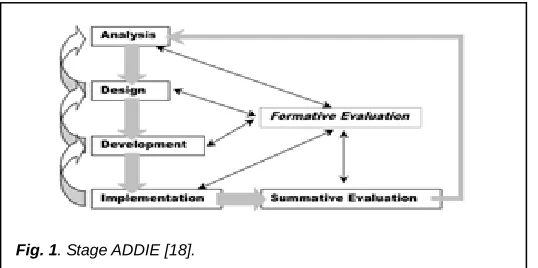
The type of research used in this study is the research and development method (Research and Development), which uses the Analysis, Design, Development, Implementation, and Evaluation (ADDIE) model. The ADDIE model directs research on process optimization to measure measurable results [17]. This research only reached the measurement of module validity and practicality. The ADDIE stage can be seen in Figure 1.
This research was conducted at MTsLB Yaketunis Yogyakarta Indonesia. The participants were 6 grade VII students of MTsLB Yaketunis Yogyakarta. this study uses instruments of validation sheets and student response questionnaires. The instrument validation sheet is aimed at two experts, namely the lecturer and mathematics teacher. The questionnaire for student responses is used to determine the practicality of the module.
3 RESULT
AND
DISCUSSION
3.1 Analysis Phase
Based on the results of the curriculum observation, it was found that the curriculum used in the modules used by students was in accordance with Core Competencies, Basic Competencies and indicators in the 2013 curriculum. Every material described was in accordance with the indicators of achievement. In the use of the 2013 curriculum, the learning process is centered on students and teachers as facilities so that the modules developed are able to help students as a center in the learning process. Based on the observations of the characteristics of blind students, it was found that blind students tended to memorize during mathematics learning in the classroom and needed a long time to recognize a geometric object. blind students need a long time to construct mental representations related to spatial concepts so that geometry material is difficult to teach them [19] Based on the results of interviews with Mrs. Wahyu as mathematics teacher of class VII MTsLB Yaketunis Yogyakarta obtained that students cannot absorb math lessons properly, general
teachers have difficulty teaching geometry material to blind students. Students need modules that can facilitate students in revering material about geometry, especially on the subject of rectangles. The teacher also explained that the constraints in the learning process of mathematics are the limited availability of media that makes the learning process ineffective, and mastery of concepts and understanding of children is low. 3.2 Design
This module is based on aspects of validity and practicality indicators. In addition, the right media selection is done so that it can help the learning process to be more maximal. The initial design of the module is based on the results of the needs analysis that has been done before. Module design based on guided discovery learning can be seen in figure 2 below.
The material in the guided discovery-based mathematics learning module contains detailed explanation of the subject matter, learning objectives, learning activities, material descriptions, and summaries delivered sequentially and systematically so that students are easy to understand the learning material. Modules are arranged in accordance with the stage of learning discovery, namely to formulate problems, analyze problems, build guesses, make conclusions and apply conclusions. According to Kadir (2017) interpreting learning which gives freedom to students to investigate mathematical problems through the following steps: (1) formulating a problem, (2) formulating a hypothesis, (3) testing a hypothesis, (4) drawing conclusions [20]. The guided discovery learning steps are as follows: (1) stimulus (asking questions or encouraging students to observe pictures and reading books about material), (2) problem statements (providing opportunities for students to identify problems), (3) collecting data (giving students opportunity to gather information), (4) processing data (processing data that has been obtained by students), (5) Verification (do a careful examination to verify the validity of the hypothesis), (6) generalizations (conclusions on problems that have been given) [21] As according to Maarif (2016) the method of discovery is in three stages, namely: clarification, drawing conclusions, validating [22]. The following module material design can be seen in figure 3:
1171 IJSTR©2019
www.ijstr.org
Modules are also arranged to be able to improve the creative thinking abilities of blind students according to the indicators, namely fluency, flexibility, originality, elaboration. The design of the discussion of the creative thinking of the following modules can be seen in Figure 4:
3.3 Develop Phase
3.3.1 Expert assesment
The existence of modules as students teaching materials must be useful in terms of appearance, content, and practicality. The results of module evaluations by experts can be seen in Table 1.
Based on the table above, it can be concluded that the module developed is valid. So that it can be tested at school to find out the practicality of the module. However, several revisions were carried out by researchers obtained from experts..
Suggestions and input from experts are summarized
in Table 2:
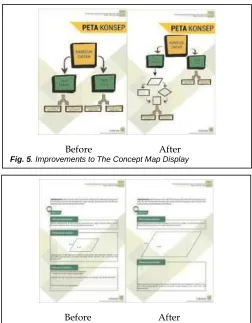
Some presentation of the module that has been improved after getting input and suggestions from experts as in the following pictures:
3.3.2 The Practicality
The module practicality test is carried out to see the level of comfort of students in receiving material obtained from the results of filling out the questionnaire. The questionnaire was filled out after the development of a series of modules was completed. practicality test results can be seen in graph 1. Fig. 4. Example Part of Creative Activity
Table 1
Results of Modules Evaluation by Experts
No
Aspect
Level of
Validity
Validity
criteria
1
Content
feasibility
3.67
Valid
2
Familiarity
3.60
Valid
3
Presentation
feasibility
3.60
Valid
4
Conformity with
guided discovery
learning model
3.50
Valid
Table 2
Suggestions and Input from Experts
Suggestions and
comments
Follow up
presentation of the
image is made
bigger
the presentation of the
image has been made
bigger
Concept maps are
made according to
the objectives of
achieving basic
competencies
Concept maps have been
made according to the
objectives of achieving
basic competencies
Before After
Fig. 5. Improvements to The Concept Map Display
Before After
Based on the results of the questionnaire, the module does not need to be revised because every aspect or indicator of the module is practical. It also shows that the modules developed are suitable for use in the learning process. students can use this module to study independently. For the application of an appropriate learning approach, the mathematics module is based on guided discovery learning.
4 CONCLUSION
This study aims to develop mathematical modules based on guided discovery learning that is feasible and practical. With meaningful learning, students can correctly understand concepts in mathematics learning. Guided discovery-based learning material in mathematics modules also emphasizes students to develop concepts in learning. The results of validation analysis from two validators were 3.67 for aspects of content feasibility, 3.60 for language aspects, 3.50 for display feasibility aspects and 3.50 for conformity aspects with guided discovery learning models. This shows that the module developed was in accordance with the four aspects of validation. After being validated, the module was tested on 5 7th grade students at MTsLB in Yogyakarta. The test results show the module received a good response. Therefore, modules that have been developed can be used as teaching materials in classroom learning.
5 SUGGESTION
The development of a mathematical module based on guided discovery was made to improve the creative thinking skills of blind students. In the next stage, the researcher will see whether the guided discovery-based mathematics module is effective or not.
ACKNOWLEDGMENT
My thanks go to Allah SWT, our Prophet Muhammad SAW, and to all colleagues involved in this study such as parents, validators, teachers, and students of MTsLB in Yogyakarta, MPMAT UAD lecturers, friends, and others who could not find one by one.
REFERENCES
[1] Saragih. Sarah, and Habbeahan. WL, “The Improving of Problem Solving Ability and Students Creativity Mathematical by Using Problem Based Learning in SMP Negeri 2 Siantar,” Journal of Education and Practice, Vol. 5, No. 35, pp. 123-132, 2014.
[2] Cockroft. WH, Counts: Report of The Committee of Enquiry into the Teaching of Mathematics in Schools, London: HMSO, 1982.
[3] WitaHarahap. L, and Surya. E, “Development of Learning Media in Mathematics for Students with Special Needs,” International Journal of Sciences: Basic and Applied Research, Vol. 33, No. 3, pp. 1-12, 2017.
[4] Murni. A, and Anggraini. R, “The Influence Of Applying Problem Based Learning Based On Soft Skill To Increase Students Creativity In The Subject Development Of High School Mathematics Curriculum,” Pekan Baru, UNRI, pp. 1203-1212. 2015.
[5] Khalilinezhad. Shahvarani. A, & Mardanbeigi. M, “The Analysis of The Effect Of Removing Barriers On The Creativity Students' Mathematical Learning,” Mathematics Education Trends and Research, 2017(1), pp. 1-11, 2017. [6] Otta. M, & Pozzia. F, “Towards a model to evaluate
creativity-oriented learning activities,” Procedia Social and Behavioral Sciences, 2010(2), pp. 3532-3536, 2010. [7] Tuğrul. B, H. Uysal. G. Güneş, & N. Ş. Okutan, “Picture of
the creativity,” Procedia - Social and Behavioral Sciences, 2014(116), pp. 3096-3100, 2014.
[8] Rahmawati. N. D, Nugroho. A. A, & Harun. L, “Effect Of Students Creativity In Wolfram Mathematica Assisted On Learning Achievement In Linear Algebra Course,” 2017. [9] Treffinger. D. J, Selby. E. C, and Isaksen. S. G,
“Understanding individual problem-solving style: A key to learning and applying creative problem solving,” Learning and Individual Differences, 2007.
[10] Sternbergn. R. J, & Lubart. T. L, The Concept of Creativity: Prospects and Paradigms. in R.J. Sternbergn (Ed), Handbook of Creativity, New York: Cambridge University Press, 2002.
[11] McCartan. C. D, “Evaluating Assesment in an Engineering Mathematics Module,” Proceedings of the 4th International CDIO Conference, Hogeschool Gent, Gent, Belgium, June 16-19, 2008.
[12] Wahyudi, “The Development of Realistic Mathematics Education (RME) Model for the Improvement of Mathematics Learnings of Primary Teacher Education Program (PGSD) Students of Teacher Training and Education Faculty (FKIP) of Sebelas Maret University in Kebumen,” Proceeding The 2nd International Conference On Teacher Training and Education Sebelas Maret University, Vol. 2, No. 1, 2016.
[13] Khabibah. E. N, Masykuri. M, Maridi, “The Effectiveness of Module Based on Discovery Learning to Increase Generic Science Skills,” Journal of Education and Learning, Vol.11, No.2, pp. 146-153, 2017.
[14] Vianna. C. S, Barbosa. P. M, Rocha. D. F, & Silva. B, “Teaching Geometry for Blind and Visually Impaired Students,” International Congress on Mathematical Education, 2008.
[15] Anders. B. A, Human Motivations and Discovery Learning, USA: Constructing Self-Discovery Learning Spaces Online, 2012.
1173 IJSTR©2019
www.ijstr.org
[16] Jew. S. H, Who Are Self-Discovery Learners Online? A Literature Review USA: Constructing Self-Discovery Learning Spaces Online, 2012.
[17] LOT, ADDIE:Instructional Design Model, Texas: College Station, 2001.
[18] Steven. J, Instructional Systems Design (ISD): Using The ADDIE Model, Penn State University: College of Education, 2000.
[19] Andriyani, “The Blind Student’s Interpretation of Two-Dimensional Shapes In Geometry,” Journal of Physics Conference Series 947,pp. 1-6, 2018.
[20] Kadir. L, and Satriawati. G, “The Implementaton of Open-Inquiry Approach to Improve Student’s Learning Activities, Responses and Mathematical Creative Thinking Skills,” Journal on Mathematics Education, Vol. 8, No. 1, pp. 103-114, 2017.
[21] Adelia. W.S, and Surya. E, “Resolution to Increase Capacity by Using Guided Discovery Learning Math Student’s,” International Journal Sciences: Basic and Applied Research, Vol. 34, No. 1, pp. 144-154, 2017. [22] Maarif. S, “Improving Junior High School Students