© 2016, IRJET | Impact Factor value: 4.45 | ISO 9001:2008 Certified Journal
| Page 1180
EFFECT OF EXHAUST GAS RECIRCULATION (EGR) IN INTERNAL
COMBUSTION ENGINE
1
Ajinkya B. Amritkar,
2Nilesh Badge
1
[email protected],
2[email protected]
1,2
B.E.Student, Department of Mechanical Engineering,
Sandip Institute of Technology and Research Centre, Nasik, India
---***---Abstract -
Today most of the transport vehicles in countrieslike India where cost effective is the predominant criteria utilize diesel engines rather than petrol engines. Diesel engines are used due to its low cost and low CO emissions. But it has some disadvantage also like due to high temperature in combustion chamber leads to formation of NOx and particulate matter which is harmful to human as well as environment. So exhaust gas recirculation (EGR) technique is used to reduce emission of NOx without affection engine performance. This paper includes formation of NOx in diesel engine, detailed about EGR system and one case study regarding this.
Key Words: - NOx, Compression ignition engine, EGR, NOx
formation, effect of EGR.
1. INTRODUCTION
Now a day’s pollution increases due to various harmful gases occurs due to globalization, industrial development and transportation industries. In case of transportation industries internal combustion engines are the main power source. In Comparison to petrol engine, diesel engines have high thermal efficiency because of high compression ratio and lean air-fuel mixture. High compression ratio leads to high temperature which is require for achieving auto ignition and the high expansion ratio makes the engine discharge less thermal energy in exhaust. Due to the lean air-fuel mixture, extra oxygen is present in the cylinder for complete combustion. This oxygen reacts with carbon, nitrogen and hydrogen and produces pollutants like carbon monoxide, carbon dioxide and oxides of nitrogen. Better efforts are being made to reduce the pollutants emitted from the engine exhaust system without loss of power and fuel consumption. The
reduction in NOX emissions pollutant content have probably become the most difficult aim to attain, comparing to the associated reverse effect of other recently used techniques are high supercharging process, an improved mixing process by efficient injection systems etc. Pollutants are formed because of the unburnt combustion of the air-fuel in the engine combustion chamber Harial S. Sorathia et al., [1]. The major pollutants emitted from the engine exhaust due to incomplete combustion are:
1. Carbon monoxide (CO) 2. Carbon Dioxide (CO2) 3. Hydrocarbons (HC) 4. Oxides of nitrogen (NOx)
If complete combustion occurs then the products being expelled from exhaust would be water vapor and carbon dioxide which is less harmful to human being as well as environment.
2. FORMATION OF NO
XAbout 2000 ppm of oxides of nitrogen is present in exhaust of engine. Mostly this contains nitrogen oxide (NO) and small amount of nitrogen dioxide (NO2) and other combinations. These are all grouped together NOx, with x represents suitable number. This NOx is found in fuel blend as well as in air. But these oxides of nitrogen are undesirable. There are number of possible reaction that forms NO and NO2 as follows:
O + N2 NO + N N + O2 NO + O N + OH NO + H NO + H2O NO2 + H2
NO + O2 NO2 + O
© 2016, IRJET | Impact Factor value: 4.45 | ISO 9001:2008 Certified Journal
| Page 1181
that occurs in IC engine. At very high temperature thisdiatomic nitrogen breaks in to monatomic nitrogen which is very reactive.
N2 2N
This monatomic nitrogen reacts with oxygen to form NOx. More is the temperature more N2 will dissociate and more NOx will be form. At low temperature less amount of NOx is created. In addition to temperature, NOx formation is depends on pressure and air fuel mixture.
3. CONTROL OVER OXIDES OF NITROGEN (NOX)
Many of theoretical and experimental investigation show that the concentration of NOx in exhaust gas is closely related to peak cycle temperature and available amount of oxygen in combustion chamber. Any process to reduce cylinder peak temperature and the concentration of oxygen will reduce the oxides of nitrogen. This suggests a number of methods are used for reducing the level of nitrogen oxides. Among these the dilution of fuel-air mixture entering the engine cylinder with non-combustible substance is one which absorbs a portion energy released during combustion, thereby affecting overall reduction in combustion temperature and consequently in the NOx emission level. The following are the some methods used for reducing peak cycle temperature and thereby reducing NOx emission.
3.1 Water Injection:
Nitrogen oxides (NOx) minimization is the function of water injection rate. NOx emission decreases due to with increase in water injection rate per kg of the fuel. The specific fuel consumption decreases a little percent at medium water injection rate. Water injection system is used as like a device for controlling NOx emission from the engine exhaust.
3.2 Catalyst Converter:
A copper catalyst used to minimize the NOx emission from engine in the presence amount of CO. Catalytic converter is use to control emission levels of pollutants by changing chemical properties of the exhaust gases. Catalyst materials used such as platinum and palladium are applied to a support made up of ceramic
which has been treated with an aluminum oxide wash coat. This results in form as extremely porous structure providing the large surface area to stimulate combination of oxygen with HC and CO. This type of oxidation process converts most of these compounds to water vapor and carbon- dioxide.
3.3 Exhaust Gas Recirculation:
© 2016, IRJET | Impact Factor value: 4.45 | ISO 9001:2008 Certified Journal
| Page 1182
gas absorbs energy at the time of combustion and does notcontribute any energy input.
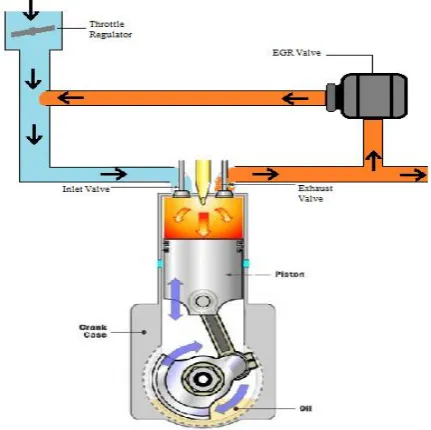
[image:3.595.55.271.335.550.2]Exhaust Gas Recirculation is done by diverting some exhaust gases back into inlet port, usually after the throttle. EGR combines with exhaust residual of previous cycle left in the cylinder to reduce the maximum burning temperature Mr. Harshraj Dangar et al., [7]. As the specific heat of EGR is much higher than ambient air, increases heat capacity of charge and leads to decreasing the temperature rise for the same heat output. EGR displaces fresh air entering the chamber with CO2 and water vapour present in exhaust. Hence due to this displacement, amount of oxygen in the air fuel mixture reduces and also reduces the effective air-fuel ratio which affects exhaust emission substantially Pratibhu Roy et al., [6]. As discuss earlier EGR increases heat capacity of intake mixture, which results in decreasing flame temperature and NOx formation reactions.
Fig -1: Schematic diagram of EGR system
EGR is defining as mass percent of the total intake flow.
Where,
mcyl = total mass flow in the cylinders.
EGR not only reduces maximum combustion temperature but also reduces overall combustion efficiency. Engine Management System controls the amount of EGR, by sensing both terminating condition flow is controlled, ranging from 0 up to 15-30%.
4. EFFECT OF DIFFERENT FUELS ON NOX EMISSION
Different fuels have different effects on engine
and engine temperature depending on their
characteristics, also it directly affect on NOx emission.
Here is list of some fuels and their effect on emission.
4.1 Effect Of EGR On NOx Emission From Engine
Fueled With A JETROPHA Bio-Diesel:
Cetane improving the additives in combustion chamber is capable of reducing NOx pollutant; the amount of NOx reduction is inadequate. Exhaust gas recirculation is an effective method used for NOx control. The exhaust gases are unburned carbon dioxide, nitrogen and high specific heat in combustion chamber. When exhaust gas recirculated to the engine inlet, it can decrease oxygen concentration and act as a heat sink. So this process reduces amount of oxygen concentration and peak combustion temperature which is mainly responsible for NOx generation. NO emission slightly increases using Jetropha bio- diesel while comparing to diesel at full load condition, this is because excess amount of oxygen is present in Jetropha bio- diesel and also it has higher viscosity resulting in a dynamic injection advance technique apart from injection advance provided for optimum efficiency Harial S. Sorathia et al., [1]. At 5% EGR, NO level decreases for both Diesel and Jetropha but still it is more than diesel. At 20-25% EGR, NO emission reduces by large amount but on other side it increases smoke, HC, CO emission. 15% EGR is found to be more effective because it reduces NO emission without affecting other parameters.
4.2 Effect of EGR on NOx Emission from Constant
Speed C.I. Diesel Engine
© 2016, IRJET | Impact Factor value: 4.45 | ISO 9001:2008 Certified Journal
| Page 1183
available for combustion in the intake mixture. Reducedamount of oxygen available for combustion lowers effective air-fuel ratio. Exhaust gases mixed with intake air increases the specific heat of the air intake mixture of gases, which results in reduction of flame temperature. Thus combination of lesser oxygen quantity in the intake air and reduced flame temperature reduces NOx formation in combustion chamber. At low load condition diesel engine requires high EGR ratio because recirculating gases contains high amount of oxygen and low carbon dioxide while at high load the oxygen in exhaust gas decreases and inert gas constituents star increasing with increased temperature. At high EGR rate of about 44% reduces NO emissions but significantly affect fuel economy. 15% EGR rate is found to be more effective as it decreases NOx emission without affecting engine performance and emission.
4.3 Effect of EGR on NOx Emission from LPG
Fuelled Diesel Engine
The LPG has a low cetane number (> 3). Therefore diethyl ether added to LPG for ignition purpose also it will improve the cetane number (greater than 125) and has a low auto ignition temperature is about 160°C. The concentration of NOx amount in the case of LPG operation without EGR is about 60% less than NOx amount concentration in case of diesel engine operation at any load. NO emission is found slightly higher as compared to LPG operation without EGR from no load to 40% load. This is because of the exhaust gases mixes with intake air and raises the inlet air temperature. This EGR enhance the combustion rate and leading to increased peak temperature and because of higher NO emissions in the engine exhaust. But at higher power outputs, reduction in NOx concentration is 10% to 20% of EGR from 80% to 100% load. This may be due to fact that at higher loads as well as with higher EGR percentages, concentration of both CO2 and H2O present in intake is more. These gases absorb energy released by combustion, which reduces peak combustion temperature in combustion
chamber hence reduction of NO emission achieved. LPG using with EGR operation exhibits lower exhaust gas temperature with high EGR percentages at higher loads.
4.4 Effect of EGR on NOx Emission from Diesel
Engine with Hydrogen as a Dual Fuel
Hydrogen is used one of the best alternatives for conventional fuels. Hydrogen enriched air is used as intake charges in a diesel engine adopting exhaust gas recirculation. There are various ways to reduce emission from the exhaust of engine running with hydrogen as fuel, but EGR is the most efficient technique used to control the emission. The main pollutant exhausted by hydrogen fueled engine is oxides of nitrogen. NOx emission from hydrogen duel fuel engine without EGR is higher than diesel engine. But with EGR, the NOx formation decreases with increase in the EGR. This is mainly the replacement of air-fuel mixture by inert gas, which decreases combustion temperature.
5. Case Study:
A.Paykani et al., [2] conducted an experiment on EGR. Detail is given below:
5.1 Experimental Setup and Procedure:
© 2016, IRJET | Impact Factor value: 4.45 | ISO 9001:2008 Certified Journal
| Page 1184
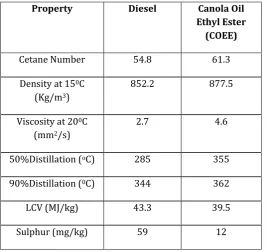
Table -1: Properties of Diesel and Canola Oil Ethyl Ester fuelProperty Diesel Canola Oil Ethyl Ester
(COEE)
Cetane Number 54.8 61.3
Density at 150C (Kg/m3)
852.2 877.5
Viscosity at 200C (mm2/s)
2.7 4.6
50%Distillation (oC) 285 355
90%Distillation (0C) 344 362
LCV (MJ/kg) 43.3 39.5
Sulphur (mg/kg) 59 12
Table -2: Engine Specification
Item Specification
Type Four Stroke
Number of Cylinder 1
Combustion System IDI
Bore 144.1 mm
Stroke 139.7 mm
Swept Volume 1.43 Lit
Compression Ratio 17.5:1
Ma. Power hp/rpm 8/850
Injection pressure 91.7 Kg/ cm2
Injection Timing 200BTDC
5.2 Test Condition Examine
Engine was operated at constant speed of 730 rpm with full load condition. Experiment was done at different D-COEE mixture and various EGR flow rates. For all engine conditions, diesel, pure biodiesel (COEE) and two D-COEE blends (B20 and B50) were examined. About 20 min was required to reach engine to steady state after that performance and emission characteristics was measured.
6. Results
6.1 Break Thermal Efficiency:
Break thermal efficiency decreases by substituting biodiesel because calorific value of biodiesel is lower than diesel.
Break thermal efficiency improves at low EGR ratio because of recirculation of active radicals, which increases combustion process.
High EGR ratio results in to decrease in oxygen concentration as well as combustion temperature due to which break thermal efficiency decreases. 6.2 Oxides of Nitrogen:
Oxygen content of biodiesel provides high combustion temperature results in high NOx emission.
By increasing EGR ratio combustion temperature decreases which leads to decrease in NOx formation for both net diesel fuel and COEE blends.
6.3 Unburned Hydrocarbon:
Unburned hydrocarbon emission decreases as the oxygen in combustion chamber increases this occurs when oxygenated fuels are used.
[image:5.595.32.302.411.725.2]© 2016, IRJET | Impact Factor value: 4.45 | ISO 9001:2008 Certified Journal
| Page 1185
6.4 Carbon Monoxide: The CO variation follows a close trend with increase in COEE substitution percentage resulting in slight decrease in CO emission.
Increasing EGR flow rates to high levels resulted in considerable rise in CO emission for both net diesel fuel and COEE blends.
7.
CONCLUSIONS
This paper shows the importance and advantages of EGR. Formation of oxides of nitrogen is occurred at high temperature which is available in cylinder at the time of combustion. EGR reduces the rise in temperature by recirculation of exhaust gases, exhaust gas displaces fresh air-entering in the combustion chamber and hence air displacement lowers oxygen amount available for combustion in the intake mixture. Experiment shows that by increasing EGR flow rate local peak temperature of combustion chamber decreases which leads to break thermal efficiency, formation of NOx and formation of unburned hydrocarbon decreases.
REFERENCES
[1] Harilal S. Sorathia , Dr. Pravin P. Rahhod and Arvind S.
Sorathiya. “Effect of Exhaust Gas Recirculation (EGR) on NOx Emission from C.I. Engine” - A Review Study. International Journal of Advanced Engineering Research and Studies, IJAERS/Vol. I/ Issue III/April-June, 2012/223-227.
[2] Paykani, A. Akbarzadeh and M. T. Shervani Tabar.
“Experimental Investigation of the Effect of Exhaust Gas. Recirculation on Performance and Emissions Characteristics of a Diesel Engine Fueled with Biodiesel” IACSIT International Journal of Engineering and Technology, Vol.3, No.3, June 2011.
[3] Pratik G. Sapre, Kunal A.Bhagat. “Emission
Characteristics for Single Cylinder DI Diesel Engine with EGR (Exhaust Gas Recirculation) System.” International Journal of Engineering Sciences & Research Technology. ISSN: 2277-9655
[4] Hardik B. Charola, C. D. Sankhavara, M.B.Charola.
“Evaluate the Performance and Emission using EGR (Exhaust gas recirculation) in Compression-ignition engine fuelled with blend.” IOSR Journal of Mechanical and Civil Engineering (IOSR-JMCE) e-ISSN: 2278-1684,p-ISSN: 2320-334X, Volume 10, Issue 5 (Jan. 2014), PP 16-21
[5] P.V.Ramana, D.Maheswar. “Experimental Investigation
of EGR at Various Fuel Substitutions on Dual Fuel CI Engine.” International Journal of Engineering Development and Research, 2014 IJEDR | Volume 2, Issue 4 | ISSN: 2321-9939
[6] Pratibhu Roy, Indranil Sinha, Bijan Kumar Mandal, Achin
Kumar Chowdhuri. “The Effect of Exhaust Gas Recirculation (EGR) In Compression Ignition Engine.” International Journal of Emerging Technology and Advanced Engineering Volume 3, Special Issue 3: ICERTSD 2013, Feb 2013, pages 106-111.
[7] Mr. Harshraj Dangar, Prof. Gaurav P. Rathod. ”Combine