Opinosis: A Graph-Based Approach to Abstractive Summarization of
Highly Redundant Opinions
Kavita Ganesan and ChengXiang Zhai and Jiawei Han
Department of Computer Science University of Illinois at Urbana-Champaign
{kganes2,czhai,hanj}@cs.uiuc.edu
Abstract
We present a novel graph-based summa-rization framework (Opinosis) that generates concise abstractive summaries of highly re-dundant opinions. Evaluation results on sum-marizing user reviews show that Opinosis summaries have better agreement with hu-man summaries compared to the baseline ex-tractive method. The summaries are readable, reasonably well-formed and are informative enough to convey the major opinions.
1 Introduction
Summarization is critically needed to help users better digest the large amounts of opinions ex-pressed on the web. Most existing work in Opin-ion SummarizatOpin-ion focus on predicting sentiment orientation on an entity (Pang et al., 2002) (Pang and Lee, 2004) or attempt to generate aspect-based ratings for that entity (Snyder and Barzilay, 2007) (Lu et al., 2009)(Lerman et al., 2009)(Titov and Mcdonald, 2008). Such summaries are very infor-mative, but it is still hard for a user to understand why an aspect received a particular rating, forcing a user to read many, often highly redundant sen-tences about each aspect. To help users further di-gest the opinions in each aspect, it is thus desirable to generate a concise textual summary of such re-dundant opinions.
Indeed, in many scenarios, we will face the problem of summarizing a large number of highly redundant opinions; other examples include sum-marizing the ‘tweets’ on Twitter or comments made about a blog or news article. Due to the sub-tle variations of redundant opinions, typical extrac-tive methods are often inadequate for summarizing such opinions. Consider the following sentences:
1. The iPhone’s battery lasts long, only had to charge it once every few days.
2. iPhone’s battery is bulky but it is cheap..
3. iPhone’s battery is bulky but it lasts long!
With extractive summarization, no matter which single sentence of the three is chosen as a sum-mary, the generated summary would be biased.
In such a case, an abstractive summary such as ‘iPhone’s battery is cheap, lasts long but is bulky’ is a more complete summary, conveying all the necessary information. Extractive methods also tend to be verbose and this is especially problem-atic when the summaries need to be viewed on smaller screens like on a PDA. Thus, an informa-tive and concise abstracinforma-tive summary would be a better solution.
Unfortunately, abstractive summarization is known to be difficult. Existing work in abstractive summarization has been quite limited and can be categorized into two categories: (1) approaches us-ing prior knowledge (Radev and McKeown, 1998) (Finley and Harabagiu, 2002) (DeJong, 1982) and (2) approaches using Natural Language Genera-tion (NLG) systems (Saggion and Lapalme, 2002) (Jing and McKeown, 2000). The first line of work requires considerable amount of manual effort to define schemas such as frames and templates that can be filled with the use of information extraction techniques. These systems were mainly used to summarize news articles. The second category of work uses deeper NLP analysis with special tech-niques for text regeneration. Both approaches ei-ther heavily rely on manual effort or are domain dependent.
In this paper, we propose a novel flexible sum-marization framework, Opinosis, that uses graphs to produce abstractive summaries of highly redun-dant opinions. In contrast with the previous work, Opinosis assumes no domain knowledge and uses shallow NLP, leveraging mostly the word order in the existing text and its inherent redundancies to generate informative abstractive summaries. The key idea of Opinosis is to first construct a tex-tual graph that represents the text to be summa-rized. Then, three unique properties of this graph are used to explore and score various subpaths that help in generating candidate abstractive sum-maries.
gener-ated summaries are readable, concise and fairly well-formed. Since Opinosis assumes no do-main knowledge and is highly flexible, it can be potentially used to summarize any highly re-dundant content and could even be ported to other languages. (All materials related to this work including the dataset and demo software can be found at http://timan.cs.uiuc.edu/
downloads.html.)
2 Opinosis-Graph
Our key idea is to use a graph data structure (called Opinosis-Graph) to represent natural language text and cast this abstractive summarization problem as one of finding appropriate paths in the graph. Graphs have been commonly used for extractive summarization (e.g., LexRank (Erkan and Radev, 2004) and TextRank (Mihalcea and Tarau, 2004)), but in these works the graph is often undirected
with sentences as nodes and similarity as edges. Our graph data structure is different in that each node represents a word unit with directed edges
representing the structure of sentences. Moreover, we also attach positional information to nodes as will be discussed later.
Algorithm 1(A1): OpinosisGraph(Z) 1: Input:Topic related sentences to be summarized:Z={zi}n
i=1
2: Output:G= (V, E)
3: fori= 1tondo 4: w←T okenize(zi)
5: sent size←SizeOf(w)
6: forj= 1tosent sizedo
7: LABEL←wj
8: P ID←j
9: SID←i
10: ifExistsN ode(G, LABEL)then
11: vj←GetExistingN ode(G, LABEL)
12: P RIvj←P RIvj∪(SID, P ID)
13: else
14: vj←CreateN ewN ode(G, LABEL)
15: P RIvj←(SID, P ID)
16: end if
17: if notExistsEdge(vj−1→vj, G)then
18: AddEdge(vj−1→vj, G)
19: end if 20: end for 21: end for
Our graph representation is closer to that used by Barzilay and Lee (Barzilay and Lee, 2003) for the task of paraphrasing, wherein each node in the graph represents a unique word. However, in their work, such a graph is used to identify regions of commonality and variability amongst similar sen-tences. Thus, the positional information is not re-quired nor is it maintained. In contrast, we main-tain positional information at each node as this is critical for the selection of candidate paths.
Algorithm A1 outlines the steps involved in building an Opinosis-Graph. We start with a set of sentences relevant to a specific topic, which can
be obtained in different ways depending on the ap-plication. For example, they may be all sentences related to thebattery lifeof theiPod Nano. We de-note these sentences asZ ={zi}ni=1where eachzi
is a sentence containing part-of-speech (POS) an-notations. (A1:4) Each zi ∈ Z is split into a set
ofword units, where each unit, wj consists of a
word and its corresponding POS annotation (e.g. “service:nn”, “good:adj”). (A1:7-9) Each unique
wj will form a node, vj, in the Opinosis-Graph,
withwj being the label. Also, since we only have
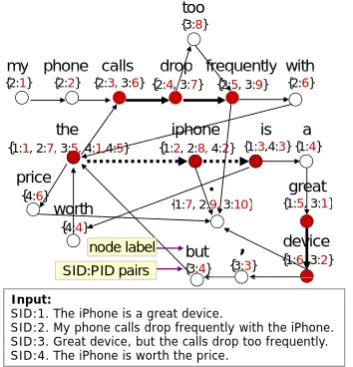
one node per unique word unit, each node keeps track of all sentences that it is a part of using a sen-tence identifier(SID) along with itsposition of oc-currencein that sentence (PID). (A1:10-16) Each node will thus carry aPositional Reference Infor-mation (PRI) which is a list of {SID:PID} pairs
representing the node’s membership in a sentence. (A1:17-19) The original structure of a sentence is recorded with the use of directed edges. Figure1
shows a resulting Opinosis-Graph based on four sentences.
The Opinosis-Graph has some unique proper-ties that are crucial in generating abstractive sum-maries. We highlight some of the core properties by drawing examples from Figure1:
Property 1. (Redundancy Capture). Highly
re-dundant discussions are naturally captured by sub-graphs.
Figure1shows that although the phrase ‘great de-vice’ was mentioned in different parts of sentences (1) and (3), this phrase forms a relatively heavy sub-path in the resulting graph. This is a good in-dication of salience.
Property 2. (Gapped Subsequence Capture). Ex-isting sentence structures introduce lexical links that facilitate the discovery of new sentences or re-inforce existing ones.
The main point conveyed by sentences (2) and (3) in Figure1is thatcalls drop frequently. However, this is expressed in slightly different ways and is reflected in the resulting subgraph. Since sentence (2) introduces a lexical link between ‘drop’ and ‘frequently’, the word ‘too’ can be ignored for sen-tence (3) as the same amount of information is re-tained. This is analogous to capturing arepetitive gapped subsequencewhere similar sequences with minor variations are captured. With this, the sub-graphcalls drop frequently can be considered re-dundant.
Property 3. (Collapsible Structures). Nodes that resemble hubs are possibly collapsible.
my phone calls frequently too
{3:8}
with drop
iphone is a
my
{2:1}
phone
{2:2}
calls
{2:3, 3:6}
frequently
{2:5, 3:9}
with
{2:6}
the
drop
{2:4, 3:7}
great
{1:5, 3:1}
{1:2, 2:8, 4:2} {1:3,4:3} {1:4}
.
{1:7, 2:9, 3:10}
{1:1, 2:7, 3:5, 4:1,4:5}
worth price
{4:6}
{ , }
,
{3:3}
but
{3:4}
{1:7, 2:9, 3:10}
worth
{4:4}
node label
SID:PID pairs
device
{1:6, 3:2}
Input:
SID:1. The iPhone is a great device.
SID:2. My phone calls drop frequently with the iPhone. SID:3. Great device, but the calls drop too frequently.
p
, p q y
SID:4. The iPhone is worth the price.
Figure 1: Sample Opinosis-Graph. Thick edges indicate salient paths.
‘hub’ where it connects to various other nodes. Such a structure is naturally captured by the Opinosis-Graph and is a good candidate for com-pression to generate a summary such as ‘The iPhone is a great device and is worth the price’. Also, certain word POS (e.g. linking verbs like ‘is’ and ‘are’) often carry hub-like properties that can be used in place of the outlink information.
3 Opinosis Summarization Framework
In this section, we describe a general framework for generating abstractive summaries using the Opinosis-Graph. We also describe our implemen-tation of the components in this framework.
At a high level, we generate an abstractive sum-mary by repeatedly searching the Opinosis graph for appropriate subgraphs that both encode a valid sentence (thus meaningful sentences) and have high redundancy scores (thus representative of the major opinions). The sentences encoded by these subgraphs would then form an abstractive sum-mary.
Going strictly by the definition of true abstrac-tion (Radev et al., 2002), our problem formula-tion is still more extractive than abstractive be-cause the generated summary can only contain words that occur in the text to be summarized; our problem definition may be regarded as a word-level (finer granularity) extractive summarization. However, compared to the conventional sentence-level extractive summarization, our formulation has flavors of abstractive summarization wherein we have elements offusion (combining extracted portions) and compression (squeezing out unim-portant material from a sentence). Hence, the sen-tences in the generated summary are generally not the same as any original sentence. Such a “shal-low” abstractive summarization problem is more
tractable, enabling us to develop a general solution to the problem. We now describe each component in such a summarization framework.
3.1 Valid Path
A valid path intuitively refers to a path that corre-sponds to a meaningful sentence.
Definition 1. (Valid Start Node - VSN). A nodevq
is a valid start node if it is a natural starting point of a sentence.
We use the positional information of a node to de-termine if it is a VSN. Specifically, we check if
Average(P IDvq) ≤ σvsn, where σvsn is a
pa-rameter to be empirically set. With this, we only qualify nodes that tend to occur early on in a sen-tence.
Definition 2. (Valid End Node - VEN). A nodevs
is a valid end point if it completes a sentence.
We use the natural ending points in the text to be summarized as hints to which node may be a valid end point of a path (i.e., a sentence). Specifically, a node is a valid end node if (1) the node is a punctuation such asperiod andcommaor (2) the node is any coordinating conjunction (e.g., ‘but’
and‘yet’).
Definition 3. (Valid Path). A pathW ={vq...vs} is valid if it is connected by a set of directed edges such that (1) vq is a VSN, (2) vs is a VEN, and
(3)W satisfies a set of well-formedness POS
con-straints.
Since not every path starting with a VSN and end-ing at a VEN encodes a meanend-ingful sentence, we further require a valid path to satisfy the following POS constraints (expressed in regular-expression) to ensure that a valid path encodes a well-formed sentence:
1. .∗(/nn) +.∗(/vb) +.∗(/jj) +.∗ 2. .∗(/jj) +.∗(/to) +.∗(/vb).∗ 3. .∗(/rb)∗.∗(/jj) +.∗(/nn) +.∗
4. .∗(/rb) +.∗(/in) +.∗(/nn) +.∗
This also provides a way (if needed) for the appli-cation to generate only specific type of sentences likecomparative sentencesorstrictly opinionated sentences. These rules are thus application spe-cific.
3.2 Path Scoring
Intuitively, to generate an abstractive summary, we should select a valid path that can represent most of the redundant opinions well. We would thus favor a valid path with a high redundancy score.
Definition 4. (Path Redundancy). Let W =
{vq...vs}be a path from an Opinosis-Graph. The
r(q, s) =nq∩¯nq+1...∩¯ns,
where ni = P RIvi and∩¯ is the intersection
tween two sets of SIDs such that the difference be-tween the corresponding PIDs is no greater than
σgap, andσgap>0is a parameter.
Path redundancies provide good indication of how many sentences discuss something similar at each point in the path. Theσgapparameter controls the
maximum allowed gaps in discovering these re-dundancies. Thus, a common sentenceXbetween nodes vq andvr, will be considered a valid
inter-sect if(P IDvr x −P IDvq x)≤σgap.
Based on path redundancy, we propose several ways to score a path for the purpose of selecting a good path to include in the summary:
1.Sbasic(W) = |W1|Psk=i+1,ir(i, k)
2.Swt len(W) = |W1|Psk=i+1,i|vi, vk| ∗r(i, k)
3.Swt loglen(W) = |W1|(r(i, i+ 1) + Ps
k=i+2,i+1log2|vi, vk| ∗r(i, k))
vi is the first node in the path being scored andvs
is the last node. |vi, vk|is the length from nodevi
to vk. |W|is the length of the entire path being
scored. TheSbasic scoring function scores a path
purely based on the level of redundancy. One could also argue that high redundancy on a longer path is intuitively more valuable than high redundancy on a shorter path as the former would provide better coverage than the latter. This intuition is factored in by theSwt len andSwt loglen scoring functions
where the level of redundancyisweighted by the
path length. Swt loglen is similar to Swt len only
that it scales down the path length so that it does not entirely dominate.
3.3 Collapsed paths
In some cases, paths in the Opinosis-Graph may be collapsible (as explained in Section 2). In such a case, the collapse operation is performed and then the path scores are computed. We will now ex-plain a few concepts related to collapsible struc-tures. Let Wc = {vi...vk} be a path from the
Opinosis-Graph.
Definition 5. (Collapsible Node). Node vk is a
candidate for collapse if its POS is averb.
We only attempt to collapse nodes that are verbs
due to the heavy usage of verbs in opinion text and the ease with which the structures can be combined to form a new sentence. However, as mentioned earlier other properties like the outlink information can be used to determine if a node is collapsible.
Definition 6. (Collapsed Candidates, Anchor). Letvk be a collapsible node. The collapsed
can-didates ofvk(denoted byCC={cci}mi=1) are the
Canchor CC Connector
a. the sound quality is cc1:really good and
cc2:clear
b. the iphone is cc1:great but
cc2:expensive
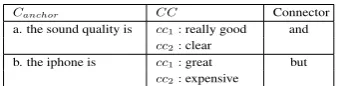
Table 1: Example of anchors, collapsed candidates and suitable connectors
remaining paths aftervkin all the valid paths
go-ing throughvi...vk. The prefixvi...vkis called the
anchor, denoted as Canchor = {vi...vk}. Each
path{vi...vn}, wherevn is the last node in each cci∈CC, is an individually valid path.
Table1shows a simplistic example of anchors and corresponding collapsed candidates. Once the an-chor and collapsed candidates have been identified, the task is then to combine all of these to form a new sentence.
Definition 7. (Stitched Sentence) A stitched sen-tence is one that combines Canchor and CC to
form a combined, logical sentence.
We will now describe the stitching procedure that we use, by drawing examples from Table1. Since we are dealing with verbs, Canchor can be
com-bined with the corresponding CC with commas
to separate eachcci ∈ CC with one exception
-the correct sentence connector has to be used for the lastcci. ForCanchora, the phrasesreally good and clear can be connected by ‘and’ due to the same sentiment orientation. ForCanchorb, the
col-lapsed candidate phrases are well connected by the word ‘but’. We use the existing Opinosis-Graph to determine the most appropriate connector. We do this by looking at allcoordinating conjunction
(e.g. ‘but’, ‘yet’) nodes (vcconj) that are connected
to the first node of the last collapsed candidate,
ccm. This would be the node labeled ‘clear’ for Canchora and ‘expensive’ forCanchorb. We denote these nodes asv0,ccm. The vcconj, with the high-estpath redundancy with v0,ccm, will be selected as the connector.
Definition 8. (Collapsed Path Score) The final path score after the entire collapse operation is the average across path scores computed fromvito the
last node in eachcci ∈CC.
The collapsed path score essentially involves com-puting thepath scoresof the individual sentences assuming that they are not collapsed and then av-eraging them.
3.4 Generation of summary
eliminate duplicated (or extremely similar) paths by using a similarity measure (in our experiments, we used Jaccard). We then take the top few re-maining paths as the generated summary, with the number of paths to be chosen controlled by a pa-rameterσss, which represents summary size.
Although conceptually we enumerate all the valid paths, in reality we can use a redundancy score threshold,σr to prune many non-promising
paths. This is reasonable because we are only in-terested in paths with high redundancy scores.
4 Summarization Algorithm
AlgorithmsA2andA3describe the steps involved in Opinosis Summarization. A2 is the starting point of the Opinosis Summarization and A3 is a subroutine where path finding takes place, invoked from within A2.
Algorithm 2(A2): OpinosisSummarization(Z) 1: Input:Topic related sentences to be summarized:Z={zi}n
i=1
2: Output:O={Opinosis Summaries}
3: g←OpinosisGraph(Z)
4: node size←SizeOf(g)
5: forj= 1tonode sizedo 6: ifV SN(vj)then
7: pathLen←1
8: score←0
9: cList←CreateN ewList()
10: Traverse(cList, vj, score, P RIvj, labelvj, pathLen)
11: candidates← {candidates∪cList}
12: end if 13: end for
14: C ←EliminateDuplicates(candidates)
15: C ←SortByP athScore(C)
16: fori= 1toσssdo
17: O={O ∪P ickN extBestCandidate(C)}
18: end for
(A2:3) Opinosis Summarization starts with the construction of the Opinosis-Graph, described in detail in Section 2. This is followed by thedepth first traversal of this graph to locate valid paths
that become candidate summaries. (A2:6-12) To achieve this, each nodevj in the Opinosis-Graph
is examined to determine if it is aVSN and, if it is, path finding will start from this node by invok-ing subroutine A3. A3 takes the followinvok-ing as in-put: list - a list to hold candidate summaries; vi
- the node to continue traversal from; score - the accumulated path score;P RIoverlap- the intersect
between PRIs of all nodes visited so far (see Defi-nition4);sentence- the summary sentence formed so far;len- the current path length. (A2:7-10) Be-fore invoking A3 from A2, the path length is set to ‘1’, path score is set to ‘0’ and a new list is cre-ated to store candidate summaries genercre-ated from nodevj. (A2:11) All candidate summaries
gener-ated fromvj will be stored in a common pool of
candidate summaries.
Algorithm 3(A3): T raverse(...)
1: Input:list,vk⊆V,score,P RIoverlap,sentence,len
2: Output:A set of candidate summaries
3: redundancy←SizeOf(P RIoverlap)
4: ifredundancy≥σrthen
5: ifV EN(vk)then
6: ifV alidSentence(sentence)then
7: f inalScore←score
len
8: AddCandidate(list, sentence, f inalScore)
9: end if 10: end if
11: forvn∈N eighborsvkdo
12: P RInew←P RIoverlap ∩¯ P RIvn
13: redundancy←SizeOf(P RInew)
14: newSent←Concat(sentence, labelvn)
15: L←len+ 1
16: newScore←score+P athScore(redundancy, L)
17: ifCollapsible(vn)then
18: Canchor←newSent
19: tmp←CreateN ewList()
20: forvx∈N eighborsvndo
21: Traverse(tmp, vx,0, P RInew, labelvx, L)
22: CC←EliminateDuplicates(tmp)
23: CCP athScore←AverageP athScore(CC)
24: f inalScore←newScore+CCP athScore
25: stitchedSent←Stitch(Canchor, CC)
26: AddCandidate(list, stitchedSent, f inalScore)
27: end for 28: else
29: Traverse(list, vn, newScore, P RInew, newSent, L)
30: end if 31: end for 32: end if
(A3:3-4) Algorithm A3 starts with a check to ensure that the minimum path redundancy require-ment is satisfied (see definition 4). For the very first node sent from A2, the path redundancy is the size of the rawP RI. (A3:5-10) If the redundancy requirement is satisfied, a few checks are done to determine if avalid pathhas been found. If it has, then the resulting sentence and its final score are added to the list of candidate summaries.
(A3:11-31) Traversal proceeds recursively through the exploration of all neighboring nodes of the current node, vk. (A3:12-16) For every
neighboring node,vnthePRIoverlap information,
path length, summary sentence and path score are updated before the next recursion. (A3:29) If a vn is not collapsible, then a regular
traver-sal takes place. (A3:17-27) However, if vn is
collapsible, the updated sentence in A3:14, will now serve as an anchor in A3:18. (A3:21) A3 will then attempt to start a recursive traversal from all neighboring nodes ofvn in order to find
corresponding collapsed candidates. (A3:22-26) After this, duplicates are eliminated from the
collapsed candidatesand thecollapsed path score
is computed. The resulting stitched sentence and itsfinal scoreare then added to the original list of candidate summaries.
for candidate generation, duplicate candidates are removed and the remaining are sorted in descend-ing order of their path scores. The bestσss
candi-dates are ‘picked’ as final Opinosis summaries.
5 Experimental Setup
We evaluate this abstractive summarization task using reviews of hotels, cars and various prod-ucts1. Based on these reviews, 2 humans were
asked to construct ‘opinion seeking’ queries which would consist of anentity nameand atopic of in-terest. Example of such queries are:Amazon Kin-dle:buttons, Holiday Inn, Chicago: staff, and so on. We compiled a set of 51 such queries. We cre-ate one review document per query by collecting all review sentences that contain the query words for the given entity. Each review document thus consists of a set of unordered, redundant review sentences related to the query. There are approxi-mately 100 sentences per review document.
We use ROUGE (Lin, 2004b) to quantitatively assess the agreement of Opinosis summaries with human composed summaries. ROUGE is based on an n-gram co-occurrence between machine sum-maries and human sumsum-maries and is a widely ac-cepted standard for evaluation of summarization tasks. In our experiments, we use ROUGE-1, 2 and SU4 measures. ROUGE-1 and ROUGE-2 have been shown to have most correlation with human summaries (Lin and Hovy, 2003) and higher order ROUGE-N scores (N >1)
estimate the fluency of summaries.
We use multiple reference (human) summaries in our evaluation since it can achieve better cor-relation with human judgment (LIN, 2004a). We leverage Amazon’s Online Workforce2to get 5
dif-ferent human workers to summarize each review document. The workers were asked to be concise and were asked to summarize the major opinions in the review document presented to them. We manu-ally reviewed each set of reference summaries and dropped summaries that had little or no correlation with the majority. This left us with around 4 refer-ence summaries for each review document.
To allow performance comparison between hu-mans, Opinosis and the baseline method, we im-plemented a Jackknifing procedure where, given K references, the ROUGE score is computed over K sets of K-1 references. With this, average human performance is computed by treating each refer-ence summary as a ‘system’ summary, computing ROUGE scores over the remaining K-1 reference
1Reviews collected from Tripadvisor, Amazon, Edmunds 2https://www.mturk.com
summaries.
Due to the limited work in abstractive sum-marization, no natural baseline could be used for comparison. The existing work in this area is mostly domain dependent and requires too much manual effort (explained in Section 1). The next best baseline is to use a state of the art extractive method. Thus, we use MEAD (Radev et al., 2000) as our baseline. MEAD is an extractive summa-rizer based on cluster centroids. It uses a collection of the most important words from the whole clus-ter to select the best sentences for summarization. By default, the scoring of sentences in MEAD is based on 3 parameters -minimum sentence length,
centroid, and position in text. MEAD was ideal for our task because a good summary in our case would be one that could capture the most essential information. This is exactly what centroid-based summarization aims to achieve. Also, since the po-sition in textparameter is irrelevant in our case, we could easily turn this off with MEAD.
We introduce areadability testto understand if Opinosis summaries are in fact readable. Suppose we have N sentences from a system-generated
summary and M sentences from corresponding
human summaries. We mix all these sentences and then ask a human assessor to pick at mostN
sentences that areleast readable as the prediction of system summary.
readability(O) = 1−#CorrectP ickN
If the human assessor often picks out system gen-erated summaries as being least readable, then the readability of system summaries is poor. If not, then the system generated summaries are no dif-ferent from human summaries.
6 Results
The baseline method (MEAD) selects 2 most rep-resentative sentences as summaries. To give a fair comparison, we fix the Opinosis summary size,
σss= 2. We also fixσvsn= 15. The best Opinosis
configuration with σss= 2 and σvsn = 15 is
called Opinosisbest(σgap= 4, σr= 2,Swt loglen).
ROUGE scores reported are with the use of stem-mingandstopword removal.
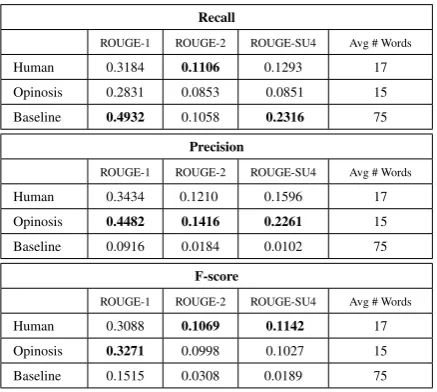
Performance comparison between humans, Opinosis and baseline. Table2shows the perfor-mance comparison between humans, Opinosisbest
Recall
ROUGE-1 ROUGE-2 ROUGE-SU4 Avg # Words
Human 0.3184 0.1106 0.1293 17
Opinosis 0.2831 0.0853 0.0851 15
Baseline 0.4932 0.1058 0.2316 75
Precision
ROUGE-1 ROUGE-2 ROUGE-SU4 Avg # Words
Human 0.3434 0.1210 0.1596 17
Opinosis 0.4482 0.1416 0.2261 15
Baseline 0.0916 0.0184 0.0102 75
F-score
ROUGE-1 ROUGE-2 ROUGE-SU4 Avg # Words
Human 0.3088 0.1069 0.1142 17
Opinosis 0.3271 0.0998 0.1027 15
Baseline 0.1515 0.0308 0.0189 75
Table 2: Performance comparison between Hu-mans, Opinosisbestand Baseline.
0.110
Figure 2: ROUGE scores (f-measure) at different levels ofσgap,σr= 2.
precision scores.
Next, we see that humans have reasonable agreement amongst themselves given that these are independently composed summaries. This agree-ment is especially clear with the ROUGE-2 re-call score where the rere-call is better than Opinosis but comparable to the baseline even though the summaries are much shorter. It is also clear that Opinosis is closer in performance to humans than to the baseline method. The recall scores of Opinosis summaries are slightly lower than that achieved by humans, while the precision scores are higher (Wilcoxon test shows that the increase in precision is statistically more significant than the decrease in recall). In terms of f-scores, Opinosis has the best ROUGE-1 score and its ROUGE-2 and ROUGE-SU4 scores are comparable with human performance. The baseline method has the low-est f-scores. The difference between the f-scores of Opinosis and that of humans is statistically in-significant.
Comparison of scoring functions.Next, we look
into the performance of the three scoring func-tions, Sbasic, Swt len and Swt loglen described in
Section3. Figure2shows ROUGE scores of these scoring methods at varying levels of σgap. First,
0.30
Figure 3: ROUGE scores (f-measure) at different levels ofσraveraged acrossσgap∈[1,5]
Figure 4: Precision-Recall comparison with differ-ent Opinosis features turned off.
it can be observed that Swt basic which does not
use path length information, performs the worst. This is due to the effect of heavily favoring re-dundant paths over longer but reasonably redun-dant ones that can provide more coverage. We also see that Swt len and Swt loglen are similar in
per-formance with Swt loglen marginally
outperform-ing Swt len when σgap > 2. Since Swt len uses
the rawpath lengthin its scoring function, it may be inflating the path scores of long but insignifi-cant paths. Swt loglenscales down the path length,
thus providing a reasonable tradeoff between re-dundancy and the length of the selected path. The three scoring functions are not influenced by dif-ferent levels ofσras shown in Figure3.
Effect of gap setting (σgap). Now, we will
ex-amine the effect of σgap on the generated
sum-maries. Based on Figure 2, we see that setting
σgap=1yields in relatively low performance. This
is because σgap=1 implies immediate adjacency
between the PIDs of two nodes and such strict ad-jacency enforcements prevent redundancies from being discovered. When σgap is increased to 2,
there is a big jump in performance, after which improvements are observed in smaller amounts. A very large gap setting could increase the possibility of generating ill-formed sentences, thus we recom-mend thatσgapis set between2-5.
Effect of redundancy requirement (σr) .
Fig-ure3shows the ROUGE scores at different levels ofσr. It is clear that whenσr >2, the quality of
summaries is negatively impacted. Since we only have about 100 sentences per review document, σr > 2severely restricts the number of paths that
can be explored, yielding in lower ROUGE scores. Since the scoring function can account for the level of redundancy, σr should be set according to the
size of the input data. For our dataset,σr = 2was
“About food at Holiday Inn, London”
Human summaries:
[1]Food was excellent with a wide range of choices and good services.
[2]The food is good, the service great. Very good selection of food for breakfast buffet.
“What is free at Bestwestern Inn, San Francisco”
Human summaries:
[1]There is free WiFi internet access available in all the rooms.. From 5-6 p.m. there is free wine tasting and appetizers available to all the guests.
[2]Evening wine reception and free coffee in the morning. Free internet, free parking and free massage
Opinosis abstractive summary:
The food was excellent, good and delicious. Very good selection of food.
Baseline extractive summary:
Within 200 yards of leaving the hotel and heading to the Tube Station you have a number of fast food outlets, highstreet Restautants, Pastry shops and supermarkets so if you did wish to live in your hotel room for the duration of your
free massage.
Opinosis abstractive summary:
Free wine reception in evening. Free coffee and biscotti and wine.
Baseline extractive summary:
The free wine and nibbles served between 5pm and 6pm were a lovely touch. There's free coffee teas at breakfast time with little biscotti and best of all from 5 till 6pm you get a free supermarkets, so if you did wish to live in your hotel room for the duration of your
stay, you could do...
coffee, teas at breakfast time with little biscotti and, best of all, from 5 till 6pm you get a free wine 'tasting' reception which, as long as you don't take……
Figure 5: Sample results comparing Opinosis summaries with human and baseline summaries.
Effect of collapsed structures and duplicate elimination. So far, it has been assumed that all features used in Opinosis are required to gener-ate reasonable summaries. To test this hypothesis, we use Opinosisbestas a baseline and then we turn
off different features of Opinosis. We turn off the
duplicate elimination feature, then the collapsi-ble structure feature, and finally both. Figure 4
shows the resulting precision-recall curve. From this graph, we see that without duplicate elimina-tion and when collapsing is turned off, the preci-sion is highest but recall is lowest. No collaps-ing implies shorter sentences and thus lower recall, which is clearly reflected in Figure 4. On top of this, if duplicates are allowed, the overall informa-tion coverage is low, further affecting the recall. Notice that the presence of duplicates with the col-lapse feature turned on results in very high recall (even higher than the baseline). This is caused by the presence of similar phrases that were not elim-inated from the collapsed candidates, resulting in long sentences that artificially boost recall. The Opinosis baseline which uses duplicate elimina-tion and the collapsible structure feature, offers a reasonable tradeoff between precision and recall.
Readability of Summaries.To test the readability of Opinosis summaries, we conducted a readabil-ity test (described in Section 5) using summaries generated from Opinosisbest. A human assessor
picked the 2 least readable sentences from each of the 51 test sets (based on 51 summaries). Collec-tively, there were 565 sentences out of which 102 were Opinosis generated. Out of these, the hu-man assessor picked only 34 of the sentences as being least readable, resulting in an average read-ability score of 0.67. This shows that more than 60% of the generated sentences are indistinguish-able from human composed sentences. Of the 34 sentences with problems, 11 containedno informa-tionor wereincomprehensible, 12 wereincomplete
possibly due to false positives when the sentence validity check was done, and 8 hadconflicting in-formation such as ‘the hotel room is clean and dirty’. This happens due to mixed feelings about
the same topic and can be resolved using sentiment analysis. The remaining 3 sentences were found to containpoor grammar, possibly caused by the gaps allowed in finding redundant paths.
Sample Summaries.Finally, in Figure5we show
two sample summaries on two different topics. Notice that the Opinosis summaries are concise, fairly well-formed and have closer resemblance to human summaries than to the baseline summaries.
7 Conclusion
In this paper, we described a novel summarization framework (Opinosis) that uses textual graphs to generate abstractive summaries of highly redun-dant opinions. Evaluation results on a set of review documents show that Opinosis summaries have better agreement with human summaries com-pared to the baseline extractive method. The Opinosis summaries are concise, reasonably well-formed and communicate essential information. Our readability test shows that more than 60% of the generated sentences are no different from hu-man composed sentences.
Opinosis is a flexible framework in that many of its modules can be easily improved or replaced with other suitable implementation. Also, since Opinosis is domain independent and relies on min-imal external resources, it can be used with any corpus containing high amounts of redundancies.
Our graph representation naturally ensures the coherence of a summary, but such a graph empha-sizes too much on the surface order of words. As a result, it cannot group sentences at a deep seman-tic level. To address this limitation, we can use a similar idea to overlay parse trees and this would be a very interesting future research.
8 Acknowledgments
References
[Barzilay and Lee2003] Barzilay, Regina and Lillian Lee. 2003. Learning to paraphrase: an unsuper-vised approach using multiple-sequence alignment. In NAACL ’03: Proceedings of the 2003 Confer-ence of the North American Chapter of the Associ-ation for ComputAssoci-ational Linguistics on Human Lan-guage Technology, pages 16–23, Morristown, NJ, USA. Association for Computational Linguistics.
[DeJong1982] DeJong, Gerald F. 1982. An overview of the FRUMP system. In Lehnert, Wendy G. and Mar-tin H. Ringle, editors, Strategies for Natural Lan-guage Processing, pages 149–176. Lawrence Erl-baum, Hillsdale, NJ.
[Erkan and Radev2004] Erkan, G¨unes and Dragomir R. Radev. 2004. Lexrank: graph-based lexical central-ity as salience in text summarization. J. Artif. Int. Res., 22(1):457–479.
[Finley and Harabagiu2002] Finley, Sanda Harabagiu and Sanda M. Harabagiu. 2002. Generating sin-gle and multi-document summaries with gistexter. In
Proceedings of the workshop on automatic summa-rization, pages 30–38.
[Jing and McKeown2000] Jing, Hongyan and Kath-leen R. McKeown. 2000. Cut and paste based text summarization. InProceedings of the 1st North American chapter of the Association for Computa-tional Linguistics conference, pages 178–185, San Francisco, CA, USA. Morgan Kaufmann Publishers Inc.
[Lerman et al.2009] Lerman, Kevin, Sasha Blair-Goldensohn, and Ryan Mcdonald. 2009. Sentiment summarization: Evaluating and learning user prefer-ences. In12th Conference of the European Chapter of the Association for Computational Linguistics (EACL-09).
[Lin and Hovy2003] Lin, Chin-Yew and Eduard Hovy. 2003. Automatic evaluation of summaries using n-gram co-occurrence statistics. InProc. HLT-NAACL, page 8 pages.
[LIN2004a] LIN, Chin-Yew. 2004a. Looking for a few good metrics : Rouge and its evaluation. proc. of the 4th NTCIR Workshops, 2004.
[Lin2004b] Lin, Chin-Yew. 2004b. Rouge: a pack-age for automatic evaluation of summaries. In Pro-ceedings of the Workshop on Text Summarization Branches Out (WAS 2004), Barcelona, Spain.
[Lu et al.2009] Lu, Yue, ChengXiang Zhai, and Neel Sundaresan. 2009. Rated aspect summarization of short comments. In18th International World Wide Web Conference (WWW2009), April.
[Mihalcea and Tarau2004] Mihalcea, R. and P. Tarau. 2004. TextRank: Bringing order into texts. In Pro-ceedings of EMNLP-04and the 2004 Conference on Empirical Methods in Natural Language Processing, July.
[Pang and Lee2004] Pang, Bo and Lillian Lee. 2004. A sentimental education: Sentiment analysis using subjectivity summarization based on minimum cuts. InProceedings of the ACL, pages 271–278.
[Pang et al.2002] Pang, Bo, Lillian Lee, and Shivaku-mar Vaithyanathan. 2002. Thumbs up? Sentiment classification using machine learning techniques. In
Proceedings of the 2002 Conference on Empirical Methods in Natural Language Processing (EMNLP), pages 79–86.
[Radev and McKeown1998] Radev, DR and K. McKe-own. 1998. Generating natural language summaries from multiple on-line sources. Computational Lin-guistics, 24(3):469–500.
[Radev et al.2000] Radev, Dragomir, Hongyan Jing, and Malgorzata Budzikowska. 2000. Centroid-based summarization of multiple documents: Sentence ex-traction, utility-based evaluation, and user studies. In In ANLP/NAACL Workshop on Summarization, pages 21–29.
[Radev et al.2002] Radev, Dragomir R., Eduard Hovy, and Kathleen McKeown. 2002. Introduction to the special issue on summarization.
[Saggion and Lapalme2002] Saggion, Horacio and Guy Lapalme. 2002. Generating indicative-informative summaries with sumum. Computational Linguistics, 28(4):497–526.
[Snyder and Barzilay2007] Snyder, Benjamin and Regina Barzilay. 2007. Multiple aspect ranking using the good grief algorithm. InIn Proceedings of the Human Language Technology Conference of the North American Chapter of the Association of Computational Linguistics (HLT-NAACL, pages 300–307.